
Toolbox presentation Approaches to hazard identification Importance of

Toolbox presentation: Approaches to hazard identification
Importance of hazard identification l l l Employers have a duty to ensure employees are not exposed to hazards at the workplace To ensure a safe and healthy mine, the mine should be modified to suit people, not the other way round Three basic steps: l l l identify the hazards analyse and assess the risk reduce the risk Department of Consumer and Employment Protection Resources Safety 2
Identify the hazards l l Identification procedure will depend on type of work processes and hazards involved Ways to identify potential sources of injury or disease include: l l l l develop a hazards checklist conduct walkthrough surveys review information from manufacturers analyse an unsafe incident analyse work processes consult with employees use information from material safety data sheets (MSDSs) and product labels seek advice from consultants Department of Consumer and Employment Protection Resources Safety 3

Hazards l Categories: l l Some hazards inherent in the work process: l l physical mental biological mechanical hazards noise toxic substances Others hazards result from: l l equipment failures and misuse control or power system failures chemical spills structural failures Department of Consumer and Employment Protection Resources Safety 4
Analyse and assess the risk l Prepare a list of the potential injury or harm arising from the hazards identified l Assess likelihood of these occurring l List in order of most to least serious consequence Department of Consumer and Employment Protection Resources Safety 5
Risk assessment process l Should consider: l l l l l adequacy of training required how jobs are performed work organisation size and layout of the workplace number and movement of people on the site type of operation performed procedures for emergency evacuation storage and handling of material and substances environmental factors Department of Consumer and Employment Protection Resources Safety 6
Reduce the risk l l Introduce measures to eliminate or reduce the risk of a person being exposed to the hazard Identify control measures: l l hazardous work processes effects of injury or disease exposure to hazardous substances plant, noise, UV radiation Department of Consumer and Employment Protection Resources Safety 7

Hierarchy of control Effectiveness High Low Department of Consumer and Employment Protection Control measure What’s involved Elimination Remove the hazard Substitution Replace with a less hazardous substance or process Isolation Separate hazard from people not involved in the work Engineering Modify tools and equipment or add guarding to machinery Administrative Introduce work practices to reduce risk, including reduction in exposure PPE Use as last resort when other control measures not practicable Resources Safety 8
Review control measures l Regularly review control measures to ensure relevance l Regularly test engineering controls to ensure effectiveness l l Repair and maintenance programs should specify and record the servicing history and be kept up-to-date For accurate record keeping, recording or reporting system should be: l l l developed implemented maintained Department of Consumer and Employment Protection Resources Safety 9
Responsibilities of manufacturers l Mining uses large, heavy and complex plant l All plant installed at a mine must be: l l l designed and constructed to safely use and maintain tested and examined to not expose users to hazards have adequate information on its use and maintenance Department of Consumer and Employment Protection Resources Safety 10
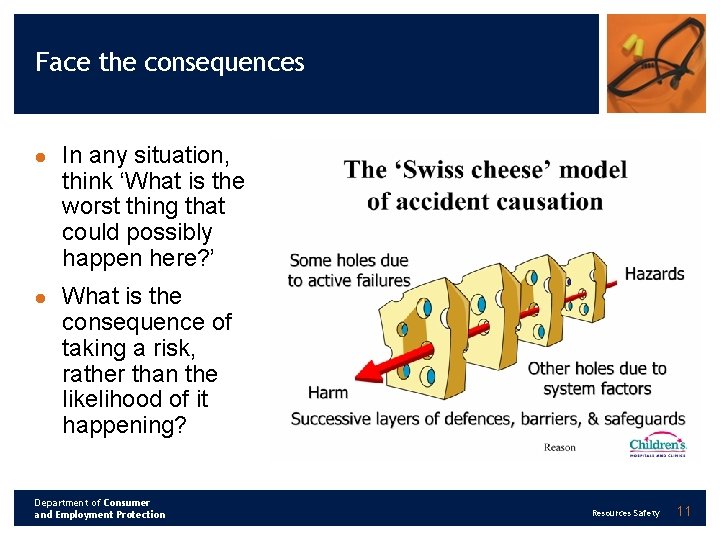
Face the consequences l l In any situation, think ‘What is the worst thing that could possibly happen here? ’ What is the consequence of taking a risk, rather than the likelihood of it happening? Department of Consumer and Employment Protection Resources Safety 11
- Slides: 11