
Toolbox of Nonformal learning methods Youth Support Youth
Toolbox of Non-formal learning methods Youth Support Youth Toolbox of Non-formal learning methods Training Course 30. 08 -07. 09. 2016 Stara Kraśnica, Poland Organised by: Granted by: Funded by:
Training Course „Youth Support Youth”, 30. 08 -07. 09. 2016, Stara Kraśnica, Poland TOOLBOX of Non-formal learning methods ACKNOWLEDGEMENTS This booklet brings you a compilation of workshops that can be used on Youth Exchanges with young people, Training Courses and Seminars with youth workers and youth leaders. This publication has been created as a result of the intensive work by participants and trainer’s team during the Training Course „Youth Support Youth” (2016 -1 PL 01 -KA 105 -025093), organised by Youth Support Centre Foundation in Stara Kraśnica, Poland. We would like to express our gratitude to all those who contributed to creating this toolbox, with their suggestions, feedback and dedicated work. We thank all of the participants, project team and volunteers from Youth Support Centre who took part in the project and made it possible as well as the local community of Stara Kraśnica where the project was hosted. The project was funded by Erasmus Plus Prorgamme of the European Union and granted through the Polish National Agency Fundacja Rozwoju Systemu Edukacji. This project has been funded with support from the European Commission. This publication reflects the views only of the authors, and the Commission or the Polish National Agency cannot be held responsible for any use which may be made of the information contained therein.
Training Course „Youth Support Youth”, 30. 08 -07. 09. 2016, Stara Kraśnica, Poland TOOLBOX of Non-formal learning methods ABOUT THE PROJECT Project “Youth Support Youth” included one Training Course – Mobility of youth workers that was hosted in Poland with from 30/08/2016 to 07/09/2016. Training Course gathered 28 participants and 5 project team members from 14 partner organizations including hosting organization Youth Support Center. Other partner organizations are from Cyprus, Czech Republic, Lithuania, Malta, Spain, United Kingdom, Latvia, Italy, Macedonia, Bulgaria, Romania, Croatia and Estonia. Main aim of the project was to create innovative approach in youth work for involved organizations and other relevant stakeholders in order to help them to promote European values, European citizenship and active participation among target groups. Visit the project website www. youthsupportyouth. wordpress. com to learn more about the project context and activities, read participant’s impression from it as well as find used and produced materials and multimedia.
Training Course „Youth Support Youth”, 30. 08 -07. 09. 2016, Stara Kraśnica, Poland TOOLBOX of Non-formal learning methods PROJECT OBJECTIVES O 1: To educate 28 youth workers from 14 youth organisations about active participation, European values, European citizenship and discover role of youth work in that field, as well to provide them with competences that will help them to establish local, regional and international consortiums with other relevant stakeholders O 2: To develop facilitation, leadership and youth work competences of involved representatives of organisations and on that way contribute to capacities of organizations not only during Training Course but also during follow up activities of the project O 3: To create innovative methods in work with young people, particularly young people with fewer opportunities, and use existing experience and examples of good practice that will be exchanged during project for defining new approaches and creating innovative methods in youth work O 4: To identify and assess needs of young people with fewer opportunities and O 5: To provide communication competences for using youth innovative workers methods and educate youth workers about reaching this groups involved in the project approach O 6: To develop partnership among involved organizations and develop new project ideas and on that way provide learning mobility opportunities for their staff and volunteers, as wall for young people that are their target groups
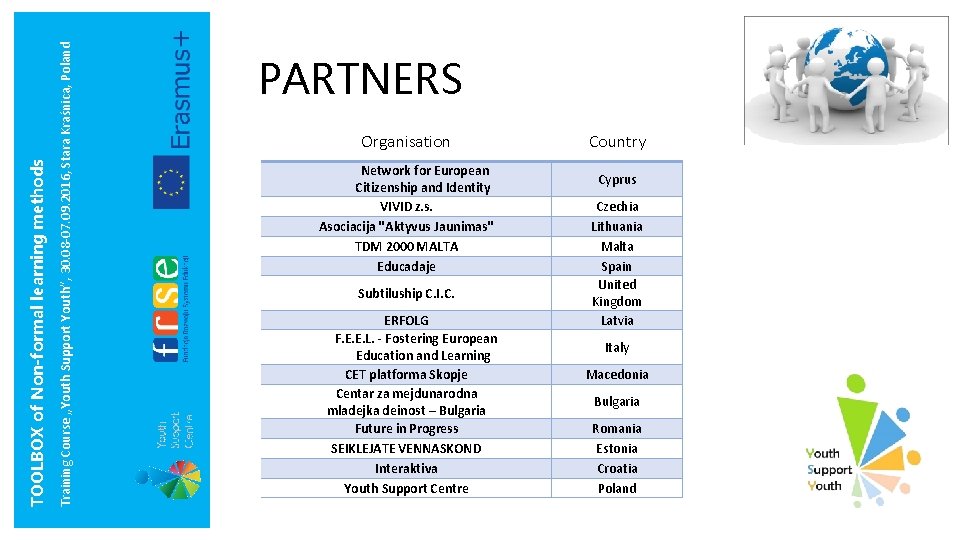
Training Course „Youth Support Youth”, 30. 08 -07. 09. 2016, Stara Kraśnica, Poland TOOLBOX of Non-formal learning methods PARTNERS Organisation Network for European Citizenship and Identity VIVID z. s. Asociacija "Aktyvus Jaunimas" TDM 2000 MALTA Educadaje Subtiluship C. I. C. ERFOLG F. E. E. L. - Fostering European Education and Learning CET platforma Skopje Centar za mejdunarodna mladejka deinost – Bulgaria Future in Progress SEIKLEJATE VENNASKOND Interaktiva Youth Support Centre Country Cyprus Czechia Lithuania Malta Spain United Kingdom Latvia Italy Macedonia Bulgaria Romania Estonia Croatia Poland
Training Course „Youth Support Youth”, 30. 08 -07. 09. 2016, Stara Kraśnica, Poland TOOLBOX of Non-formal learning methods ERASMUS PLUS Erasmus+ is the EU's programme to support education, training, youth and sport in Europe. Its budget of € 14. 7 billion will provide opportunities for over 4 million Europeans to study, train gain experience, and volunteers abroad. Set to last until 2020, Erasmus+ doesn't just have opportunities for students. Merging seven prior programmes, it has opportunities for a wide variety of individuals and organisations. Detailed information on these opportunities, inluding eligiblity criteria, is available in the Erasmus+ Programme Guide. An indicative funding guide for some centralised opportunities is also available.
Training Course „Youth Support Youth”, 30. 08 -07. 09. 2016, Stara Kraśnica, Poland TOOLBOX of Non-formal learning methods WHAT IS TOOLBOX? Toolbox is a source of non-formal learning training methods and activities for youth workers, trainers and young people. The Toolbox can be used for youth work on the following themes: social inclusion and active participation of young people with fewer opportunities, minority rights and issues, minority-majority relations, social inclusion of vulnerable groups, intercultural dialogue and learning, interfaith dialogue, human rights, cultural differences, discrimination, racism, xenophobia, social exclusion. The Toolbox is created and tested by participants of the Training course “Youth Support Youth”, organised in Stara Kraśnica, Poland by Youth Support Centre. The Training course was funded by the Polish National Agency through the Erasmus+ programme.
Training Course „Youth Support Youth”, 30. 08 -07. 09. 2016, Stara Kraśnica, Poland TOOLBOX of Non-formal learning methods NON FORMAL LEARNING During all your live you learn in formal (like school, university), non-formal (courses, sports club) and informal (from parents and friends) settings. But what does this mean? What is behind this terms? We want to present you definition of non-formal learning based on Lynne Chisholm, who is a professor in Innsbruck/Austria and who has a lot of experience in the youth field: • . . . is purposive but voluntary learning that takes place in a diverse range of environments and situations for which teaching/training and learning is not necessarily their sole or main activity. These environments and situations may be temporarily, and the activities or courses that take place may be staffed by professional learning facilitators (such as youth trainers) or by volunteers (such as youth leaders). The activities and courses are planned, but are seldom structured by conventional rhythms or curriculum subjects. They usually address specific target groups, but rarely document or assess learning outcomes or achievements in conventionally visible ways. • If you want you can already look on your Youth Initiative project: Do you participate voluntary? Is this an temporarily environment? Did you structure your process and plan the activity? Then you are in a non-forma learning process! More about non-formal learning you can find here.
Training Course „Youth Support Youth”, 30. 08 -07. 09. 2016, Stara Kraśnica, Poland TOOLBOX of Non-formal learning methods All the activities proposed below were created and developed by participants of the project „Youth Support Youth” in order to support future actions of organisations, youth workers, youth leaders and young people on local, regional, national and international events.
Training Course „Youth Support Youth”, 30. 08 -07. 09. 2016, Stara Kraśnica, Poland TOOLBOX of Non-formal learning methods ENERGIZERS Short, simple and interactive game
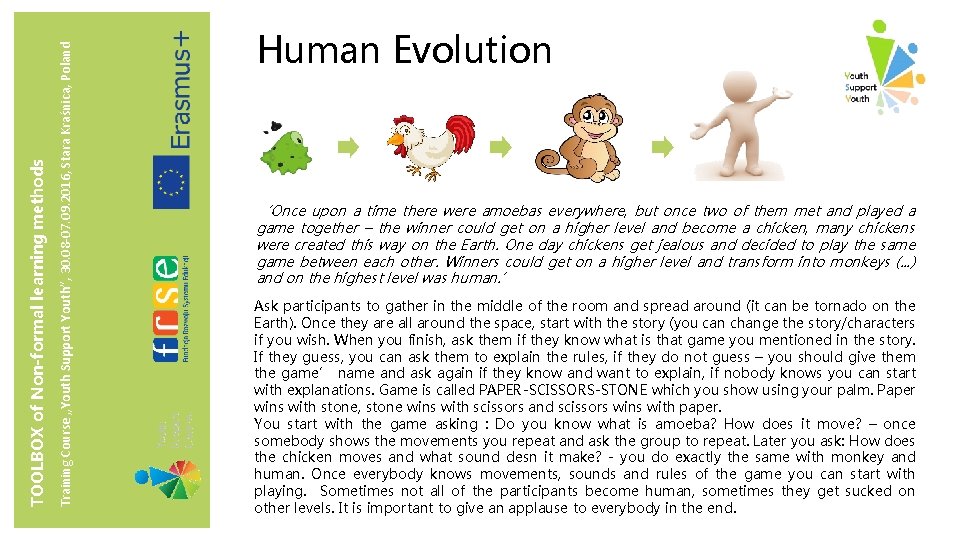
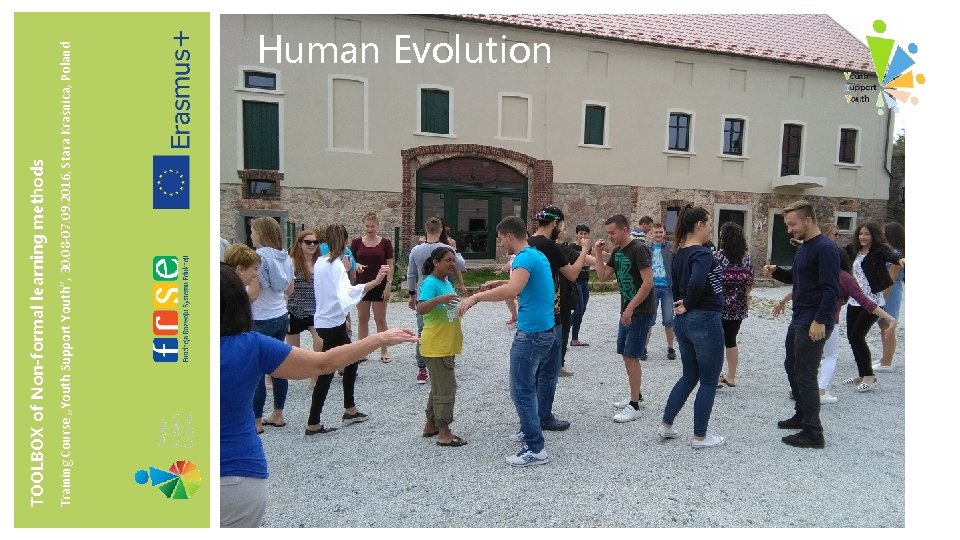
Training Course „Youth Support Youth”, 30. 08 -07. 09. 2016, Stara Kraśnica, Poland TOOLBOX of Non-formal learning methods Human Evolution ‘Once upon a time there were amoebas everywhere, but once two of them met and played a game together – the winner could get on a higher level and become a chicken, many chickens were created this way on the Earth. One day chickens get jealous and decided to play the same game between each other. Winners could get on a higher level and transform into monkeys (. . . ) and on the highest level was human. ’ Ask participants to gather in the middle of the room and spread around (it can be tornado on the Earth). Once they are all around the space, start with the story (you can change the story/characters if you wish. When you finish, ask them if they know what is that game you mentioned in the story. If they guess, you can ask them to explain the rules, if they do not guess – you should give them the game’ name and ask again if they know and want to explain, if nobody knows you can start with explanations. Game is called PAPER-SCISSORS-STONE which you show using your palm. Paper wins with stone, stone wins with scissors and scissors wins with paper. You start with the game asking : Do you know what is amoeba? How does it move? – once somebody shows the movements you repeat and ask the group to repeat. Later you ask: How does the chicken moves and what sound desn it make? - you do exactly the same with monkey and human. Once everybody knows movements, sounds and rules of the game you can start with playing. Sometimes not all of the participants become human, sometimes they get sucked on other levels. It is important to give an applause to everybody in the end.
Training Course „Youth Support Youth”, 30. 08 -07. 09. 2016, Stara Kraśnica, Poland TOOLBOX of Non-formal learning methods Human Evolution
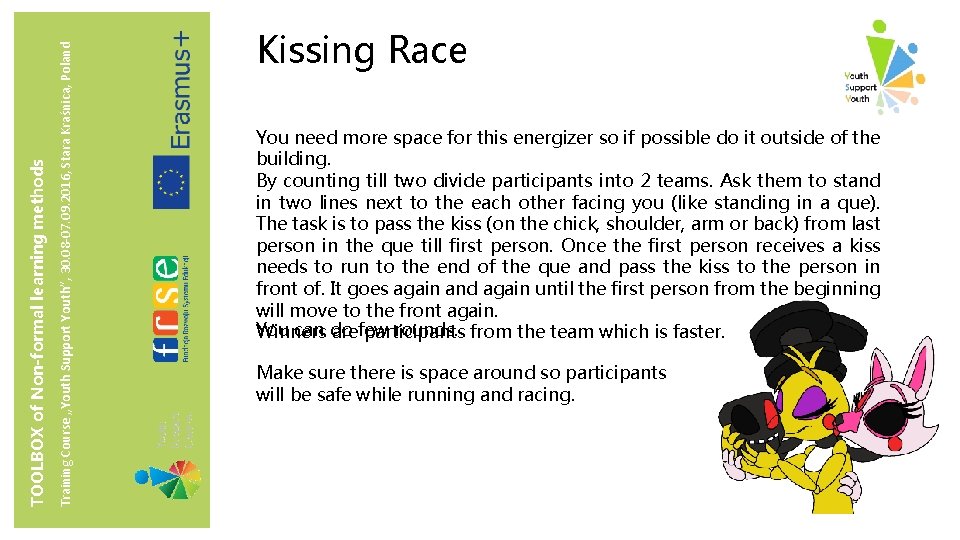
Training Course „Youth Support Youth”, 30. 08 -07. 09. 2016, Stara Kraśnica, Poland TOOLBOX of Non-formal learning methods Kissing Race You need more space for this energizer so if possible do it outside of the building. By counting till two divide participants into 2 teams. Ask them to stand in two lines next to the each other facing you (like standing in a que). The task is to pass the kiss (on the chick, shoulder, arm or back) from last person in the que till first person. Once the first person receives a kiss needs to run to the end of the que and pass the kiss to the person in front of. It goes again and again until the first person from the beginning will move to the front again. You can do few rounds. Winners are participants from the team which is faster. Make sure there is space around so participants will be safe while running and racing.
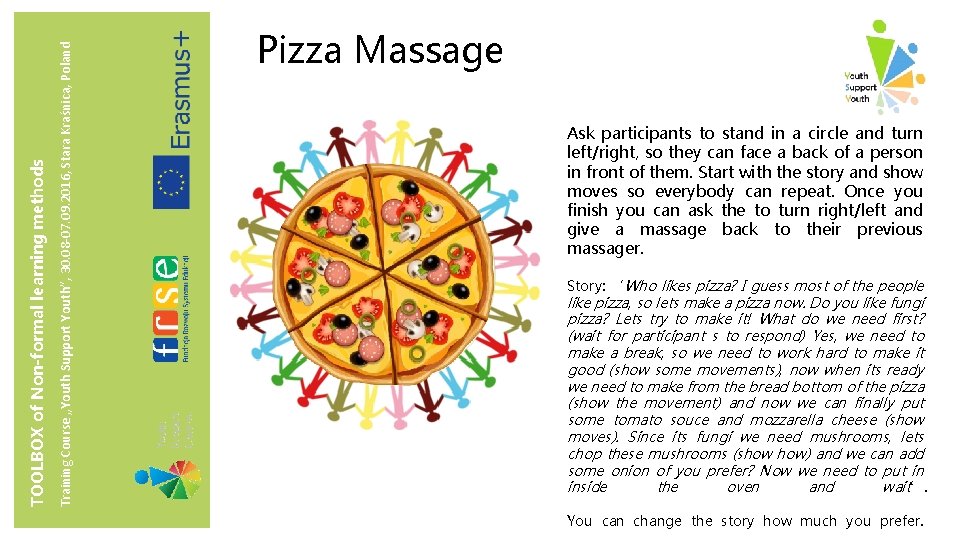
Training Course „Youth Support Youth”, 30. 08 -07. 09. 2016, Stara Kraśnica, Poland TOOLBOX of Non-formal learning methods Pizza Massage Ask participants to stand in a circle and turn left/right, so they can face a back of a person in front of them. Start with the story and show moves so everybody can repeat. Once you finish you can ask the to turn right/left and give a massage back to their previous massager. Story: ‘Who likes pizza? I guess most of the people like pizza, so lets make a pizza now. Do you like fungi pizza? Lets try to make it! What do we need first? (wait for participant s to respond) Yes, we need to make a break, so we need to work hard to make it good (show some movements), now when its ready we need to make from the bread bottom of the pizza (show the movement) and now we can finally put some tomato souce and mozzarella cheese (show moves). Since its fungi we need mushrooms, lets chop these mushrooms (show how) and we can add some onion of you prefer? Now we need to put in inside the oven and wait’. You can change the story how much you prefer.
Training Course „Youth Support Youth”, 30. 08 -07. 09. 2016, Stara Kraśnica, Poland TOOLBOX of Non-formal learning methods WORKSHOPS Step by step instructions
THEME: • Unemployment • Awareness of Skills • Employability Competences AIMS AND OBJECTIVES: • Mobility within employment • Assessment of transferable skills • Interview Techniques • (Sub-objective) Thinking on the feet. TARGET GROUP: 18 – 25 years old NEET* *Not in employment and training GROUP SIZE: 20 -25 participants TIME: 30 minutes MATERIALS: ALL 4 SKILLS Activity about making participants aware of their transferable skills when it comes to employability options. Developed by: Samuel Moore (United Kingdom), Andrea Bernieri (Italy), Marithea Konstantinou (Cyprus), Radostina Yurukova (Bulgaria) Step by step instruction: 12 -18 mins 1. Choose 3 people to be the employers. 2. Divide the remaining participants into 3 groups and assign them all with a job role by picking up labels and introduce them to the positions they are being interviewed for. 1 -2 mins 3. Take the employers out of the room and ask them to consider which competences are required for given jobs. Later ask the participants to consider their set of skills (both personal and professional). 3 -5 mins. 4. Invite the Employers back to the working room. Place them in 3 corners of the room and assign one of the previous groups to each employer. 1 -2 mins 5. Each employee will line up in front of the employers and have 30 seconds to persuade that his/her set of skills are the most suitable for the job position. This will be done in a consecutive, quick-fire fashion. 5 -6 mins 6. After this time the employers will select potential candidates they would hire for the job. Debriefing: 10 -12 mins 1. All: What do you think of the activity? 2. Employers: which were the common answers that you got? What primarily affected your decision- making? Job seekers: On what basis did you choose your set of skills 3. If you could do this all over again what would you do differently? 4. Identify 4 key competences that can be applied when looking for job opportunity. Learning outcomes: Participants will become aware of how to develop and present there skills, both personal and professional, to make yourself more attractive to the employer.
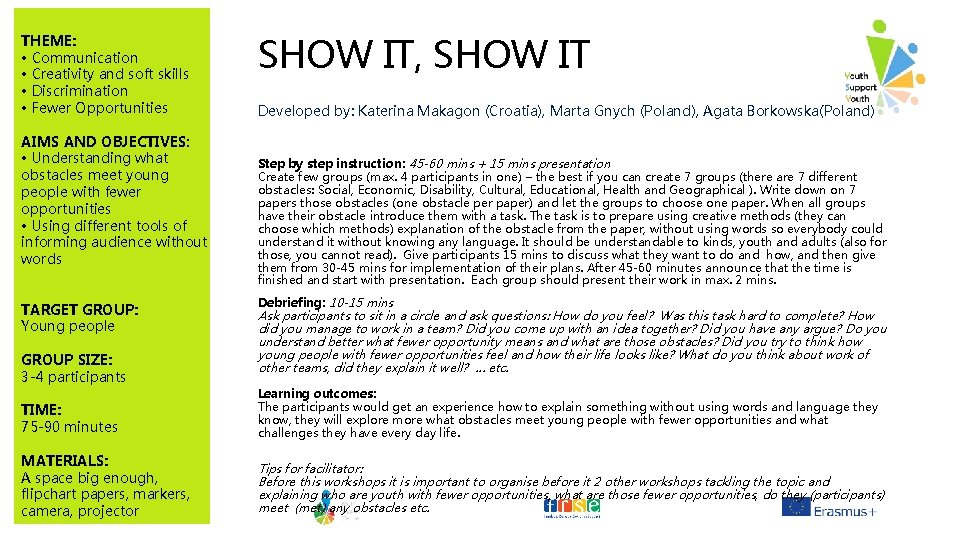
THEME: • Communication • Creativity and soft skills • Discrimination • Fewer Opportunities AIMS AND OBJECTIVES: • Understanding what obstacles meet young people with fewer opportunities • Using different tools of informing audience without words TARGET GROUP: Young people GROUP SIZE: 3 -4 participants SHOW IT, SHOW IT Developed by: Katerina Makagon (Croatia), Marta Gnych (Poland), Agata Borkowska(Poland) Step by step instruction: 45 -60 mins + 15 mins presentation Create few groups (max. 4 participants in one) – the best if you can create 7 groups (there are 7 different obstacles: Social, Economic, Disability, Cultural, Educational, Health and Geographical ). Write down on 7 papers those obstacles (one obstacle per paper) and let the groups to choose one paper. When all groups have their obstacle introduce them with a task. The task is to prepare using creative methods (they can choose which methods) explanation of the obstacle from the paper, without using words so everybody could understand it without knowing any language. It should be understandable to kinds, youth and adults (also for those, you cannot read). Give participants 15 mins to discuss what they want to do and how, and then give them from 30 -45 mins for implementation of their plans. After 45 -60 minutes announce that the time is finished and start with presentation. Each group should present their work in max. 2 mins. Debriefing: 10 -15 mins Ask participants to sit in a circle and ask questions: How do you feel? Was this task hard to complete? How did you manage to work in a team? Did you come up with an idea together? Did you have any argue? Do you understand better what fewer opportunity means and what are those obstacles? Did you try to think how young people with fewer opportunities feel and how their life looks like? What do you think about work of other teams, did they explain it well? … etc. TIME: 75 -90 minutes Learning outcomes: The participants would get an experience how to explain something without using words and language they know, they will explore more what obstacles meet young people with fewer opportunities and what challenges they have every day life. MATERIALS: A space big enough, flipchart papers, markers, camera, projector Tips for facilitator: Before this workshops it is important to organise before it 2 other workshops tackling the topic and explaining who are youth with fewer opportunities, what are those fewer opportunities, do they (participants) meet (met) any obstacles etc.
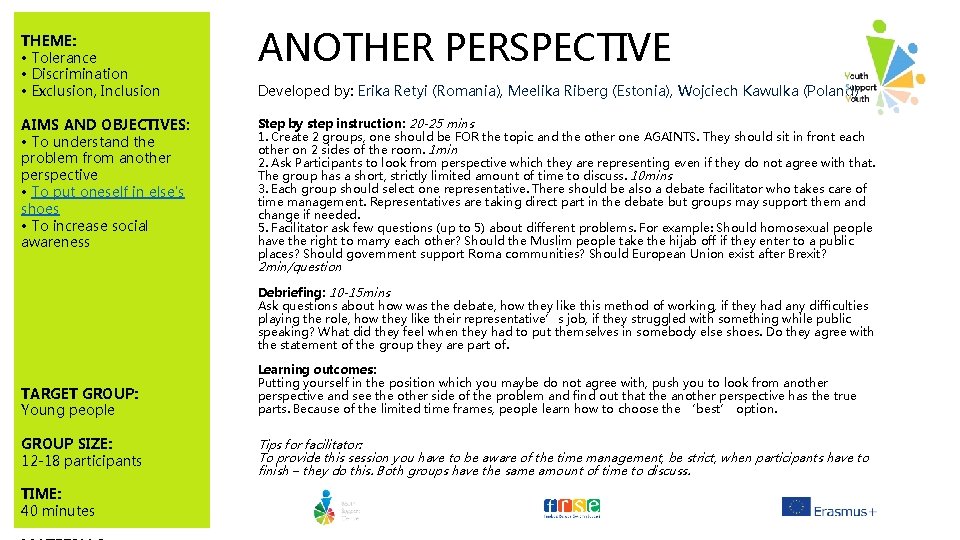
THEME: • Tolerance • Discrimination • Exclusion, Inclusion AIMS AND OBJECTIVES: • To understand the problem from another perspective • To put oneself in else's shoes • To increase social awareness ANOTHER PERSPECTIVE Developed by: Erika Retyi (Romania), Meelika Riberg (Estonia), Wojciech Kawulka (Poland) Step by step instruction: 20 -25 mins 1. Create 2 groups, one should be FOR the topic and the other one AGAINTS. They should sit in front each other on 2 sides of the room. 1 min 2. Ask Participants to look from perspective which they are representing even if they do not agree with that. The group has a short, strictly limited amount of time to discuss. 10 mins 3. Each group should select one representative. There should be also a debate facilitator who takes care of time management. Representatives are taking direct part in the debate but groups may support them and change if needed. 5. Facilitator ask few questions (up to 5) about different problems. For example: Should homosexual people have the right to marry each other? Should the Muslim people take the hijab off if they enter to a public places? Should government support Roma communities? Should European Union exist after Brexit? 2 min/question Debriefing: 10 -15 mins Ask questions about how was the debate, how they like this method of working, if they had any difficulties playing the role, how they like their representative’s job, if they struggled with something while public speaking? What did they feel when they had to put themselves in somebody else shoes. Do they agree with the statement of the group they are part of. TARGET GROUP: Young people GROUP SIZE: 12 -18 participants TIME: 40 minutes Learning outcomes: Putting yourself in the position which you maybe do not agree with, push you to look from another perspective and see the other side of the problem and find out that the another perspective has the true parts. Because of the limited time frames, people learn how to choose the ‘best’ option. Tips for facilitator: To provide this session you have to be aware of the time management, be strict, when participants have to finish – they do this. Both groups have the same amount of time to discuss.
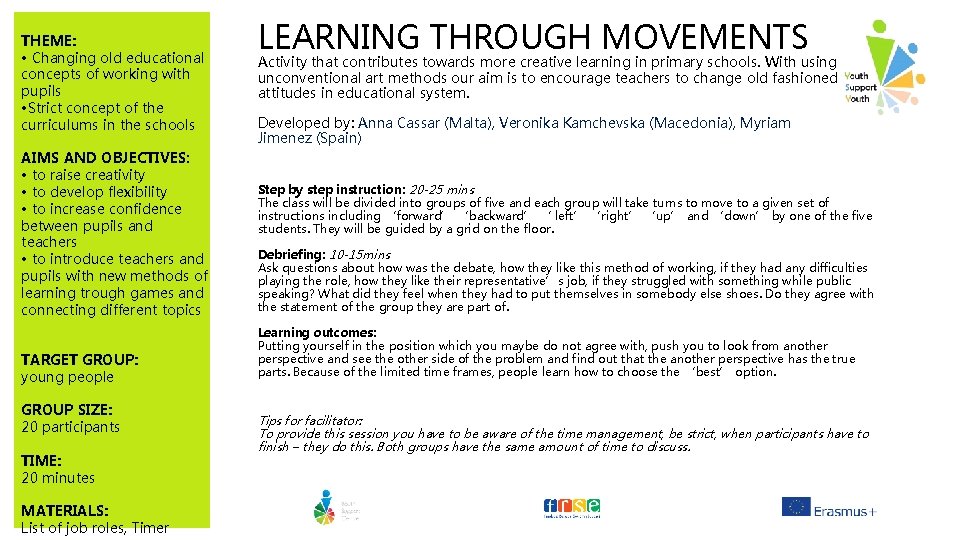
THEME: • Changing old educational concepts of working with pupils • Strict concept of the curriculums in the schools AIMS AND OBJECTIVES: • to raise creativity • to develop flexibility • to increase confidence between pupils and teachers • to introduce teachers and pupils with new methods of learning trough games and connecting different topics TARGET GROUP: young people GROUP SIZE: 20 participants TIME: 20 minutes MATERIALS: List of job roles, Timer LEARNING THROUGH MOVEMENTS Activity that contributes towards more creative learning in primary schools. With using unconventional art methods our aim is to encourage teachers to change old fashioned attitudes in educational system. Developed by: Anna Cassar (Malta), Veronika Kamchevska (Macedonia), Myriam Jimenez (Spain) Step by step instruction: 20 -25 mins The class will be divided into groups of five and each group will take turns to move to a given set of instructions including ‘forward’ ‘backward’ ‘ left’ ‘right’ ‘up’ and ‘down’ by one of the five students. They will be guided by a grid on the floor. Debriefing: 10 -15 mins Ask questions about how was the debate, how they like this method of working, if they had any difficulties playing the role, how they like their representative’s job, if they struggled with something while public speaking? What did they feel when they had to put themselves in somebody else shoes. Do they agree with the statement of the group they are part of. Learning outcomes: Putting yourself in the position which you maybe do not agree with, push you to look from another perspective and see the other side of the problem and find out that the another perspective has the true parts. Because of the limited time frames, people learn how to choose the ‘best’ option. Tips for facilitator: To provide this session you have to be aware of the time management, be strict, when participants have to finish – they do this. Both groups have the same amount of time to discuss.
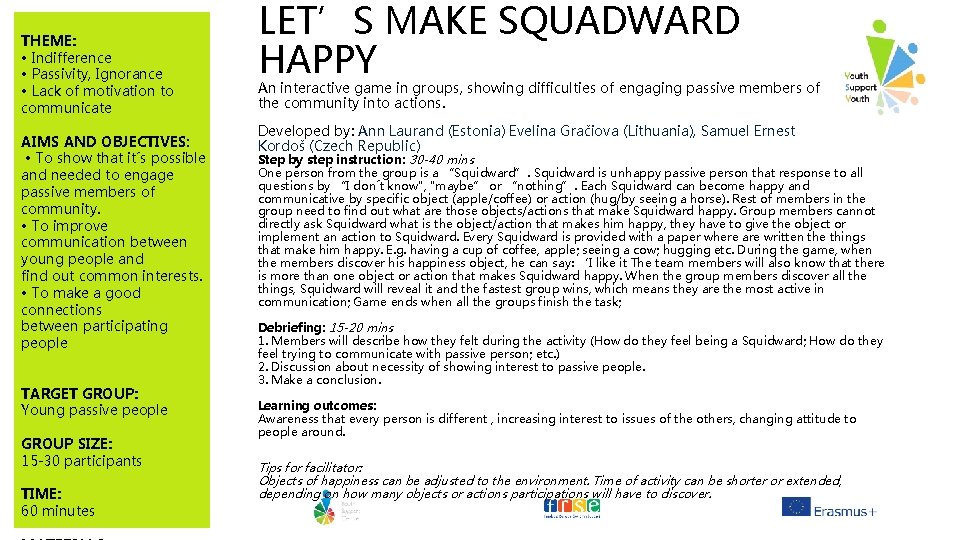
THEME: • Indifference • Passivity, Ignorance • Lack of motivation to communicate AIMS AND OBJECTIVES: • To show that it´s possible and needed to engage passive members of community. • To improve communication between young people and find out common interests. • To make a good connections between participating people TARGET GROUP: Young passive people GROUP SIZE: 15 -30 participants TIME: 60 minutes LET’S MAKE SQUADWARD HAPPY An interactive game in groups, showing difficulties of engaging passive members of the community into actions. Developed by: Ann Laurand (Estonia) Evelina Gračiova (Lithuania), Samuel Ernest Kordoš (Czech Republic) Step by step instruction: 30 -40 mins One person from the group is a “Squidward”. Squidward is unhappy passive person that response to all questions by “I don´t know", "maybe” or “nothing”. Each Squidward can become happy and communicative by specific object (apple/coffee) or action (hug/by seeing a horse). Rest of members in the group need to find out what are those objects/actions that make Squidward happy. Group members cannot directly ask Squidward what is the object/action that makes him happy, they have to give the object or implement an action to Squidward. Every Squidward is provided with a paper where are written the things that make him happy. E. g. having a cup of coffee, apple; seeing a cow; hugging etc. During the game, when the members discover his happiness object, he can say: ‘I like it The team members will also know that there is more than one object or action that makes Squidward happy. When the group members discover all the things, Squidward will reveal it and the fastest group wins, which means they are the most active in communication; Game ends when all the groups finish the task; Debriefing: 15 -20 mins 1. Members will describe how they felt during the activity (How do they feel being a Squidward; How do they feel trying to communicate with passive person; etc. ) 2. Discussion about necessity of showing interest to passive people. 3. Make a conclusion. Learning outcomes: Awareness that every person is different , increasing interest to issues of the others, changing attitude to people around. Tips for facilitator: Objects of happiness can be adjusted to the environment. Time of activity can be shorter or extended, depending on how many objects or actions participations will have to discover.
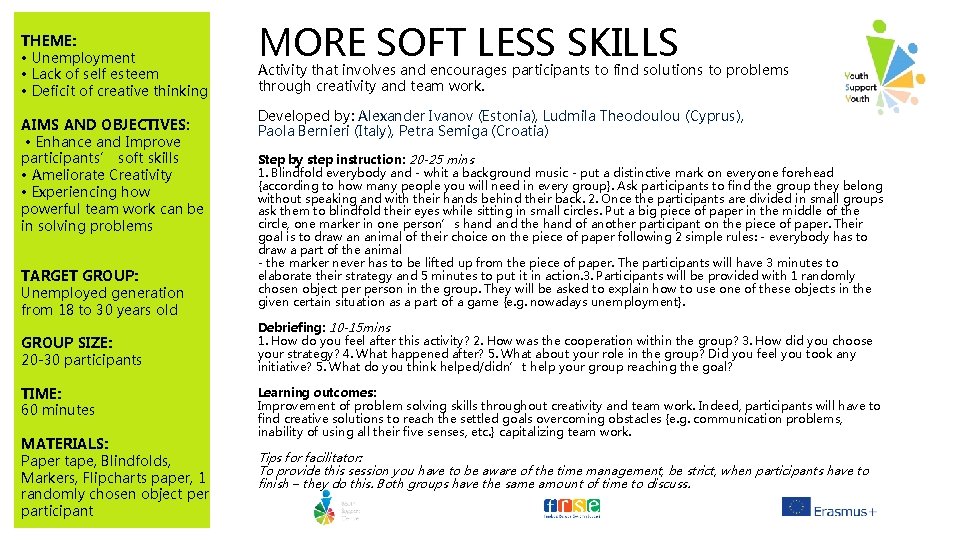
THEME: • Unemployment • Lack of self esteem • Deficit of creative thinking AIMS AND OBJECTIVES: • Enhance and Improve participants’ soft skills • Ameliorate Creativity • Experiencing how powerful team work can be in solving problems TARGET GROUP: Unemployed generation from 18 to 30 years old GROUP SIZE: 20 -30 participants TIME: 60 minutes MATERIALS: Paper tape, Blindfolds, Markers, Flipcharts paper, 1 randomly chosen object per participant MORE SOFT LESS SKILLS Activity that involves and encourages participants to find solutions to problems through creativity and team work. Developed by: Alexander Ivanov (Estonia), Ludmila Theodoulou (Cyprus), Paola Bernieri (Italy), Petra Semiga (Croatia) Step by step instruction: 20 -25 mins 1. Blindfold everybody and - whit a background music - put a distinctive mark on everyone forehead {according to how many people you will need in every group}. Ask participants to find the group they belong without speaking and with their hands behind their back. 2. Once the participants are divided in small groups ask them to blindfold their eyes while sitting in small circles. Put a big piece of paper in the middle of the circle, one marker in one person’s hand the hand of another participant on the piece of paper. Their goal is to draw an animal of their choice on the piece of paper following 2 simple rules: - everybody has to draw a part of the animal - the marker never has to be lifted up from the piece of paper. The participants will have 3 minutes to elaborate their strategy and 5 minutes to put it in action. 3. Participants will be provided with 1 randomly chosen object person in the group. They will be asked to explain how to use one of these objects in the given certain situation as a part of a game {e. g. nowadays unemployment}. Debriefing: 10 -15 mins 1. How do you feel after this activity? 2. How was the cooperation within the group? 3. How did you choose your strategy? 4. What happened after? 5. What about your role in the group? Did you feel you took any initiative? 5. What do you think helped/didn’t help your group reaching the goal? Learning outcomes: Improvement of problem solving skills throughout creativity and team work. Indeed, participants will have to find creative solutions to reach the settled goals overcoming obstacles {e. g. communication problems, inability of using all their five senses, etc. } capitalizing team work. Tips for facilitator: To provide this session you have to be aware of the time management, be strict, when participants have to finish – they do this. Both groups have the same amount of time to discuss.
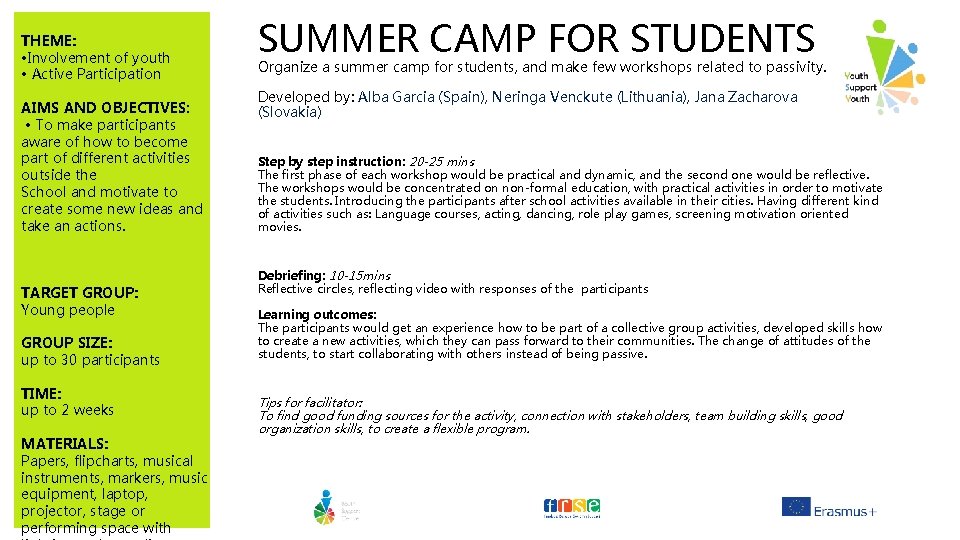
THEME: • Involvement of youth • Active Participation AIMS AND OBJECTIVES: • To make participants aware of how to become part of different activities outside the School and motivate to create some new ideas and take an actions. TARGET GROUP: Young people GROUP SIZE: up to 30 participants TIME: up to 2 weeks MATERIALS: Papers, flipcharts, musical instruments, markers, music equipment, laptop, projector, stage or performing space with SUMMER CAMP FOR STUDENTS Organize a summer camp for students, and make few workshops related to passivity. Developed by: Alba Garcia (Spain), Neringa Venckute (Lithuania), Jana Zacharova (Slovakia) Step by step instruction: 20 -25 mins The first phase of each workshop would be practical and dynamic, and the second one would be reflective. The workshops would be concentrated on non-formal education, with practical activities in order to motivate the students. Introducing the participants after school activities available in their cities. Having different kind of activities such as: Language courses, acting, dancing, role play games, screening motivation oriented movies. Debriefing: 10 -15 mins Reflective circles, reflecting video with responses of the participants Learning outcomes: The participants would get an experience how to be part of a collective group activities, developed skills how to create a new activities, which they can pass forward to their communities. The change of attitudes of the students, to start collaborating with others instead of being passive. Tips for facilitator: To find good funding sources for the activity, connection with stakeholders, team building skills, good organization skills, to create a flexible program.
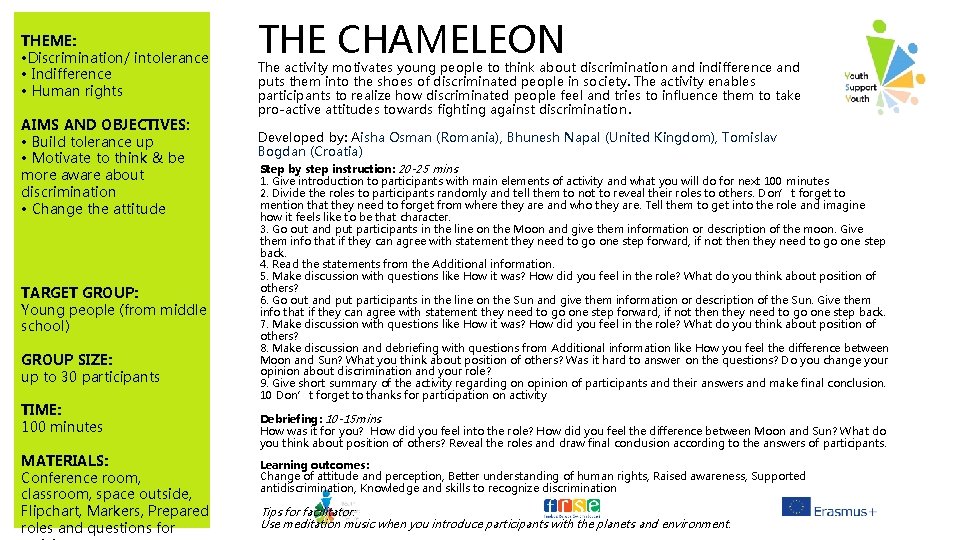
THEME: • Discrimination/ intolerance • Indifference • Human rights AIMS AND OBJECTIVES: • Build tolerance up • Motivate to think & be more aware about discrimination • Change the attitude TARGET GROUP: Young people (from middle school) GROUP SIZE: up to 30 participants TIME: 100 minutes MATERIALS: Conference room, classroom, space outside, Flipchart, Markers, Prepared roles and questions for THE CHAMELEON The activity motivates young people to think about discrimination and indifference and puts them into the shoes of discriminated people in society. The activity enables participants to realize how discriminated people feel and tries to influence them to take pro-active attitudes towards fighting against discrimination. Developed by: Aisha Osman (Romania), Bhunesh Napal (United Kingdom), Tomislav Bogdan (Croatia) Step by step instruction: 20 -25 mins 1. Give introduction to participants with main elements of activity and what you will do for next 100 minutes 2. Divide the roles to participants randomly and tell them to not to reveal their roles to others. Don’t forget to mention that they need to forget from where they are and who they are. Tell them to get into the role and imagine how it feels like to be that character. 3. Go out and put participants in the line on the Moon and give them information or description of the moon. Give them info that if they can agree with statement they need to go one step forward, if not then they need to go one step back. 4. Read the statements from the Additional information. 5. Make discussion with questions like How it was? How did you feel in the role? What do you think about position of others? 6. Go out and put participants in the line on the Sun and give them information or description of the Sun. Give them info that if they can agree with statement they need to go one step forward, if not then they need to go one step back. 7. Make discussion with questions like How it was? How did you feel in the role? What do you think about position of others? 8. Make discussion and debriefing with questions from Additional information like How you feel the difference between Moon and Sun? What you think about position of others? Was it hard to answer on the questions? Do you change your opinion about discrimination and your role? 9. Give short summary of the activity regarding on opinion of participants and their answers and make final conclusion. 10 Don’t forget to thanks for participation on activity Debriefing: 10 -15 mins How was it for you? How did you feel into the role? How did you feel the difference between Moon and Sun? What do you think about position of others? Reveal the roles and draw final conclusion according to the answers of participants. Learning outcomes: Change of attitude and perception, Better understanding of human rights, Raised awareness, Supported antidiscrimination, Knowledge and skills to recognize discrimination Tips for facilitator: Use meditation music when you introduce participants with the planets and environment.
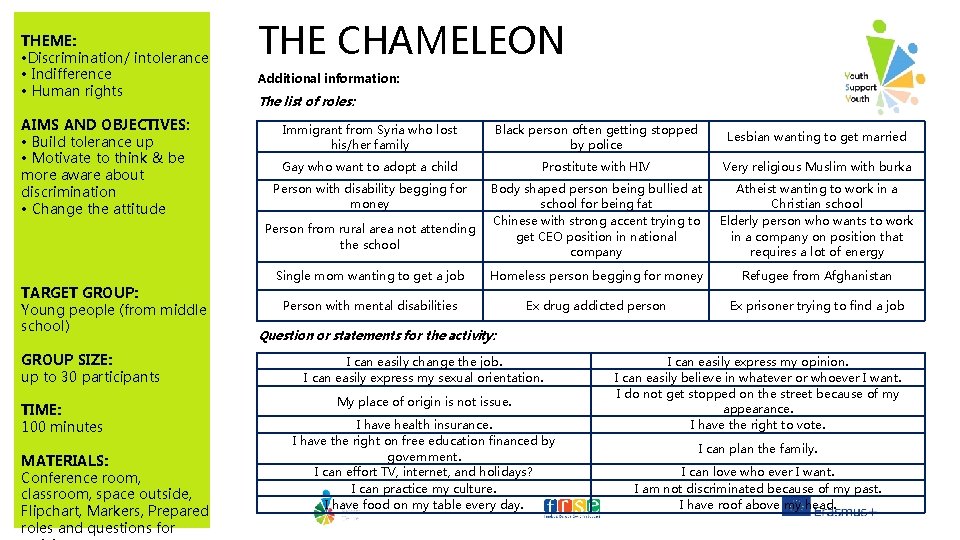
THEME: • Discrimination/ intolerance • Indifference • Human rights AIMS AND OBJECTIVES: • Build tolerance up • Motivate to think & be more aware about discrimination • Change the attitude THE CHAMELEON Additional information: The list of roles: Immigrant from Syria who lost his/her family Black person often getting stopped by police Lesbian wanting to get married Gay who want to adopt a child Prostitute with HIV Very religious Muslim with burka Person with disability begging for money Body shaped person being bullied at school for being fat Chinese with strong accent trying to get CEO position in national company Atheist wanting to work in a Christian school Elderly person who wants to work in a company on position that requires a lot of energy Single mom wanting to get a job Homeless person begging for money Refugee from Afghanistan Person with mental disabilities Ex drug addicted person Ex prisoner trying to find a job Person from rural area not attending the school TARGET GROUP: Young people (from middle school) GROUP SIZE: up to 30 participants TIME: 100 minutes MATERIALS: Conference room, classroom, space outside, Flipchart, Markers, Prepared roles and questions for Question or statements for the activity: I can easily change the job. I can easily express my sexual orientation. My place of origin is not issue. I have health insurance. I have the right on free education financed by government. I can effort TV, internet, and holidays? I can practice my culture. I have food on my table every day. I can easily express my opinion. I can easily believe in whatever or whoever I want. I do not get stopped on the street because of my appearance. I have the right to vote. I can plan the family. I can love who ever I want. I am not discriminated because of my past. I have roof above my head.
THEME: • Communication • Lack of understanding • Individual approach AIMS AND OBJECTIVES: • Communication skills • Understanding how to formulate messages according to the situation and the other people involved to work together in a team • to get participants out of their comfort zones TARGET GROUP: Young people GROUP SIZE: 4 -8 participants TIME: 45 -60 minutes MATERIALS: A space big enough, Chairs and tables / desks, Scissors and paper sheets WORDS AND SHAPES The activity requires participants to communicate between each other in a competitive environment, with certain rules and obstacles placed in order to explore the process and analyse it afterwards. Developed by: Zlatina Dobreva (Bulgaria), Jane Meilak (Malta), Olegs Litvinovs (Latvia) Step by step instruction: 20 -25 mins 1. The facilitators give instructions to the participants and divide everyone into groups of 8 people each. 2. The first group is divided in two parts – 4 people each. They will be competing against each other 3. The other groups serve as an audience to the ones who are competing at the moment. 4. We have the two 4 -people groups separate and each one is being supervised by a facilitator. 5. They sit down – two people on a table in front, and two people about 2 steps behind, also on a table. The people that sit behind have a figure formed in front of them from paper parts. The ones in front have the same parts, but they are not formed in any particular way. 6. The two 4 -people groups now have to compete. 7. The people from behind need to give instructions to the people in the front how to build the same shape that they have already done in front of them. 8. The people in the front can’t turn around nor ask any questions, they must only follow the instructions by their teammates behind them. 9. The teams work simultaneously, and they have 5 minutes. They are both constantly being observed by the facilitators and the audience are witnessing everything all the time, and should, of course, remain completely silent and impartial. 10. When the time is up, the facilitators check what teams did. The team whose front two members did a better job at recreating the figure, wins. 11. Same is repeated for the other one or two sets of competing teams. 12. After all competitions end, a discussion starts. The facilitators interrogate all sides of the process, how people felt in every role and what realisations they had during the exercise.
THEME: • Communication • Lack of understanding • Individual approach AIMS AND OBJECTIVES: • Communication skills • Understanding how to formulate messages according to the situation and the other people involved to work together in a team • to get participants out of their comfort zones TARGET GROUP: Young people GROUP SIZE: 4 -8 participants TIME: 45 -60 minutes MATERIALS: A space big enough, Chairs and tables / desks, Scissors and paper sheets WORDS AND SHAPES Debriefing: 10 -15 mins 1. The evaluation will be done by a discussion at the end of the activity – for about 10 -15 minutes. 2. The participants themselves have to assess and analyse the situation they were put in. 3. Questions asked would be – How did the situation make you feel? – What do you think about that? – Do you think you would have done better at the other side? – What did you observe in other groups? How do you think you should act to get the result that you want in a situation like this? 4. Generally, this exercise aims to drive people to their own conclusion through self assessment and the psychological effect that it offers. Learning outcomes: The participants will develop a much better understanding of the importance of good communication. They will rethink their approach in the way they do it in their future projects, see clearly what they need to work on in order to become better educators. They will realise the crucial need to always consider and know what your audience is like and aim to be more involved with them in order to get what they want out of them. The workshop has an important psychological effect. Tips for facilitator: Facilitators should remain impartial and silent during the competition, explain the rules well in the beginning and ask the questions in the end. Additional notes: The idea for this workshop revolves around one of the most important aspects in the educational area – the connection between students and teachers. It puts teachers and educators in a different position which flawlessly depicts the shortcomings of the communication approach teachers usually have for their students. It also promotes an individual element for teachers to implement towards their students. The idea is that if this gets enough support and positive feedback by teachers themselves, it could end up not just improving teacher – student relationships, but also changing the educational system in its very roots. The individual approach, as opposed to the standardized one, is an irreplaceably important shift to make in every public school / high school, not just the private ones.
Training Course „Youth Support Youth”, 30. 08 -07. 09. 2016, Stara Kraśnica, Poland TOOLBOX of Non-formal learning methods DAILY REFLECTIONS Short self-assesment methods
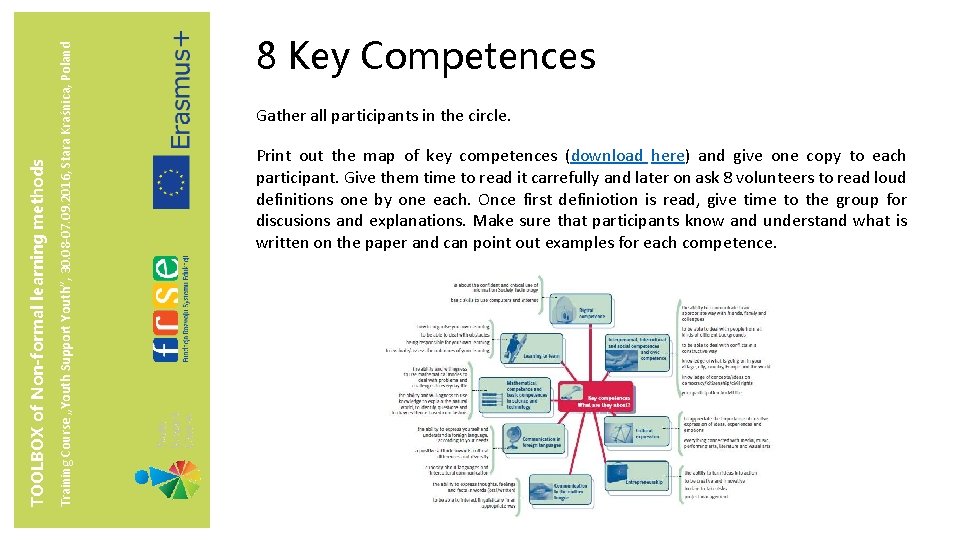
Training Course „Youth Support Youth”, 30. 08 -07. 09. 2016, Stara Kraśnica, Poland TOOLBOX of Non-formal learning methods 8 Key Competences Gather all participants in the circle. Print out the map of key competences (download here) and give one copy to each participant. Give them time to read it carrefully and later on ask 8 volunteers to read loud definitions one by one each. Once first definiotion is read, give time to the group for discusions and explanations. Make sure that participants know and understand what is written on the paper and can point out examples for each competence.
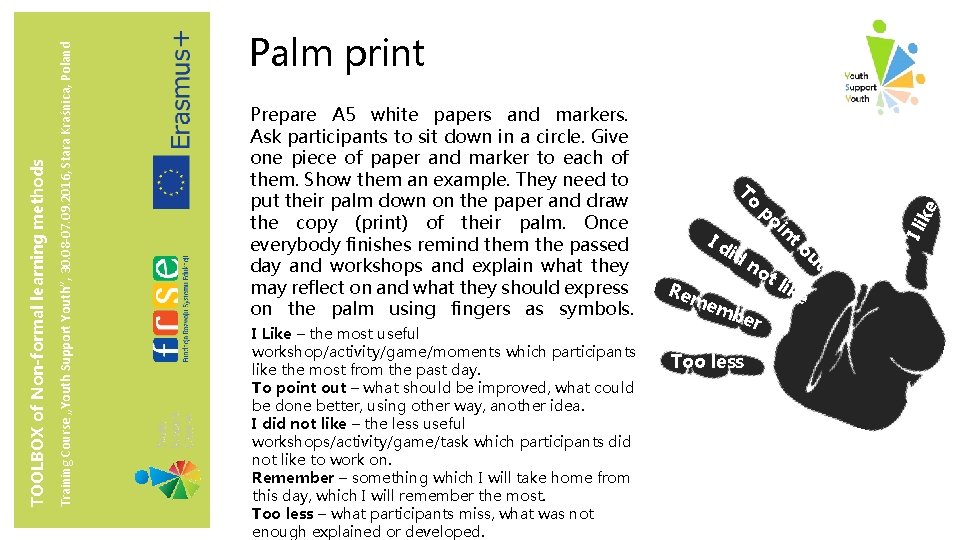
Prepare A 5 white papers and markers. Ask participants to sit down in a circle. Give one piece of paper and marker to each of them. Show them an example. They need to put their palm down on the paper and draw the copy (print) of their palm. Once everybody finishes remind them the passed day and workshops and explain what they may reflect on and what they should express on the palm using fingers as symbols. I Like – the most useful workshop/activity/game/moments which participants like the most from the past day. To point out – what should be improved, what could be done better, using other way, another idea. I did not like – the less useful workshops/activity/game/task which participants did not like to work on. Remember – something which I will take home from this day, which I will remember the most. Too less – what participants miss, what was not enough explained or developed. To Id id Rem em po i nt no ber Too less ou I li ke Training Course „Youth Support Youth”, 30. 08 -07. 09. 2016, Stara Kraśnica, Poland TOOLBOX of Non-formal learning methods Palm print tl t ike
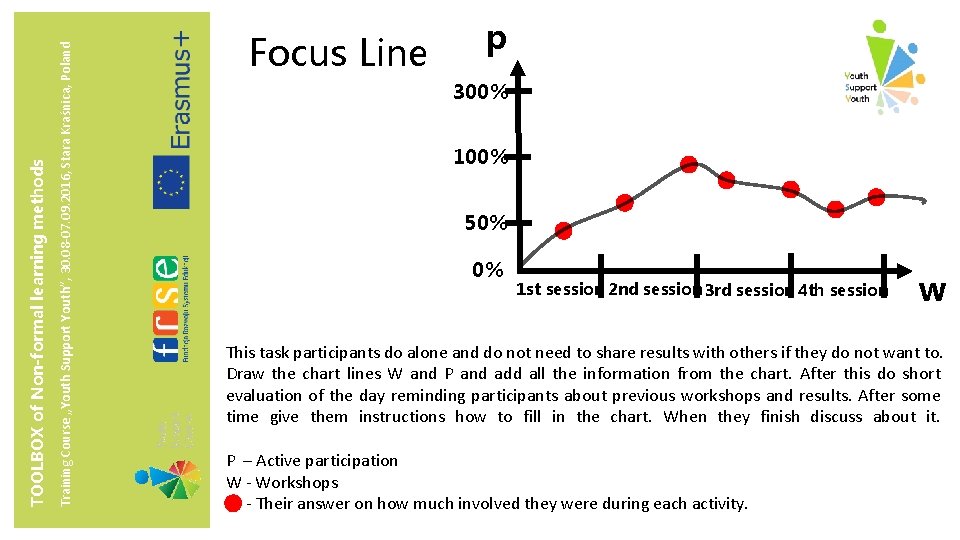
Training Course „Youth Support Youth”, 30. 08 -07. 09. 2016, Stara Kraśnica, Poland TOOLBOX of Non-formal learning methods Focus Line p 300% 100% 50% 0% 1 st session 2 nd session 3 rd session 4 th session w This task participants do alone and do not need to share results with others if they do not want to. Draw the chart lines W and P and add all the information from the chart. After this do short evaluation of the day reminding participants about previous workshops and results. After some time give them instructions how to fill in the chart. When they finish discuss about it. P – Active participation W - Workshops - Their answer on how much involved they were during each activity.
Training Course „Youth Support Youth”, 30. 08 -07. 09. 2016, Stara Kraśnica, Poland TOOLBOX of Non-formal learning methods Erasmus Plus gives you many possibilities and opportunities to develop, explore and discover. Do not get lazy and sit at home, go and gain new skills together with people from all around the world. Discuss, play, meet people and establish new friendships. It is totally worth it! Warning! It is addictive, so be prepared . This document had been created by participants of the project „Youth Support Youth” hosted by Youth Support Centre Foundation on August/Septeber 2016 in Poland. Thank you for your interest. If you would like to know more or have any questions, feel inited to visit the website of the project: https: //youthsupportyouth. wordpress. com/.
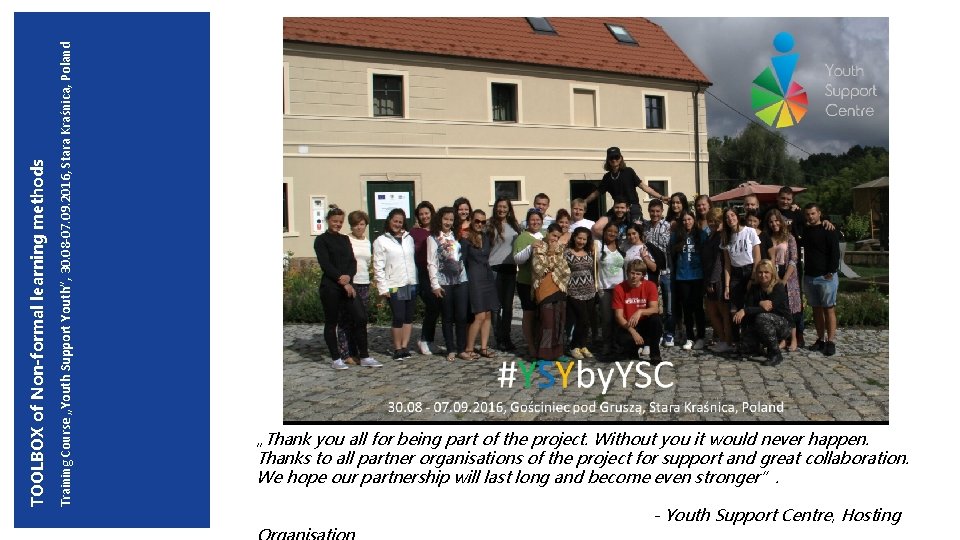
Training Course „Youth Support Youth”, 30. 08 -07. 09. 2016, Stara Kraśnica, Poland TOOLBOX of Non-formal learning methods „Thank you all for being part of the project. Without you it would never happen. Thanks to all partner organisations of the project for support and great collaboration. We hope our partnership will last long and become even stronger”. - Youth Support Centre, Hosting
- Slides: 32