
Tool Impact tracking Tool Impact tracking Purpose and

- Slides: 9
Tool: Impact tracking
Tool: Impact tracking Purpose and yield The project's business case consists of the expenditure side and the revenue side. The follow-up of the expenditure is made using budget follow-up, for example S-curves. The revenues are evaluated using impact tracking. Impact tracking is done in order to: • Ensure that the project creates the impacts described in the hierarchy of objectives or the impact case. • Establish a system that gives early warning when the impacts are not developed as planned. • Ensure that the benefits are realized as planned • Provide a quantitative follow-up on all types of impacts. When is the Impact Tracking used in the project? • Impact Tracking should be started as early as possible, even before all deliverables are established. • Early indicators such as employee response to training, testing of competencies and assessment of behavioral changes can often be detected relatively early. • The business impacts can often only be measured when all deliverables are established. Pitfalls and restrictions • The prerequisite for an appropriate impact tracking is a well-defined hierarchy of objectives or an impact case. • Follow-up must be made early enough to make it possible to correct and affect the impacts. • The impacts can usually only be measured in the following order: Deliverables, competencies, behavioral change, immediate business impacts, impacts on medium-term and long-term. • The impacts are often measured by different target groups, so it is necessary to have access to all these target groups. • The results must be used by the management or the project, otherwise they make no sense. • It is a good idea to highlight the results in the organization, for example using a bulletin board. • Responsibility for the measurements must be organized and put into system. There must be a person responsible for the measurements. • There must be consensus and acceptance of the measurement points, otherwise discussion may arise whether the results are significant or relevant.
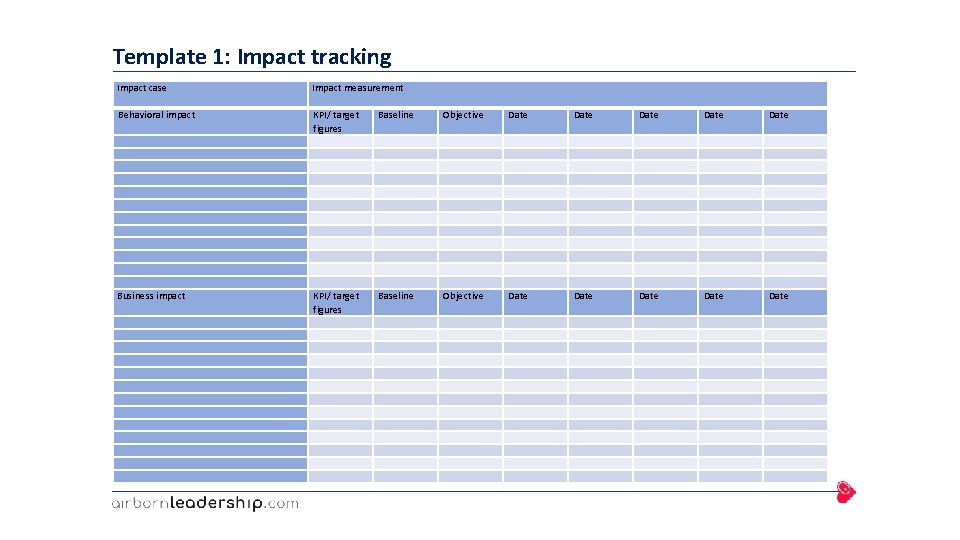
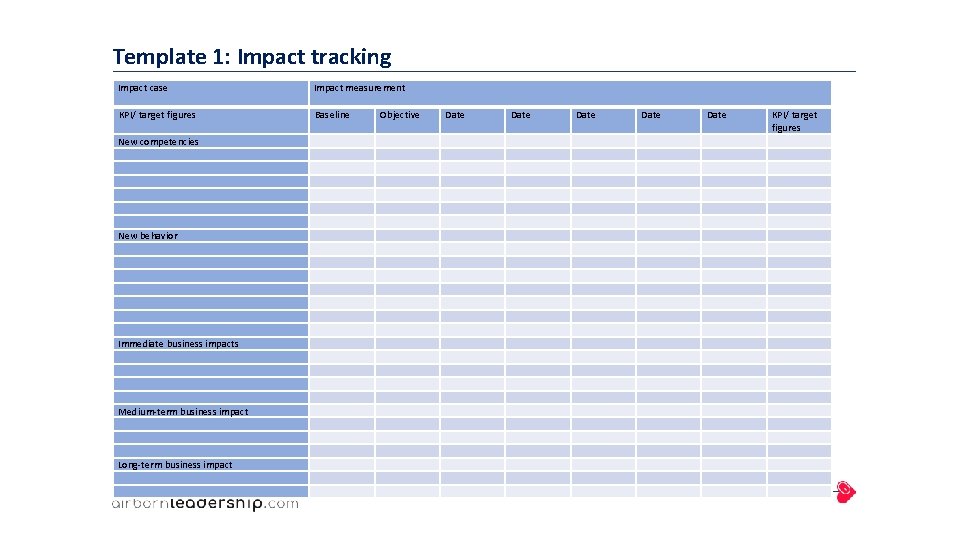
Approach for the impact tracking Who participates? The measurements should be made by the operating personnel in the areas concerned. The organization of the measurements is done by the project. Project owner and management in the affected operating areas make decisions about any corrective activities. Approach for the impact tracking A well-defined hierarchy of objectives or an impact case is a prerequisite. Step 1: Measurement points and measurement methods are defined for the different impacts in the hierarchy of objectives or the impact case. Step 2: Measuring frequency and time is planned in cooperation with the operating organization. Step 3: The follow-up is organized and responsible persons are appointed in the project and the operational organization Step 4: The measurement results are documented, e. g. in template 1 or 2. Templates 1 and 2 can be presented as posters that are placed visibly in relevant places in the organization. • Step 5: Meetings are held with project owner or steering committee at relevant times in relation to the follow-up plan. • • Template 1 • The desired effects are described in the column on the left. First the behavioral impacts and below the business impacts. A behavioral impact could be: Finishes the case processing in one round. • The next column describes the desired measurement e. g. : Calculated as a percentage of all cases. • The third pillar indicates the baseline before the project was launched, for example: 30% • In the fourth column, measures for this impact are recorded for example: 90% of all cases. • In the following columns, the observations are recorded on different dates e. g. : 46% are cases are processed in one round on 14 May. Template 2 • This template is used just like template 1. In this case, the impacts in the first column are just specified in advance. The templates can be expanded with a column indicating who is responsible for the different impact measurements.
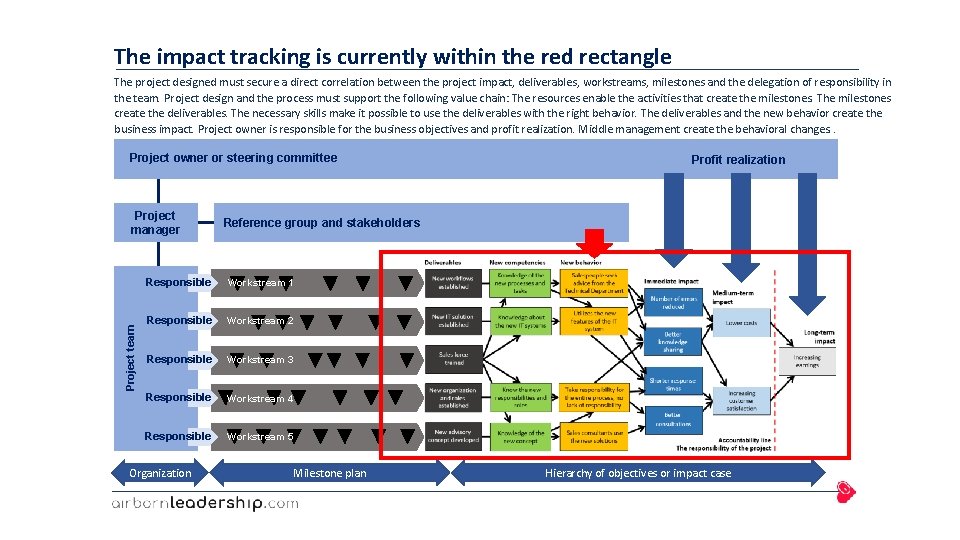
The impact tracking is currently within the red rectangle The project designed must secure a direct correlation between the project impact, deliverables, workstreams, milestones and the delegation of responsibility in the team. Project design and the process must support the following value chain: The resources enable the activities that create the milestones. The milestones create the deliverables. The necessary skills make it possible to use the deliverables with the right behavior. The deliverables and the new behavior create the business impact. Project owner is responsible for the business objectives and profit realization. Middle management create the behavioral changes. . Project owner or steering committee Project team Project manager Reference group and stakeholders Responsible Workstream 1 Responsible Workstream 2 Responsible Workstream 3 Responsible Workstream 4 Responsible Workstream 5 Organization Profit realization Milestone plan Hierarchy of objectives or impact case
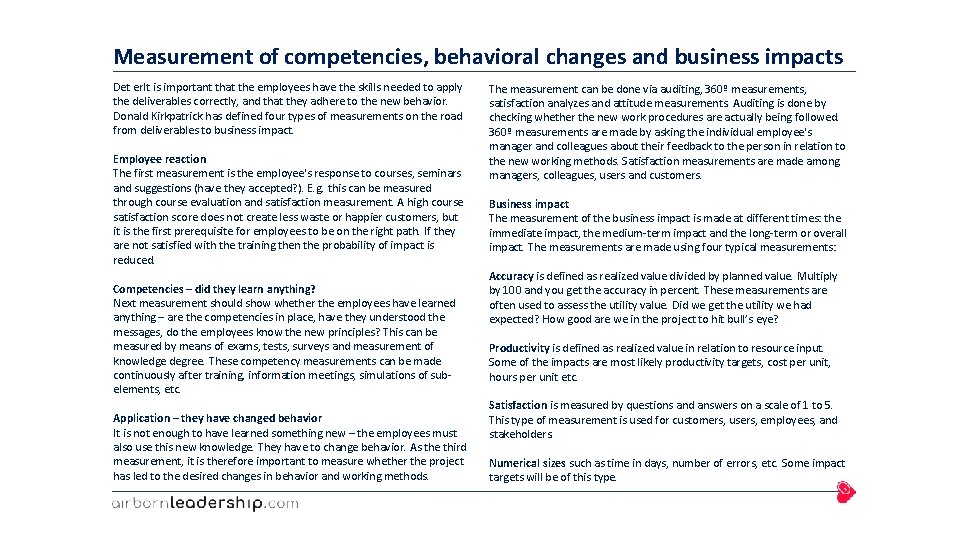
Measurement of competencies, behavioral changes and business impacts Det er. It is important that the employees have the skills needed to apply the deliverables correctly, and that they adhere to the new behavior. Donald Kirkpatrick has defined four types of measurements on the road from deliverables to business impact. Employee reaction The first measurement is the employee's response to courses, seminars and suggestions (have they accepted? ). E. g. this can be measured through course evaluation and satisfaction measurement. A high course satisfaction score does not create less waste or happier customers, but it is the first prerequisite for employees to be on the right path. If they are not satisfied with the training then the probability of impact is reduced. Competencies – did they learn anything? Next measurement should show whether the employees have learned anything – are the competencies in place, have they understood the messages, do the employees know the new principles? This can be measured by means of exams, tests, surveys and measurement of knowledge degree. These competency measurements can be made continuously after training, information meetings, simulations of subelements, etc. Application – they have changed behavior It is not enough to have learned something new – the employees must also use this new knowledge. They have to change behavior. As the third measurement, it is therefore important to measure whether the project has led to the desired changes in behavior and working methods. The measurement can be done via auditing, 360º measurements, satisfaction analyzes and attitude measurements. Auditing is done by checking whether the new work procedures are actually being followed. 360º measurements are made by asking the individual employee's manager and colleagues about their feedback to the person in relation to the new working methods. Satisfaction measurements are made among managers, colleagues, users and customers. Business impact The measurement of the business impact is made at different times: the immediate impact, the medium-term impact and the long-term or overall impact. The measurements are made using four typical measurements: Accuracy is defined as realized value divided by planned value. Multiply by 100 and you get the accuracy in percent. These measurements are often used to assess the utility value. Did we get the utility we had expected? How good are we in the project to hit bull’s eye? Productivity is defined as realized value in relation to resource input. Some of the impacts are most likely productivity targets, cost per unit, hours per unit etc. Satisfaction is measured by questions and answers on a scale of 1 to 5. This type of measurement is used for customers, users, employees, and stakeholders. Numerical sizes such as time in days, number of errors, etc. Some impact targets will be of this type.
Template 1: Impact tracking Impact measurement Impact case Behavioral impact Business impact KPI/ target figures Baseline Objective Date Date Date
Template 1: Impact tracking Impact measurement Impact case KPI/ target figures Baseline Objective Date Date KPI/ target figures New competencies New behavior Immediate business impacts Medium-term business impact Long-term business impact
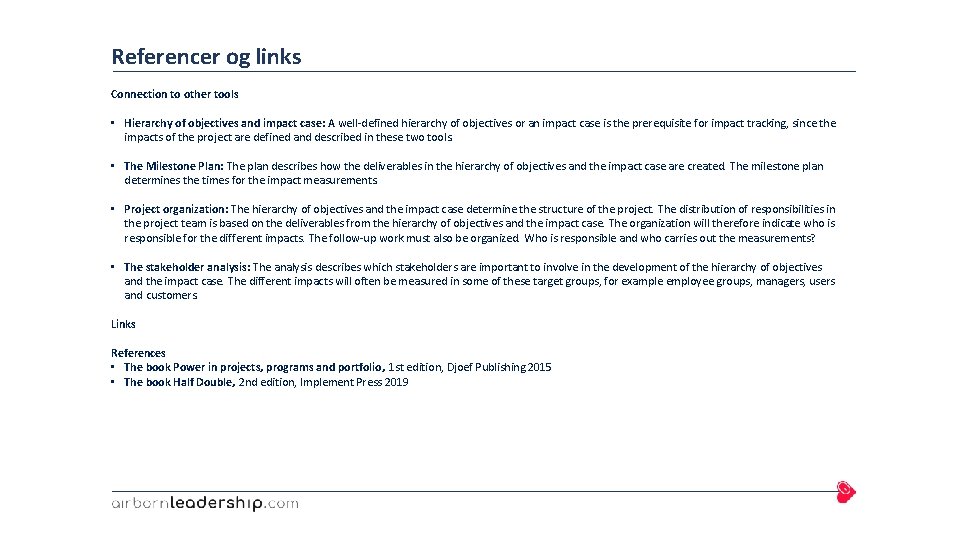
Referencer og links Connection to other tools • Hierarchy of objectives and impact case: A well-defined hierarchy of objectives or an impact case is the prerequisite for impact tracking, since the impacts of the project are defined and described in these two tools. • The Milestone Plan: The plan describes how the deliverables in the hierarchy of objectives and the impact case are created. The milestone plan determines the times for the impact measurements. • Project organization: The hierarchy of objectives and the impact case determine the structure of the project. The distribution of responsibilities in the project team is based on the deliverables from the hierarchy of objectives and the impact case. The organization will therefore indicate who is responsible for the different impacts. The follow-up work must also be organized. Who is responsible and who carries out the measurements? • The stakeholder analysis: The analysis describes which stakeholders are important to involve in the development of the hierarchy of objectives and the impact case. The different impacts will often be measured in some of these target groups, for example employee groups, managers, users and customers. Links References • The book Power in projects, programs and portfolio, 1 st edition, Djoef Publishing 2015 • The book Half Double, 2 nd edition, Implement Press 2019
Find other tools and other useful knowledge in theories, videos, books or through our e-learning modules Unleash your potential