
Tool 1 BehavioralBased Interview BBI Guide for Physicians
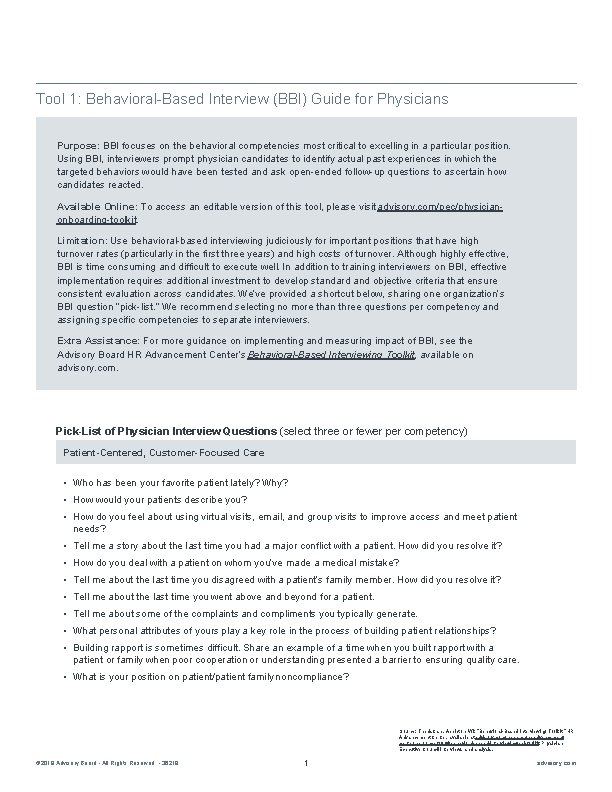
Tool 1: Behavioral-Based Interview (BBI) Guide for Physicians Purpose: BBI focuses on the behavioral competencies most critical to excelling in a particular position. Using BBI, interviewers prompt physician candidates to identify actual past experiences in which the targeted behaviors would have been tested and ask open-ended follow-up questions to ascertain how candidates reacted. Available Online: To access an editable version of this tool, please visit advisory. com/pec/physicianonboarding-toolkit. Limitation: Use behavioral-based interviewing judiciously for important positions that have high turnover rates (particularly in the first three years) and high costs of turnover. Although highly effective, BBI is time consuming and difficult to execute well. In addition to training interviewers on BBI, effective implementation requires additional investment to develop standard and objective criteria that ensure consistent evaluation across candidates. We’ve provided a shortcut below, sharing one organization’s BBI question “pick-list. ” We recommend selecting no more than three questions per competency and assigning specific competencies to separate interviewers. Extra Assistance: For more guidance on implementing and measuring impact of BBI, see the Advisory Board HR Advancement Center’s Behavioral-Based Interviewing Toolkit, available on advisory. com. Pick-List of Physician Interview Questions (select three or fewer per competency) Patient-Centered, Customer-Focused Care • Who has been your favorite patient lately? Why? • How would your patients describe you? • How do you feel about using virtual visits, email, and group visits to improve access and meet patient needs? • Tell me a story about the last time you had a major conflict with a patient. How did you resolve it? • How do you deal with a patient on whom you’ve made a medical mistake? • Tell me about the last time you disagreed with a patient’s family member. How did you resolve it? • Tell me about the last time you went above and beyond for a patient. • Tell me about some of the complaints and compliments you typically generate. • What personal attributes of yours play a key role in the process of building patient relationships? • Building rapport is sometimes difficult. Share an example of a time when you built rapport with a patient or family when poor cooperation or understanding presented a barrier to ensuring quality care. • What is your position on patient/patient family noncompliance? Source: Theda. Care, Appleton, WI; “Behavioral-Based Interviewing Toolkit, ” HR Advancement Center, available at advisory. com/research/hr-advancementcenter/resources/2014/behavioral-based-interviewing/bbi-toolkit; Physician Executive Council interviews and analysis. © 2018 Advisory Board • All Rights Reserved • 36218 1 advisory. com
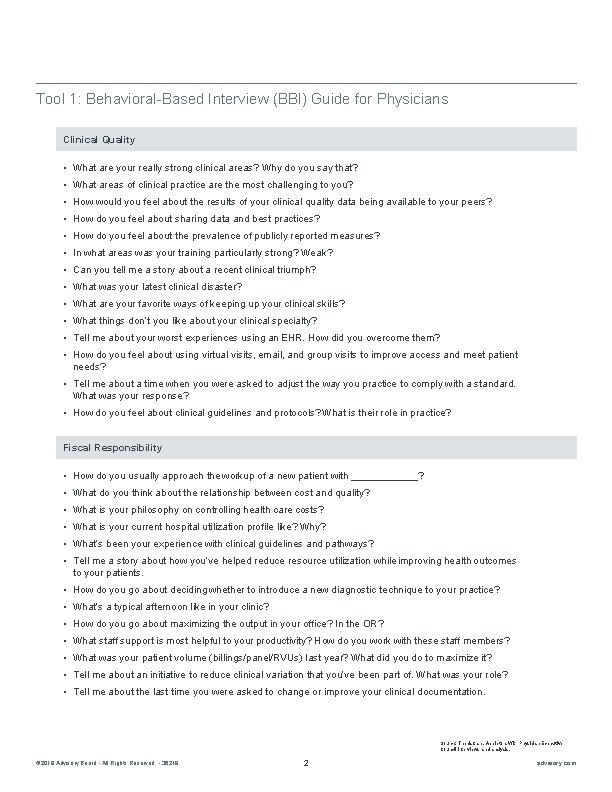
Tool 1: Behavioral-Based Interview (BBI) Guide for Physicians Clinical Quality • What are your really strong clinical areas? Why do you say that? • What areas of clinical practice are the most challenging to you? • How would you feel about the results of your clinical quality data being available to your peers? • How do you feel about sharing data and best practices? • How do you feel about the prevalence of publicly reported measures? • In what areas was your training particularly strong? Weak? • Can you tell me a story about a recent clinical triumph? • What was your latest clinical disaster? • What are your favorite ways of keeping up your clinical skills? • What things don’t you like about your clinical specialty? • Tell me about your worst experiences using an EHR. How did you overcome them? • How do you feel about using virtual visits, email, and group visits to improve access and meet patient needs? • Tell me about a time when you were asked to adjust the way you practice to comply with a standard. What was your response? • How do you feel about clinical guidelines and protocols? What is their role in practice? Fiscal Responsibility • How do you usually approach the workup of a new patient with ______? • What do you think about the relationship between cost and quality? • What is your philosophy on controlling health care costs? • What is your current hospital utilization profile like? Why? • What’s been your experience with clinical guidelines and pathways? • Tell me a story about how you’ve helped reduce resource utilization while improving health outcomes to your patients. • How do you go about deciding whether to introduce a new diagnostic technique to your practice? • What’s a typical afternoon like in your clinic? • How do you go about maximizing the output in your office? In the OR? • What staff support is most helpful to your productivity? How do you work with these staff members? • What was your patient volume (billings/panel/RVUs) last year? What did you do to maximize it? • Tell me about an initiative to reduce clinical variation that you’ve been part of. What was your role? • Tell me about the last time you were asked to change or improve your clinical documentation. Source: Theda. Care, Appleton, WI; Physician Executive Council interviews and analysis. © 2018 Advisory Board • All Rights Reserved • 36218 2 advisory. com
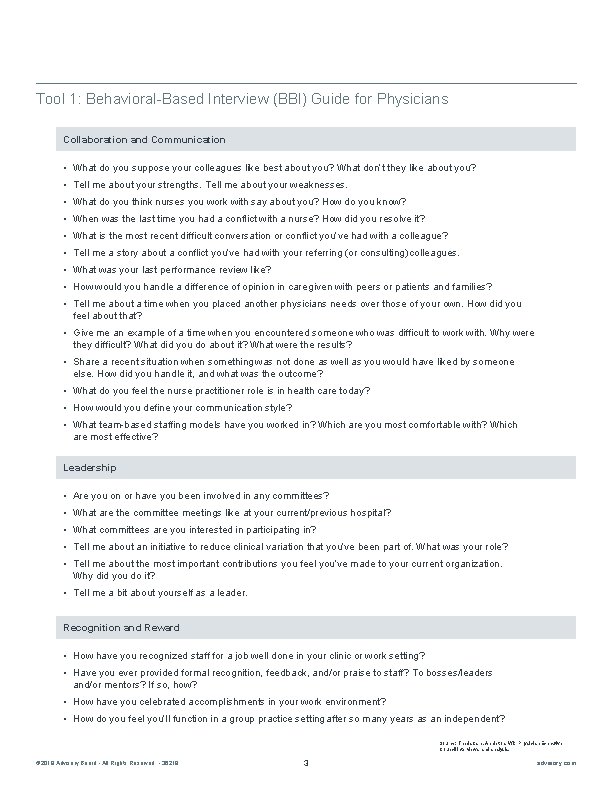
Tool 1: Behavioral-Based Interview (BBI) Guide for Physicians Collaboration and Communication • What do you suppose your colleagues like best about you? What don’t they like about you? • Tell me about your strengths. Tell me about your weaknesses. • What do you think nurses you work with say about you? How do you know? • When was the last time you had a conflict with a nurse? How did you resolve it? • What is the most recent difficult conversation or conflict you’ve had with a colleague? • Tell me a story about a conflict you’ve had with your referring (or consulting) colleagues. • What was your last performance review like? • How would you handle a difference of opinion in care given with peers or patients and families? • Tell me about a time when you placed another physicians needs over those of your own. How did you feel about that? • Give me an example of a time when you encountered someone who was difficult to work with. Why were they difficult? What did you do about it? What were the results? • Share a recent situation when something was not done as well as you would have liked by someone else. How did you handle it, and what was the outcome? • What do you feel the nurse practitioner role is in health care today? • How would you define your communication style? • What team-based staffing models have you worked in? Which are you most comfortable with? Which are most effective? Leadership • Are you on or have you been involved in any committees? • What are the committee meetings like at your current/previous hospital? • What committees are you interested in participating in? • Tell me about an initiative to reduce clinical variation that you’ve been part of. What was your role? • Tell me about the most important contributions you feel you’ve made to your current organization. Why did you do it? • Tell me a bit about yourself as a leader. Recognition and Reward • How have you recognized staff for a job well done in your clinic or work setting? • Have you ever provided formal recognition, feedback, and/or praise to staff? To bosses/leaders and/or mentors? If so, how? • How have you celebrated accomplishments in your work environment? • How do you feel you’ll function in a group practice setting after so many years as an independent? Source: Theda. Care, Appleton, WI; Physician Executive Council interviews and analysis. © 2018 Advisory Board • All Rights Reserved • 36218 3 advisory. com

Tool 1: Behavioral-Based Interview (BBI) Guide for Physicians Flexibility • It’s 10 minutes to 5: 00, and you get a call from a mother about her child’s 103° fever. It will take her 20 minutes to get to the office, but the office is closing. What do you do? • How do you feel about change? Can you give me an example of some process or practice that you have recently changed? • Share an experience working in an unsettled or rapidly changing environment. How did you react? • Some people prefer well laid out tasks, others prefer work that changes frequently. Which is your preference? Create a Positive Work Environment • What is a workplace “pet peeve” of yours? • What about your job excites you the most? • Tell me how you handle stress. What are your stress relievers? • In a hectic work environment, how do you prioritize? What do you like best about this type of atmosphere? Least? • How do you typically establish relationships with fellow physicians? Support staff? Management? Other • What’s appealing about this practice opportunity? • Tell me about some of the things you like to do when you’re not practicing medicine. • What should we accentuate during orientation to accelerate your familiarity with our health system? • What interests you about the community? Why would you like to practice medicine in this community? • Why did you choose pediatrics/internal medicine/family practice? • What do you see as your ideal position? • What do you need from a health system in order to be successful? • What appeals to you about this opportunity? • You have been called to the ER for a pediatric trauma case. A pediatric specialist is not immediately available and you have to stabilize the patient. How do you feel about this situation? What would you do? • What are your preferred areas of growth and development (learning plans) over the next five years? • Tell me about your ten-year plan. Source: Theda. Care, Appleton, WI; Physician Executive Council interviews and analysis. © 2018 Advisory Board • All Rights Reserved • 36218 4 advisory. com
- Slides: 4