
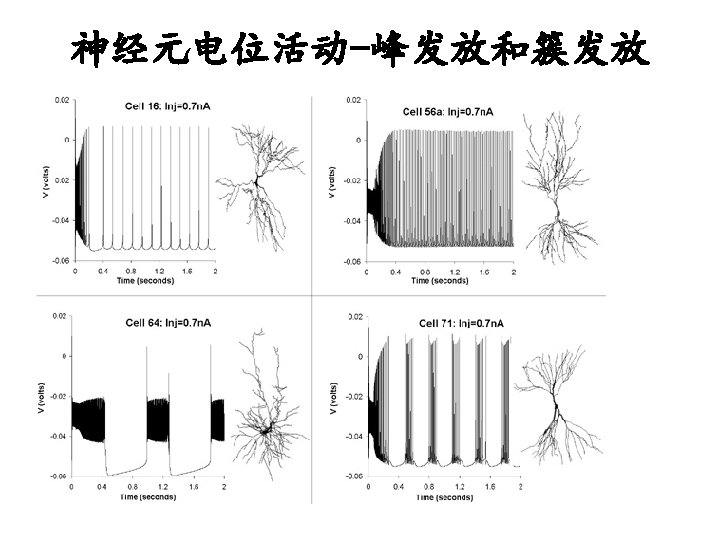
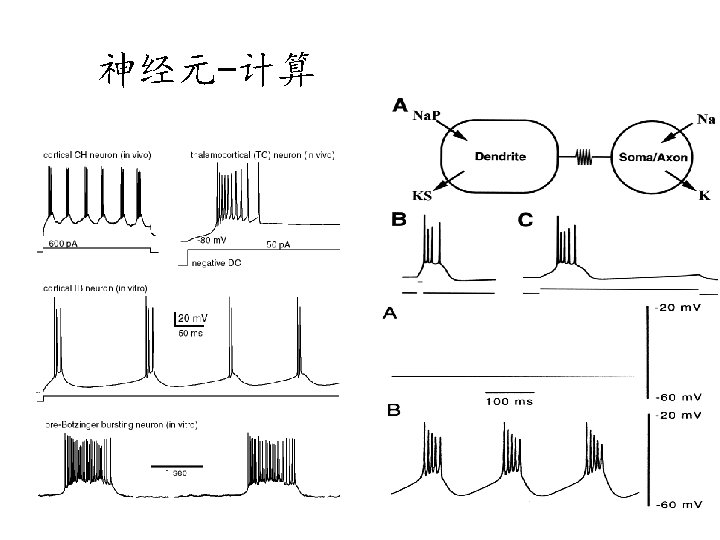
Tonic Spiking Phasic Spiking Tonic Bursting Phasic Bursting

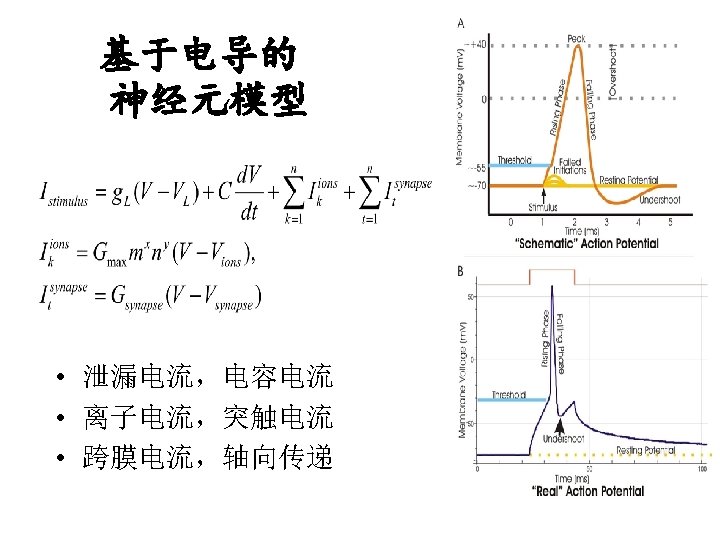
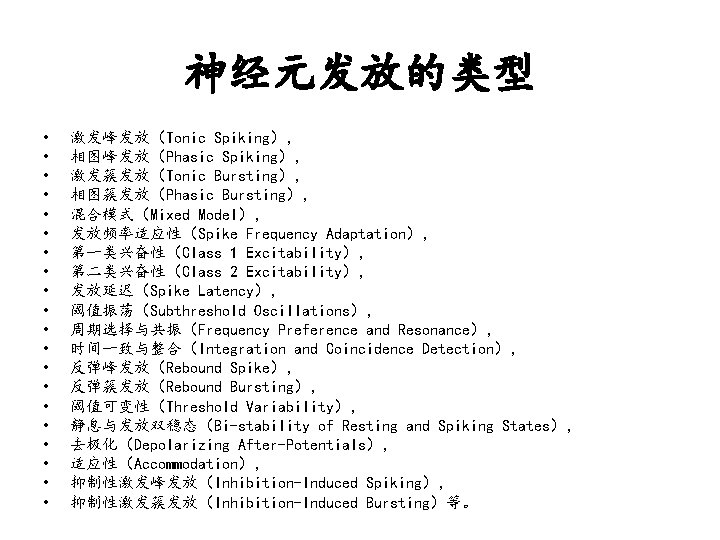
神经元发放的类型 • • • • • 激发峰发放(Tonic Spiking), 相图峰发放(Phasic Spiking), 激发簇发放(Tonic Bursting), 相图簇发放(Phasic Bursting), 混合模式(Mixed Model), 发放频率适应性(Spike Frequency Adaptation), 第一类兴奋性(Class 1 Excitability), 第二类兴奋性(Class 2 Excitability), 发放延迟(Spike Latency), 阈值振荡(Subthreshold Oscillations), 周期选择与共振(Frequency Preference and Resonance), 时间一致与整合(Integration and Coincidence Detection), 反弹峰发放(Rebound Spike), 反弹簇发放(Rebound Bursting), 阈值可变性(Threshold Variability), 静息与发放双稳态(Bi-stability of Resting and Spiking States), 去极化(Depolarizing After-Potentials), 适应性(Accommodation), 抑制性激发峰发放(Inhibition-Induced Spiking), 抑制性激发簇发放(Inhibition-Induced Bursting)等。
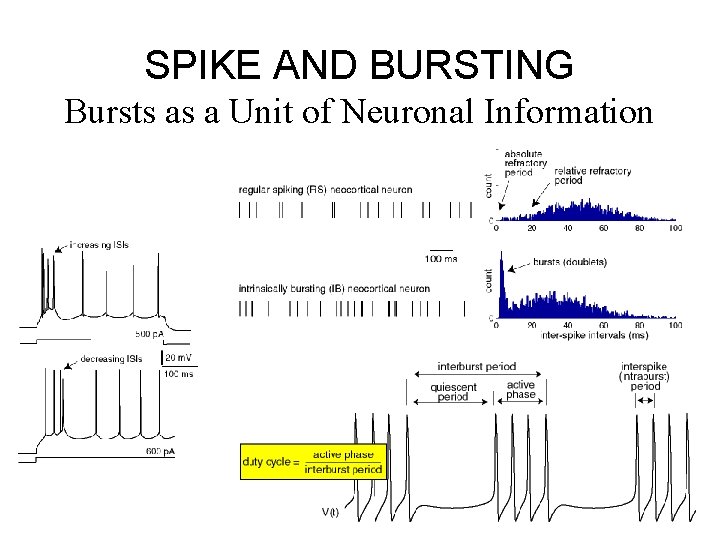
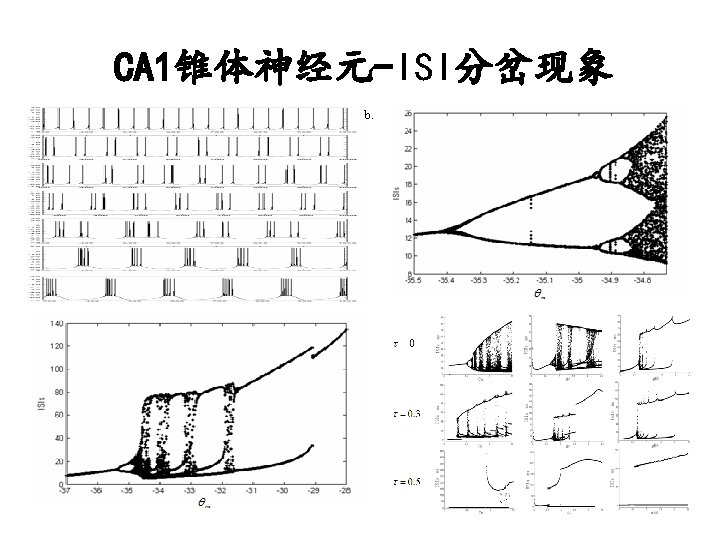
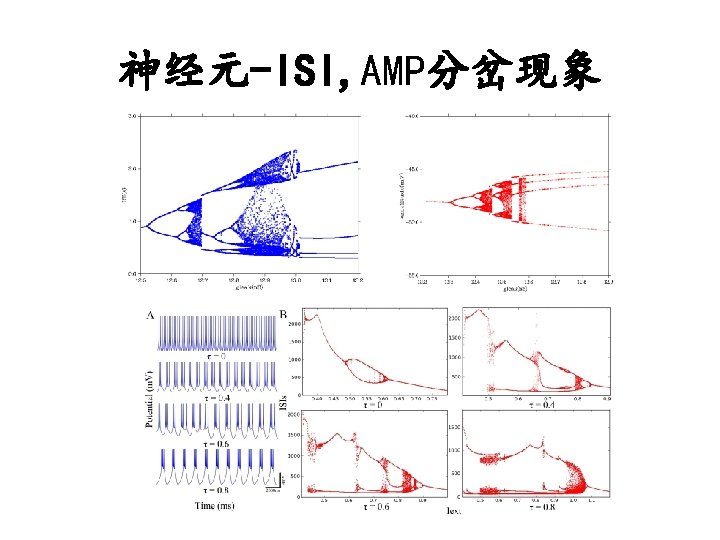
SPIKE AND BURSTING Bursts as a Unit of Neuronal Information
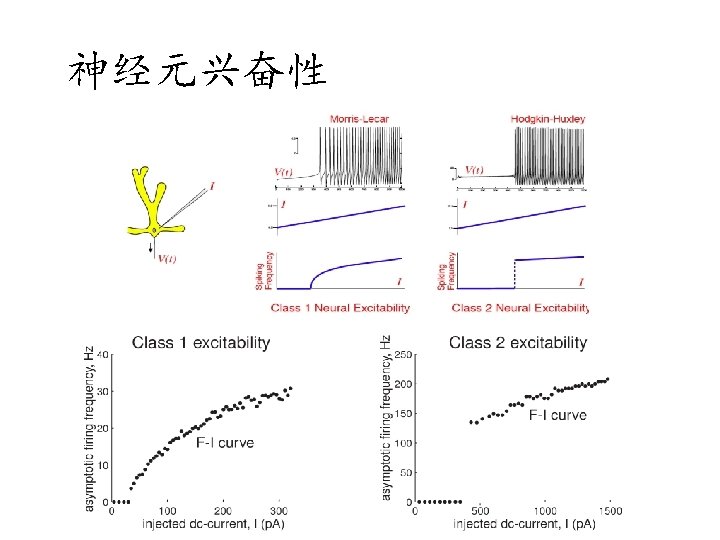
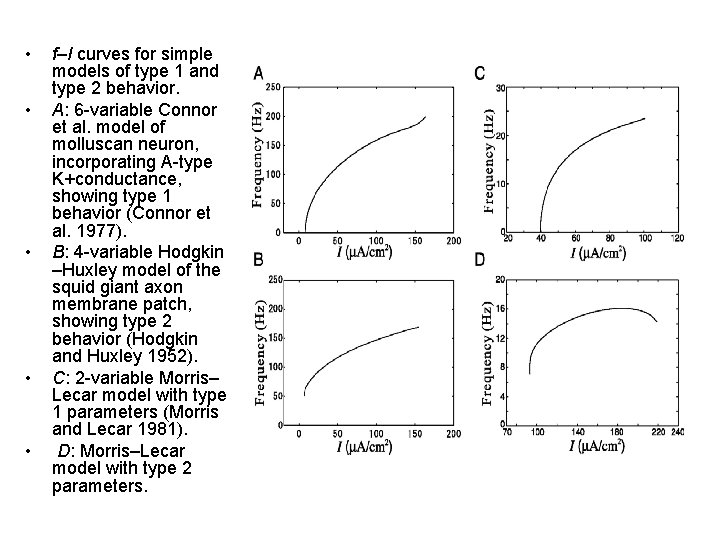
• • • f–I curves for simple models of type 1 and type 2 behavior. A: 6 -variable Connor et al. model of molluscan neuron, incorporating A-type K+conductance, showing type 1 behavior (Connor et al. 1977). B: 4 -variable Hodgkin –Huxley model of the squid giant axon membrane patch, showing type 2 behavior (Hodgkin and Huxley 1952). C: 2 -variable Morris– Lecar model with type 1 parameters (Morris and Lecar 1981). D: Morris–Lecar model with type 2 parameters.
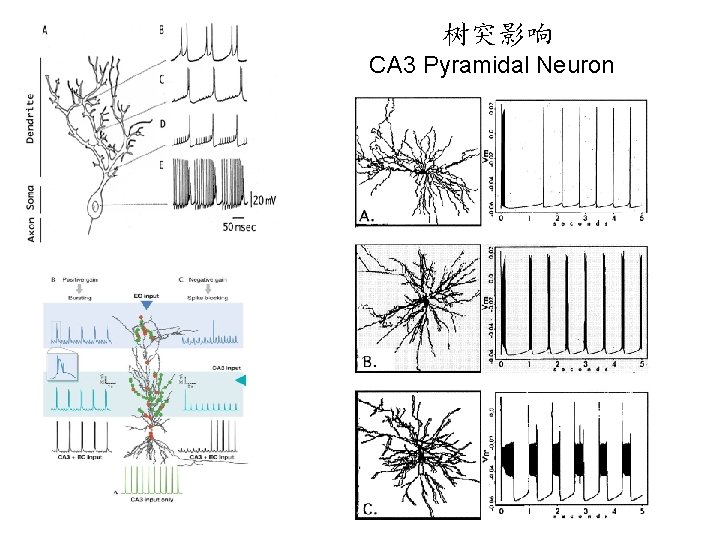
树突影响 CA 3 Pyramidal Neuron
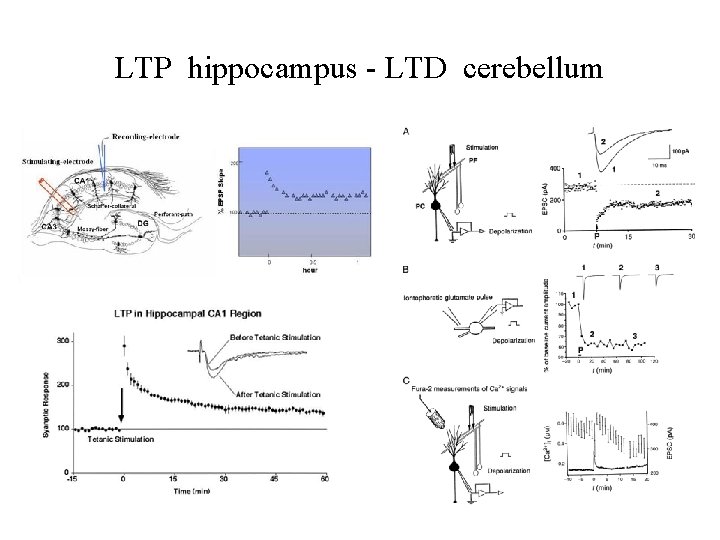
LTP hippocampus - LTD cerebellum
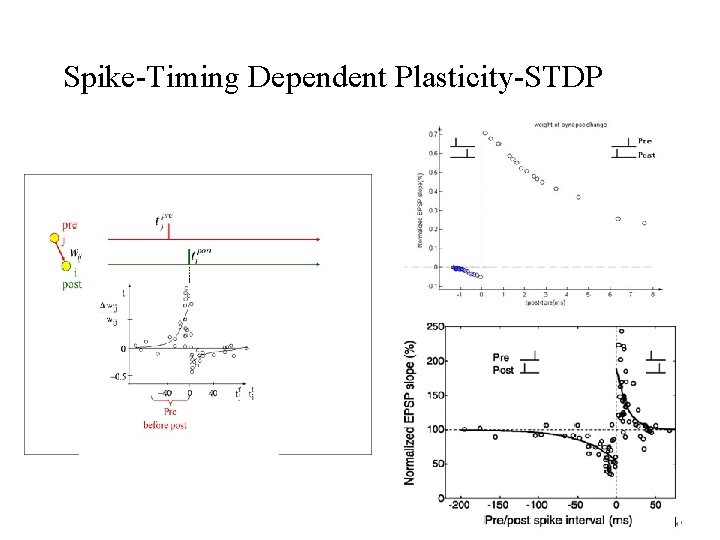
Spike-Timing Dependent Plasticity-STDP
Neuron simulation environment • • • Matlab and Mathematica NEURON - http: //www. neuron. yale. edu/ GENESIS - http: //genesis-sim. org/ XPPAUT - http: //www. math. pitt. edu/~bard/xpp. html MATCONT-http: //www. matcont. ugent. be/ • HHsim: http: //www. cs. cmu. edu/~dst/HHsim/ • L-Measure - http: //cng. gmu. edu: 8080/Lm/help/index. htm • Neuro. ML - http: //www. neuroml. org/index. php • Scholarpedia -http: //www. scholarpedia. org/article/Main_Page
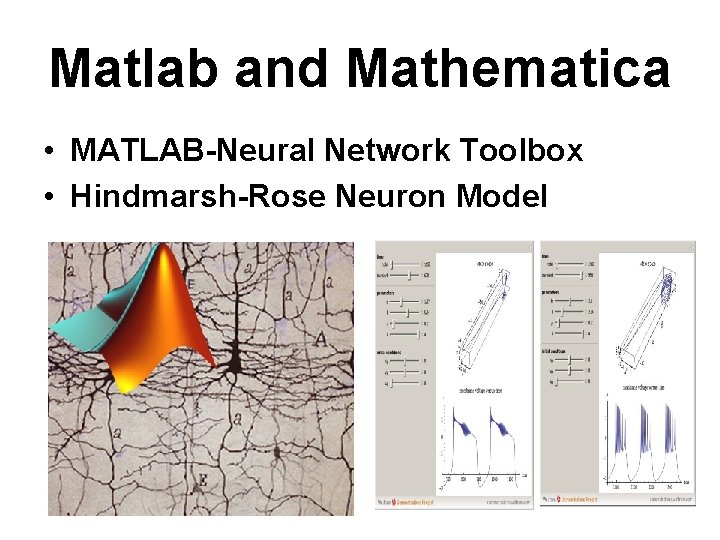
Matlab and Mathematica • MATLAB-Neural Network Toolbox • Hindmarsh-Rose Neuron Model
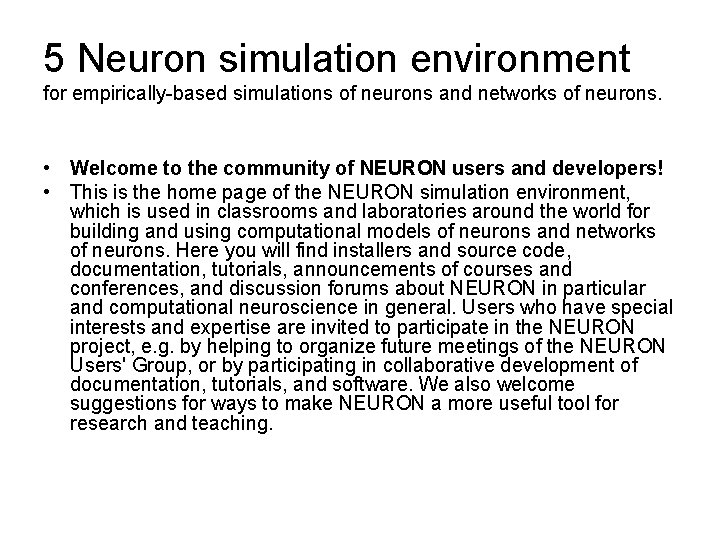
5 Neuron simulation environment for empirically-based simulations of neurons and networks of neurons. • Welcome to the community of NEURON users and developers! • This is the home page of the NEURON simulation environment, which is used in classrooms and laboratories around the world for building and using computational models of neurons and networks of neurons. Here you will find installers and source code, documentation, tutorials, announcements of courses and conferences, and discussion forums about NEURON in particular and computational neuroscience in general. Users who have special interests and expertise are invited to participate in the NEURON project, e. g. by helping to organize future meetings of the NEURON Users' Group, or by participating in collaborative development of documentation, tutorials, and software. We also welcome suggestions for ways to make NEURON a more useful tool for research and teaching.
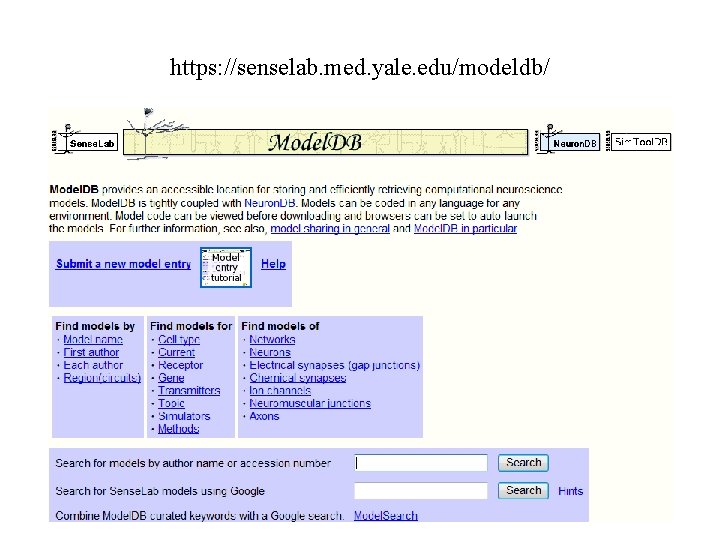
https: //senselab. med. yale. edu/modeldb/
6 GENESIS (simulation environment) • GENESIS (the GEneral NEural SImulation System) is a general purpose software platform that was developed to support the biologically realistic simulation of neural systems, ranging from subcellular components and biochemical reactions to complex models of single neurons, simulations of large networks, and systems-level models. The object-oriented approach taken by GENESIS and its high-level simulation language allows modelers to easily extend the capabilities of the simulator, and to exchange, modify, and reuse models or model components.
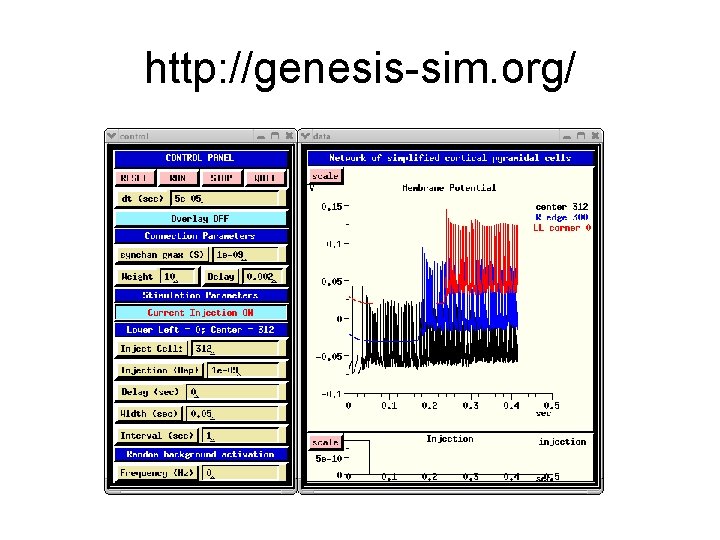
http: //genesis-sim. org/
7 XPPAUT 6. 10 • XPPAUT is a general numerical tool for simulating, animating, and analyzing dynamical systems. These can range from • discrete finite state models (e. g. , Mc. Culloch-Pitts neurons) to • stochastic Markov models, to • discretization of partial differential equations and integrodifferential equations. • The program evolved from a DOS program that was originally written so that John Rinzel and Bard Ermentrout could easily illustrate the dynamics of a simple model for an excitable membrane. The DOS program, PHASEPLANE, became a commercial project and was used for many years by a number of patient folks.
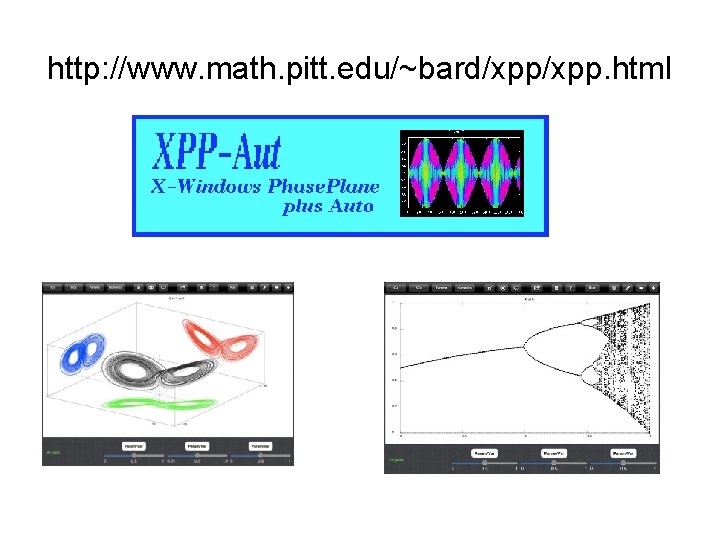
http: //www. math. pitt. edu/~bard/xpp. html
8 MATCONT, CL_MATCONT and CL_MATCONT_for_MAPS • The study of differential equations requires good and powerful mathematical software. Also, a flexible and extendible package is important. A powerful and widely used environment for scientific computing is Matlab. The aim of Mat. Cont and Cl_Mat. Cont is to provide a continuation and bifurcation toolbox which is compatible with the standard Matlab ODE representation of differential equations. • Mat. Cont is a graphical Matlab package for the interactive numerical study of dynamical systems. It is developed in parallel with the command line continuation toolbox Cl_Mat. Cont. The package (Cl_)Mat. Cont is freely available for non-commercial use on an as is basis. It should never be sold as part of some other software product. Also, in no circumstances can the authors be held liable for any deficiency, fault or other mishappening with regard to the use or performance of (Cl_)Mat. Cont.
The following actions are supported by the present version of Mat. Cont and Cl_Mat. Cont • • • • • continuation of equilibrium and periodic solutions with respect to a control parameter; computation of phase response curves and their derivatives for periodic solutions; detection of fold, Hopf and branching points on curves of equilibria; computation of normal form coefficients for fold and Hopf equilibrium bifurcations; continuation of fold and Hopf equilibrium bifurcations in two control parameters; detection of all codim 2 equilibrium bifurcations (cusp, Bogdanov-Takens, generalized Hopf, zero. Hopf, and double Hopf) on fold and Hopf curves; computation of normal form coefficients for all codim 2 equilibrium bifurcations; detection of branch bifurcation points on fold curves; continuation of branching equilibria in three control parameters; detection of flip, fold, torus and branch bifurcations of periodic solutions; computation of normal form coefficients for bifurcations of periodic solutions; continuation of flip, fold and torus bifurcations of periodic solutions in two control parameters; detection of several codim 2 bifurcations of periodic solutions on fold, flip and torus bifurcation curves; switching to the period doubled branch in a flip point; branch switching at branch points of equilibria and limit cycles; continuation of branching periodic solutions in three control parameters; continuation of orbits homoclinic to a hyperbolic saddle; continuation of orbits homoclinic to a saddle-node.
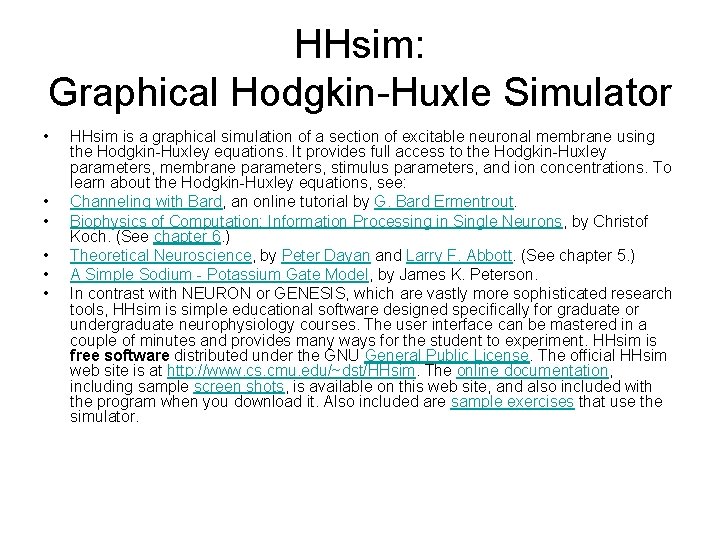
HHsim: Graphical Hodgkin-Huxle Simulator • • • HHsim is a graphical simulation of a section of excitable neuronal membrane using the Hodgkin-Huxley equations. It provides full access to the Hodgkin-Huxley parameters, membrane parameters, stimulus parameters, and ion concentrations. To learn about the Hodgkin-Huxley equations, see: Channeling with Bard, an online tutorial by G. Bard Ermentrout. Biophysics of Computation: Information Processing in Single Neurons, by Christof Koch. (See chapter 6. ) Theoretical Neuroscience, by Peter Dayan and Larry F. Abbott. (See chapter 5. ) A Simple Sodium - Potassium Gate Model, by James K. Peterson. In contrast with NEURON or GENESIS, which are vastly more sophisticated research tools, HHsim is simple educational software designed specifically for graduate or undergraduate neurophysiology courses. The user interface can be mastered in a couple of minutes and provides many ways for the student to experiment. HHsim is free software distributed under the GNU General Public License. The official HHsim web site is at http: //www. cs. cmu. edu/~dst/HHsim. The online documentation, including sample screen shots, is available on this web site, and also included with the program when you download it. Also included are sample exercises that use the simulator.
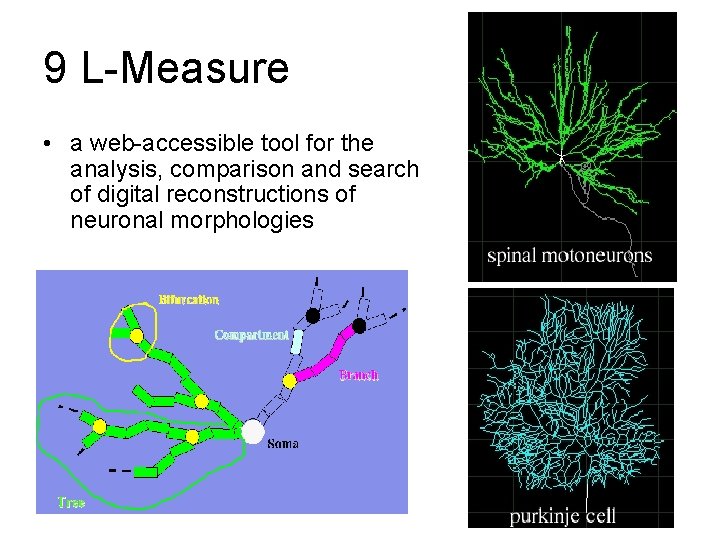
9 L-Measure • a web-accessible tool for the analysis, comparison and search of digital reconstructions of neuronal morphologies

Data represented in a SWC format • • • • • • • structure file n 400. swc digitized with Neurolucida creature rat F 344 region Hippocampus field/layer CA 1 cell type CA 1 Pyramidal Cell in vivo young contributed by. Buzsaki_G & Turner_DA published in J. Comp. Neurol. 391: 335 -352, 1998 raw data. N 400. asc additional notes turner_p_ca 1. txt soma area 0. 41 E 3 shrinkage correction (x, y, z) 1. 33 4. 00 version no. 2. 0 dated 1998 -03 -27 appleid correction 1. 33 4. 0 red-green image n 400 1 1 -0. 426 4. 549 10 4. 52 -1 2 1 -0. 638 2. 82 10 0. 907 1 3 1 -0. 838 1. 516 10 4. 52 2 4 1 -0. 638 0 10 4. 52 3 5 1 -0. 426 0 10 4. 52 4 6 1 -0. 213 -1. 955 10 4. 2 5 7 1 -0. 213 -2. 168 10 4. 2 6 8 1 -0. 213 -3. 471 10 4. 2 7 9 1 0. 213 -4. 761 10 3. 73 8 10 1 0. 838 -6. 504 10 3. 57 9 11 1 1. 264 -7. 368 10 3. 41 10
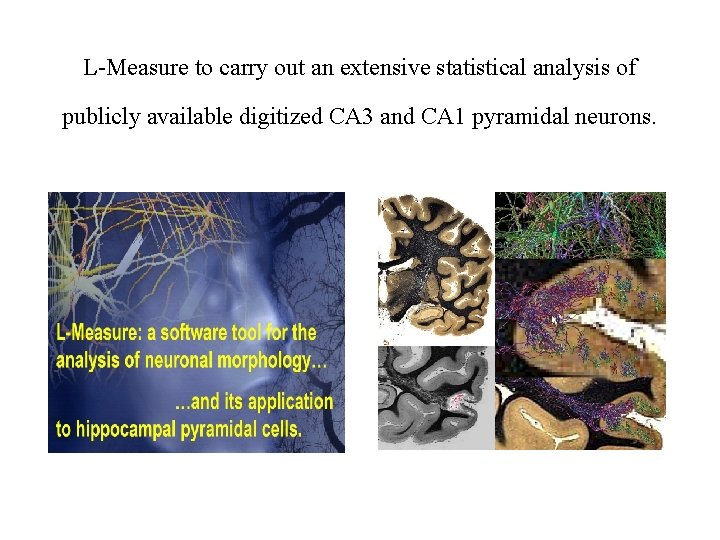
L-Measure to carry out an extensive statistical analysis of publicly available digitized CA 3 and CA 1 pyramidal neurons.
11 Model Descriptions for Computational Neuroscience • • • Computational models based on detailed neuroanatomical and electrophysiological data have been used for many years as an aid for understanding the function of the nervous system. Neuro. ML is an international, collaborative initiative to develop a language for describing detailed models of neural systems. The aims of the Neuro. ML initiative are: To create specifications for a language in XML to describe the biophysics, anatomy and network architecture of neuronal systems at multiple scales • To facilitate the exchange of complex neuronal models between researchers, allowing for greater transparency and accessibility of models • To promote software tools which support Neuro. ML and support the development of new software and databases • To encourage researchers with models within the scope of Neuro. ML to exchange and publish their models in this format. • • Neuro. ML is a free and open community effort developed with input from many contributors. We need your help as the language and tools continue to evolve. Neuro. ML v 1. 8. 1 is the latest stable release of the specification, and has been described in detail in a recent publication. Neuro. ML version 2. 0 is in active development. See here for details on the ongoing work towards this new version of the language.

12 Py. NN-http: //neuralensemble. org/trac/Py. NN • • Py. NN (pronounced 'pine' ) is a simulator-independent language for building neuronal network models. In other words, you can write the code for a model once, using the Py. NN API and the Python programming language, and then run it without modification on any simulator that Py. NN supports (currently NEURON, NEST, PCSIM and Brian). The Py. NN API aims to support modelling at a high-level of abstraction (populations of neurons, layers, columns and the connections between them) while still allowing access to the details of individual neurons and synapses when required. Py. NN provides a library of standard neuron, synapse and synaptic plasticity models, which have been verified to work the same on the different supported simulators. Py. NN also provides a set of commonly-used connectivity algorithms (e. g. all-to-all, random, distance-dependent, small-world) but makes it easy to provide your own connectivity in a simulator-independent way, either using the Connection Set Algebra ( Djurfeldt, 2010) or by writing your own Python code. The low-level API is good for small networks, and perhaps gives more flexibility. The high-level API is good for hiding the details and the book-keeping, allowing you to concentrate on the overall structure of your model. The other thing that is required to write a model once and run it on multiple simulators is standard cell models. Py. NN translates standard cell-model names and parameter names into simulator-specific names, e. g. standard model IF_curr_alpha is iaf_neuron in NEST and Standard. IF in NEURON, while Spike. Source. Poisson is a poisson_generator in NEST and a Net. Stim in NEURON. Only a few cell models have been implemented so far. Even if you don't wish to run simulations on multiple simulators, you may benefit from writing your simulation code using Py. NN's powerful, high-level interface. In this case, you can use any neuron or synapse model supported by your simulator, and are not restricted to the standard models. Py. NN is a work in progress, but is already being used for several large-scale simulation projects. Download the current stable release of the API (0. 7), or get the development version from the Subversion repository.
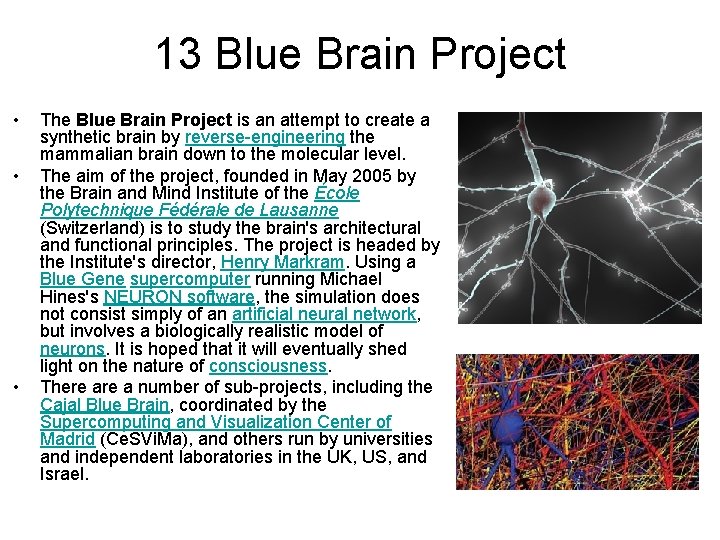
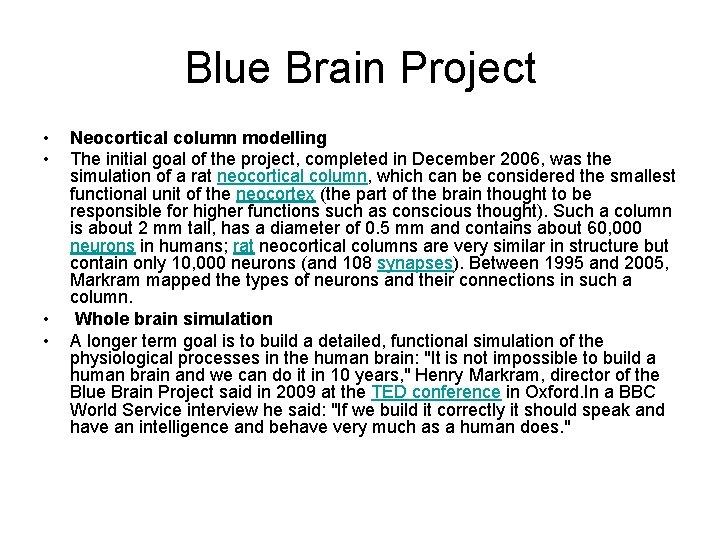
13 Blue Brain Project • • • The Blue Brain Project is an attempt to create a synthetic brain by reverse-engineering the mammalian brain down to the molecular level. The aim of the project, founded in May 2005 by the Brain and Mind Institute of the École Polytechnique Fédérale de Lausanne (Switzerland) is to study the brain's architectural and functional principles. The project is headed by the Institute's director, Henry Markram. Using a Blue Gene supercomputer running Michael Hines's NEURON software, the simulation does not consist simply of an artificial neural network, but involves a biologically realistic model of neurons. It is hoped that it will eventually shed light on the nature of consciousness. There a number of sub-projects, including the Cajal Blue Brain, coordinated by the Supercomputing and Visualization Center of Madrid (Ce. SVi. Ma), and others run by universities and independent laboratories in the UK, US, and Israel.
Blue Brain Project • • Neocortical column modelling The initial goal of the project, completed in December 2006, was the simulation of a rat neocortical column, which can be considered the smallest functional unit of the neocortex (the part of the brain thought to be responsible for higher functions such as conscious thought). Such a column is about 2 mm tall, has a diameter of 0. 5 mm and contains about 60, 000 neurons in humans; rat neocortical columns are very similar in structure but contain only 10, 000 neurons (and 108 synapses). Between 1995 and 2005, Markram mapped the types of neurons and their connections in such a column. Whole brain simulation A longer term goal is to build a detailed, functional simulation of the physiological processes in the human brain: "It is not impossible to build a human brain and we can do it in 10 years, " Henry Markram, director of the Blue Brain Project said in 2009 at the TED conference in Oxford. In a BBC World Service interview he said: "If we build it correctly it should speak and have an intelligence and behave very much as a human does. "
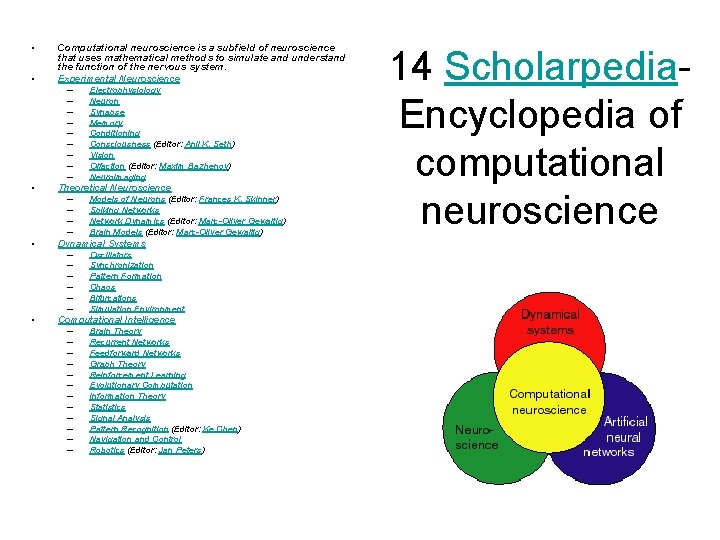
• • Computational neuroscience is a subfield of neuroscience that uses mathematical methods to simulate and understand the function of the nervous system. Experimental Neuroscience – – – – – • Theoretical Neuroscience – – • Models of Neurons (Editor: Frances K. Skinner) Spiking Networks Network Dynamics (Editor: Marc-Oliver Gewaltig) Brain Models (Editor: Marc-Oliver Gewaltig) Dynamical Systems – – – • Electrophysiology Neuron Synapse Memory Conditioning Consciousness (Editor: Anil K. Seth) Vision Olfaction (Editor: Maxim Bazhenov) Neuroimaging Oscillators Synchronization Pattern Formation Chaos Bifurcations Simulation Environment Computational Intelligence – – – Brain Theory Recurrent Networks Feedforward Networks Graph Theory Reinforcement Learning Evolutionary Computation Information Theory Statistics Signal Analysis Pattern Recognition (Editor: Ke Chen) Navigation and Control Robotics (Editor: Jan Peters) 14 Scholarpedia. Encyclopedia of computational neuroscience
15 Sloan-Swartz Centers for Theoretical Neurobiology • • The Centers for Theoretical Neurobiology were established at five outstanding U. S. research institutions (Brandeis University, California Institute of Technology, New York University, Salk Institute, and University of California at San Francisco) in 1994 by the Sloan Foundation. The Swartz Foundation joined Sloan as co-sponsor of Sloan-Swartz Program in Theoretical Neurobiology in 2000. The aim of the Program is to establish an integral role for theory and quantitative approaches in neuroscience research. Theory, a natural part of research programs in many sciences, was substantially absent from neuroscience. Recognizing the value of an integrated theoretical approach, this initiative places both experimentally- and theoretically-trained scientists from physics, mathematics and computer sciences into selected experimental brain research laboratories. In that environment, they become conversant with neuroscience questions and experimental approaches in neurobiology, enabling them to apply their unusual vantage and theoretical skills to cooperative lines of inquiry.
Research Centers and Initiatives • • • Brandeis University California Institute of Technology Cold Spring Harbor Laboratory Columbia Harvard New York University Princeton Salk Institute University of California at San Diego University of California at San Francisco Yale
Swartz Prize for Theoretical and Computational Neuroscience • • • 2011: Haim Sompolinsky 2010: Larry Abbott 2009: Horace Barlow 2008: Wilfrid Rall $25, 000 Swartz Prize for Theoretical and Computational Neuroscience
16 Institute for Nonlinear Science • The goal of neural science is to understand the brain, mind, how we perceive, move, think, and remember. All those things are dynamical processes which are taking place in a complex, changing and noisy environment. That means that these dynamical processes at all levels from small neural networks to behavior should be stable against perturbation but flexible and adaptive. The goal of neurodynamics is to formulate the main dynamical principles which can be a basis for such behavior and to predict the possible activities of neurons and neural ensembles using the tools of nonlinear dynamics.
Neurodynamics group • Stability and Flexibility of small neural circuits (CPGs) • The role of sensory systems for the organization of motor activity • Winnerless Competition and the olfactory system of insects • Electronic Neurons and hybrid circuits • Reconstruction of input spaces • Mechanisms of synaptic plasticity • Electronic Nervous Systems for Biomimetic Robots
17 University of Ottawa Center for Neural Dynamics • • Research Groups Sensory Systems Motor Control Autonomic Nervous System Control Memory and Plasticity Neuromuscular Systems Modeling
COMPUTATIONAL NEUROSCIENCE • • http: //home. earthlink. net/~perlewitz/sftwr. html MODELING – – • Microphysiological Compartmental Realistic Network Interoperability MODELING SUPPORT – – Data Aquisition & Control Data Analysis & Visualization • • • – – Morphology Time Series Network Database Management Differential Equation Solvers
- Slides: 42