
TONGUE TWISTER Peter Piper picked a peck of
- Slides: 24
TONGUE TWISTER Peter Piper picked a peck of pickled pepper. Did Peter Piper pick a peck of pickled pepper? If Peter Piper picked a peck of pickled pepper, where’s the peck of pickled pepper Peter Piper picked?
Review on Figures of Speech _____1. The cold clams close their shells. _____2. Blood is thicker than water. _____3. My heart has turned to stone. _____4. I wandered lonely as a cloud. _____5. She sells a sea shell on the shore.
POETRY it is an art of condensation and implication. bit concentrates meaning and distill feelings. b
POETRY ba kind of language that says more and says it more intensely than does ordinary language.
ELEMENTS OF POETRY: b Voice: Speaker and Tone b Musical Device b Sound b Diction (choice of words) b Imagery b Rhythm and Meter b Figures of Speech b Denotation and Connotation b Theme
VOICE: Speaker and Tone b The speaker is the one speaking in the poem. It is this voice that conveys the poem’s tone.
b. Tone is an abstraction we make from the detail of a poem’s language: the use of meter and rhyme; inclusion of certain kinds of details. b. Tone , in literature, may be defined as the writer's or speaker's attitude toward the subject, the audience, or toward herself/himself.
Musical Device b Verbal music is one of the important resources that enable the poet to do something more than communicate mere information. b Essential elements in all music are repetition and variation.
SOUND: Rhyme b. The most familiar element of poetry is rhyme, which can be defined as the matching of final vowel and consonant sounds in two or more words.
DICTION b Poems include “ the best words in the best order” b It is necessary to know what the word means b Denotative and connotative meaning of words, ex: blood which is something red, but it could be war, life or or battle.
IMAGERY b Poems are grounded in the concrete and the specific--in the details that stimulate our senses. b An image is a concrete representation of a sense of impression, feeling, or idea.
b It triggers our imaginative re-enactment of sensory experience by rendering feelings b Images may be visual, aural, tactile, olfactory and gustatory. b visual imagery is the most frequently occurring kind of imagery in poetry.
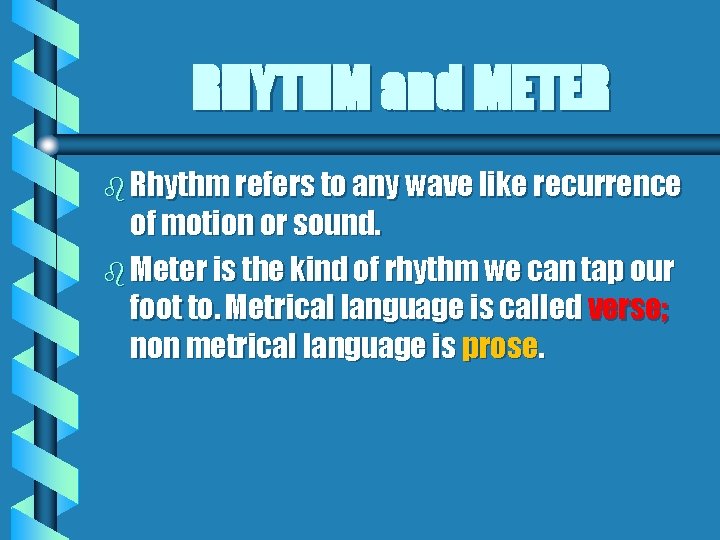
RHYTHM and METER b Rhythm refers to any wave like recurrence of motion or sound. b Meter is the kind of rhythm we can tap our foot to. Metrical language is called verse; non metrical language is prose.
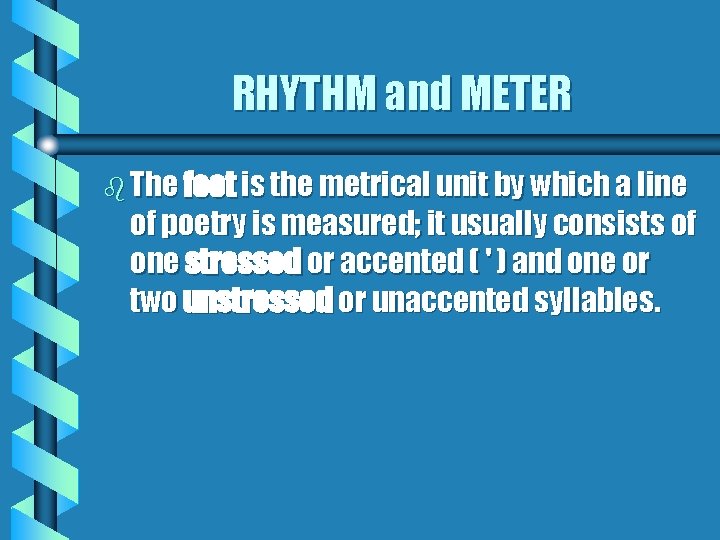
RHYTHM and METER b The foot is the metrical unit by which a line of poetry is measured; it usually consists of one stressed or accented ( ' ) and one or two unstressed or unaccented syllables.
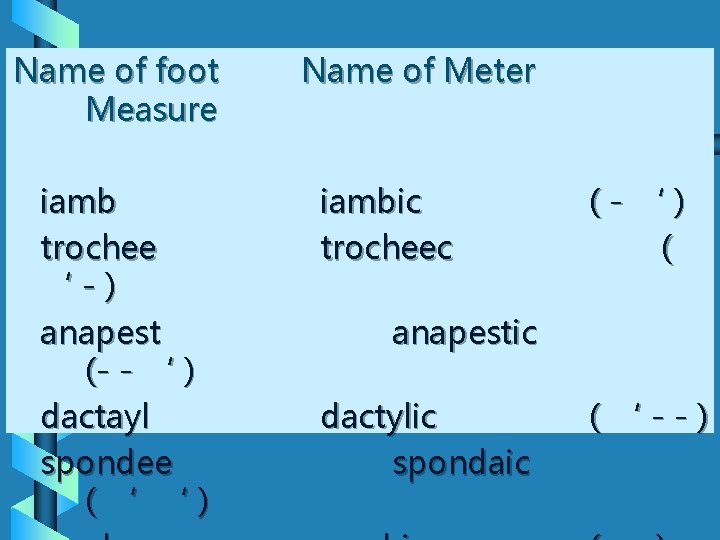
Name of foot Measure iamb trochee ‘-) anapest (- - ‘ ) dactayl spondee (‘ ‘) Name of Meter iambic trocheec (-‘) ( anapestic dactylic spondaic (‘--)
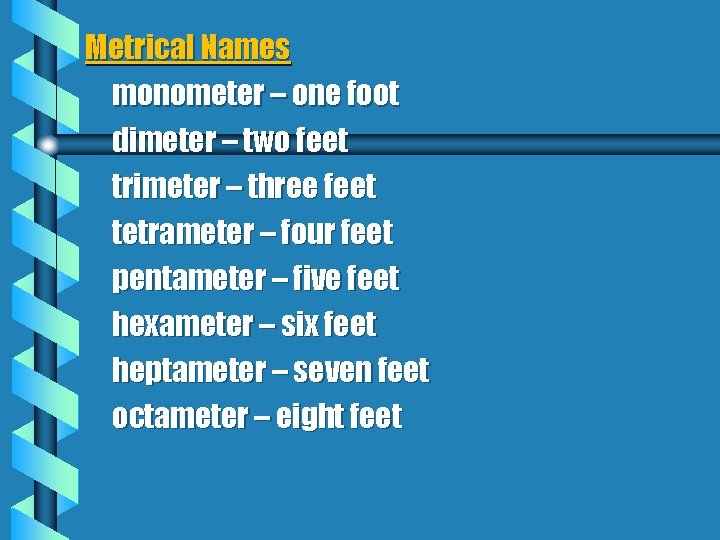
Metrical Names monometer – one foot dimeter – two feet trimeter – three feet tetrameter – four feet pentameter – five feet hexameter – six feet heptameter – seven feet octameter – eight feet
b The process of measuring verse is referred to as scansion. To scan a poem we do these three things: 1. we identify the prevailing meter, 2. we give a metrical name to the number of feet in a line, and 3. we describe the stanza pattern or rhyme-scheme.
FIGURE OF SPEECH b Figures of speech are another way of adding extra dimensions to language. b Broadly defined, a figure of speech is any of saying something other than the ordinary way, and some rhetoricians have classified as many as 250 separate figures. b Figurative language is language that cannot be taken literally.
b Metaphor and simile are both used as a means of comparing things that are essentially unlike. b Personification b Synecdoche b Apostrophe b Symbol and Allegory: A symbol may be roughly defined as something that means more than what it is. Allegory is a narrative or description that has a second meaning beneath the surface one.
b Paradox is an apparent contradiction that is nevertheless true. b Overstatement, or hyperbole, is simply exaggeration but exaggeration in the service of truth. b Like paradox, irony has meanings that extend beyond its use merely as a figure of speech. It is saying the opposite of what one means, is often confused with sarcasm and with satire. b Allusion, a reference to something in history or previous literature, is, like a richly connotative word or a symbol, a means of suggesting far more that it says.
DENOTATION and CONNOTATION b Denotation is the dictionary meaning(s) of the word; b connotations are what it suggests beyond what it expresses: its overtones of meaning. It acquires these connotations by its past history and associations, by the way and the circumstances in which it has been used.
THEME b Defined as abstraction or generalization drawn from the details of a literary work. b Refers to the idea or intellectually apprehensible meaning inherent and implicit in a work.
Analyze the poem by identifying the elements of poetry. Analyze it according to its: - voice - diction - imagery - figures of speech - sound -theme
ASSIGNMENT: Have a copy of one of the sonnets of Shakespeare. Try to identify the elements in it.