
Tone vs Mood and Figurative Language Tone vs
- Slides: 23
Tone vs. Mood and Figurative Language
Tone vs. Mood Tone and mood are literary elements integrated into literary works, but can also be included into any piece of writing, including NONFICTION writing. Identifying the tone is very important to truly understanding what a writer is trying to say and can be helpful in helping to discern purpose and main idea. Students often confuse tone with mood.
TONE Tone is the AUTHOR’S attitude towards the audience, the subject, or the character. *Tone is shown through Dialogue - talking Descriptions – author’s diction [word choice]
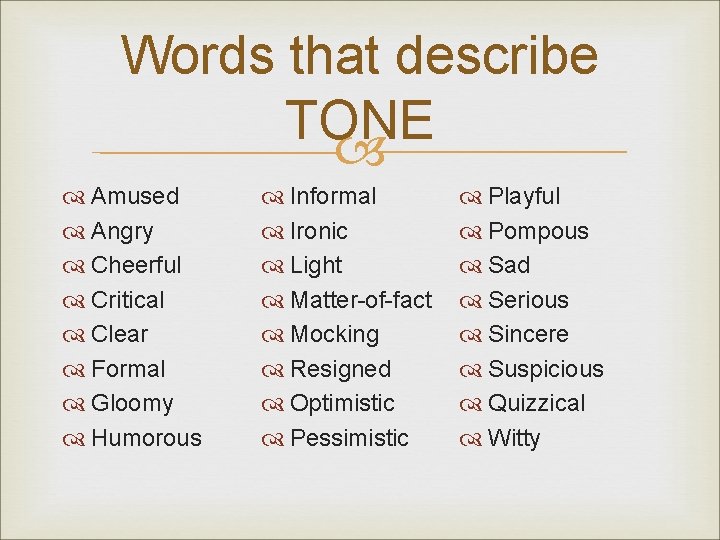
Words that describe TONE Amused Angry Cheerful Critical Clear Formal Gloomy Humorous Informal Ironic Light Matter-of-fact Mocking Resigned Optimistic Pessimistic Playful Pompous Sad Serious Sincere Suspicious Quizzical Witty
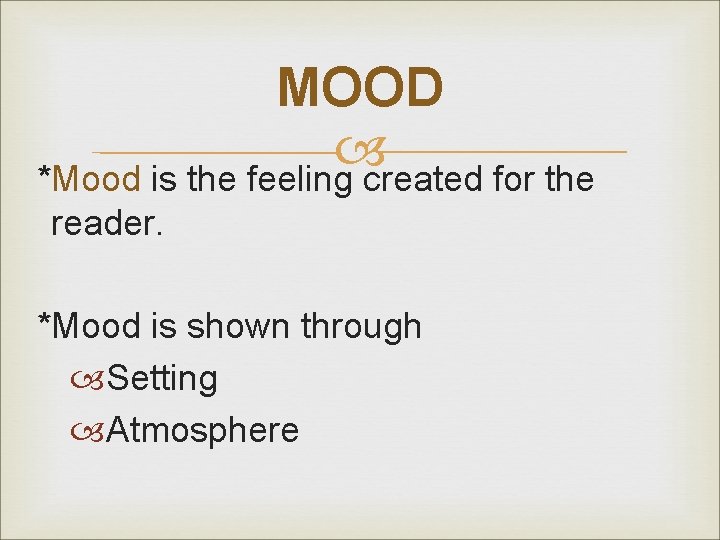
MOOD *Mood is the feeling created for the reader. *Mood is shown through Setting Atmosphere
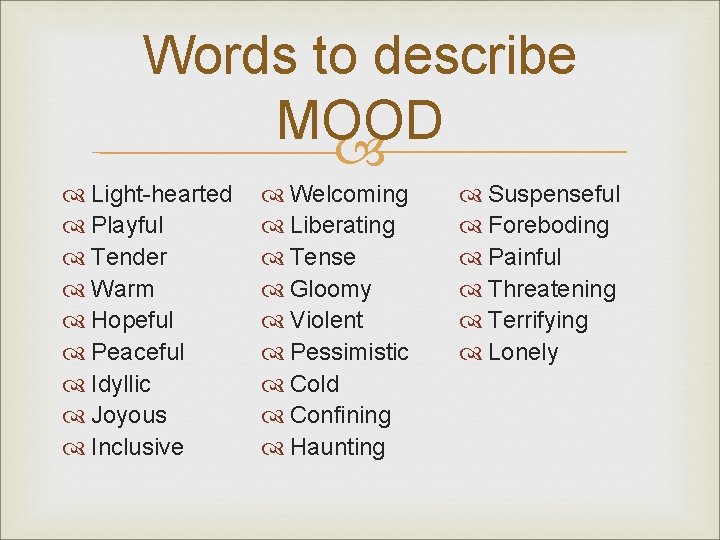
Words to describe MOOD Light-hearted Playful Tender Warm Hopeful Peaceful Idyllic Joyous Inclusive Welcoming Liberating Tense Gloomy Violent Pessimistic Cold Confining Haunting Suspenseful Foreboding Painful Threatening Terrifying Lonely
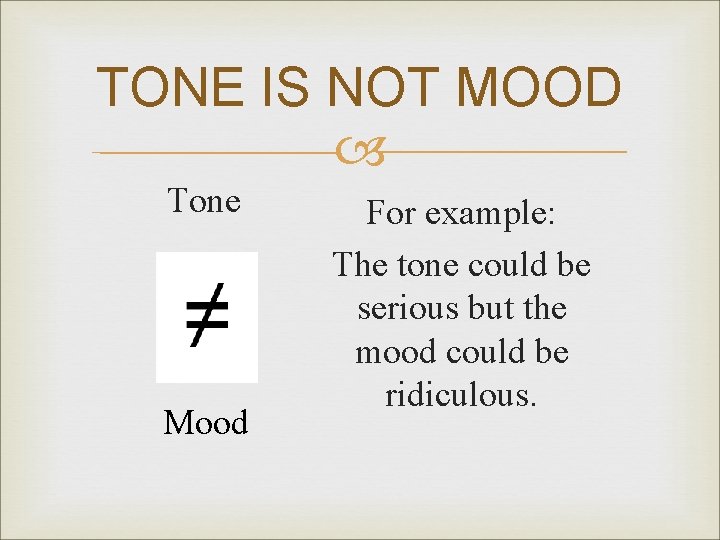
TONE IS NOT MOOD Tone Mood For example: The tone could be serious but the mood could be ridiculous.
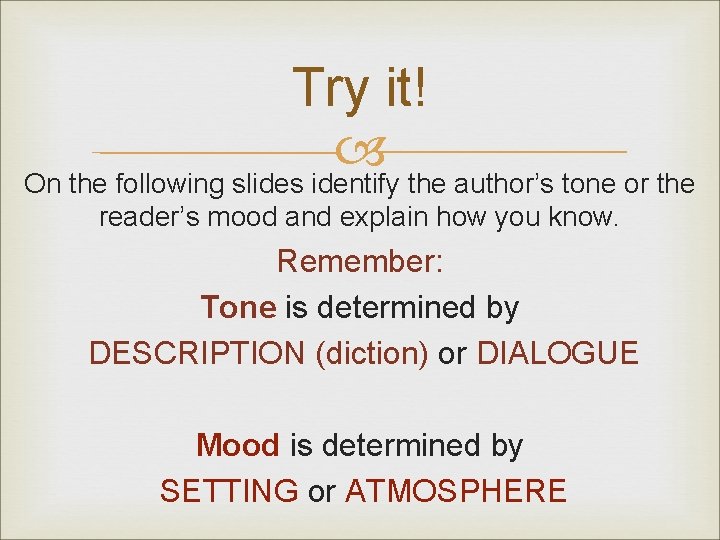
Try it! On the following slides identify the author’s tone or the reader’s mood and explain how you know. Remember: Tone is determined by DESCRIPTION (diction) or DIALOGUE Mood is determined by SETTING or ATMOSPHERE
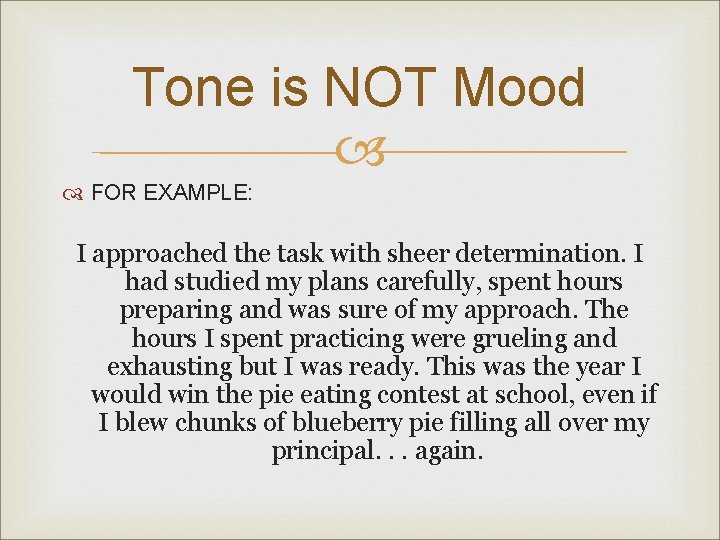
Tone is NOT Mood FOR EXAMPLE: I approached the task with sheer determination. I had studied my plans carefully, spent hours preparing and was sure of my approach. The hours I spent practicing were grueling and exhausting but I was ready. This was the year I would win the pie eating contest at school, even if I blew chunks of blueberry pie filling all over my principal. . . again.
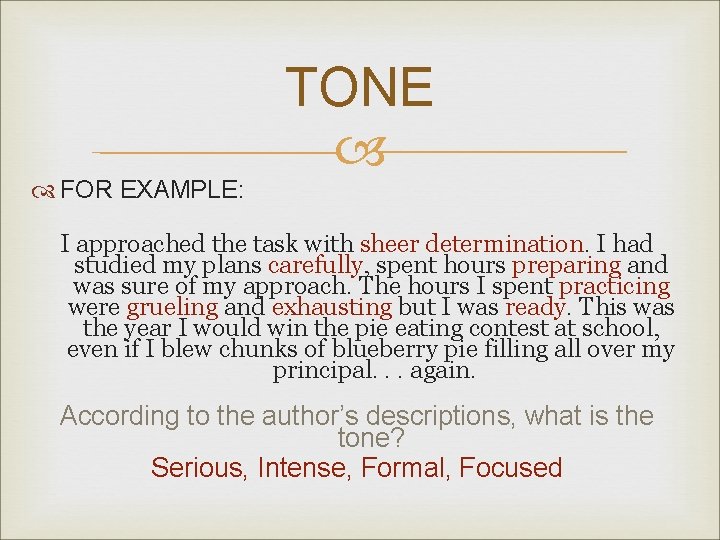
FOR EXAMPLE: TONE I approached the task with sheer determination. I had studied my plans carefully, spent hours preparing and was sure of my approach. The hours I spent practicing were grueling and exhausting but I was ready. This was the year I would win the pie eating contest at school, even if I blew chunks of blueberry pie filling all over my principal. . . again. According to the author’s descriptions, what is the tone? Serious, Intense, Formal, Focused
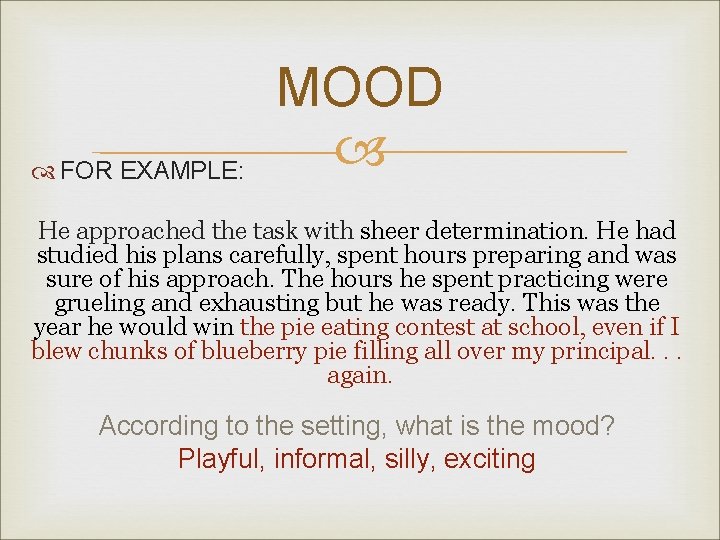
FOR EXAMPLE: MOOD He approached the task with sheer determination. He had studied his plans carefully, spent hours preparing and was sure of his approach. The hours he spent practicing were grueling and exhausting but he was ready. This was the year he would win the pie eating contest at school, even if I blew chunks of blueberry pie filling all over my principal. . . again. According to the setting, what is the mood? Playful, informal, silly, exciting
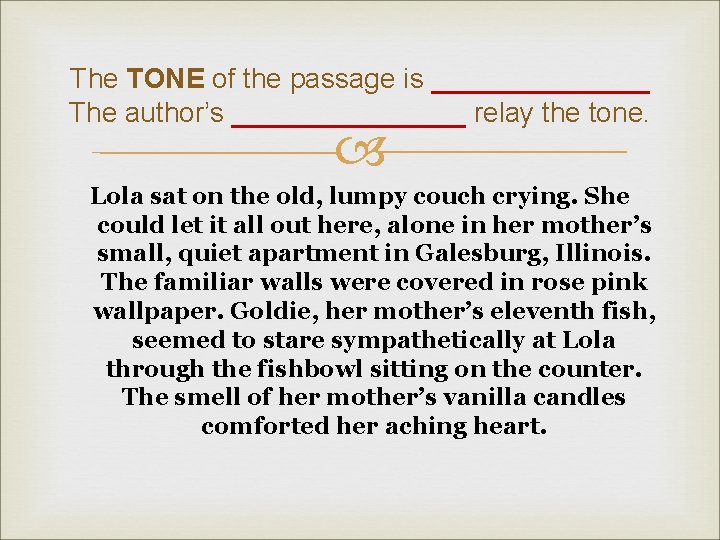
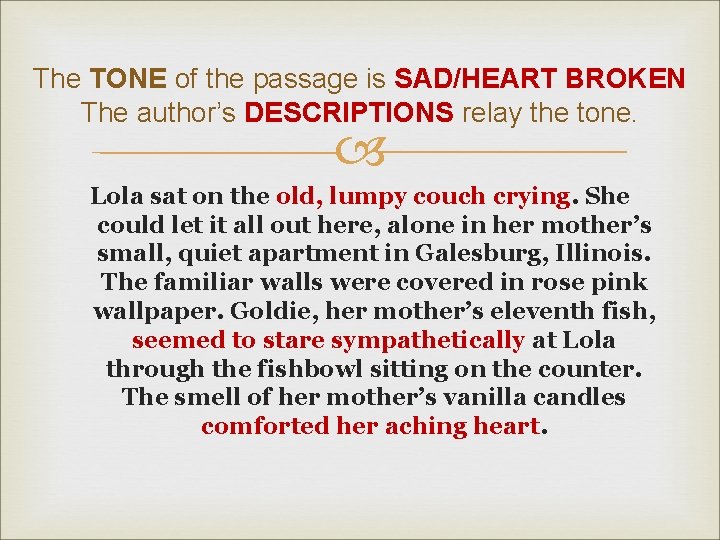
The TONE of the passage is _______ The author’s ________ relay the tone. Lola sat on the old, lumpy couch crying. She could let it all out here, alone in her mother’s small, quiet apartment in Galesburg, Illinois. The familiar walls were covered in rose pink wallpaper. Goldie, her mother’s eleventh fish, seemed to stare sympathetically at Lola through the fishbowl sitting on the counter. The smell of her mother’s vanilla candles comforted her aching heart.
The TONE of the passage is SAD/HEART BROKEN The author’s DESCRIPTIONS relay the tone. Lola sat on the old, lumpy couch crying. She could let it all out here, alone in her mother’s small, quiet apartment in Galesburg, Illinois. The familiar walls were covered in rose pink wallpaper. Goldie, her mother’s eleventh fish, seemed to stare sympathetically at Lola through the fishbowl sitting on the counter. The smell of her mother’s vanilla candles comforted her aching heart.
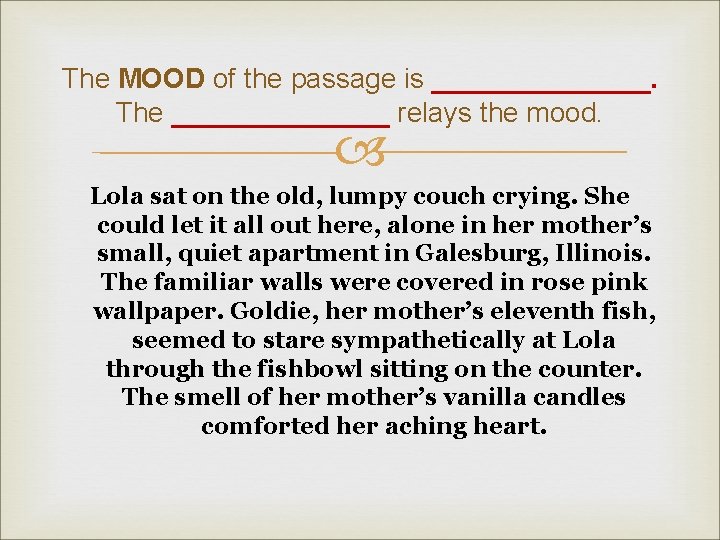
The MOOD of the passage is _______. The _______ relays the mood. Lola sat on the old, lumpy couch crying. She could let it all out here, alone in her mother’s small, quiet apartment in Galesburg, Illinois. The familiar walls were covered in rose pink wallpaper. Goldie, her mother’s eleventh fish, seemed to stare sympathetically at Lola through the fishbowl sitting on the counter. The smell of her mother’s vanilla candles comforted her aching heart.
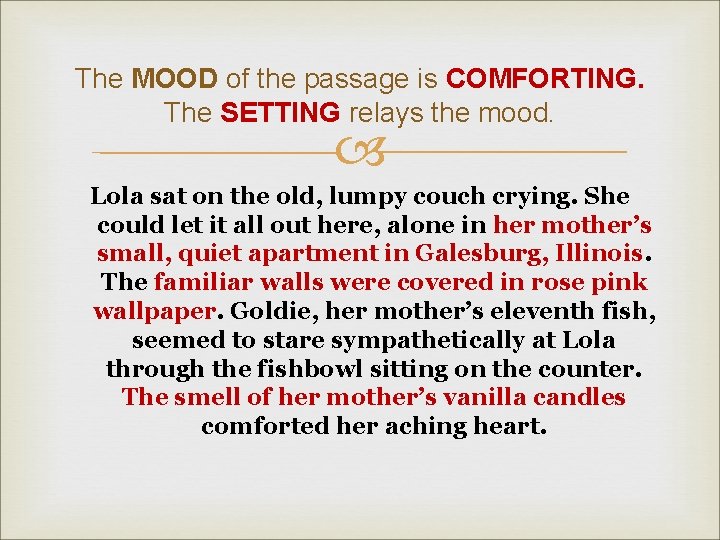
The MOOD of the passage is COMFORTING. The SETTING relays the mood. Lola sat on the old, lumpy couch crying. She could let it all out here, alone in her mother’s small, quiet apartment in Galesburg, Illinois. The familiar walls were covered in rose pink wallpaper. Goldie, her mother’s eleventh fish, seemed to stare sympathetically at Lola through the fishbowl sitting on the counter. The smell of her mother’s vanilla candles comforted her aching heart.
Figurative Language Literal = You mean exactly what you say. Figurative = To be figurative is to not mean what you say but imply something else. Figurative Language does not always mean exactly what is being said or read, but rather, authors use it to describe things in a more interesting way.
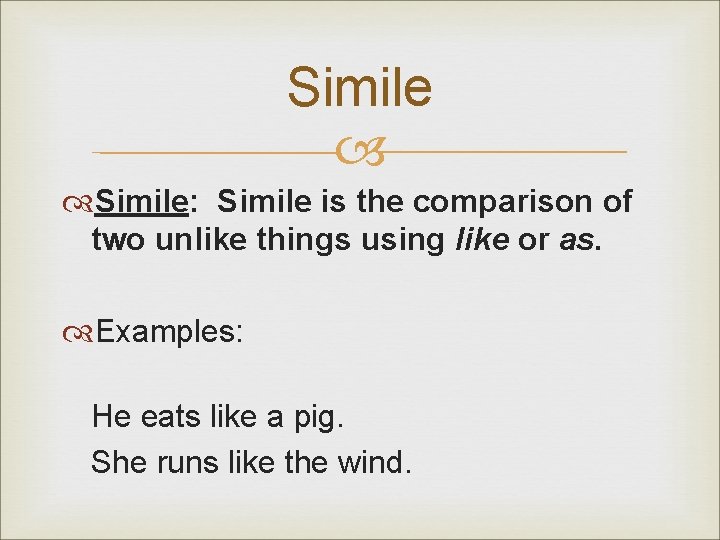
Simile Simile: Simile is the comparison of two unlike things using like or as. Examples: He eats like a pig. She runs like the wind.
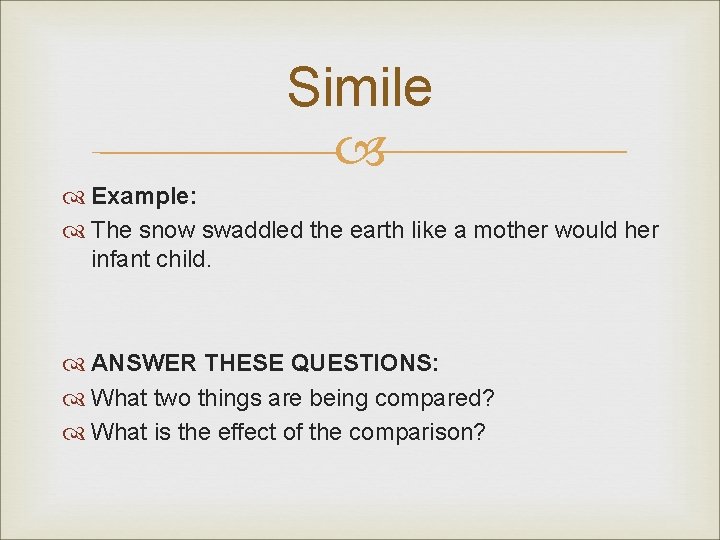
Simile Example: The snow swaddled the earth like a mother would her infant child. ANSWER THESE QUESTIONS: What two things are being compared? What is the effect of the comparison?
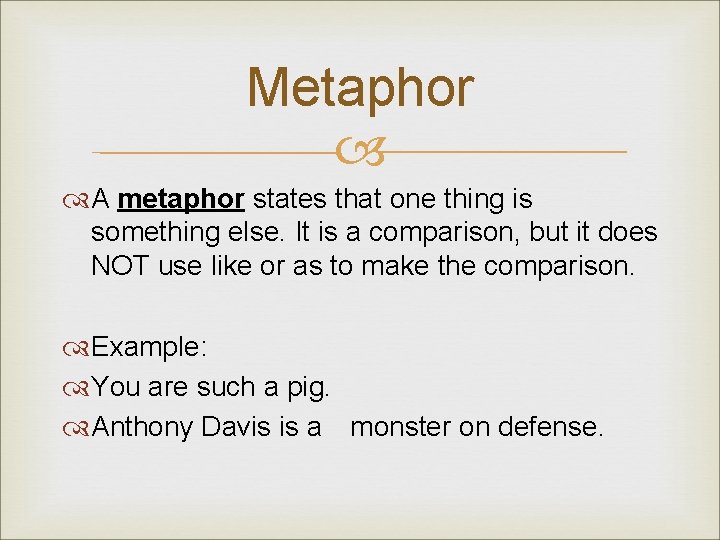
Metaphor A metaphor states that one thing is something else. It is a comparison, but it does NOT use like or as to make the comparison. Example: You are such a pig. Anthony Davis is a monster on defense.
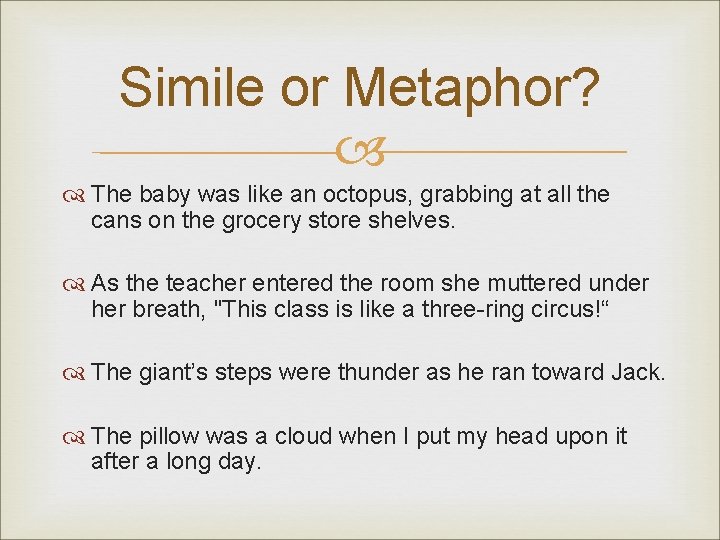
Simile or Metaphor? The baby was like an octopus, grabbing at all the cans on the grocery store shelves. As the teacher entered the room she muttered under her breath, "This class is like a three-ring circus!“ The giant’s steps were thunder as he ran toward Jack. The pillow was a cloud when I put my head upon it after a long day.
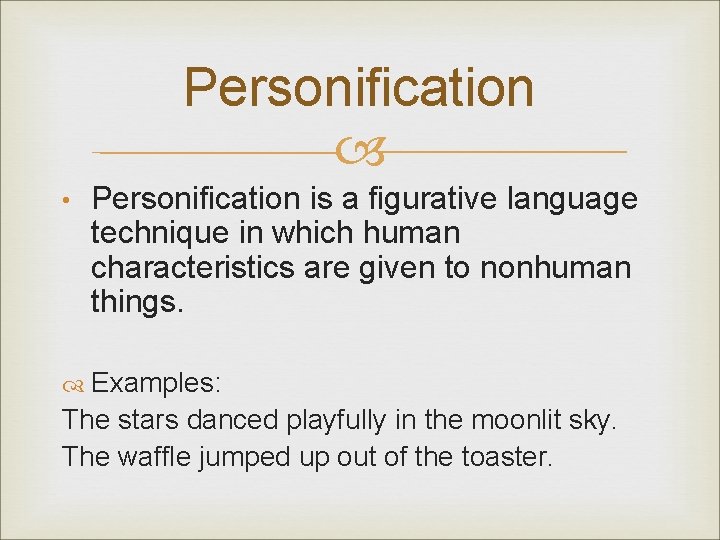
Personification • Personification is a figurative language technique in which human characteristics are given to nonhuman things. Examples: The stars danced playfully in the moonlit sky. The waffle jumped up out of the toaster.
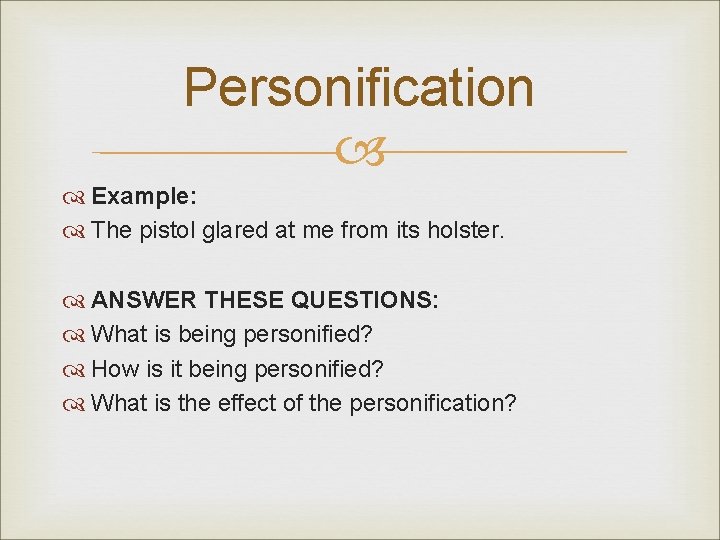
Personification Example: The pistol glared at me from its holster. ANSWER THESE QUESTIONS: What is being personified? How is it being personified? What is the effect of the personification?
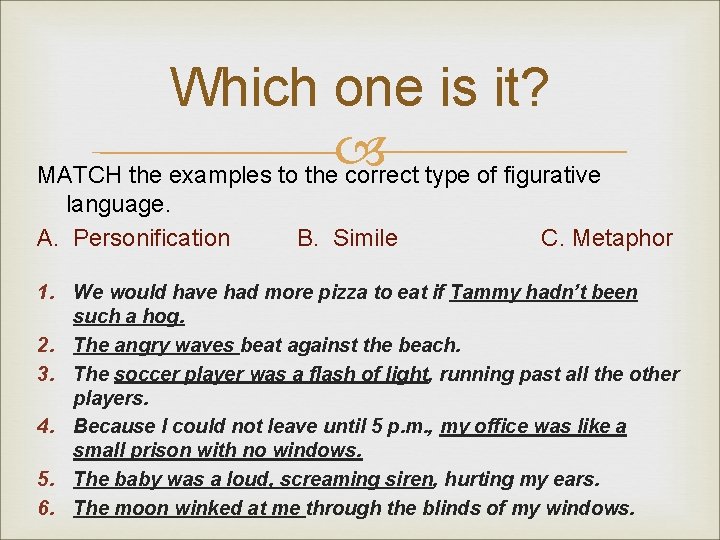
Which one is it? MATCH the examples to the correct type of figurative language. A. Personification B. Simile C. Metaphor 1. We would have had more pizza to eat if Tammy hadn’t been such a hog. 2. The angry waves beat against the beach. 3. The soccer player was a flash of light, running past all the other players. 4. Because I could not leave until 5 p. m. , my office was like a small prison with no windows. 5. The baby was a loud, screaming siren, hurting my ears. 6. The moon winked at me through the blinds of my windows.