
Tone and Purpose Copyright 2005 Pearson Education Inc
- Slides: 22
Tone and Purpose Copyright © 2005 Pearson Education, Inc. , publishing as Longman Publishers
Purpose and Tone • Purpose is the reason the author writes about a topic. – To inform, to persuade, to entertain • Tone is the author’s attitude toward the topic. – Objective tone, subjective tone Copyright © 2005 Pearson Education Inc. , publishing as Longman Publishers
Subjective and Objective Tone Words • Subjective: – Admiring, belligerent, disdainful, joyful, poetic, sincere, thoughtful, wry • Objective: – Accurate, factual, matter-of-fact, truthful Copyright © 2005 Pearson Education Inc. , publishing as Longman Publishers
Three Categories of Purpose • To inform the reader about a topic. – “A healthy diet includes several daily servings from each of the major food groups. ” Copyright © 2005 Pearson Education Inc. , publishing as Longman Publishers
Three Categories of Purpose • To persuade the reader to agree with his/her view on the topic. – “Required physical education classes should be a part of public school education from elementary through high school. ” Copyright © 2005 Pearson Education Inc. , publishing as Longman Publishers
Three Categories of Purpose • To entertain by amusing or interesting the reader. – “If clothes say much about a person, a woman risking life and limb to wear 6 -inchspike high heels to the office must be screaming something about herself. ” Copyright © 2005 Pearson Education Inc. , publishing as Longman Publishers
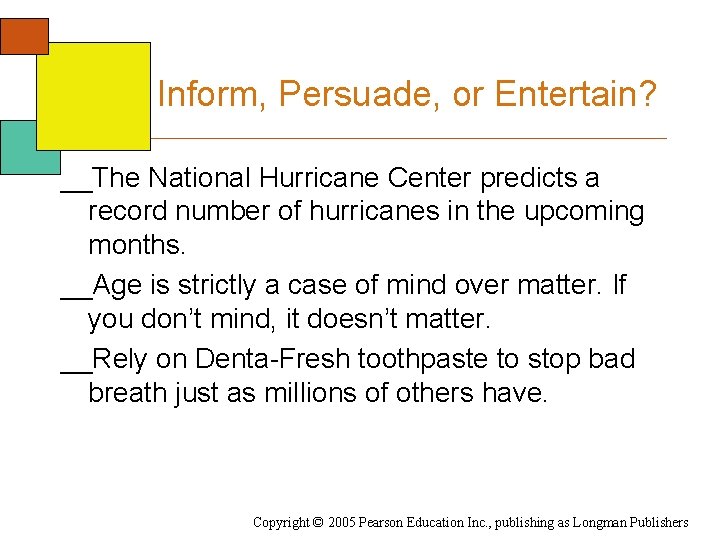
Inform, Persuade, or Entertain? __The National Hurricane Center predicts a record number of hurricanes in the upcoming months. __Age is strictly a case of mind over matter. If you don’t mind, it doesn’t matter. __Rely on Denta-Fresh toothpaste to stop bad breath just as millions of others have. Copyright © 2005 Pearson Education Inc. , publishing as Longman Publishers
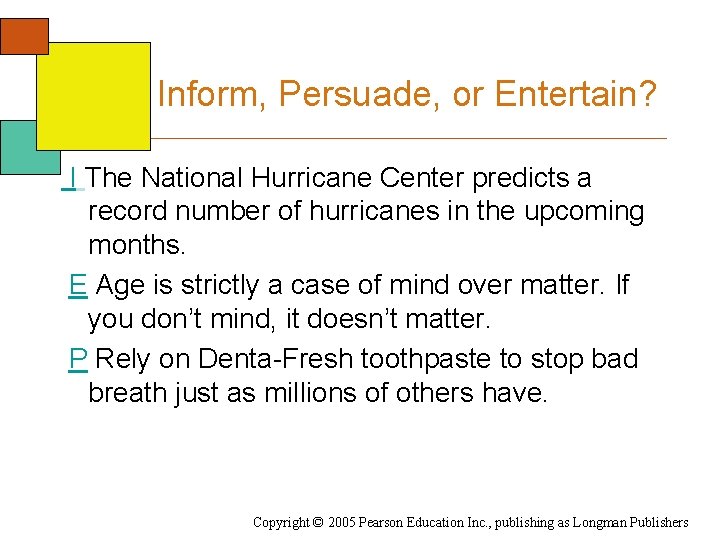
Inform, Persuade, or Entertain? I The National Hurricane Center predicts a record number of hurricanes in the upcoming months. E Age is strictly a case of mind over matter. If you don’t mind, it doesn’t matter. P Rely on Denta-Fresh toothpaste to stop bad breath just as millions of others have. Copyright © 2005 Pearson Education Inc. , publishing as Longman Publishers
Primary Purpose • Primary purpose is the author’s main reason for writing the passage. • Ask, “What is the author’s main idea? ” and that will reveal the primary purpose. Copyright © 2005 Pearson Education Inc. , publishing as Longman Publishers
What is the primary purpose? Think of long-term memory as a “data bank” for all of your feelings and ideas. Information you heard hours, days, weeks, even years ago is stored in long-term memory. Long term memory can handle large amounts of information; short-term memory has less space for storage. Putting information in and getting it out again is a slow process in longterm memory. On the other hand, short-term memory is a rapid process. Copyright © 2005 Pearson Education Inc. , publishing as Longman Publishers
What is the main purpose of the paragraph? To argue against poor memory skills. To amuse the reader with humorous details about long-term memory. To inform the reader about the differences between long-term and short-term memory. Copyright © 2005 Pearson Education Inc. , publishing as Longman Publishers
The main purpose of the paragraph is: To argue against poor memory skills. To amuse the reader with humorous details about long-term memory. To inform the reader about the differences between long-term and short-term memory. Copyright © 2005 Pearson Education Inc. , publishing as Longman Publishers
What is the tone? 1. “Mom, please, ” she said as she rolled her eyes, “I would rather do it myself. ” a. emotional b. neutral Copyright © 2005 Pearson Education Inc. , publishing as Longman Publishers
What is the tone? 1. “Mom, please, ” she said as she rolled her eyes, “I would rather do it myself. ” a. emotional b. neutral Copyright © 2005 Pearson Education Inc. , publishing as Longman Publishers
What is the tone? 2. “Mother, I would like to introduce you to my professor, Dr. Henry!” a. formal b. informal Copyright © 2005 Pearson Education Inc. , publishing as Longman Publishers
What is the tone? 2. “Mother, I would like to introduce you to my professor, Dr. Henry!” a. formal b. informal Copyright © 2005 Pearson Education Inc. , publishing as Longman Publishers
What is the tone? 3. “Mom, I’m having a terrible time; could you please, please come over? a. instructive b. emotional Copyright © 2005 Pearson Education Inc. , publishing as Longman Publishers
Choose the tone word: 3. “Mom, I’m having a terrible time; could you please, please come over? a. instructive b. emotional Copyright © 2005 Pearson Education Inc. , publishing as Longman Publishers
Choose the tone word: 4. “My mother’s name is Gerta Powell, and she was born in 1933. ” a. objective b. subjective Copyright © 2005 Pearson Education Inc. , publishing as Longman Publishers
Choose the tone word: 4. “My mother’s name is Gerta Powell, and she was born in 1933. ” a. objective b. subjective Copyright © 2005 Pearson Education Inc. , publishing as Longman Publishers
Irony • Verbal irony occurs when the author’s words state one thing but imply the opposite. • Example: Looking at the empty plate before the happy diner, the waiter says, “You didn’t like the meal. ” Copyright © 2005 Pearson Education Inc. , publishing as Longman Publishers
Irony • Situational irony occurs when the events of a situation differ from what is expected. • Example: A person afraid of water eventually becomes a certified scuba diver. Copyright © 2005 Pearson Education Inc. , publishing as Longman Publishers