
Tomasz Potaczek MD Daniel Zarzycki MD Ph D
- Slides: 15
Tomasz Potaczek, MD Daniel Zarzycki, MD, Ph. D Natural history and results of surgical treatment of spine deformities in patients with spinal muscular atrophy type 2 and type 3 a Department of Orthopedic Surgery and Rehabilitation, Jagiellonian University, Zakopane, Poland 1
Introduction F Spinal muscular atrophy (SMA); diseases that manifests in progressive muscle weakness and flaccid paresis F Pathogenesis - Degeneration of anterior motor cells of the spinal cord F Incidence - 1/6 -10 k births F Genetics - autosomal recessive, gene SMN 1 (survival of motor neuron) location, long arm of the 5 th chromosome (5 q 11. 2 -13. 3), incidence of carriers: 1/35 -50 births F Types of SMA 1, 2: – SMA 1 (Werdnig – Hoffman disease, acute) – SMA 2 (Sub-acute, non-ambulatory) – SMA 3 (SMA 3 a, start to walk independently, but loose this ability < 3 y. o age; type SMA 3 b, Kugelberg-Welander disease) 2
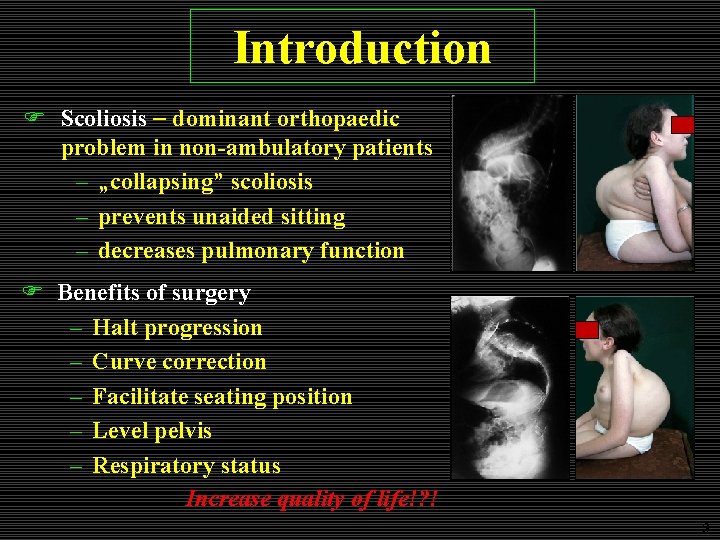
Introduction F Scoliosis dominant orthopaedic problem in non-ambulatory patients – „collapsing” scoliosis – prevents unaided sitting – decreases pulmonary function F Benefits of surgery – Halt progression – Curve correction – Facilitate seating position – Level pelvis – Respiratory status Increase quality of life!? ! 3
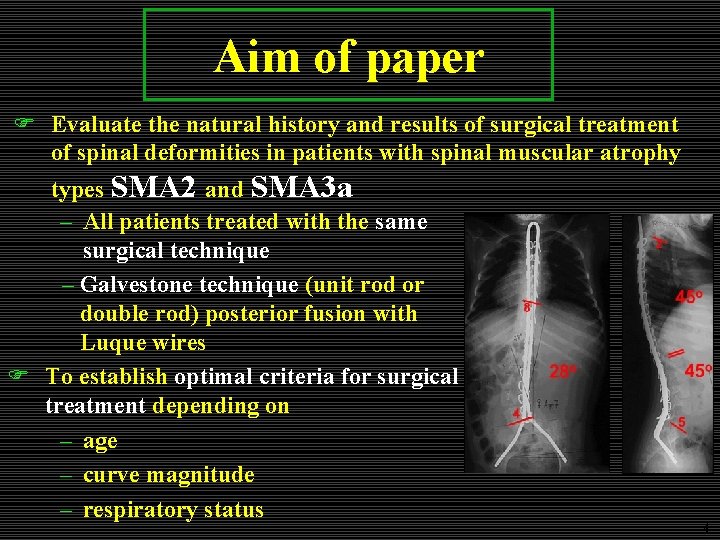
Aim of paper F Evaluate the natural history and results of surgical treatment of spinal deformities in patients with spinal muscular atrophy types SMA 2 and SMA 3 a – All patients treated with the same surgical technique – Galvestone technique (unit rod or double rod) posterior fusion with Luque wires F To establish optimal criteria for surgical treatment depending on – age – curve magnitude – respiratory status 4
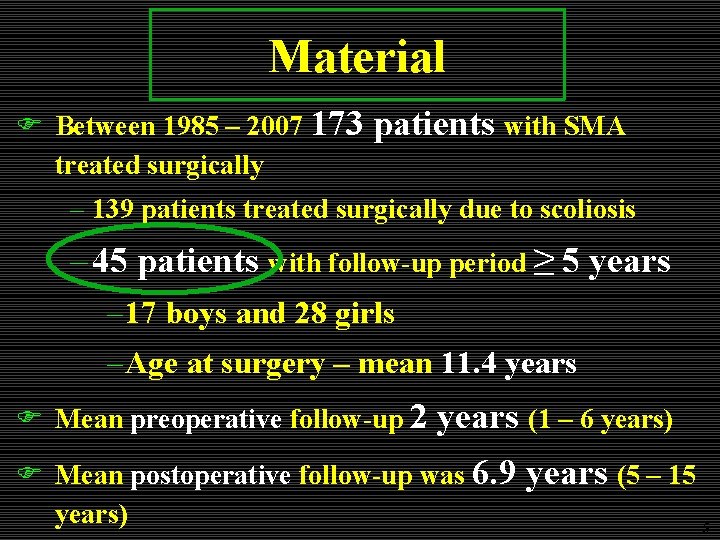
Material F Between 1985 – 2007 173 treated surgically patients with SMA – 139 patients treated surgically due to scoliosis – 45 patients with follow-up period ≥ 5 years – 17 boys and 28 girls – Age at surgery – mean 11. 4 years F Mean preoperative follow-up 2 years (1 – 6 years) F Mean postoperative follow-up was 6. 9 years) years (5 – 15 5
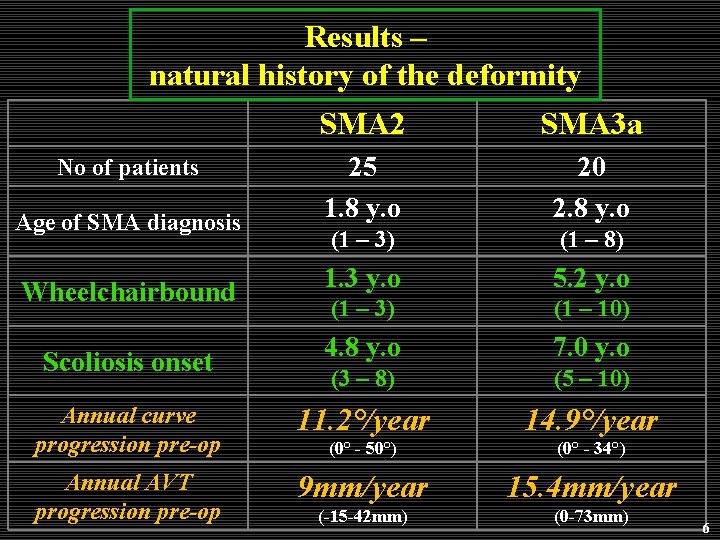
Results – natural history of the deformity SMA 2 SMA 3 a 25 1. 8 y. o 20 2. 8 y. o (1 – 3) (1 – 8) 1. 3 y. o 5. 2 y. o (1 – 3) (1 – 10) 4. 8 y. o 7. 0 y. o (3 – 8) (5 – 10) Annual curve progression pre-op 11. 2°/year 14. 9°/year (0° - 50°) (0° - 34°) Annual AVT progression pre-op 9 mm/year 15. 4 mm/year (-15 -42 mm) (0 -73 mm) No of patients Age of SMA diagnosis Wheelchairbound Scoliosis onset 6
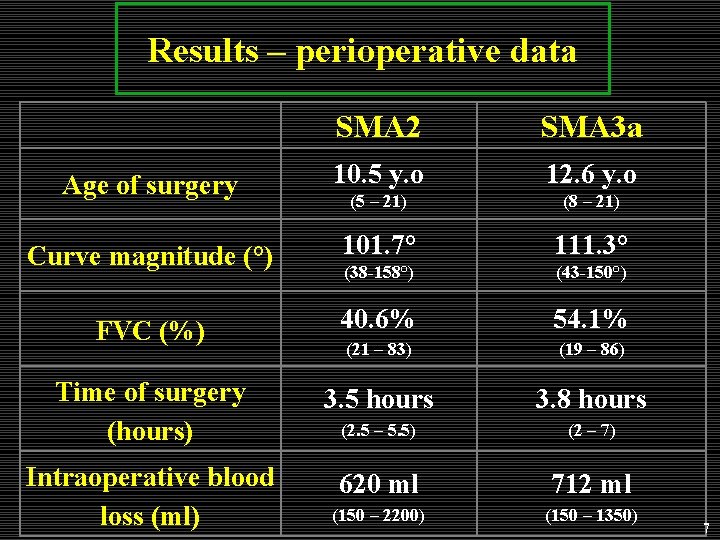
Results – perioperative data SMA 2 SMA 3 a Age of surgery 10. 5 y. o 12. 6 y. o (5 – 21) (8 – 21) Curve magnitude (°) 101. 7° 111. 3° (38 -158°) (43 -150°) FVC (%) 40. 6% 54. 1% (21 – 83) (19 – 86) Time of surgery (hours) 3. 5 hours 3. 8 hours (2. 5 – 5. 5) (2 – 7) Intraoperative blood loss (ml) 620 ml 712 ml (150 – 2200) (150 – 1350) 7
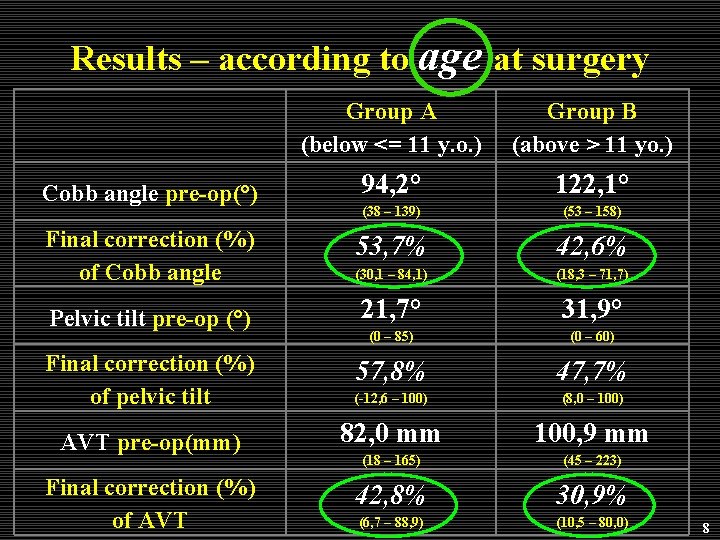
Results – according to age at surgery Group A (below <= 11 y. o. ) Group B (above > 11 yo. ) Cobb angle pre-op(°) 94, 2° 122, 1° (38 – 139) (53 – 158) Final correction (%) of Cobb angle 53, 7% 42, 6% (30, 1 – 84, 1) (18, 3 – 71, 7) Pelvic tilt pre-op (°) 21, 7° 31, 9° (0 – 85) (0 – 60) Final correction (%) of pelvic tilt 57, 8% 47, 7% (-12, 6 – 100) (8, 0 – 100) AVT pre-op(mm) 82, 0 mm 100, 9 mm (18 – 165) (45 – 223) Final correction (%) of AVT 42, 8% 30, 9% (6, 7 – 88, 9) (10, 5 – 80, 0) 8
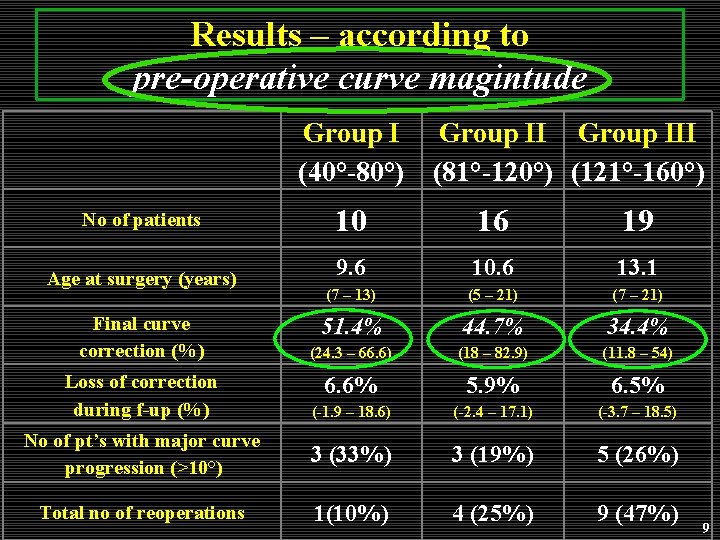
Results – according to pre-operative curve magintude Group I (40°-80°) Group III (81°-120°) (121°-160°) No of patients 10 16 19 Age at surgery (years) 9. 6 10. 6 13. 1 (7 – 13) (5 – 21) (7 – 21) 51. 4% 44. 7% 34. 4% (24. 3 – 66. 6) (18 – 82. 9) (11. 8 – 54) 6. 6% 5. 9% 6. 5% (-1. 9 – 18. 6) (-2. 4 – 17. 1) (-3. 7 – 18. 5) No of pt’s with major curve progression (>10°) 3 (33%) 3 (19%) 5 (26%) Total no of reoperations 1(10%) 4 (25%) 9 (47%) Final curve correction (%) Loss of correction during f-up (%) 9
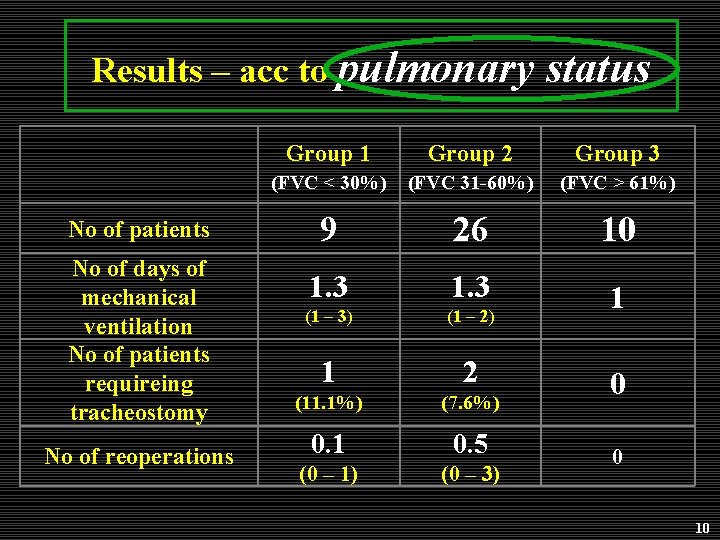
Results – acc to pulmonary No of patients No of days of mechanical ventilation No of patients requireing tracheostomy No of reoperations status Group 1 Group 2 Group 3 (FVC < 30%) (FVC 31 -60%) (FVC > 61%) 9 26 10 1. 3 (1 – 3) (1 – 2) 1 1 2 (11. 1%) (7. 6%) 0. 1 0. 5 (0 – 1) (0 – 3) 0 0 10
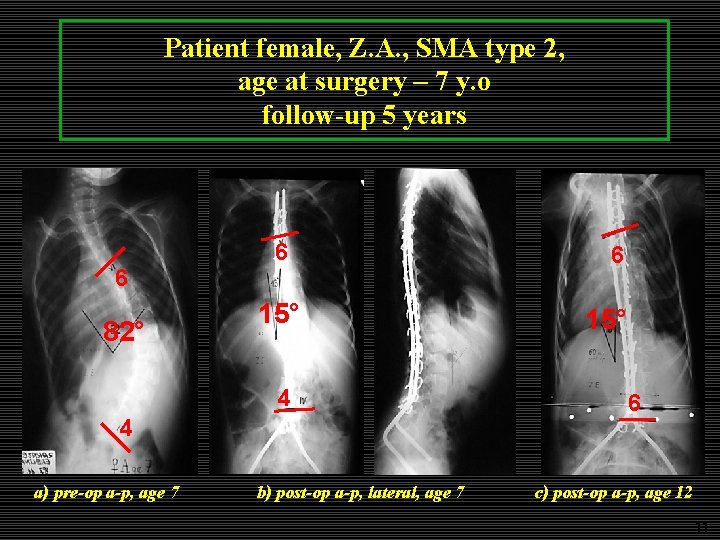
Patient female, Z. A. , SMA type 2, age at surgery – 7 y. o follow-up 5 years 6 82° 6 15° 4 4 a) pre-op a-p, age 7 b) post-op a-p, lateral, age 7 6 15° 6 c) post-op a-p, age 12 11
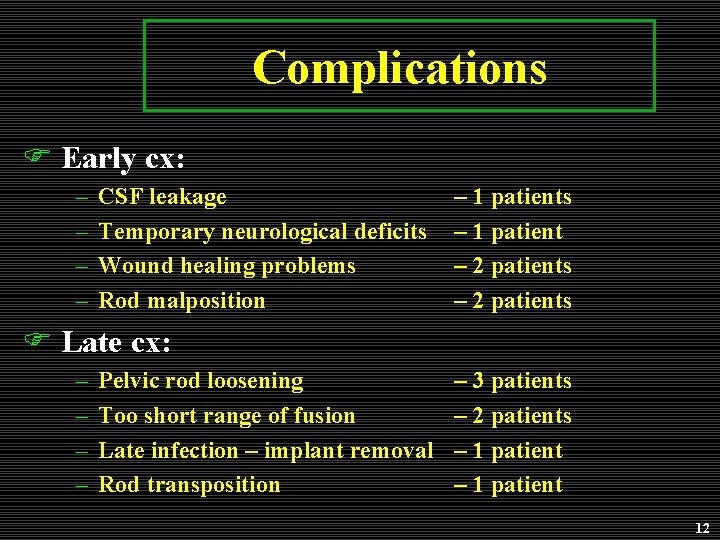
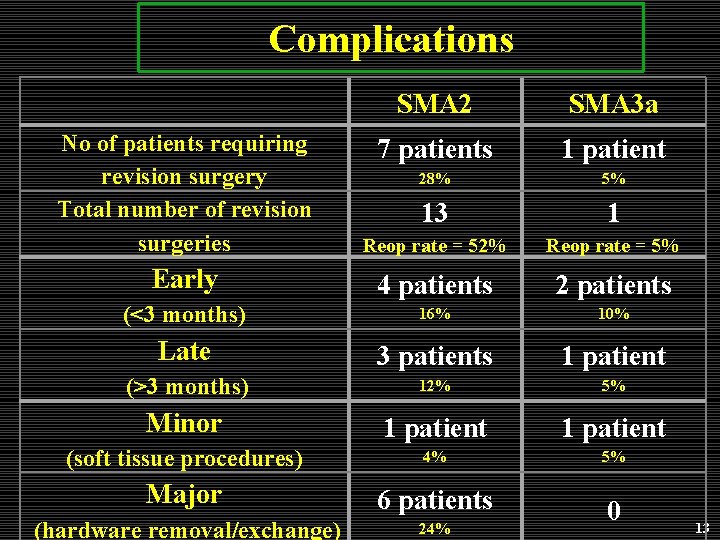
Complications F Early cx: – – CSF leakage Temporary neurological deficits Wound healing problems Rod malposition – 1 patients – 1 patient – 2 patients F Late cx: – – Pelvic rod loosening Too short range of fusion Late infection – implant removal Rod transposition – 3 patients – 2 patients – 1 patient 12
Complications SMA 2 SMA 3 a 7 patients 1 patient 28% 5% No of patients requiring revision surgery Total number of revision surgeries 13 1 Reop rate = 52% Reop rate = 5% Early 4 patients 2 patients (<3 months) 16% 10% Late 3 patients 1 patient (>3 months) 12% 5% Minor 1 patient (soft tissue procedures) 4% 5% Major 6 patients (hardware removal/exchange) 24% 0 13
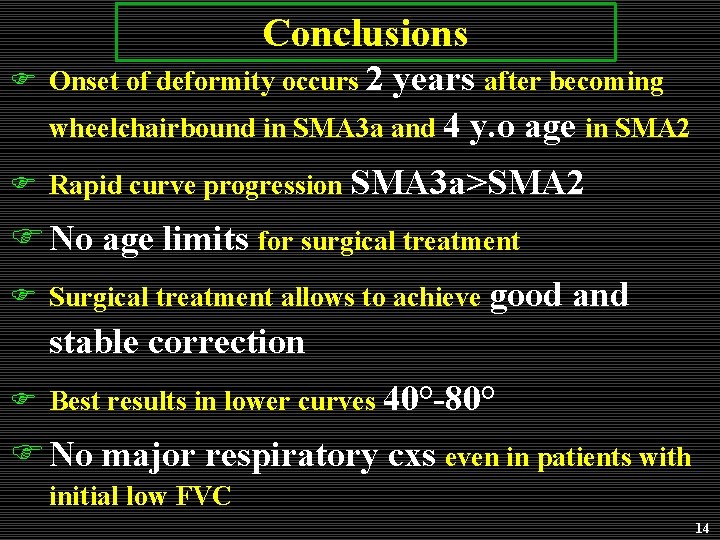
Conclusions F Onset of deformity occurs 2 years after becoming wheelchairbound in SMA 3 a and 4 y. o age in SMA 2 F Rapid curve progression SMA 3 a>SMA 2 F No age limits for surgical treatment F Surgical treatment allows to achieve good and stable correction F Best results in lower curves 40°-80° F No major respiratory cxs even in patients with initial low FVC 14
Referneces 1. 2. 3. 4. 5. 6. 7. 8. 9. 10. 11. Evans GA, Drennan JC, Russman BS. Functional classification and orthopaedic management of spinal muscular atrophy. J Bone Joint Surg Br. 1981; 63 B(4): 516 -522. Zerres K. , Rudnik-Schöneborn S. : Natural history in proximal spinal muscular atrophy. Clinical analysis of 445 patients and suggestions for a modification of existing classifications. Arch Neurol. 1995; 52(5): 51823 Shapiro F, Bresnan MJ. Orthopaedic management of childhood neuromuscular disease, 1: spinal muscle atrophy. J Bone Joint Surg Am. 1982; 64: 785 -789. Phillips DP, Roye DP Jr, Farcy JP, Leet A, Shelton YA. Surgical treatment of scoliosis in a spinal muscular atrophy population. Spine. 1990; 15(9): 942 -945. Merlini L, Granata C, Bonfiglioli S, Marini ML, Cervellati S, Savini R. Scoliosis in spinal muscular atrophy: natural history and management. Dev Med Child Neurol. 1989; 31(4): 501 -8. Aprin H, Bowen JR, Mac. Ewan GD, et al. Spine fusion in patients with spinal muscle atrophy. Spine. 1982; 7: 276 -284. Brown JC, Zeller JL, Swank SM, Furumasu J, Warath SL. Surgical and functional results of spine fusion in spinal muscular atrophy. Spine. 1989; 14(7): 763 -70. Linson M, Bresnan M, Eraklis A, Shapiro F. Acute gastric volvulus following Harrington rod instrumentation in a patient with Werdnig-Hoffman disease. Spine. 1981; 6(5): 522 -523. Boachie-Adjei O, Lonstein JE, Winter RB, et al. Management of neuromuscular spinal deformities with Luque segmental instrumentation. J Bone Joint Surg Am. 1989; 71: 548 -562. Zebala LP, Bridwell KH, Baldur C, Richards B, Dormans JP, Lenke LG et al. Minimum 5 -year Radiographic Results of Long Scoliosis Fusion in Juvenile Spinal Muscular Atrophy Patients: Major Curve Progression After Instrumented Fusion. J Pediatr Orthop 2011; 31: 480– 488 Chng SY, Wong YQ, Hiu JH, et al. Pulmonary function and scoliosis in children with spinal muscular atrophy types II and III. J Paediatr Child Health. 2003; 39: 673 -676. 15