
Tolerances Introduction to Engineering Design 2012 Project Lead

- Slides: 26
Tolerances Introduction to Engineering Design © 2012 Project Lead The Way, Inc.
Tolerances • Variation is unavoidable • No two manufactured parts are identical – some degree of variation will exist • Tolerances are used in production drawings to control the manufacturing process and control the variation between copies of the same part • In particular, tolerances are applied to mating parts in an assembly – One advantage in using tolerances is that interchangeable parts can be used
Tolerances • Large tolerance may affect functionality of part – Specify tolerances to ensure proper function • Small tolerance will affect the cost of the part – Cost generally increases with smaller tolerances – Will require precise manufacturing – Will require quality control with inspection and rejection of parts • Do not specify a tolerance that is smaller than necessary!
Tolerances ANSI/ASME Standard Y 14. 5 Each dimension shall have a tolerance, except those dimensions specifically identified as reference, maximum, minimum, or stock. The tolerance may be applied directly to the dimension or indicated by a general note located in the title block of the drawing.
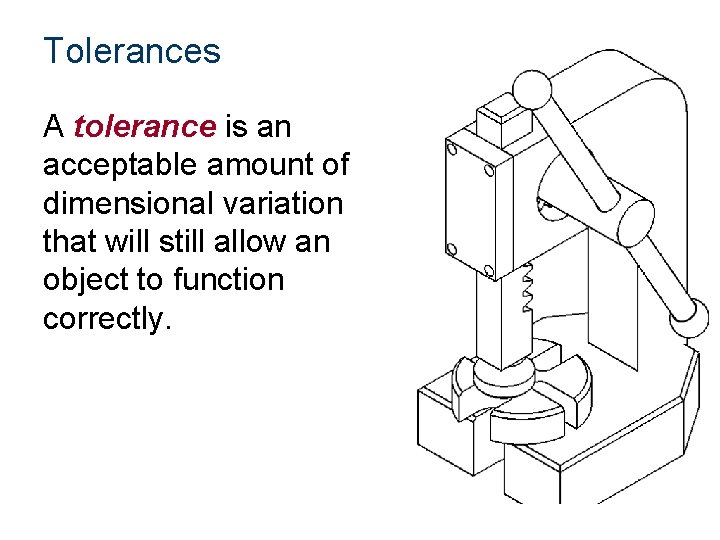
Tolerances A tolerance is an acceptable amount of dimensional variation that will still allow an object to function correctly.
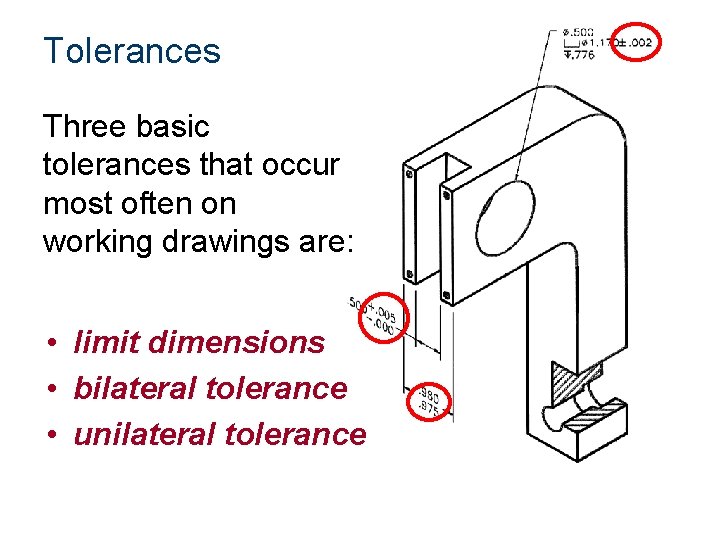
Tolerances Three basic tolerances that occur most often on working drawings are: • limit dimensions • bilateral tolerance • unilateral tolerance
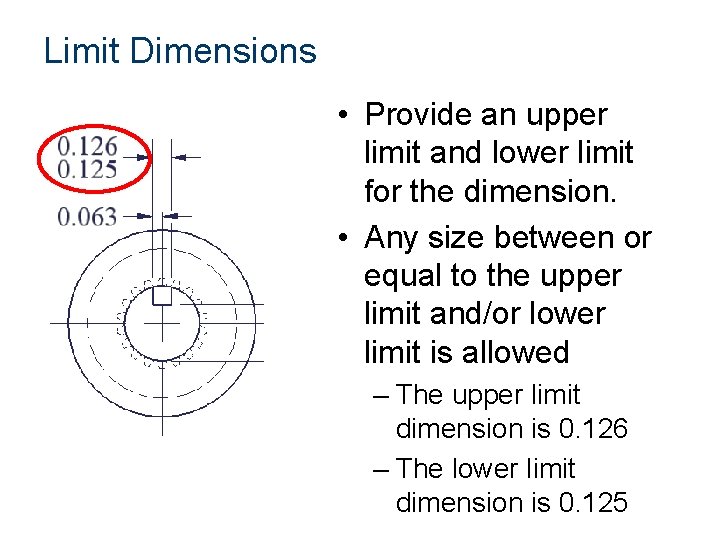
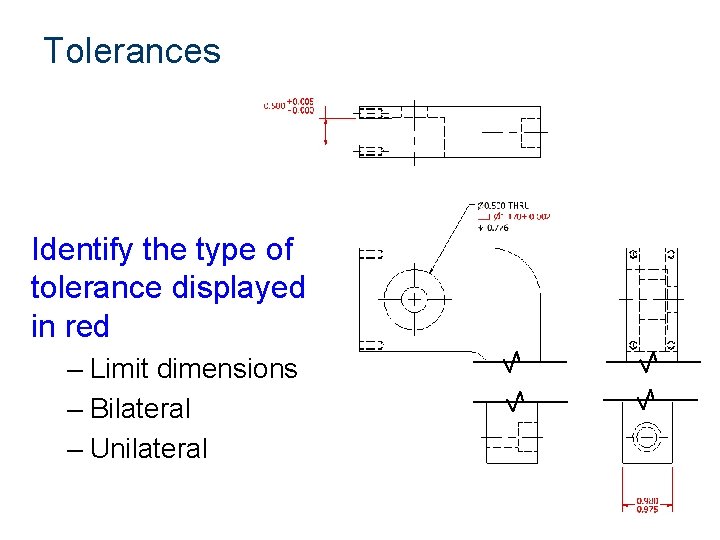
Limit Dimensions • Provide an upper limit and lower limit for the dimension. • Any size between or equal to the upper limit and/or lower limit is allowed – The upper limit dimension is 0. 126 – The lower limit dimension is 0. 125
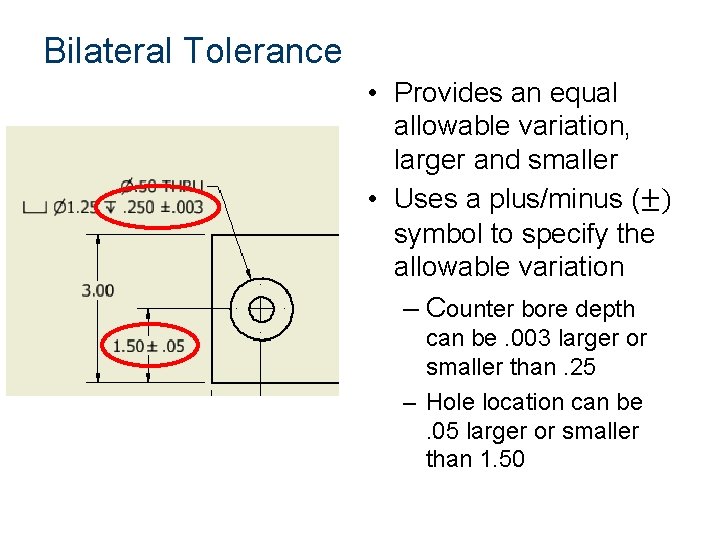
Bilateral Tolerance • Provides an equal allowable variation, larger and smaller • Uses a plus/minus (±) symbol to specify the allowable variation – Counter bore depth can be. 003 larger or smaller than. 25 – Hole location can be. 05 larger or smaller than 1. 50
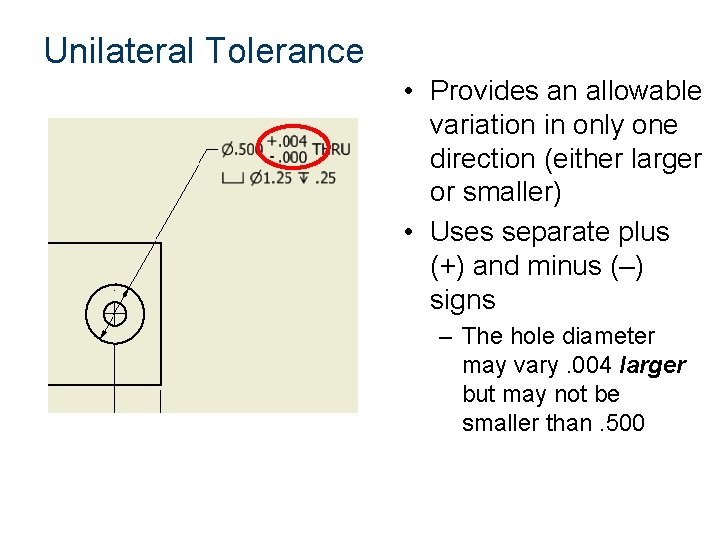
Unilateral Tolerance • Provides an allowable variation in only one direction (either larger or smaller) • Uses separate plus (+) and minus (–) signs – The hole diameter may vary. 004 larger but may not be smaller than. 500
Tolerances Identify the type of tolerance displayed in red – Limit dimensions – Bilateral – Unilateral
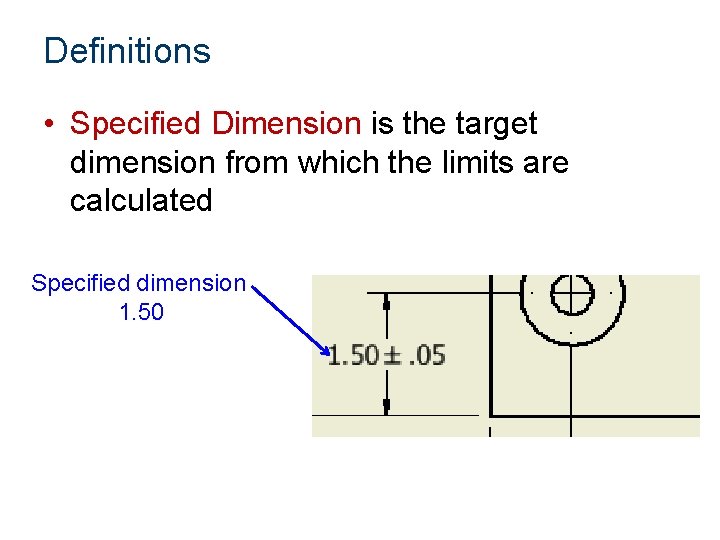
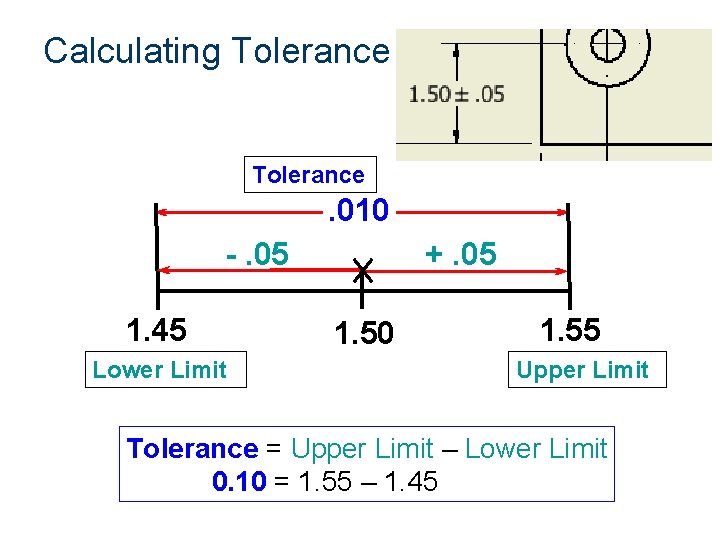
Definitions • Specified Dimension is the target dimension from which the limits are calculated Specified dimension 1. 50
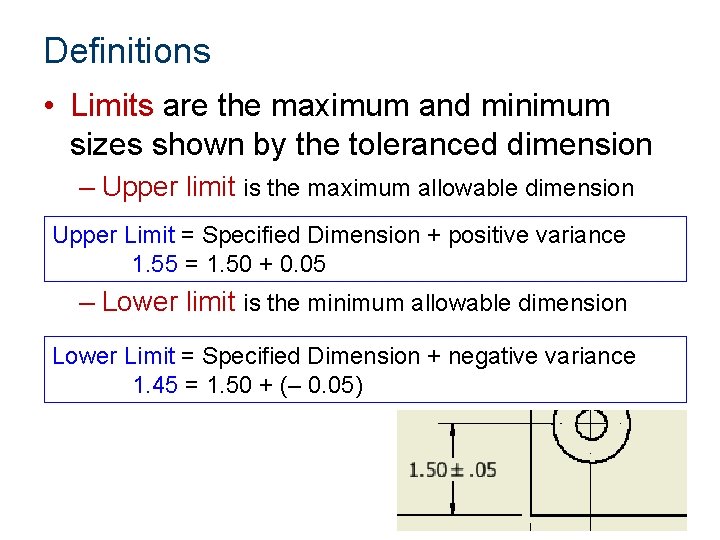
Definitions • Limits are the maximum and minimum sizes shown by the toleranced dimension – Upper limit is the maximum allowable dimension Upper Limit = Specified Dimension + positive variance 1. 55 = 1. 50 + 0. 05 – Lower limit is the minimum allowable dimension Lower Limit = Specified Dimension + negative variance 1. 45 = 1. 50 + (– 0. 05)
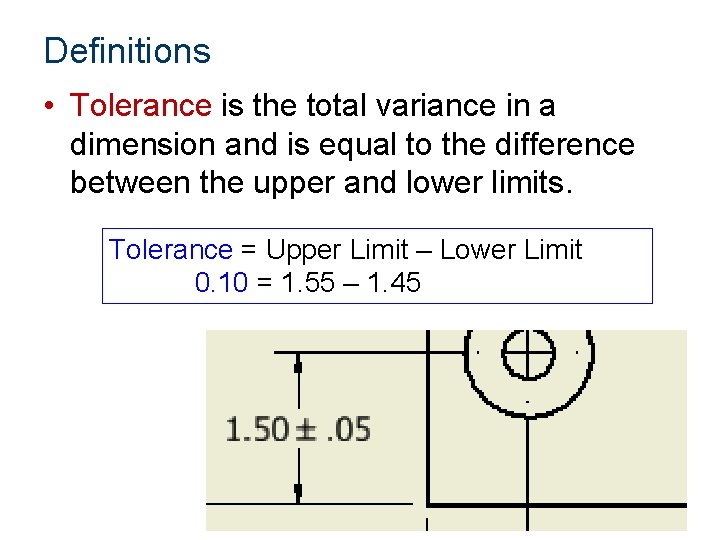
Definitions • Tolerance is the total variance in a dimension and is equal to the difference between the upper and lower limits. Tolerance = Upper Limit – Lower Limit 0. 10 = 1. 55 – 1. 45
Calculating Tolerance . 010 -. 05 1. 45 Lower Limit +. 05 1. 50 1. 55 Upper Limit Tolerance = Upper Limit – Lower Limit 0. 10 = 1. 55 – 1. 45
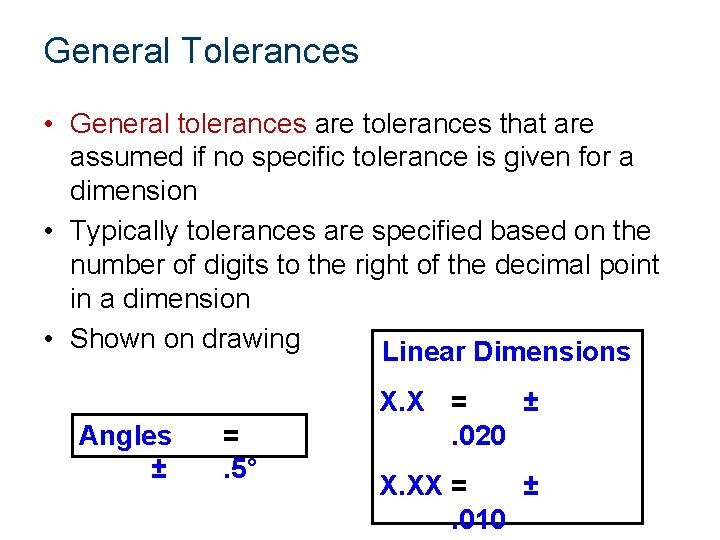
General Tolerances • General tolerances are tolerances that are assumed if no specific tolerance is given for a dimension • Typically tolerances are specified based on the number of digits to the right of the decimal point in a dimension • Shown on drawing Linear Dimensions Angles ± =. 5° X. X = ±. 020 X. XX = ±. 010
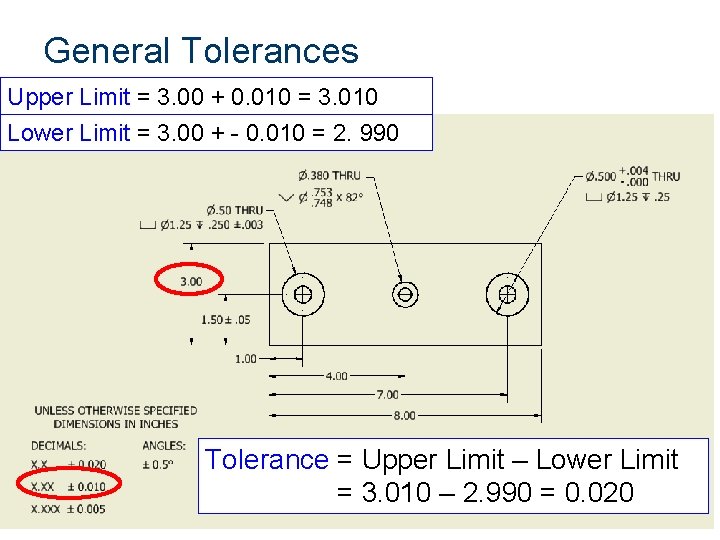
General Tolerances Upper Limit = 3. 00 + 0. 010 = 3. 010 Lower Limit = 3. 00 + - 0. 010 = 2. 990 Tolerance = Upper Limit – Lower Limit = 3. 010 – 2. 990 = 0. 020
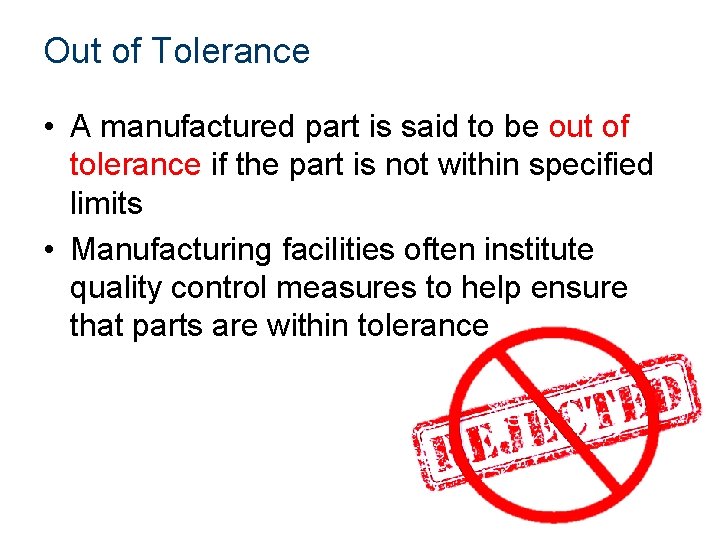
Out of Tolerance • A manufactured part is said to be out of tolerance if the part is not within specified limits • Manufacturing facilities often institute quality control measures to help ensure that parts are within tolerance
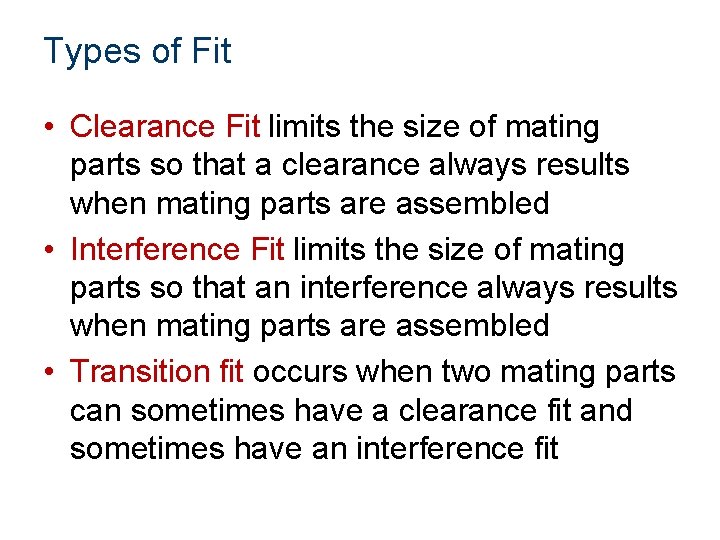
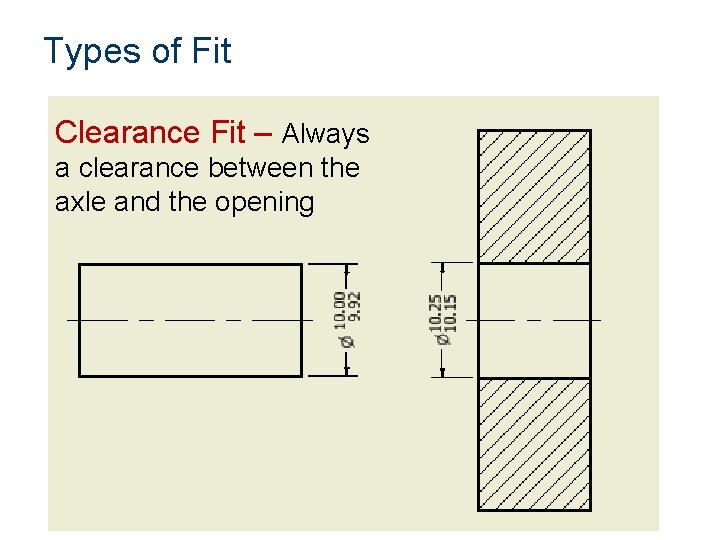
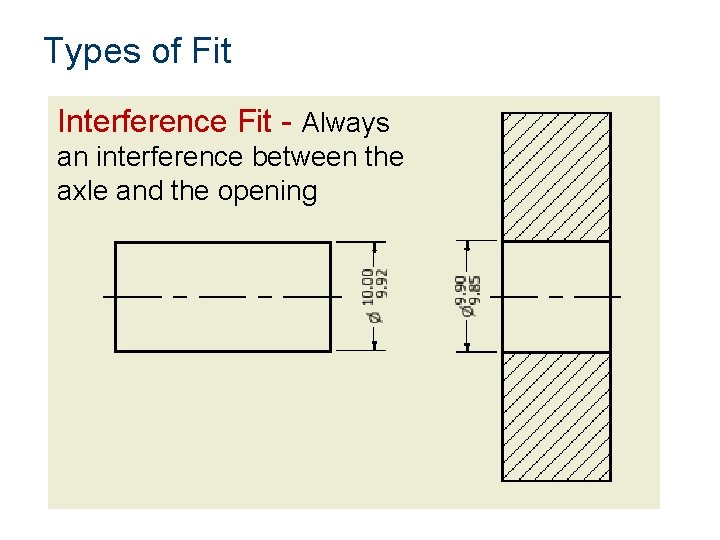
Types of Fit • Clearance Fit limits the size of mating parts so that a clearance always results when mating parts are assembled • Interference Fit limits the size of mating parts so that an interference always results when mating parts are assembled • Transition fit occurs when two mating parts can sometimes have a clearance fit and sometimes have an interference fit
Types of Fit Clearance Fit – Always a clearance between the axle and the opening
Types of Fit Interference Fit - Always an interference between the axle and the opening
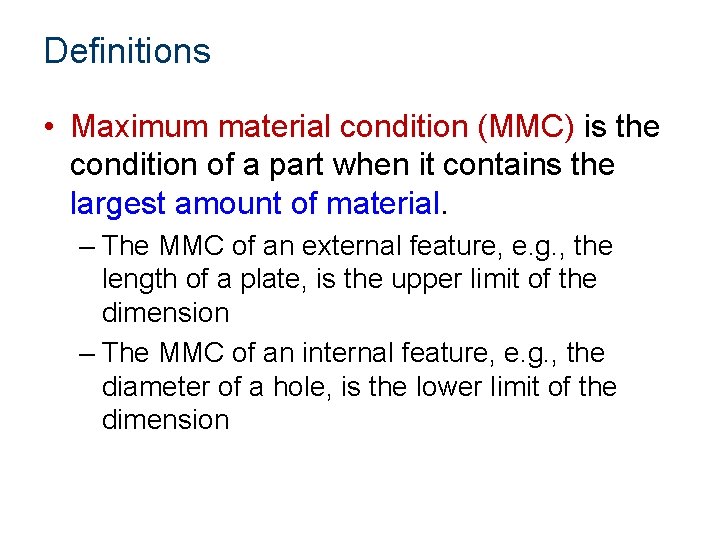
Definitions • Maximum material condition (MMC) is the condition of a part when it contains the largest amount of material. – The MMC of an external feature, e. g. , the length of a plate, is the upper limit of the dimension – The MMC of an internal feature, e. g. , the diameter of a hole, is the lower limit of the dimension
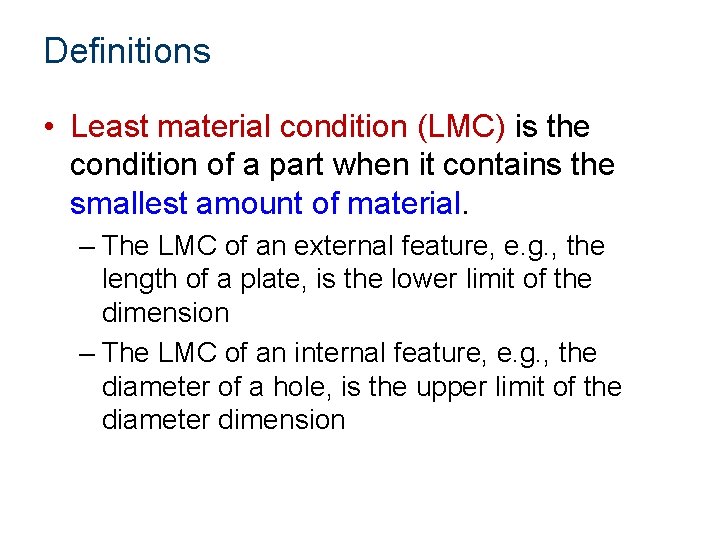
Definitions • Least material condition (LMC) is the condition of a part when it contains the smallest amount of material. – The LMC of an external feature, e. g. , the length of a plate, is the lower limit of the dimension – The LMC of an internal feature, e. g. , the diameter of a hole, is the upper limit of the diameter dimension
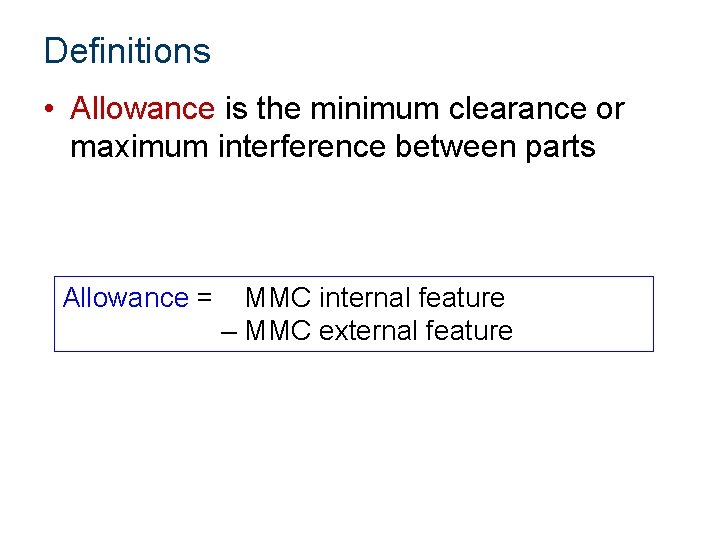
Definitions • Allowance is the minimum clearance or maximum interference between parts Allowance = MMC internal feature – MMC external feature
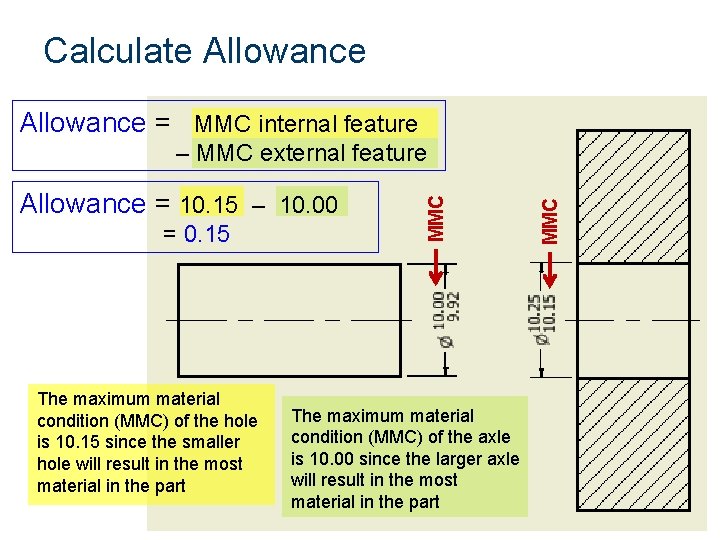
Calculate Allowance = MMC internal feature = 0. 15 The maximum material condition (MMC) of the hole is 10. 15 since the smaller hole will result in the most material in the part The maximum material condition (MMC) of the axle is 10. 00 since the larger axle will result in the most material in the part MMC Allowance = 10. 15 – 10. 00 MMC – MMC external feature
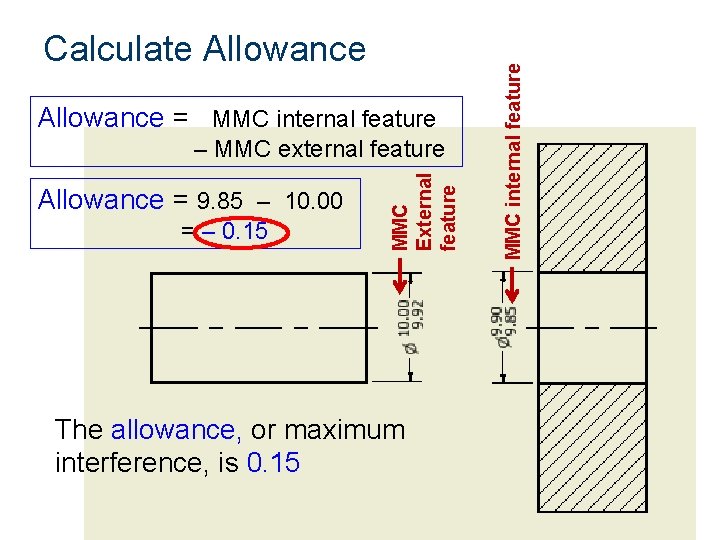
Allowance = MMC internal feature Allowance = 9. 85 – 10. 00 = – 0. 15 MMC External feature – MMC external feature The allowance, or maximum interference, is 0. 15 MMC internal feature Calculate Allowance
A Note About Dimension Tolerance • In general, the more significant figures in the dimension, the tighter the tolerance • Overly precise dimensions and overly tight tolerances increase manufacturing costs • Specify dimensions only to the precision and tolerance necessary for the part to function properly