
Tokyo Institute of Technology Simulationbased Technology and Nuclear
Tokyo Institute of Technology Simulation-based Technology and Nuclear Reactor Thermohydraulics and Safety - Current states of the arts and future perspective - Korea Advanced Institute of Science and Technology February 26, 2008 Tokyo Tech Nuclear Engineering IRIS Consortium Hisashi Ninokata

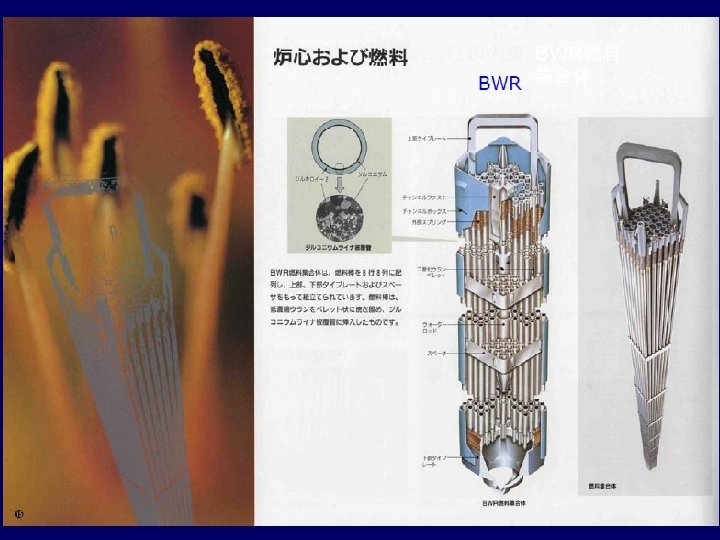
Tokyo Institute of Technology Nuclear Engineering Department From Lecture Note on Nuclear Rx Design Course Nuclear Engineering Department, Tokyo Tech Korea Advanced Institute of Science and Technology February 26, 2008
Tokyo Institute of Technology Nuclear Engineering Department Korea Advanced Institute of Science and Technology February 26, 2008
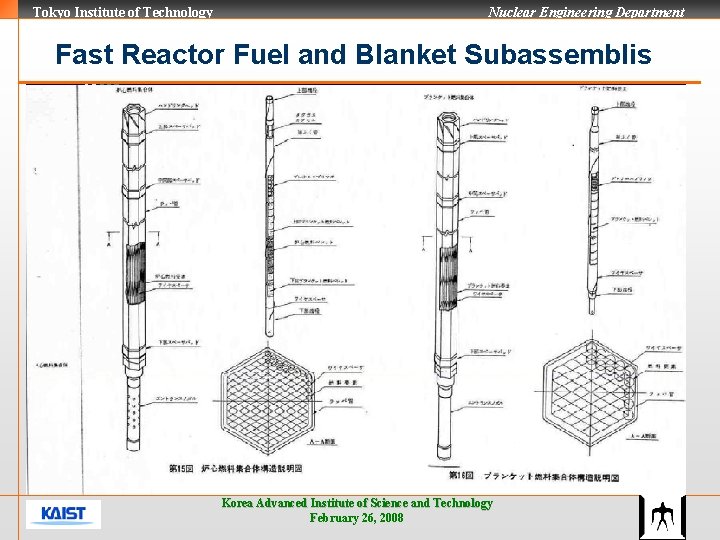
Tokyo Institute of Technology Nuclear Engineering Department Fast Reactor Fuel and Blanket Subassemblis Korea Advanced Institute of Science and Technology February 26, 2008
Tokyo Institute of Technology I. Introduction Simulation-Based Design and Engineering
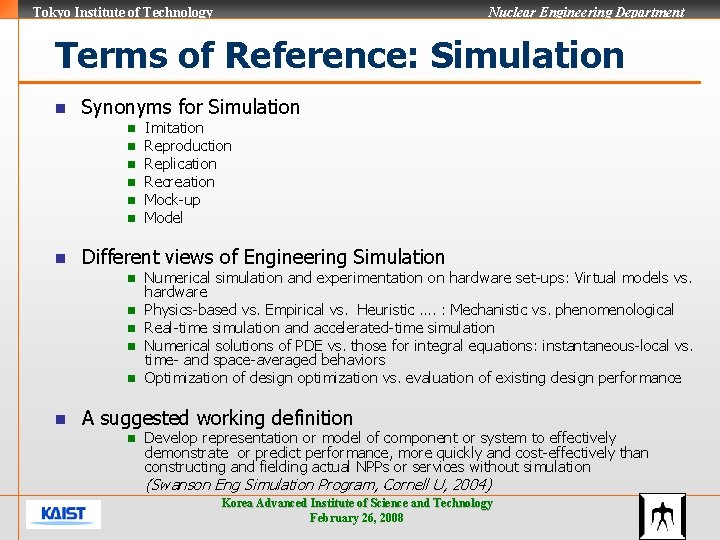
Tokyo Institute of Technology Nuclear Engineering Department Terms of Reference: Simulation n Synonyms for Simulation n n n Different views of Engineering Simulation n n n Imitation Reproduction Replication Recreation Mock-up Model Numerical simulation and experimentation on hardware set-ups: Virtual models vs. hardware Physics-based vs. Empirical vs. Heuristic …. : Mechanistic vs. phenomenological Real-time simulation and accelerated-time simulation Numerical solutions of PDE vs. those for integral equations: instantaneous-local vs. time- and space-averaged behaviors Optimization of design optimization vs. evaluation of existing design performance A suggested working definition n Develop representation or model of component or system to effectively demonstrate or predict performance, more quickly and cost-effectively than constructing and fielding actual NPPs or services without simulation (Swanson Eng Simulation Program, Cornell U, 2004) Korea Advanced Institute of Science and Technology February 26, 2008
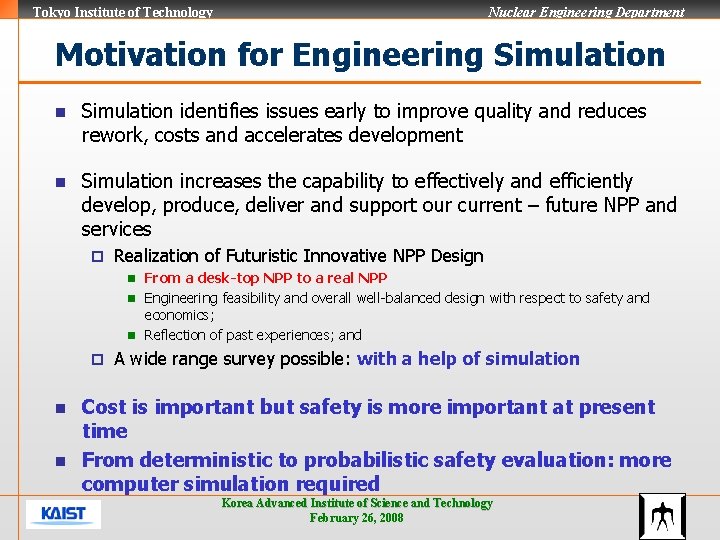
Tokyo Institute of Technology Nuclear Engineering Department Motivation for Engineering Simulation n Simulation identifies issues early to improve quality and reduces rework, costs and accelerates development n Simulation increases the capability to effectively and efficiently develop, produce, deliver and support our current – future NPP and services p Realization of Futuristic Innovative NPP Design n From a desk-top NPP to a real NPP n Engineering feasibility and overall well-balanced design with respect to safety and economics; n Reflection of past experiences; and p A wide range survey possible: with a help of simulation Cost is important but safety is more important at present time n From deterministic to probabilistic safety evaluation: more computer simulation required n Korea Advanced Institute of Science and Technology February 26, 2008
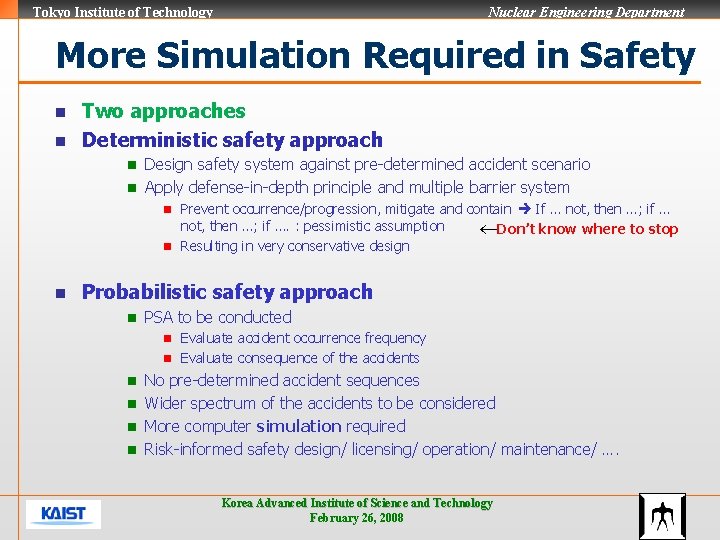
Tokyo Institute of Technology Nuclear Engineering Department More Simulation Required in Safety Two approaches n Deterministic safety approach n Design safety system against pre-determined accident scenario n Apply defense-in-depth principle and multiple barrier system n n Prevent occurrence/progression, mitigate and contain If … not, then …; if …. : pessimistic assumption n Resulting in very conservative design n Don’t know where to stop Probabilistic safety approach n PSA to be conducted n Evaluate accident occurrence frequency n Evaluate consequence of the accidents No pre-determined accident sequences n Wider spectrum of the accidents to be considered n More computer simulation required n Risk-informed safety design/ licensing/ operation/ maintenance/ …. n Korea Advanced Institute of Science and Technology February 26, 2008

Tokyo Institute of Technology Nuclear Engineering Department Nuclear Engineering and Simulation Nuclear --- power (energy) production / radiation technology (materials and medicine, biology) n Nuclear reactor engineering --- nuclear fuels, core, plant, … , ---n p Physics and chemistry n Nuclear reaction and neutron behaviors n Thermal hydraulics n Materials/structure integrity and durability Evaluation under normal operating, transient and accident conditions p Evaluation of behaviors of ultra large and complex engineering systems p n Objective of simulation: p n Design performance improvement and optimization; confirmation of safety Types of Simulation p Hardware Simulation n Full-scale mock-up tests n Whole model n Partial model n Reduced-size model tests Similarity laws (Buckingham π‐Theorem) n Scaling n p Computer Simulation Korea Advanced Institute of Science and Technology February 26, 2008
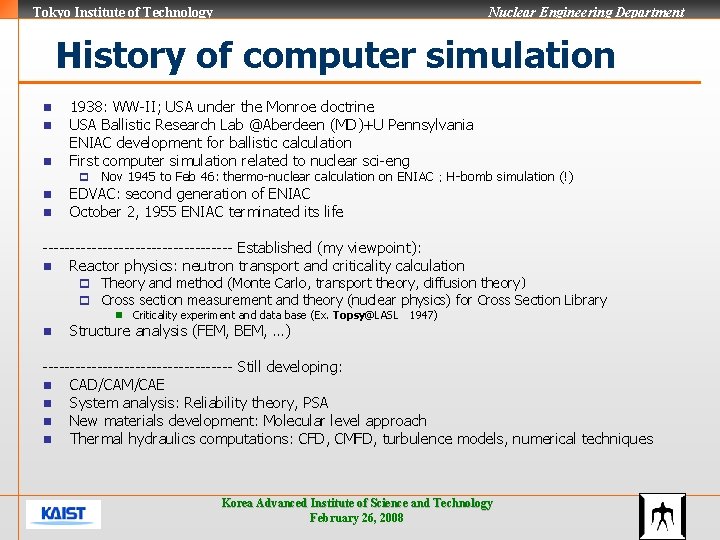
Tokyo Institute of Technology Nuclear Engineering Department History of computer simulation n 1938: WW-II; USA under the Monroe doctrine USA Ballistic Research Lab @Aberdeen (MD)+U Pennsylvania ENIAC development for ballistic calculation First computer simulation related to nuclear sci-eng p n n Nov 1945 to Feb 46: thermo-nuclear calculation on ENIAC;H-bomb simulation (!) EDVAC: second generation of ENIAC October 2, 1955 ENIAC terminated its life ------------------ Established (my viewpoint): n Reactor physics: neutron transport and criticality calculation p p Theory and method (Monte Carlo, transport theory, diffusion theory) Cross section measurement and theory (nuclear physics) for Cross Section Library n n Criticality experiment and data base (Ex. Topsy@LASL 1947) Structure analysis (FEM, BEM, …) ------------------ Still developing: n CAD/CAM/CAE n System analysis: Reliability theory, PSA n New materials development: Molecular level approach n Thermal hydraulics computations: CFD, CMFD, turbulence models, numerical techniques Korea Advanced Institute of Science and Technology February 26, 2008
Tokyo Institute of Technology II. Nuclear Reactor Thermal Hydraulics Computations
Tokyo Institute of Technology Nuclear Engineering Department Needs: (Example) Tight Lattice Fuel Subassembly n Liquid metal fast breeder (Sodium), high-conversion LWR (H 2 O) – for high burn-up and/or long-life core option n P/D = 1. 05 ~1. 2 n Demonstration needed for tight lattice subassembly thermal hydraulics performances and safety n Phenomena of recent interests; tough to simulate numerically: n Secondary flow n Local flow regime transition (laminar-turbulent) n Global flow pulsation n Decay heat removals by natural/mixed convection in particular at low Re ------n Let’s look at the simulation technology to the date in the next few slides: Korea Advanced Institute of Science and Technology February 26, 2008
Tokyo Institute of Technology Nuclear Engineering Department Nuclear Reactor Thermal-Hydraulics Analysis n Can we solve a complete set of governing equation for nuclear reactor thermal hydraulics? n Mass conservation equation n Momentum conservation equation n Energy conservation equation Answer is: n The equations are strongly non-linear; n No (--- Yes, DNS does) n p Turbulence structure too complicated p Temperature field and velocity field are associated each other Therefore the approximations made: p Reynolds-Averaged-NS (RANS): model required CFD p Lumped parameter analysis (LPA) introduced for engineering design Korea Advanced Institute of Science and Technology February 26, 2008
Tokyo Institute of Technology Nuclear Engineering Department DNS n n n Solve the N-S and energy equations directly; No approximations, no compromises No turbulence modeling You need high-end computers Most reliable; you must trust it Korea Advanced Institute of Science and Technology February 26, 2008
Tokyo Institute of Technology Nuclear Engineering Department Nuclear Reactor Thermal-Hydraulics Analysis n n Lumped parameter analysis (LPA) codes for engineering design n Integrated system analysis – SSC-L, -P, (RELAP, TRAC, …) n Subchannel analysis – COBRA, ASFRE, Distributed parameter CFD codes for design or backups to LPA n RANS n LES n DNS Korea Advanced Institute of Science and Technology February 26, 2008
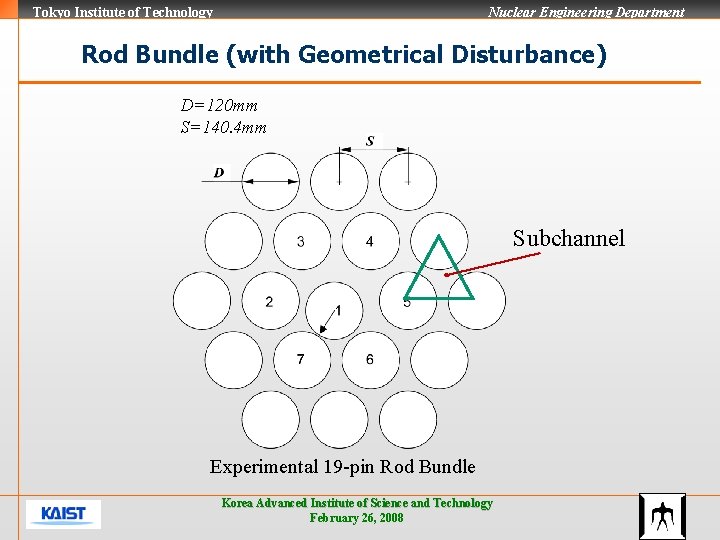
Tokyo Institute of Technology Nuclear Engineering Department Rod Bundle (with Geometrical Disturbance) D=120 mm S=140. 4 mm Subchannel Experimental 19 -pin Rod Bundle Korea Advanced Institute of Science and Technology February 26, 2008
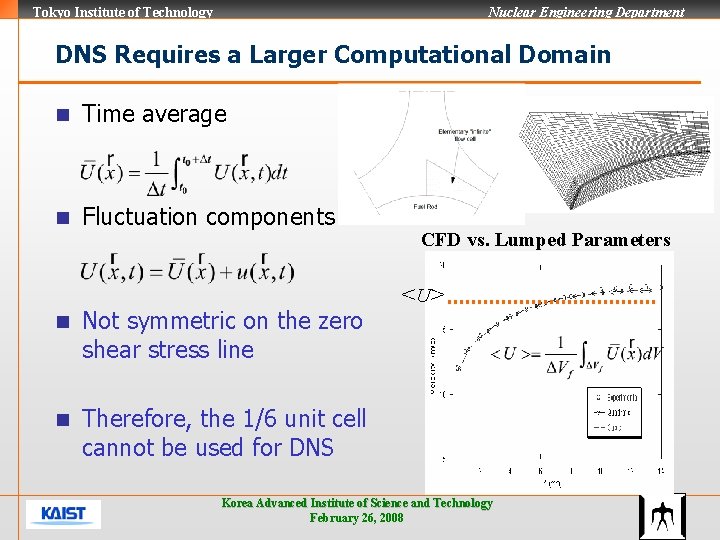
Tokyo Institute of Technology Nuclear Engineering Department DNS Requires a Larger Computational Domain n Time average n Fluctuation components n Not symmetric on the zero shear stress line n Therefore, the 1/6 unit cell cannot be used for DNS CFD vs. Lumped Parameters < U> Korea Advanced Institute of Science and Technology February 26, 2008
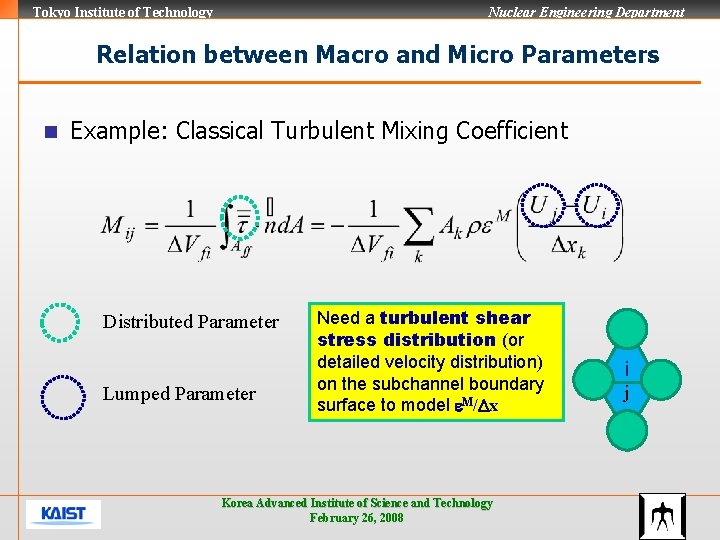
Tokyo Institute of Technology Nuclear Engineering Department Relation between Macro and Micro Parameters n Example: Classical Turbulent Mixing Coefficient Distributed Parameter Lumped Parameter Need a turbulent shear stress distribution (or detailed velocity distribution) on the subchannel boundary surface to model e. M/Dx Korea Advanced Institute of Science and Technology February 26, 2008 i j
Tokyo Institute of Technology Nuclear Engineering Department Does the model explain the physics? n If Uj=Ui, then Mij = 0. p (Note: Ui is the space average of the time averaged velocity) In bare rod bundle experiments, results show more mixing n Global flow pulsation n Computer simulation has failed in reproducing the phenomena until recently n HPC (= HEC +DNS) has made it possible to finally explain the phenomena n Korea Advanced Institute of Science and Technology February 26, 2008
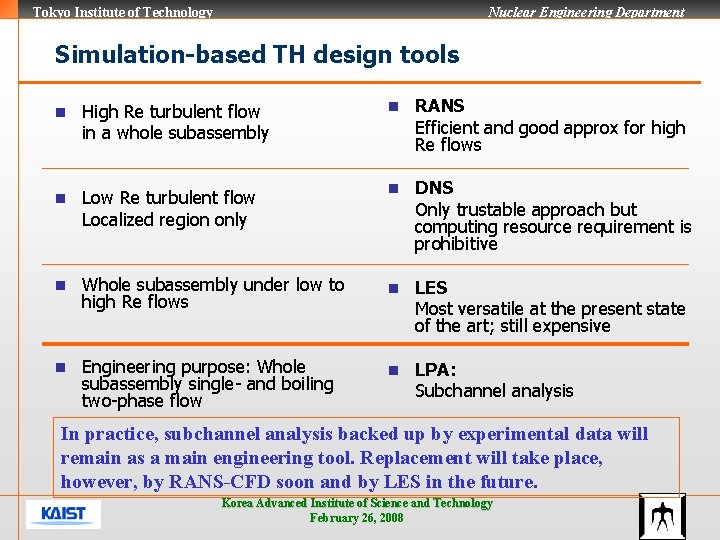
Tokyo Institute of Technology Nuclear Engineering Department Simulation-based TH design tools n High Re turbulent flow in a whole subassembly n RANS Efficient and good approx for high Re flows n Low Re turbulent flow Localized region only n DNS Only trustable approach but computing resource requirement is prohibitive n Whole subassembly under low to high Re flows n LES Most versatile at the present state of the art; still expensive n Engineering purpose: Whole subassembly single- and boiling two-phase flow n LPA: Subchannel analysis In practice, subchannel analysis backed up by experimental data will remain as a main engineering tool. Replacement will take place, however, by RANS-CFD soon and by LES in the future. Korea Advanced Institute of Science and Technology February 26, 2008
Tokyo Institute of Technology III. Direct Numerical Simulation of Turbulence (DNS) Turbulence models do not provide physics but explain, helps understanding but not a substitute for thinking, since the models are constructed based on the physics Only DNS provides the physics
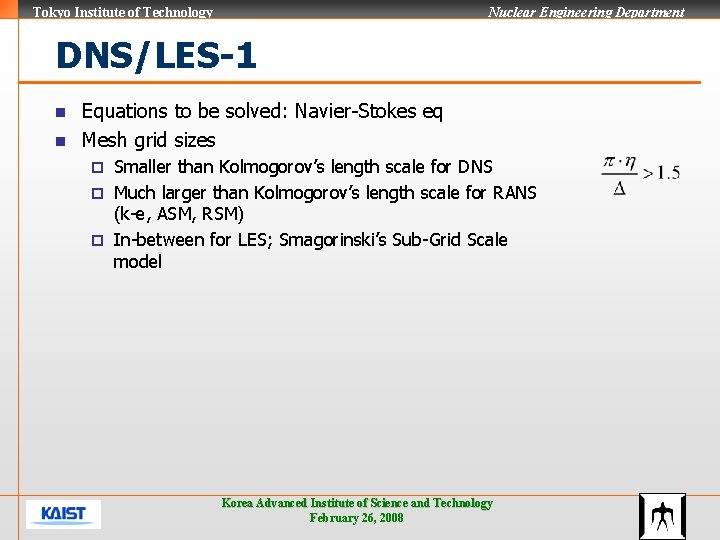
Tokyo Institute of Technology Nuclear Engineering Department DNS/LES-1 Equations to be solved: Navier-Stokes eq n Mesh grid sizes n Smaller than Kolmogorov’s length scale for DNS p Much larger than Kolmogorov’s length scale for RANS (k-e, ASM, RSM) p In-between for LES; Smagorinski’s Sub-Grid Scale model p Korea Advanced Institute of Science and Technology February 26, 2008
Tokyo Institute of Technology Nuclear Engineering Department DNS/LES-2 n Requires HPC on HEC DNS Re**9/4; LES Re**5/3 n High-Performance-Computation on High-End-Computer n Earth Simulator (J), Blue Genes L (USA) -- TFLOPS n Blue Genes P (USA/IBM) – PFLOPS in a year n --n 6 -7 months on E-S for Re=20, 000 flow in an eccentric annulus with 3 x 10⁸ grid points (on 1 GFLOPS PC, how many years? ) n Still not sufficient n n Computations limited to: A small volume of fluid n Fully developed flow: (velocity)/ Z=0 and n Geometrically symmetric channel n Low Reynolds number turbulent flows n Korea Advanced Institute of Science and Technology February 26, 2008
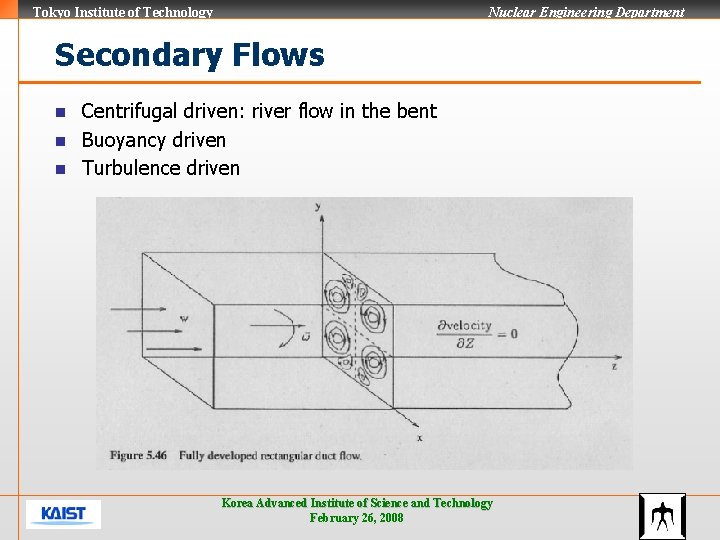
Tokyo Institute of Technology Nuclear Engineering Department Secondary Flows Centrifugal driven: river flow in the bent n Buoyancy driven n Turbulence driven n Korea Advanced Institute of Science and Technology February 26, 2008
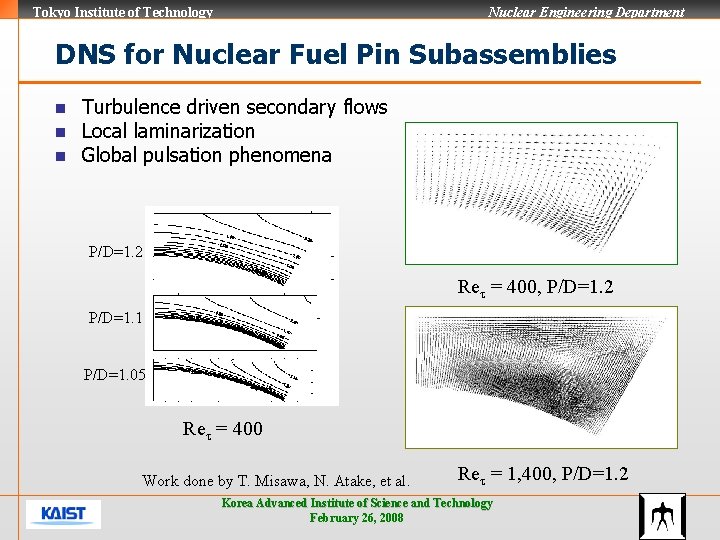
Tokyo Institute of Technology Nuclear Engineering Department DNS for Nuclear Fuel Pin Subassemblies n n n Turbulence driven secondary flows Local laminarization Global pulsation phenomena P/D=1. 2 Ret = 400, P/D=1. 2 P/D=1. 1 P/D=1. 05 Ret = 400 Work done by T. Misawa, N. Atake, et al. Ret = 1, 400, P/D=1. 2 Korea Advanced Institute of Science and Technology February 26, 2008
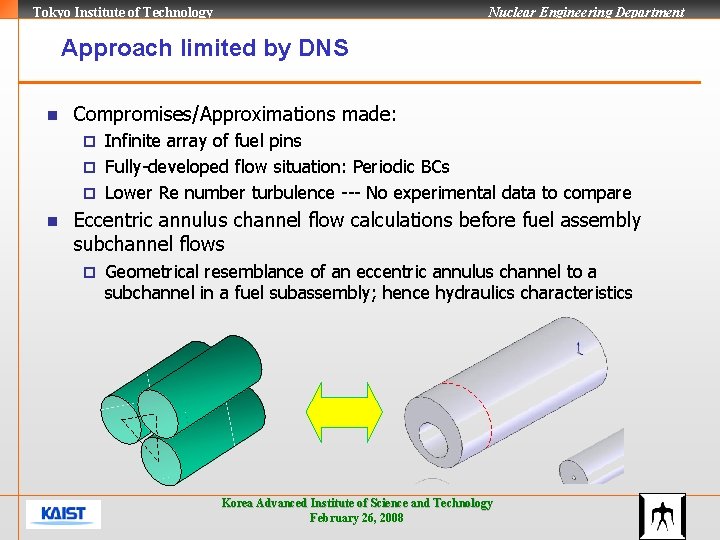
Tokyo Institute of Technology Nuclear Engineering Department Approach limited by DNS n Compromises/Approximations made: Infinite array of fuel pins p Fully-developed flow situation: Periodic BCs p Lower Re number turbulence --- No experimental data to compare p n Eccentric annulus channel flow calculations before fuel assembly subchannel flows p Geometrical resemblance of an eccentric annulus channel to a subchannel in a fuel subassembly; hence hydraulics characteristics Korea Advanced Institute of Science and Technology February 26, 2008
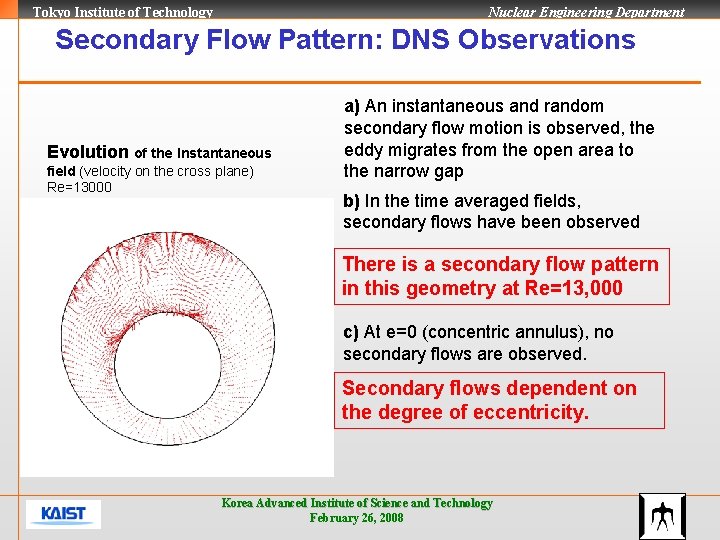
Tokyo Institute of Technology Nuclear Engineering Department Secondary Flow Pattern: DNS Observations Evolution of the Instantaneous field (velocity on the cross plane) Re=13000 a) An instantaneous and random secondary flow motion is observed, the eddy migrates from the open area to the narrow gap b) In the time averaged fields, secondary flows have been observed There is a secondary flow pattern in this geometry at Re=13, 000 c) At e=0 (concentric annulus), no secondary flows are observed. Secondary flows dependent on the degree of eccentricity. Korea Advanced Institute of Science and Technology February 26, 2008
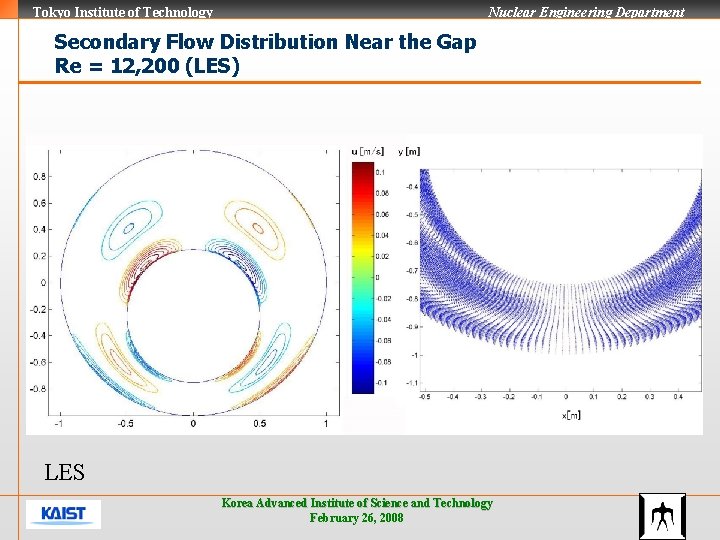
Tokyo Institute of Technology Nuclear Engineering Department Secondary Flow Distribution Near the Gap Re = 12, 200 (LES) LES Korea Advanced Institute of Science and Technology February 26, 2008
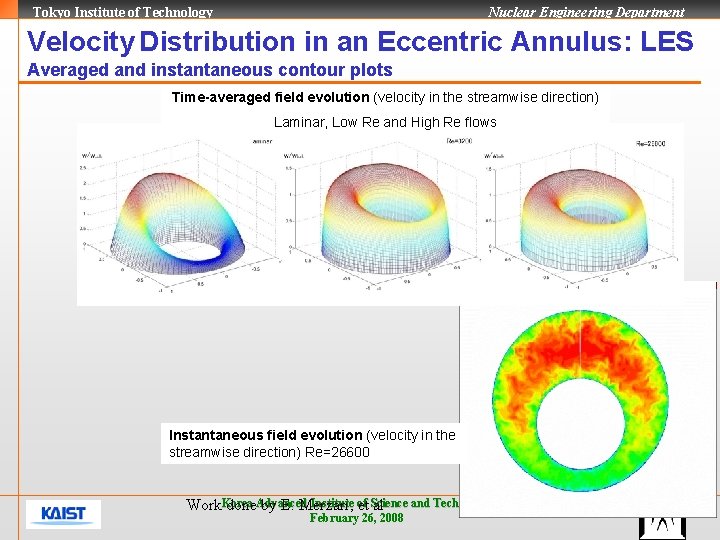
Tokyo Institute of Technology Nuclear Engineering Department Velocity Distribution in an Eccentric Annulus: LES Averaged and instantaneous contour plots Time-averaged field evolution (velocity in the streamwise direction) Laminar, Low Re and High Re flows Instantaneous field evolution (velocity in the streamwise direction) Re=26600 Institute of and Technology Work. Korea done. Advanced by E. Merzari, et Science al February 26, 2008
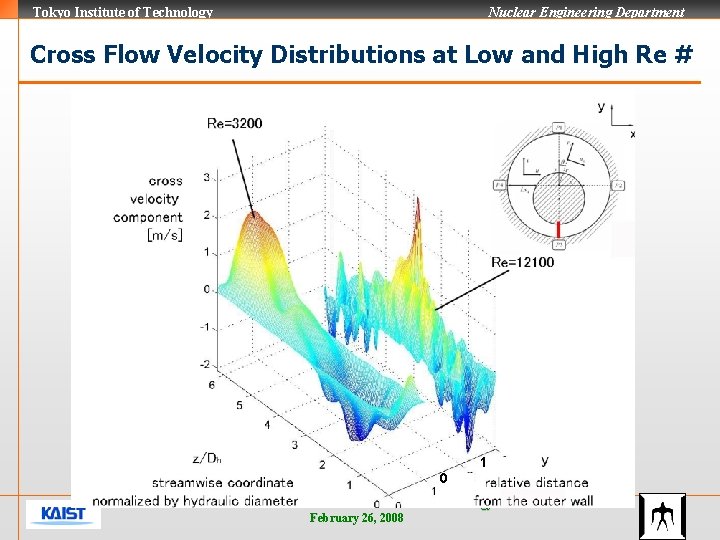
Tokyo Institute of Technology Nuclear Engineering Department Cross Flow Velocity Distributions at Low and High Re # 1 0 Korea Advanced Institute of Science and Technology February 26, 2008
Tokyo Institute of Technology Global Pulsation in an inter-connected two rectangular flow subchannels Predicted by LES [Experiments by van der Haagen; NURETH-11, 2005]
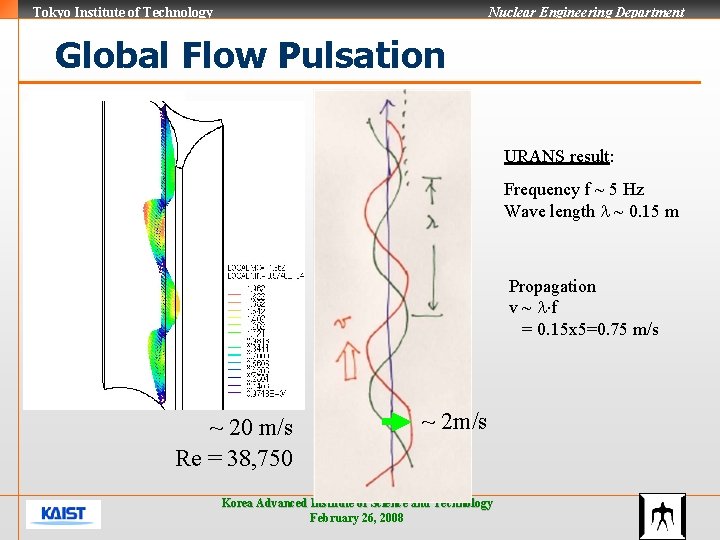
Tokyo Institute of Technology Nuclear Engineering Department Global Flow Pulsation URANS result: Frequency f ~ 5 Hz Wave length l ~ 0. 15 m Propagation v ~ l f = 0. 15 x 5=0. 75 m/s Air flow ~ 20 m/s Re = 38, 750 ~ 2 m/s Korea Advanced Institute of Science and Technology February 26, 2008
Tokyo Institute of Technology Nuclear Engineering Department Global Flow Pulsation by LES Cannot be calculated by the classical RANS methods but by URANS with appropriate ASM or RSM turbulence models n Flows in pin subassemblies: anisotropic turbulence dominated n Classical isotropic k-e model cannot reproduce some important n phenomena n Computer simulation has failed in reproducing the phenomena until recently ======= n Experiments by Van der Haagen n Cross-flow oscillation between two inter-connected square channels n Triggered by heterogeneous turbulent structure n LES Reported in NURETH-12 (Pittsburgh, 2007) by Merzari and Ninokata Korea Advanced Institute of Science and Technology February 26, 2008
Tokyo Institute of Technology IV. Simulation-based design Applications
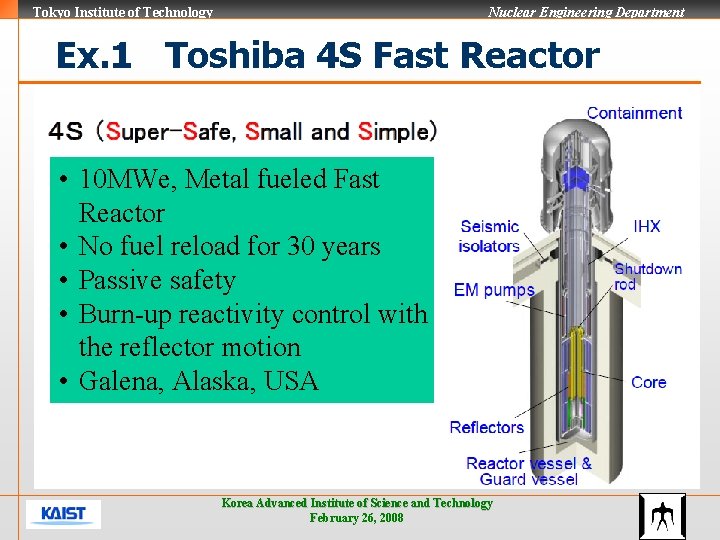
Tokyo Institute of Technology Nuclear Engineering Department Ex. 1 Toshiba 4 S Fast Reactor • 10 MWe, Metal fueled Fast Reactor • No fuel reload for 30 years • Passive safety • Burn-up reactivity control with the reflector motion • Galena, Alaska, USA Korea Advanced Institute of Science and Technology February 26, 2008
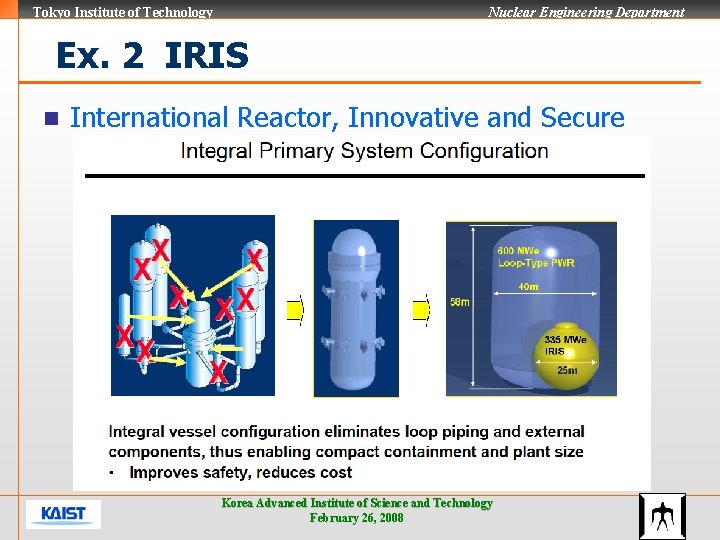
Tokyo Institute of Technology Nuclear Engineering Department Ex. 2 IRIS n International Reactor, Innovative and Secure Korea Advanced Institute of Science and Technology February 26, 2008
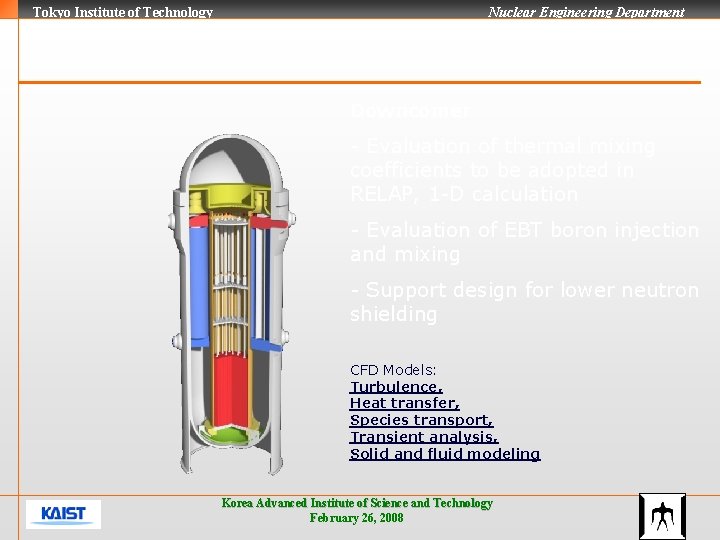
Tokyo Institute of Technology Nuclear Engineering Department Downcomer - Evaluation of thermal mixing coefficients to be adopted in RELAP, 1 -D calculation - Evaluation of EBT boron injection and mixing - Support design for lower neutron shielding CFD Models: Turbulence, Heat transfer, Species transport, Transient analysis, Solid and fluid modeling Korea Advanced Institute of Science and Technology February 26, 2008
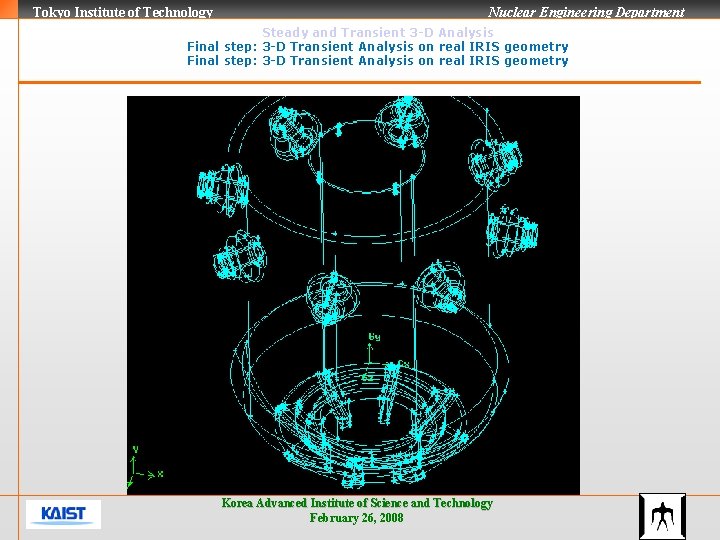
Tokyo Institute of Technology Nuclear Engineering Department Steady and Transient 3 -D Analysis Final step: 3 -D Transient Analysis on real IRIS geometry Korea Advanced Institute of Science and Technology February 26, 2008
Tokyo Institute of Technology V. Final Remarks and Conclusions
Tokyo Institute of Technology Nuclear Engineering Department Final Concluding Remarks Various approaches to CFD result in various computational requirements; n Yet there is no universal approach other than directly solving the N-S equations (DNS); n Computational results are substantially dependent on: p Specified mesh schemes and boundary conditions; p Numerical schemes in general, modeling selections which require: n Users’ knowledge on turbulence and expertise in n creating specific simulation models and n interpreting the results of the simulations. n n Therefore modeling-required CFD and Lumped Parameter Codes (such as subchannel analysis) need extensive validation/verification; while DNS is not subject to v/v on the condition that the numerical scheme employed is sound. n Should keep in mind that: p p Only DNS can provide the physics…. Science In principle, turbulence models do not provide physics; but explain, helps understanding; are not a substitute for thinking: since the models are constructed based on the physics Korea Advanced Institute of Science and Technology February 26, 2008
Tokyo Institute of Technology END and Thanks
- Slides: 41