
Tokens Patterns Lexemes When talking about lexical analysis
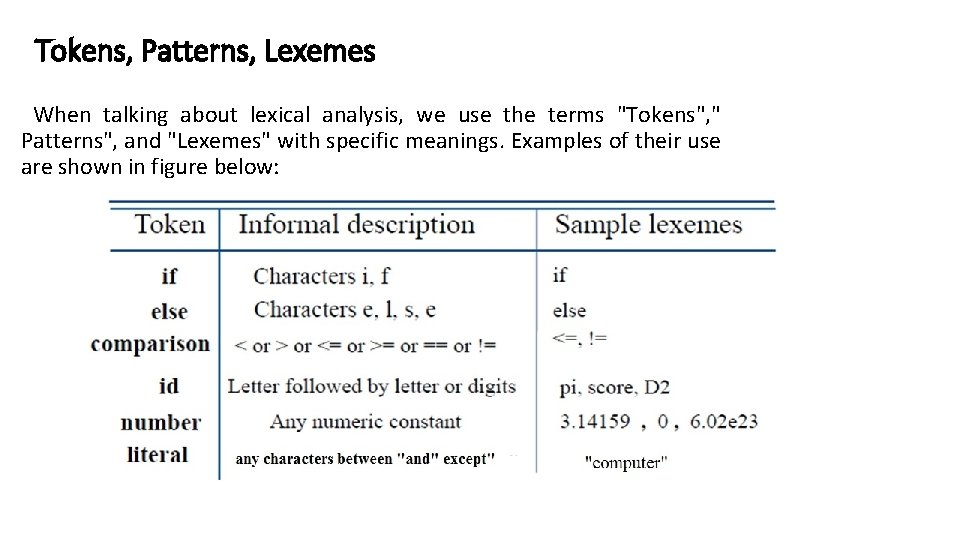
Tokens, Patterns, Lexemes When talking about lexical analysis, we use the terms "Tokens", " Patterns", and "Lexemes" with specific meanings. Examples of their use are shown in figure below:

Tokens, Patterns, Lexemes A lexeme is a sequence of characters in the source program that is matched by the pattern for a token. A sequence of characters identified as a token For example, the pattern for the Relation Operator (RELOP) token contains six lexemes (=, < >, <, < =, >, >=) so the lexical analyzer should return a RELOP token to parser whenever it sees any one of the six. Pattern is a rule describing the set of lexemes that can represent a particular token in source programs. By using Regular Expressions, we can specify patterns to lexical that allow it to scan and match strings in the input. For example, the pattern for the Pascal Identifier token "Id" is:
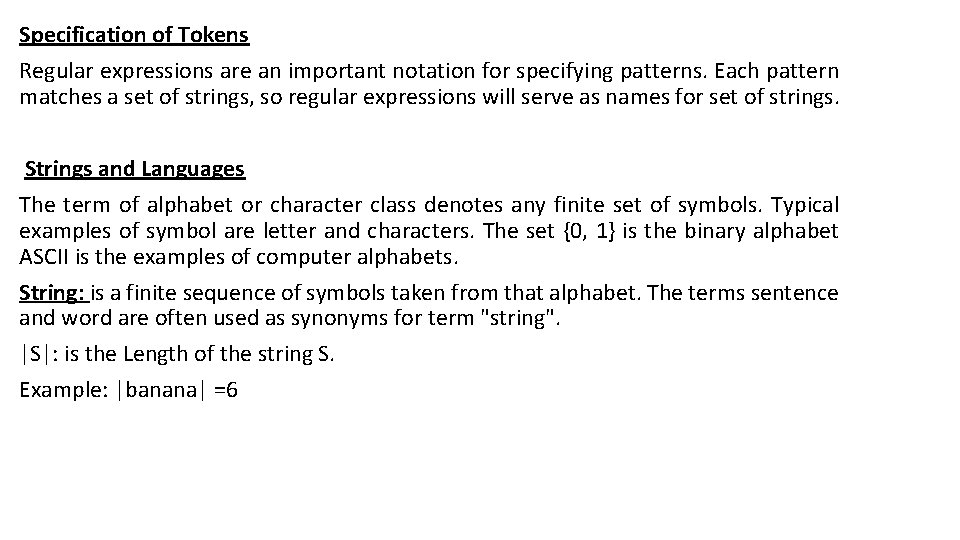
Specification of Tokens Regular expressions are an important notation for specifying patterns. Each pattern matches a set of strings, so regular expressions will serve as names for set of strings. Strings and Languages The term of alphabet or character class denotes any finite set of symbols. Typical examples of symbol are letter and characters. The set {0, 1} is the binary alphabet ASCII is the examples of computer alphabets. String: is a finite sequence of symbols taken from that alphabet. The terms sentence and word are often used as synonyms for term "string". |S|: is the Length of the string S. Example: |banana| =6
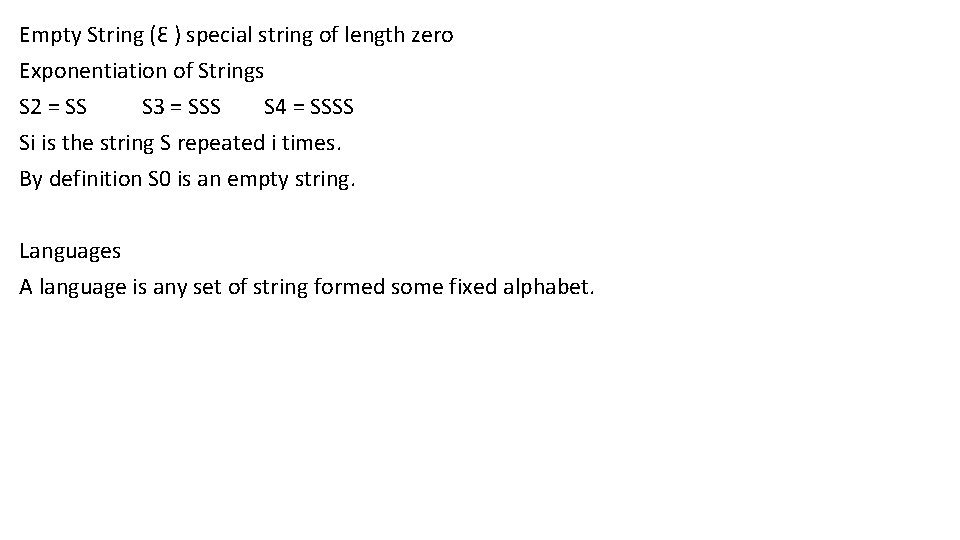
Empty String (Ɛ ) special string of length zero Exponentiation of Strings S 2 = SS S 3 = SSS S 4 = SSSS Si is the string S repeated i times. By definition S 0 is an empty string. Languages A language is any set of string formed some fixed alphabet.
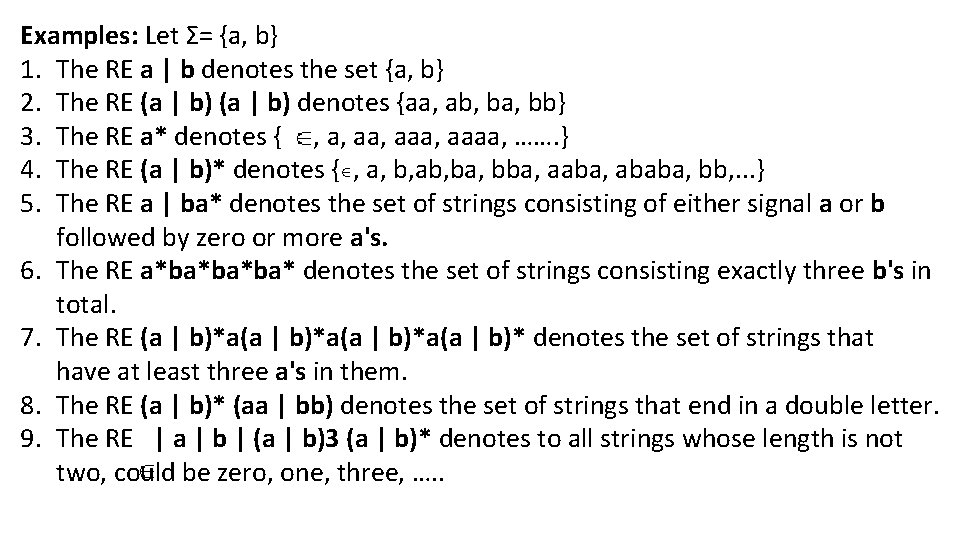
Examples: Let Σ= {a, b} 1. The RE a | b denotes the set {a, b} 2. The RE (a | b) denotes {aa, ab, ba, bb} 3. The RE a* denotes { , a, aaa, aaaa, ……. } 4. The RE (a | b)* denotes { , a, b, ab, ba, bba, aaba, ababa, bb, . . . } 5. The RE a | ba* denotes the set of strings consisting of either signal a or b followed by zero or more a's. 6. The RE a*ba*ba*ba* denotes the set of strings consisting exactly three b's in total. 7. The RE (a | b)*a(a | b)* denotes the set of strings that have at least three a's in them. 8. The RE (a | b)* (aa | bb) denotes the set of strings that end in a double letter. 9. The RE | a | b | (a | b)3 (a | b)* denotes to all strings whose length is not two, could be zero, one, three, …. .
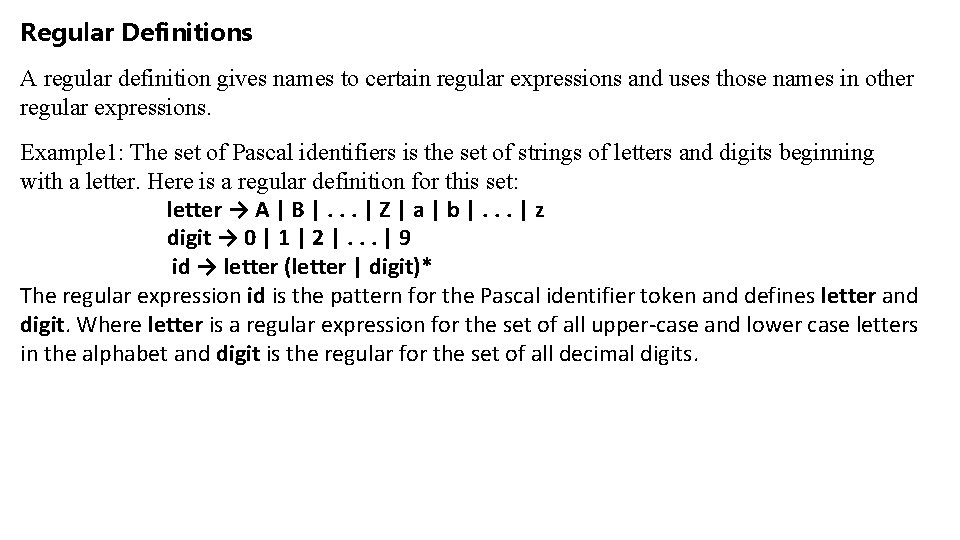
Regular Definitions A regular definition gives names to certain regular expressions and uses those names in other regular expressions. Example 1: The set of Pascal identifiers is the set of strings of letters and digits beginning with a letter. Here is a regular definition for this set: letter → A | B |. . . | Z | a | b |. . . | z digit → 0 | 1 | 2 |. . . | 9 id → letter (letter | digit)* The regular expression id is the pattern for the Pascal identifier token and defines letter and digit. Where letter is a regular expression for the set of all upper-case and lower case letters in the alphabet and digit is the regular for the set of all decimal digits.
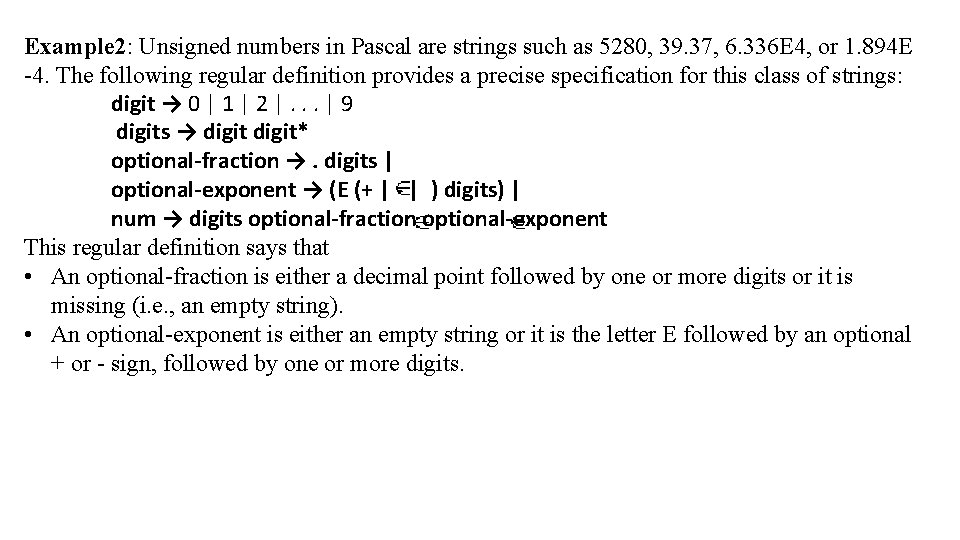
Example 2: Unsigned numbers in Pascal are strings such as 5280, 39. 37, 6. 336 E 4, or 1. 894 E -4. The following regular definition provides a precise specification for this class of strings: digit → 0 | 1 | 2 |. . . | 9 digits → digit* optional-fraction →. digits | optional-exponent → (E (+ | - | ) digits) | num → digits optional-fraction optional-exponent This regular definition says that • An optional-fraction is either a decimal point followed by one or more digits or it is missing (i. e. , an empty string). • An optional-exponent is either an empty string or it is the letter E followed by an optional + or - sign, followed by one or more digits.
- Slides: 7