
TOK Presentations What will we discuss today Examples

- Slides: 23
TOK Presentations
What will we discuss today? • Examples of TOK Presentation Ideas • Choosing a real life situation and knowledge question • How to structure a Theory of Knowledge presentation • How to deliver a TOK Presentation
Choosing a real life situation and knowledge question • There are two ways to start preparing for your TOK Presentation. • Choosing a real life situation first then knowledge question based on the real life situation • Choosing a knowledge question then finding a real life situation that links to it.
Real life situation first • The first way is to begin with your real life situation knowledge issue. You may have come across a news story that you’ve found intriguing, or be aware of a particular issue that troubles or interests you. Perhaps you’ve read an article on how we begin to learn to speak before we’re even born. Perhaps you’ve seen something on how a certain religious leader has argued that his beliefs alone can provide us with all the answers to existence. From here, you’ll need to figure out a knowledge issue. For the first example, perhaps you could come up with ‘How innate is our ability to communicate? ’ for the second, ‘Does religion provide us with certainty?
Knowledge question first • The second way is to begin with the knowledge question. You may have been wondering about a particular question connected to the ways of knowing or areas of knowledge. A popular example would be ethics: perhaps you are interested in which of the ways of knowing we use to work out the answers to moral questions.
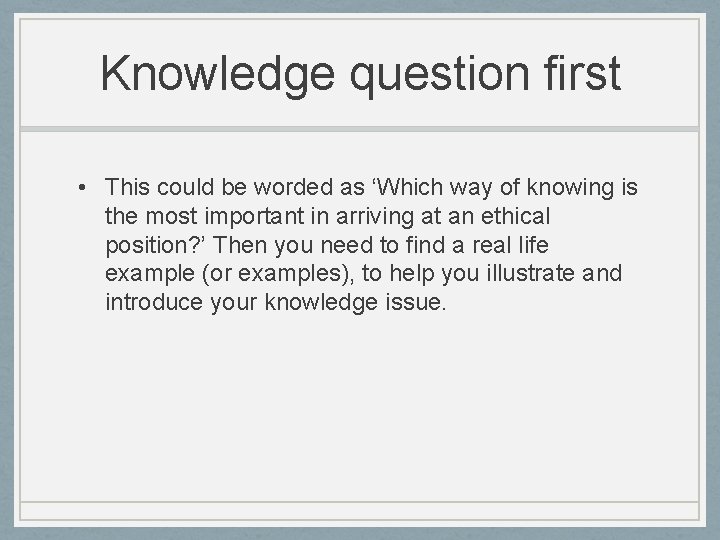
Knowledge question first • This could be worded as ‘Which way of knowing is the most important in arriving at an ethical position? ’ Then you need to find a real life example (or examples), to help you illustrate and introduce your knowledge issue.
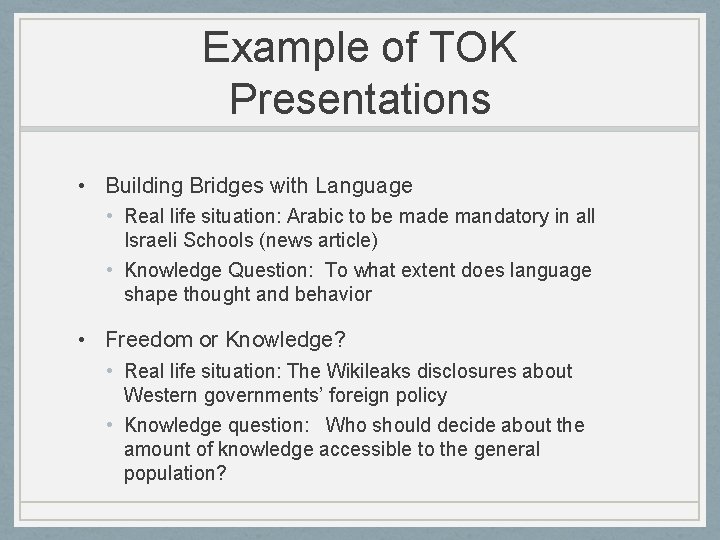
Example of TOK Presentations • Building Bridges with Language • Real life situation: Arabic to be made mandatory in all Israeli Schools (news article) • Knowledge Question: To what extent does language shape thought and behavior • Freedom or Knowledge? • Real life situation: The Wikileaks disclosures about Western governments’ foreign policy • Knowledge question: Who should decide about the amount of knowledge accessible to the general population?
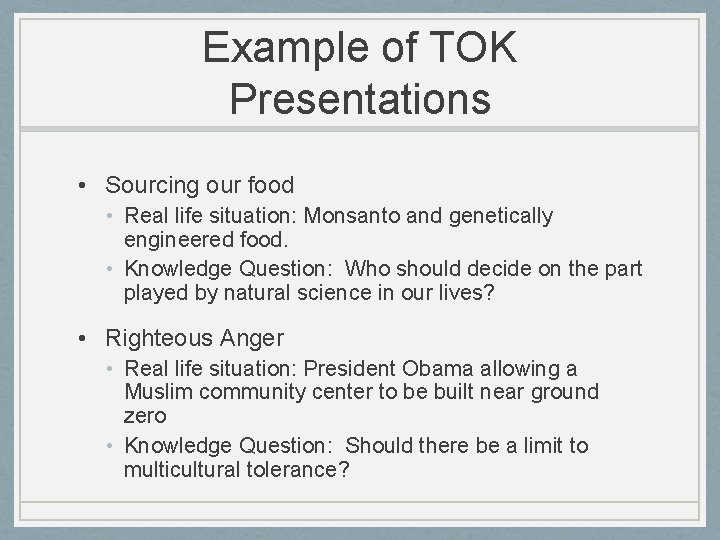
Example of TOK Presentations • Sourcing our food • Real life situation: Monsanto and genetically engineered food. • Knowledge Question: Who should decide on the part played by natural science in our lives? • Righteous Anger • Real life situation: President Obama allowing a Muslim community center to be built near ground zero • Knowledge Question: Should there be a limit to multicultural tolerance?
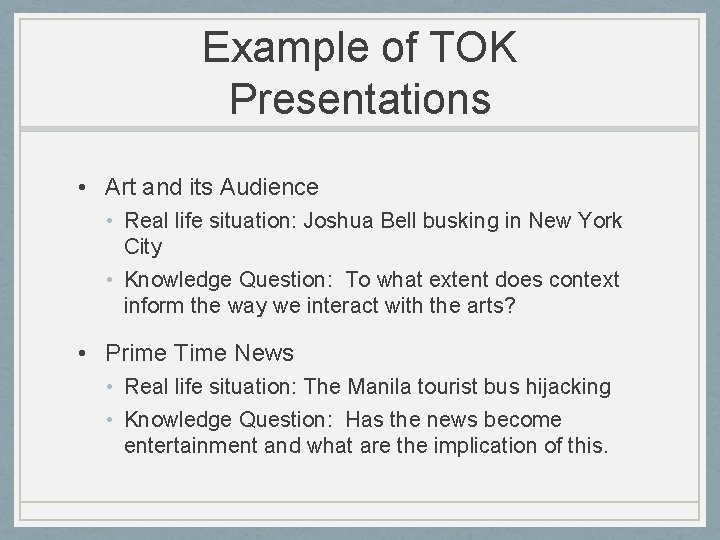
Example of TOK Presentations • Art and its Audience • Real life situation: Joshua Bell busking in New York City • Knowledge Question: To what extent does context inform the way we interact with the arts? • Prime Time News • Real life situation: The Manila tourist bus hijacking • Knowledge Question: Has the news become entertainment and what are the implication of this.
Development Section • When you get into the Development section (where the knowledge question is explored analysed with reference to the AOKs and WOKs), you’ll see that we use a Claim, Counterclaim, Mini-Conclusion structure. We do this (claim, counterclaim, mini-conclusion) for each of your developments (AOKs or WOKs), so we do it 3 times in total.
Development Section • Here’s an example, for one of your developments: • -Your claim might be that all art is ethical and you show this using some theory (evidence) from the course. • -Your counterclaim is a problem (a limitation) with your claim, or an opposing idea in the same perspective. It might be that art can be viewed in a different way, which would show it to be unethical. You show this using (as evidence) an example from your own life experience or knowledge referenced material or material studied in some other theory from the course.
Development Section • -And then, in the mini-conclusion, you basically have to find a way to draw together the two opposing sides. You have to somehow synthesize these two insights to arrive at a more insightful understanding or some kind of summary. So you might say that art can be both ethical and unethical at the same time, depending on the perspective taken and then explain how that might be true. So the MC is a possible conclusion to your KQ (Knowledge Question). • In the final conclusion of the presentation you will try to combine (draw together/synthesise) the insights of this miniconclusion as well as the other ones (from the 2 other development sections) to show a really sophisticated/developed answer to your KQ.
Using Evidence • Use evidence for each of your claims and your counterclaims. It will make your talk much more compelling. • Evidence can be: • -Examples of from the course or from your research. For example, stories of real scientific experiments or how society responded to a certain piece of art. • -Personal examples. Specific and realistic examples from your own life experiences are highly valued in this course. So you might tell us about something that you did in IB Biology class, or when you suspected a classmate of cheating. • Now let’s go through the structure of your presentation, slide by slide.
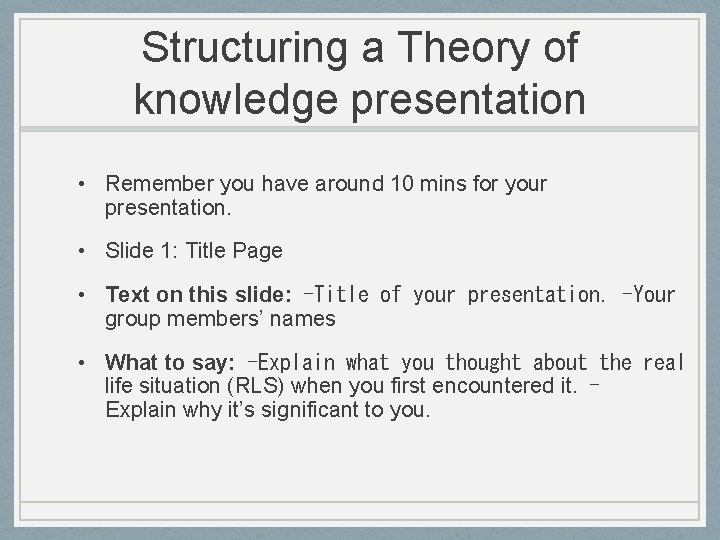
Structuring a Theory of knowledge presentation • Remember you have around 10 mins for your presentation. • Slide 1: Title Page • Text on this slide: -Title of your presentation. -Your group members’ names • What to say: -Explain what you thought about the real life situation (RLS) when you first encountered it. Explain why it’s significant to you.
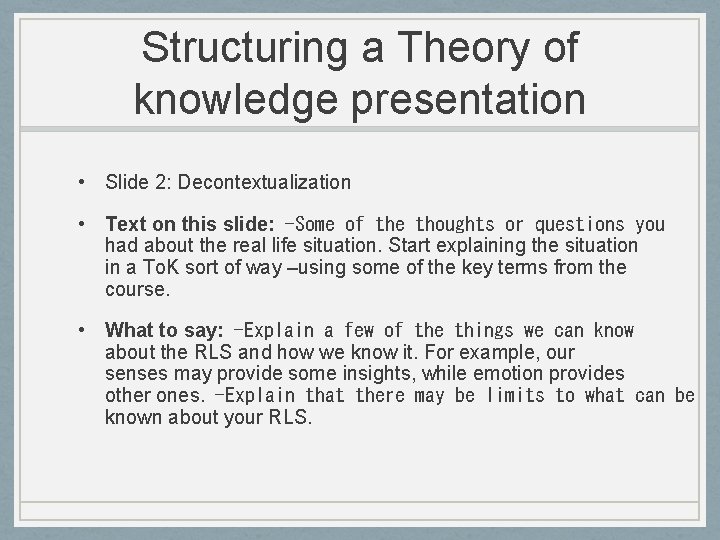
Structuring a Theory of knowledge presentation • Slide 2: Decontextualization • Text on this slide: -Some of the thoughts or questions you had about the real life situation. Start explaining the situation in a To. K sort of way –using some of the key terms from the course. • What to say: -Explain a few of the things we can know about the RLS and how we know it. For example, our senses may provide some insights, while emotion provides other ones. -Explain that there may be limits to what can be known about your RLS.
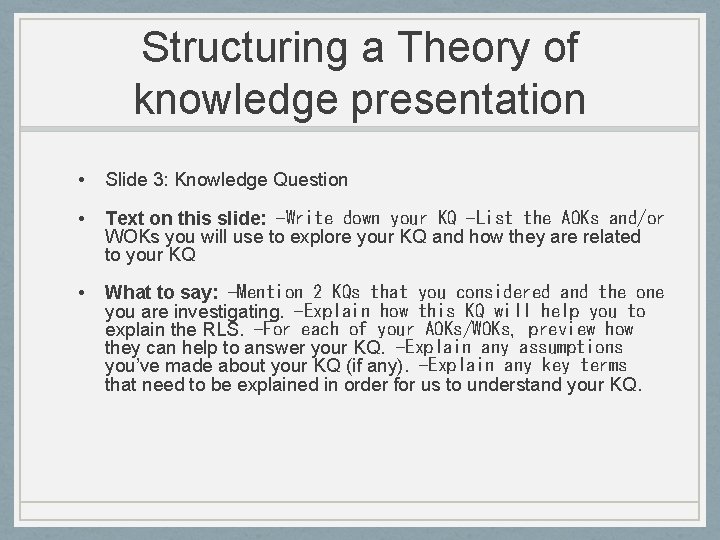
Structuring a Theory of knowledge presentation • Slide 3: Knowledge Question • Text on this slide: -Write down your KQ -List the AOKs and/or WOKs you will use to explore your KQ and how they are related to your KQ • What to say: -Mention 2 KQs that you considered and the one you are investigating. -Explain how this KQ will help you to explain the RLS. -For each of your AOKs/WOKs, preview how they can help to answer your KQ. -Explain any assumptions you’ve made about your KQ (if any). -Explain any key terms that need to be explained in order for us to understand your KQ.
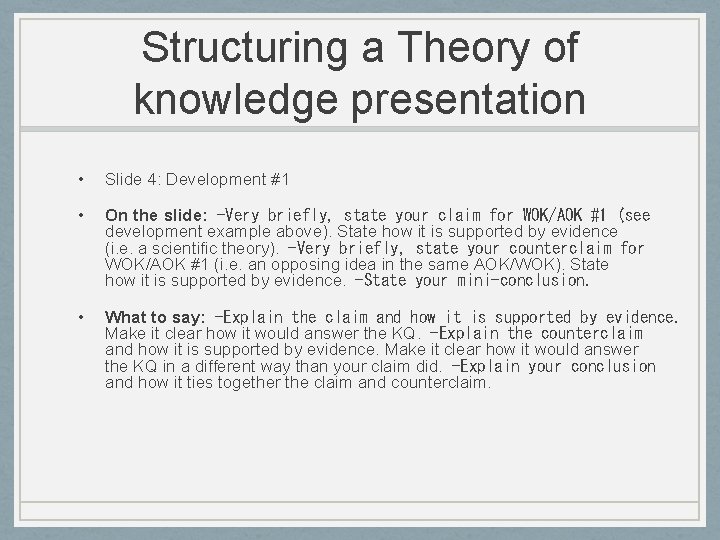
Structuring a Theory of knowledge presentation • Slide 4: Development #1 • On the slide: -Very briefly, state your claim for WOK/AOK #1 (see development example above). State how it is supported by evidence (i. e. a scientific theory). -Very briefly, state your counterclaim for WOK/AOK #1 (i. e. an opposing idea in the same AOK/WOK). State how it is supported by evidence. -State your mini-conclusion. • What to say: -Explain the claim and how it is supported by evidence. Make it clear how it would answer the KQ. -Explain the counterclaim and how it is supported by evidence. Make it clear how it would answer the KQ in a different way than your claim did. -Explain your conclusion and how it ties together the claim and counterclaim.
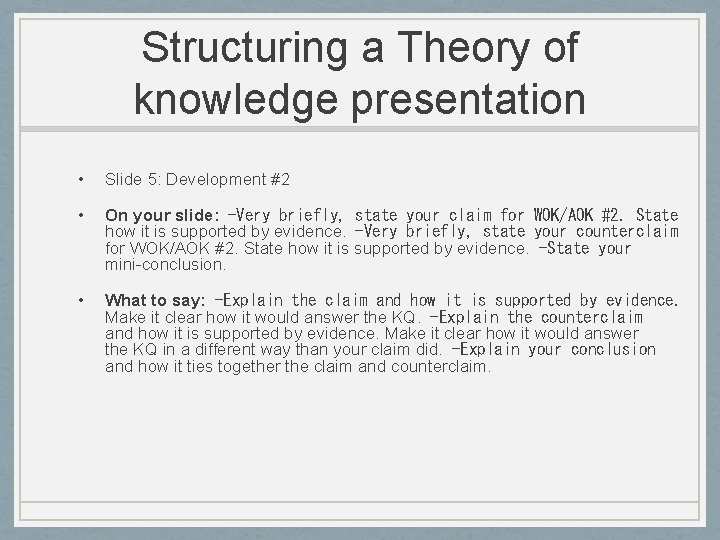
Structuring a Theory of knowledge presentation • Slide 5: Development #2 • On your slide: -Very briefly, state your claim for WOK/AOK #2. State how it is supported by evidence. -Very briefly, state your counterclaim for WOK/AOK #2. State how it is supported by evidence. -State your mini-conclusion. • What to say: -Explain the claim and how it is supported by evidence. Make it clear how it would answer the KQ. -Explain the counterclaim and how it is supported by evidence. Make it clear how it would answer the KQ in a different way than your claim did. -Explain your conclusion and how it ties together the claim and counterclaim.
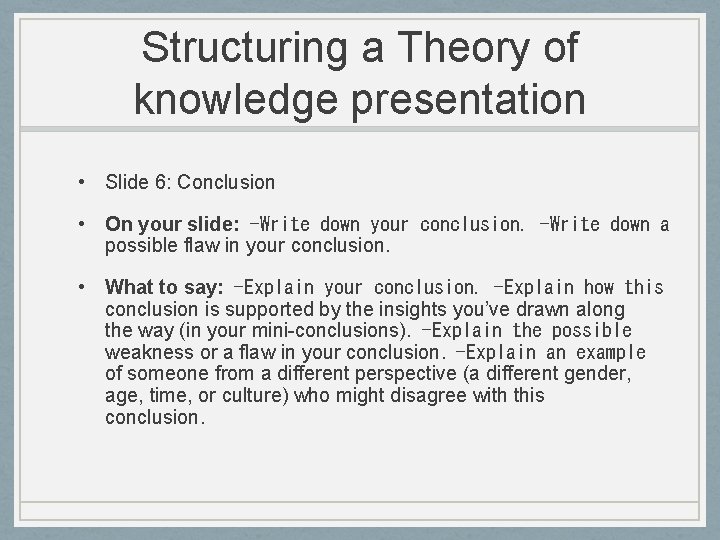
Structuring a Theory of knowledge presentation • Slide 6: Conclusion • On your slide: -Write down your conclusion. -Write down a possible flaw in your conclusion. • What to say: -Explain your conclusion. -Explain how this conclusion is supported by the insights you’ve drawn along the way (in your mini-conclusions). -Explain the possible weakness or a flaw in your conclusion. -Explain an example of someone from a different perspective (a different gender, age, time, or culture) who might disagree with this conclusion.
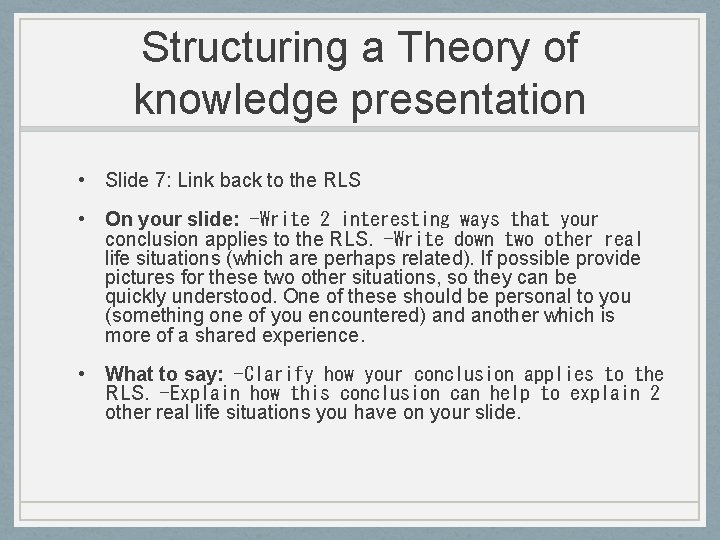
Structuring a Theory of knowledge presentation • Slide 7: Link back to the RLS • On your slide: -Write 2 interesting ways that your conclusion applies to the RLS. -Write down two other real life situations (which are perhaps related). If possible provide pictures for these two other situations, so they can be quickly understood. One of these should be personal to you (something one of you encountered) and another which is more of a shared experience. • What to say: -Clarify how your conclusion applies to the RLS. -Explain how this conclusion can help to explain 2 other real life situations you have on your slide.
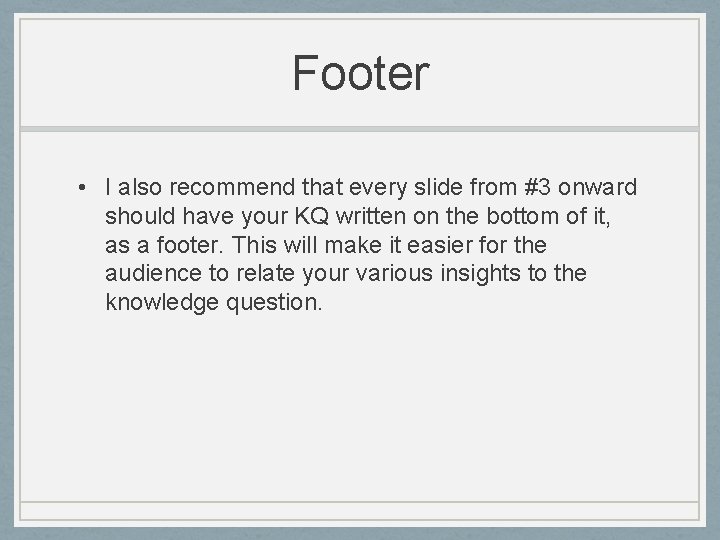
Footer • I also recommend that every slide from #3 onward should have your KQ written on the bottom of it, as a footer. This will make it easier for the audience to relate your various insights to the knowledge question.
Signposting • Finally, to help to make sure that the person marking you gives you full credit, it’s useful to do what we call signposting. This means, using the exact key words the marker was trained to look for. Professionals do this all the time. Their use of specialist language signals to their colleagues that they know what they’re talking about. So try to speak like a TOK teacher basically. In this case, your marker will respond favorably if you use a fair amount of terminology you learned in the course. For example, use the term perspective. So you might say, “from the perspective of a historian. . ” rather than saying, “Historians believe that…” –just to get that word in there.
Delivering a TOK Presentation • Think different (out of the box) • Talking to a crowd • Model your public speaking • Slowly but surely • Body Language • Engage your audience • Be a professional • Practice makes perfect