
TOK AND MFL How to embed TOK elements
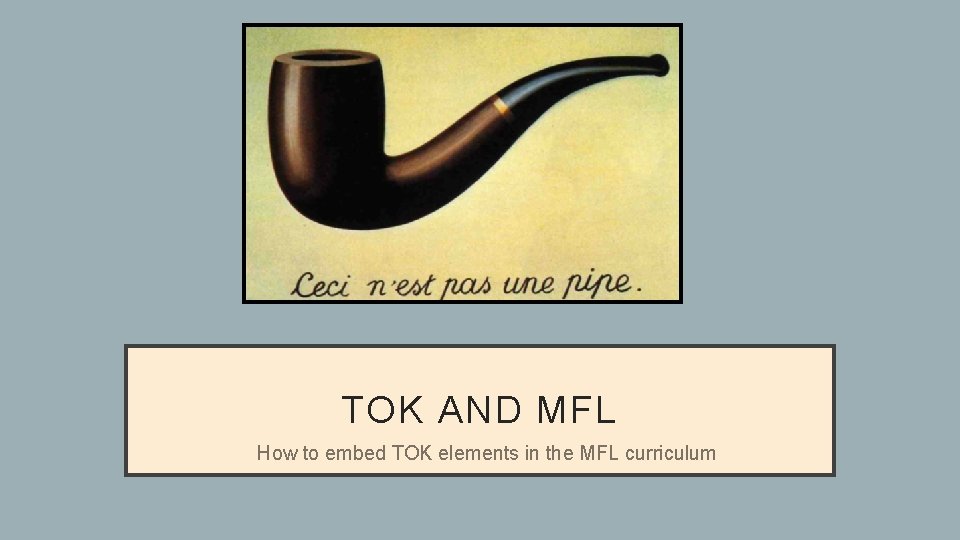
TOK AND MFL How to embed TOK elements in the MFL curriculum
LINKS BETWEEN TOK AND LANGUAGE • Language as a way of knowing (current spec) • The arts as an area of knowledge (Current spec and new spec) • Knowledge and Language (2020 -2022 spec) SL and HL The connection between language and knowledge/knowing More for HL What kind of knowledge can the arts (literature, drama…) bring us?
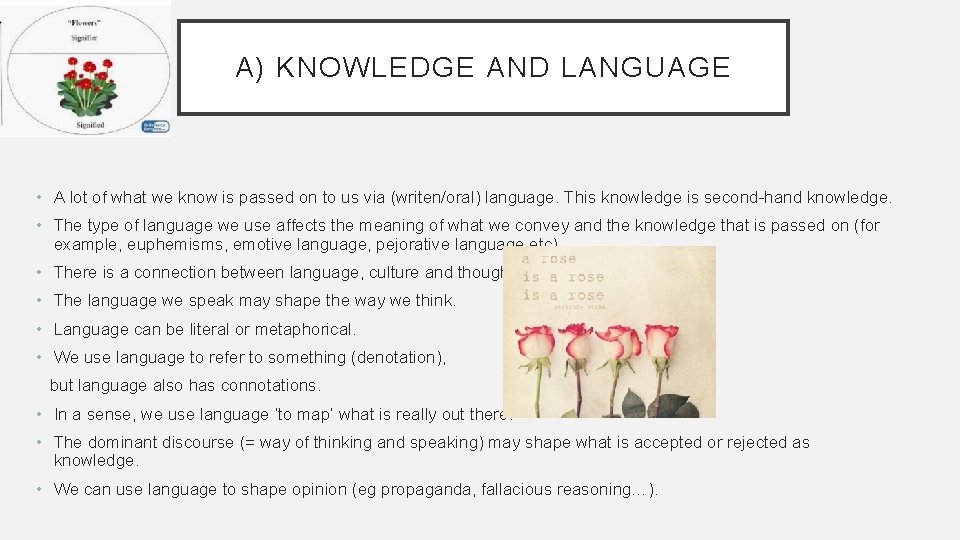
A) KNOWLEDGE AND LANGUAGE • A lot of what we know is passed on to us via (writen/oral) language. This knowledge is second-hand knowledge. • The type of language we use affects the meaning of what we convey and the knowledge that is passed on (for example, euphemisms, emotive language, pejorative language etc). • There is a connection between language, culture and thought. • The language we speak may shape the way we think. • Language can be literal or metaphorical. • We use language to refer to something (denotation), but language also has connotations. • In a sense, we use language ‘to map’ what is really out there. • The dominant discourse (= way of thinking and speaking) may shape what is accepted or rejected as knowledge. • We can use language to shape opinion (eg propaganda, fallacious reasoning…).
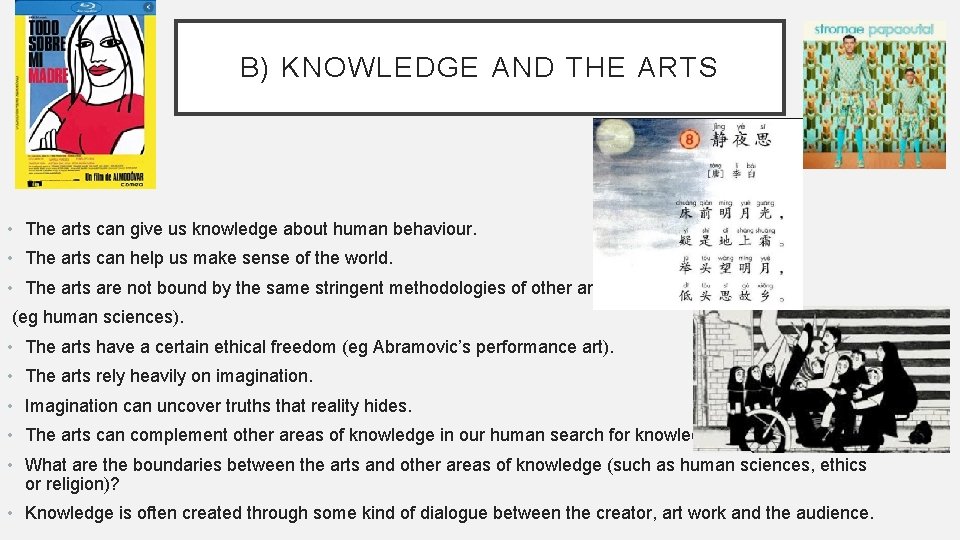
B) KNOWLEDGE AND THE ARTS • The arts can give us knowledge about human behaviour. • The arts can help us make sense of the world. • The arts are not bound by the same stringent methodologies of other areas (eg human sciences). • The arts have a certain ethical freedom (eg Abramovic’s performance art). • The arts rely heavily on imagination. • Imagination can uncover truths that reality hides. • The arts can complement other areas of knowledge in our human search for knowledge. • What are the boundaries between the arts and other areas of knowledge (such as human sciences, ethics or religion)? • Knowledge is often created through some kind of dialogue between the creator, art work and the audience.
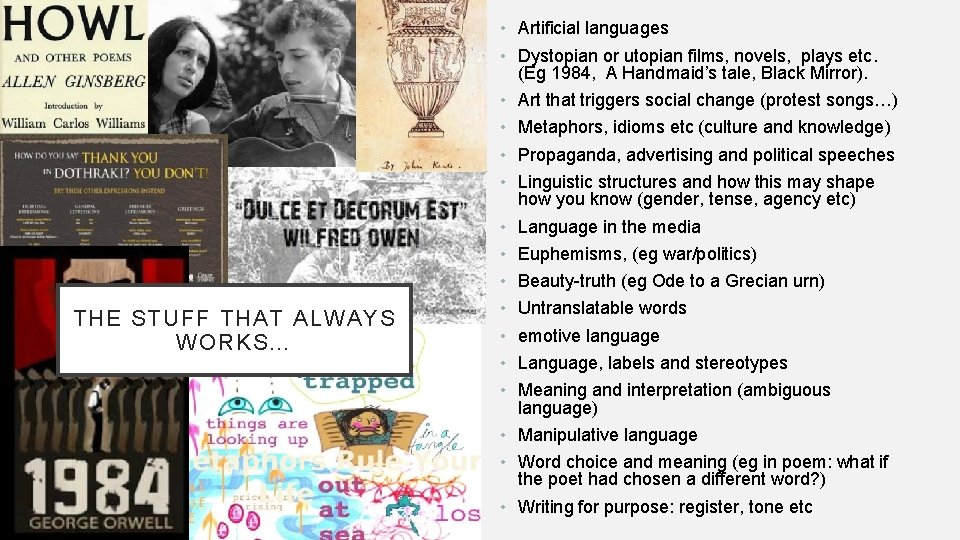
THE STUFF THAT ALWAYS WORKS… • Artificial languages • Dystopian or utopian films, novels, plays etc. (Eg 1984, A Handmaid’s tale, Black Mirror). • Art that triggers social change (protest songs…) • Metaphors, idioms etc (culture and knowledge) • Propaganda, advertising and political speeches • Linguistic structures and how this may shape how you know (gender, tense, agency etc) • Language in the media • Euphemisms, (eg war/politics) • Beauty-truth (eg Ode to a Grecian urn) • Untranslatable words • emotive language • Language, labels and stereotypes • Meaning and interpretation (ambiguous language) • Manipulative language • Word choice and meaning (eg in poem: what if the poet had chosen a different word? ) • Writing for purpose: register, tone etc
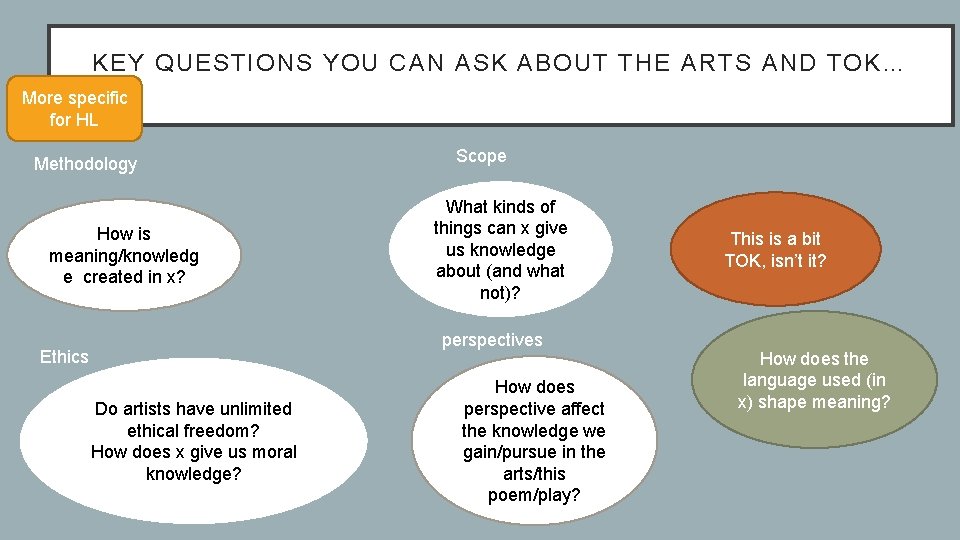
KEY QUESTIONS YOU CAN ASK ABOUT THE ARTS AND TOK… More specific for HL Methodology How is meaning/knowledg e created in x? Scope What kinds of things can x give us knowledge about (and what not)? perspectives Ethics Do artists have unlimited ethical freedom? How does x give us moral knowledge? How does perspective affect the knowledge we gain/pursue in the arts/this poem/play? This is a bit TOK, isn’t it? How does the language used (in x) shape meaning?
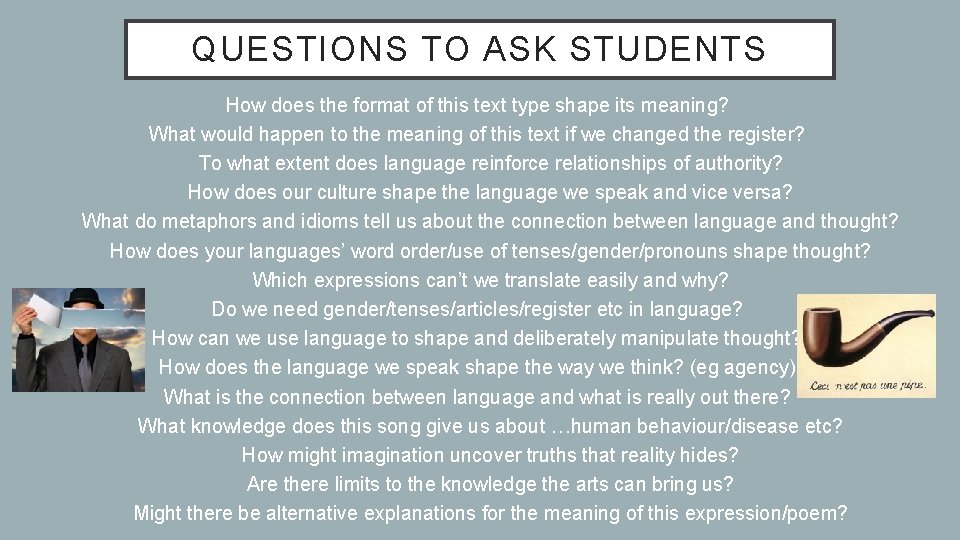
QUESTIONS TO ASK STUDENTS How does the format of this text type shape its meaning? What would happen to the meaning of this text if we changed the register? • To what extent does language reinforce relationships of authority? • How does our culture shape the language we speak and vice versa? • What do metaphors and idioms tell us about the connection between language and thought? • How does your languages’ word order/use of tenses/gender/pronouns shape thought? • Which expressions can’t we translate easily and why? Do we need gender/tenses/articles/register etc in language? How can we use language to shape and deliberately manipulate thought? How does the language we speak shape the way we think? (eg agency) What is the connection between language and what is really out there? • What knowledge does this song give us about …human behaviour/disease etc? • How might imagination uncover truths that reality hides? • Are there limits to the knowledge the arts can bring us? • Might there be alternative explanations for the meaning of this expression/poem?
IF YOU ARE REALLY KEEN… • Textbook TOK references • Language B guide • Teacher support materials (My. IB) • Sohowdoweknow. weebly. com (current) • TOK 2022. weebly. com (first teaching August 2020): free website I made with a page on language and knowledge. • Boroditsky’s articles and TED talks on language: How language shapes the way we think.
- Slides: 8