
TOGO TOpologyassist Geo Opportunistic Routing in Urban Vehicular
TO-GO: TOpology-assist Geo. Opportunistic Routing in Urban Vehicular Grids Kevin Lee, Uichin Lee, Mario Gerla WONS 2009 2/2/2009
Possible Routing Solutions in VANET • Proactive (table-driven) => Not too scalable – DSDV – OLSR • Reactive (on-demand) Þ Long route establishment, susceptible to route breaks – AODV – DSR • Geographic => Scalable, yet robust to route breaks, but… – GPSR, GPCR, GOAFR+…
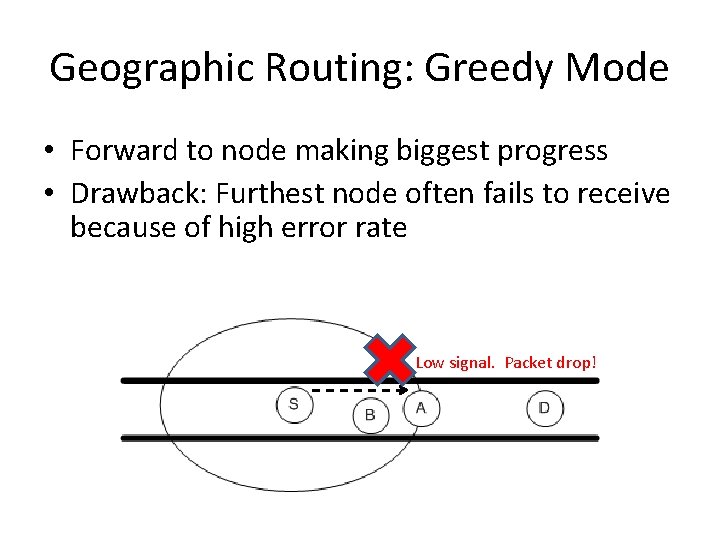
Geographic Routing: Greedy Mode • Forward to node making biggest progress • Drawback: Furthest node often fails to receive because of high error rate Low signal. Packet drop!
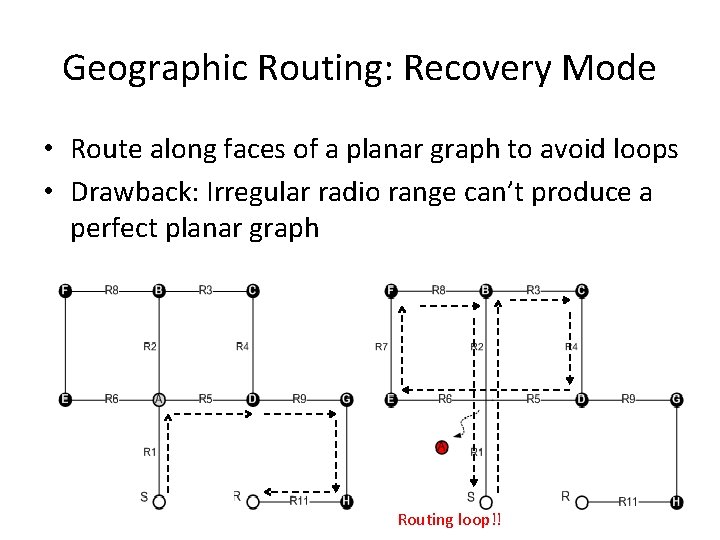
Geographic Routing: Recovery Mode • Route along faces of a planar graph to avoid loops • Drawback: Irregular radio range can’t produce a perfect planar graph Routing loop!!
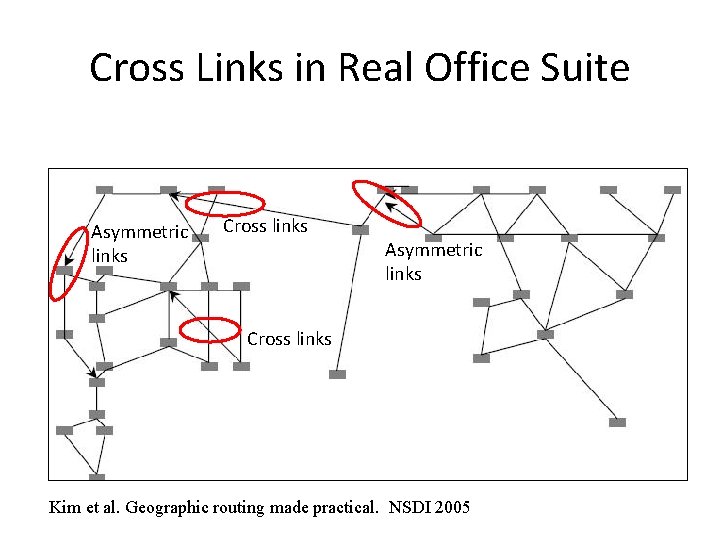
Cross Links in Real Office Suite Asymmetric links Cross links Kim et al. Geographic routing made practical. NSDI 2005
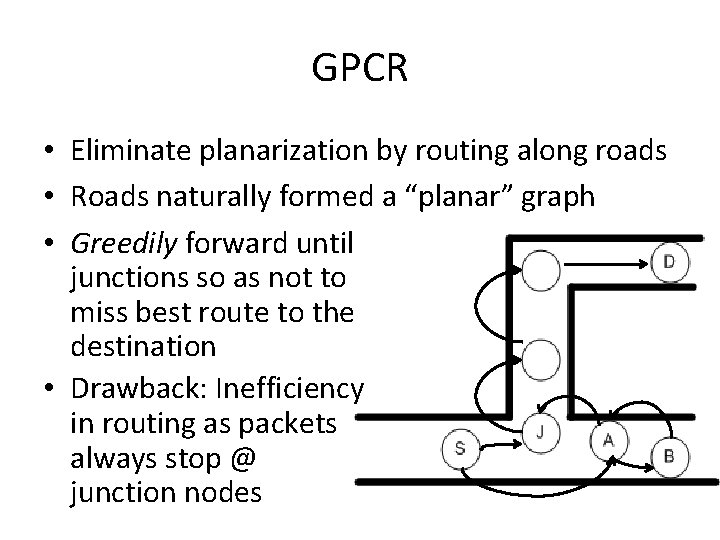
GPCR • Eliminate planarization by routing along roads • Roads naturally formed a “planar” graph • Greedily forward until junctions so as not to miss best route to the destination • Drawback: Inefficiency in routing as packets always stop @ junction nodes
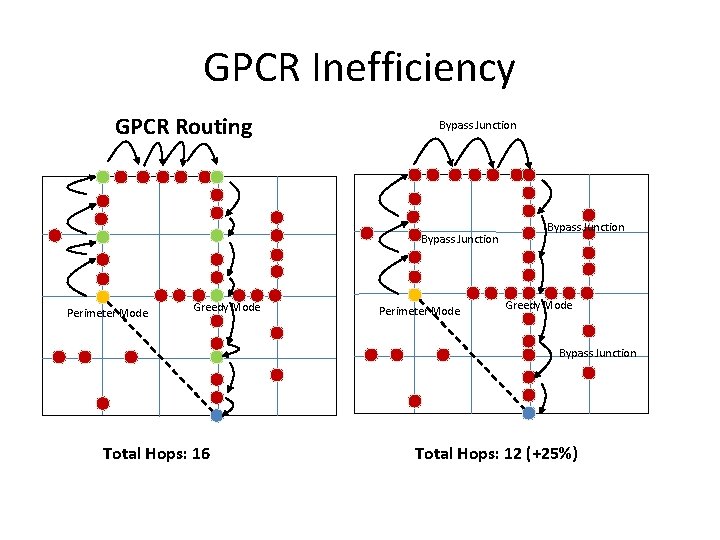
GPCR Inefficiency GPCR Routing Bypass Junction Perimeter Mode Greedy Mode Perimeter Mode Bypass Junction Greedy Mode Bypass Junction Total Hops: 16 Total Hops: 12 (+25%)
TO-GO Contributions • Opportunistic forwarding to improve packet delivery in greedy and recovery forwarding – Broadcast to a set of nodes – Forwarding set construction – Priority scheduling • Junction look-ahead – Bypassing junction whenever it can
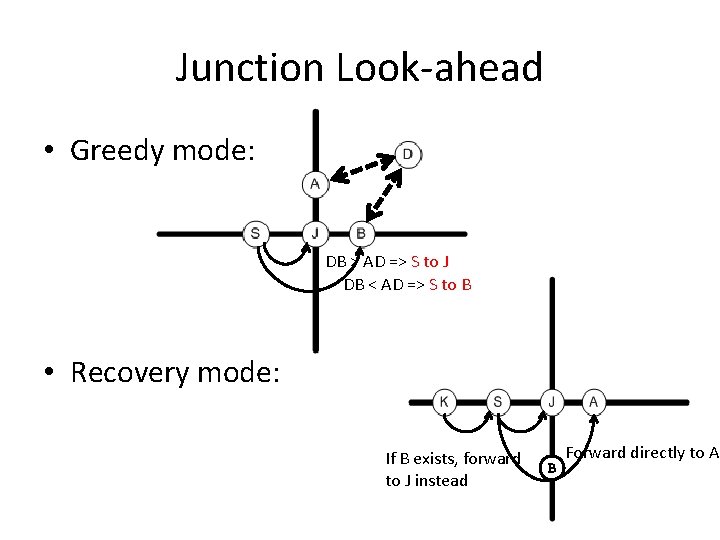
Junction Look-ahead • Greedy mode: DB > AD => S to J DB < AD => S to B • Recovery mode: If B exists, forward to J instead B Forward directly to A
TO-GO Opportunistic Forwarding • Node forwards to a set of nodes • Construct a set between the current node and the target node – Nodes in a set can hear each other and contend the channel – Node closest to the destination wins the contention and is chosen to be the next forwarding node (priority scheduling) – Equivalent to finding a clique, NP-hard!
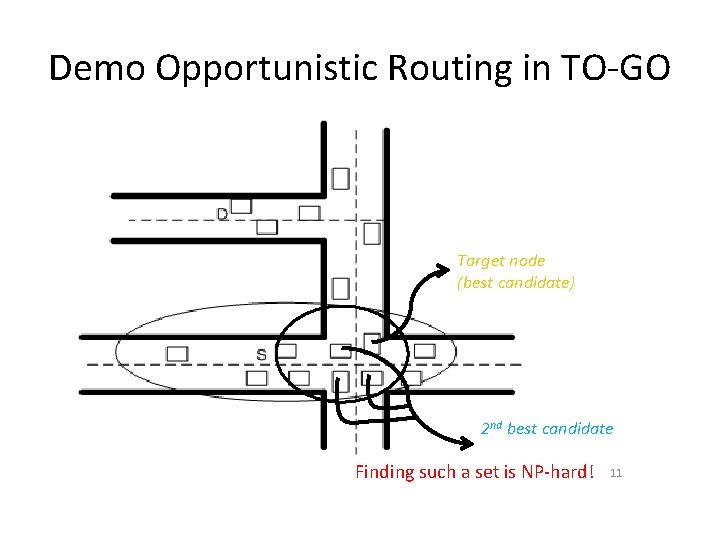
Demo Opportunistic Routing in TO-GO Target node (best candidate) 2 nd best candidate Finding such a set is NP-hard! 11
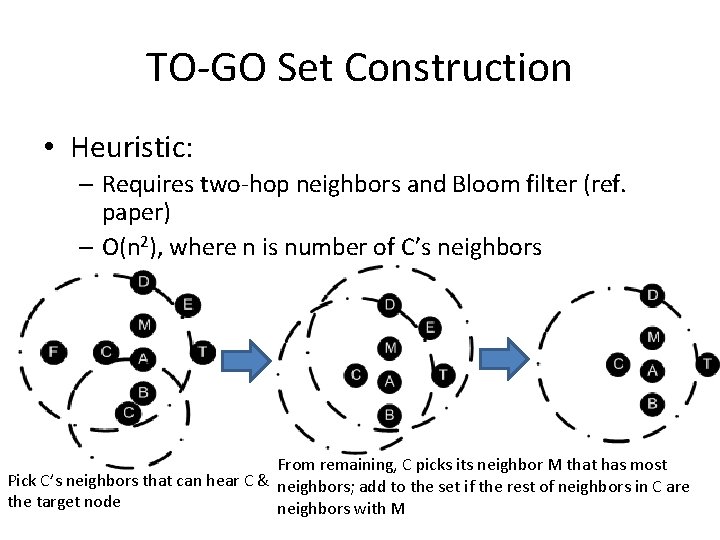
TO-GO Set Construction • Heuristic: – Requires two-hop neighbors and Bloom filter (ref. paper) – O(n 2), where n is number of C’s neighbors From remaining, C picks its neighbor M that has most Pick C’s neighbors that can hear C & neighbors; add to the set if the rest of neighbors in C are the target node neighbors with M
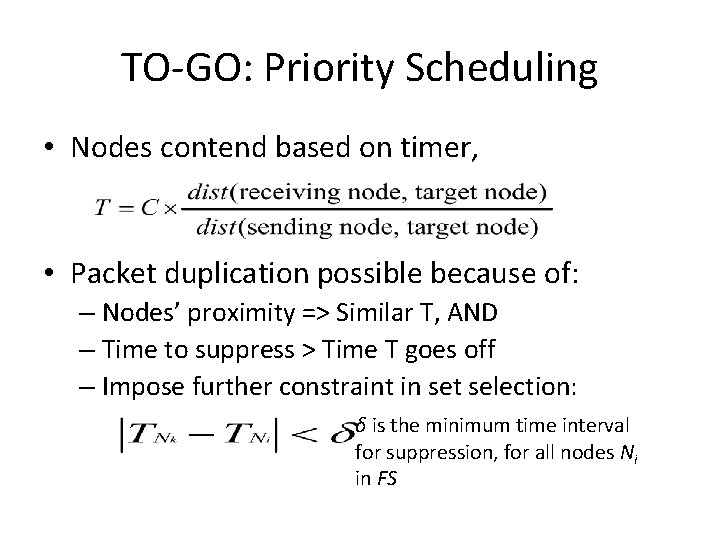
TO-GO: Priority Scheduling • Nodes contend based on timer, • Packet duplication possible because of: – Nodes’ proximity => Similar T, AND – Time to suppress > Time T goes off – Impose further constraint in set selection: δ is the minimum time interval for suppression, for all nodes Ni in FS
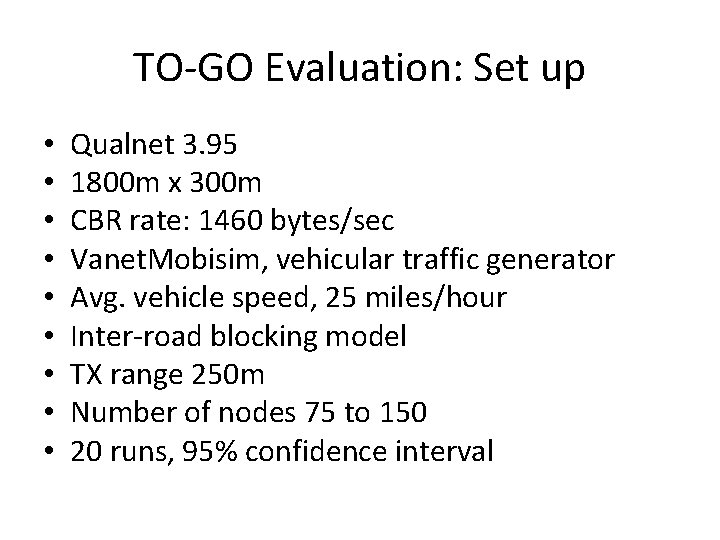
TO-GO Evaluation: Set up • • • Qualnet 3. 95 1800 m x 300 m CBR rate: 1460 bytes/sec Vanet. Mobisim, vehicular traffic generator Avg. vehicle speed, 25 miles/hour Inter-road blocking model TX range 250 m Number of nodes 75 to 150 20 runs, 95% confidence interval
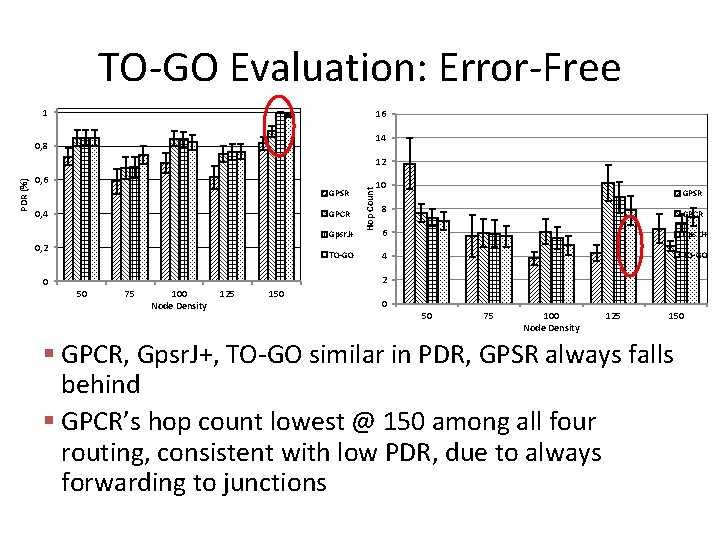
TO-GO Evaluation: Error-Free 1 16 14 0, 8 0, 6 GPSR 0, 4 GPCR Gpsr. J+ 0, 2 TO-GO Hop Count PDR (%) 12 10 GPSR 8 GPCR 6 Gpsr. J+ 4 TO-GO 2 0 50 75 100 Node Density 125 150 § GPCR, Gpsr. J+, TO-GO similar in PDR, GPSR always falls behind § GPCR’s hop count lowest @ 150 among all four routing, consistent with low PDR, due to always forwarding to junctions
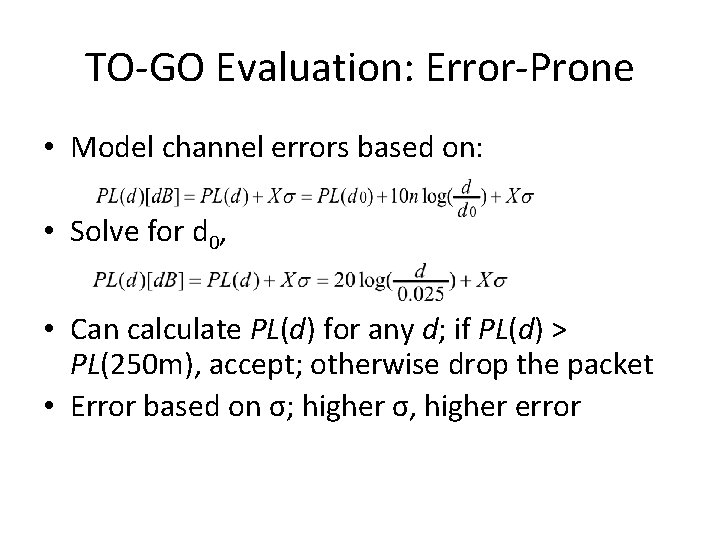
TO-GO Evaluation: Error-Prone • Model channel errors based on: • Solve for d 0, • Can calculate PL(d) for any d; if PL(d) > PL(250 m), accept; otherwise drop the packet • Error based on σ; higher σ, higher error
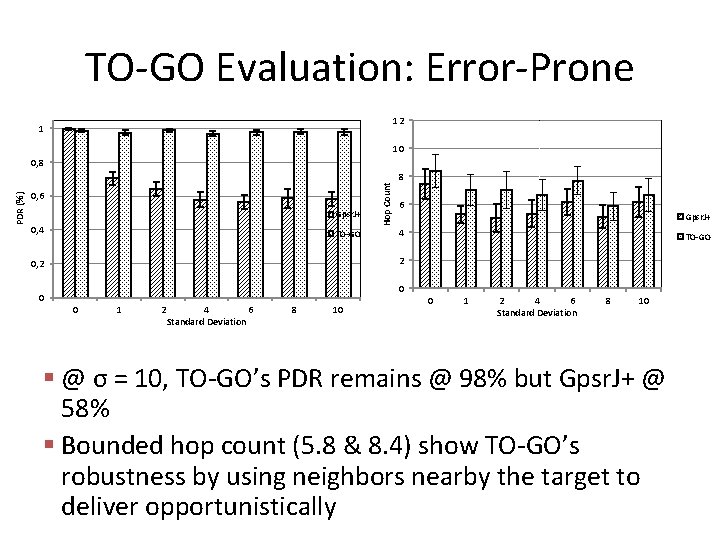
TO-GO Evaluation: Error-Prone 12 1 10 0, 6 Gpsr. J+ 0, 4 TO-GO Hop Count PDR (%) 0, 8 8 6 Gpsr. J+ 4 TO-GO 2 0, 2 0 0 0 1 2 4 6 Standard Deviation 8 10 § @ σ = 10, TO-GO’s PDR remains @ 98% but Gpsr. J+ @ 58% § Bounded hop count (5. 8 & 8. 4) show TO-GO’s robustness by using neighbors nearby the target to deliver opportunistically
Conclusion • TO-GO: A geographic opportunistic routing protocol that exploits – road-topology information – opportunistic packet reception • Forwarding set and priority scheduling to make sure no packet duplication • Junction lookahead to reduce hop count
- Slides: 18