
Together from the beginning child care Summary messages
Together from the beginning: child care Summary, messages and implications for child health services
Summary � Video deals with the intimate relationship between the mother and infant � Starts in-utero: � Unborn child is able to sense the mother � Highlights ill effects of maternal substance abuse � Following birth the baby gets to know his/ her mother through sensory stimulation
Summary � Babies enjoy being touched and experience a sense of security when held by their mothers � They need to be picked up when distressed � Babies � Fear response to parental discord: and anxiety � Aggression � Happy and secure when their parents get along.
Summary � Babies experience separation anxiety when their mothers abruptly place them in the care of another individual � They experience a sense of security with strangers when their mother is present � When the mother is depressed the baby experiences: � Feelings of sadness � This can affect their growth � It is important that the mother seeks help and support
Summary � They need to be stimulated through: � Story telling/ talking � Songs � They need adequate nutrition which in turn impacts on their development e. g. crawling and walking � Fathers and siblings play an important role in their love and care
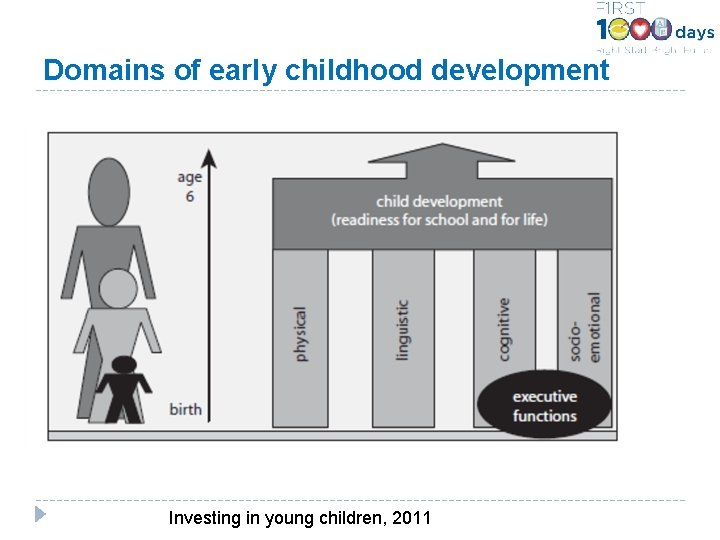
Domains of early childhood development Investing in young children, 2011
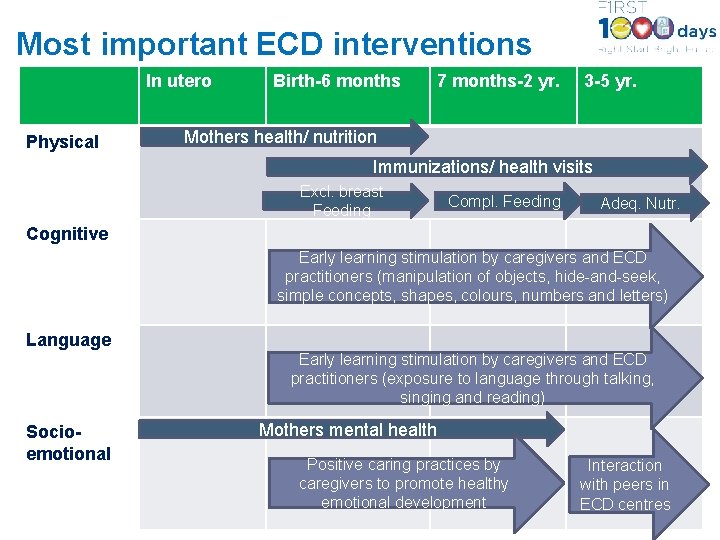
Most important ECD interventions In utero Physical Birth-6 months 7 months-2 yr. 3 -5 yr. Mothers health/ nutrition Immunizations/ health visits Excl. breast Feeding Compl. Feeding Adeq. Nutr. Cognitive Early learning stimulation by caregivers and ECD practitioners (manipulation of objects, hide-and-seek, simple concepts, shapes, colours, numbers and letters) Language Early learning stimulation by caregivers and ECD practitioners (exposure to language through talking, singing and reading) Socioemotional Mothers mental health Positive caring practices by caregivers to promote healthy emotional development Interaction with peers in ECD centres
What are the main messages?
Optimal maternal physical and mental health The relationship with the baby starts in pregnancy and the care that the mother will provide depends on her mental and physical well being � The physical and mental health of the mother is critical � Mothers must avoid alcohol, tobacco and drugs � Mothers should be supported to provide a loving, caring and nurturing environment for their unborn child � Important to identify and support the mother who is suffering from depression
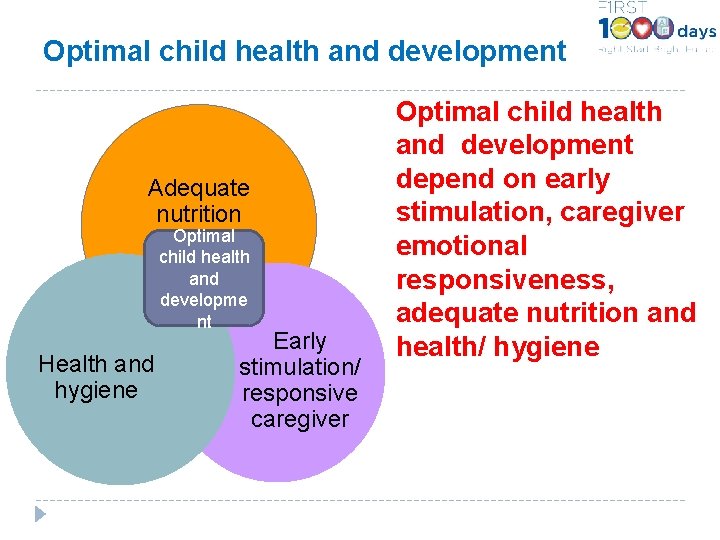
Optimal child health and development Adequate nutrition Optimal child health and developme nt Health and hygiene Early stimulation/ responsive caregiver Optimal child health and development depend on early stimulation, caregiver emotional responsiveness, adequate nutrition and health/ hygiene
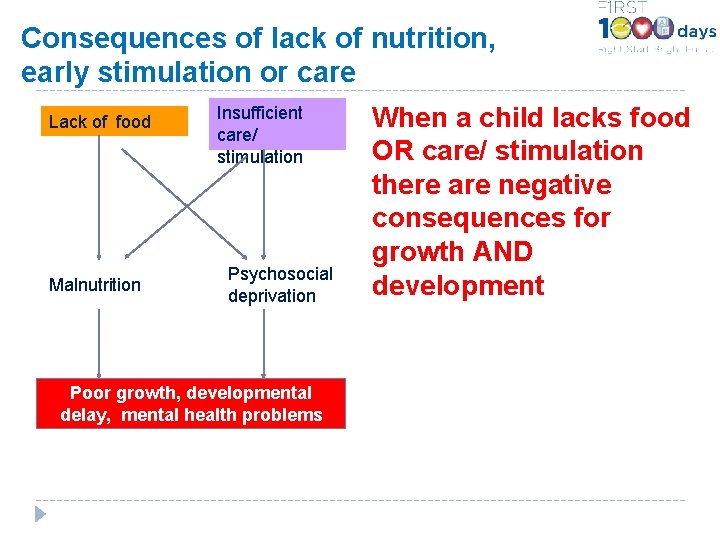
Consequences of lack of nutrition, early stimulation or care Lack of food Malnutrition Insufficient care/ stimulation Psychosocial deprivation Poor growth, developmental delay, mental health problems When a child lacks food OR care/ stimulation there are negative consequences for growth AND development
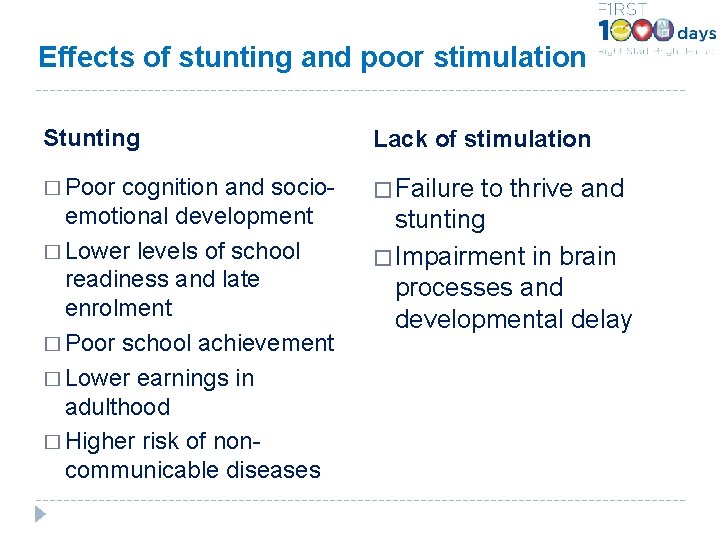
Effects of stunting and poor stimulation Stunting Lack of stimulation � Poor � Failure cognition and socioemotional development � Lower levels of school readiness and late enrolment � Poor school achievement � Lower earnings in adulthood � Higher risk of noncommunicable diseases to thrive and stunting � Impairment in brain processes and developmental delay
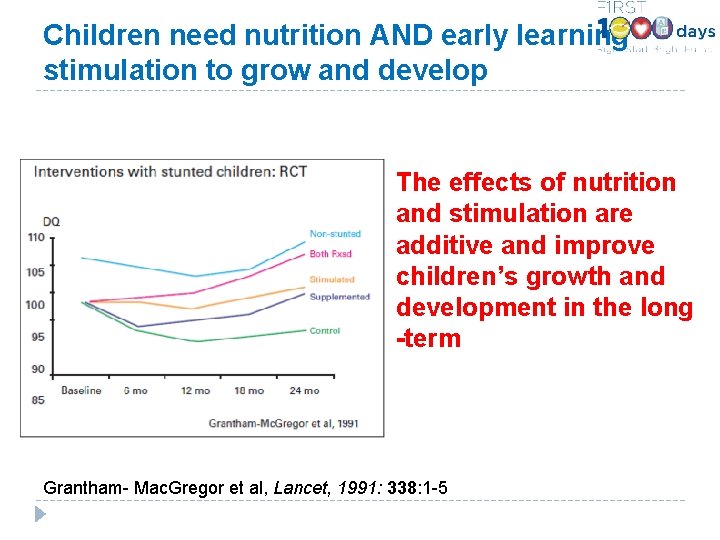
Children need nutrition AND early learning stimulation to grow and develop The effects of nutrition and stimulation are additive and improve children’s growth and development in the long -term Grantham- Mac. Gregor et al, Lancet, 1991: 338: 1 -5
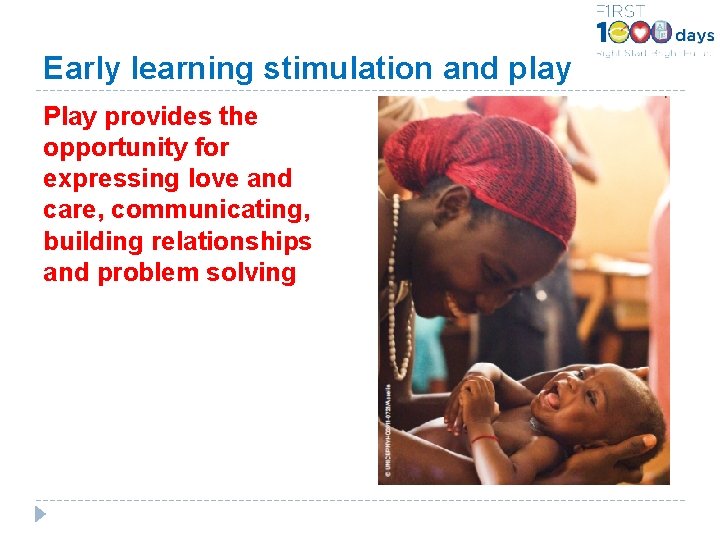
Early learning stimulation and play Play provides the opportunity for expressing love and care, communicating, building relationships and problem solving
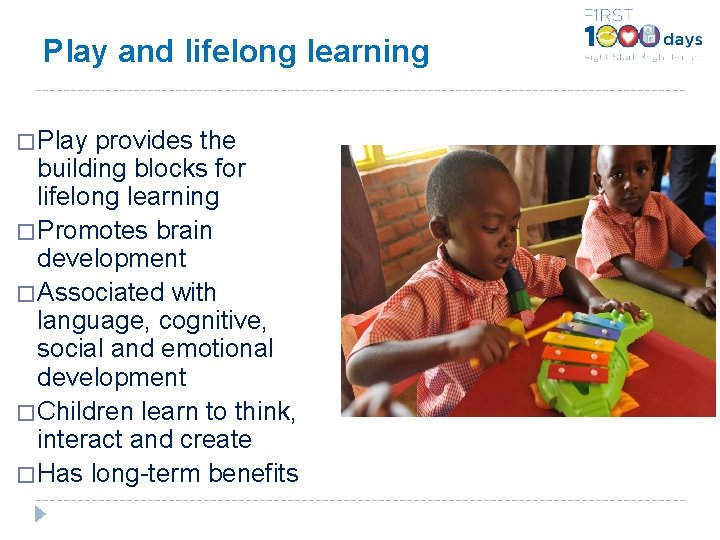
Play and lifelong learning � Play provides the building blocks for lifelong learning � Promotes brain development � Associated with language, cognitive, social and emotional development � Children learn to think, interact and create � Has long-term benefits
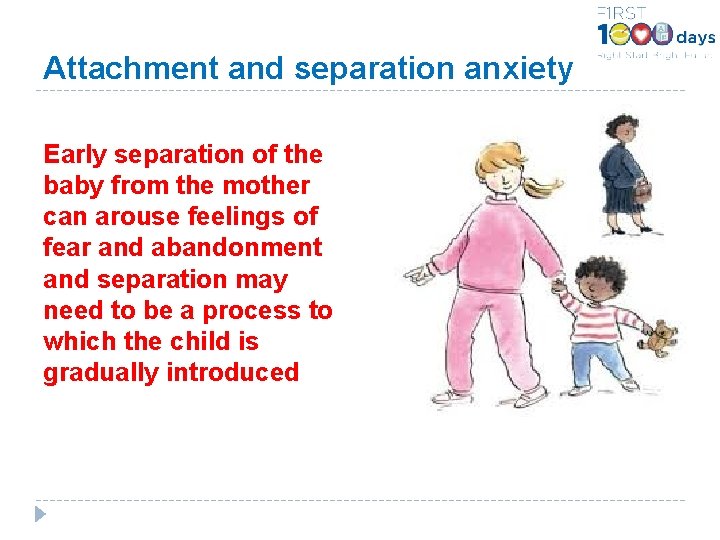
Attachment and separation anxiety Early separation of the baby from the mother can arouse feelings of fear and abandonment and separation may need to be a process to which the child is gradually introduced
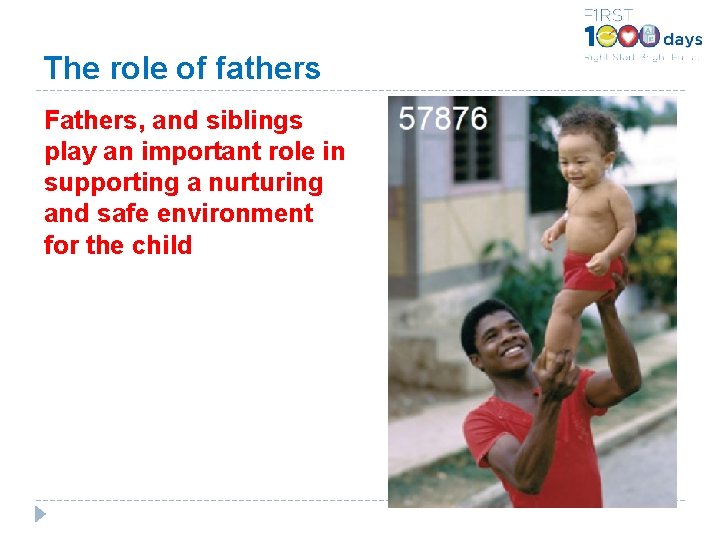
The role of fathers Fathers, and siblings play an important role in supporting a nurturing and safe environment for the child
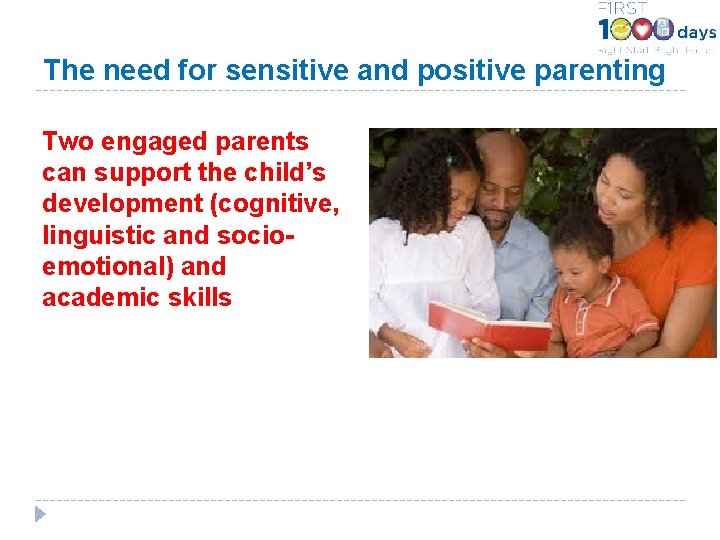
The need for sensitive and positive parenting Two engaged parents can support the child’s development (cognitive, linguistic and socioemotional) and academic skills
What are the implications for services
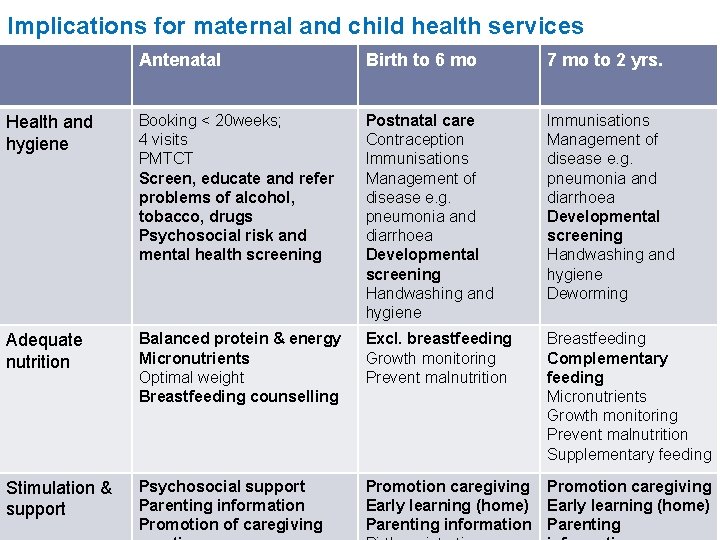
Implications for maternal and child health services Antenatal Birth to 6 mo 7 mo to 2 yrs. Health and hygiene Booking < 20 weeks; 4 visits PMTCT Screen, educate and refer problems of alcohol, tobacco, drugs Psychosocial risk and mental health screening Postnatal care Contraception Immunisations Management of disease e. g. pneumonia and diarrhoea Developmental screening Handwashing and hygiene Deworming Adequate nutrition Balanced protein & energy Micronutrients Optimal weight Breastfeeding counselling Excl. breastfeeding Growth monitoring Prevent malnutrition Breastfeeding Complementary feeding Micronutrients Growth monitoring Prevent malnutrition Supplementary feeding Stimulation & support Psychosocial support Parenting information Promotion of caregiving Promotion caregiving Early learning (home) Parenting information Parenting

Conclusions � The mother’s mental and physical health from the time of pregnancy impacts on her relationship with and the care she will provide to her child. � Adequate nutrition, caregiver responsiveness/ stimulation and health & hygiene are all needed to ensure optimal child health and development. � There is an essential package of ECD services and support that needs to be integrated into existing services.
References � Berry L, et al. South African Child Gauge 2013, Children’s Institute, University of Cape Town � UNICEF, WHO Integrating ECD into Nutrition Programmes in Emergencies, 2012 � Pria Britto, UNICEF. Play the basis of lifelong learning � World Bank. Investing in young children, 2011 � Grantham- Mac. Gregor et al, Lancet, 1991: 338: 1 -5
No involvement, no commitment! Thank You
- Slides: 24