
TOEIC Skills Strategies to improve your reading scores





- Slides: 56
TOEIC Skills Strategies to improve your reading scores. 1. Part 5 Reading 2. Question Types 3. Speed 4. Plan for Improvement 5. Questions Edward Morrow Amanda Tomanek Global Teaching Fellows Tokyo International University
Part 1: Information You will have a worksheet for this first part of the workshop. If you have a question any time or you don’t understand something, please ask me or Amanda.
How did you study for the TOEIC test? How do you study for the TOEIC test? • Don’t study any TOEIC material at all. (I only study English at school. ) • I use TOEIC books written in Japanese. • I use TOEIC books written in English. • I take special TOEIC classes.
Part 2: Strategies for Part 5 • A lot of books talk about strategies for Part 5 of the reading test. • I have looked at several books in both English and Japanese and they basically talk about the same things • Here are some things to think about 1) How are the test questions designed. 2) How to recognize the test questions. 3) Do the easy questions first for better time management
Let’s look at some short term strategies. Identifying question types.
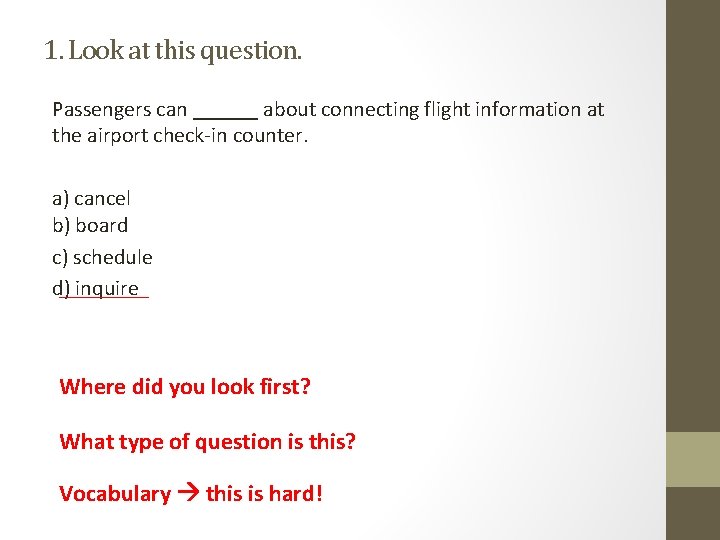
1. Look at this question. Passengers can ______ about connecting flight information at the airport check-in counter. a) cancel b) board c) schedule _____ d) inquire Where did you look first? What type of question is this? Vocabulary this is hard!
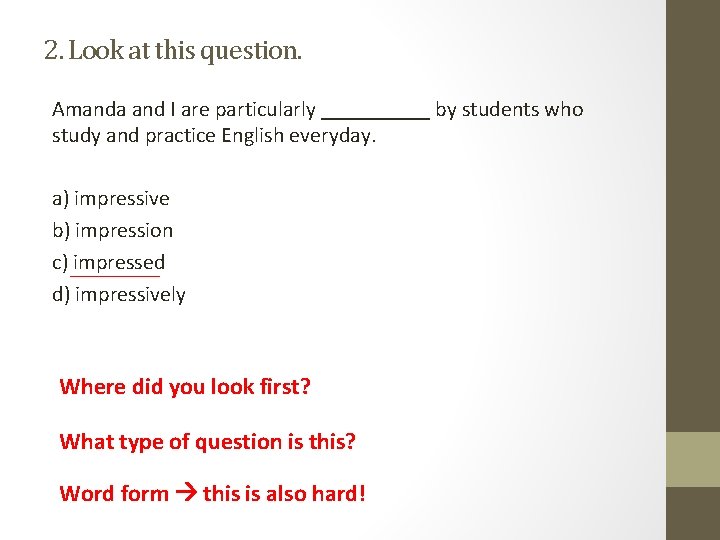
2. Look at this question. Amanda and I are particularly _____ by students who study and practice English everyday. a) impressive b) impression c) impressed _____ d) impressively Where did you look first? What type of question is this? Word form this is also hard!
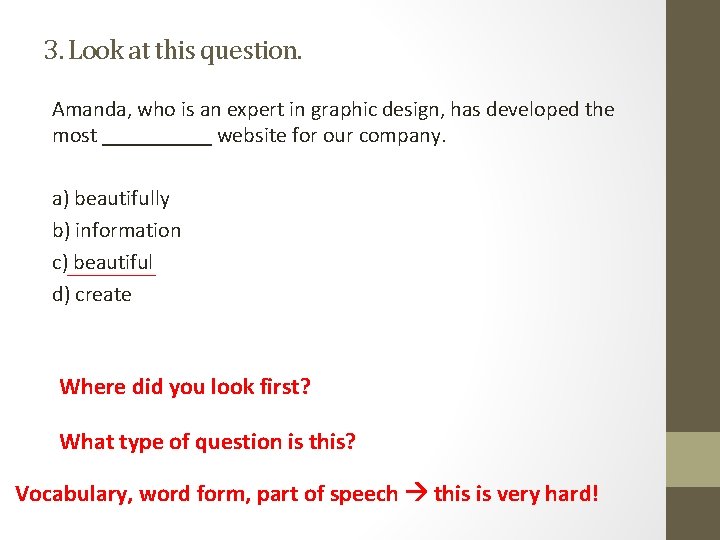
3. Look at this question. Amanda, who is an expert in graphic design, has developed the most _____ website for our company. a) beautifully b) information c) beautiful _____ d) create Where did you look first? What type of question is this? Vocabulary, word form, part of speech this is very hard!
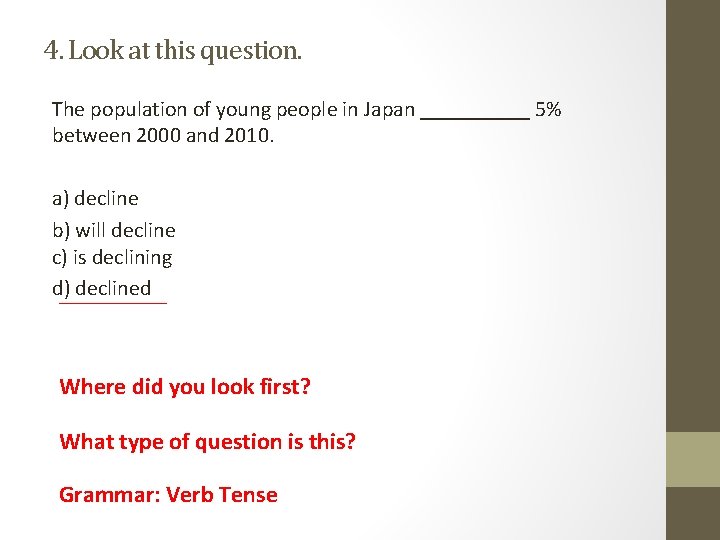
4. Look at this question. The population of young people in Japan _____ 5% between 2000 and 2010. a) decline b) will decline c) is declining d) declined ______ Where did you look first? What type of question is this? Grammar: Verb Tense
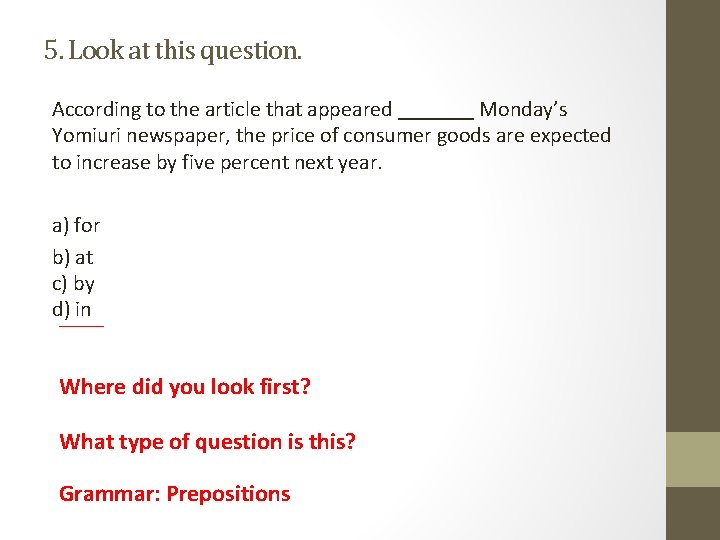
5. Look at this question. According to the article that appeared _______ Monday’s Yomiuri newspaper, the price of consumer goods are expected to increase by five percent next year. a) for b) at c) by d) in _____ Where did you look first? What type of question is this? Grammar: Prepositions
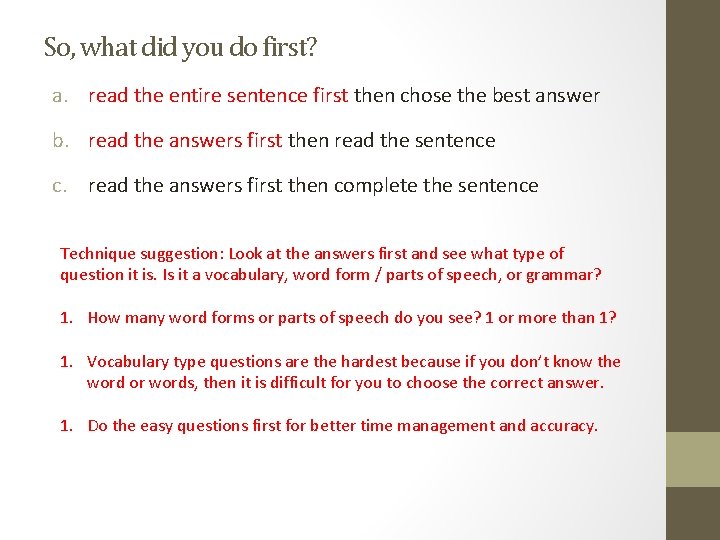
So, what did you do first? a. read the entire sentence first then chose the best answer b. read the answers first then read the sentence c. read the answers first then complete the sentence Technique suggestion: Look at the answers first and see what type of question it is. Is it a vocabulary, word form / parts of speech, or grammar? 1. How many word forms or parts of speech do you see? 1 or more than 1? 1. Vocabulary type questions are the hardest because if you don’t know the word or words, then it is difficult for you to choose the correct answer. 1. Do the easy questions first for better time management and accuracy.
Strategy 1: Read the answer choices first. This will tell you the type of question. Part 5 of the TOEIC Reading is testing your knowledge of: 1. Parts of speech and word forms. 2. Grammar: verb tenses, prepositions, conjunctions, other. 3. Vocabulary: This is the hardest! The goal for you is to do Part 5 really fast. The Strategies for Part 5 can also be used for Part 6. The goal is to do Parts 5 and 6 in 20 to 30 minutes because Part 7 takes a lot of time to do!
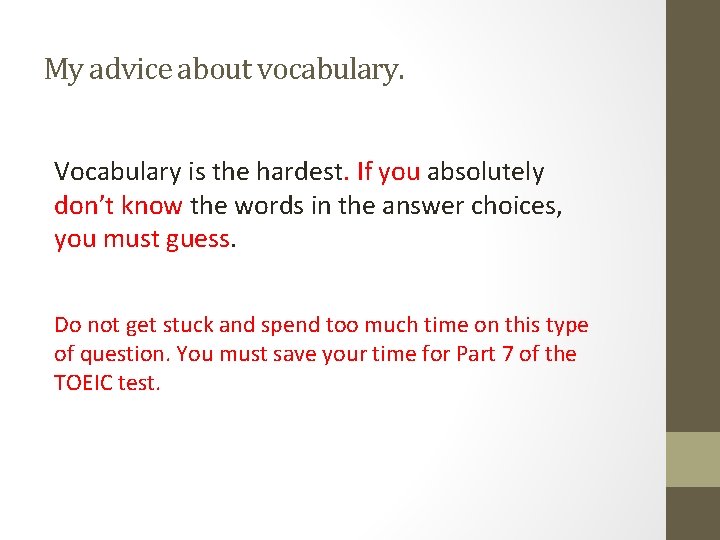
My advice about vocabulary. Vocabulary is the hardest. If you absolutely don’t know the words in the answer choices, you must guess. Do not get stuck and spend too much time on this type of question. You must save your time for Part 7 of the TOEIC test.
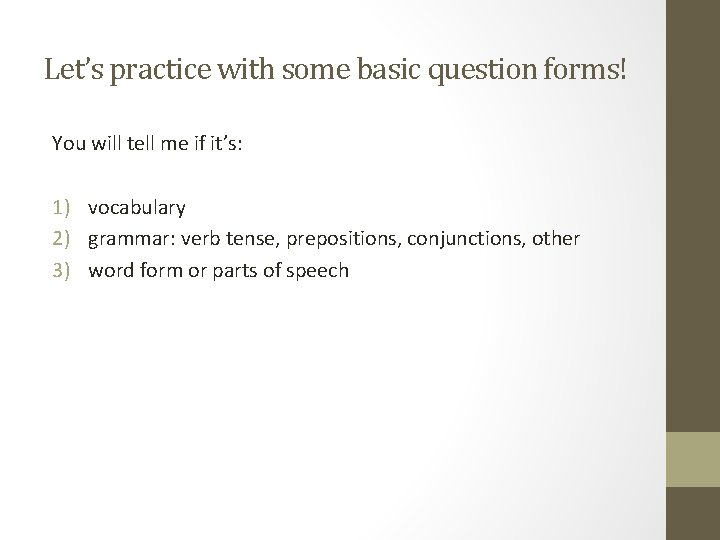
Let’s practice with some basic question forms! You will tell me if it’s: 1) vocabulary 2) grammar: verb tense, prepositions, conjunctions, other 3) word form or parts of speech
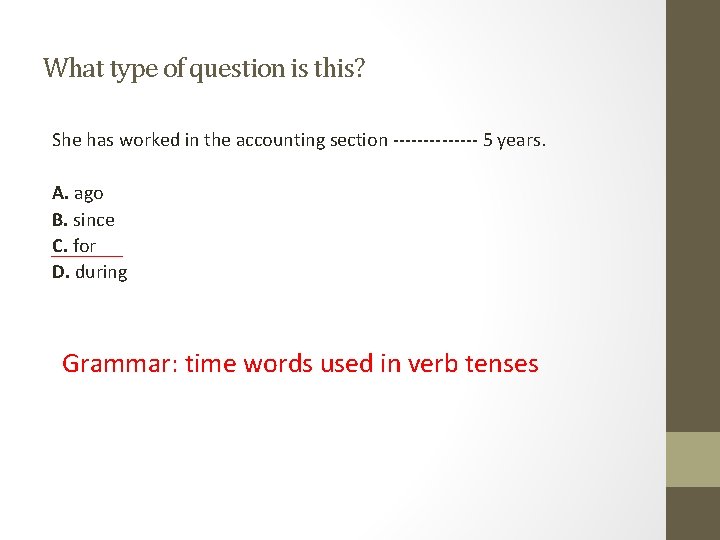
What type of question is this? She has worked in the accounting section ------- 5 years. A. ago B. since C. for ____ D. during Grammar: time words used in verb tenses
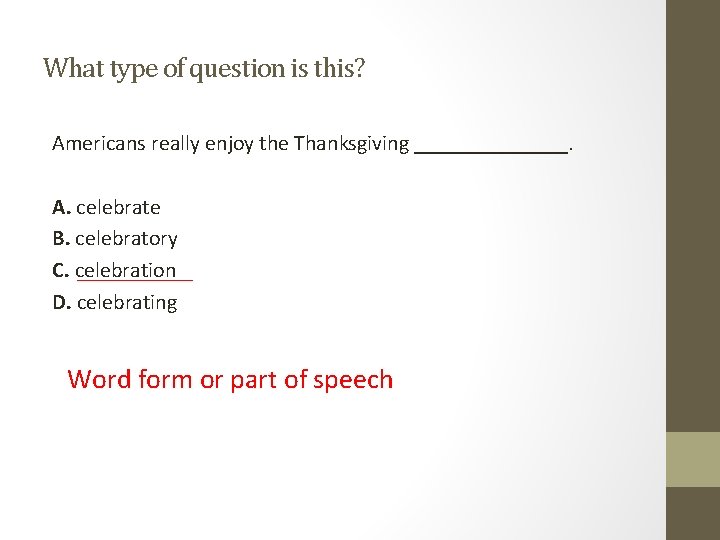
What type of question is this? Americans really enjoy the Thanksgiving _______. A. celebrate B. celebratory C. celebration _______ D. celebrating Word form or part of speech
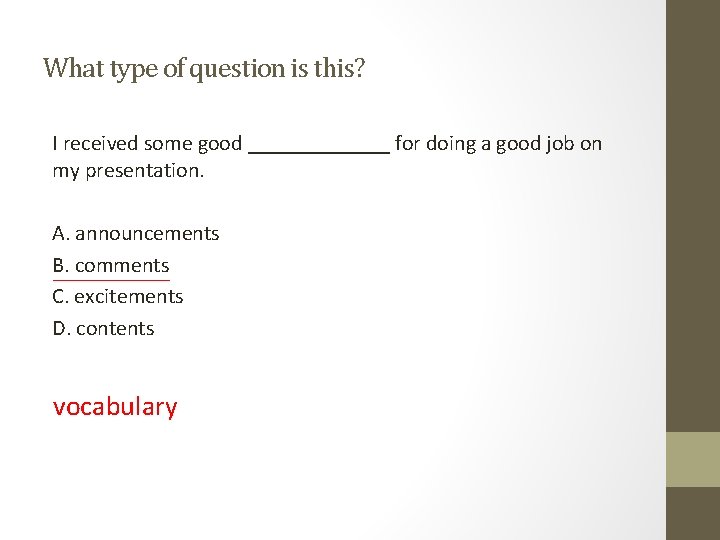
What type of question is this? I received some good _______ for doing a good job on my presentation. A. announcements B. comments _______ C. excitements D. contents vocabulary
Strategy 2: Separating and Deciding Once you learn the question types, you have to learn to separate them by types and their level of difficulty.
Activity! Separating Question Types Each group will have a set of TOEIC type questions. Separate the questions into three categories. 1. 2. 3. 4. Part of speech / word form Grammar: prepositions, verb tenses, conjunctions, other Vocabulary Combination
Strategy 3: Finding the easy ones. Try to find the easy ones in each group.
Activity! What are the easiest for you? 1. 2. 3. 4. parts of speech – word forms grammar vocabulary Combination You must choose only one.
Easiest to learn and study for the short term. Word forms and parts of speech.
Parts of Speech Type Questions Do not spend a lot of time on these questions. These are the easiest to do. These are the easiest to review before the test.
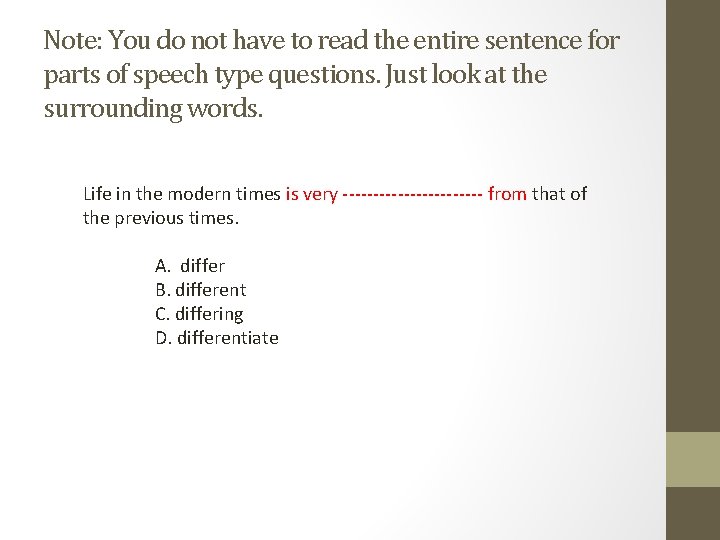
Note: You do not have to read the entire sentence for parts of speech type questions. Just look at the surrounding words. Life in the modern times is very ------------ from that of the previous times. A. differ B. different C. differing D. differentiate
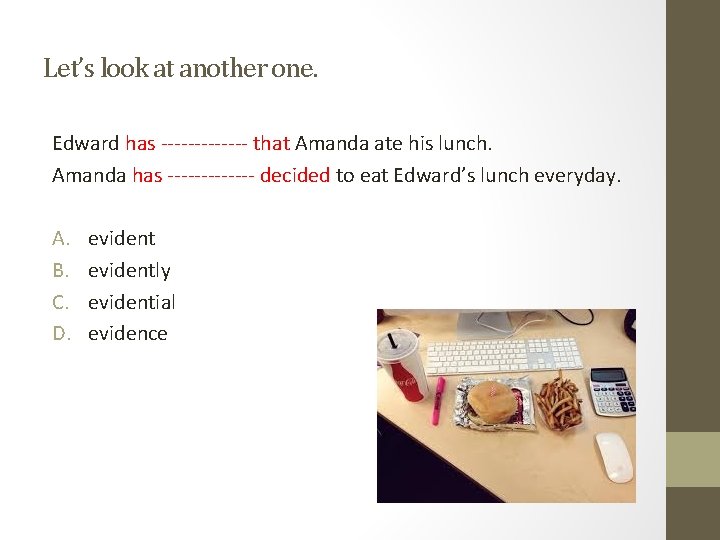
Let’s look at another one. Edward has ------- that Amanda ate his lunch. Amanda has ------- decided to eat Edward’s lunch everyday. A. B. C. D. evidently evidential evidence
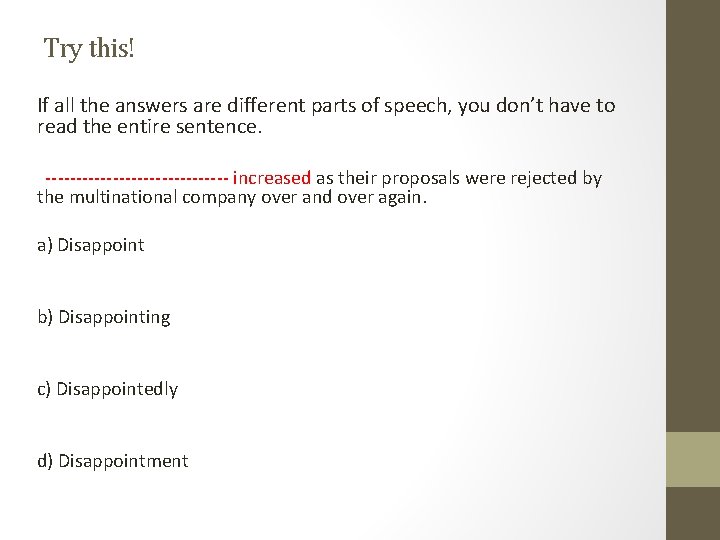
Try this! If all the answers are different parts of speech, you don’t have to read the entire sentence. --------------- increased as their proposals were rejected by the multinational company over and over again. a) Disappoint b) Disappointing c) Disappointedly d) Disappointment
Activity! • First, you must know what part of speech is missing. • Second, you must know the word forms. Let’s practice!
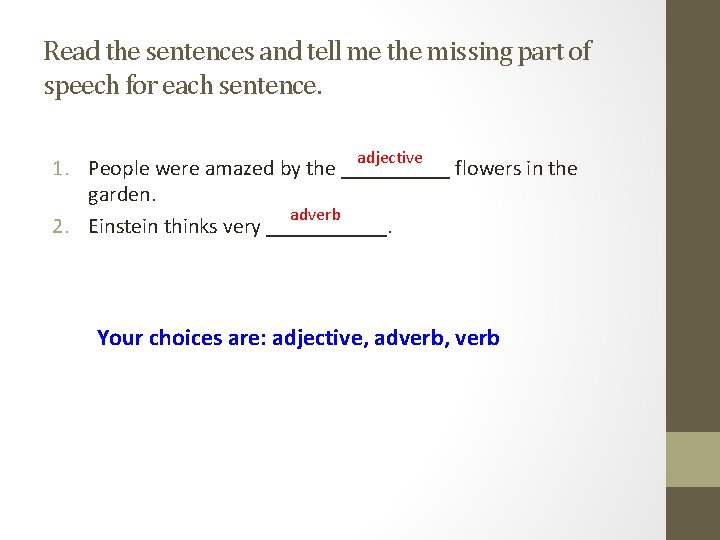
Read the sentences and tell me the missing part of speech for each sentence. adjective 1. People were amazed by the _____ flowers in the garden. adverb 2. Einstein thinks very ______. Your choices are: adjective, adverb, verb
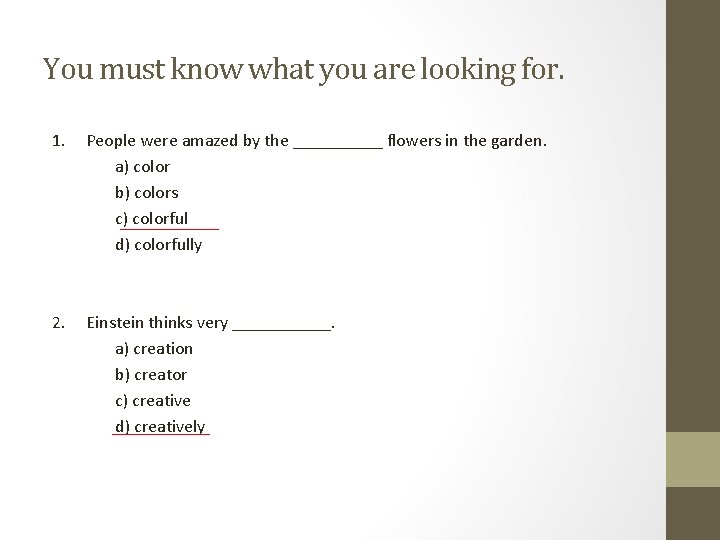
You must know what you are looking for. 1. People were amazed by the _____ flowers in the garden. a) color b) colors c) colorful ______ d) colorfully 2. Einstein thinks very ______. a) creation b) creator c) creative ______ d) creatively
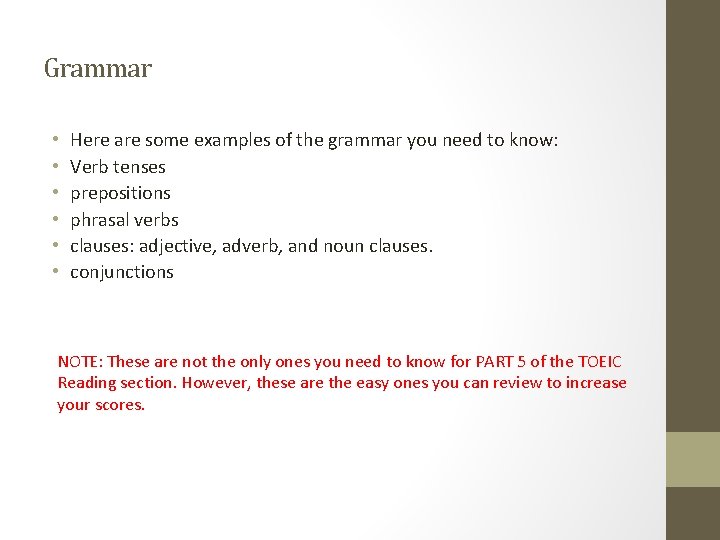
Grammar • • • Here are some examples of the grammar you need to know: Verb tenses prepositions phrasal verbs clauses: adjective, adverb, and noun clauses. conjunctions NOTE: These are not the only ones you need to know for PART 5 of the TOEIC Reading section. However, these are the easy ones you can review to increase your scores.
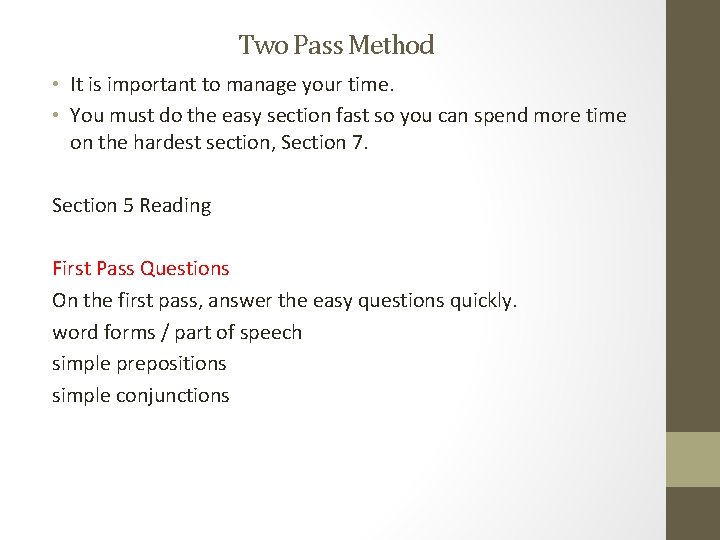
Two Pass Method • It is important to manage your time. • You must do the easy section fast so you can spend more time on the hardest section, Section 7. Section 5 Reading First Pass Questions On the first pass, answer the easy questions quickly. word forms / part of speech simple prepositions simple conjunctions
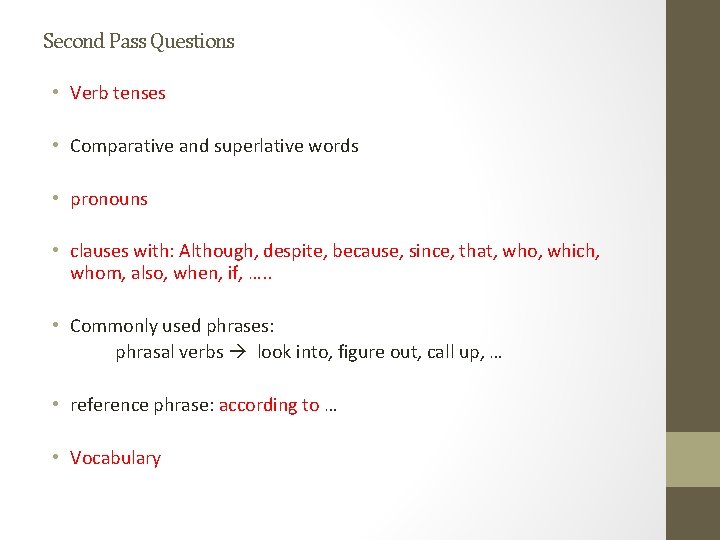
Second Pass Questions • Verb tenses • Comparative and superlative words • pronouns • clauses with: Although, despite, because, since, that, who, which, whom, also, when, if, …. . • Commonly used phrases: phrasal verbs look into, figure out, call up, … • reference phrase: according to … • Vocabulary
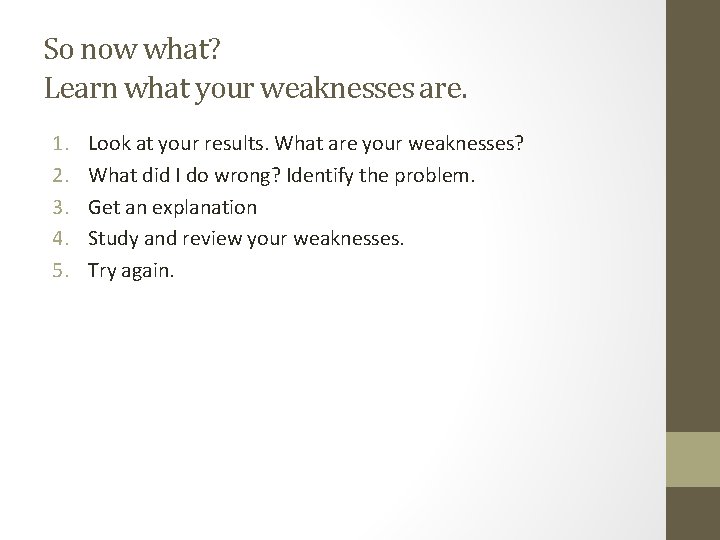
So now what? Learn what your weaknesses are. 1. 2. 3. 4. 5. Look at your results. What are your weaknesses? What did I do wrong? Identify the problem. Get an explanation Study and review your weaknesses. Try again.
Long Term Strategy
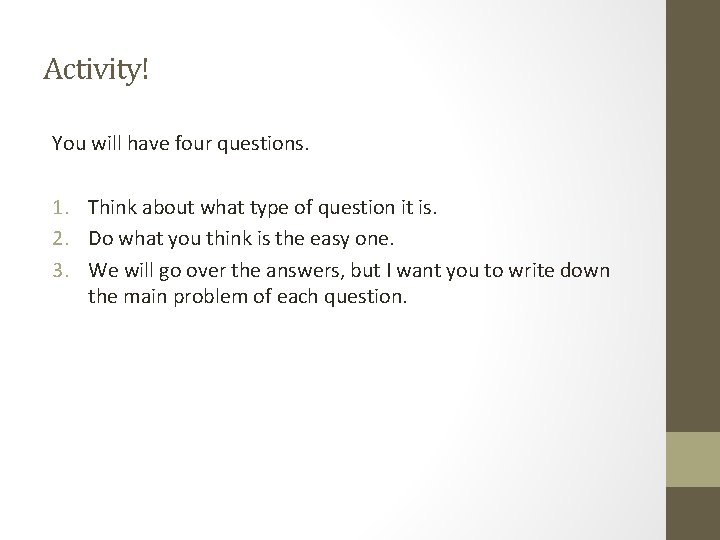
Activity! You will have four questions. 1. Think about what type of question it is. 2. Do what you think is the easy one. 3. We will go over the answers, but I want you to write down the main problem of each question.
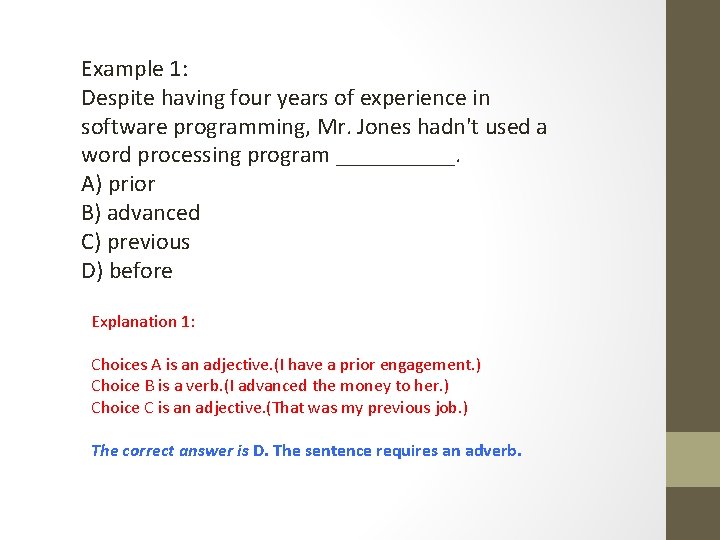
Example 1: Despite having four years of experience in software programming, Mr. Jones hadn't used a word processing program _____. A) prior B) advanced C) previous D) before Explanation 1: Choices A is an adjective. (I have a prior engagement. ) Choice B is a verb. (I advanced the money to her. ) Choice C is an adjective. (That was my previous job. ) The correct answer is D. The sentence requires an adverb.
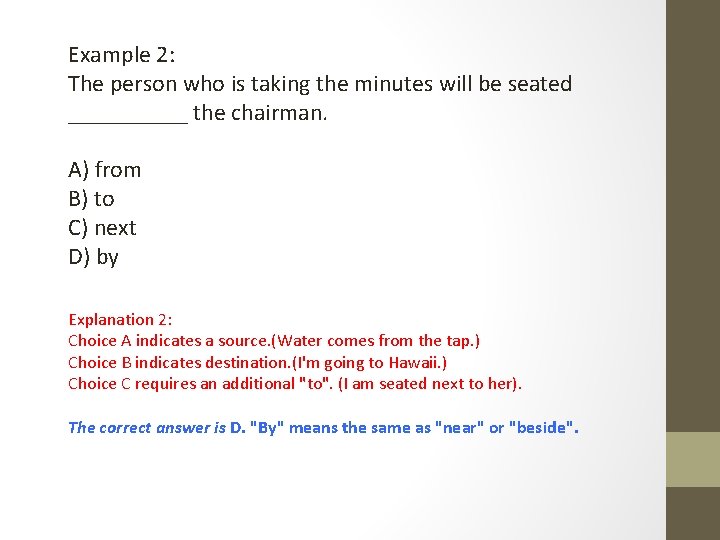
Example 2: The person who is taking the minutes will be seated _____ the chairman. A) from B) to C) next D) by Explanation 2: Choice A indicates a source. (Water comes from the tap. ) Choice B indicates destination. (I'm going to Hawaii. ) Choice C requires an additional "to". (I am seated next to her). The correct answer is D. "By" means the same as "near" or "beside".
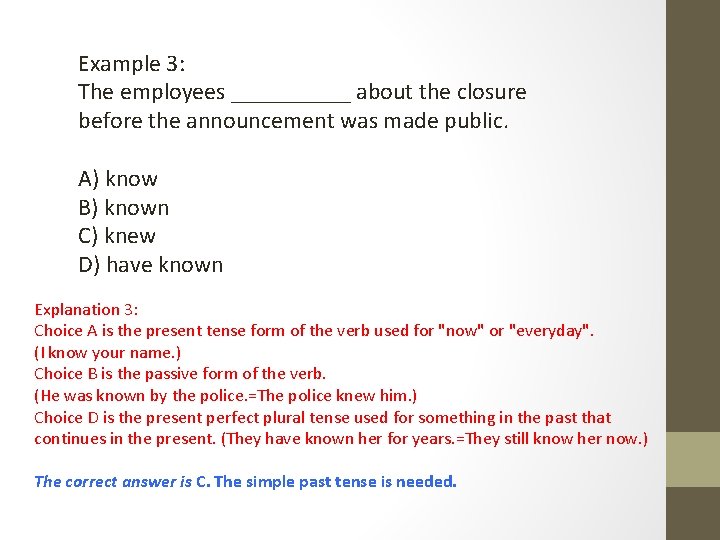
Example 3: The employees _____ about the closure before the announcement was made public. A) know B) known C) knew D) have known Explanation 3: Choice A is the present tense form of the verb used for "now" or "everyday". (I know your name. ) Choice B is the passive form of the verb. (He was known by the police. =The police knew him. ) Choice D is the present perfect plural tense used for something in the past that continues in the present. (They have known her for years. =They still know her now. ) The correct answer is C. The simple past tense is needed.
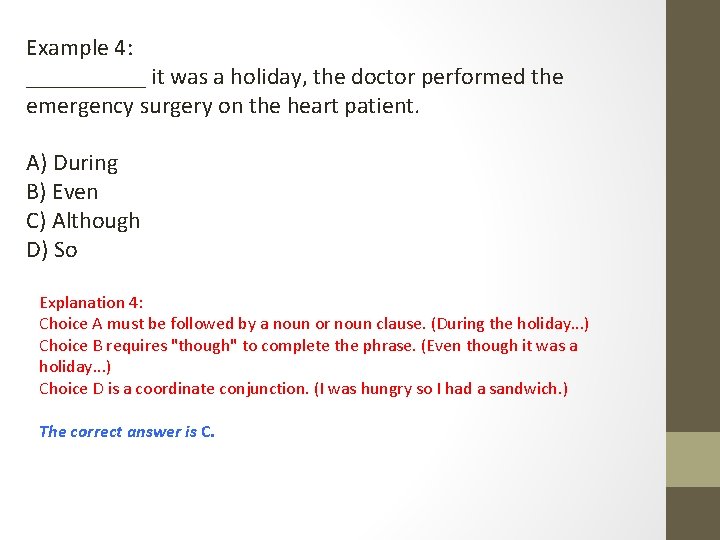
Example 4: _____ it was a holiday, the doctor performed the emergency surgery on the heart patient. A) During B) Even C) Although D) So Explanation 4: Choice A must be followed by a noun or noun clause. (During the holiday. . . ) Choice B requires "though" to complete the phrase. (Even though it was a holiday. . . ) Choice D is a coordinate conjunction. (I was hungry so I had a sandwich. ) The correct answer is C.
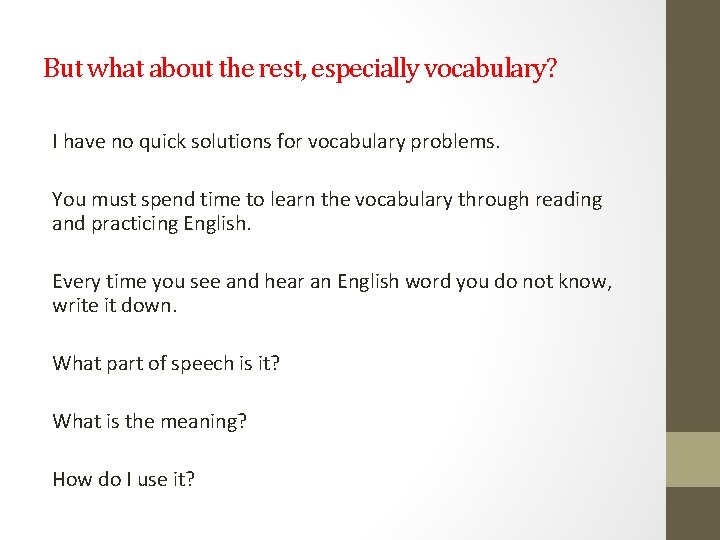
But what about the rest, especially vocabulary? I have no quick solutions for vocabulary problems. You must spend time to learn the vocabulary through reading and practicing English. Every time you see and hear an English word you do not know, write it down. What part of speech is it? What is the meaning? How do I use it?
My best vocabulary advice is practice using it! Students who score over 500 are those who take notes. They also read and write a lot. They also speak a lot. Even when you speak to other Japanese students, you must try with your best English. You must also try to fix your mistakes with the help of your instructors. We are here to help you.
Final note… • • • It is important to do Parts 5 and 6 very fast. Use the two pass method. Skip any difficult questions on the first pass. Go back to them on the second pass. Guess the vocabulary questions you don’t know. Learn your weaknesses and improve them. Learning vocabulary takes a lot of practice and time. Read, read, write, speak, speak …. . Ask questions Vocabulary journal
Handout of Word Forms If this is one of your weaknesses, please use this as a reference guide. Practice using these words in sentences. Find how they are used in books.
Questions?
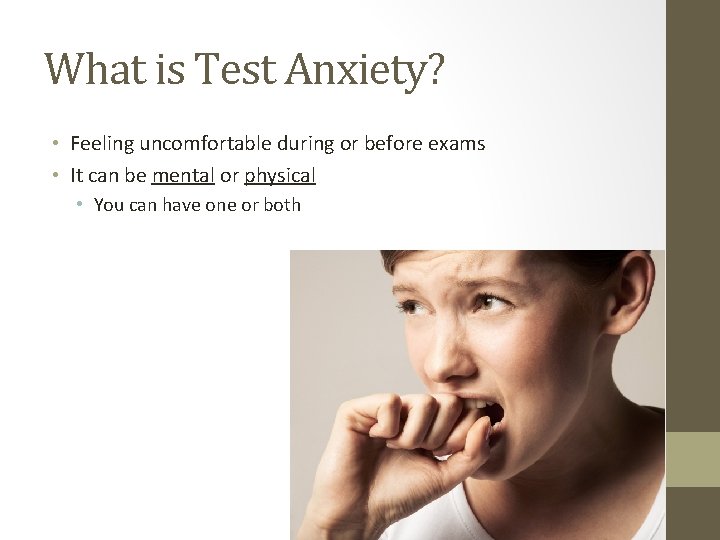
What is Test Anxiety? • Feeling uncomfortable during or before exams • It can be mental or physical • You can have one or both
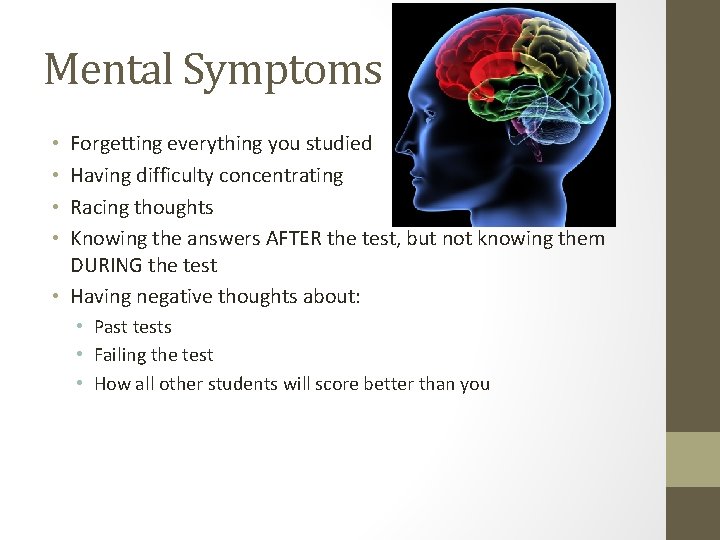
Mental Symptoms Forgetting everything you studied Having difficulty concentrating Racing thoughts Knowing the answers AFTER the test, but not knowing them DURING the test • Having negative thoughts about: • • • Past tests • Failing the test • How all other students will score better than you
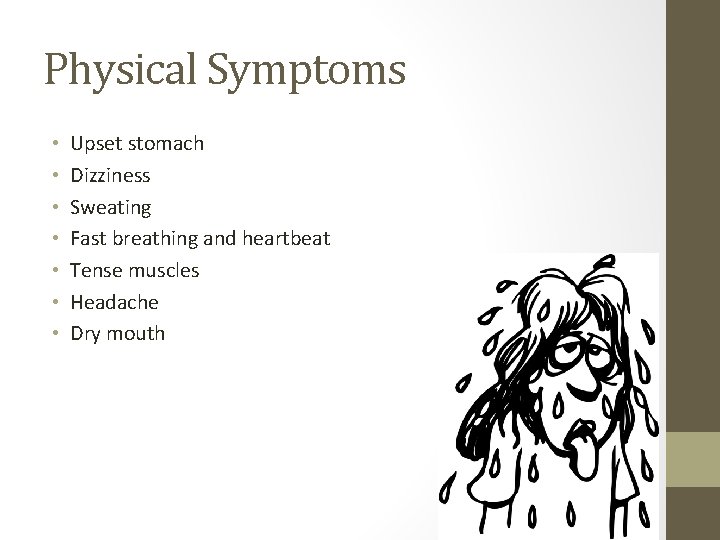
Physical Symptoms • • Upset stomach Dizziness Sweating Fast breathing and heartbeat Tense muscles Headache Dry mouth
Do you have test anxiety? • Have you ever experienced test anxiety? • What symptoms did you have? • Do you know how to overcome it? • Here’s some solutions from ETS (the people who make the TOEIC) and Amanda’s personal experience!
What to Do BEFORE the Test • Set up a study schedule • Do NOT cram the night before! • If you study well, you’ll feel more relaxed • Take practice tests • Knowing the format of the test will help you get in the right mindset • Be serious when you take the practice test. Just like an athlete preparing for a big race, the practice tests get your mind ready • Some research has shown students need to do at least EIGHT tests before they can do well on the TOEIC. This includes practice tests, so work hard on them!
What to Do BEFORE the Test • Visit the room ahead of time, if possible • See the room. Try sitting in a chair. This will get you more familiar with your surroundings. • Even if you can’t visit the room, sit in the same chair as you do in class (front, middle, back, etc) • Make a plan for what to do if you start having symptoms during the test • Having a plan will make it easier to calm down • Practice this plan beforehand so that it’s easy to do.
What to do DURING the test • The next slides are cause-effect slides to help you deal with problems in the test.
Negative Thoughts • If you start to have negative thoughts, repeat positive thoughts inside your head. • This will help you stay in a good mindset. • Choose your “mantra” ahead of time. • “I can do this. ” • “I know I’ll do well. ” • “I studied hard. I’ll be okay. ” • What will you say to yourself?
Your mind goes blank • “Action fights anxiety. ” Do some of the following things to get focused again: • • Close your eyes and count to five. Tap your pencil or fingers on your leg Tap your foot Change the section of the test you’re working on, if you’re doing the reading portion
You’re feeling panicked • Repeat your “mantra” • Remember, it should be positive words! • Take slow, deep breaths • Let’s practice! • Squeeze your hands into tight fists and then release them slowly. • Close your eyes and count to ten.
Want more practice? • We have a full practice test on WEDNESDAY in room 234, from 16: 30 -18: 30! Meet at the Information Desk at 16: 30. Sign up on the Workshop website!