
Toddler Development from age 1 3 Physical Ages
- Slides: 14
Toddler Development from age 1 -3
Physical �Ages 1 -3 �Height and Weight slow during these years � 12 -18 months children begin to climb � 2 years children can climb DOWN stairs �Skills in running, hopping and jumping increase � 18 -24 months children push wheeled toys �By the end of 2 they begin to pedal tricycles �Small motor skills are refined
Physical � 12 -18 month olds can stack 2 to 4 blocks and join a 2 piece puzzle together � 18 -36 months can put together a 6 piece puzzle and stack about 8 blocks �Develop more self help skills such as getting dressed, washing hands, eating with utensils, brushing teeth, and putting away toys �Toileting: when children are ready it usually takes a few days or a week.
Check for Understanding � Toddlers are ages ___ to ___. � 1 to 3 � Which area of development slows down during this time? � Height and Weight � By 12 -18 months children can climb up the stair, by what age can they come DOWN? � 2 years � What self help skills are being developed during this stage? � Feeding, getting dressed, washing hands, brushing teeth, cleaning up � When a toddler is ready, how long will toilet training take? � Few days to a week
Intellectual �Learn by doing and using senses �Ask “Why” questions �Use trial and error, repetition, and imitation to learn �ATTENTION SPAN: time spent focused on one activity �Increased memory of events, family members, and favorite stories or songs �SYMBOLIC THINKING: children understand that one thing can stand for something else �PREOPERATIONAL STAGE: Piaget’s second period of intellectual development (2 years-7 years)
Intellectual �Play make-believe and use their imagination �Imagination and creativity are natural products of symbolic thinking and this is a significant milestone in a child’s development. �LANGUAGE: � 18 months can respond yes or no, follow simple commands � 24 months- 50 words � 2 -3 year olds have a vocabulary of 50 -300 words and can name objects and follow more complex commands
Intellectual � RECEPTIVE LANGUAGE: understand spoken words � PRODUCTIVE LANGUAGE: spoken language � CONCEPTUAL DEVELOPMENT � Assimilation: children try to take in new information and try to make it fit what they already know and understand. � Accommodation: children change their thinking to make the new information fit � Understand similarities and differences � Learn Opposites � SEPARATION ANXIETY: separation from familiar people
Check for Understanding � Toddlers use t___ and e___ to learn as well as r______ and imitation. � Trial, error as well as repetition � The time spent on thinking is called the _____ span. � Attention � Understanding that one thing can mean something else is _______ thinking. � Symbolic � Toddlers development falls under P______ stage. � Piaget’s Preoperational Stage � I_______ and c_______ are natural products of symbolic thinking and this is a significant milestone in a child’s development. � Imagination and Creativity
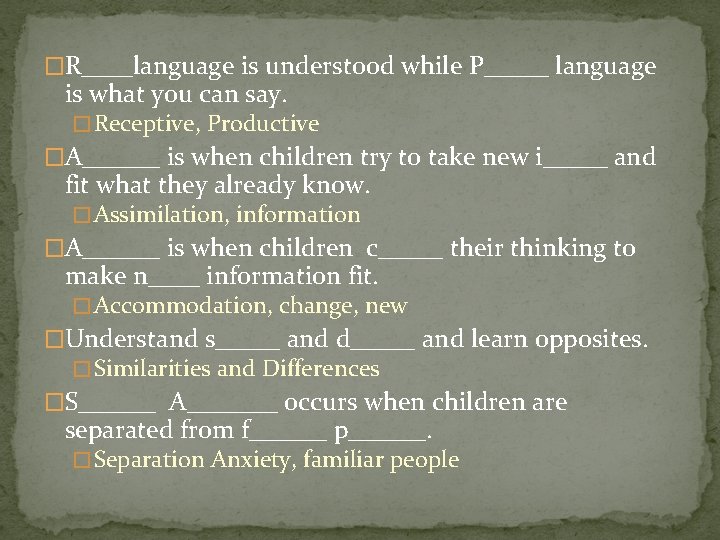
�R____language is understood while P_____ language is what you can say. � Receptive, Productive �A______ is when children try to take new i_____ and fit what they already know. � Assimilation, information �A______ is when children c_____ their thinking to make n____ information fit. � Accommodation, change, new �Understand s_____ and d_____ and learn opposites. � Similarities and Differences �S______ A_______ occurs when children are separated from f______ p______. � Separation Anxiety, familiar people
Emotional �Begin to develop emotional control �Mood swings �AUTOMONY: Erikson, develop a sense of independence �Emerging fears: storms, birds, being alone, animals, water, the dark, etc. �Sense of security is a primary emotional need �Stable routines help create security �Attachments to specific people can set the foundation for children’s future emotional and social development
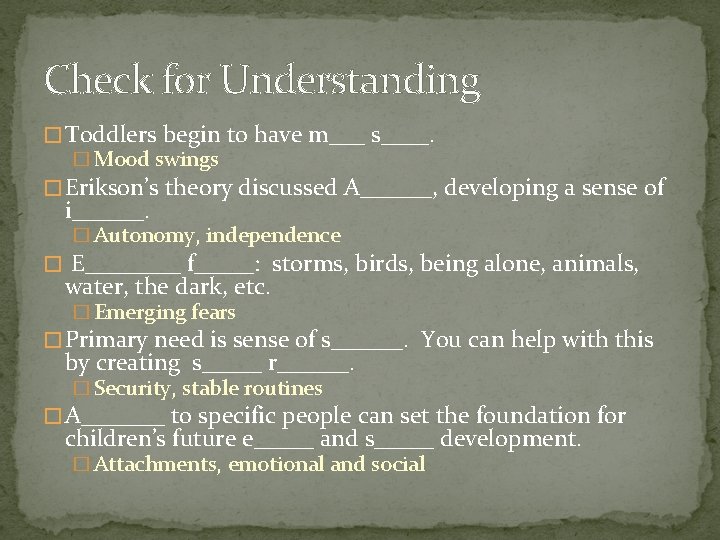
Check for Understanding � Toddlers begin to have m___ s____. � Mood swings � Erikson’s theory discussed A______, developing a sense of i______. � Autonomy, independence � E____ f_____: storms, birds, being alone, animals, water, the dark, etc. � Emerging fears � Primary need is sense of s______. You can help with this by creating s_____ r______. � Security, stable routines � A_______ to specific people can set the foundation for children’s future e_____ and s_____ development. � Attachments, emotional and social
Social �Social development is slow �At age 2, can take part in group activities with up to 8 children �Main social interactions continue to be with parents and adult caregivers �Begin making friends at age 2 �Show emotion is someone is hurting or crying �SOLITARY PLAY: playing alone �PARALLEL PLAY: playing near other children but with their own toys.
Social �As they approach 3 they begin to interact more with other children but for limited times. �Learn social skills such as using table manners, sharing, and cooperating.
Check for Understanding � Social development is s____. � slow � By age 2, children can take part in activities with up to e____ children. � eight � Main social interactions continue to be with p____ and c_____. � Parents and caregivers � Begin making friends by age t___. � two � S_____ play is when a child plays alone while P_____ occurs when two children are playing side by side. � Solitary, Parallel � Learn social skills such as t___ m____, sharing and c_____. � Table manners, cooperation