
Todays topics Probability Definitions Events Conditional probability Reading
Today’s topics • Probability – – – Definitions Events Conditional probability • Reading: Sections 5. 1 -5. 3 • Upcoming – Expected value Comp. Sci 102 © Michael Frank 12. 1
Why Probability? • In the real world, we often don’t know whether a given proposition is true or false. • Probability theory gives us a way to reason about propositions whose truth is uncertain. • It is useful in weighing evidence, diagnosing problems, and analyzing situations whose exact details are unknown. Comp. Sci 102 © Michael Frank 12. 2
Random Variables • A “random variable” V is any variable whose value is unknown, or whose value depends on the precise situation. – E. g. , the number of students in class today – Whether it will rain tonight (Boolean variable) • Let the domain of V be dom[V]≡{v 1, …, vn} – Infinite domains can also be dealt with if needed. • The proposition V=vi may have an uncertain truth value, and may be assigned a probability. Comp. Sci 102 © Michael Frank 12. 3
![Information Capacity • The information capacity I[V] of a random variable V with a](http://slidetodoc.com/presentation_image/8a761aae22b1018f29636a3a5be3ea35/image-4.jpg "Information Capacity • The information capacity I[V] of a random variable V with a")
Information Capacity • The information capacity I[V] of a random variable V with a finite domain can be defined as the logarithm (with indeterminate base) of the size of the domain of V, I[V] : ≡ log |dom[V]|. – The log’s base determines the associated information unit! • Taking the log base 2 yields an information unit of 1 bit b = log 2. – Related units include the nybble N = 4 b = log 16 (1 hexadecimal digit), – and more famously, the byte B = 8 b = log 256. • Other common logarithmic units that can be used as units of information: • – the nat, or e-fold n = log e, » widely known in thermodynamics as Boltzmann’s constant k. – the bel or decade or order of magnitude (D = log 10), – and the decibel or d. B = D/10 = (log 10)/10 ≈ log 1. 2589 Example: An 8 -bit register has 28 = 256 possible values. – Its information capacity is thus: log 256 = 8 log 2 = 8 b! • Or 2 N, or 1 B, or loge 256 ≈ 5. 545 n, or log 10256 = 2. 408 D, or 24. 08 d. B Comp. Sci 102 © Michael Frank 12. 4
Experiments & Sample Spaces • A (stochastic) experiment is any process by which a given random variable V gets assigned some particular value, and where this value is not necessarily known in advance. – We call it the “actual” value of the variable, as determined by that particular experiment. • The sample space S of the experiment is just the domain of the random variable, S = dom[V]. • The outcome of the experiment is the specific value vi of the random variable that is selected. Comp. Sci 102 © Michael Frank 12. 5
Events • An event E is any set of possible outcomes in S… – That is, E S = dom[V]. • E. g. , the event that “less than 50 people show up for our next class” is represented as the set {1, 2, …, 49} of values of the variable V = (# of people here next class). • We say that event E occurs when the actual value of V is in E, which may be written V E. – Note that V E denotes the proposition (of uncertain truth) asserting that the actual outcome (value of V) will be one of the outcomes in the set E. Comp. Sci 102 © Michael Frank 12. 6
![Probability • The probability p = Pr[E] [0, 1] of an event E is](http://slidetodoc.com/presentation_image/8a761aae22b1018f29636a3a5be3ea35/image-7.jpg "Probability • The probability p = Pr[E] [0, 1] of an event E is")
Probability • The probability p = Pr[E] [0, 1] of an event E is a real number representing our degree of certainty that E will occur. – If Pr[E] = 1, then E is absolutely certain to occur, • thus V E has the truth value True. – If Pr[E] = 0, then E is absolutely certain not to occur, • thus V E has the truth value False. – If Pr[E] = ½, then we are maximally uncertain about whether E will occur; that is, • V E and V E are considered equally likely. – How do we interpret other values of p? Note: We could also define probabilities for more general propositions, as well as events. Comp. Sci 102 © Michael Frank 12. 7
Four Definitions of Probability • Several alternative definitions of probability are commonly encountered: – Frequentist, Bayesian, Laplacian, Axiomatic • They have different strengths & weaknesses, philosophically speaking. – But fortunately, they coincide with each other and work well together, in the majority of cases that are typically encountered. Comp. Sci 102 © Michael Frank 12. 8
Probability: Frequentist Definition • The probability of an event E is the limit, as n→∞, of the fraction of times that we find V E over the course of n independent repetitions of (different instances of) the same experiment. • Some problems with this definition: – It is only well-defined for experiments that can be independently repeated, infinitely many times! • or at least, if the experiment can be repeated in principle, e. g. , over some hypothetical ensemble of (say) alternate universes. – It can never be measured exactly in finite time! • Advantage: It’s an objective, mathematical definition. Comp. Sci 102 © Michael Frank 12. 9
Probability: Bayesian Definition • Suppose a rational, profit-maximizing entity R is offered a choice between two rewards: – Winning $1 if and only if the event E actually occurs. – Receiving p dollars (where p [0, 1]) unconditionally. • If R can honestly state that he is completely indifferent between these two rewards, then we say that R’s probability for E is p, that is, Pr. R[E] : ≡ p. • Problem: It’s a subjective definition; depends on the reasoner R, and his knowledge, beliefs, & rationality. – The version above additionally assumes that the utility of money is linear. • This assumption can be avoided by using “utils” (utility units) instead of dollars. Comp. Sci 102 © Michael Frank 12. 10
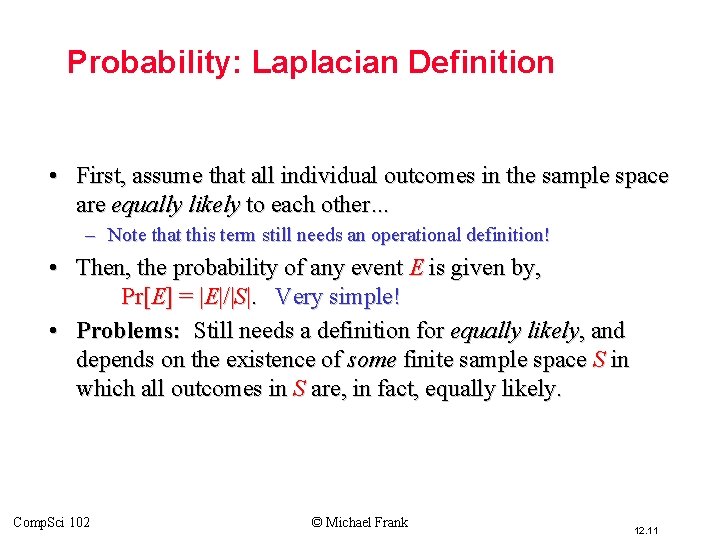
Probability: Laplacian Definition • First, assume that all individual outcomes in the sample space are equally likely to each other… – Note that this term still needs an operational definition! • Then, the probability of any event E is given by, Pr[E] = |E|/|S|. Very simple! • Problems: Still needs a definition for equally likely, and depends on the existence of some finite sample space S in which all outcomes in S are, in fact, equally likely. Comp. Sci 102 © Michael Frank 12. 11
![Probability: Axiomatic Definition • Let p be any total function p: S→[0, 1] such](http://slidetodoc.com/presentation_image/8a761aae22b1018f29636a3a5be3ea35/image-12.jpg "Probability: Axiomatic Definition • Let p be any total function p: S→[0, 1] such")
Probability: Axiomatic Definition • Let p be any total function p: S→[0, 1] such that ∑s p(s) = 1. • Such a p is called a probability distribution. • Then, the probability under p of any event E S is just: • Advantage: Totally mathematically well-defined! – This definition can even be extended to apply to infinite sample spaces, by changing ∑→∫, and calling p a probability density function or a probability measure. • Problem: Leaves operational meaning unspecified. Comp. Sci 102 © Michael Frank 12. 12
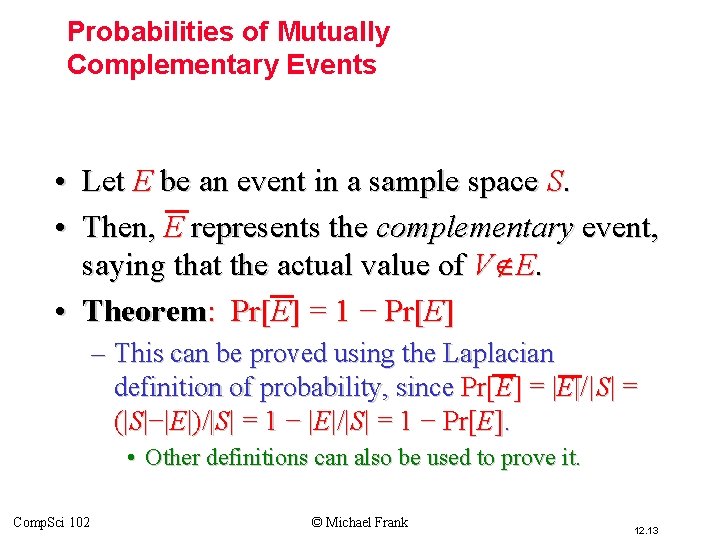
Probabilities of Mutually Complementary Events • Let E be an event in a sample space S. • Then, E represents the complementary event, saying that the actual value of V E. • Theorem: Pr[E] = 1 − Pr[E] – This can be proved using the Laplacian definition of probability, since Pr[E] = |E|/|S| = (|S|−|E|)/|S| = 1 − |E|/|S| = 1 − Pr[E]. • Other definitions can also be used to prove it. Comp. Sci 102 © Michael Frank 12. 13
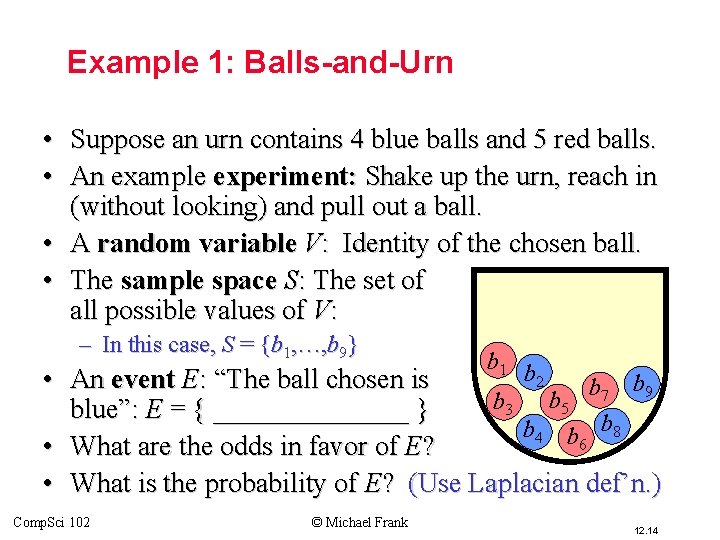
Example 1: Balls-and-Urn • Suppose an urn contains 4 blue balls and 5 red balls. • An example experiment: Shake up the urn, reach in (without looking) and pull out a ball. • A random variable V: Identity of the chosen ball. • The sample space S: The set of all possible values of V: – In this case, S = {b 1, …, b 9} b 1 b 2 b 7 b 9 b 3 b 5 b 4 b b 8 6 • An event E: “The ball chosen is blue”: E = { _______ } • What are the odds in favor of E? • What is the probability of E? (Use Laplacian def’n. ) Comp. Sci 102 © Michael Frank 12. 14
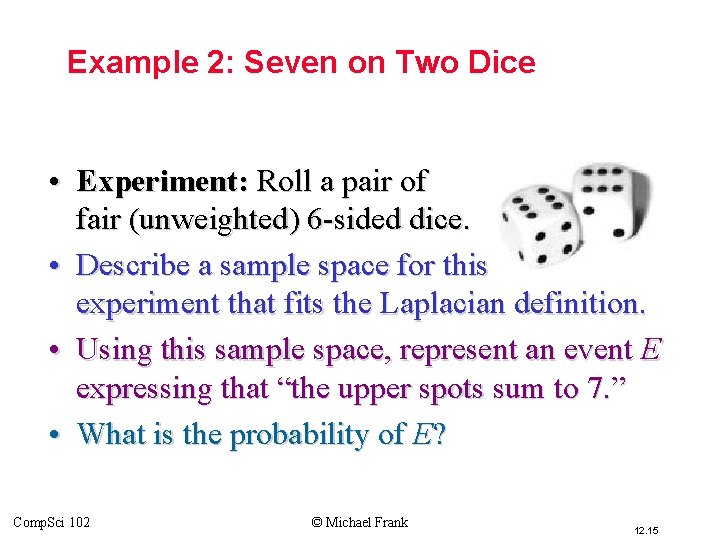
Example 2: Seven on Two Dice • Experiment: Roll a pair of fair (unweighted) 6 -sided dice. • Describe a sample space for this experiment that fits the Laplacian definition. • Using this sample space, represent an event E expressing that “the upper spots sum to 7. ” • What is the probability of E? Comp. Sci 102 © Michael Frank 12. 15
![Probability of Unions of Events • Let E 1, E 2 S = dom[V].](http://slidetodoc.com/presentation_image/8a761aae22b1018f29636a3a5be3ea35/image-16.jpg "Probability of Unions of Events • Let E 1, E 2 S = dom[V].")
Probability of Unions of Events • Let E 1, E 2 S = dom[V]. • Then we have: Theorem: Pr[E 1 E 2] = Pr[E 1] + Pr[E 2] − Pr[E 1 E 2] – By the inclusion-exclusion principle, together with the Laplacian definition of probability. • You should be able to easily flesh out the proof yourself at home. Comp. Sci 102 © Michael Frank 12. 16
Mutually Exclusive Events • Two events E 1, E 2 are called mutually exclusive if they are disjoint: E 1 E 2 = – Note that two mutually exclusive events cannot both occur in the same instance of a given experiment. • For mutually exclusive events, Pr[E 1 E 2] = Pr[E 1] + Pr[E 2]. – Follows from the sum rule of combinatorics. Comp. Sci 102 © Michael Frank 12. 17
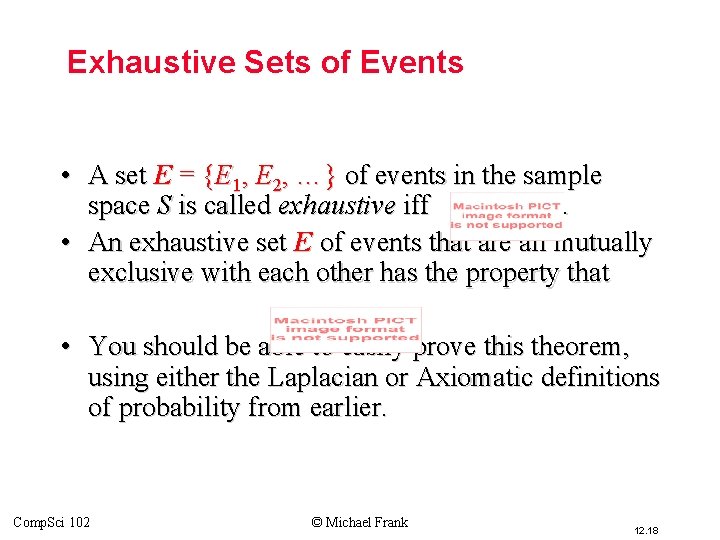
Exhaustive Sets of Events • A set E = {E 1, E 2, …} of events in the sample space S is called exhaustive iff. • An exhaustive set E of events that are all mutually exclusive with each other has the property that • You should be able to easily prove this theorem, using either the Laplacian or Axiomatic definitions of probability from earlier. Comp. Sci 102 © Michael Frank 12. 18
![Independent Events • Two events E, F are called independent if Pr[E F] =](http://slidetodoc.com/presentation_image/8a761aae22b1018f29636a3a5be3ea35/image-19.jpg "Independent Events • Two events E, F are called independent if Pr[E F] =")
Independent Events • Two events E, F are called independent if Pr[E F] = Pr[E]·Pr[F]. • Relates to the product rule for the number of ways of doing two independent tasks. • Example: Flip a coin, and roll a die. Pr[(coin shows heads) (die shows 1)] = Pr[coin is heads] × Pr[die is 1] = ½× 1/6 =1/12. Comp. Sci 102 © Michael Frank 12. 19
![Conditional Probability • Let E, F be any events such that Pr[F]>0. • Then,](http://slidetodoc.com/presentation_image/8a761aae22b1018f29636a3a5be3ea35/image-20.jpg "Conditional Probability • Let E, F be any events such that Pr[F]>0. • Then,")
Conditional Probability • Let E, F be any events such that Pr[F]>0. • Then, the conditional probability of E given F, written Pr[E|F], is defined as Pr[E|F] : ≡ Pr[E F]/Pr[F]. • This is what our probability that E would turn out to occur should be, if we are given only the information that F occurs. • If E and F are independent then Pr[E|F] = Pr[E]. �Pr[E|F] = Pr[E F]/Pr[F] = Pr[E]×Pr[F]/Pr[F] = Pr[E] Comp. Sci 102 © Michael Frank 12. 20
Prior and Posterior Probability • Suppose that, before you are given any information about the outcome of an experiment, your personal probability for an event E to occur is p(E) = Pr[E]. – The probability of E in your original probability distribution p is called the prior probability of E. • This is its probability prior to obtaining any information about the outcome. • Now, suppose someone tells you that some event F (which may overlap with E) actually occurred in the experiment. – Then, you should update your personal probability for event E to occur, to become p′(E) = Pr[E|F] = p(E∩F)/p(F). • The conditional probability of E, given F. – The probability of E in your new probability distribution p′ is called the posterior probability of E. • This is its probability after learning that event F occurred. • After seeing F, the posterior distribution p′ is defined by letting p′(v) = p({v}∩F)/p(F) for each individual outcome v S. Comp. Sci 102 © Michael Frank 12. 21
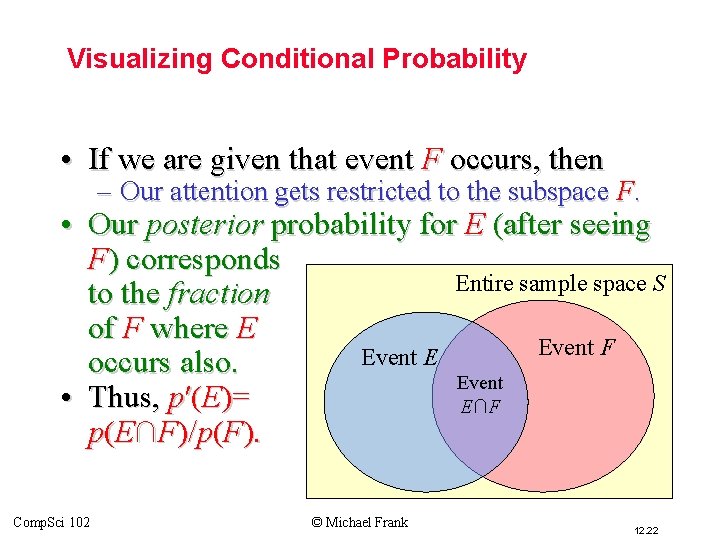
Visualizing Conditional Probability • If we are given that event F occurs, then – Our attention gets restricted to the subspace F. • Our posterior probability for E (after seeing F) corresponds Entire sample space S to the fraction of F where E Event F Event E occurs also. Event • Thus, p′(E)= E∩F p(E∩F)/p(F). Comp. Sci 102 © Michael Frank 12. 22
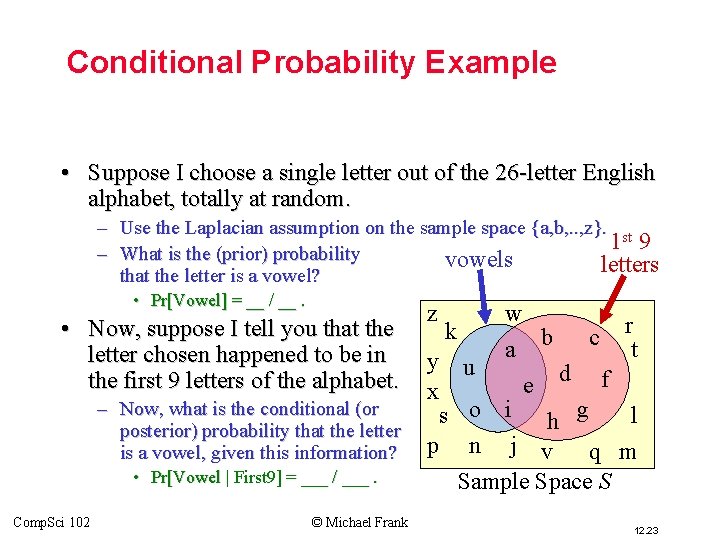
Conditional Probability Example • Suppose I choose a single letter out of the 26 -letter English alphabet, totally at random. – Use the Laplacian assumption on the sample space {a, b, . . , z}. st 1 9 – What is the (prior) probability vowels letters that the letter is a vowel? • Pr[Vowel] = __ / __. • Now, suppose I tell you that the letter chosen happened to be in the first 9 letters of the alphabet. – Now, what is the conditional (or posterior) probability that the letter is a vowel, given this information? • Pr[Vowel | First 9] = ___ / ___. Comp. Sci 102 © Michael Frank z w k b c a y u d f e x s o i h g p n j v q Sample Space S r t l m 12. 23
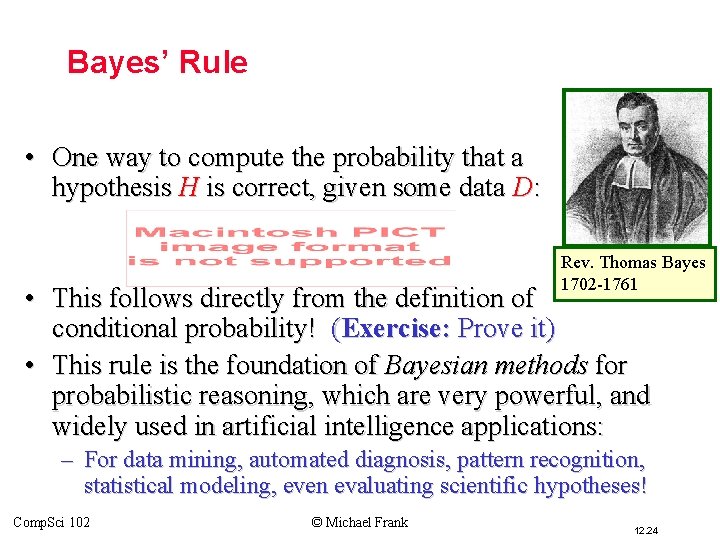
Bayes’ Rule • One way to compute the probability that a hypothesis H is correct, given some data D: Rev. Thomas Bayes 1702 -1761 • This follows directly from the definition of conditional probability! (Exercise: Prove it) • This rule is the foundation of Bayesian methods for probabilistic reasoning, which are very powerful, and widely used in artificial intelligence applications: – For data mining, automated diagnosis, pattern recognition, statistical modeling, even evaluating scientific hypotheses! Comp. Sci 102 © Michael Frank 12. 24
- Slides: 24