
Todays Topics Computer Science Program Execution Time Performance
- Slides: 9
Today’s Topics Computer Science Program Execution Time (Performance!) Upcoming Parallel Computing Great Ideas, Chapter 14 Reading Great Ideas, Chapter 13 CPS 001 36. 1
On the Limits of Computing v Reasons for Failure 1. 2. 3. v Complexity, N q q v v Runs too long o Real time requirements o Predicting yesterday's weather Non-computable ! Don't know the algorithm Time Space Tractable and Intractable Study of a Sorting Algorithm q q CPS 001 Sorting, Ordering Alphabetizing 36. 2
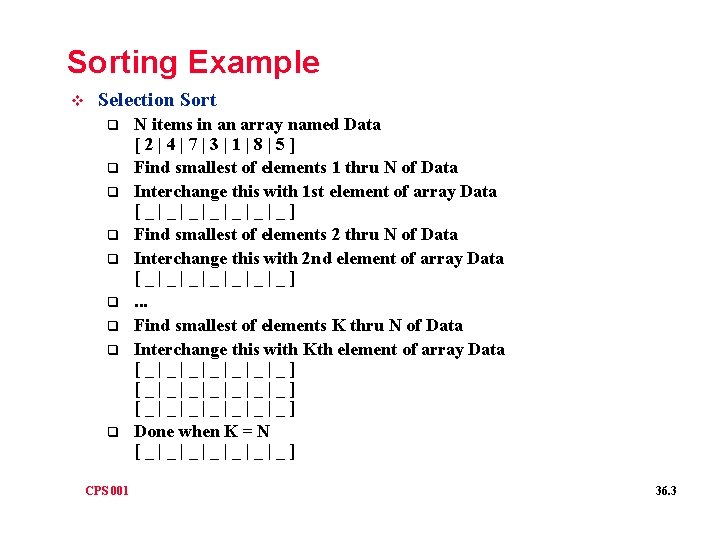
Sorting Example v Selection Sort q q q q q CPS 001 N items in an array named Data [2|4|7|3|1|8|5] Find smallest of elements 1 thru N of Data Interchange this with 1 st element of array Data [_|_|_|_] Find smallest of elements 2 thru N of Data Interchange this with 2 nd element of array Data [_|_|_|_]. . . Find smallest of elements K thru N of Data Interchange this with Kth element of array Data [_|_|_|_|_|_|_] [_|_|_|_] Done when K = N [_|_|_|_] 36. 3
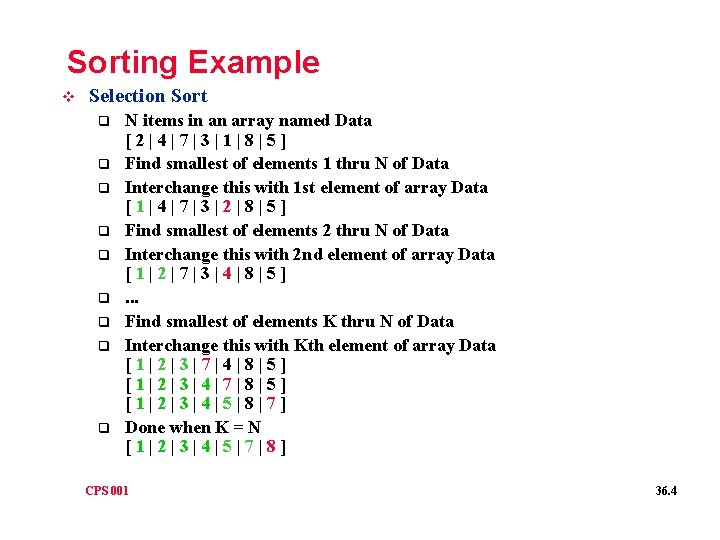
Sorting Example v Selection Sort q q q q q N items in an array named Data [2|4|7|3|1|8|5] Find smallest of elements 1 thru N of Data Interchange this with 1 st element of array Data [1|4|7|3|2|8|5] Find smallest of elements 2 thru N of Data Interchange this with 2 nd element of array Data [1|2|7|3|4|8|5]. . . Find smallest of elements K thru N of Data Interchange this with Kth element of array Data [1|2|3|7|4|8|5] [1|2|3|4|7|8|5] [1|2|3|4|5|8|7] Done when K = N [1|2|3|4|5|7|8] CPS 001 36. 4
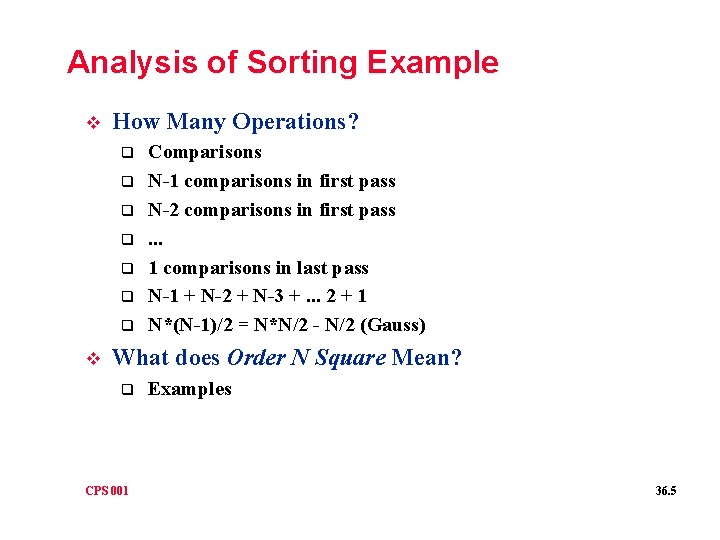
Analysis of Sorting Example v How Many Operations? q q q q v Comparisons N-1 comparisons in first pass N-2 comparisons in first pass. . . 1 comparisons in last pass N-1 + N-2 + N-3 +. . . 2 + 1 N*(N-1)/2 = N*N/2 - N/2 (Gauss) What does Order N Square Mean? q CPS 001 Examples 36. 5
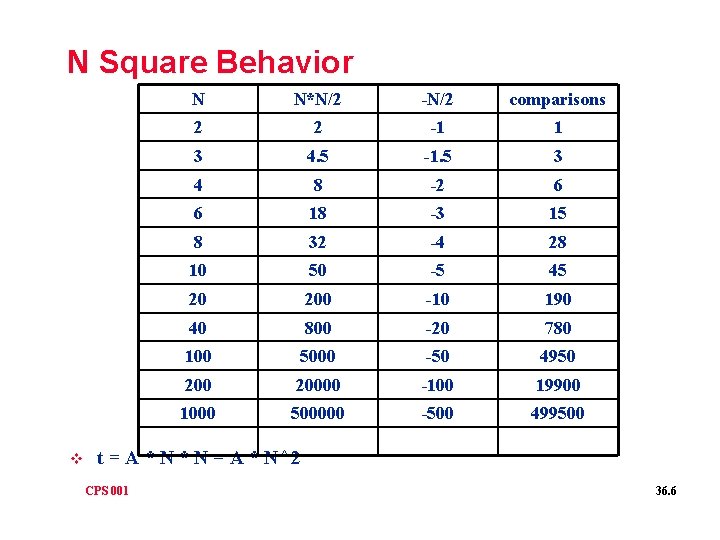
N Square Behavior v N N*N/2 -N/2 comparisons 2 2 -1 1 3 4. 5 -1. 5 3 4 8 -2 6 6 18 -3 15 8 32 -4 28 10 50 -5 45 20 200 -10 190 40 800 -20 780 100 5000 -50 4950 20000 -100 19900 1000 500000 -500 499500 t = A * N^2 CPS 001 36. 6
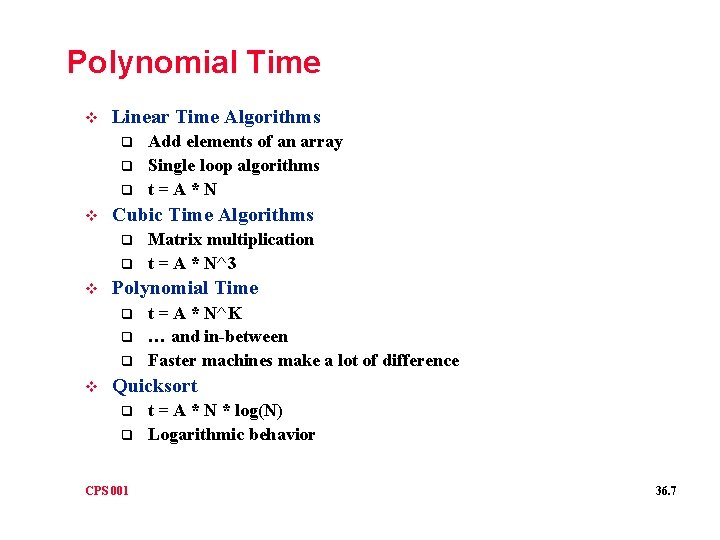
Polynomial Time v Linear Time Algorithms q q q v Cubic Time Algorithms q q v Matrix multiplication t = A * N^3 Polynomial Time q q q v Add elements of an array Single loop algorithms t=A*N t = A * N^K … and in-between Faster machines make a lot of difference Quicksort q q CPS 001 t = A * N * log(N) Logarithmic behavior 36. 7
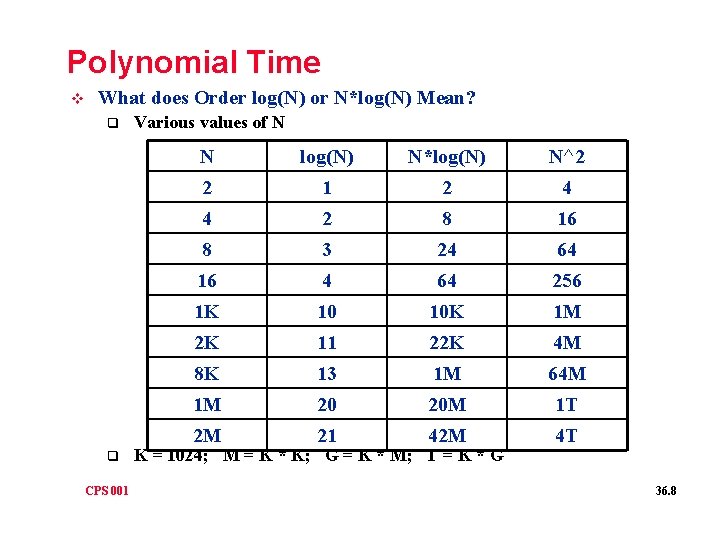
Polynomial Time v What does Order log(N) or N*log(N) Mean? q q CPS 001 Various values of N N log(N) N*log(N) N^2 2 1 2 4 4 2 8 16 8 3 24 64 16 4 64 256 1 K 10 10 K 1 M 2 K 11 22 K 4 M 8 K 13 1 M 64 M 1 M 20 20 M 1 T 2 M 21 42 M 4 T K = 1024; M = K * K; G = K * M; T = K * G 36. 8
Tractable Algorithms v v v Graphs Showing Complexity Polynomial = Tractable Binary Search q q v Assumes Sorted Like telephone book lookup Logarithmic Time t = A * log(N) Intractable Algorithms q q q CPS 001 Computer "crawls" or seems to come to halt for large N Large problems essentially unsolved May never be able to compute answer for some obvious questions 36. 9