
Todays Topic Brainstorming and Outlining Objectives 1 Learn
Today’s Topic: Brainstorming and Outlining Objectives: 1. Learn how to dissect a prompt effectively. 2. Learn how to use a prompt to help with brainstorming, thesis creation, and an outline. 3. Learn about the structure of a paper. 4. Learn about outlining.
Interpreting Writing Prompts
Basically, a prompt is a question or an instruction that tells you what you're supposed to write. For example, a prompt might instruct you to write about… § a story you have read § your opinion on a topic § something you have experienced § a research topic
(constructing means to build) Deconstructing means to take apart To deconstruct a prompt: 1. Read it 2. Take it apart 3. Understand what you need to do 4. Determine how to respond to the prompt correctly
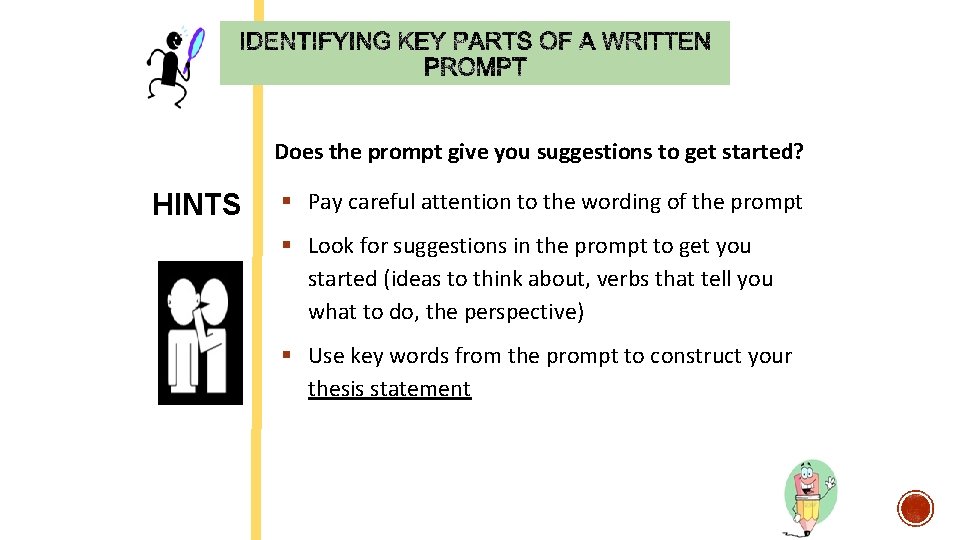
Does the prompt give you suggestions to get started? HINTS § Pay careful attention to the wording of the prompt § Look for suggestions in the prompt to get you started (ideas to think about, verbs that tell you what to do, the perspective) § Use key words from the prompt to construct your thesis statement
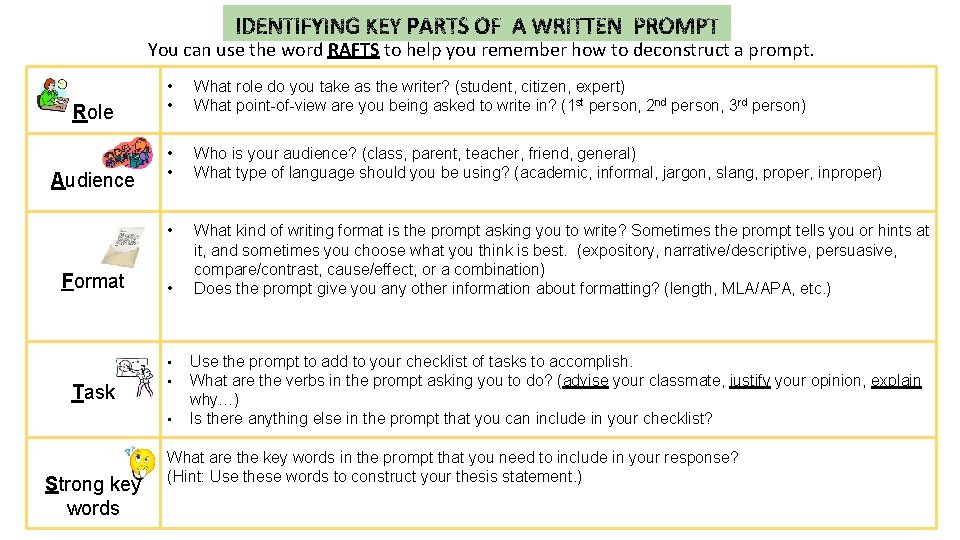
You can use the word RAFTS to help you remember how to deconstruct a prompt. Role Audience Format Task • • What role do you take as the writer? (student, citizen, expert) What point-of-view are you being asked to write in? (1 st person, 2 nd person, 3 rd person) • • Who is your audience? (class, parent, teacher, friend, general) What type of language should you be using? (academic, informal, jargon, slang, proper, inproper) • What kind of writing format is the prompt asking you to write? Sometimes the prompt tells you or hints at it, and sometimes you choose what you think is best. (expository, narrative/descriptive, persuasive, compare/contrast, cause/effect, or a combination) Does the prompt give you any other information about formatting? (length, MLA/APA, etc. ) • • Strong key words Use the prompt to add to your checklist of tasks to accomplish. What are the verbs in the prompt asking you to do? (advise your classmate, justify your opinion, explain why…) Is there anything else in the prompt that you can include in your checklist? What are the key words in the prompt that you need to include in your response? (Hint: Use these words to construct your thesis statement. )
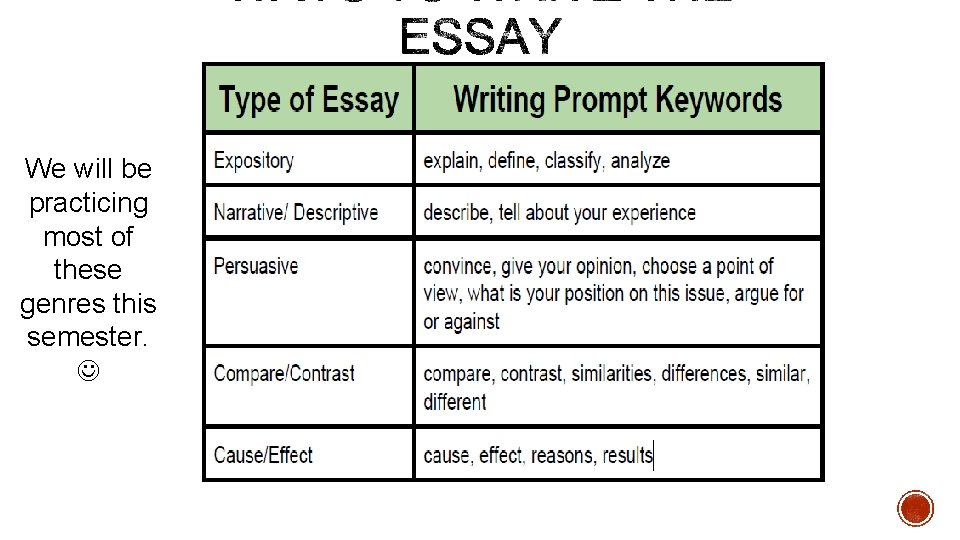
We will be practicing most of these genres this semester.
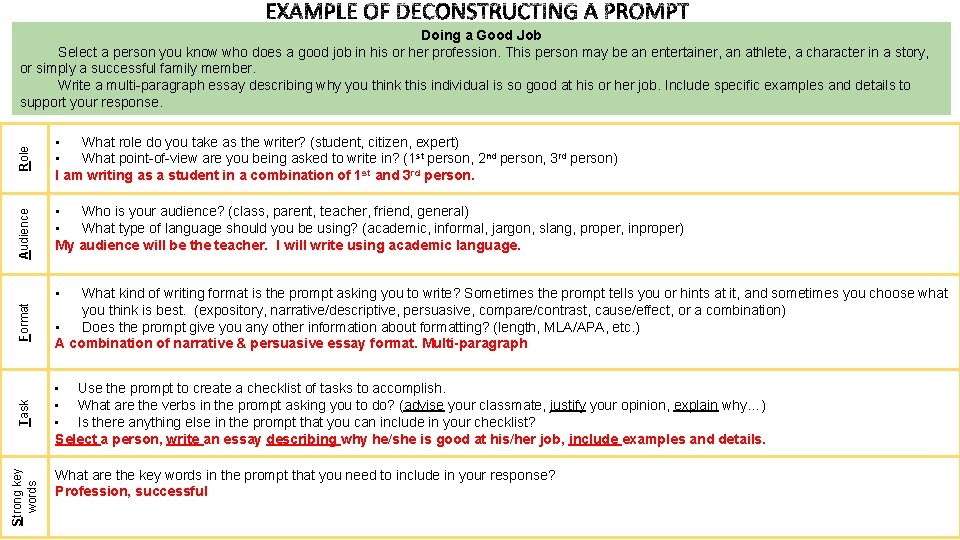
Role • What role do you take as the writer? (student, citizen, expert) • What point-of-view are you being asked to write in? (1 st person, 2 nd person, 3 rd person) I am writing as a student in a combination of 1 st and 3 rd person. Audience Doing a Good Job Select a person you know who does a good job in his or her profession. This person may be an entertainer, an athlete, a character in a story, or simply a successful family member. Write a multi-paragraph essay describing why you think this individual is so good at his or her job. Include specific examples and details to support your response. • Who is your audience? (class, parent, teacher, friend, general) • What type of language should you be using? (academic, informal, jargon, slang, proper, inproper) My audience will be the teacher. I will write using academic language. Strong key words Task Format • What kind of writing format is the prompt asking you to write? Sometimes the prompt tells you or hints at it, and sometimes you choose what you think is best. (expository, narrative/descriptive, persuasive, compare/contrast, cause/effect, or a combination) • Does the prompt give you any other information about formatting? (length, MLA/APA, etc. ) A combination of narrative & persuasive essay format. Multi-paragraph Use the prompt to create a checklist of tasks to accomplish. What are the verbs in the prompt asking you to do? (advise your classmate, justify your opinion, explain why…) Is there anything else in the prompt that you can include in your checklist? Select a person, write an essay describing why he/she is good at his/her job, include examples and details. • • • What are the key words in the prompt that you need to include in your response? Profession, successful
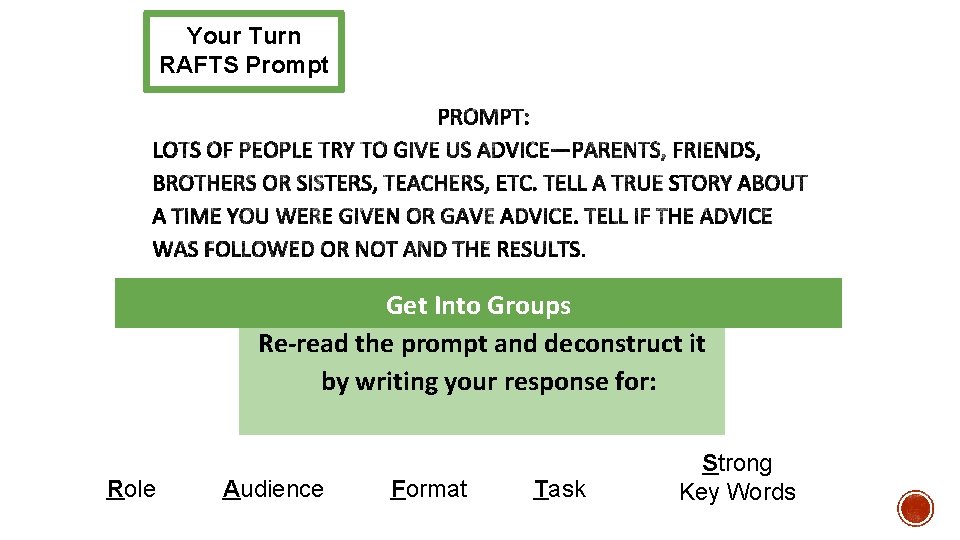
Your Turn RAFTS Prompt Get Into Groups Re-read the prompt and deconstruct it by writing your response for: Role Audience Format Task Strong Key Words
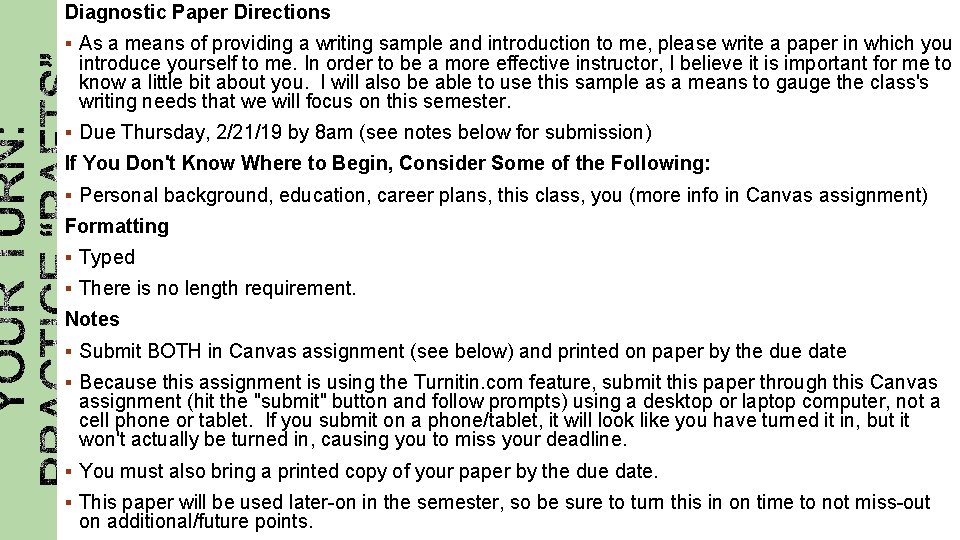
Diagnostic Paper Directions § As a means of providing a writing sample and introduction to me, please write a paper in which you introduce yourself to me. In order to be a more effective instructor, I believe it is important for me to know a little bit about you. I will also be able to use this sample as a means to gauge the class's writing needs that we will focus on this semester. § Due Thursday, 2/21/19 by 8 am (see notes below for submission) If You Don't Know Where to Begin, Consider Some of the Following: § Personal background, education, career plans, this class, you (more info in Canvas assignment) Formatting § Typed § There is no length requirement. Notes § Submit BOTH in Canvas assignment (see below) and printed on paper by the due date § Because this assignment is using the Turnitin. com feature, submit this paper through this Canvas assignment (hit the "submit" button and follow prompts) using a desktop or laptop computer, not a cell phone or tablet. If you submit on a phone/tablet, it will look like you have turned it in, but it won't actually be turned in, causing you to miss your deadline. § You must also bring a printed copy of your paper by the due date. § This paper will be used later-on in the semester, so be sure to turn this in on time to not miss-out on additional/future points.
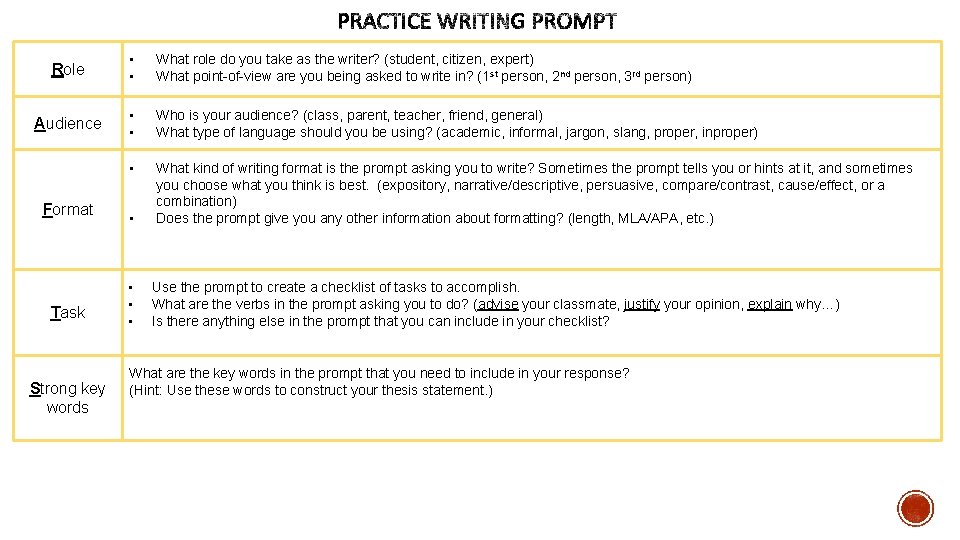
Role • • What role do you take as the writer? (student, citizen, expert) What point-of-view are you being asked to write in? (1 st person, 2 nd person, 3 rd person) Audience • • Who is your audience? (class, parent, teacher, friend, general) What type of language should you be using? (academic, informal, jargon, slang, proper, inproper) • What kind of writing format is the prompt asking you to write? Sometimes the prompt tells you or hints at it, and sometimes you choose what you think is best. (expository, narrative/descriptive, persuasive, compare/contrast, cause/effect, or a combination) Does the prompt give you any other information about formatting? (length, MLA/APA, etc. ) Format Task Strong key words • • Use the prompt to create a checklist of tasks to accomplish. What are the verbs in the prompt asking you to do? (advise your classmate, justify your opinion, explain why…) Is there anything else in the prompt that you can include in your checklist? What are the key words in the prompt that you need to include in your response? (Hint: Use these words to construct your thesis statement. )
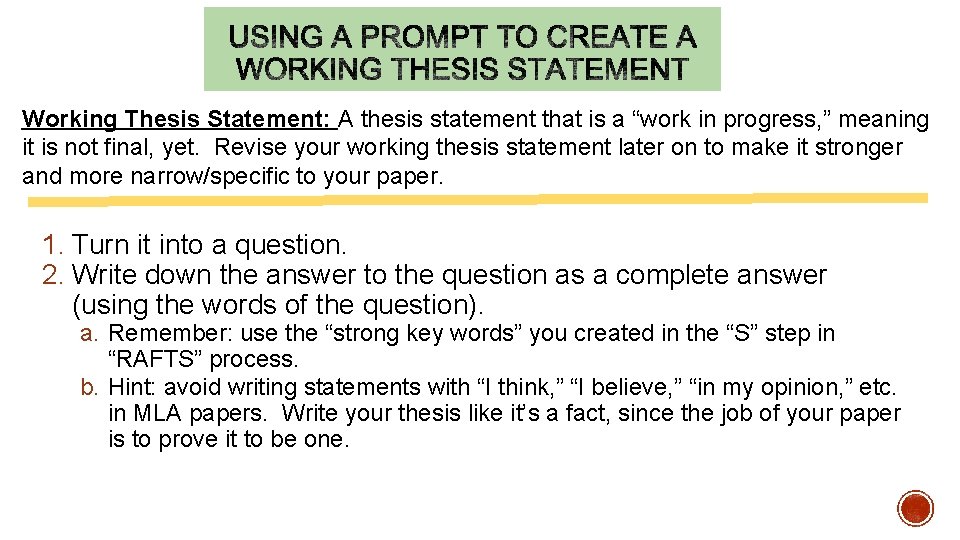
Working Thesis Statement: A thesis statement that is a “work in progress, ” meaning it is not final, yet. Revise your working thesis statement later on to make it stronger and more narrow/specific to your paper. 1. Turn it into a question. 2. Write down the answer to the question as a complete answer (using the words of the question). a. Remember: use the “strong key words” you created in the “S” step in “RAFTS” process. b. Hint: avoid writing statements with “I think, ” “I believe, ” “in my opinion, ” etc. in MLA papers. Write your thesis like it’s a fact, since the job of your paper is to prove it to be one.
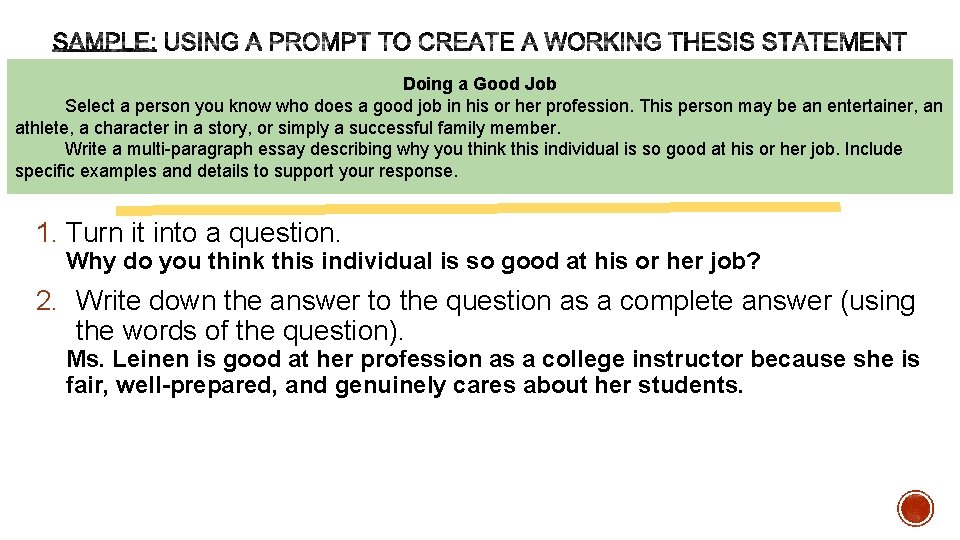
Doing a Good Job Select a person you know who does a good job in his or her profession. This person may be an entertainer, an athlete, a character in a story, or simply a successful family member. Write a multi-paragraph essay describing why you think this individual is so good at his or her job. Include specific examples and details to support your response. 1. Turn it into a question. Why do you think this individual is so good at his or her job? 2. Write down the answer to the question as a complete answer (using the words of the question). Ms. Leinen is good at her profession as a college instructor because she is fair, well-prepared, and genuinely cares about her students.
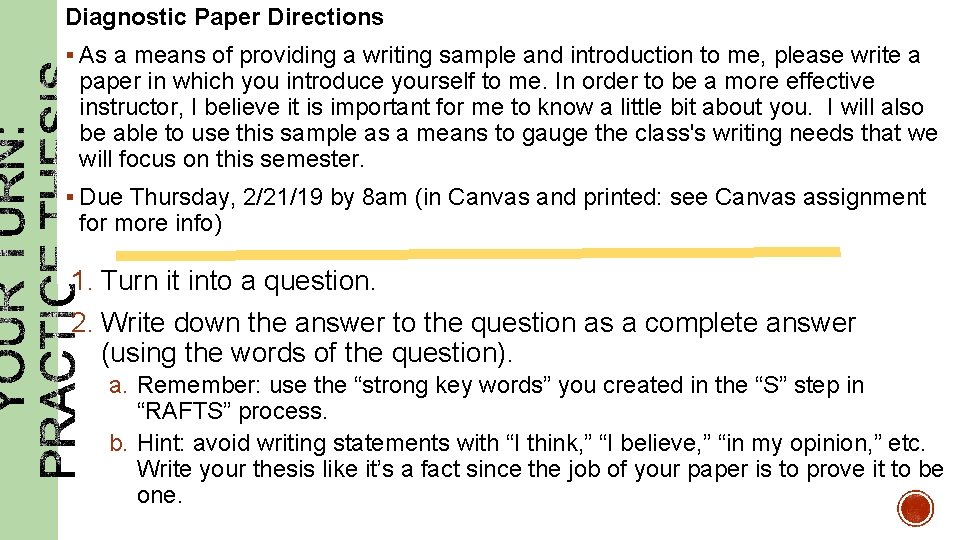
Diagnostic Paper Directions § As a means of providing a writing sample and introduction to me, please write a paper in which you introduce yourself to me. In order to be a more effective instructor, I believe it is important for me to know a little bit about you. I will also be able to use this sample as a means to gauge the class's writing needs that we will focus on this semester. § Due Thursday, 2/21/19 by 8 am (in Canvas and printed: see Canvas assignment for more info) 1. Turn it into a question. 2. Write down the answer to the question as a complete answer (using the words of the question). a. Remember: use the “strong key words” you created in the “S” step in “RAFTS” process. b. Hint: avoid writing statements with “I think, ” “I believe, ” “in my opinion, ” etc. Write your thesis like it’s a fact since the job of your paper is to prove it to be one.
Good writing is about… § Clarifying the topic/deconstructing the prompt § Identifying strong feelings about the topic § Forming an opinion about the topic
Are there any questions? 5 -Minute Break
Review up to this point: § Up to now, we have learned how prompts can help with the following: § Brainstorming § Working thesis statements § We will use this information to now learn: § The structure of a paper § How to turn the brainstorm into an outline
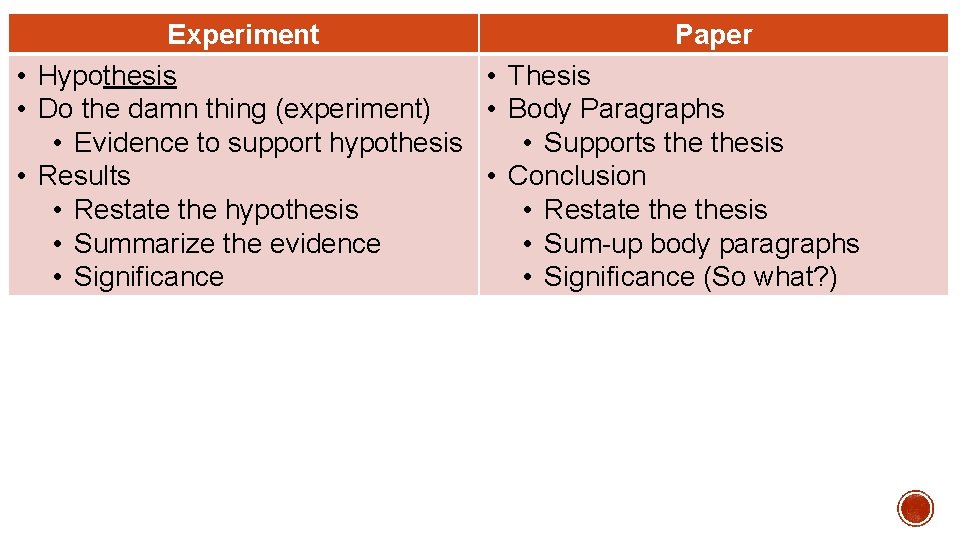
Experiment Paper • Hypothesis • Thesis • Do the damn thing (experiment) • Body Paragraphs • Evidence to support hypothesis • Supports thesis • Results • Conclusion • Restate the hypothesis • Restate thesis • Summarize the evidence • Sum-up body paragraphs • Significance (So what? )
§ Thesis Experiment § “Essay Tips” Packet § Rubric § Checklist § Essay Structure § Pre-Writing § General Tips § www. englishforeveryone. org
How to Write a Paragraph When taking notes, make sure you are answering these questions: § What are the parts needed in a thorough paragraph? § What should supporting details have to make them more specific? § What is the definition of the following: topic sentence, explanation, evidence, concluding sentence § Why is it useful to write a paragraph this way? https: //youtu. be/Wj. D 8 c. LHf 2 x. E
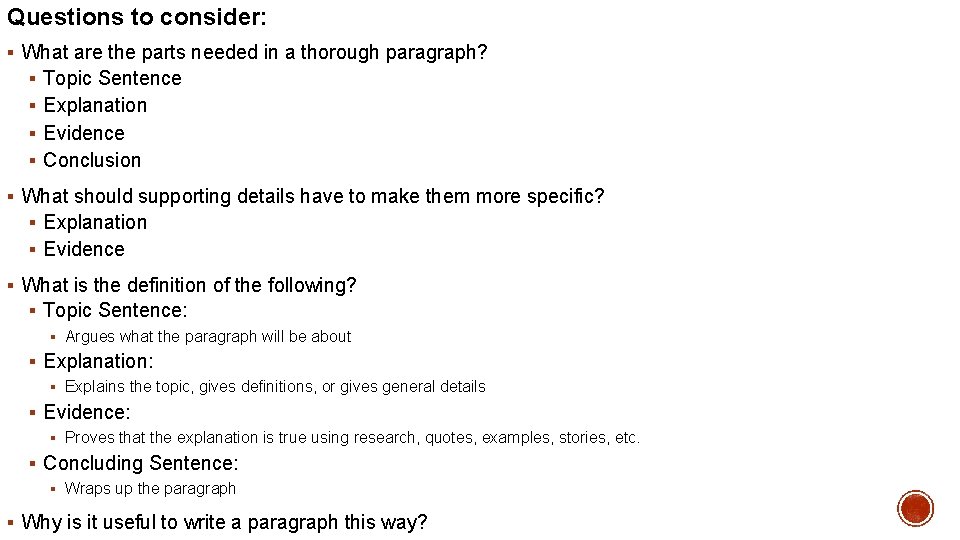
Questions to consider: § What are the parts needed in a thorough paragraph? § Topic Sentence § Explanation § Evidence § Conclusion § What should supporting details have to make them more specific? § Explanation § Evidence § What is the definition of the following? § Topic Sentence: § Argues what the paragraph will be about § Explanation: § Explains the topic, gives definitions, or gives general details § Evidence: § Proves that the explanation is true using research, quotes, examples, stories, etc. § Concluding Sentence: § Wraps up the paragraph § Why is it useful to write a paragraph this way?
Write down the questions and answers. 1. What did you learn today that you found useful? 2. What wasn’t useful? 3. What questions do you have about the structure of an academic paper? Is there anything you still don’t understand? 4. Are there any tips you want to add that you want to share with your fellow classmates?
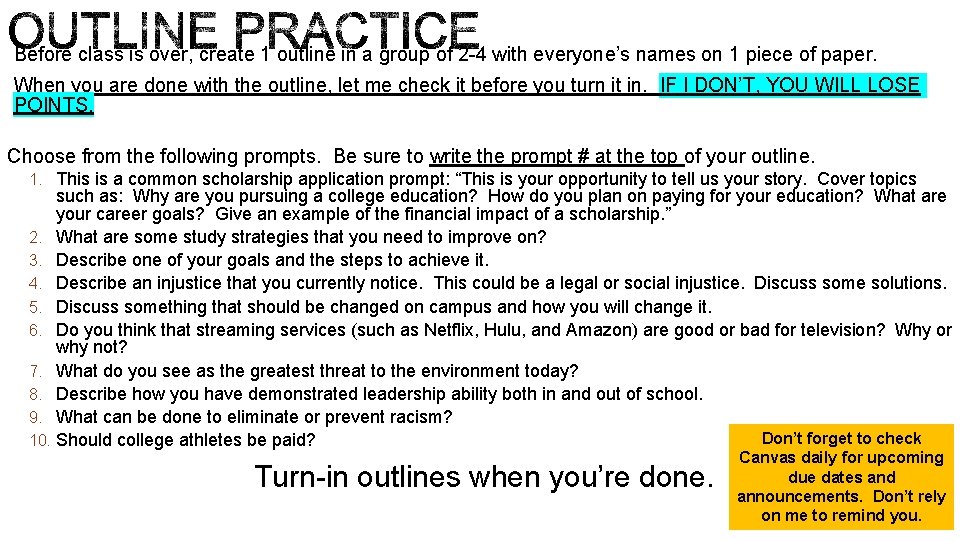
Before class is over, create 1 outline in a group of 2 -4 with everyone’s names on 1 piece of paper. When you are done with the outline, let me check it before you turn it in. IF I DON’T, YOU WILL LOSE POINTS. Choose from the following prompts. Be sure to write the prompt # at the top of your outline. 1. This is a common scholarship application prompt: “This is your opportunity to tell us your story. Cover topics such as: Why are you pursuing a college education? How do you plan on paying for your education? What are your career goals? Give an example of the financial impact of a scholarship. ” 2. What are some study strategies that you need to improve on? 3. Describe one of your goals and the steps to achieve it. 4. Describe an injustice that you currently notice. This could be a legal or social injustice. Discuss some solutions. 5. Discuss something that should be changed on campus and how you will change it. 6. Do you think that streaming services (such as Netflix, Hulu, and Amazon) are good or bad for television? Why or why not? 7. What do you see as the greatest threat to the environment today? 8. Describe how you have demonstrated leadership ability both in and out of school. 9. What can be done to eliminate or prevent racism? Don’t forget to check 10. Should college athletes be paid? Turn-in outlines when you’re done. Canvas daily for upcoming due dates and announcements. Don’t rely on me to remind you.
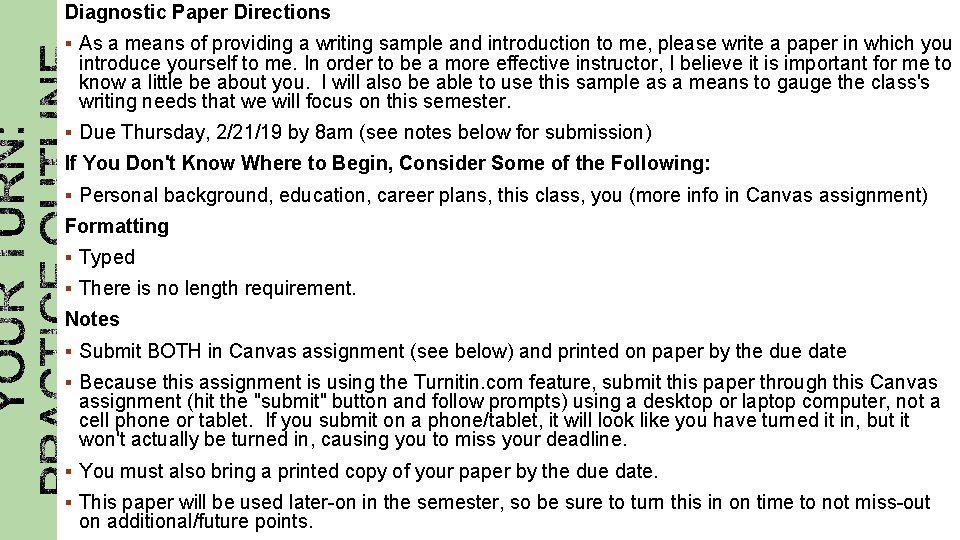
Diagnostic Paper Directions § As a means of providing a writing sample and introduction to me, please write a paper in which you introduce yourself to me. In order to be a more effective instructor, I believe it is important for me to know a little be about you. I will also be able to use this sample as a means to gauge the class's writing needs that we will focus on this semester. § Due Thursday, 2/21/19 by 8 am (see notes below for submission) If You Don't Know Where to Begin, Consider Some of the Following: § Personal background, education, career plans, this class, you (more info in Canvas assignment) Formatting § Typed § There is no length requirement. Notes § Submit BOTH in Canvas assignment (see below) and printed on paper by the due date § Because this assignment is using the Turnitin. com feature, submit this paper through this Canvas assignment (hit the "submit" button and follow prompts) using a desktop or laptop computer, not a cell phone or tablet. If you submit on a phone/tablet, it will look like you have turned it in, but it won't actually be turned in, causing you to miss your deadline. § You must also bring a printed copy of your paper by the due date. § This paper will be used later-on in the semester, so be sure to turn this in on time to not miss-out on additional/future points.
- Slides: 24