
Todays Summary Method Definition and Invocation Summarized on



- Slides: 12
Today’s Summary • • • Method Definition and Invocation Summarized on the next Expressions few slides Statements Classes Parameters, actual arguments, fields, local variables Interfaces High-level UML Overview for Word. Games Stubs What’s Ahead Fundamentals of Software Development 1 1
Method Definition and Invocation • Method Definition and Invocation – Define (write) a write its code – Invoke (call, run) a cause the method’s code to run Fundamentals of Software Development 1 2
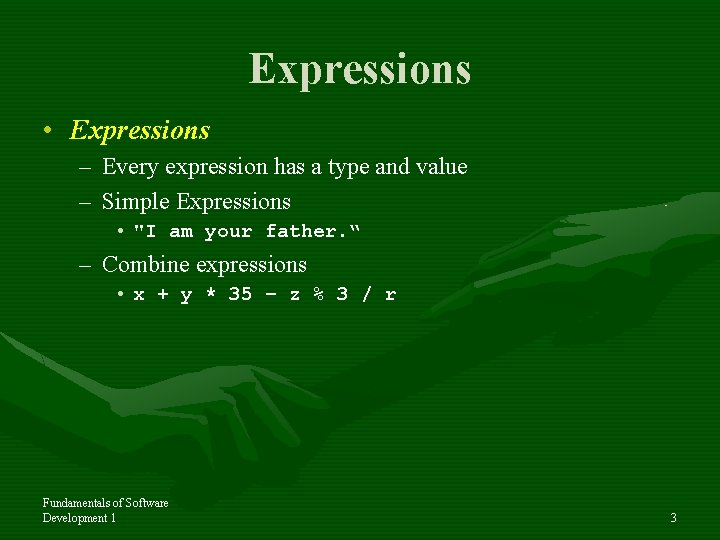
Expressions • Expressions – Every expression has a type and value – Simple Expressions • "I am your father. “ – Combine expressions • x + y * 35 – z % 3 / r Fundamentals of Software Development 1 3
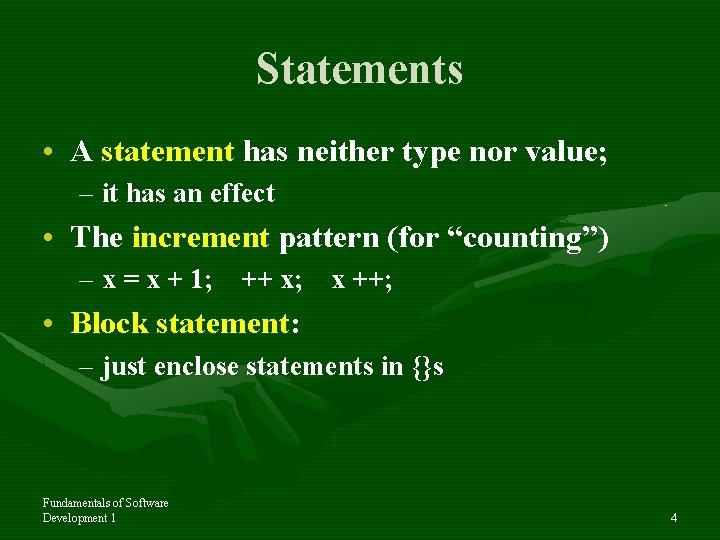
Statements • A statement has neither type nor value; – it has an effect • The increment pattern (for “counting”) – x = x + 1; ++ x; x ++; • Block statement: – just enclose statements in {}s Fundamentals of Software Development 1 4
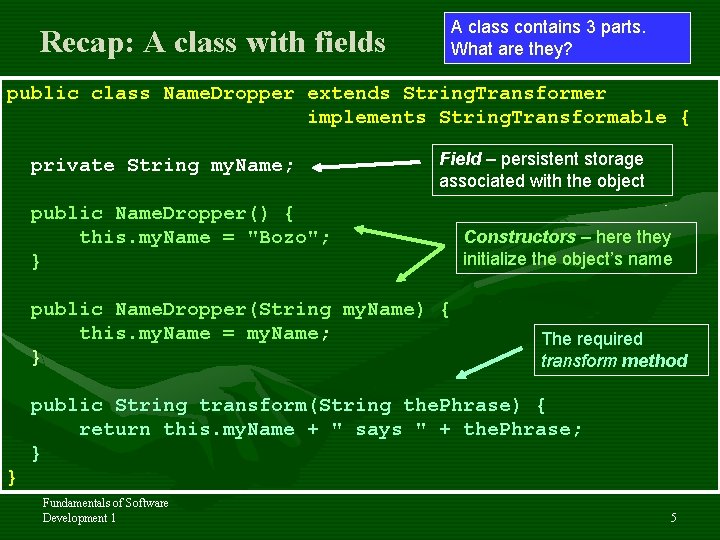
Recap: A class with fields A class contains 3 parts. What are they? public class Name. Dropper extends String. Transformer implements String. Transformable { Field – persistent storage private String my. Name; associated with the object public Name. Dropper() { this. my. Name = "Bozo"; } Constructors – here they initialize the object’s name public Name. Dropper(String my. Name) { this. my. Name = my. Name; The required } transform method public String transform(String the. Phrase) { return this. my. Name + " says " + the. Phrase; } } Fundamentals of Software Development 1 5
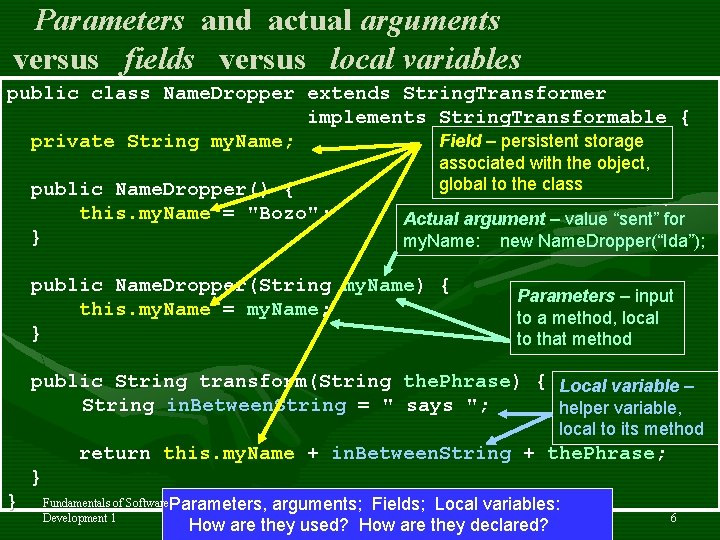
Parameters and actual arguments versus fields versus local variables public class Name. Dropper extends String. Transformer implements String. Transformable { Field – persistent storage private String my. Name; public Name. Dropper() { this. my. Name = "Bozo"; } associated with the object, global to the class Actual argument – value “sent” for my. Name: new Name. Dropper(“Ida”); public Name. Dropper(String my. Name) { Parameters – input this. my. Name = my. Name ; = to a method, local } to that method public String transform(String the. Phrase) { Local variable – String in. Between. String = " says "; String helper variable, local to its method return this. my. Name + in. Between. String + the. Phrase ; + + } } Fundamentals of Software. Parameters, arguments; Fields; Local variables: Development 1 How are they used? How are they declared? 6
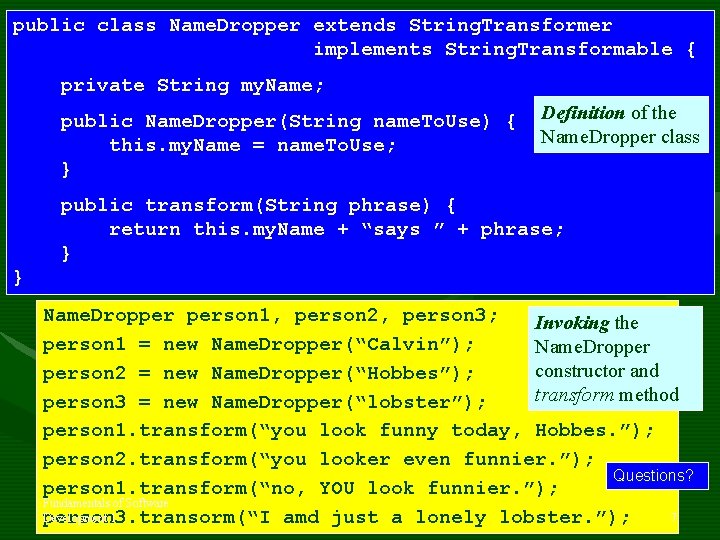
public class Name. Dropper extends String. Transformer implements String. Transformable { private String my. Name; public Name. Dropper(String name. To. Use) { this. my. Name = name. To. Use; } Definition of the Name. Dropper class public transform(String phrase) { return this. my. Name + “says ” + phrase; } } Name. Dropper person 1, person 2, person 3; Invoking the person 1 = new Name. Dropper(“Calvin”); Name. Dropper constructor and person 2 = new Name. Dropper(“Hobbes”); transform method person 3 = new Name. Dropper(“lobster”); person 1. transform(“you look funny today, Hobbes. ”); person 2. transform(“you looker even funnier. ”); Questions? person 1. transform(“no, YOU look funnier. ”); Fundamentals of Software Development 1 7 person 3. transorm(“I amd just a lonely lobster. ”);
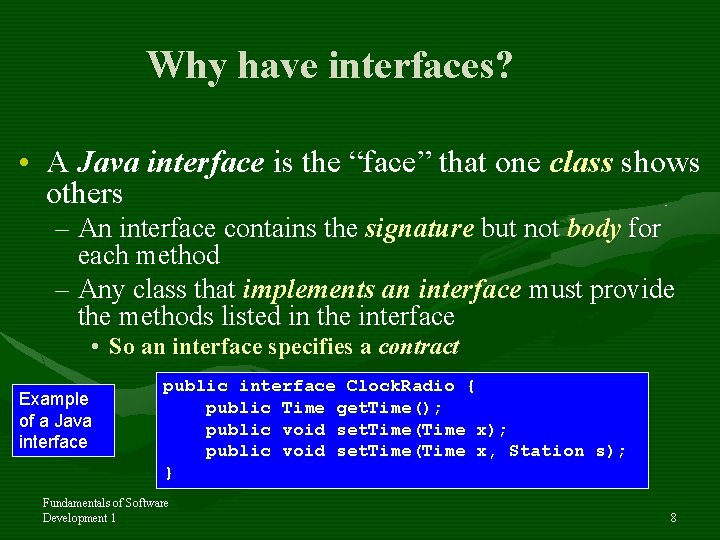
Why have interfaces? • A Java interface is the “face” that one class shows others – An interface contains the signature but not body for each method – Any class that implements an interface must provide the methods listed in the interface • So an interface specifies a contract Example of a Java interface public interface Clock. Radio { public Time get. Time(); public void set. Time(Time x, Station s); } Fundamentals of Software Development 1 8
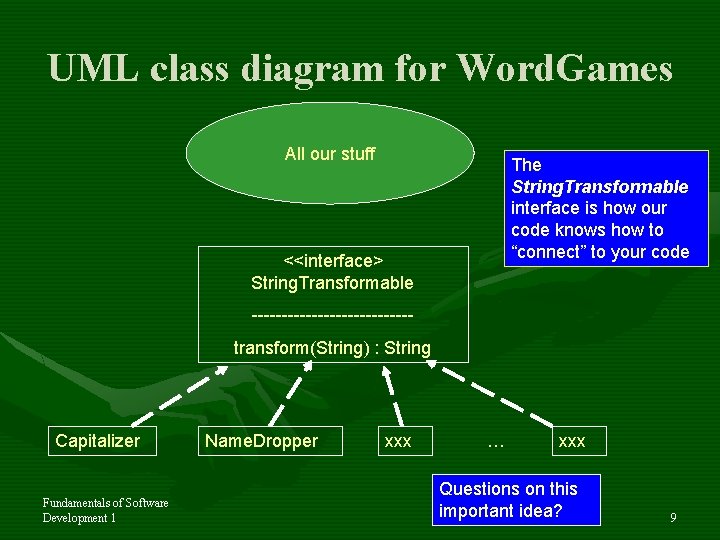
UML class diagram for Word. Games All our stuff The String. Transformable interface is how our code knows how to “connect” to your code <<interface> String. Transformable -------------transform(String) : String Capitalizer Fundamentals of Software Development 1 Name. Dropper xxx … xxx Questions on this important idea? 9
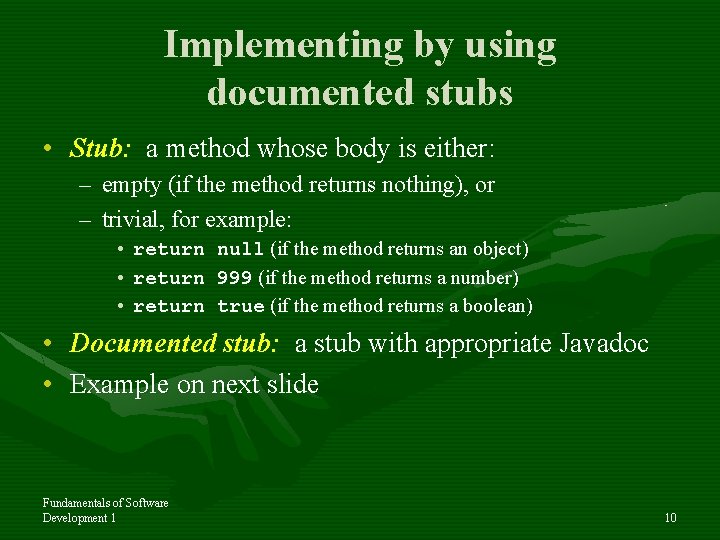
Implementing by using documented stubs • Stub: a method whose body is either: – empty (if the method returns nothing), or – trivial, for example: • return null (if the method returns an object) • return 999 (if the method returns a number) • return true (if the method returns a boolean) • Documented stub: a stub with appropriate Javadoc • Example on next slide Fundamentals of Software Development 1 10
Implementing by using documented stubs Stub: a method whose body is either empty or trivial Documented stub: a stub with appropriate Javadoc /** * A String. Transformer that transforms the phrase that it is given * by capitalizing it. * * @author David Mutchler. */ public class Name. Dropper extends String. Transformer implements String. Transformable { /** * Does nothing beyond constructing the Capitalizer. */ Stub public Capitalizer() { Documentation } Questions? /** * Capitalizes each letter of the given phrase and return the result. * * @param the. Phrase The phrase to transform. * @return The capitalized version of the given phrase. */ public String transform(String the. Phrase) { Stub, to be filled in later by: return null; return this. my. Name + “says ” + } Fundamentals of Software the. Phrase; } Development 1 11
What’s Ahead? • Before the next session: – Do Homework 8 (no late homework!) Reminder: Find the homework assignment from the Schedule page of the CSSE 120 Angel site angel. rose-hulman. edu • Including the reading and the associated online quiz – Next session: • Programming patterns (conditionals, etc. ) • More Word. Games - Implementing your own classes! • Next week – Details to follow: – Review session Tuesday night – First exam Wednesday night Our usual suggestion: Routinely do your homework in F-217 (CSSE lab). A student assistant is there every Sunday through Thursday evening, 7 pm to 9 pm, so you can get immediate answers to any questions you might have. Fundamentals of Software Development 1 12