
TODAYs OBJECTIVES Compare the momentum of different moving
TODAY’s OBJECTIVES • Compare the momentum of different moving objects • Compare the momentum of the same object moving with different velocities
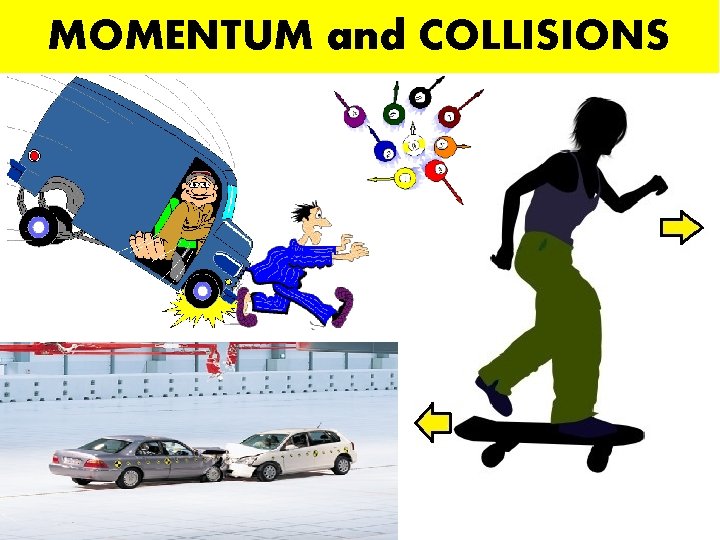
MOMENTUM and COLLISIONS
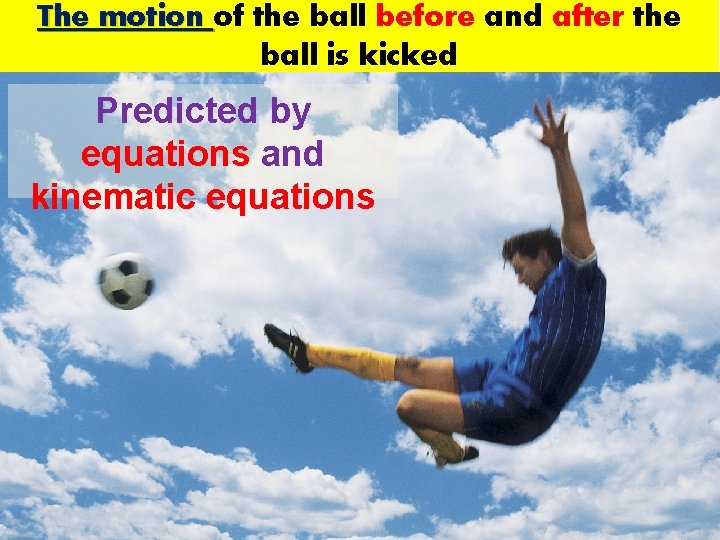
The motion of the ball before and after the ball is kicked Predicted by equations and kinematic equations
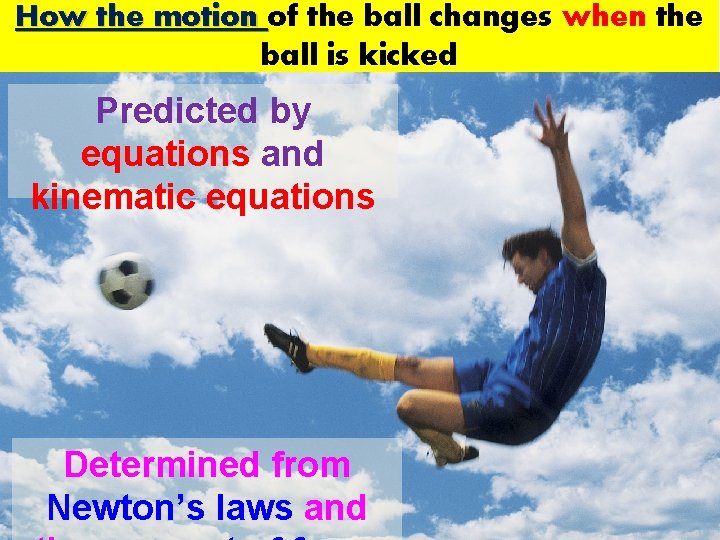
How the motion of the ball changes when the ball is kicked Predicted by equations and kinematic equations Determined from Newton’s laws and
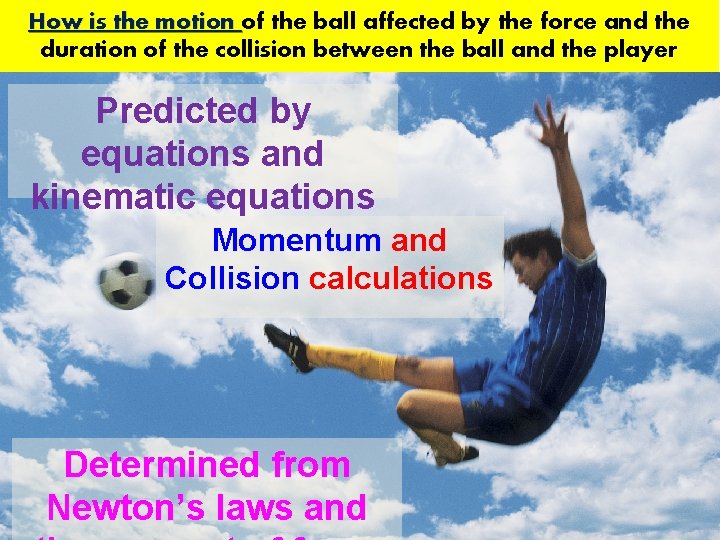
How is the motion of the ball affected by the force and the duration of the collision between the ball and the player Predicted by equations and kinematic equations Momentum and Collision calculations Determined from Newton’s laws and
What is momentum? In everyday language “This movie is gaining momentum” The movie is gaining popularity In physics a quantity defined as the product of the mass and velocity of an object
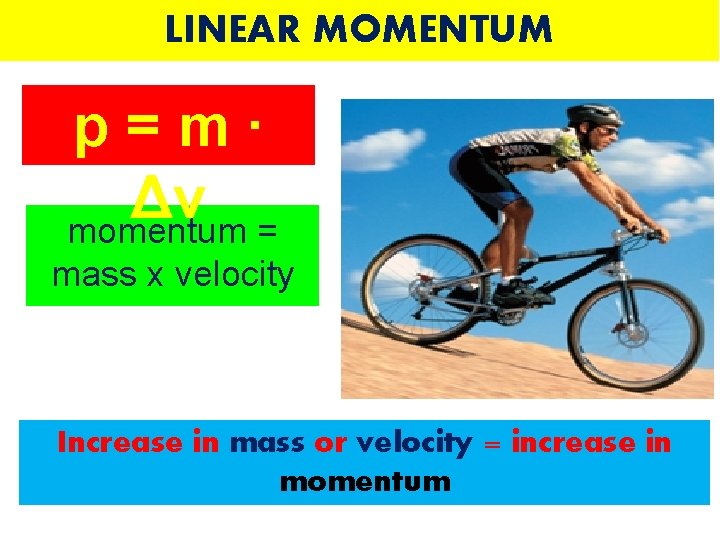
LINEAR MOMENTUM p=m∙ Δv momentum = mass x velocity Increase in mass or velocity = increase in momentum
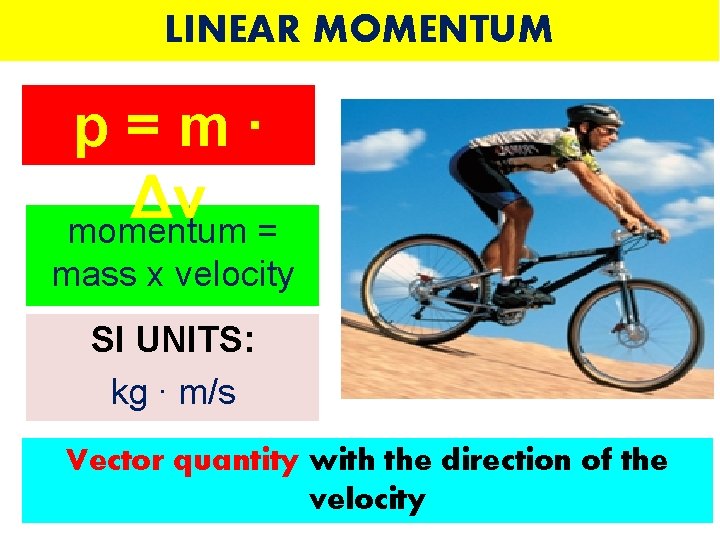
LINEAR MOMENTUM p=m∙ Δv momentum = mass x velocity SI UNITS: kg ∙ m/s Vector quantity with the direction of the velocity
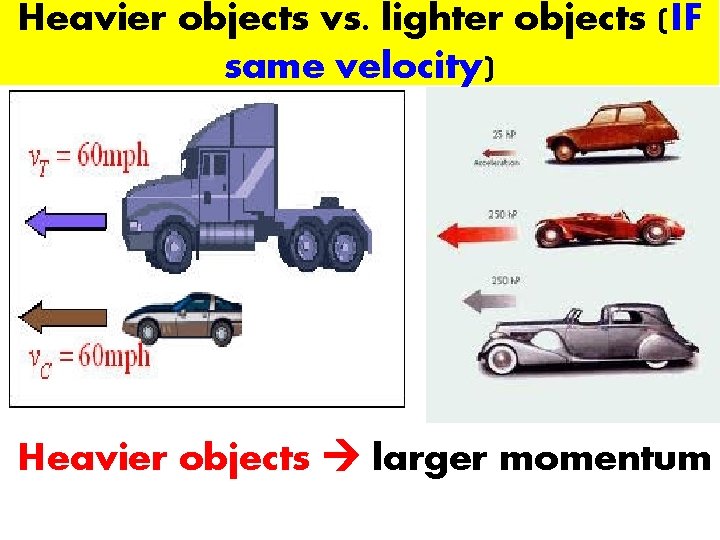
Heavier objects vs. lighter objects (IF same velocity) Heavier objects larger momentum
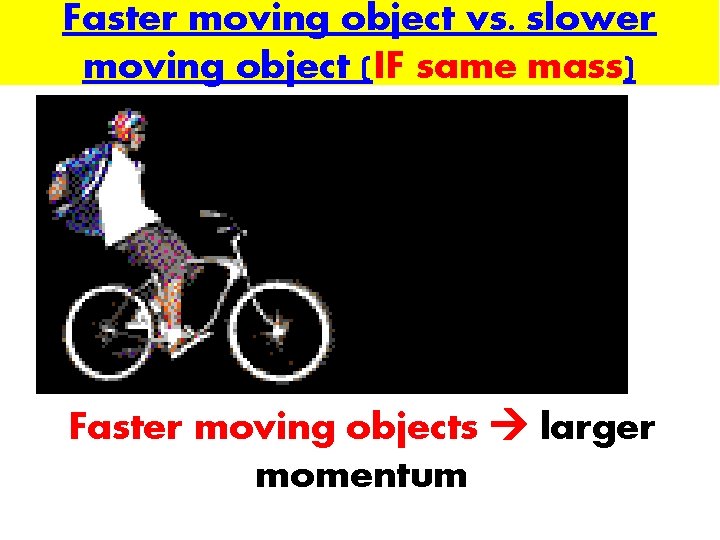
Faster moving object vs. slower moving object (IF same mass) Faster moving objects larger momentum
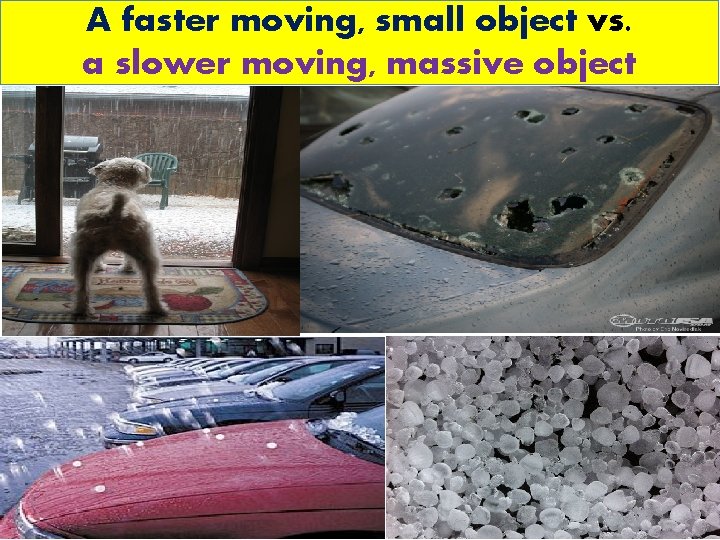
A faster moving, small object vs. a slower moving, massive object
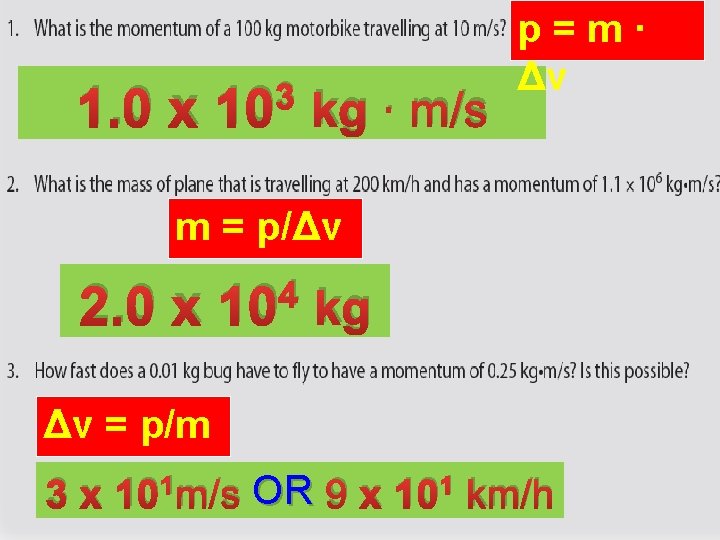
1. 0 x 3 10 kg ∙ m/s p=m∙ Δv m = p/Δv 2. 0 x 4 10 kg Δv = p/m OR 9 x 101 km/h 3 x 101 m/s OR
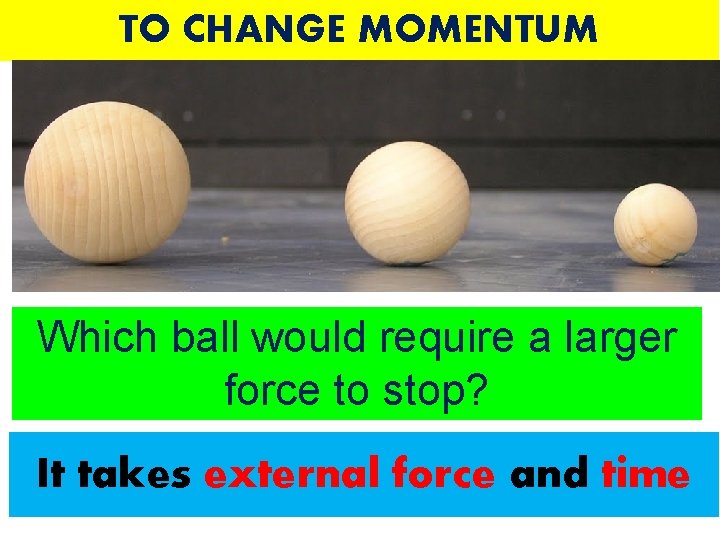
TO CHANGE MOMENTUM Which ball would require a larger force to stop? It takes external force and time
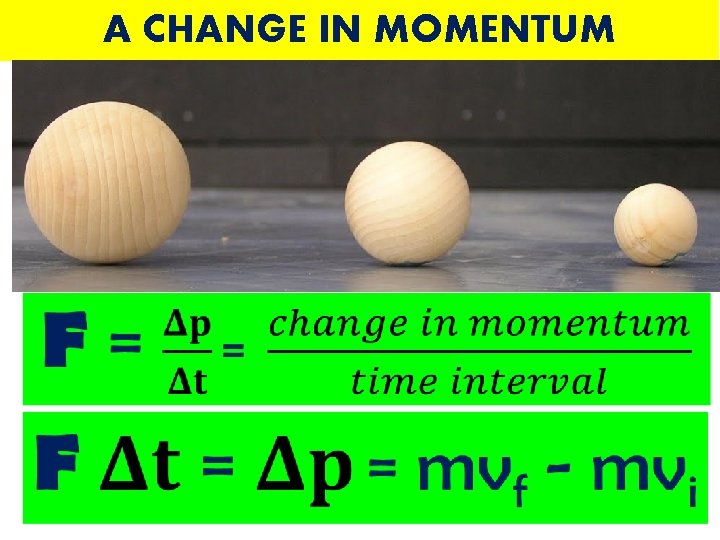
A CHANGE IN MOMENTUM
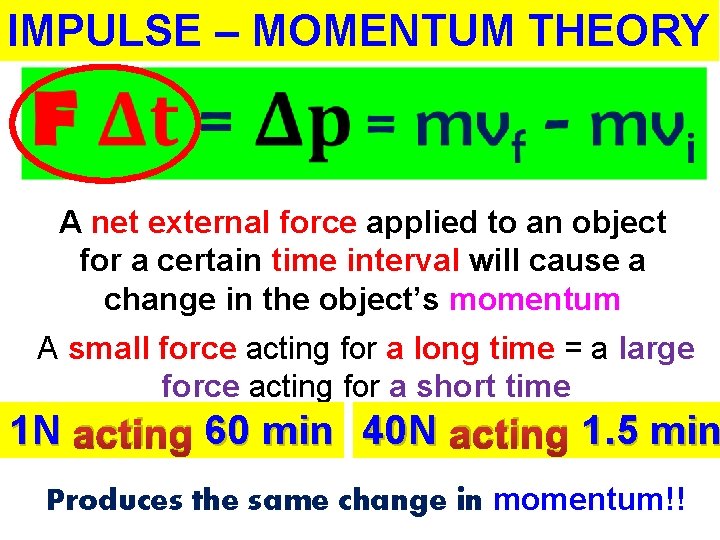
IMPULSE – MOMENTUM THEORY A net external force applied to an object for a certain time interval will cause a change in the object’s momentum A small force acting for a long time = a large force acting for a short time 1 N acting 60 min 40 N acting 1. 5 min Produces the same change in momentum!!
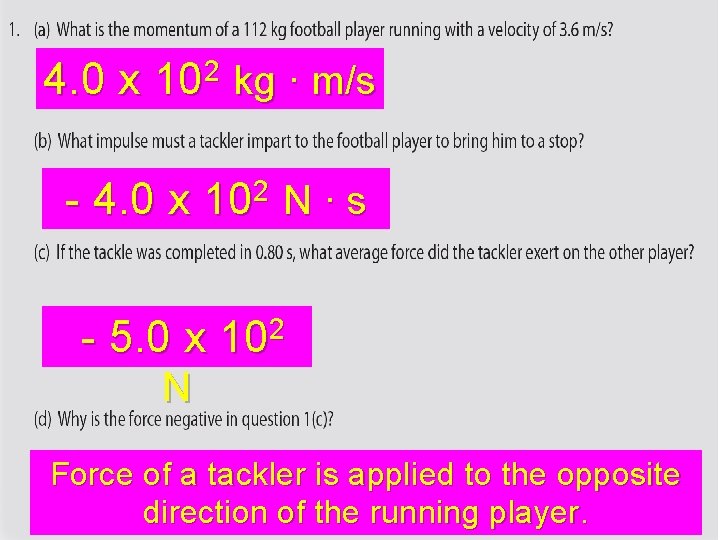
4. 0 x 102 kg ∙ m/s - 4. 0 x 102 N ∙ s 2 - 5. 0 x 10 N Force of a tackler is applied to the opposite direction of the running player.
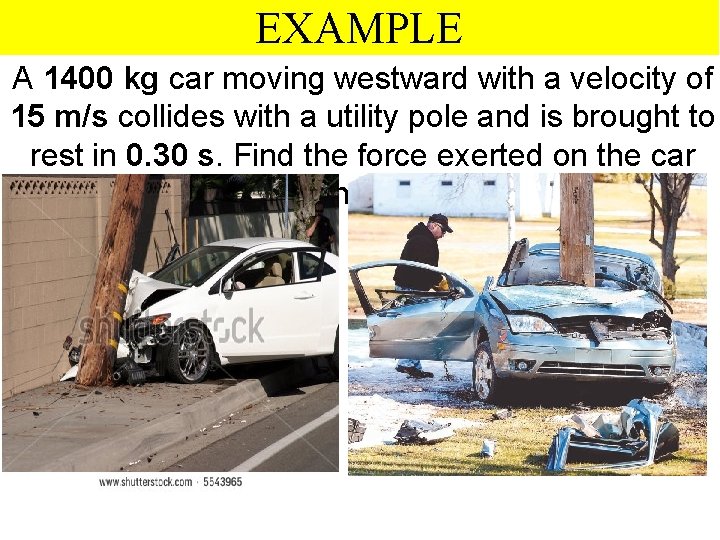
EXAMPLE A 1400 kg car moving westward with a velocity of 15 m/s collides with a utility pole and is brought to rest in 0. 30 s. Find the force exerted on the car during the collision.
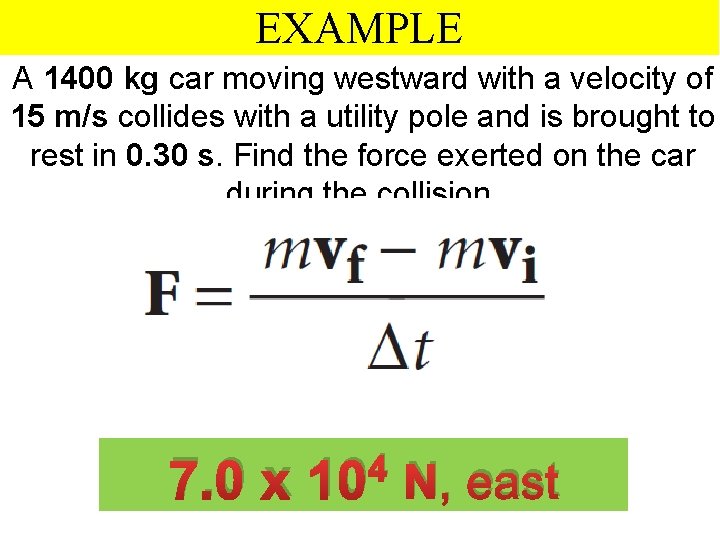
EXAMPLE A 1400 kg car moving westward with a velocity of 15 m/s collides with a utility pole and is brought to rest in 0. 30 s. Find the force exerted on the car during the collision. 7. 0 x 4 10 N, east
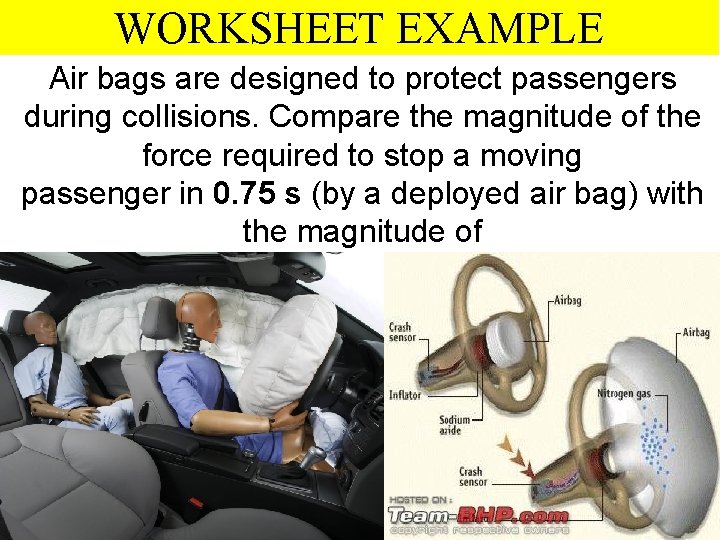
WORKSHEET EXAMPLE Air bags are designed to protect passengers during collisions. Compare the magnitude of the force required to stop a moving passenger in 0. 75 s (by a deployed air bag) with the magnitude of the force required to stop the same passenger at the same speed in 0. 026 s (by the dashboard). What can you conclude?
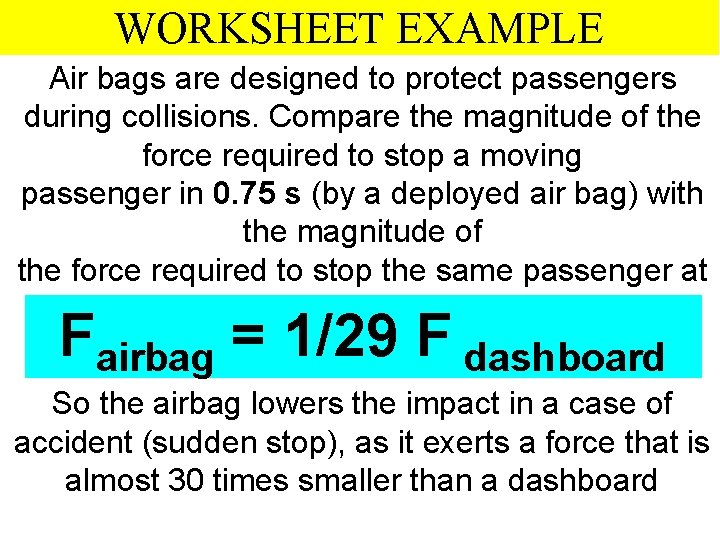
WORKSHEET EXAMPLE Air bags are designed to protect passengers during collisions. Compare the magnitude of the force required to stop a moving passenger in 0. 75 s (by a deployed air bag) with the magnitude of the force required to stop the same passenger at the same speed in 0. 026 s (by the dashboard). airbag dashboard F = 1/29 F So the airbag lowers the impact in a case of accident (sudden stop), as it exerts a force that is almost 30 times smaller than a dashboard
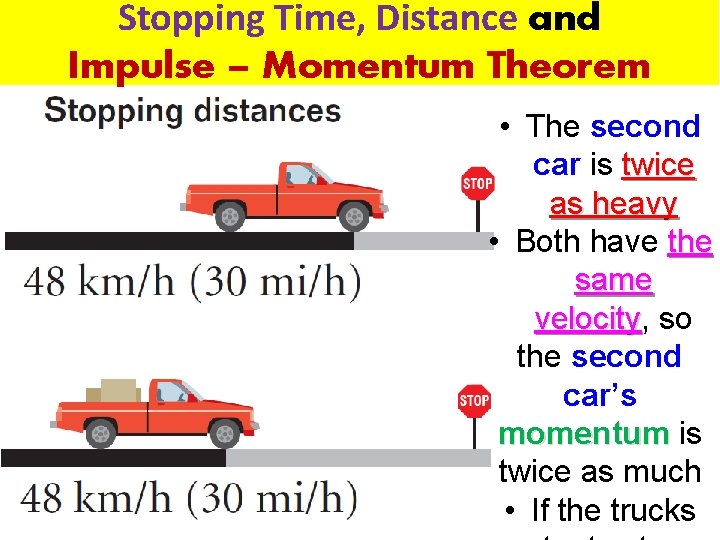
Stopping Time, Distance and Impulse – Momentum Theorem • The second car is twice as heavy • Both have the same velocity, so velocity the second car’s momentum is twice as much • If the trucks
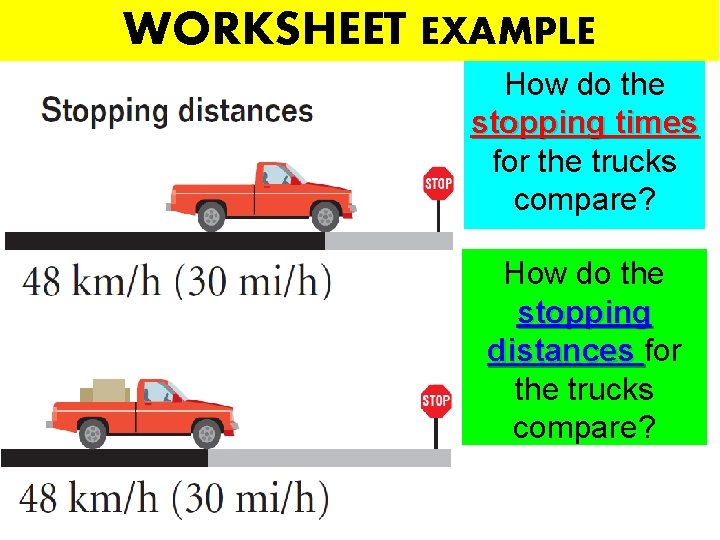
WORKSHEET EXAMPLE How do the stopping times for the trucks compare? How do the stopping distances for the trucks compare?
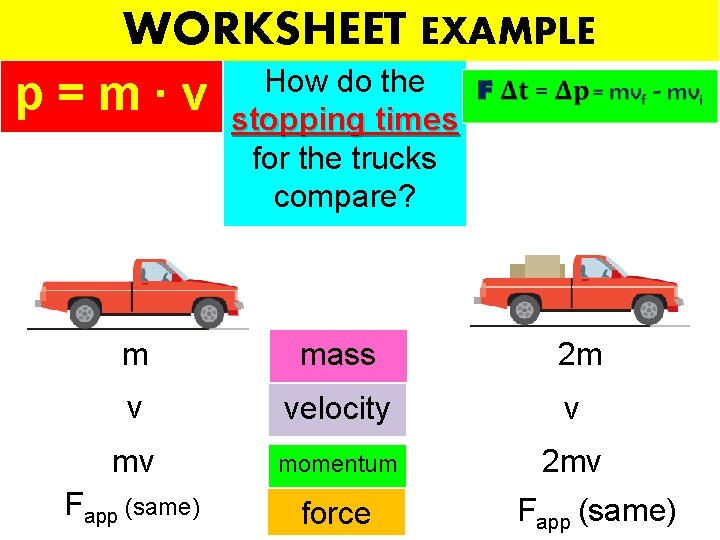
WORKSHEET EXAMPLE How do the p = m ∙ v stopping times for the trucks compare? m mass 2 m v velocity v mv momentum 2 mv Fapp (same) force Fapp (same)
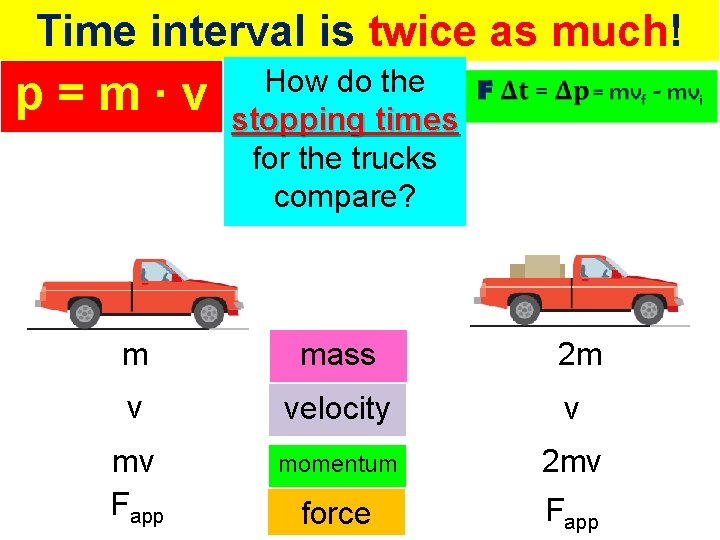
Time interval is twice as much! p=m∙v How do the stopping times for the trucks compare? m mass 2 m v velocity v mv Fapp momentum 2 mv force Fapp
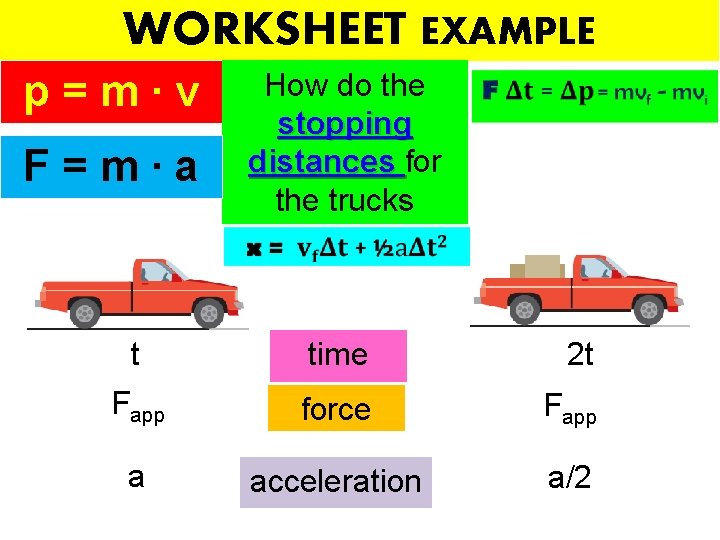
WORKSHEET EXAMPLE p=m∙v F=m∙a How do the stopping distances for the trucks compare? t time 2 t Fapp force Fapp a acceleration a/2
Use Momentum – Impulse Theorem A 2240 kg car traveling to the west slows down uniformly from 20. 0 m/s to 5. 00 m/s. How long does it take the car to decelerate if the force on the car is 8410 N to the east? How far does the car travel during the deceleration?
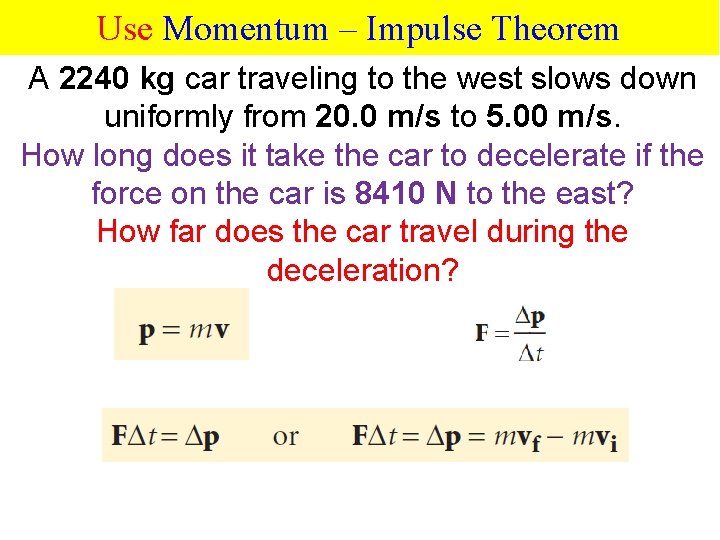
Use Momentum – Impulse Theorem A 2240 kg car traveling to the west slows down uniformly from 20. 0 m/s to 5. 00 m/s. How long does it take the car to decelerate if the force on the car is 8410 N to the east? How far does the car travel during the deceleration?
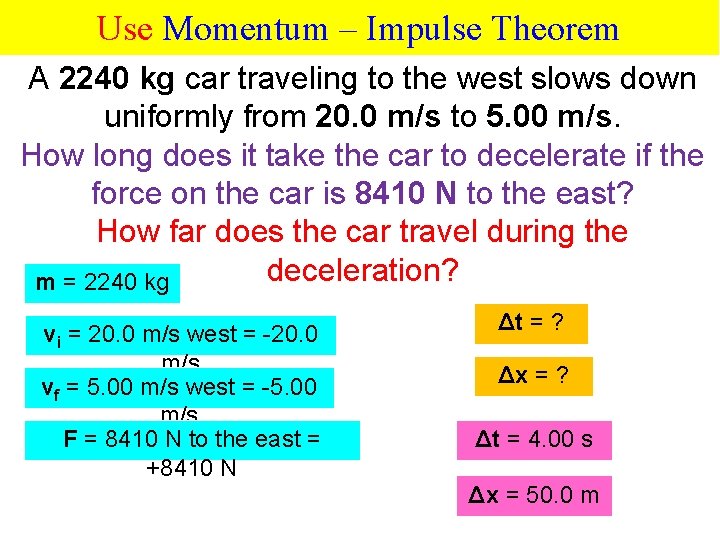
Use Momentum – Impulse Theorem A 2240 kg car traveling to the west slows down uniformly from 20. 0 m/s to 5. 00 m/s. How long does it take the car to decelerate if the force on the car is 8410 N to the east? How far does the car travel during the deceleration? m = 2240 kg vi = 20. 0 m/s west = -20. 0 m/s vf = 5. 00 m/s west = -5. 00 m/s F = 8410 N to the east = +8410 N Δt = ? Δx = ? Δt = 4. 00 s Δx = 50. 0 m
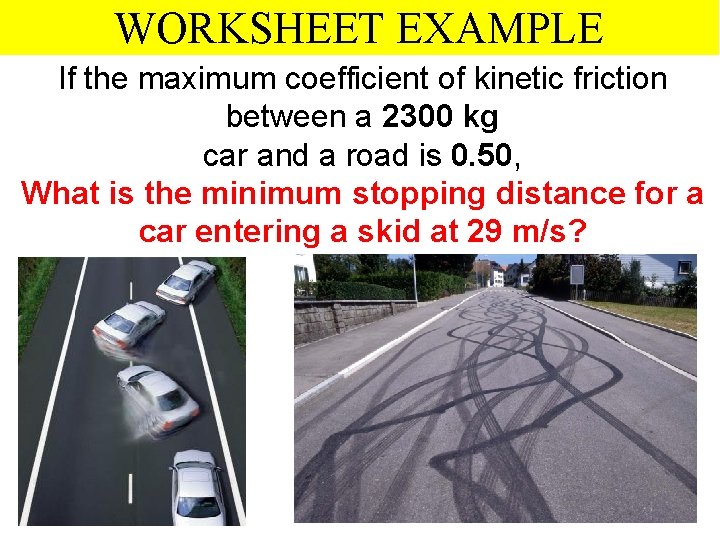
WORKSHEET EXAMPLE If the maximum coefficient of kinetic friction between a 2300 kg car and a road is 0. 50, What is the minimum stopping distance for a car entering a skid at 29 m/s?
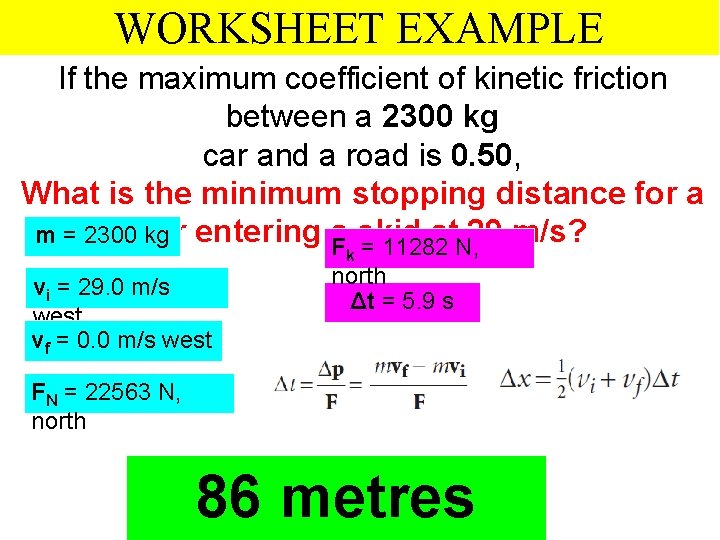
WORKSHEET EXAMPLE If the maximum coefficient of kinetic friction between a 2300 kg car and a road is 0. 50, What is the minimum stopping distance for a car entering a skid at 29 m/s? m = 2300 kg F = 11282 N, k vi = 29. 0 m/s west vf = 0. 0 m/s west north Δt = 5. 9 s FN = 22563 N, north 86 metres
CLASSWORK COMPUTER SIMULATION OFind a folder: Pedagogica. PC O run Momentum and Collisions in 1 D 31
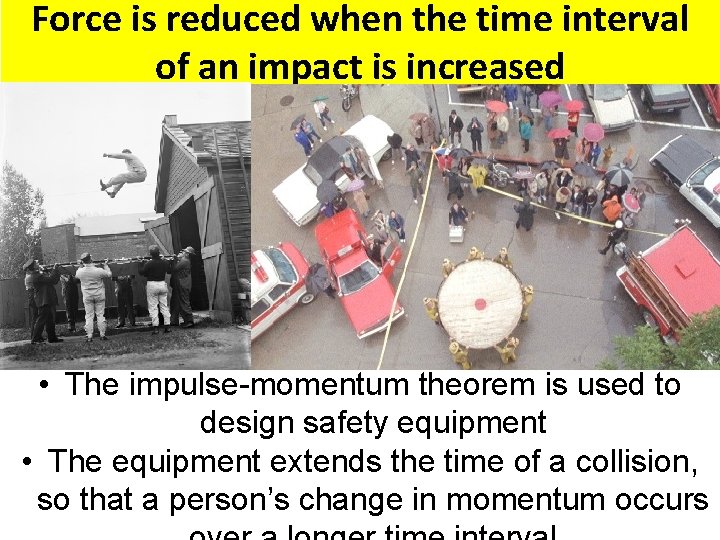
Force is reduced when the time interval of an impact is increased • The impulse-momentum theorem is used to design safety equipment • The equipment extends the time of a collision, so that a person’s change in momentum occurs
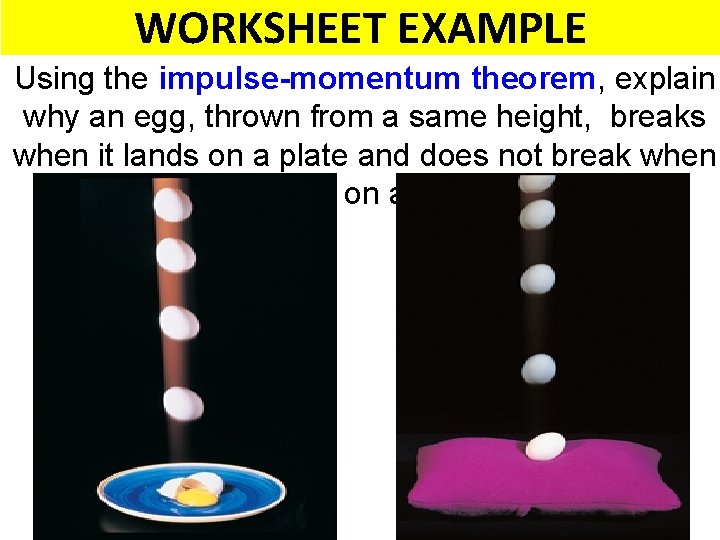
WORKSHEET EXAMPLE Using the impulse-momentum theorem, explain why an egg, thrown from a same height, breaks when it lands on a plate and does not break when it lands on a pillow
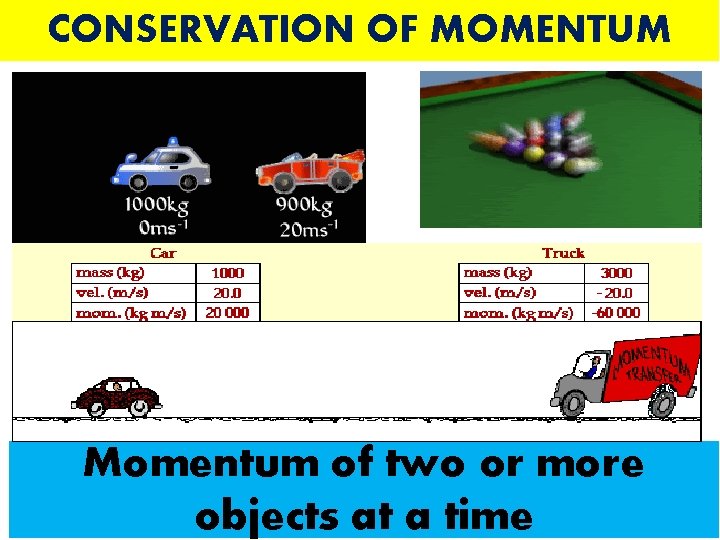
CONSERVATION OF MOMENTUM Momentum of two or more objects at a time
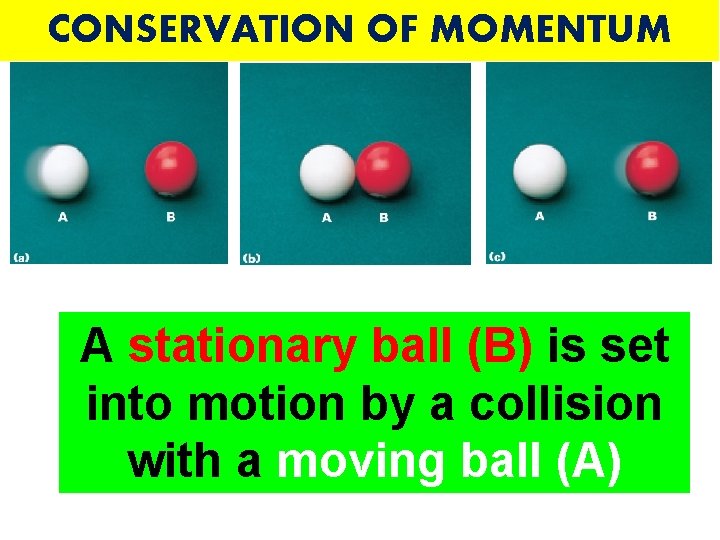
CONSERVATION OF MOMENTUM A stationary ball (B) is set into motion by a collision with a moving ball (A)
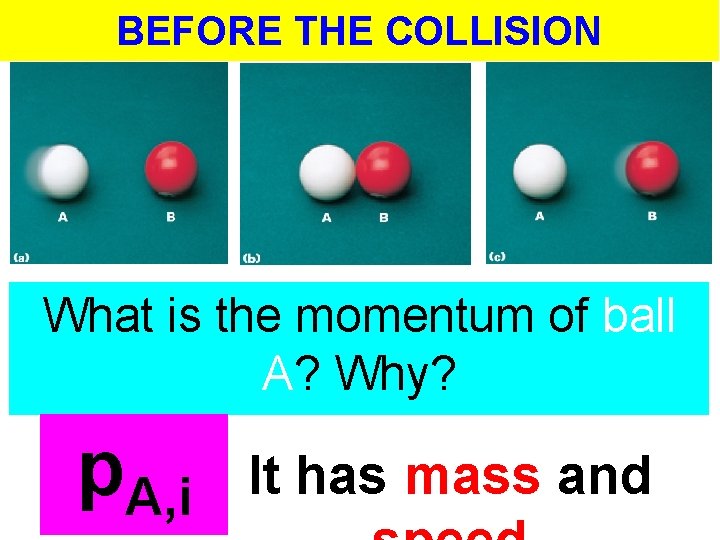
BEFORE THE COLLISION What is the momentum of ball A? Why? p. A, i It has mass and
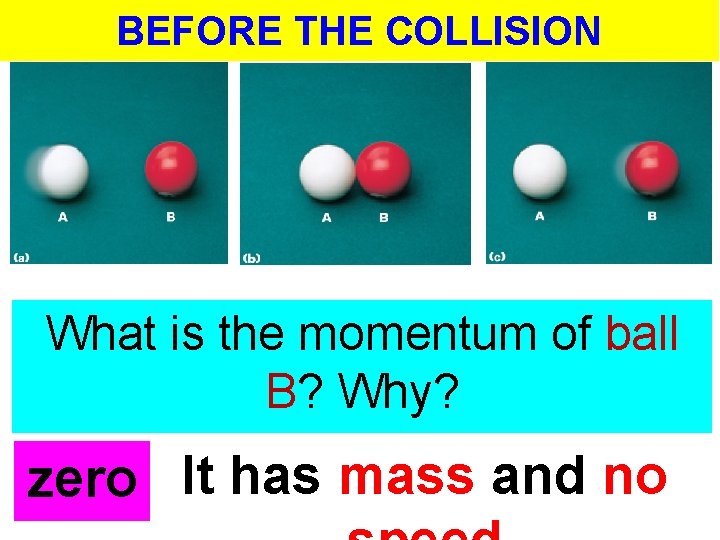
BEFORE THE COLLISION What is the momentum of ball B? Why? zero It has mass and no
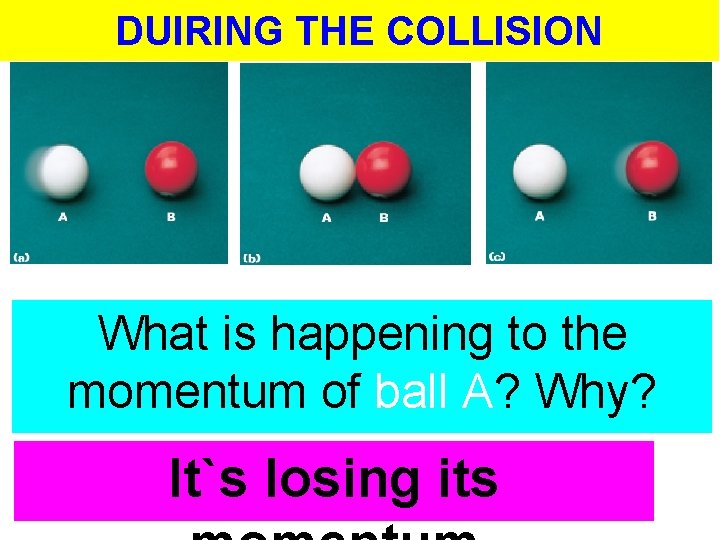
DUIRING THE COLLISION What is happening to the momentum of ball A? Why? It`s losing its
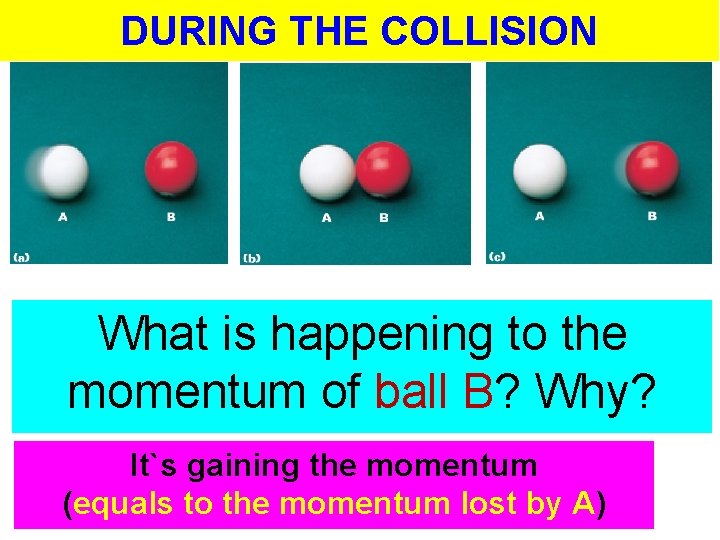
DURING THE COLLISION What is happening to the momentum of ball B? Why? It`s gaining the momentum (equals to the momentum lost by A)
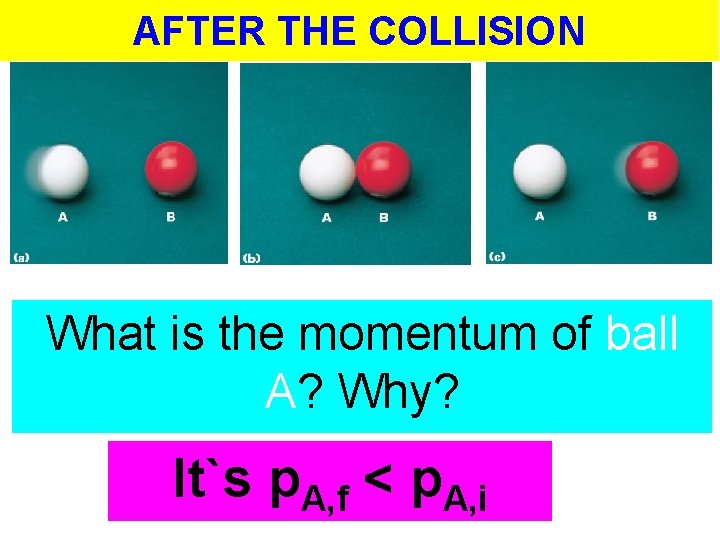
AFTER THE COLLISION What is the momentum of ball A? Why? It`s p. A, f < p. A, i
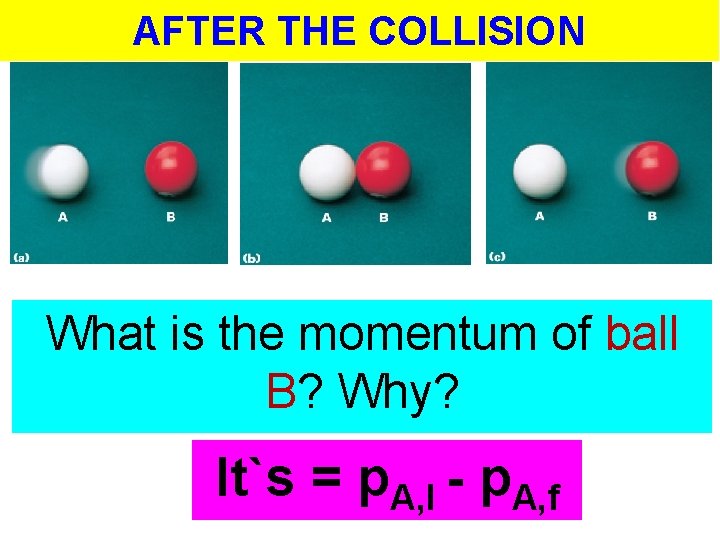
AFTER THE COLLISION What is the momentum of ball B? Why? It`s = p. A, I - p. A, f
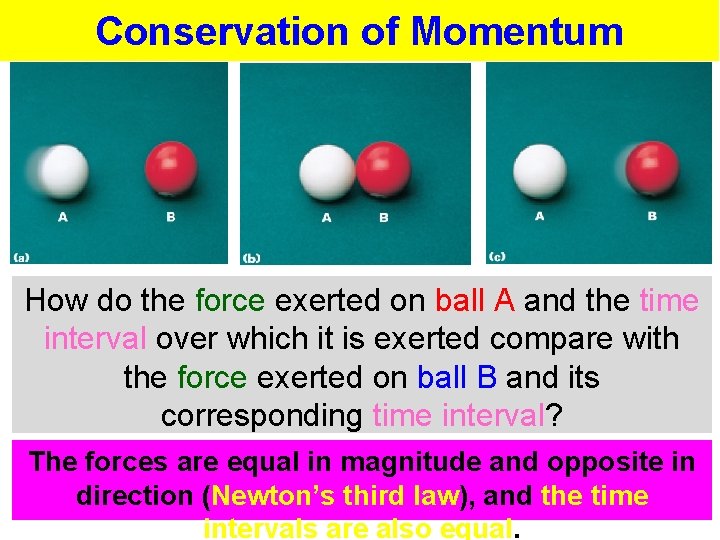
Conservation of Momentum How do the force exerted on ball A and the time interval over which it is exerted compare with the force exerted on ball B and its corresponding time interval? The forces are equal in magnitude and opposite in direction (Newton’s third law), and the time intervals are also equal.
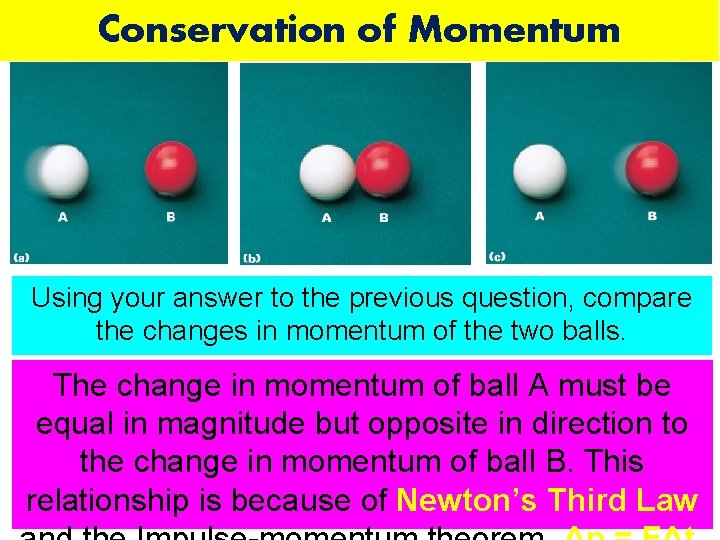
Conservation of Momentum Using your answer to the previous question, compare the changes in momentum of the two balls. The change in momentum of ball A must be equal in magnitude but opposite in direction to the change in momentum of ball B. This relationship is because of Newton’s Third Law
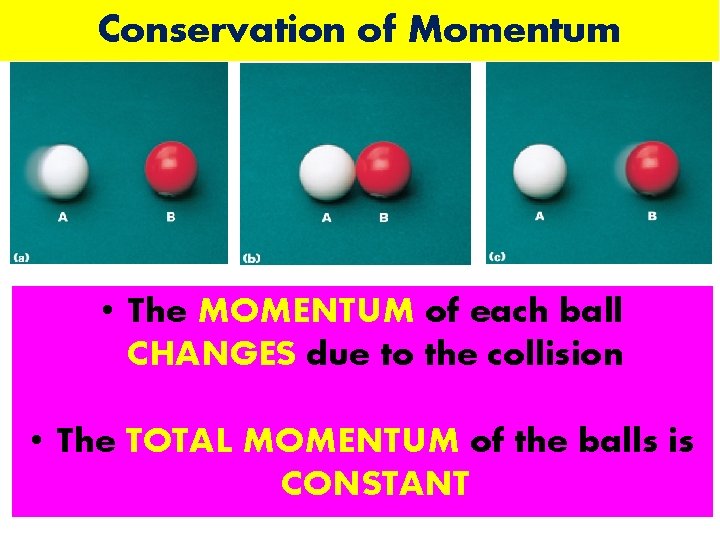
Conservation of Momentum • The MOMENTUM of each ball CHANGES due to the collision • The TOTAL MOMENTUM of the balls is CONSTANT
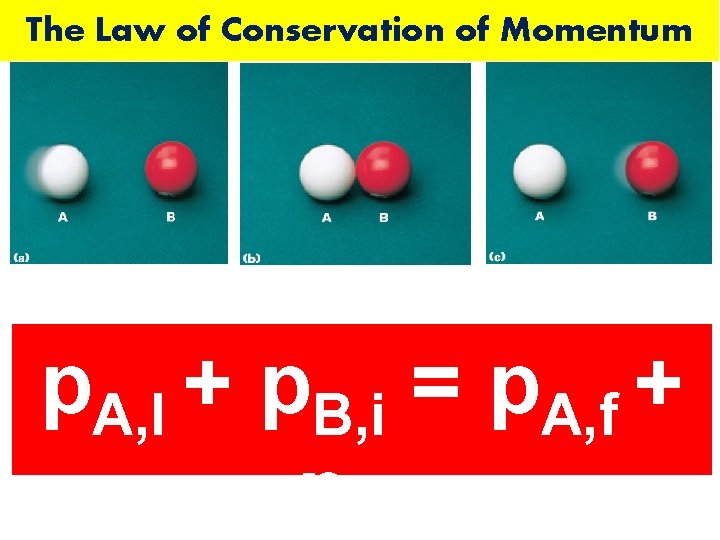
The Law of Conservation of Momentum p. A, I + p. B, i = p. A, f + p
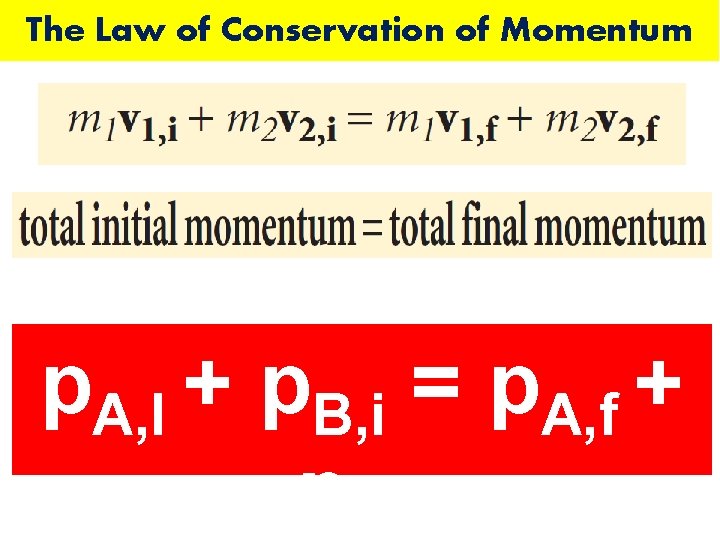
The Law of Conservation of Momentum p. A, I + p. B, i = p. A, f + p
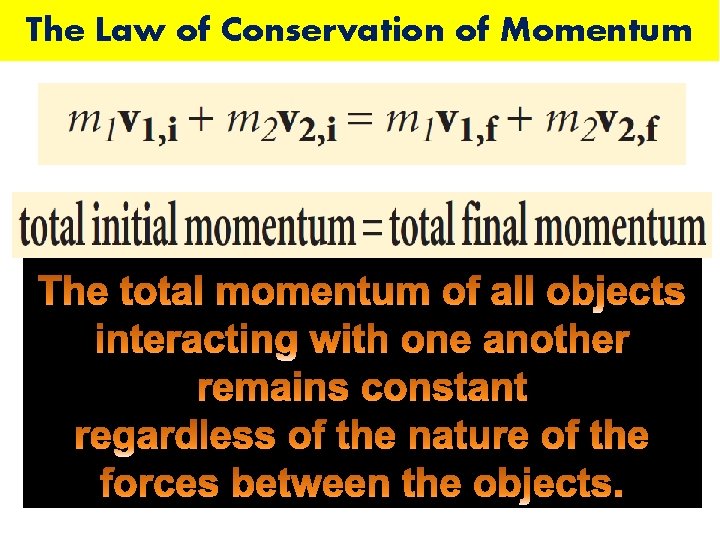
The Law of Conservation of Momentum
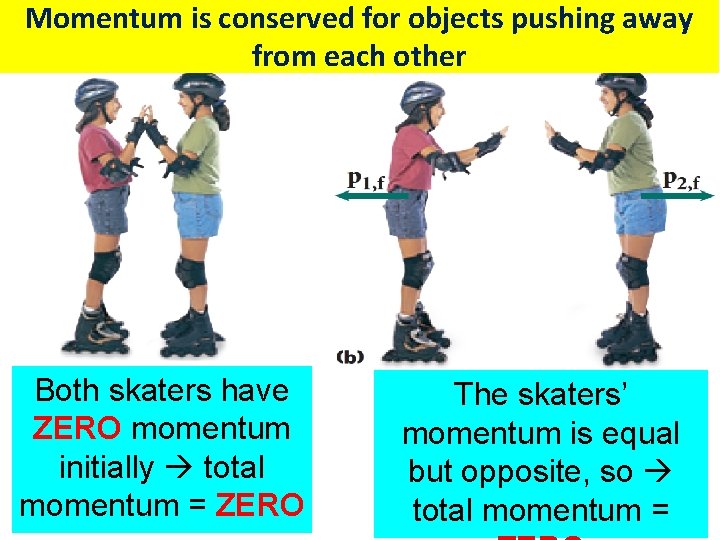
Momentum is conserved for objects pushing away from each other Both skaters have ZERO momentum initially total momentum = ZERO The skaters’ momentum is equal but opposite, so total momentum =
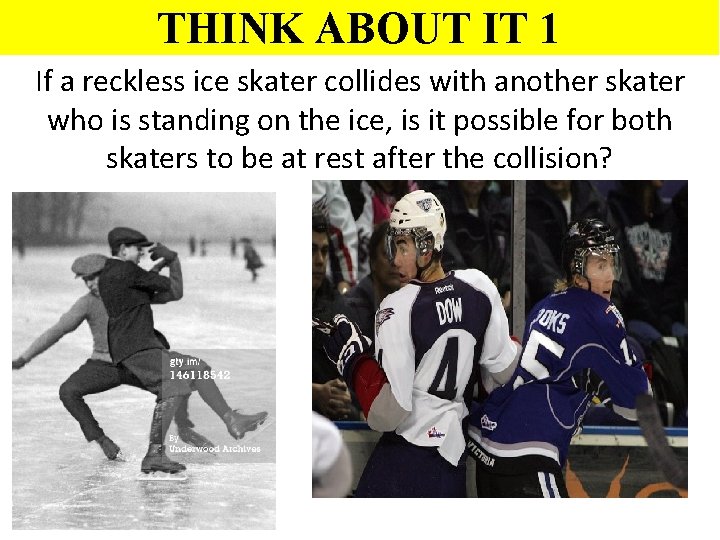
THINK ABOUT IT 1 If a reckless ice skater collides with another skater who is standing on the ice, is it possible for both skaters to be at rest after the collision?
THINK ABOUT IT 2 A spacecraft undergoes a change of velocity when its rockets are fired. How does the spacecraft change velocity in empty space, where there is nothing for the gases emitted by the rockets to push against?
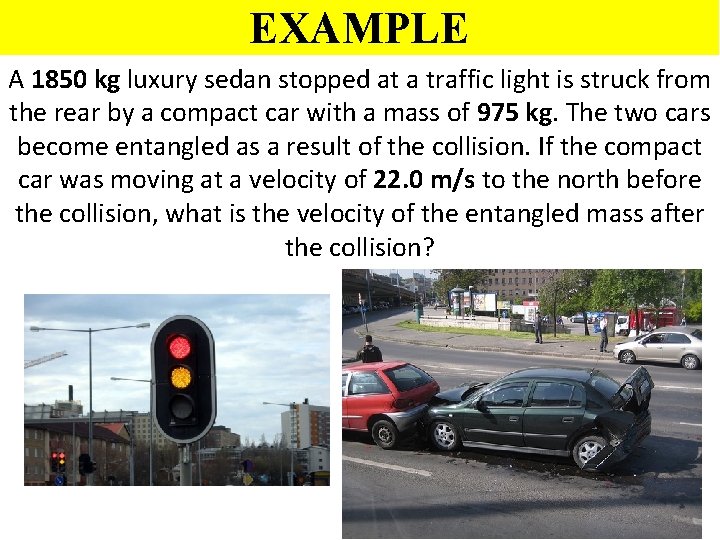
EXAMPLE A 1850 kg luxury sedan stopped at a traffic light is struck from the rear by a compact car with a mass of 975 kg. The two cars become entangled as a result of the collision. If the compact car was moving at a velocity of 22. 0 m/s to the north before the collision, what is the velocity of the entangled mass after the collision?
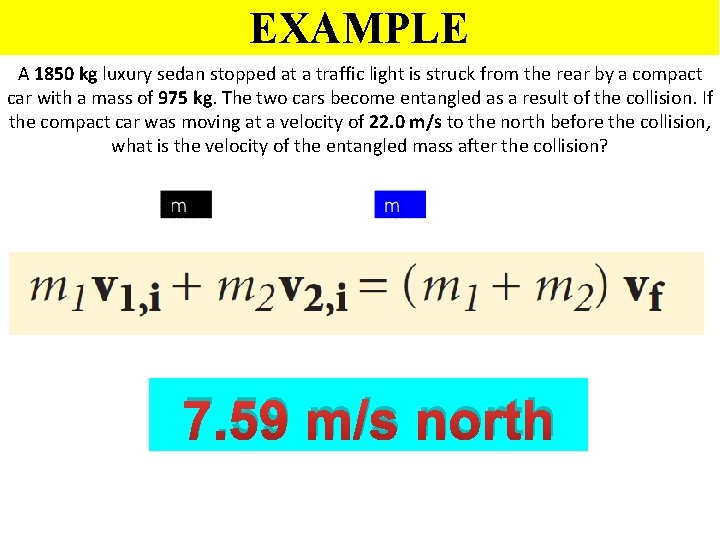
EXAMPLE A 1850 kg luxury sedan stopped at a traffic light is struck from the rear by a compact car with a mass of 975 kg. The two cars become entangled as a result of the collision. If the compact car was moving at a velocity of 22. 0 m/s to the north before the collision, what is the velocity of the entangled mass after the collision? 7. 59 m/s north
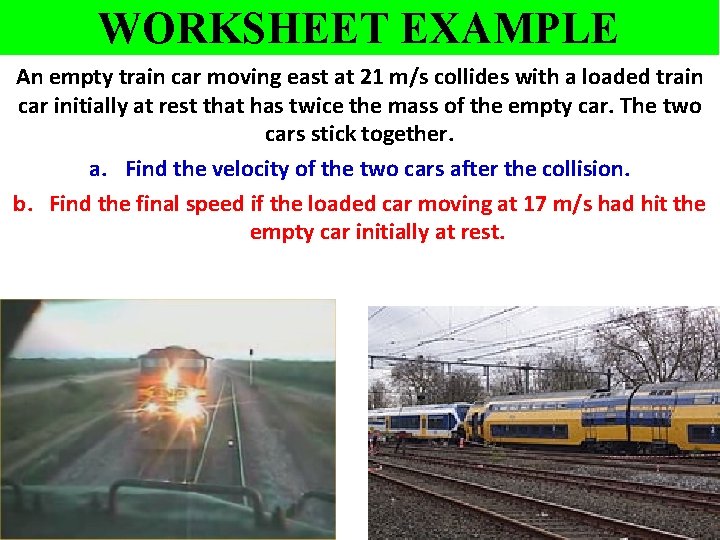
WORKSHEET EXAMPLE An empty train car moving east at 21 m/s collides with a loaded train car initially at rest that has twice the mass of the empty car. The two cars stick together. a. Find the velocity of the two cars after the collision. b. Find the final speed if the loaded car moving at 17 m/s had hit the empty car initially at rest.
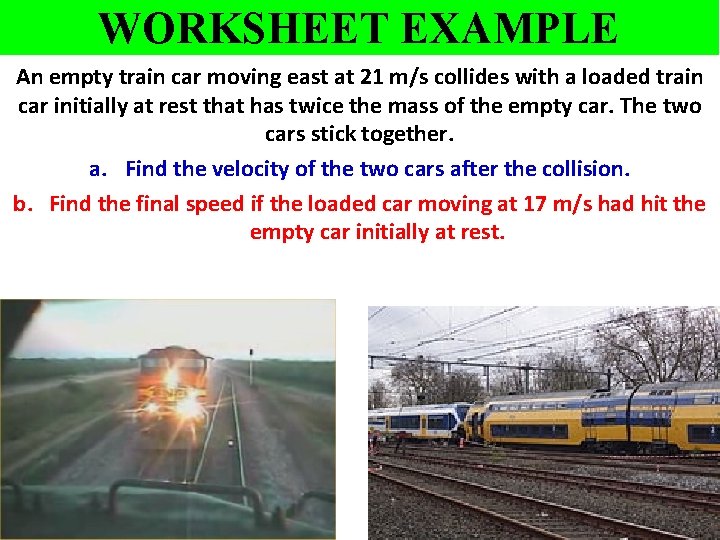
WORKSHEET EXAMPLE An empty train car moving east at 21 m/s collides with a loaded train car initially at rest that has twice the mass of the empty car. The two cars stick together. a. Find the velocity of the two cars after the collision. b. Find the final speed if the loaded car moving at 17 m/s had hit the empty car initially at rest.
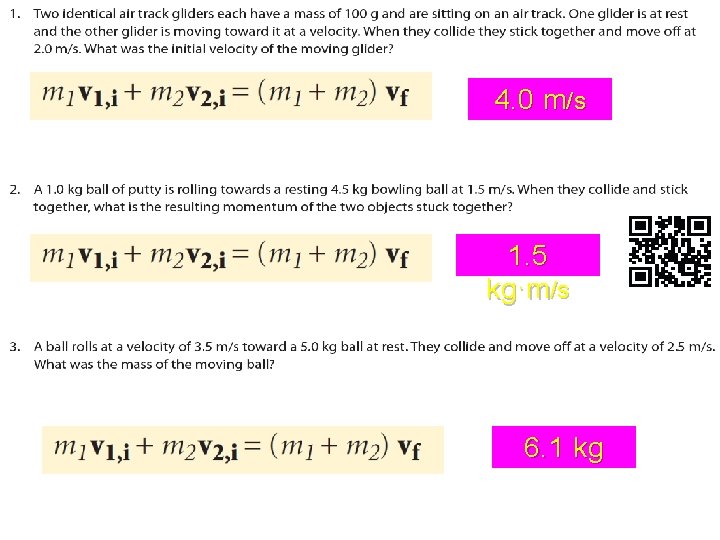
4. 0 m/s 1. 5 kg·m/s 6. 1 kg
Classwork Page: 126 (4. 4 Review Questions) Problems: all even Page: 128 – 129 (Chapter 4 Review Questions) Problems: 6, 12, 14 56
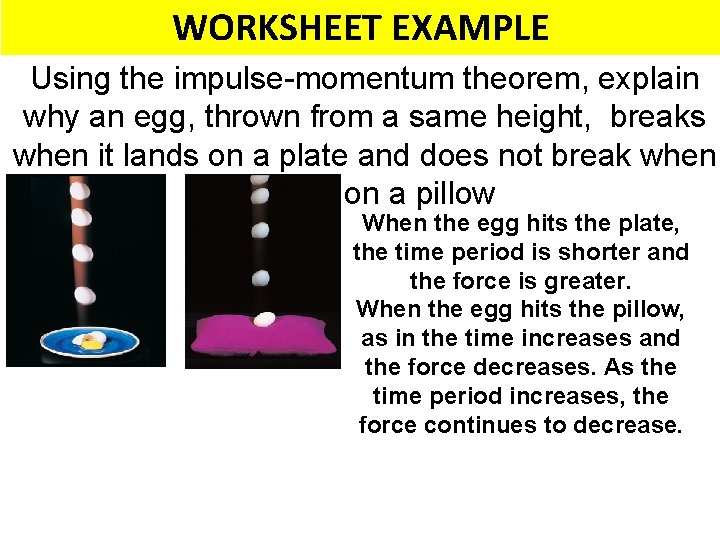
WORKSHEET EXAMPLE Using the impulse-momentum theorem, explain why an egg, thrown from a same height, breaks when it lands on a plate and does not break when it lands on a pillow When the egg hits the plate, the time period is shorter and the force is greater. When the egg hits the pillow, as in the time increases and the force decreases. As the time period increases, the force continues to decrease.
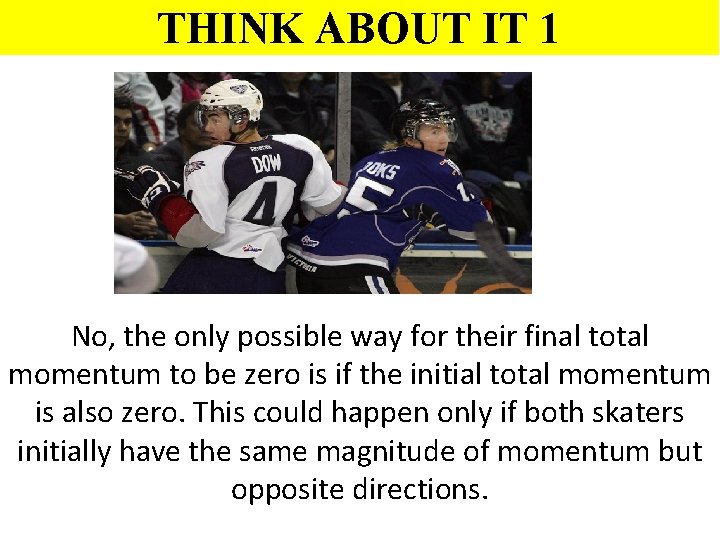
THINK ABOUT IT 1 No, the only possible way for their final total momentum to be zero is if the initial total momentum is also zero. This could happen only if both skaters initially have the same magnitude of momentum but opposite directions.
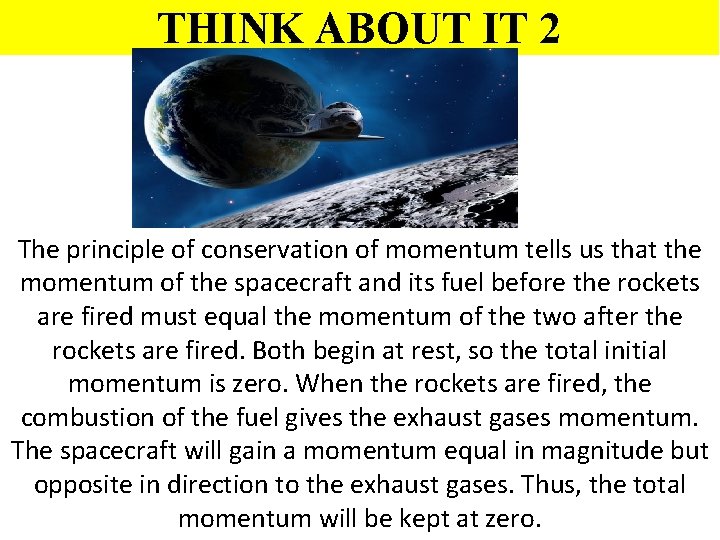
THINK ABOUT IT 2 The principle of conservation of momentum tells us that the momentum of the spacecraft and its fuel before the rockets are fired must equal the momentum of the two after the rockets are fired. Both begin at rest, so the total initial momentum is zero. When the rockets are fired, the combustion of the fuel gives the exhaust gases momentum. The spacecraft will gain a momentum equal in magnitude but opposite in direction to the exhaust gases. Thus, the total momentum will be kept at zero.
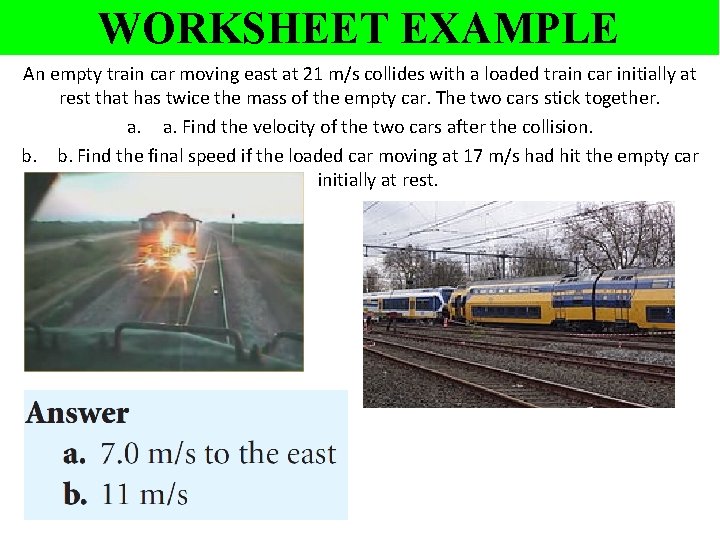
WORKSHEET EXAMPLE An empty train car moving east at 21 m/s collides with a loaded train car initially at rest that has twice the mass of the empty car. The two cars stick together. a. a. Find the velocity of the two cars after the collision. b. b. Find the final speed if the loaded car moving at 17 m/s had hit the empty car initially at rest.

WORKSHEET EXAMPLE A clay ball with a mass of 0. 35 kg hits another 0. 35 kg ball at rest, and the two stick together. The first ball has an initial speed of 4. 2 m/s. a. What is the final speed of the balls? b. Calculate the decrease in kinetic energy that occurs during the collision. c. What percentage of the initial kinetic energy is converted to other forms of energy?
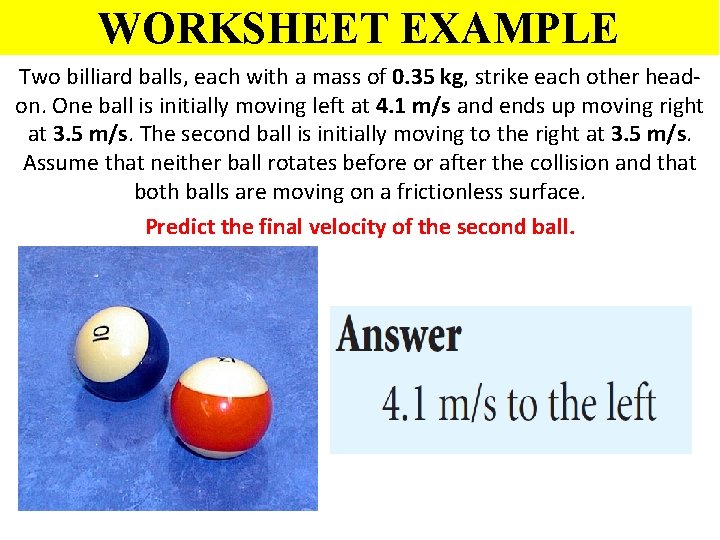
WORKSHEET EXAMPLE Two billiard balls, each with a mass of 0. 35 kg, strike each other headon. One ball is initially moving left at 4. 1 m/s and ends up moving right at 3. 5 m/s. The second ball is initially moving to the right at 3. 5 m/s. Assume that neither ball rotates before or after the collision and that both balls are moving on a frictionless surface. Predict the final velocity of the second ball.
- Slides: 62