
Todays HW Agenda Vocabulary Due Tue 320 Ch
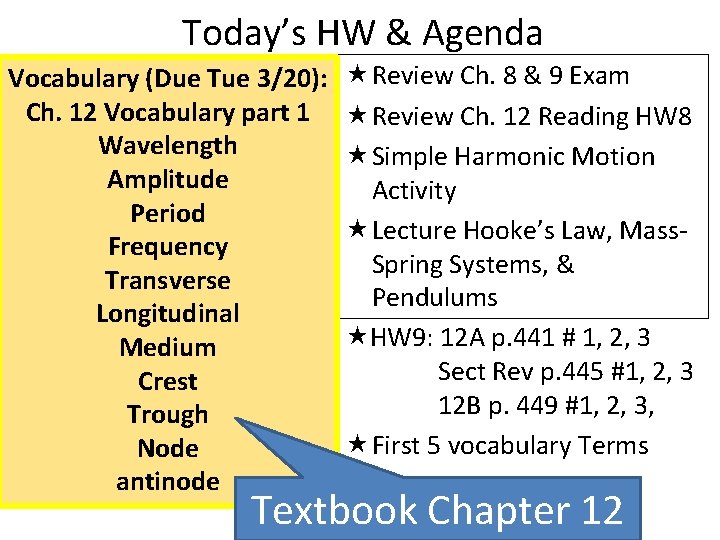
Today’s HW & Agenda Vocabulary (Due Tue 3/20): Ch. 12 Vocabulary part 1 Wavelength Amplitude Period Frequency Transverse Longitudinal Medium Crest Trough Node antinode « Review Ch. 8 & 9 Exam « Review Ch. 12 Reading HW 8 « Simple Harmonic Motion Activity « Lecture Hooke’s Law, Mass. Spring Systems, & Pendulums «HW 9: 12 A p. 441 # 1, 2, 3 Sect Rev p. 445 #1, 2, 3 12 B p. 449 #1, 2, 3, « First 5 vocabulary Terms Textbook Chapter 12
periodic motion & Waves video • https: //www. youtube. com/watch? v=j 6 Khw. O Ql. Ih 8&feature=iv&src_vid=j. AXx 0018 QCc&ann otation_id=annotation_829607
Simple Harmonic Motion Activity Partner 1 Pulls the Paper at CONSTANT Velocity Partner 2 Traces Bob’s Motion with Pencil
• • Simple Harmonic Motion Activity Look at the Drawing. Do the Following: Measure the Wavelength, . Label it. Measure the Amplitude, A. Label it. Label the crest and the trough Label the nodes Time 3 full periods of your pendulum (use watch or cell phone) , then divide that time by 3 to find the period, T. Record. Calculate the frequency, f (f=1/T). Write your names on the paper & turn in.
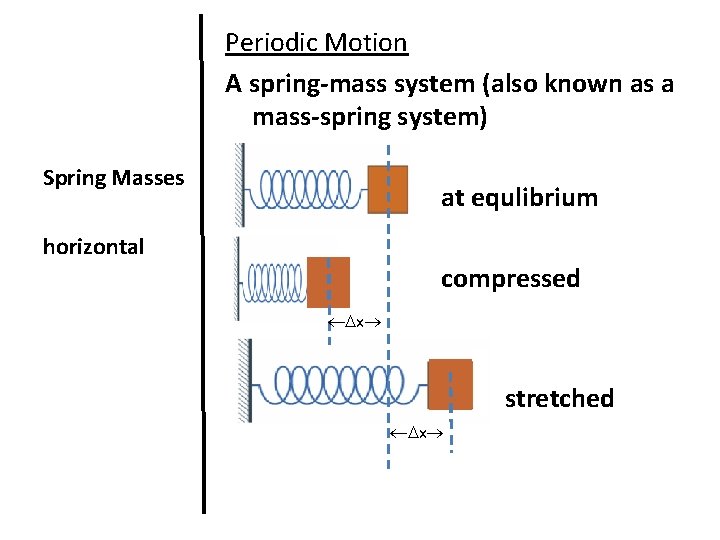
Periodic Motion A spring-mass system (also known as a mass-spring system) Spring Masses at equlibrium horizontal compressed x stretched x
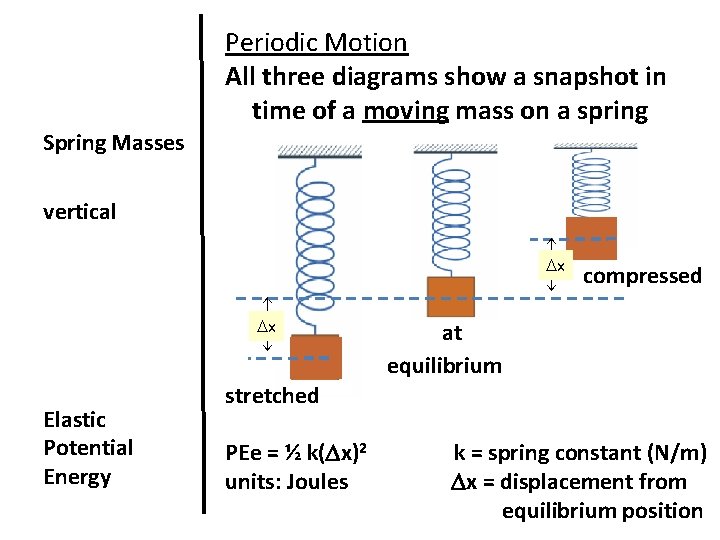
Periodic Motion All three diagrams show a snapshot in time of a moving mass on a spring Spring Masses vertical x x Elastic Potential Energy compressed at equilibrium stretched PEe = ½ k( x)2 units: Joules k = spring constant (N/m) x = displacement from equilibrium position
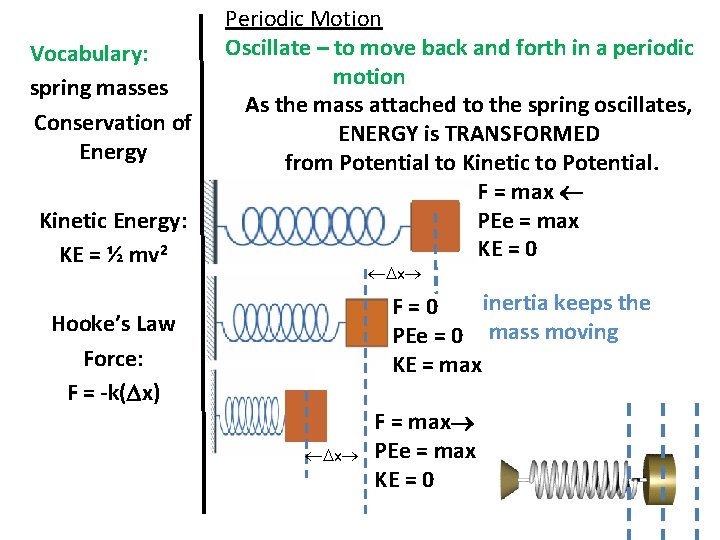
Vocabulary: spring masses Conservation of Energy Kinetic Energy: KE = ½ mv 2 Periodic Motion Oscillate – to move back and forth in a periodic motion As the mass attached to the spring oscillates, ENERGY is TRANSFORMED from Potential to Kinetic to Potential. F = max PEe = max KE = 0 x inertia keeps the F=0 PEe = 0 mass moving KE = max Hooke’s Law Force: F = -k( x) x F = max PEe = max KE = 0
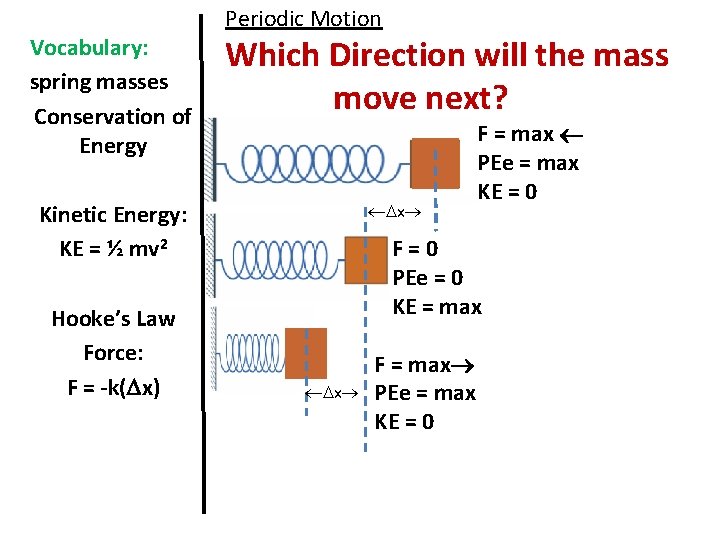
Vocabulary: spring masses Conservation of Energy Periodic Motion Which Direction will the mass move next? x Kinetic Energy: KE = ½ mv 2 Hooke’s Law Force: F = -k( x) F = max PEe = max KE = 0 F=0 PEe = 0 KE = max x F = max PEe = max KE = 0
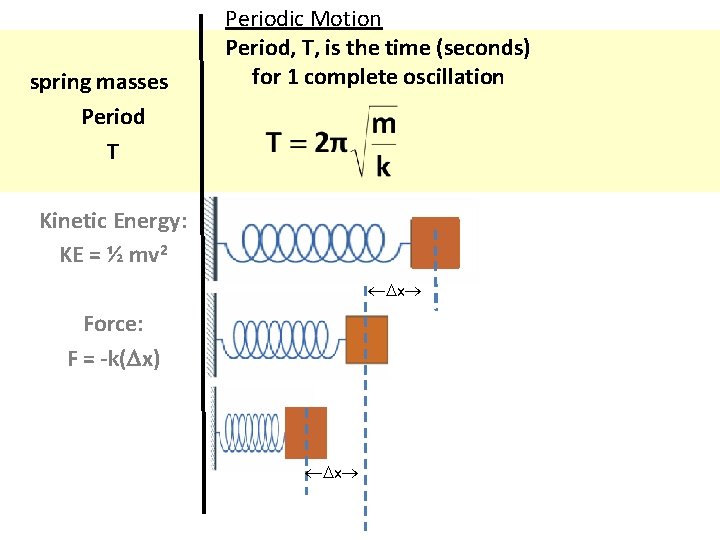
spring masses Period T Periodic Motion Period, T, is the time (seconds) for 1 complete oscillation Kinetic Energy: KE = ½ mv 2 x Force: F = -k( x) x
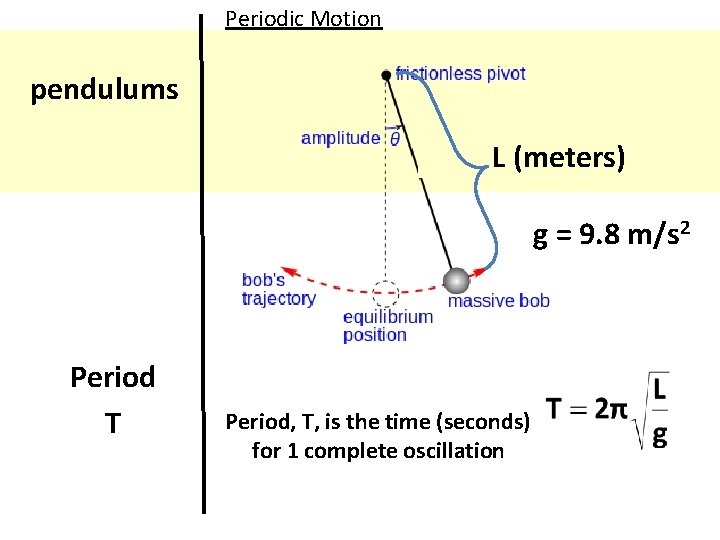
Periodic Motion pendulums L (meters) g = 9. 8 m/s 2 Period T Period, T, is the time (seconds) for 1 complete oscillation
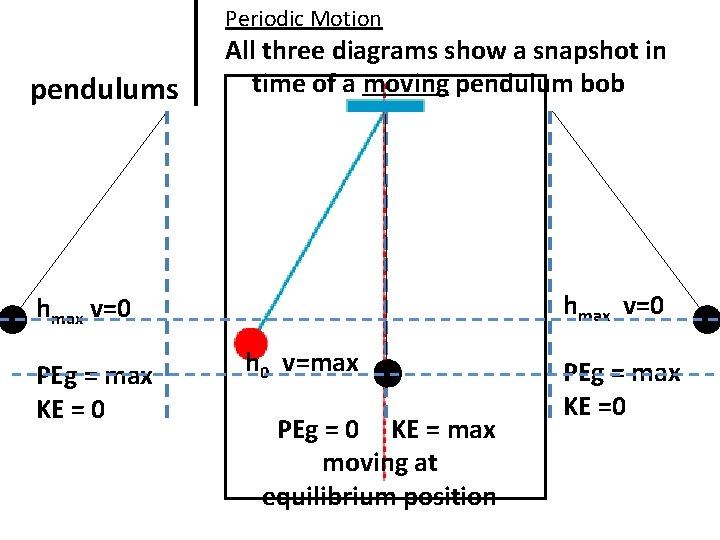
Periodic Motion pendulums All three diagrams show a snapshot in time of a moving pendulum bob hmax v=0 PEg = max KE = 0 h 0 v=max PEg = 0 KE = max moving at equilibrium position PEg = max KE =0
END OF LECTURE
- Slides: 12