
Todays Class Kant Moral Duty EMP 21 pages



- Slides: 28
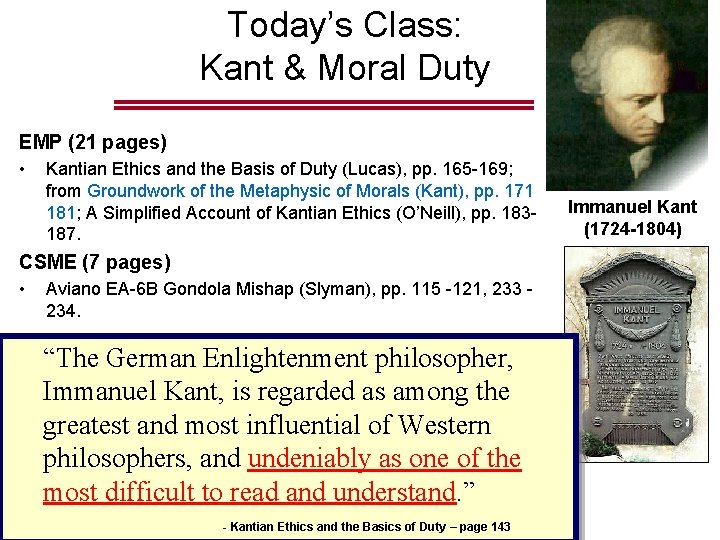
Today’s Class: Kant & Moral Duty EMP (21 pages) • Kantian Ethics and the Basis of Duty (Lucas), pp. 165 -169; from Groundwork of the Metaphysic of Morals (Kant), pp. 171181; A Simplified Account of Kantian Ethics (O’Neill), pp. 183187. CSME (7 pages) • Aviano EA-6 B Gondola Mishap (Slyman), pp. 115 -121, 233 234. Objectives from reading: “The German Enlightenment philosopher, Immanuel Kant, is regarded as among the greatest and most influential of Western philosophers, and undeniably as one of the most difficult to read and understand. ” Comprehend moral basis & standard of Kantian or duty-based ethics: • What are the strengths & weaknesses of Kantian ethics as a moral standard? • Kantian concept of good will, reason, intent, & duty • Know and apply the 3 versions of the Categorical Imperative. • How does Kantian moral theory differ from utilitarianism regarding intent & consequences? • How would you compare Kant’s concept of duty to the concept or military duty? - Kantian Ethics and the Basics of Duty – page 143 Immanuel Kant (1724 -1804)
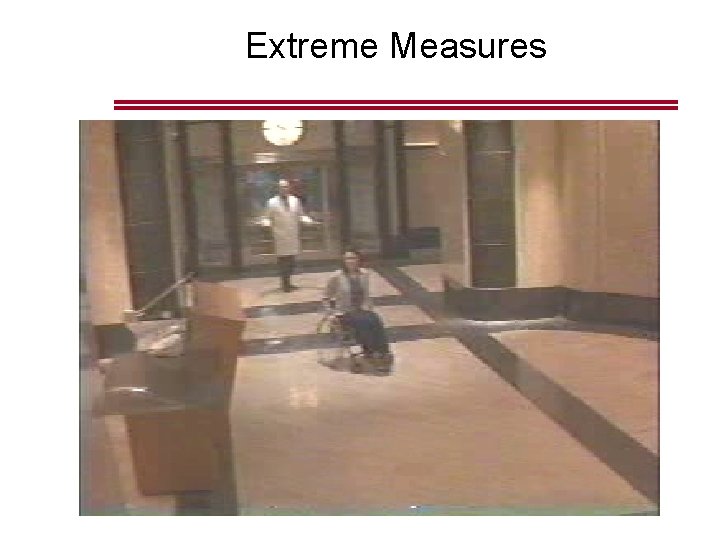
Extreme Measures
…and your rebuttal? Do what is “correct…” Do what is “right…” Do what is “brave…”
Utilitarianism (review) • The Principle of Utility (GHP) is a good example of most of these provisions… – Gives clear answers, helps resolve many problems, explains and justifies our intuitions – But the Extreme Measures story, or “shoot the prisoners” dilemma, illustrate issues (like justice, fairness, and rights) which are not sufficiently addressed
Kant’s direct swipes… • At Utilitarianism – “A good will is not good because of what it effects or accomplishes…it is good in the willing alone…” • At Aristotelian Virtues – “Intelligence, courage, resolution, determination…are good in many respects, but they can be bad or hurtful when the will is not good…” (see Adolph Hitler) • At Ego-centric Ethics – “Man feels in himself a powerful counterweight to all the commands of duty presented to him…the counterweight of his desires…. which pervert the dignity of the strict natural laws of duty…”
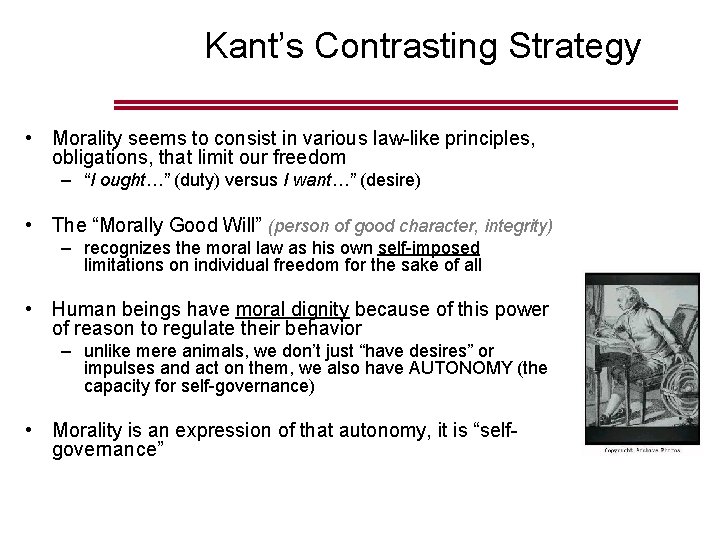
Kant’s Contrasting Strategy • Morality seems to consist in various law-like principles, obligations, that limit our freedom – “I ought…” (duty) versus I want…” (desire) • The “Morally Good Will” (person of good character, integrity) – recognizes the moral law as his own self-imposed limitations on individual freedom for the sake of all • Human beings have moral dignity because of this power of reason to regulate their behavior – unlike mere animals, we don’t just “have desires” or impulses and act on them, we also have AUTONOMY (the capacity for self-governance) • Morality is an expression of that autonomy, it is “selfgovernance”
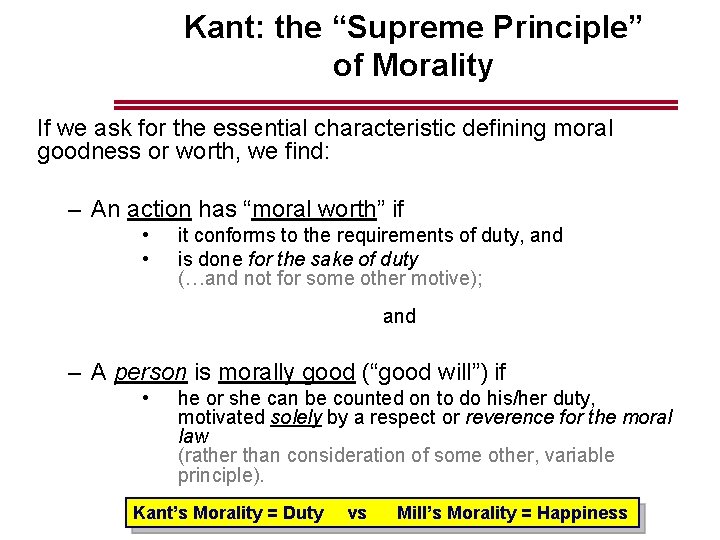
Kant: the “Supreme Principle” of Morality If we ask for the essential characteristic defining moral goodness or worth, we find: – An action has “moral worth” if • • it conforms to the requirements of duty, and is done for the sake of duty (…and not for some other motive); and – A person is morally good (“good will”) if • he or she can be counted on to do his/her duty, motivated solely by a respect or reverence for the moral law (rather than consideration of some other, variable principle). Kant’s Morality = Duty vs Mill’s Morality = Happiness
What is “Duty? ” – Main Entry: • 1 du·ty – Pronunciation: • ˈdü-tē also ˈdyü- – Function: • noun – Inflected Form(s): • plural duties – Etymology: • Middle English duete, from Anglo-French deueté, dueté, from deu due – Date: • 13 th century – 1: conduct due to parents and superiors : respect 2 a: obligatory tasks, conduct, service, or functions that arise from one's position (as in life or in a group) b (1): assigned service or business (2): active military service (3): a period of being on duty 3 a: a moral or legal obligation b: the force of moral obligation 4: tax ; especially : a tax on imports 5 a: work
Terms to Know • Categorical Imperative (CI) – “Unconditional Obligation” – “No alibi, must comply” • Maxim – Fundamental principle you act upon – Rule of conduct • Deontological Ethics – Based on Moral Obligation
Observations about Categorical Imperatives (CIs) § CI’s derive their authority from within – from the rational impulse to obey the dictates of Reason itself (as an expression of my autonomy) § CI’s command absolutely, unconditionally, “no ifs, ands or buts” (no strings attached) § CI’s are universal, unconditional, NOT subject to variation or change § Duty and the institution of morality are like this (Must comply- no alibi) § “Do this, whether you want to or not, whether you can be made to or not, whether anyone will notice, reward, praise, or blame you (or not). ”
Categorical Imperative (CI 1): Formula of Universal Law • CI 1 – Formula of Universal Law: “Act only on that maxim through which you can at the same time will that it should become a universal law” Translation: 1. Can I universalize my act without contradiction? Kant’s 4 illustrations: • Do not harm the self (suicide) • Do not harm or deceive others (lying) • Do what is good for the self (develop your talents) • Do what is good for others (beneficence)
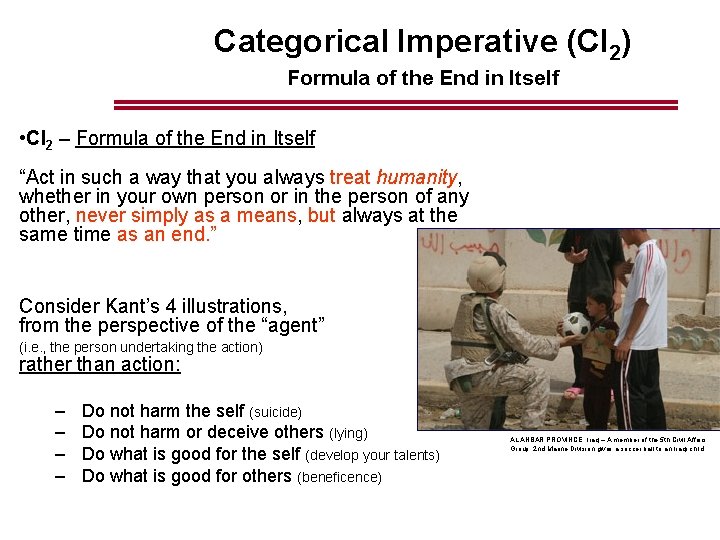
Categorical Imperative (CI 2) Formula of the End in Itself • CI 2 – Formula of the End in Itself “Act in such a way that you always treat humanity, whether in your own person or in the person of any other, never simply as a means, but always at the same time as an end. ” Consider Kant’s 4 illustrations, from the perspective of the “agent” (i. e. , the person undertaking the action) rather than action: – – Do not harm the self (suicide) Do not harm or deceive others (lying) Do what is good for the self (develop your talents) Do what is good for others (beneficence) AL ANBAR PROVINCE, Iraq – A member of the 5 th Civil Affairs Group, 2 nd Marine Division gives a soccer ball to an Iraqi child
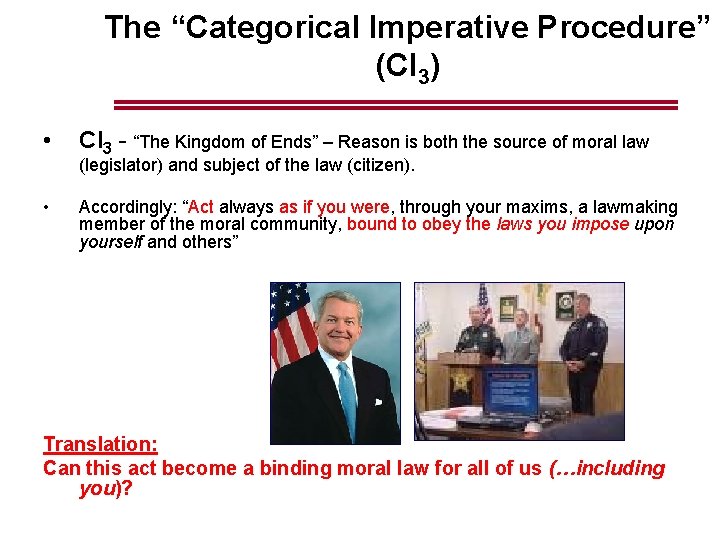
The “Categorical Imperative Procedure” (CI 3) • CI 3 - “The Kingdom of Ends” – Reason is both the source of moral law (legislator) and subject of the law (citizen). • Accordingly: “Act always as if you were, through your maxims, a lawmaking member of the moral community, bound to obey the laws you impose upon yourself and others” Translation: Can this act become a binding moral law for all of us (…including you)?
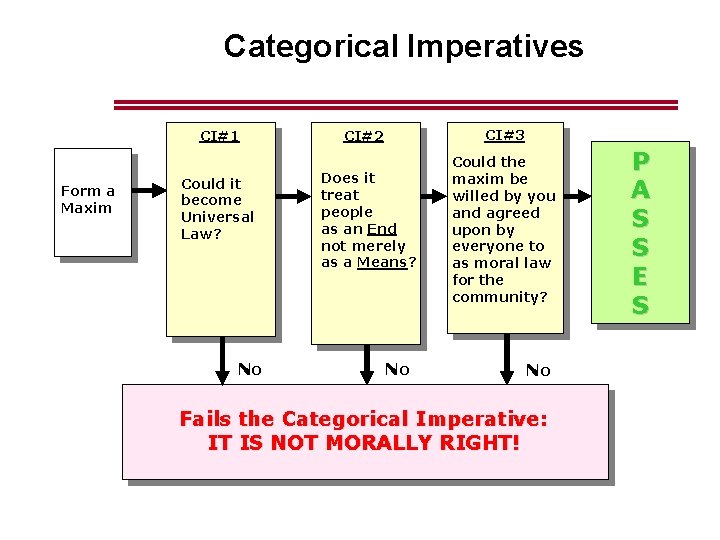
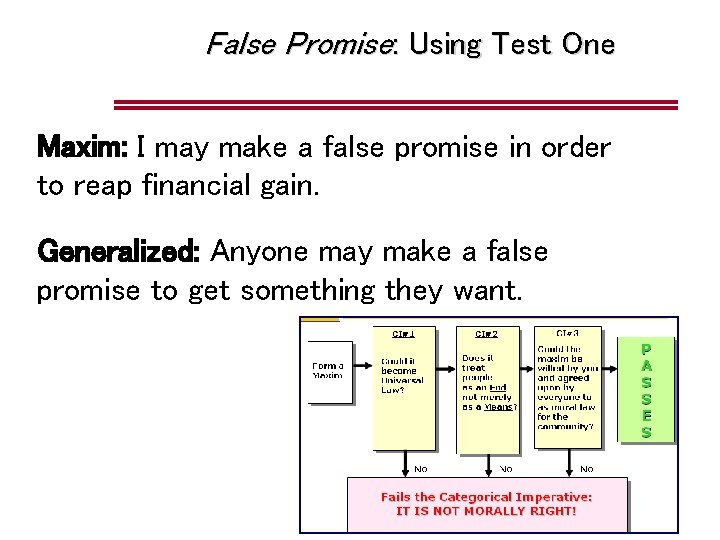
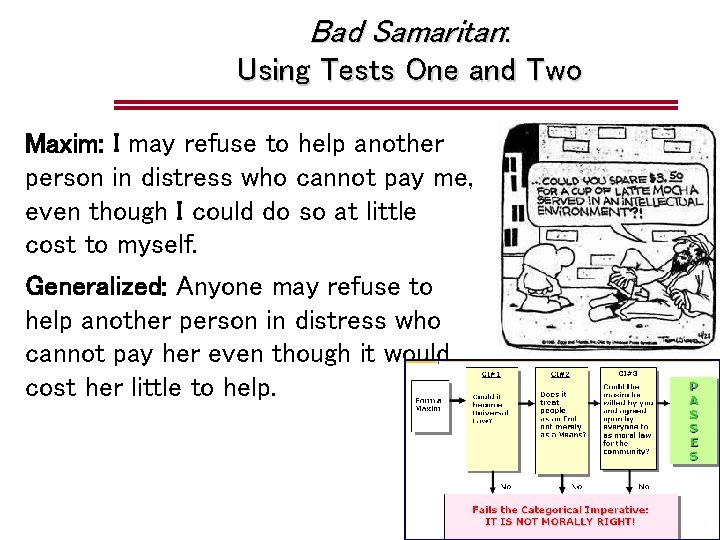
Categorical Imperatives CI#1 Form a Maxim Could it become Universal Law? No CI#3 CI#2 Does it treat people as an End not merely as a Means? No Could the maxim be willed by you and agreed upon by everyone to as moral law for the community? No Fails the Categorical Imperative: IT IS NOT MORALLY RIGHT! P A S S E S
False Promise: Using Test One Maxim: I may make a false promise in order to reap financial gain. Generalized: Anyone may make a false promise to get something they want.
Bad Samaritan: Using Tests One and Two Maxim: I may refuse to help another person in distress who cannot pay me, even though I could do so at little cost to myself. Generalized: Anyone may refuse to help another person in distress who cannot pay her even though it would cost her little to help.
Can I, or Kant I? Some potential maxims: • I will always tell the truth. • I will always throw my paper wrappers out my car window. • I will cure cancer forever by experimenting with one homeless person’s life. • I will shoot the POW to get the information to possibly save my troops. • I will provide for my family. • I will steal food for my family if they are starving.
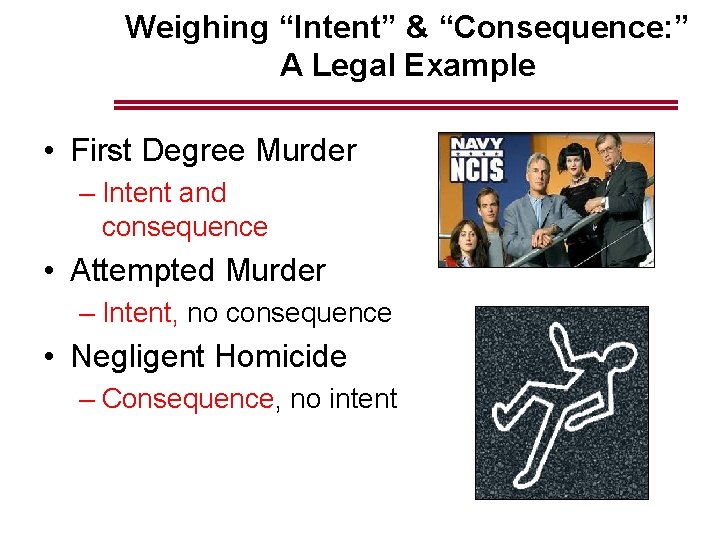
Weighing “Intent” & “Consequence: ” A Legal Example • First Degree Murder – Intent and consequence • Attempted Murder – Intent, no consequence • Negligent Homicide – Consequence, no intent
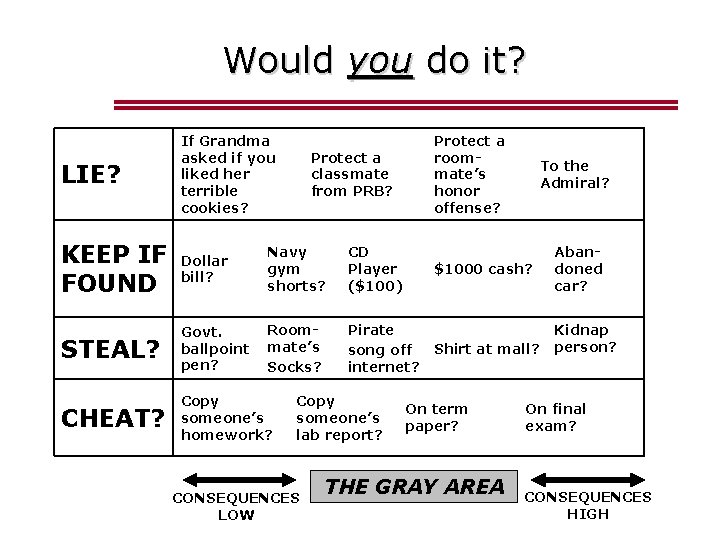
Would you do it? LIE? If Grandma asked if you liked her terrible cookies? Protect a roommate’s honor offense? KEEP IF FOUND Dollar bill? Navy gym shorts? CD Player ($100) STEAL? Govt. ballpoint pen? Roommate’s Socks? Pirate song off internet? CHEAT? Copy someone’s homework? Protect a classmate from PRB? Copy someone’s lab report? CONSEQUENCES LOW To the Admiral? $1000 cash? Shirt at mall? On term paper? THE GRAY AREA Abandoned car? Kidnap person? On final exam? CONSEQUENCES HIGH
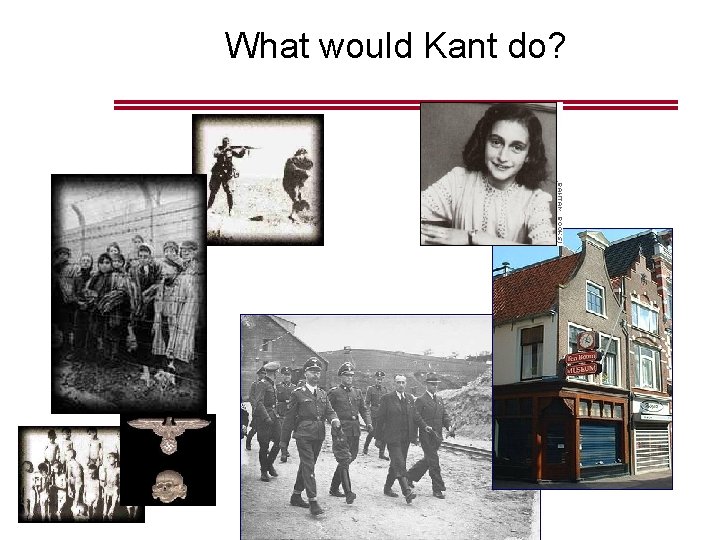
What would Kant do?
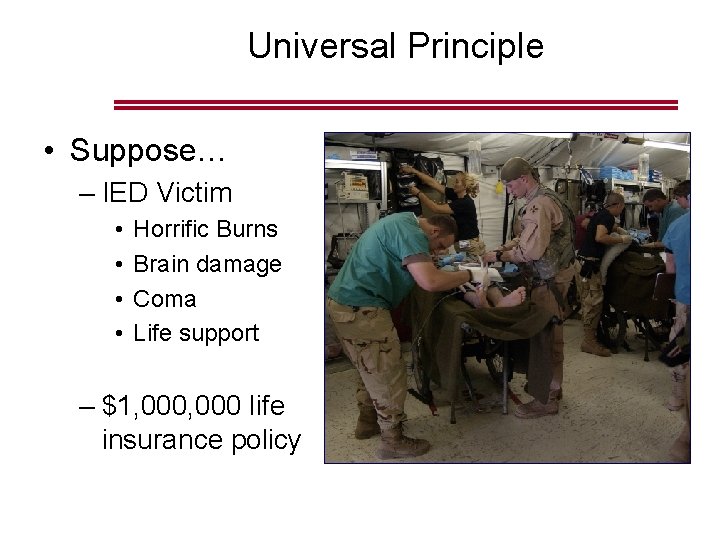
Universal Principle • Suppose… – IED Victim • • Horrific Burns Brain damage Coma Life support – $1, 000 life insurance policy
Observations about Categorical Imperatives (CIs) § CI’s derive their authority from within – from the rational impulse to obey the dictates of Reason itself (as an expression of my autonomy) § CI’s command absolutely, unconditionally, “no ifs, ands or buts” (no strings attached) § CI’s are universal, unconditional, NOT subject to variation or change § Duty and the institution of morality are like this (Must comply- no alibi) § “Do this, whether you want to or not, whether you can be made to or not, whether anyone will notice, reward, praise, or blame you (or not). ” See any issues here?
Goods and Others… Kantian Ethics Strengths • Realm of duty, free from utility (Woo-hoo! no math involved!) • Respect for persons • Golden rule – do unto others, expressed in rational terms • Reason based Weaknesses • Hyper-rationality and lack of emotion • The irrelevance of inclination • Overly formal and universal – i. e. , most of our duties are in social roles • Inflexibility • Supererogation
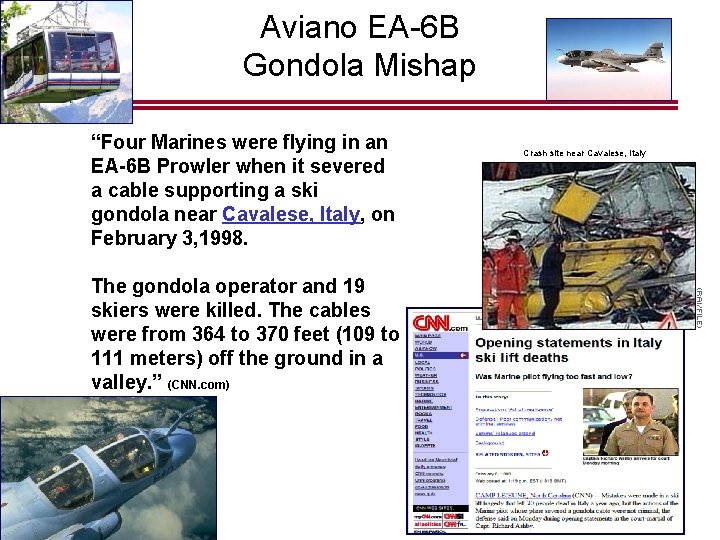
Aviano EA-6 B Gondola Mishap “Four Marines were flying in an EA-6 B Prowler when it severed a cable supporting a ski gondola near Cavalese, Italy, on February 3, 1998. The gondola operator and 19 skiers were killed. The cables were from 364 to 370 feet (109 to 111 meters) off the ground in a valley. ” (CNN. com) Crash site near Cavalese, Italy
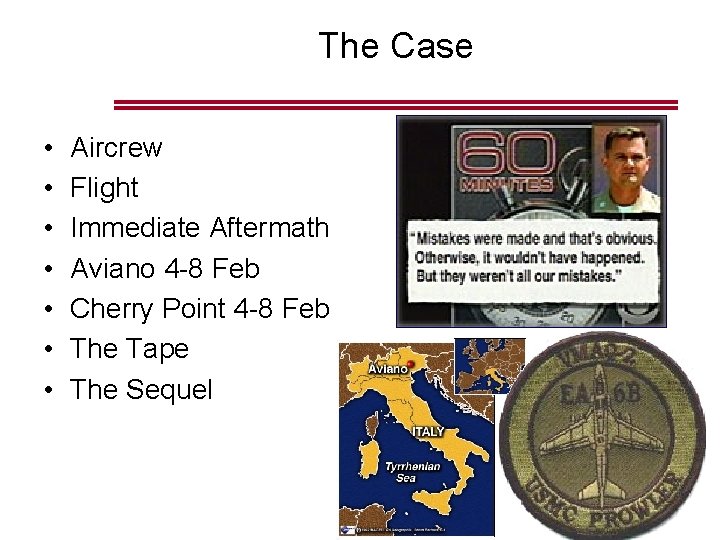
The Case • • Aircrew Flight Immediate Aftermath Aviano 4 -8 Feb Cherry Point 4 -8 Feb The Tape The Sequel
Lead in to Virtue Ethics • How does Kant account for heroism? – • Is it our duty to go “beyond the call of duty? ” Wouldn’t celibacy be immoral – Couldn’t will it to be a universal law (…not for long, anyway) • Which person is more moral? a) A pirate who returns a wallet b) A priest who returns a wallet
A Few Good Men One of those cases where law and morality coincide…
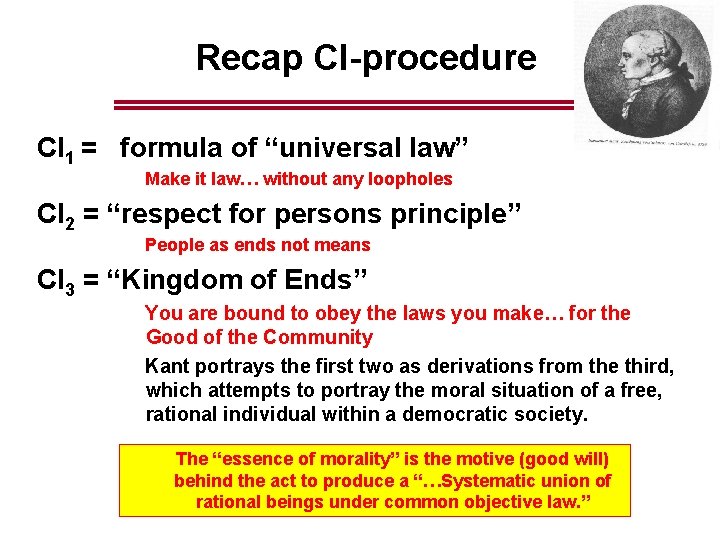
Recap CI-procedure CI 1 = formula of “universal law” Make it law… without any loopholes CI 2 = “respect for persons principle” People as ends not means CI 3 = “Kingdom of Ends” You are bound to obey the laws you make… for the Good of the Community Kant portrays the first two as derivations from the third, which attempts to portray the moral situation of a free, rational individual within a democratic society. The “essence of morality” is the motive (good will) behind the act to produce a “…Systematic union of rational beings under common objective law. ”