
Todays Agenda ISSUES TO ADDRESS What promotes bonding
Today's Agenda ISSUES TO ADDRESS. . . • What promotes bonding? • What types of bonds are there? • What properties are inferred from bonding? Chapter 2 - 1
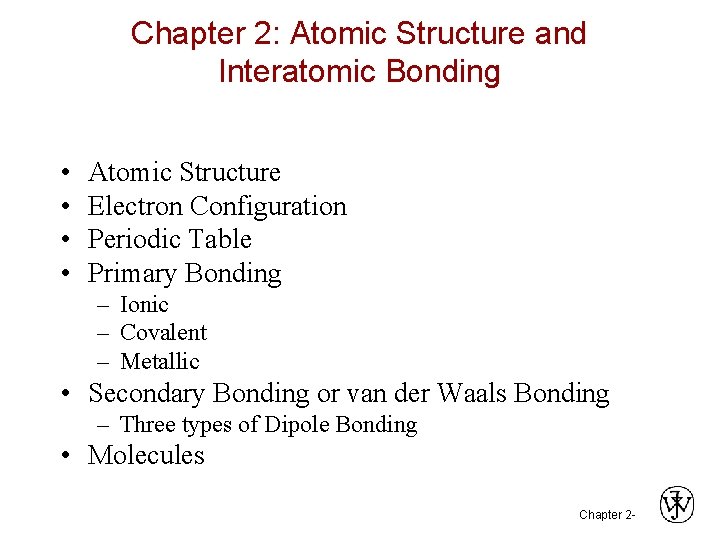
Chapter 2: Atomic Structure and Interatomic Bonding • • Atomic Structure Electron Configuration Periodic Table Primary Bonding – Ionic – Covalent – Metallic • Secondary Bonding or van der Waals Bonding – Three types of Dipole Bonding • Molecules Chapter 2 -
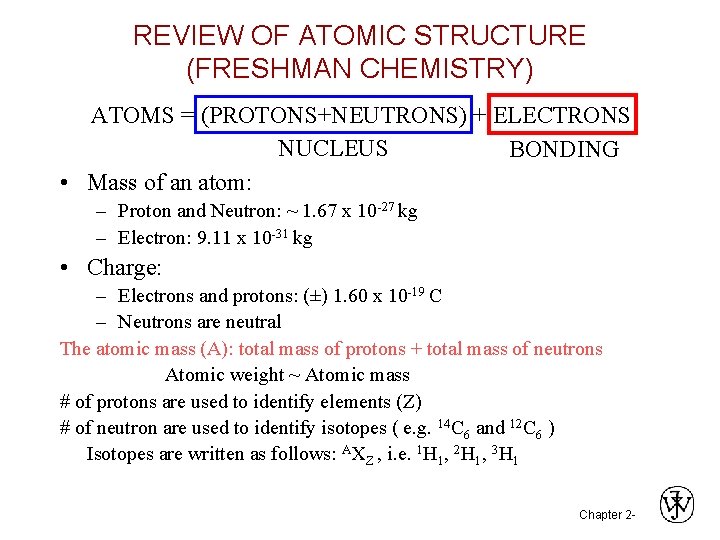
REVIEW OF ATOMIC STRUCTURE (FRESHMAN CHEMISTRY) ATOMS = (PROTONS+NEUTRONS) + ELECTRONS NUCLEUS BONDING • Mass of an atom: – Proton and Neutron: ~ 1. 67 x 10 -27 kg – Electron: 9. 11 x 10 -31 kg • Charge: – Electrons and protons: (±) 1. 60 x 10 -19 C – Neutrons are neutral The atomic mass (A): total mass of protons + total mass of neutrons Atomic weight ~ Atomic mass # of protons are used to identify elements (Z) # of neutron are used to identify isotopes ( e. g. 14 C 6 and 12 C 6 ) Isotopes are written as follows: AXZ , i. e. 1 H 1, 2 H 1, 3 H 1 Chapter 2 -
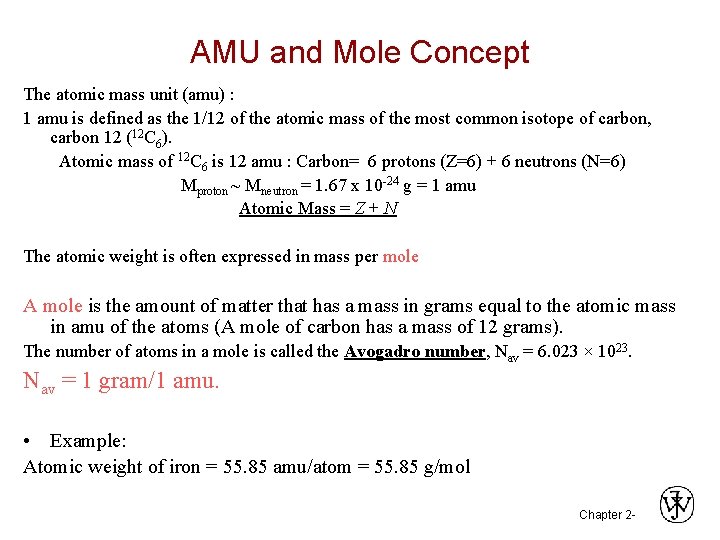
AMU and Mole Concept The atomic mass unit (amu) : 1 amu is defined as the 1/12 of the atomic mass of the most common isotope of carbon, carbon 12 (12 C 6). Atomic mass of 12 C 6 is 12 amu : Carbon= 6 protons (Z=6) + 6 neutrons (N=6) Mproton ~ Mneutron = 1. 67 x 10 -24 g = 1 amu Atomic Mass = Z + N The atomic weight is often expressed in mass per mole A mole is the amount of matter that has a mass in grams equal to the atomic mass in amu of the atoms (A mole of carbon has a mass of 12 grams). The number of atoms in a mole is called the Avogadro number, Nav = 6. 023 × 1023. Nav = 1 gram/1 amu. • Example: Atomic weight of iron = 55. 85 amu/atom = 55. 85 g/mol Chapter 2 -
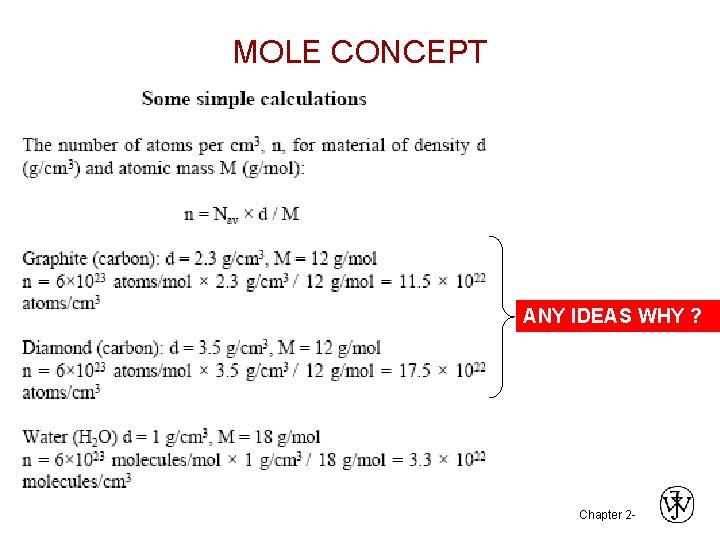
MOLE CONCEPT ANY IDEAS WHY ? Chapter 2 -
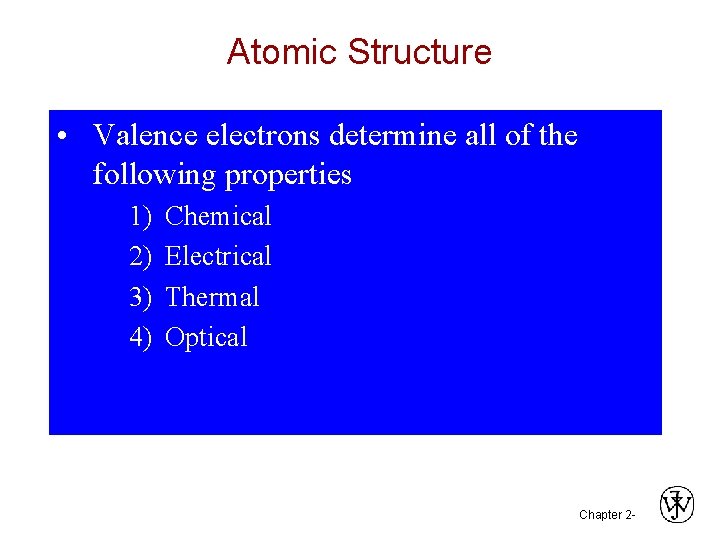
Atomic Structure • Valence electrons determine all of the following properties 1) 2) 3) 4) Chemical Electrical Thermal Optical Chapter 2 -
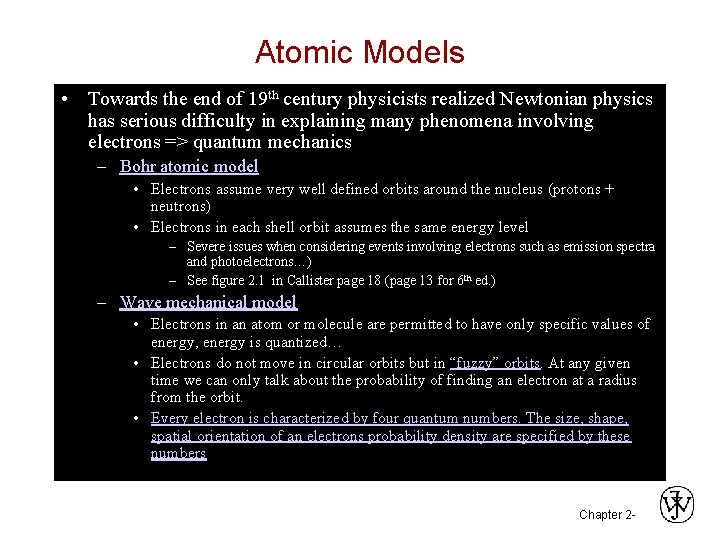
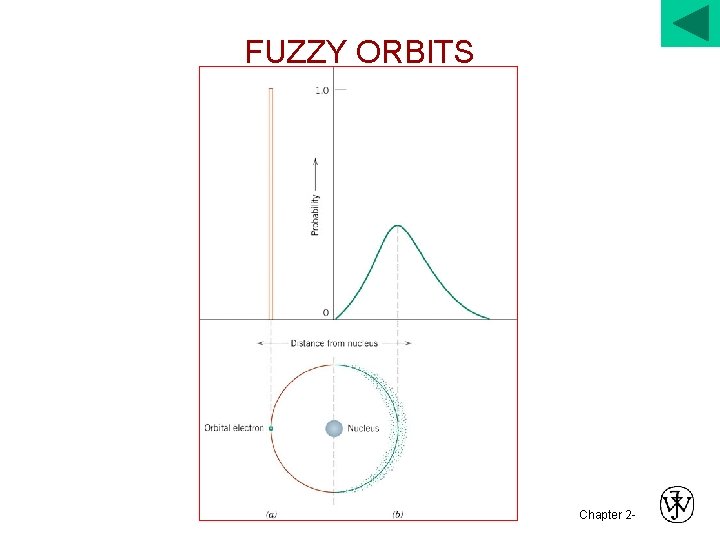
Atomic Models • Towards the end of 19 th century physicists realized Newtonian physics has serious difficulty in explaining many phenomena involving electrons => quantum mechanics – Bohr atomic model • Electrons assume very well defined orbits around the nucleus (protons + neutrons) • Electrons in each shell orbit assumes the same energy level – Severe issues when considering events involving electrons such as emission spectra and photoelectrons…) – See figure 2. 1 in Callister page 18 (page 13 for 6 th ed. ) – Wave mechanical model • Electrons in an atom or molecule are permitted to have only specific values of energy, energy is quantized… • Electrons do not move in circular orbits but in “fuzzy” orbits. At any given time we can only talk about the probability of finding an electron at a radius from the orbit. • Every electron is characterized by four quantum numbers. The size, shape, spatial orientation of an electrons probability density are specified by these numbers Chapter 2 -
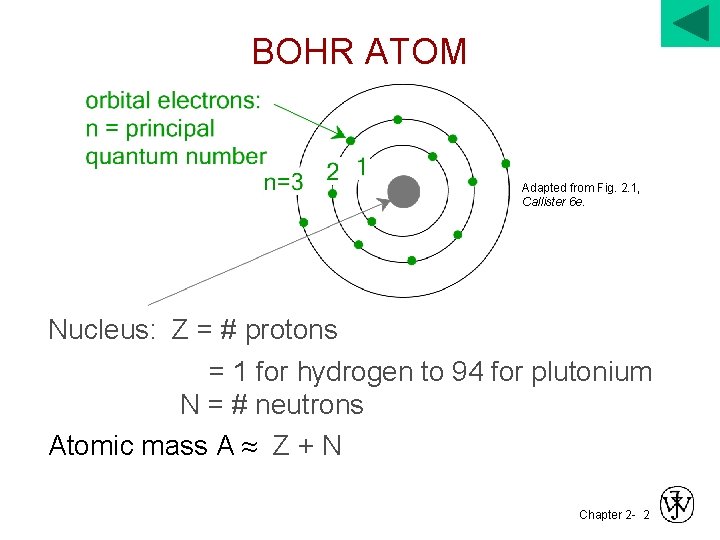
BOHR ATOM Adapted from Fig. 2. 1, Callister 6 e. Nucleus: Z = # protons = 1 for hydrogen to 94 for plutonium N = # neutrons Atomic mass A ≈ Z + N Chapter 2 - 2
FUZZY ORBITS Chapter 2 -
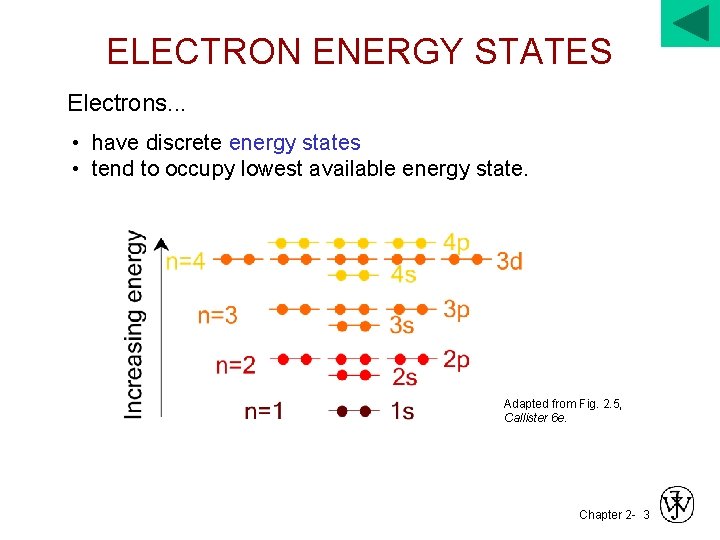
ELECTRON ENERGY STATES Electrons. . . • have discrete energy states • tend to occupy lowest available energy state. Adapted from Fig. 2. 5, Callister 6 e. Chapter 2 - 3
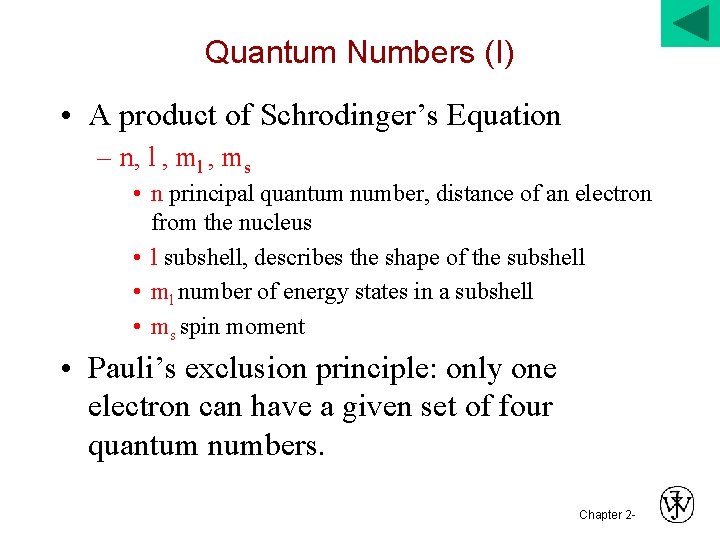
Quantum Numbers (I) • A product of Schrodinger’s Equation – n, l , ms • n principal quantum number, distance of an electron from the nucleus • l subshell, describes the shape of the subshell • ml number of energy states in a subshell • ms spin moment • Pauli’s exclusion principle: only one electron can have a given set of four quantum numbers. Chapter 2 -
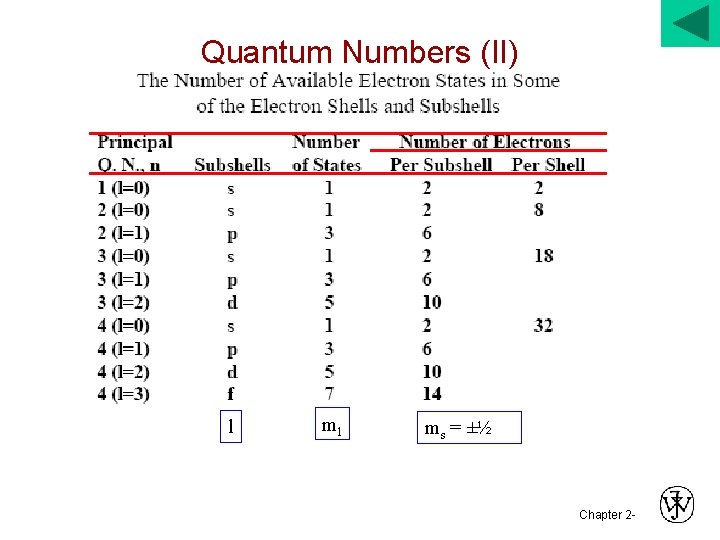
Quantum Numbers (II) l ml ms = ±½ Chapter 2 -
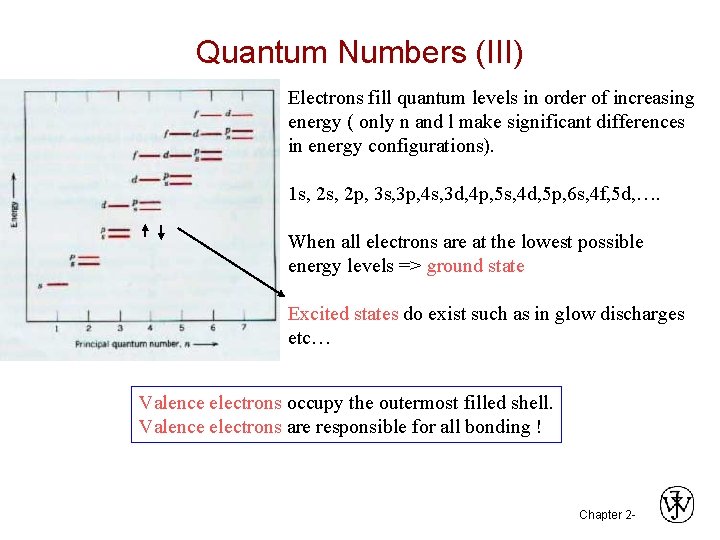
Quantum Numbers (III) Electrons fill quantum levels in order of increasing energy ( only n and l make significant differences in energy configurations). 1 s, 2 p, 3 s, 3 p, 4 s, 3 d, 4 p, 5 s, 4 d, 5 p, 6 s, 4 f, 5 d, …. When all electrons are at the lowest possible energy levels => ground state Excited states do exist such as in glow discharges etc… Valence electrons occupy the outermost filled shell. Valence electrons are responsible for all bonding ! Chapter 2 -
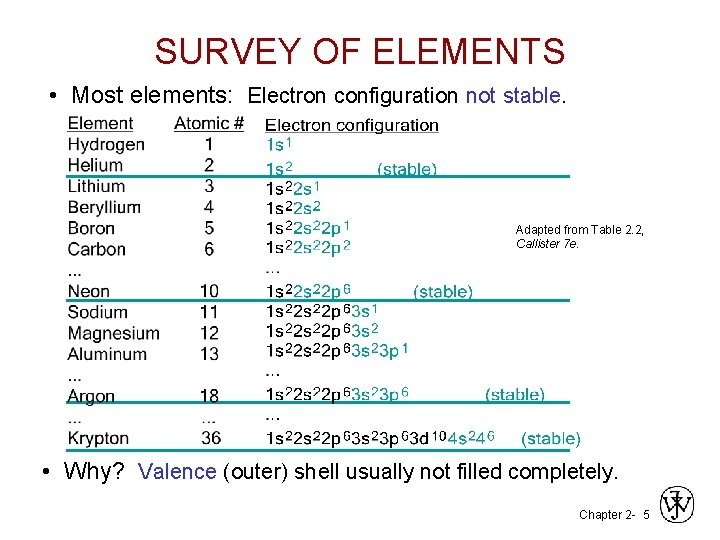
SURVEY OF ELEMENTS • Most elements: Electron configuration not stable. Adapted from Table 2. 2, Callister 7 e. • Why? Valence (outer) shell usually not filled completely. Chapter 2 - 5
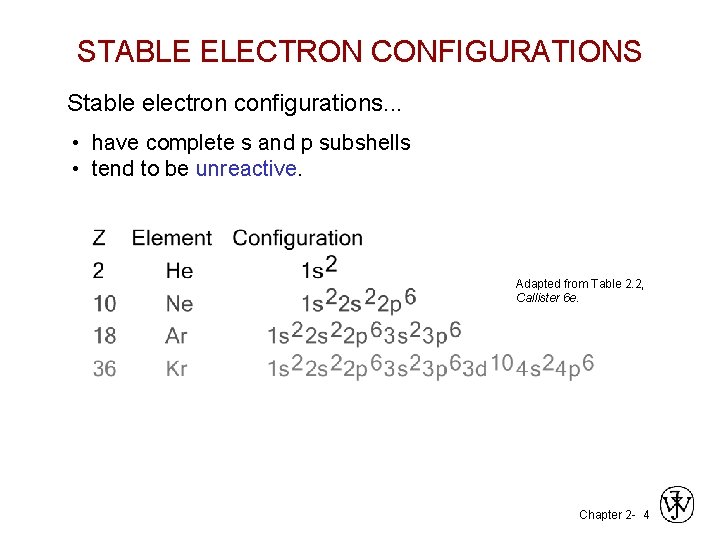
STABLE ELECTRON CONFIGURATIONS Stable electron configurations. . . • have complete s and p subshells • tend to be unreactive. Adapted from Table 2. 2, Callister 6 e. Chapter 2 - 4
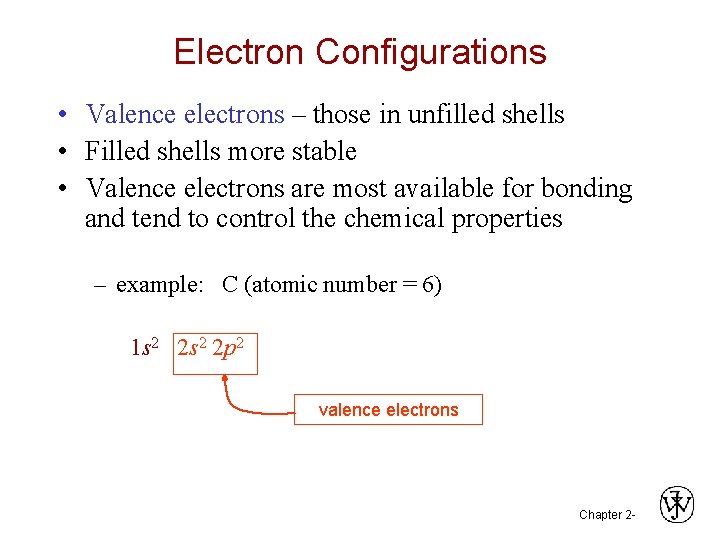
Electron Configurations • Valence electrons – those in unfilled shells • Filled shells more stable • Valence electrons are most available for bonding and tend to control the chemical properties – example: C (atomic number = 6) 1 s 2 2 s 2 2 p 2 valence electrons Chapter 2 -
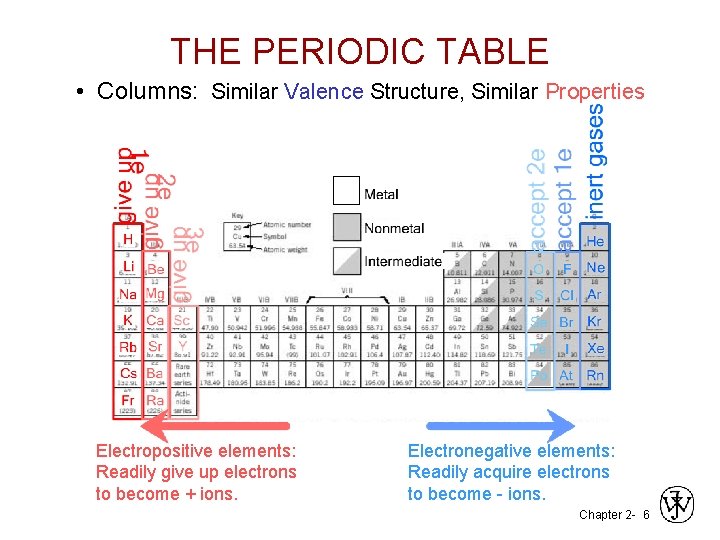
THE PERIODIC TABLE • Columns: Similar Valence Structure, Similar Properties Electropositive elements: Readily give up electrons to become + ions. Electronegative elements: Readily acquire electrons to become - ions. Chapter 2 - 6
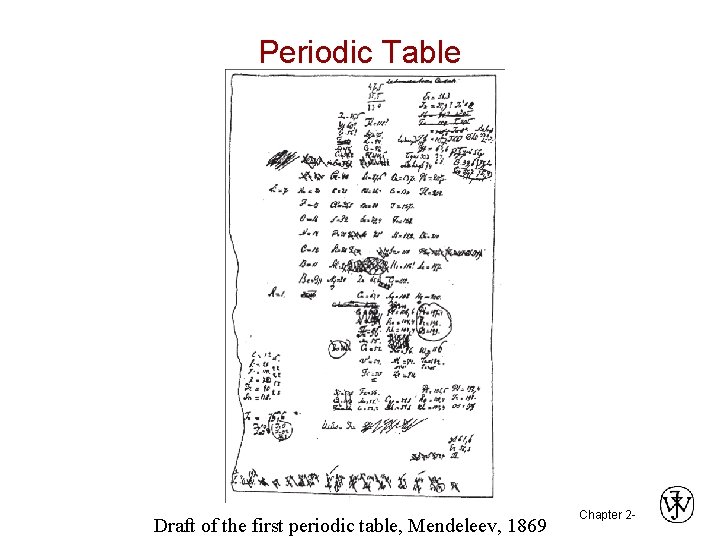
Periodic Table Draft of the first periodic table, Mendeleev, 1869 Chapter 2 -
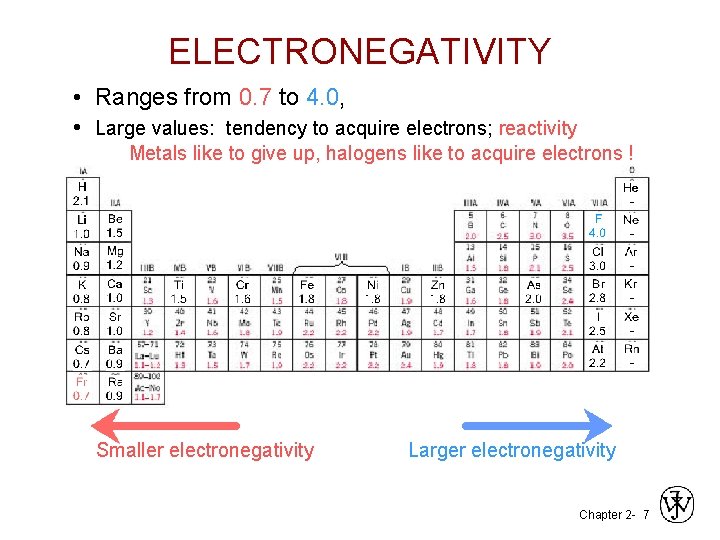
ELECTRONEGATIVITY • Ranges from 0. 7 to 4. 0, • Large values: tendency to acquire electrons; reactivity Metals like to give up, halogens like to acquire electrons ! Smaller electronegativity Larger electronegativity Chapter 2 - 7
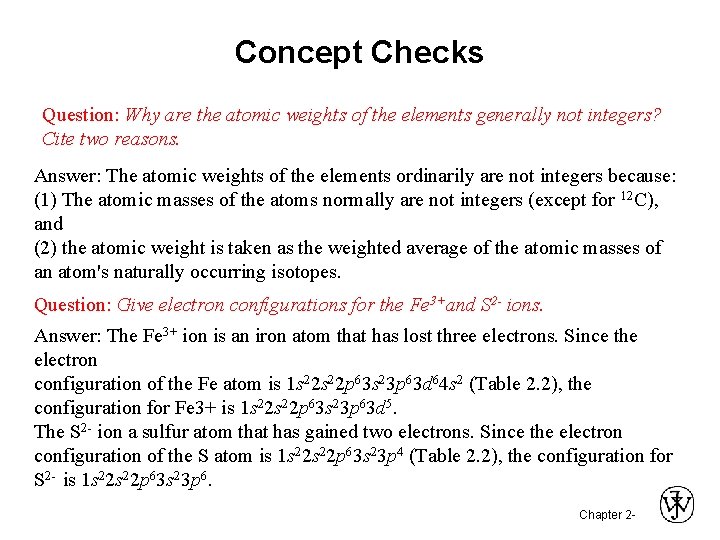
Concept Checks Question: Why are the atomic weights of the elements generally not integers? Cite two reasons. Answer: The atomic weights of the elements ordinarily are not integers because: (1) The atomic masses of the atoms normally are not integers (except for 12 C), and (2) the atomic weight is taken as the weighted average of the atomic masses of an atom's naturally occurring isotopes. Question: Give electron configurations for the Fe 3+and S 2 - ions. Answer: The Fe 3+ ion is an iron atom that has lost three electrons. Since the electron configuration of the Fe atom is 1 s 22 p 63 s 23 p 63 d 64 s 2 (Table 2. 2), the configuration for Fe 3+ is 1 s 22 p 63 s 23 p 63 d 5. The S 2 - ion a sulfur atom that has gained two electrons. Since the electron configuration of the S atom is 1 s 22 p 63 s 23 p 4 (Table 2. 2), the configuration for S 2 - is 1 s 22 p 63 s 23 p 6. Chapter 2 -
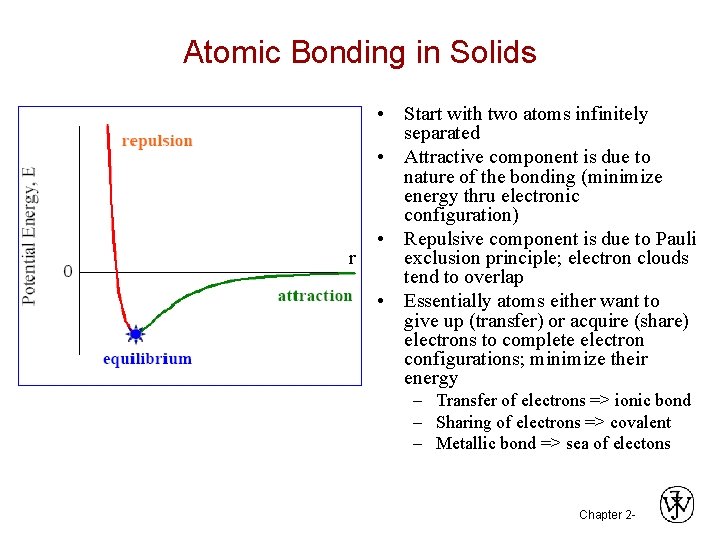
Atomic Bonding in Solids r • Start with two atoms infinitely separated • Attractive component is due to nature of the bonding (minimize energy thru electronic configuration) • Repulsive component is due to Pauli exclusion principle; electron clouds tend to overlap • Essentially atoms either want to give up (transfer) or acquire (share) electrons to complete electron configurations; minimize their energy – Transfer of electrons => ionic bond – Sharing of electrons => covalent – Metallic bond => sea of electons Chapter 2 -
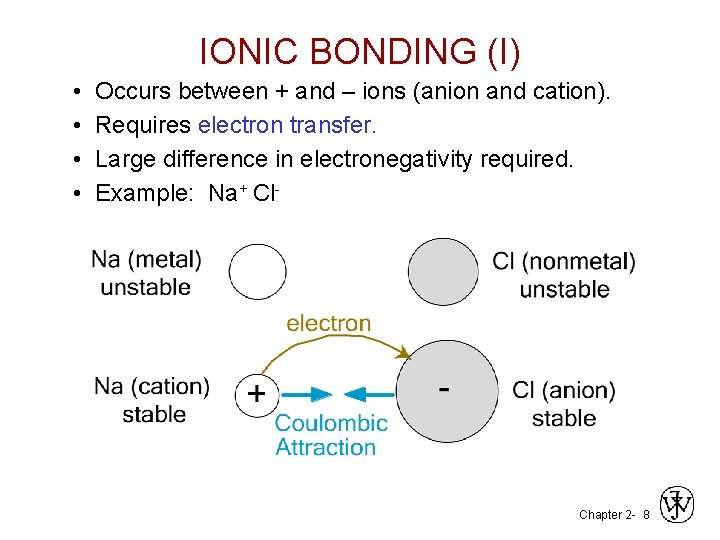
IONIC BONDING (I) • • Occurs between + and – ions (anion and cation). Requires electron transfer. Large difference in electronegativity required. Example: Na+ Cl- Chapter 2 - 8
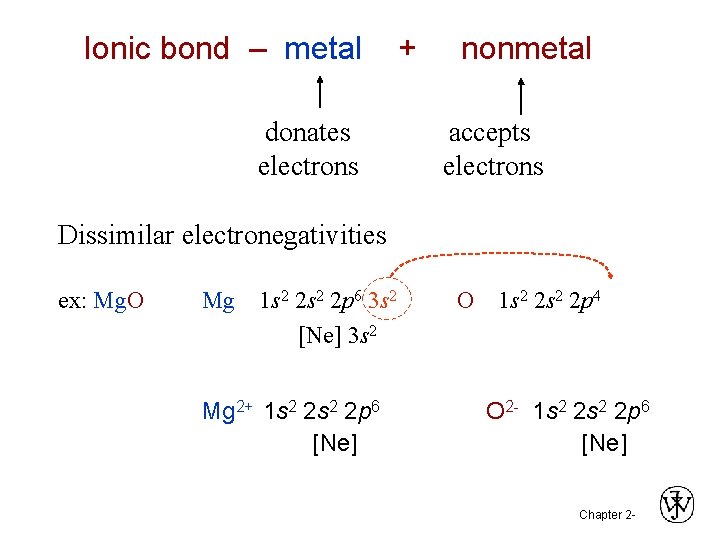
Ionic bond – metal + nonmetal donates accepts electrons Dissimilar electronegativities ex: Mg. O Mg 1 s 2 2 p 6 3 s 2 O 1 s 2 2 p 4 [Ne] 3 s 2 Mg 2+ 1 s 2 2 p 6 [Ne] O 2 - 1 s 2 2 p 6 [Ne] Chapter 2 -
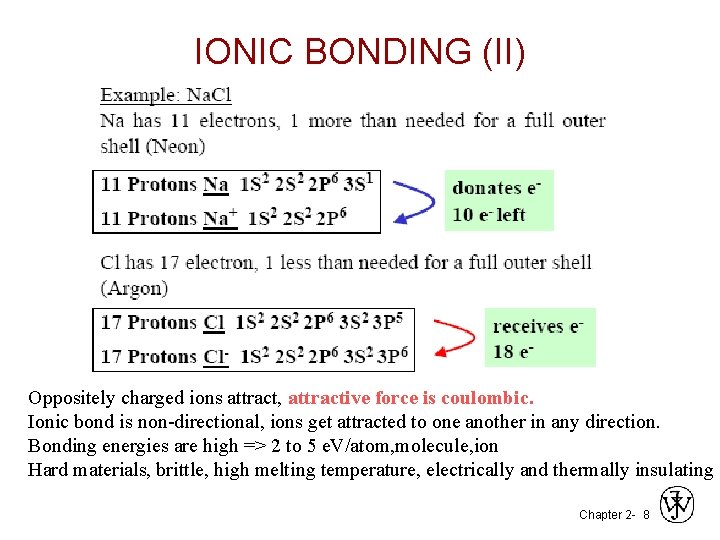
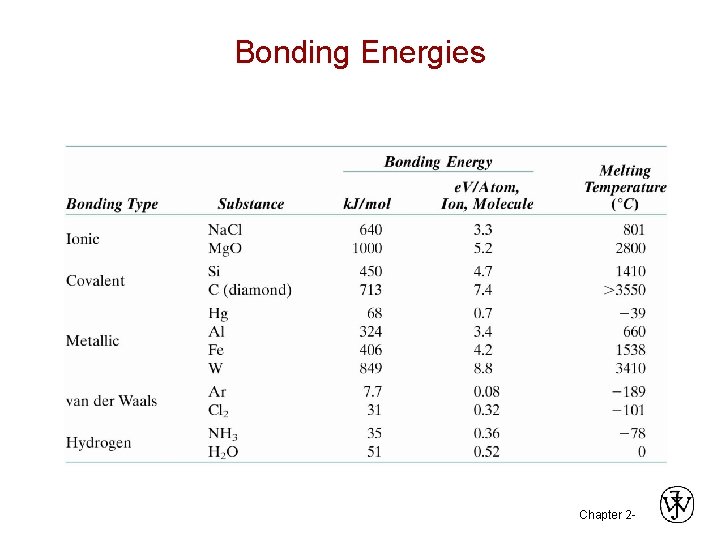
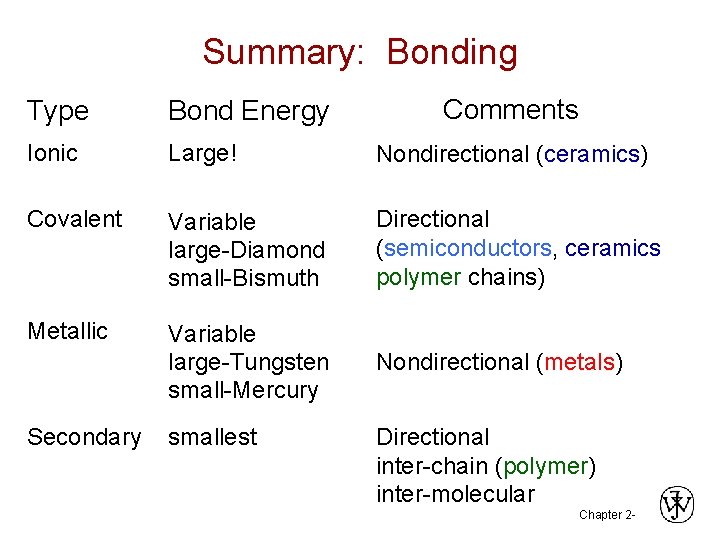
IONIC BONDING (II) Oppositely charged ions attract, attractive force is coulombic. Ionic bond is non-directional, ions get attracted to one another in any direction. Bonding energies are high => 2 to 5 e. V/atom, molecule, ion Hard materials, brittle, high melting temperature, electrically and thermally insulating Chapter 2 - 8
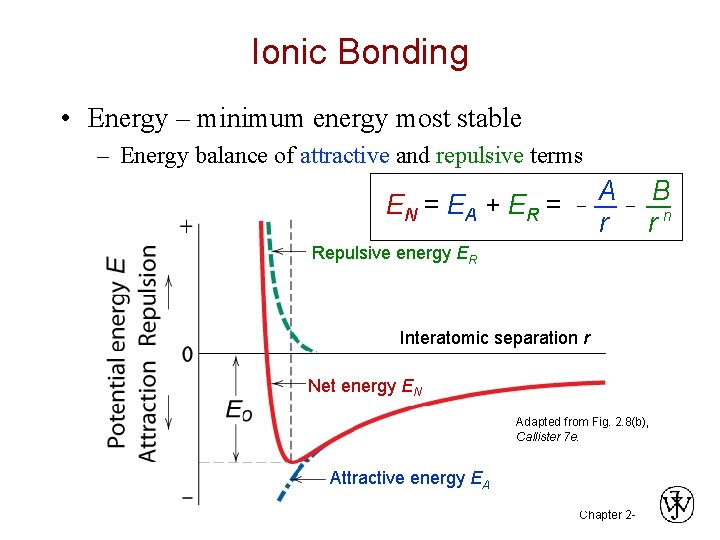
Ionic Bonding • Energy – minimum energy most stable – Energy balance of attractive and repulsive terms EN = EA + ER = - A r - B rn Repulsive energy ER Interatomic separation r Net energy EN Adapted from Fig. 2. 8(b), Callister 7 e. Attractive energy EA Chapter 2 -
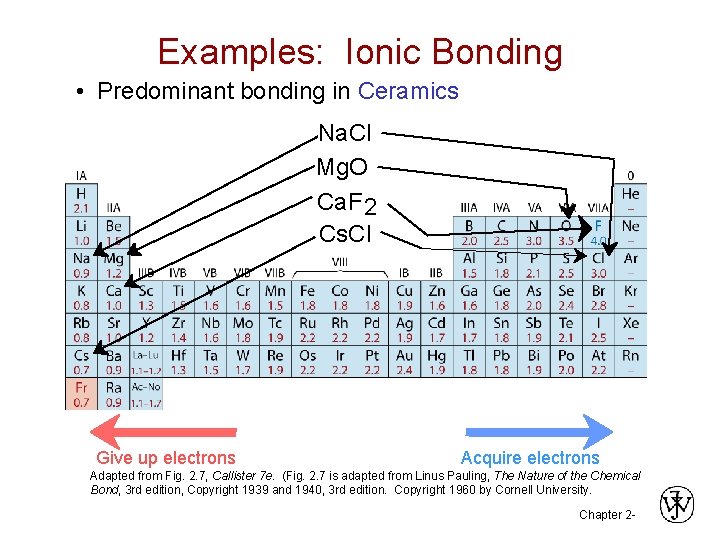
Examples: Ionic Bonding • Predominant bonding in Ceramics Na. Cl Mg. O Ca. F 2 Cs. Cl Give up electrons Acquire electrons Adapted from Fig. 2. 7, Callister 7 e. (Fig. 2. 7 is adapted from Linus Pauling, The Nature of the Chemical Bond, 3 rd edition, Copyright 1939 and 1940, 3 rd edition. Copyright 1960 by Cornell University. Chapter 2 -
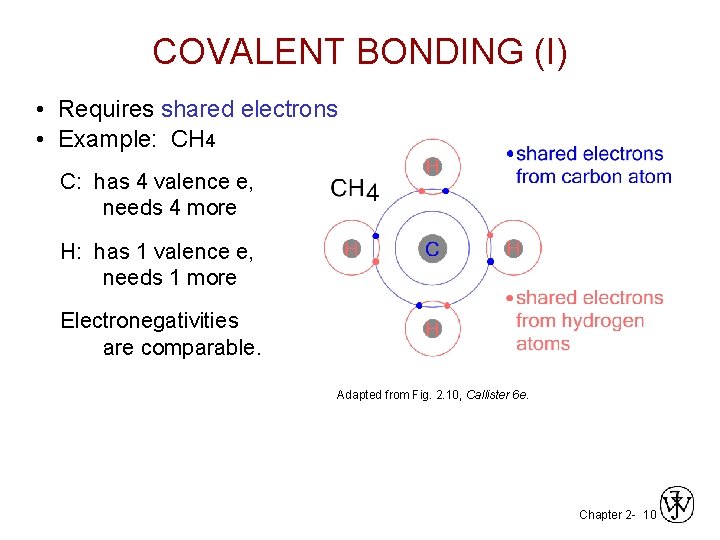
COVALENT BONDING (I) • Requires shared electrons • Example: CH 4 C: has 4 valence e, needs 4 more H: has 1 valence e, needs 1 more Electronegativities are comparable. Adapted from Fig. 2. 10, Callister 6 e. Chapter 2 - 10
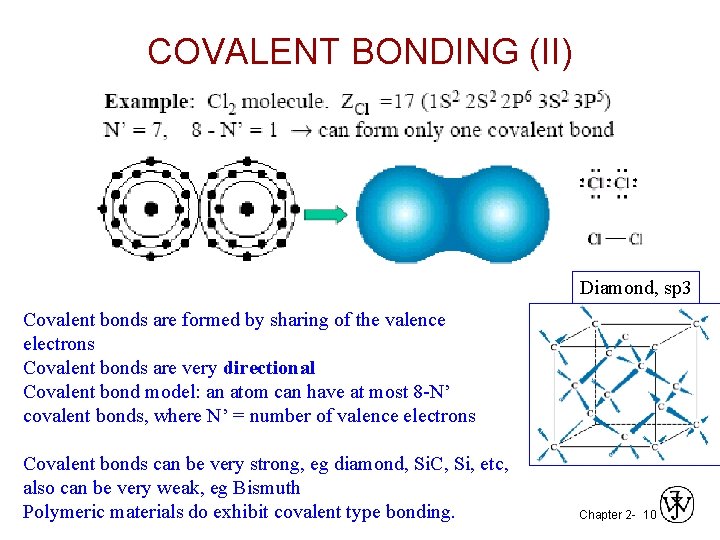
COVALENT BONDING (II) Diamond, sp 3 Covalent bonds are formed by sharing of the valence electrons Covalent bonds are very directional Covalent bond model: an atom can have at most 8 -N’ covalent bonds, where N’ = number of valence electrons Covalent bonds can be very strong, eg diamond, Si. C, Si, etc, also can be very weak, eg Bismuth Polymeric materials do exhibit covalent type bonding. Chapter 2 - 10
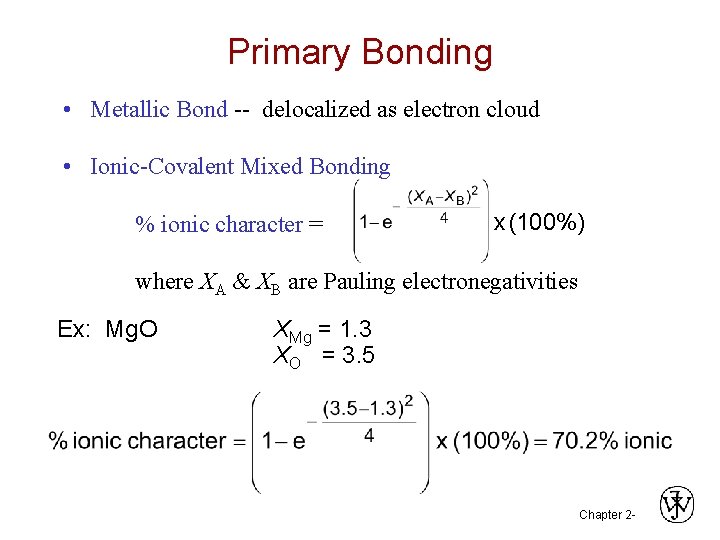
Primary Bonding • Metallic Bond -- delocalized as electron cloud • Ionic-Covalent Mixed Bonding % ionic character = x (100%) where XA & XB are Pauling electronegativities Ex: Mg. O XMg = 1. 3 XO = 3. 5 Chapter 2 -
COVALENT BONDING (III) Very few materials have pure ionic or covalent bonding; electronegativity inpart defines how much time electrons spend between ion cores… Chapter 2 - 10
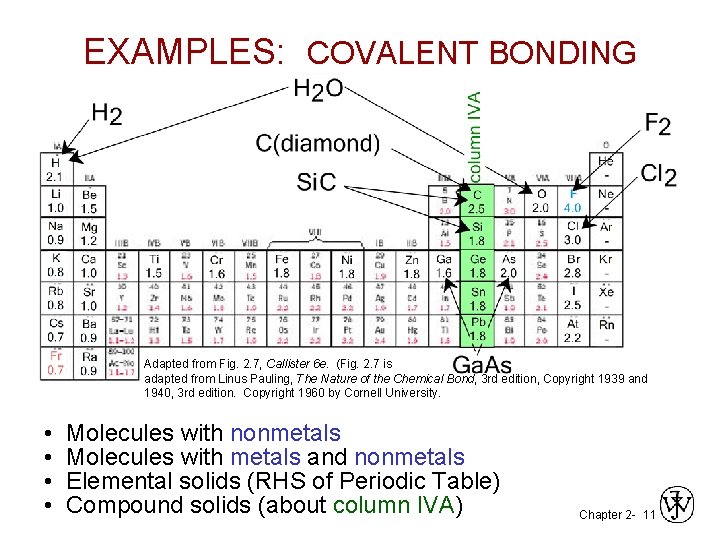
EXAMPLES: COVALENT BONDING Adapted from Fig. 2. 7, Callister 6 e. (Fig. 2. 7 is adapted from Linus Pauling, The Nature of the Chemical Bond, 3 rd edition, Copyright 1939 and 1940, 3 rd edition. Copyright 1960 by Cornell University. • • Molecules with nonmetals Molecules with metals and nonmetals Elemental solids (RHS of Periodic Table) Compound solids (about column IVA) Chapter 2 - 11
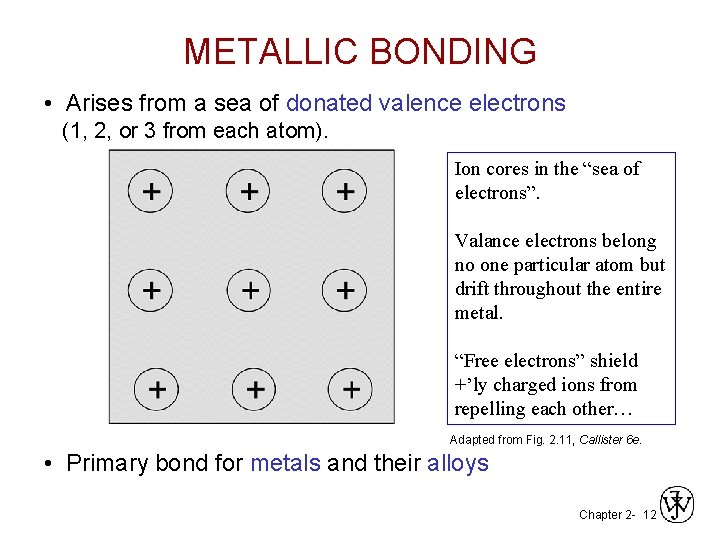
METALLIC BONDING • Arises from a sea of donated valence electrons (1, 2, or 3 from each atom). Ion cores in the “sea of electrons”. Valance electrons belong no one particular atom but drift throughout the entire metal. “Free electrons” shield +’ly charged ions from repelling each other… Adapted from Fig. 2. 11, Callister 6 e. • Primary bond for metals and their alloys Chapter 2 - 12
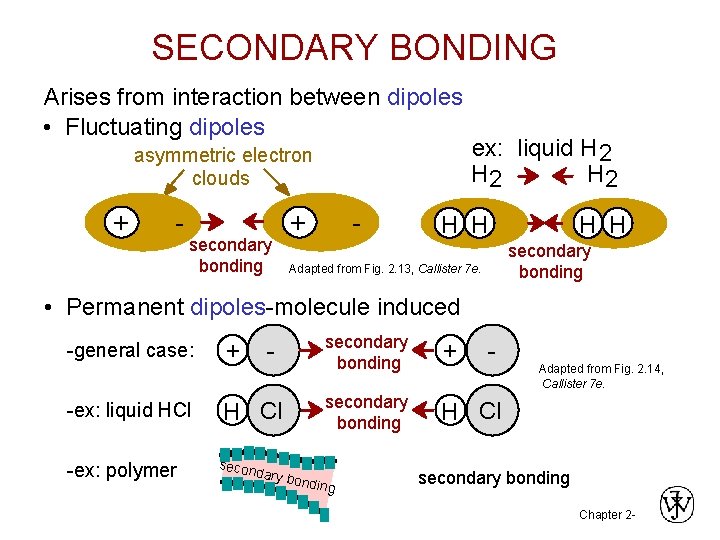
SECONDARY BONDING Arises from interaction between dipoles • Fluctuating dipoles asymmetric electron clouds + - secondary bonding + - ex: liquid H 2 H 2 H H secondary bonding Adapted from Fig. 2. 13, Callister 7 e. • Permanent dipoles-molecule induced -general case: -ex: liquid HCl -ex: polymer + - H Cl secon dary b secondary bonding + secondary bonding H Cl ondin g - Adapted from Fig. 2. 14, Callister 7 e. secondary bonding Chapter 2 -
Bonding Energies Chapter 2 -
Summary: Bonding Comments Type Bond Energy Ionic Large! Nondirectional (ceramics) Covalent Variable large-Diamond small-Bismuth Directional (semiconductors, ceramics polymer chains) Metallic Variable large-Tungsten small-Mercury Nondirectional (metals) Secondary smallest Directional inter-chain (polymer) inter-molecular Chapter 2 -
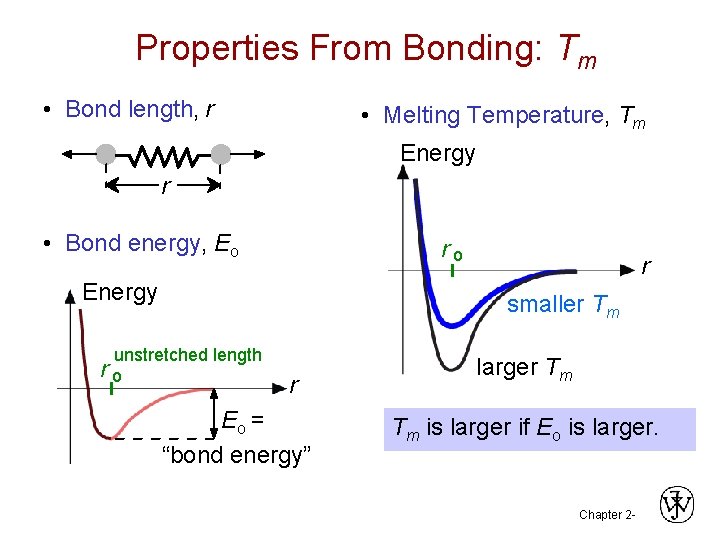
Properties From Bonding: Tm • Bond length, r • Melting Temperature, Tm Energy r • Bond energy, Eo ro Energy r smaller Tm unstretched length ro r Eo = “bond energy” larger Tm Tm is larger if Eo is larger. Chapter 2 -
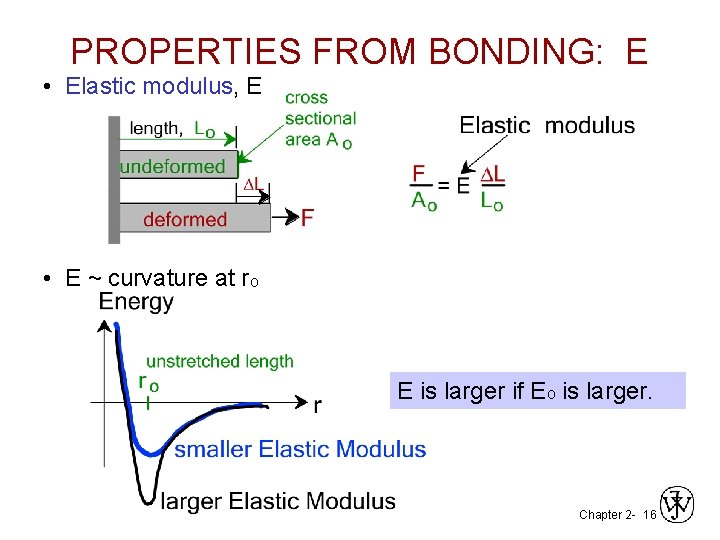
PROPERTIES FROM BONDING: E • Elastic modulus, E • E ~ curvature at ro E is larger if Eo is larger. Chapter 2 - 16
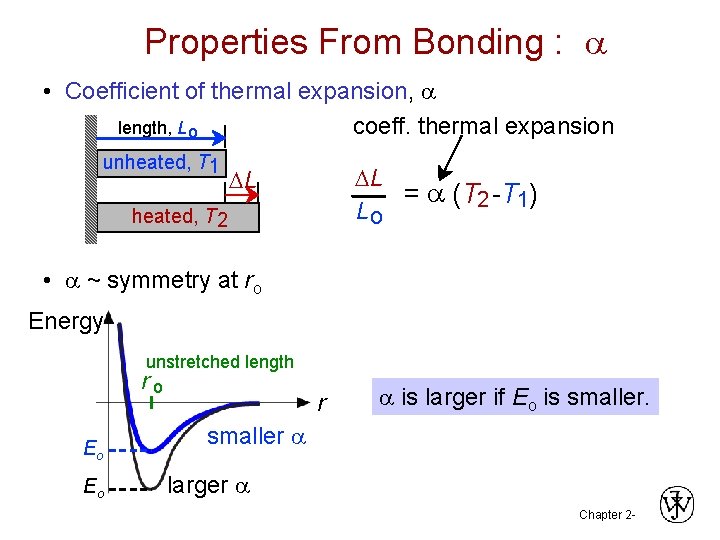
Properties From Bonding : a • Coefficient of thermal expansion, a length, L o coeff. thermal expansion unheated, T 1 DL = a (T 2 -T 1) Lo DL heated, T 2 • a ~ symmetry at ro Energy unstretched length ro Eo Eo r a is larger if Eo is smaller a larger a Chapter 2 -
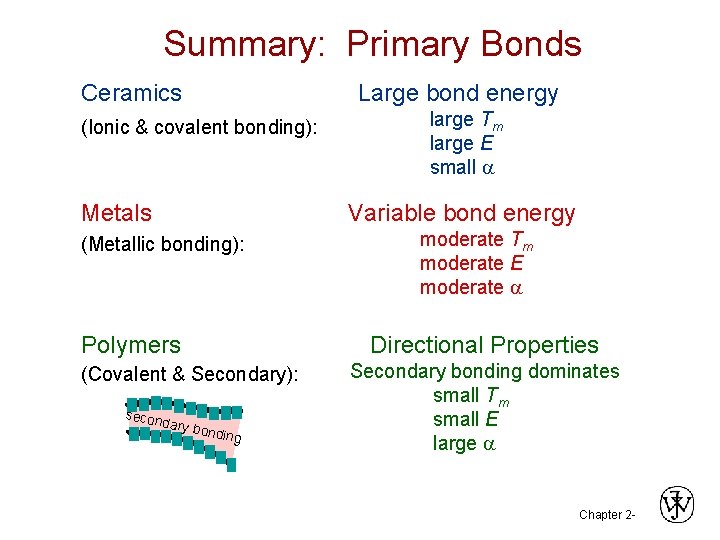
Summary: Primary Bonds Ceramics Large bond energy (Ionic & covalent bonding): Metals large Tm large E small a Variable bond energy (Metallic bonding): Polymers Directional Properties (Covalent & Secondary): secon moderate Tm moderate E moderate a dary b o nding Secondary bonding dominates small Tm small E large a Chapter 2 -
ANNOUNCEMENTS (I) Reading: Chapter 2 and 3 http: //www. fen. bilkent. edu. tr/~uner/chem 201/fenis. html Core Problems: 2. 5, 2. 7, 2. 11, 2. 12, 2. 14, 2. 15, 2. 19 Due February 21, 2008, please hand in during the lecture. SS SELF STUDY 1 - solve the BASIC QUESTIONS on the next page 2 - Why does the volume of water expand when it freezes, explain in your words (max 100 words) ? 3 - 2. 22 Chapter 2 - 0
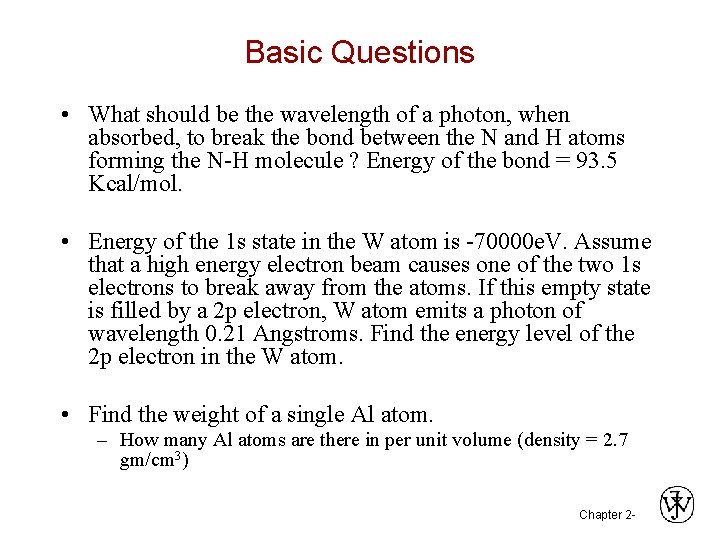
Basic Questions • What should be the wavelength of a photon, when absorbed, to break the bond between the N and H atoms forming the N-H molecule ? Energy of the bond = 93. 5 Kcal/mol. • Energy of the 1 s state in the W atom is -70000 e. V. Assume that a high energy electron beam causes one of the two 1 s electrons to break away from the atoms. If this empty state is filled by a 2 p electron, W atom emits a photon of wavelength 0. 21 Angstroms. Find the energy level of the 2 p electron in the W atom. • Find the weight of a single Al atom. – How many Al atoms are there in per unit volume (density = 2. 7 gm/cm 3) Chapter 2 -
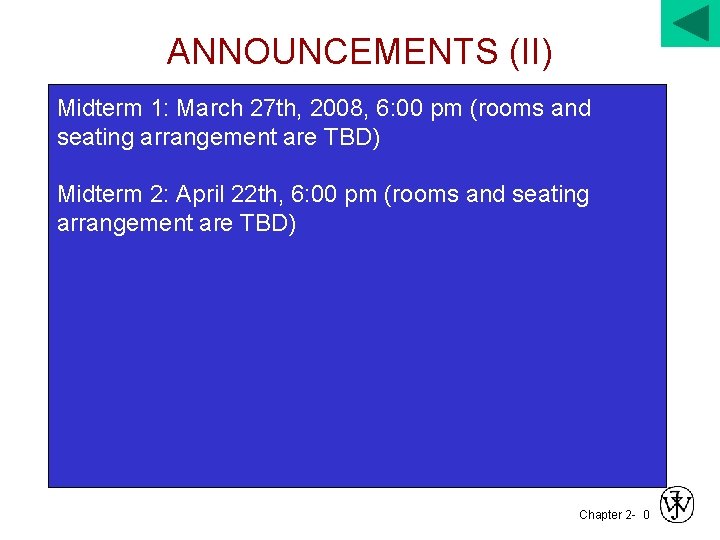
ANNOUNCEMENTS (II) Midterm 1: March 27 th, 2008, 6: 00 pm (rooms and seating arrangement are TBD) Midterm 2: April 22 th, 6: 00 pm (rooms and seating arrangement are TBD) Chapter 2 - 0
- Slides: 42