
Todays Agenda Introduce body systems Body Systems THE
Today’s Agenda • Introduce body systems
Body Systems THE FOUNDATIONS OF OUR BODIES
Standard 8 • Outline basic concepts of normal structure and function of all body systems, and explain how homeostasis is maintained. (TN Reading 2)
Today’s Objectives • Define anatomy, physiology, and the anatomical position • Introduce body systems
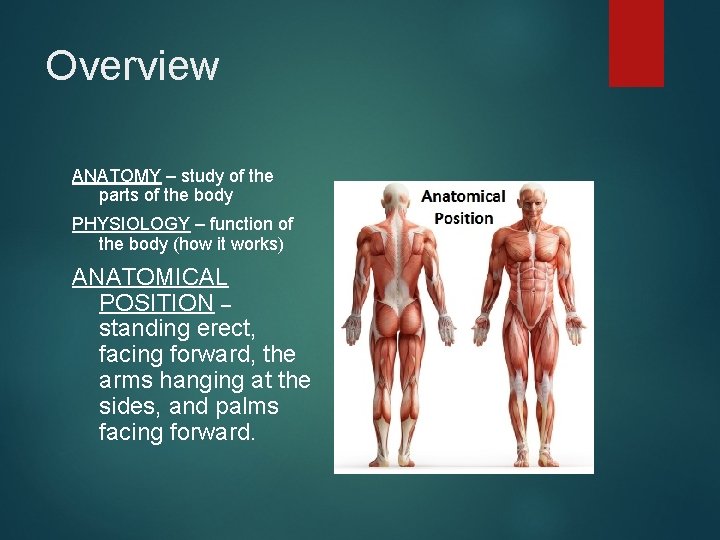
Overview ANATOMY – study of the parts of the body PHYSIOLOGY – function of the body (how it works) ANATOMICAL POSITION – standing erect, facing forward, the arms hanging at the sides, and palms facing forward.
Levels of Structural Organization 1. Chemical level- Atoms form molecules 2. Cellular level- basic unit of life 3. Tissue level- Consist of groups of similar cells working together 4. Organ level- two or more tissue types forming a complex function 5. Organ systems- group of organs working together to perform a fuctnion(example: cardiovascular system with heart and blood vessels)
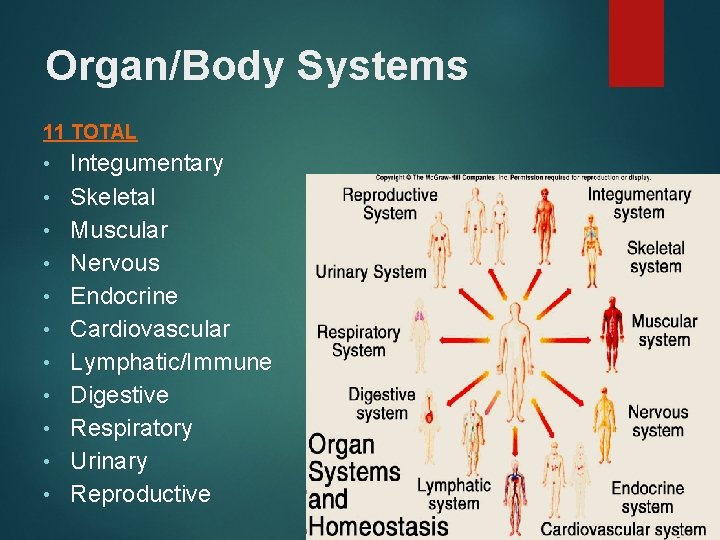
Organ/Body Systems 11 TOTAL • • • Integumentary Skeletal Muscular Nervous Endocrine Cardiovascular Lymphatic/Immune Digestive Respiratory Urinary Reproductive
Integumentary System • Forms external body covering • Skin, hair, nails • Protects deep tissues from injury • Production of vitamin D • Site of many receptors • (Pain, pressure, etc. ) • Sweat and oil glands
Standard 8 • Outline basic concepts of normal structure and function of all body systems, and explain how homeostasis is maintained. (TN Reading 2)
Today’s Objective • Continue assessing and learning the remaining body systems
Bellwork • Name the 11 organ/body systems • Name 4 types of bones and examples
Skeletal System • Protects and supports body organs • Provides a framework for muscles • Blood cells formed within bones • Stores minerals • http: //www. youtube. com/watch? v=J 8 x 6 t. ZI 2 h. VI
Skeleton • • Axial • Main trunk of body • Skull, spinal column, ribs, and sternum Appendicular • Extremities • Shoulder girdle, arm bones, pelvic girdle, and leg bones
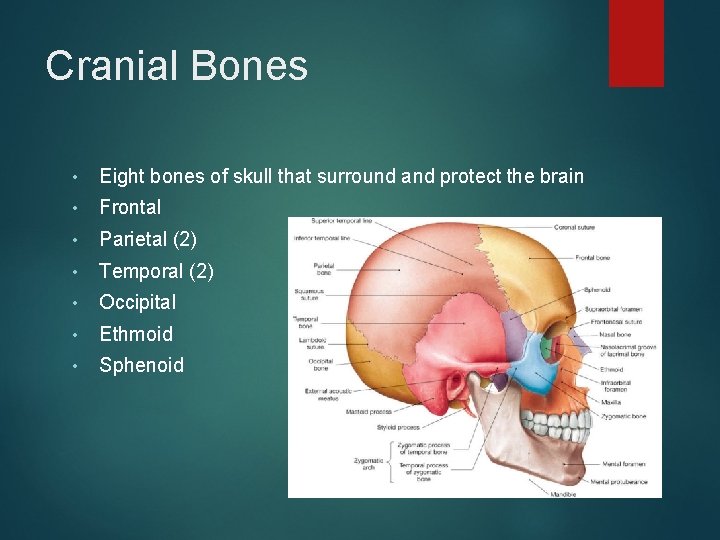
Cranial Bones • Eight bones of skull that surround and protect the brain • Frontal • Parietal (2) • Temporal (2) • Occipital • Ethmoid • Sphenoid
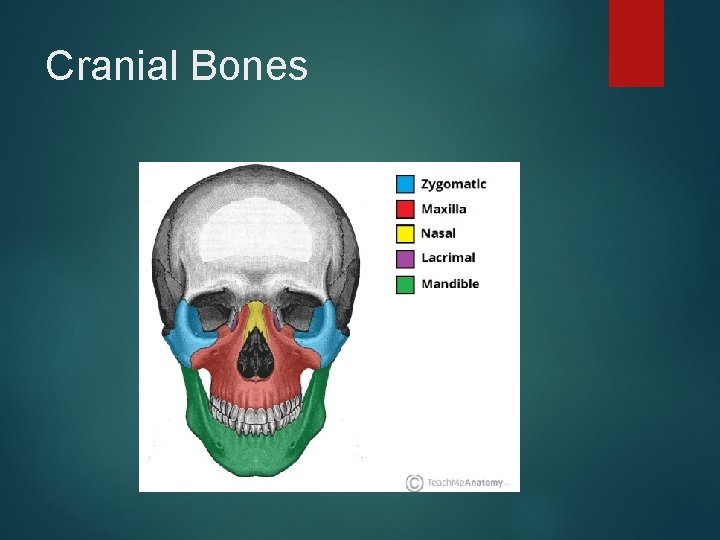
Cranial Bones
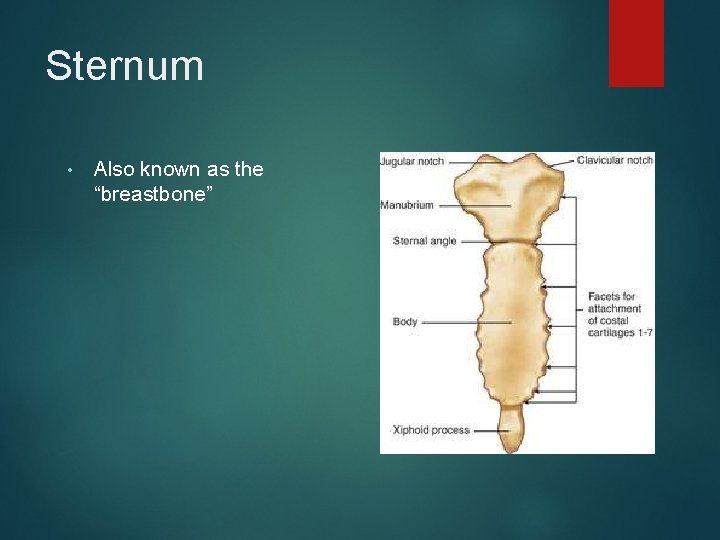
Sternum • Also known as the “breastbone”
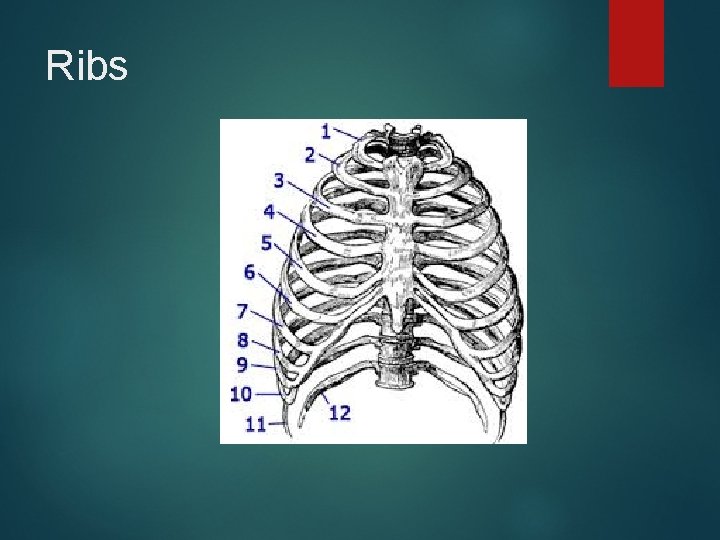
Ribs
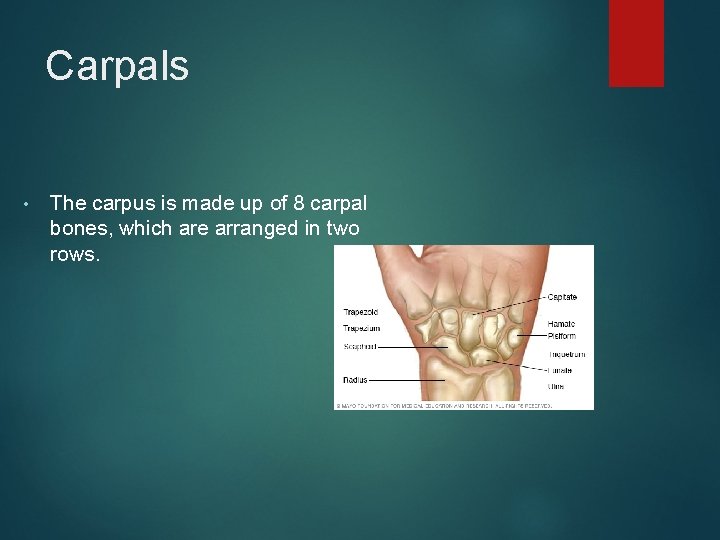
Carpals • The carpus is made up of 8 carpal bones, which are arranged in two rows.
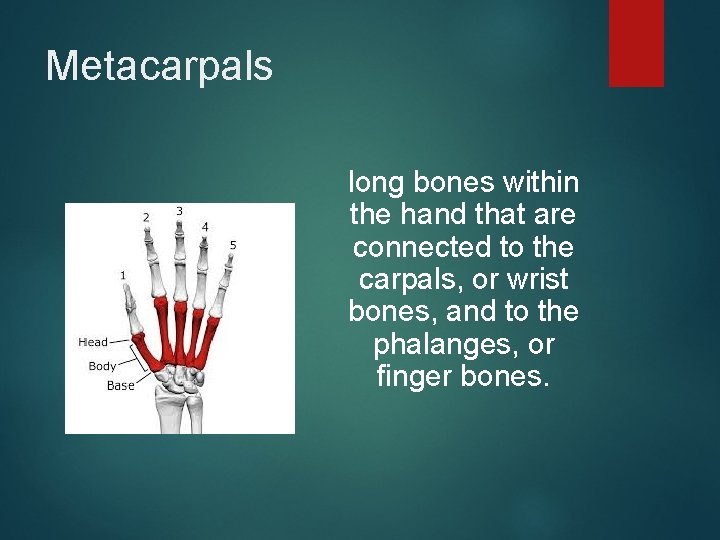
Metacarpals long bones within the hand that are connected to the carpals, or wrist bones, and to the phalanges, or finger bones.
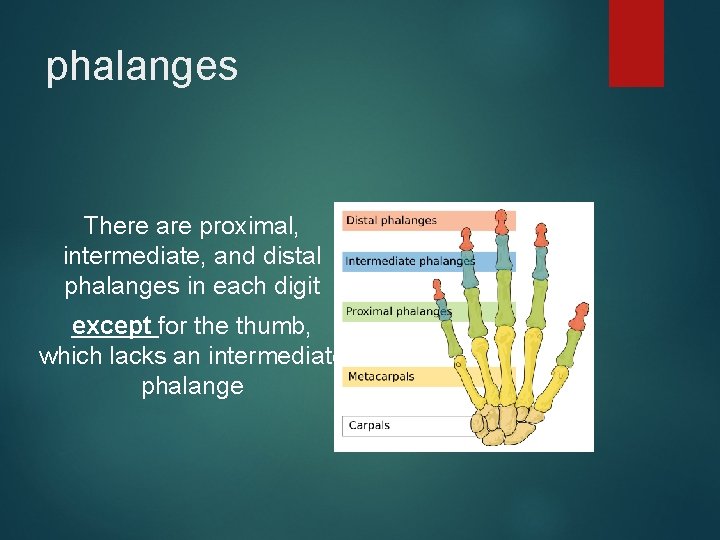
phalanges There are proximal, intermediate, and distal phalanges in each digit except for the thumb, which lacks an intermediate phalange
Bellwork Name the 3 major bone classifications in the hand Name the 3 parts of the sternum
Muscular System • Allows MOVEMENT of the body • Walking, lifting, etc. • Facial expression • Maintains posture • Produces heat • http: //www. youtube. com/watch? v=au 1 uc. KBcjf. U
Kinds of Muscles • Cardiac • Visceral or smooth • Skeletal 23
Actions or Movements of Muscles • Adduction • Abduction • Flexion • Extension • Rotation • Circumduction 24
Nervous System • Fast-acting control system • Responds to internal and external changes • Includes brain, spinal cord, & nerves • http: //www. youtube. com/watch? v=-s 8 y. Eh. RZgvw
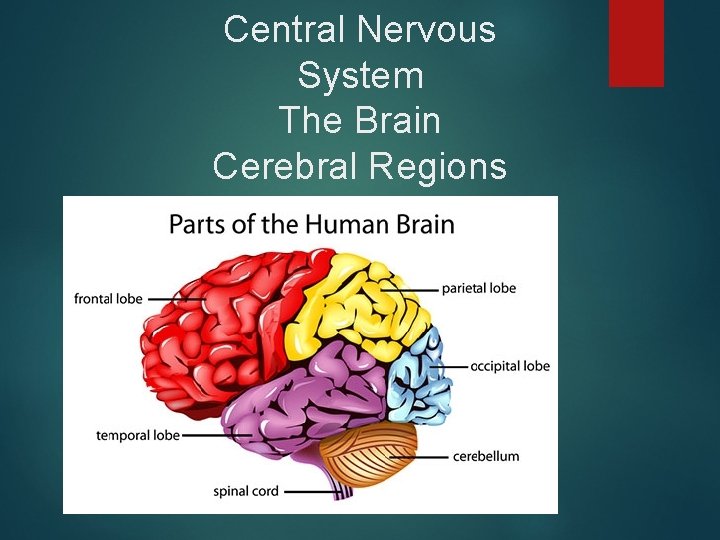
Central Nervous System The Brain Cerebral Regions
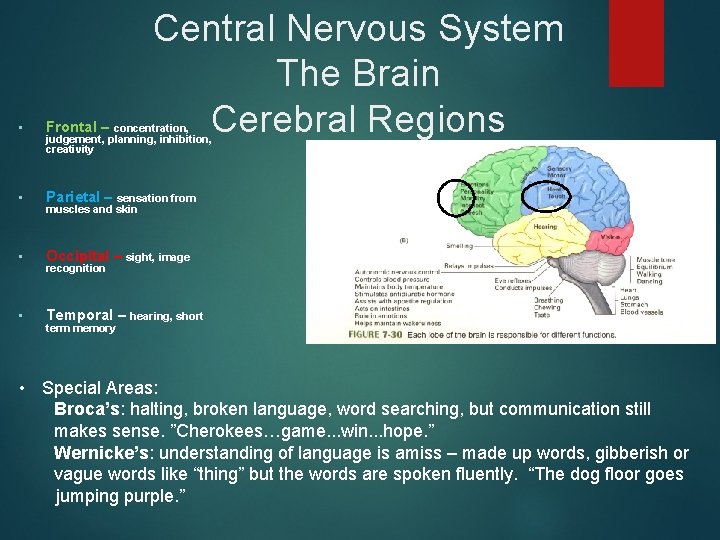
Central Nervous System The Brain Cerebral Regions • Frontal – concentration, • Parietal – sensation from • Occipital – sight, image • Temporal – hearing, short judgement, planning, inhibition, creativity muscles and skin recognition term memory • Special Areas: Broca’s: halting, broken language, word searching, but communication still makes sense. ”Cherokees…game. . . win. . . hope. ” Wernicke’s: understanding of language is amiss – made up words, gibberish or vague words like “thing” but the words are spoken fluently. “The dog floor goes jumping purple. ”
Central Nervous System The Cerebellum The cerebellum coordinates voluntary motor movement, proprioception, balance and equilibrium and muscle tone. Cerebellar injury results in movements that are slow and uncoordinated. Individuals with cerebellar lesions tend to sway and stagger when walking. Damage to the cerebellum can lead to: 1) loss of coordination of motor movement (asynergia) 2) the inability to judge distance and when to stop (dysmetria) 3) the inability to perform rapid alternating movements (adiadochokinesia) 4) movement tremors (intention tremor) 5) staggering, wide based walking (ataxic gait) 6) weak muscles (hypotonia) 7) slurred speech (ataxic dysarthria) 8) abnormal eye movements (nystagmus).
Endocrine System • Glands secrete hormones that regulate • Growth • Reproduction • Nutrient use • http: //www. youtube. com/watch? v=gjm. S 4_7 kv. DM
Cardiovascular System • • Blood vessels transport blood • Carries oxygen and carbon dioxide • Also carries nutrients and wastes Heart pumps blood through blood vessels Arteries : carries O 2 -rich blood away from the heart • Veins: carry deoxygenated blood to the heart • http: //www. youtube. com/watch? v=o. HMmt q. Kgs 50 •
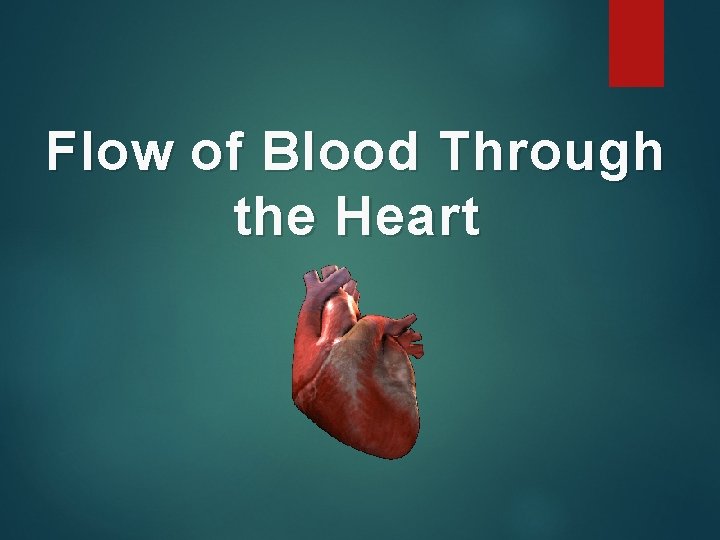
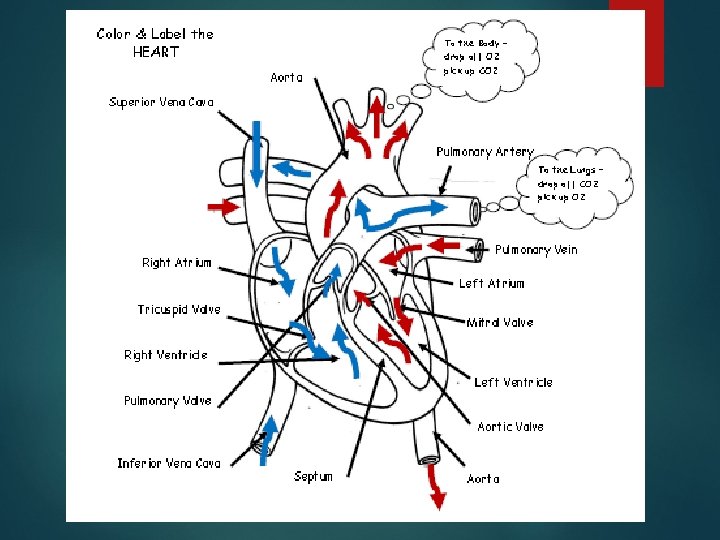
Flow of Blood Through the Heart
Put your hand on your heart. Did you place your hand on the left side of your chest? Many people do, but the heart is actually located almost in the center of the chest, between the lungs. It's tipped slightly so that a part of it sticks out and taps against the left side of the chest, which is what makes it seem as though it is located there.
Hold out your hand make a fist If you're a kid, your heart is about the same size as your fist if you're an adult, it's about the same size as two fists.
Circulatory System 1. Blood: fluid that contains oxygen, nutrients, and wastes. 2. Blood Vessels: transport or carry blood throughout the body. 3. The heart: the main organ of the circulatory system. – Valves: keeps blood from flowing back into heart – The heart's job is to transport oxygenated blood to the body's cells and carry away waste materials. – Your heart is a muscular organ, about the size of a clenched fist, that pumps the blood.
Your Heart • • • It may be hard to believe, but your heart is the strongest muscle in your body. It has to be strong to move blood through your body to other muscle cells, your brain cells, skin cells, and nerve and bone cells all day and all night long for your entire life. Blood travels at least 60, 000 miles per day. Each square inch of your skin contains 20 feet of blood vessels. The average heart will beat 3 billion times in a lifetime and pump 50 million gallons of blood.
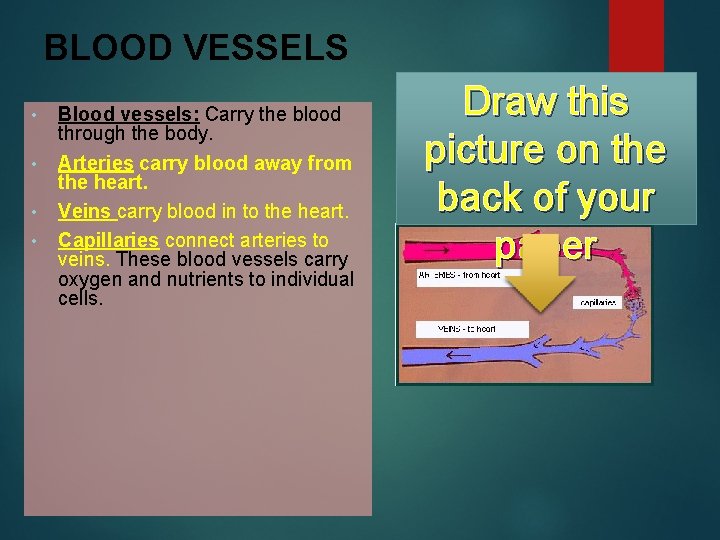
BLOOD VESSELS • • Blood vessels: Carry the blood through the body. Arteries carry blood away from the heart. Veins carry blood in to the heart. Capillaries connect arteries to veins. These blood vessels carry oxygen and nutrients to individual cells. Draw this picture on the back of your paper
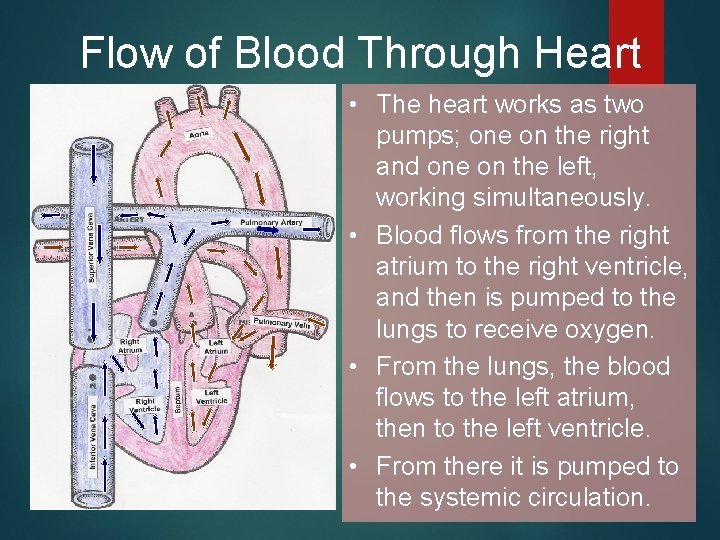
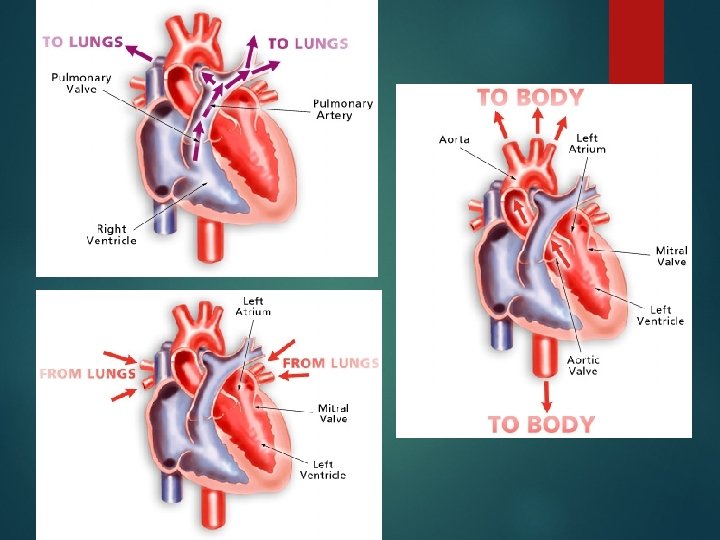
Flow of Blood Through Heart • The heart works as two pumps; one on the right and one on the left, working simultaneously. • Blood flows from the right atrium to the right ventricle, and then is pumped to the lungs to receive oxygen. • From the lungs, the blood flows to the left atrium, then to the left ventricle. • From there it is pumped to the systemic circulation.
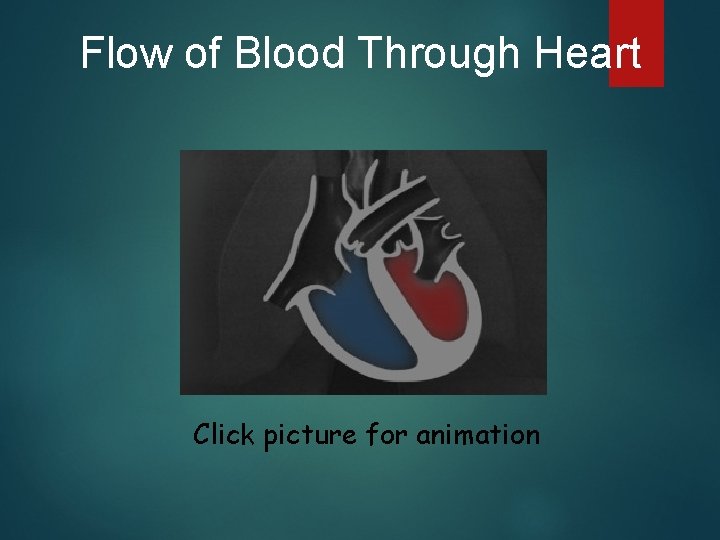
Flow of Blood Through Heart Click picture for animation
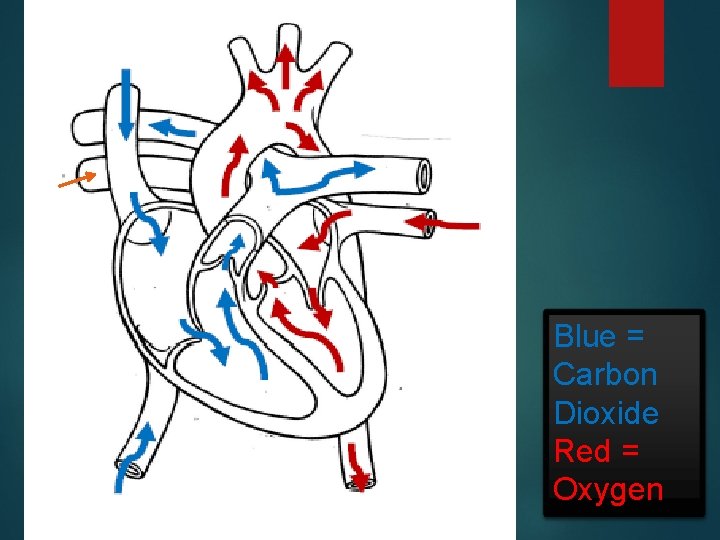
Blue = Carbon Dioxide Red = Oxygen
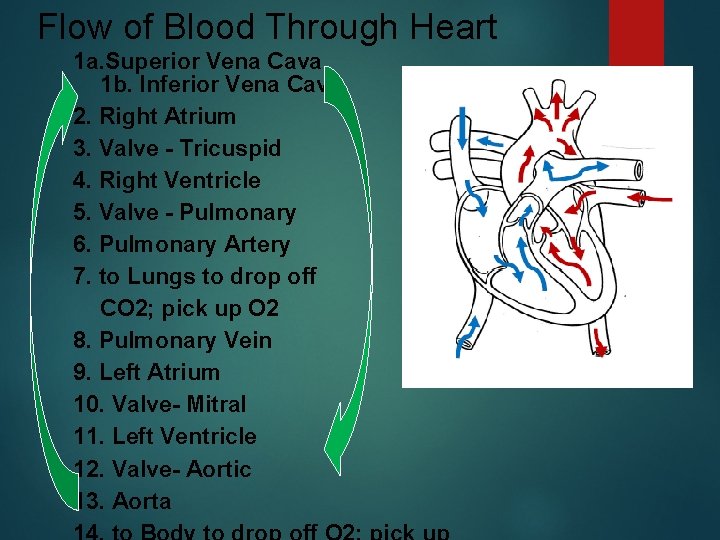
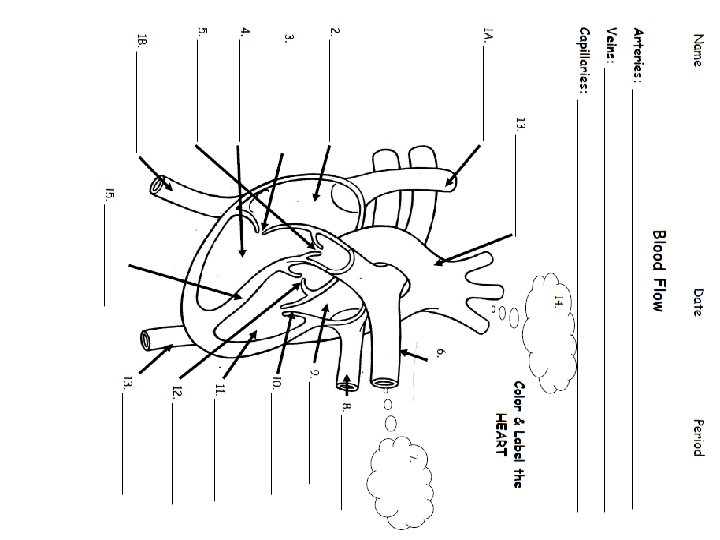
Flow of Blood Through Heart 1 a. Superior Vena Cava 1 b. Inferior Vena Cava 2. Right Atrium 3. Valve - Tricuspid 4. Right Ventricle 5. Valve - Pulmonary 6. Pulmonary Artery 7. to Lungs to drop off CO 2; pick up O 2 8. Pulmonary Vein 9. Left Atrium 10. Valve- Mitral 11. Left Ventricle 12. Valve- Aortic 13. Aorta
Cardiac Output
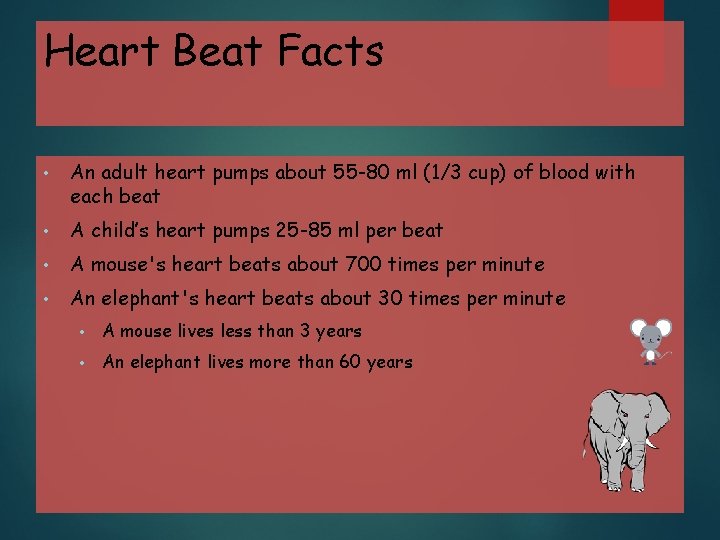
Heart Beat Facts • An adult heart pumps about 55 -80 ml (1/3 cup) of blood with each beat • A child’s heart pumps 25 -85 ml per beat • A mouse's heart beats about 700 times per minute • An elephant's heart beats about 30 times per minute • A mouse lives less than 3 years • An elephant lives more than 60 years
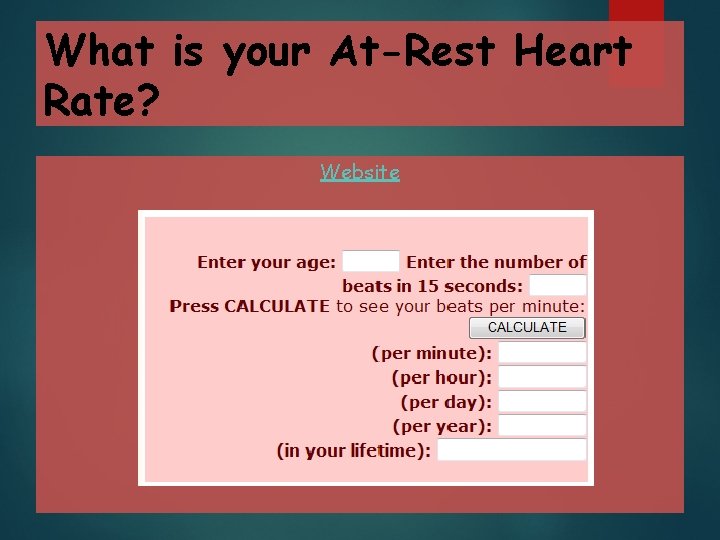
What is your At-Rest Heart Rate? Website
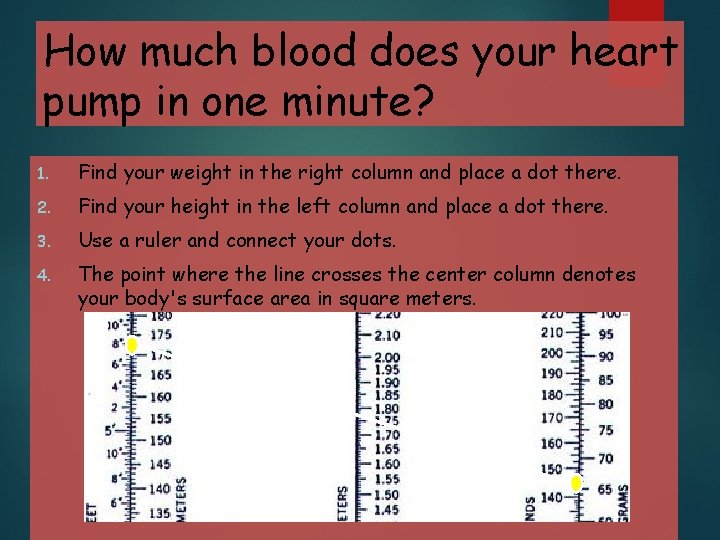
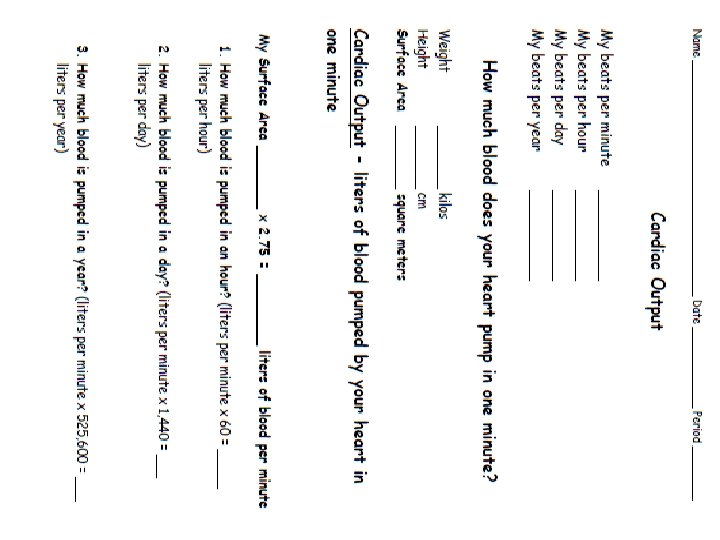
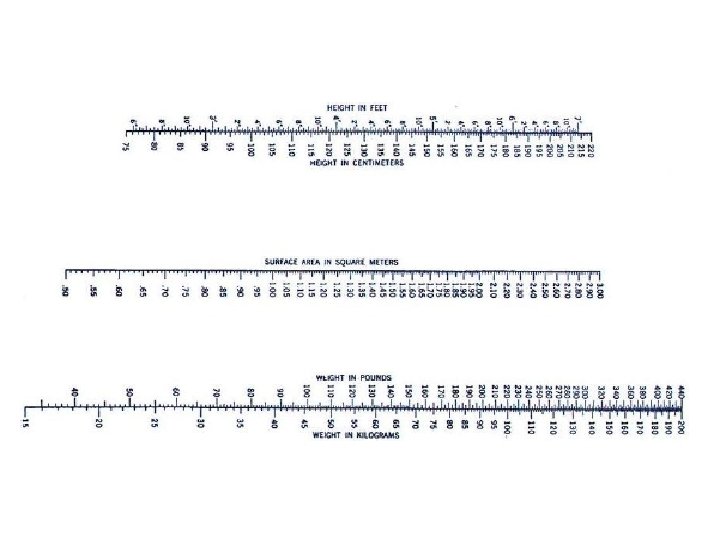
How much blood does your heart pump in one minute? 1. Find your weight in the right column and place a dot there. 2. Find your height in the left column and place a dot there. 3. Use a ruler and connect your dots. 4. The point where the line crosses the center column denotes your body's surface area in square meters.
Cardiac Output? • How much blood the heart pumps for every square meter of surface area (cardiac index) varies with the age of the individual. For children ages 10 13, the average cardiac index is 2. 75 liters at a resting state. • Multiply your body surface area by the cardiac index (2. 75) to determine the liters of blood pumped by your heart in one minute (cardiac output).
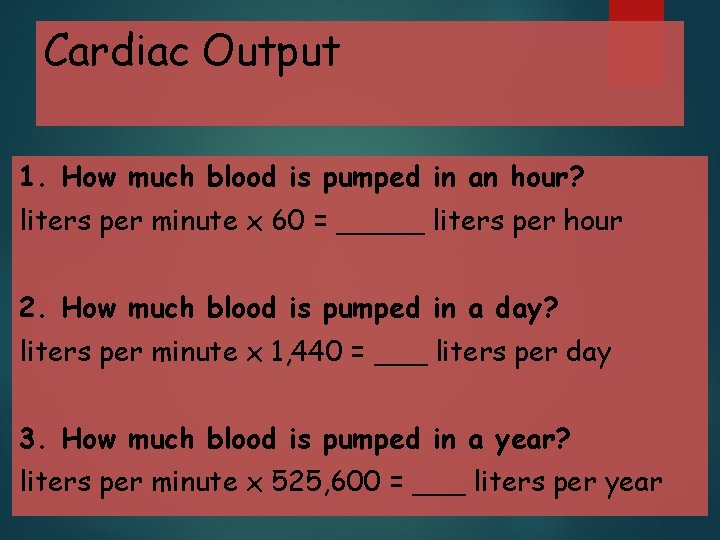
Cardiac Output 1. How much blood is pumped in an hour? liters per minute x 60 = _____ liters per hour 2. How much blood is pumped in a day? liters per minute x 1, 440 = ___ liters per day 3. How much blood is pumped in a year? liters per minute x 525, 600 = ___ liters per year

Lymphatic System/Immunity • Disposes of debris in the lymphatic system • Houses white blood cells (lymphocytes) • Mounts attack against foreign substances in the body • http: //www. youtube. com/watch? v=X 4 Wn 0 j 3 e. Jr. A
Respiratory System • Keeps blood supplied with oxygen • Removes carbon dioxide • Gas exchange occurs through walls of air sacs in the lungs • https: //www. youtube. com/watch? v=hc 1 Yt. Xc_84 A
Digestive System • Breaks down food into usable energy • Indigestible food particles eliminated as feces • http: //www. youtube. com/watch? v=_QYwsc. ALNng
Urinary System • Eliminates nitrogenous wastes • Regulates water, electrolyte, and acid-base balance • http: //www. youtube. com/watch? v=lf. GYd 1 wr. Tg. E
Male & Female Reproductive Systems • Overall function is to produce offspring • Testes produce sperm and male sex hormones testosterone • Ovaries produce eggs and female sex hormones estrogen • Mammary glands produce milk

Bell Work • Pick up the worksheet from the back roller • On a half sheet of paper, create a quiz-pass question over the notes we have taken so far in this chapter

Announcement • You will have a quiz tomorrow over the notes we have taken so far! • • Today’s notes will NOT be on the quiz. Let’s review…
Today’s Objective • Anatomy terminology • Body planes • Body cavities
Anatomic Terminology and Directional • Position ANTERIOR or VENTRAL – front or in front of Terms • • • POSTERIOR or DORSAL – back or in back of CRANIAL – refers to the head of the body CAUDAL – means tail end SUPERIOR – upper or above something INFERIOR – lower or below something MEDIAL – toward the middle LATERAL – toward the side of the body PROXIMAL – toward the point of attachment to the body DISTAL – away from the point of attachment SUPERFICIAL (EXTERNAL) – near the surface or outside the body DEEP (INTERNAL) – inside the body
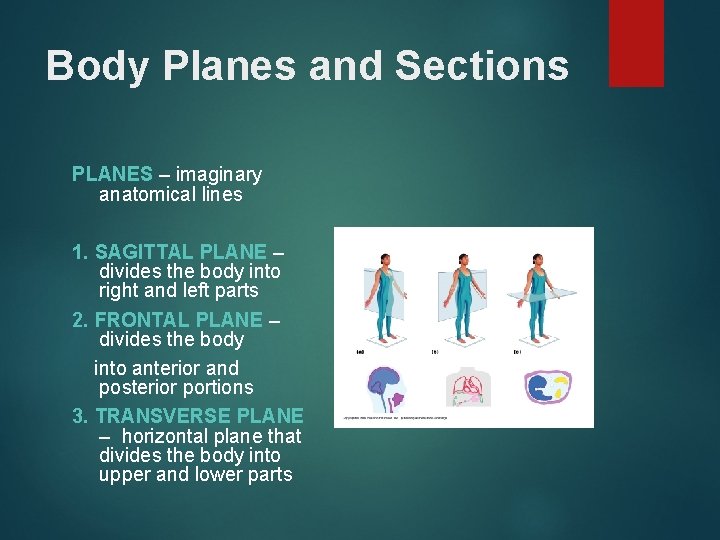
Body Planes and Sections PLANES – imaginary anatomical lines 1. SAGITTAL PLANE – divides the body into right and left parts 2. FRONTAL PLANE – divides the body into anterior and posterior portions 3. TRANSVERSE PLANE – horizontal plane that divides the body into upper and lower parts
Cavities of the Body • • POSTERIOR or DORSAL CAVITY • The brain is in the CRANIAL CAVITY and • The spinal cord is in the SPINAL CAVITY. ANTERIOR or VENTRAL CAVITY THORACIC CAVITY contains the lungs and heart • ABDOMINAL CAVITY contains stomach, intestines, liver, gallbladder and pancreas • PELVIC CAVITY contains urinary bladder and reproductive organs •
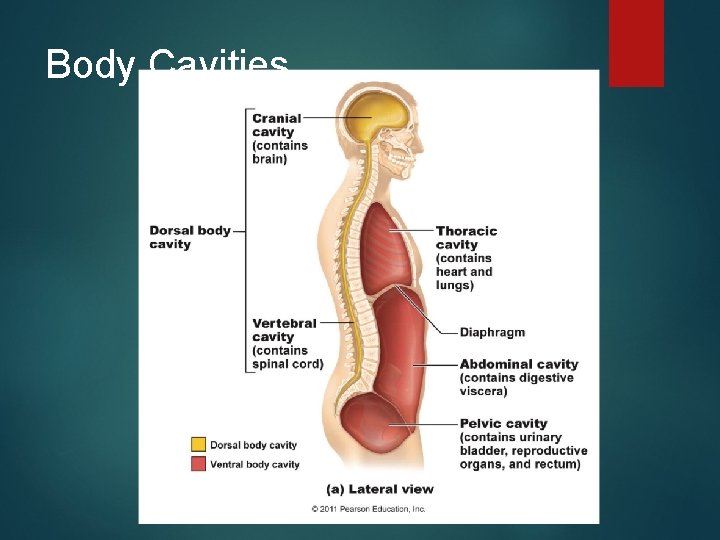
Body Cavities
Bell Work • Pick up a study guide from the back roller. • You have 3 minutes to review for your quiz • Please be quiet as soon as the bell rings.

Review • By yourself or with a partner, and without looking, try to label the diagram on the next slide…
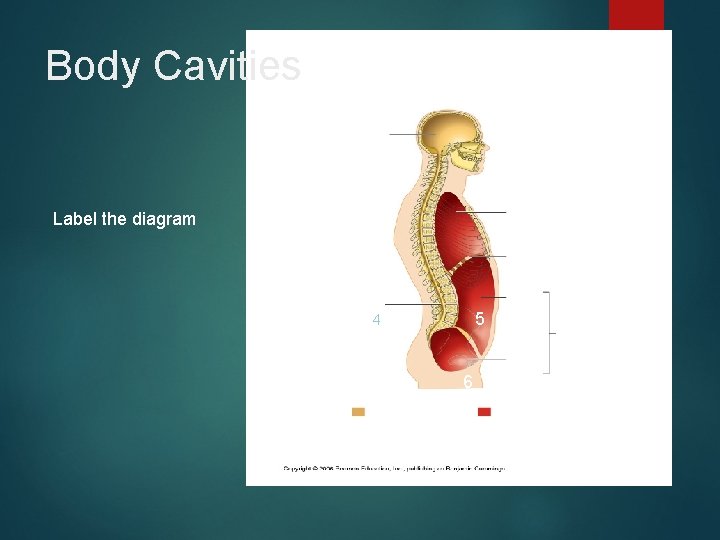
Body Cavities 1 Label the diagram 2 3 5 4 6 7

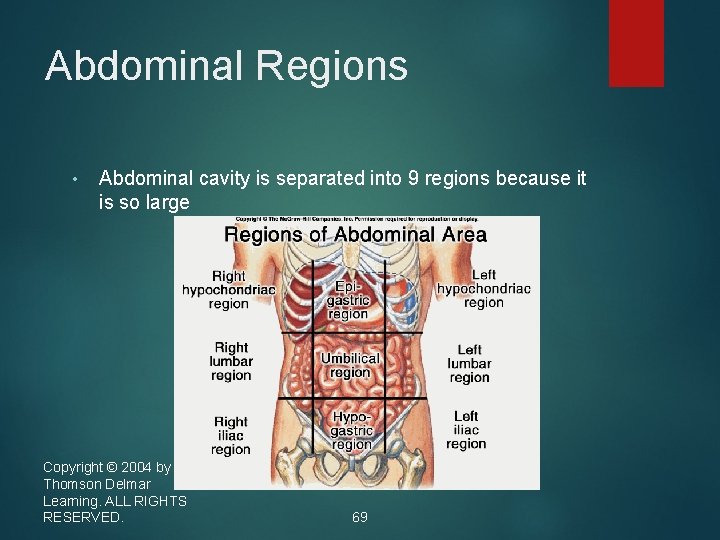
Abdominal Regions • Abdominal cavity is separated into 9 regions because it is so large Copyright © 2004 by Thomson Delmar Learning. ALL RIGHTS RESERVED. 69
Announcement • Your test over this chapter of notes (body systems) will be on FRIDAY! • We will review more tomorrow…
Body Systems Documentary • The following video will take us on a journey through the body • Please pay attention and try to relate what we’ve learned in class this week to what you’re seeing in the video • http: //www. youtube. com/watch? v=65 U 3 NSDn 2 dg

Bell Work • Create a matching quiz using ALL 12 of the anatomical terms from your notes • Be sure to have a separate answer key • Once everyone is done, we will trade your matching quizzes and “grade” them • These will not count as a “real” grade, but it will be a great way to review
Reminder • • Your test is tomorrow! • Remember to use your review sheet • Don’t forget the diagrams! Any questions?
Bell Work • You have 5 minutes to review for your Body Systems test.
- Slides: 74