
Today we are going to learn about Timelines
Today we are going to learn about Timelines.

Time lines help us to understand History!!

1. If you are able to order events into chronological order. 2. If you are able to read a timeline – interpret their data. 3. If you are able to make a timeline.

Chronologically Arranged in the order in which events happened; according to date Arranged in order of occurrence; so a story may be chronological, in which case it relates events in the sequence they occurred;
B. C. Before Christ A. D. Anno Domino (in the year of our Lord)
BC and AD relate all dates to the birth of Jesus. Referring to Jesus Christ - using dates that are based on the birth of Jesus - which are part of the Christian Religion. However, this was seen as offensive to non-Christians, so, historians developed new terms to date events.
BIRTH OF CHRIST AD 1 Alleged date of the birth of Jesus Christ. Calendar dates back from here (BC: Before Christ) and forward from here. c. 4 B. C. birth of Jesus c. 6 BC – Suggested birth (earliest)
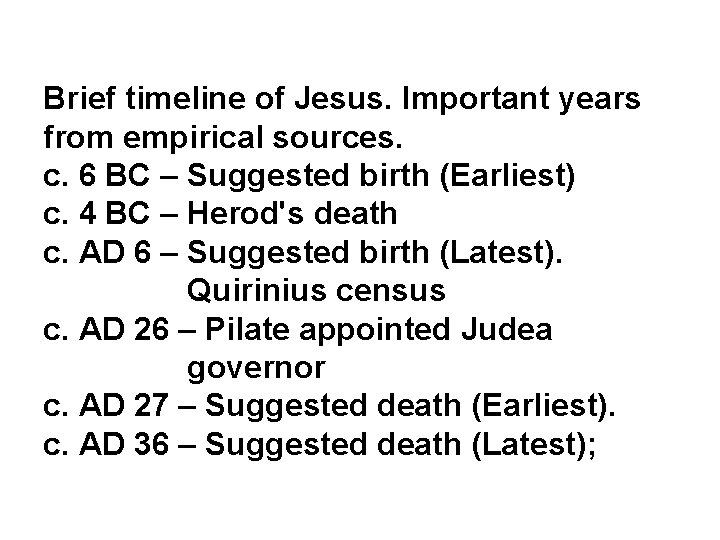
Brief timeline of Jesus. Important years from empirical sources. c. 6 BC – Suggested birth (Earliest) c. 4 BC – Herod's death c. AD 6 – Suggested birth (Latest). Quirinius census c. AD 26 – Pilate appointed Judea governor c. AD 27 – Suggested death (Earliest). c. AD 36 – Suggested death (Latest);
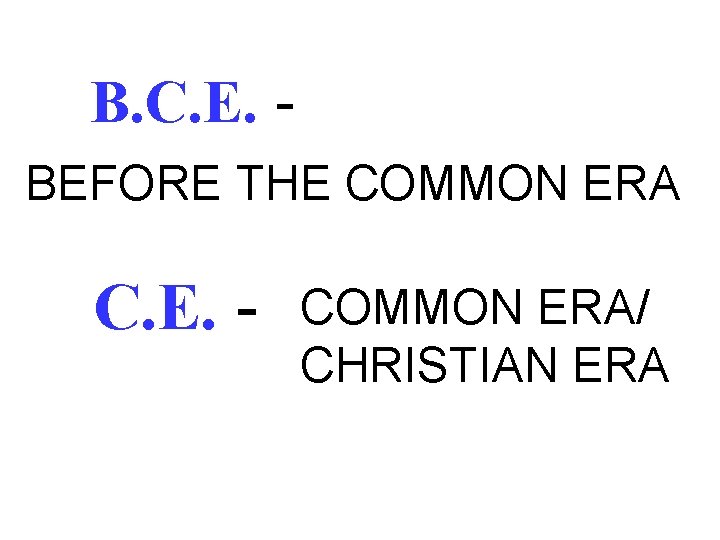
B. C. E. BEFORE THE COMMON ERA C. E. - COMMON ERA/ CHRISTIAN ERA
Since many non-Christians have come to use this calendar, an alternative notation "C. E. " is sometimes used. It is presently uncertain what the original meaning of this abbreviation was, although today it is taken to mean either the Common Era or the Christian Era: many references cite both.
Often, the letter “C” will appear before the date on a time line. This “c” stands for the word circa which means “around”. This notation is used when the exact date is not known.
BIRTH OF CHRIST AD 1 Alleged date of the birth of Jesus Christ. Calendar dates back from here (BC: Before Christ) and forward from here. c. 4 B. C. birth of Jesus c. 6 BC – Suggested birth (earliest)
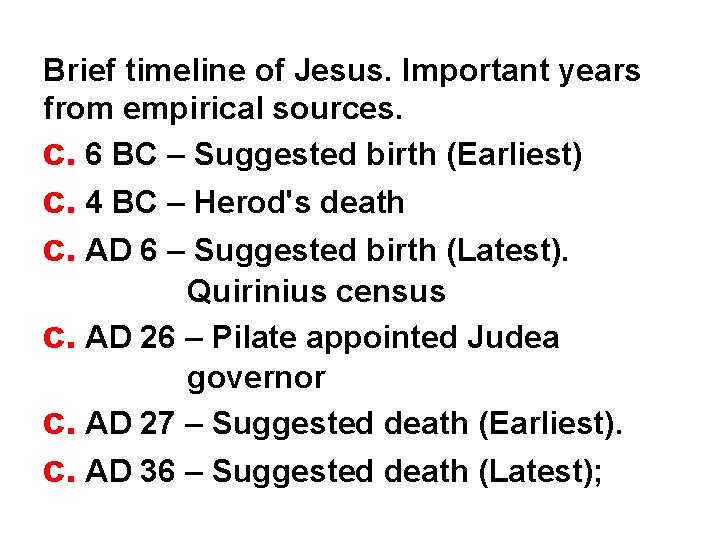
Brief timeline of Jesus. Important years from empirical sources. c. 6 BC – Suggested birth (Earliest) c. 4 BC – Herod's death c. AD 6 – Suggested birth (Latest). Quirinius census c. AD 26 – Pilate appointed Judea governor c. AD 27 – Suggested death (Earliest). c. AD 36 – Suggested death (Latest);

A century is one hundred of something, usually one hundred consecutive years
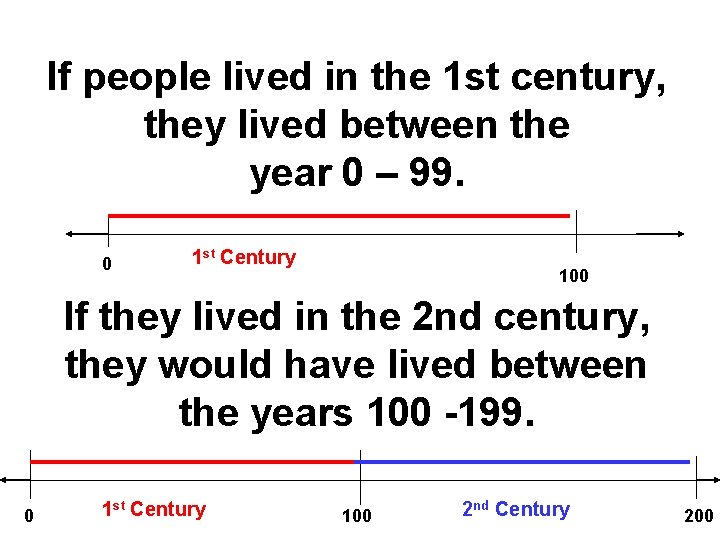
If people lived in the 1 st century, they lived between the year 0 – 99. 0 1 st Century 100 If they lived in the 2 nd century, they would have lived between the years 100 -199. 0 1 st Century 100 2 nd Century 200
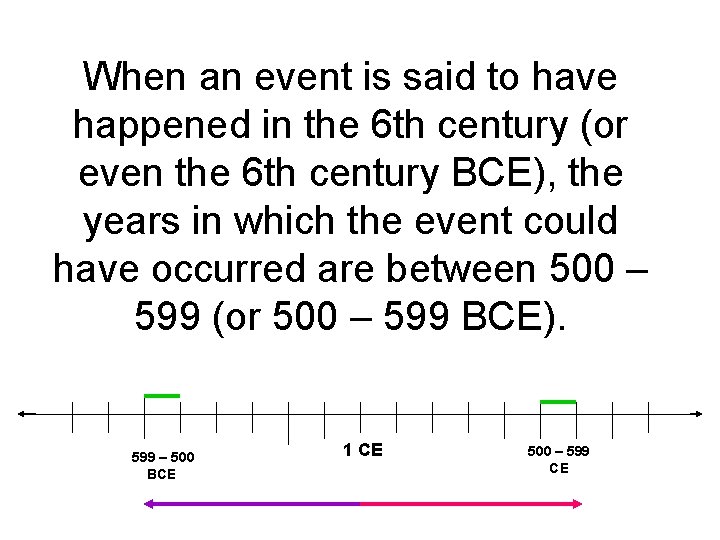
When an event is said to have happened in the 6 th century (or even the 6 th century BCE), the years in which the event could have occurred are between 500 – 599 (or 500 – 599 BCE). 599 – 500 BCE 1 CE 500 – 599 CE
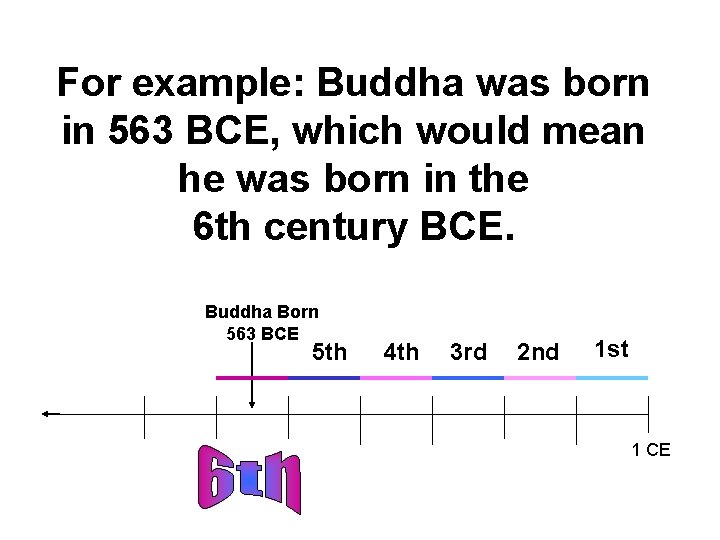
For example: Buddha was born in 563 BCE, which would mean he was born in the 6 th century BCE. Buddha Born 563 BCE 5 th 4 th 3 rd 2 nd 1 st 1 CE

What century are we part of today…. 2017? Remember…… always go up…………………
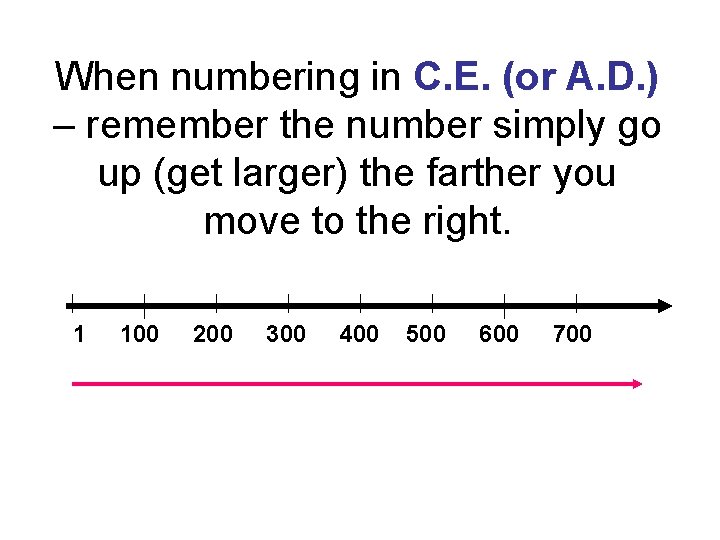
When numbering in C. E. (or A. D. ) – remember the number simply go up (get larger) the farther you move to the right. 1 100 200 300 400 500 600 700
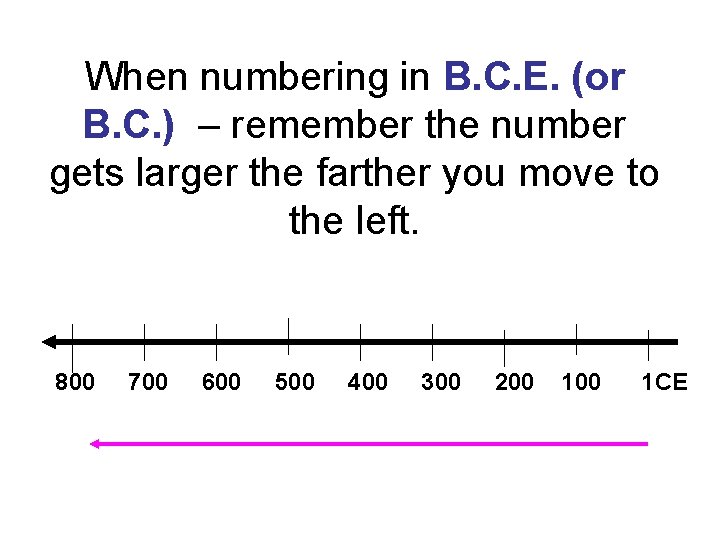
When numbering in B. C. E. (or B. C. ) – remember the number gets larger the farther you move to the left. 800 700 600 500 400 300 200 1 CE

1. We need to know that history has an order. 2. History is organized chronologically. 3. Once you understand know about events chronologically – We can begin to explain/ examine historical relationships. Knowing about TIMELINES, we can begin to look at/answer these questions: Which King or Queen came before who? Which battle was when? Were the Greeks more ancient than the Egyptians? Could King Henry VIII have met Florence Nightingale?

Timelines help us to understand History!!
- Slides: 22