
TODAY T LYMPHOCYTE DEVELOPMENT Asilmi 08 T CELL
- Slides: 27
TODAY T LYMPHOCYTE DEVELOPMENT Asilmi 08 - T CELL DEVELOPMENT
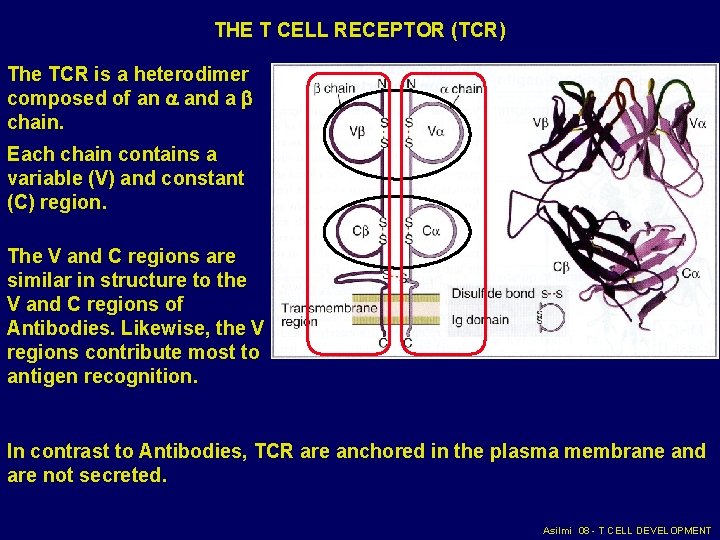
THE T CELL RECEPTOR (TCR) The TCR is a heterodimer composed of an and a chain. Each chain contains a variable (V) and constant (C) region. The V and C regions are similar in structure to the V and C regions of Antibodies. Likewise, the V regions contribute most to antigen recognition. In contrast to Antibodies, TCR are anchored in the plasma membrane and are not secreted. Asilmi 08 - T CELL DEVELOPMENT
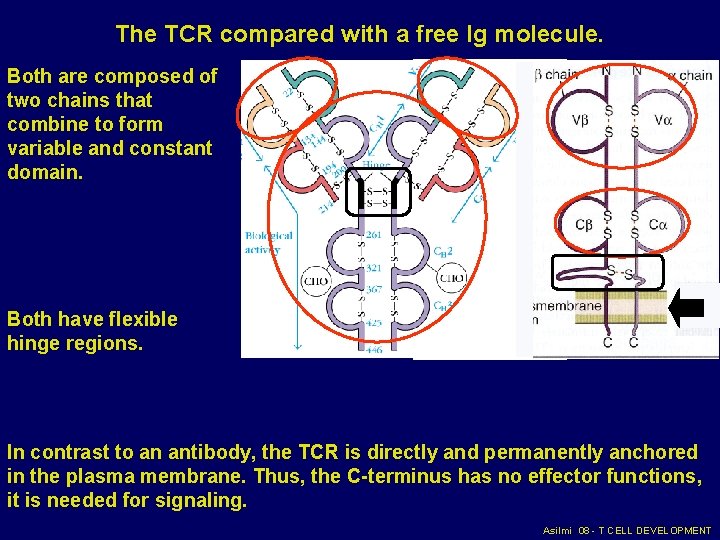
The TCR compared with a free Ig molecule. Both are composed of two chains that combine to form variable and constant domain. Both have flexible hinge regions. In contrast to an antibody, the TCR is directly and permanently anchored in the plasma membrane. Thus, the C-terminus has no effector functions, it is needed for signaling. Asilmi 08 - T CELL DEVELOPMENT
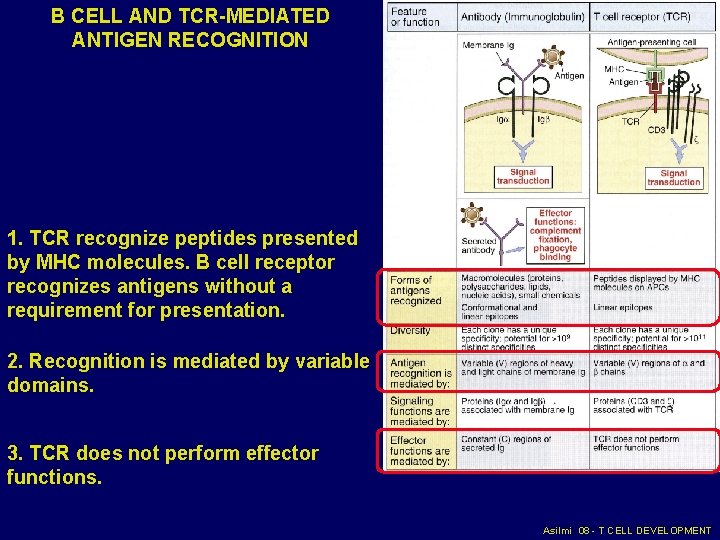
B CELL AND TCR-MEDIATED ANTIGEN RECOGNITION 1. TCR recognize peptides presented by MHC molecules. B cell receptor recognizes antigens without a requirement for presentation. 2. Recognition is mediated by variable domains. 3. TCR does not perform effector functions. Asilmi 08 - T CELL DEVELOPMENT
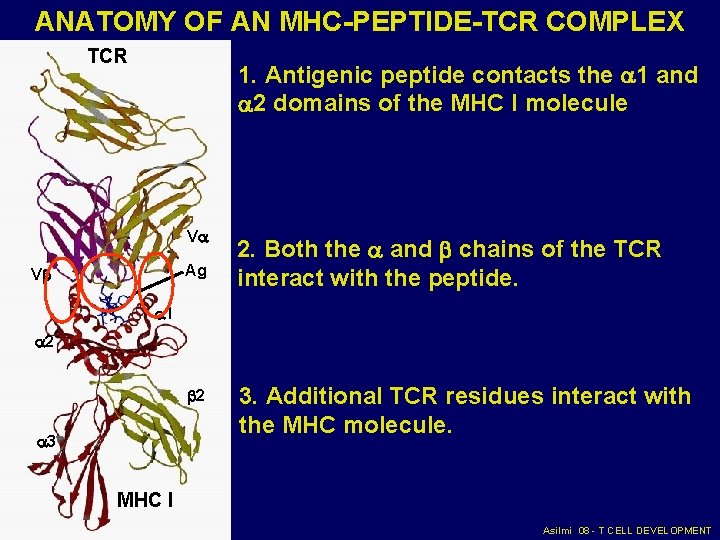
ANATOMY OF AN MHC-PEPTIDE-TCR COMPLEX TCR 1. Antigenic peptide contacts the 1 and 2 domains of the MHC I molecule V Ag V 2. Both the and chains of the TCR interact with the peptide. 1 2 2 3 3. Additional TCR residues interact with the MHC molecule. MHC I Asilmi 08 - T CELL DEVELOPMENT
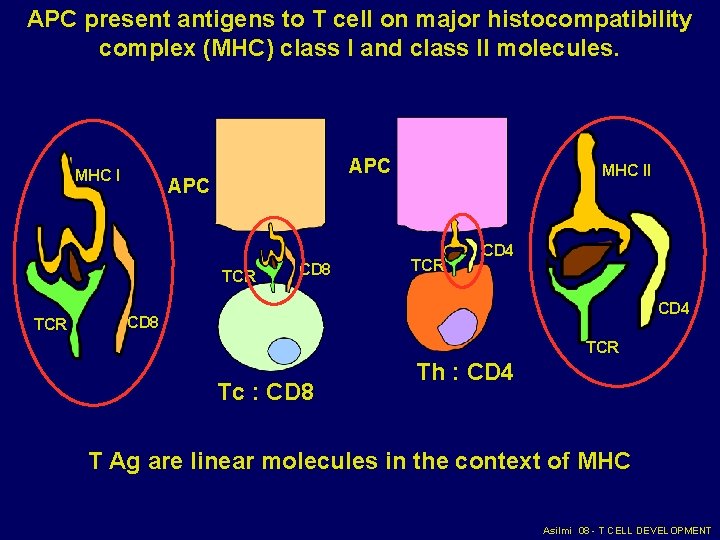
APC present antigens to T cell on major histocompatibility complex (MHC) class I and class II molecules. MHC I APC TCR CD 8 MHC II TCR CD 4 CD 8 TCR Tc : CD 8 Th : CD 4 T Ag are linear molecules in the context of MHC Asilmi 08 - T CELL DEVELOPMENT
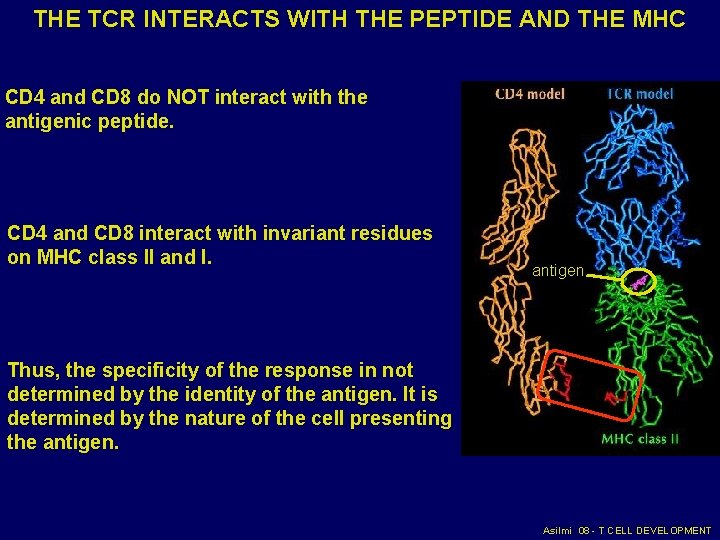
THE TCR INTERACTS WITH THE PEPTIDE AND THE MHC CD 4 and CD 8 do NOT interact with the antigenic peptide. CD 4 and CD 8 interact with invariant residues on MHC class II and I. antigen Thus, the specificity of the response in not determined by the identity of the antigen. It is determined by the nature of the cell presenting the antigen. Asilmi 08 - T CELL DEVELOPMENT
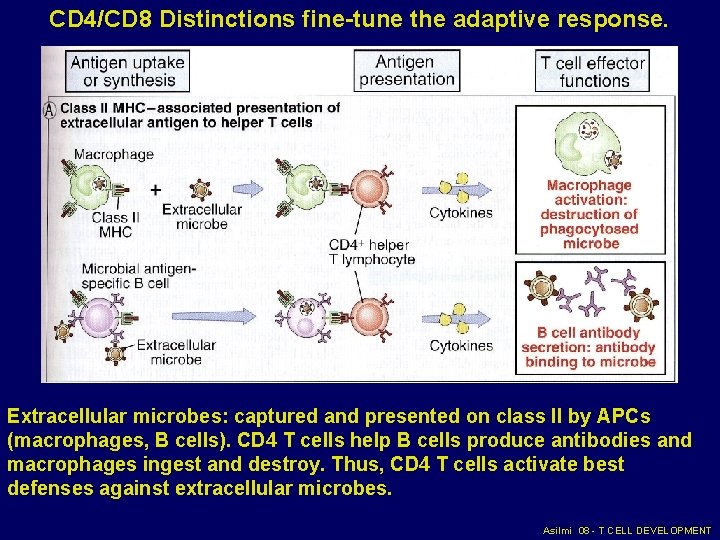
CD 4/CD 8 Distinctions fine-tune the adaptive response. Extracellular microbes: captured and presented on class II by APCs (macrophages, B cells). CD 4 T cells help B cells produce antibodies and macrophages ingest and destroy. Thus, CD 4 T cells activate best defenses against extracellular microbes. Asilmi 08 - T CELL DEVELOPMENT
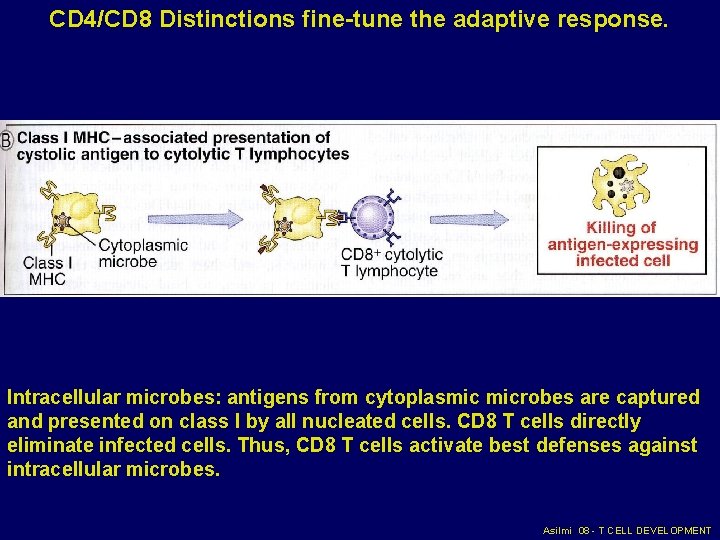
CD 4/CD 8 Distinctions fine-tune the adaptive response. Intracellular microbes: antigens from cytoplasmic microbes are captured and presented on class I by all nucleated cells. CD 8 T cells directly eliminate infected cells. Thus, CD 8 T cells activate best defenses against intracellular microbes. Asilmi 08 - T CELL DEVELOPMENT
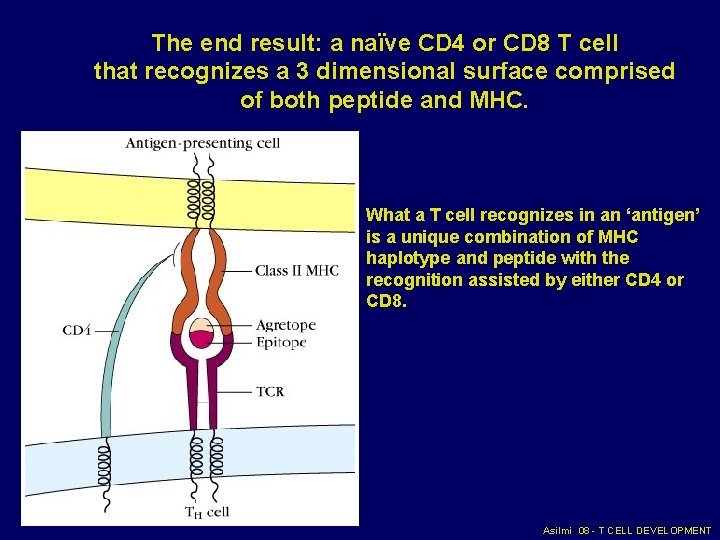
The end result: a naïve CD 4 or CD 8 T cell that recognizes a 3 dimensional surface comprised of both peptide and MHC. What a T cell recognizes in an ‘antigen’ is a unique combination of MHC haplotype and peptide with the recognition assisted by either CD 4 or CD 8. Asilmi 08 - T CELL DEVELOPMENT
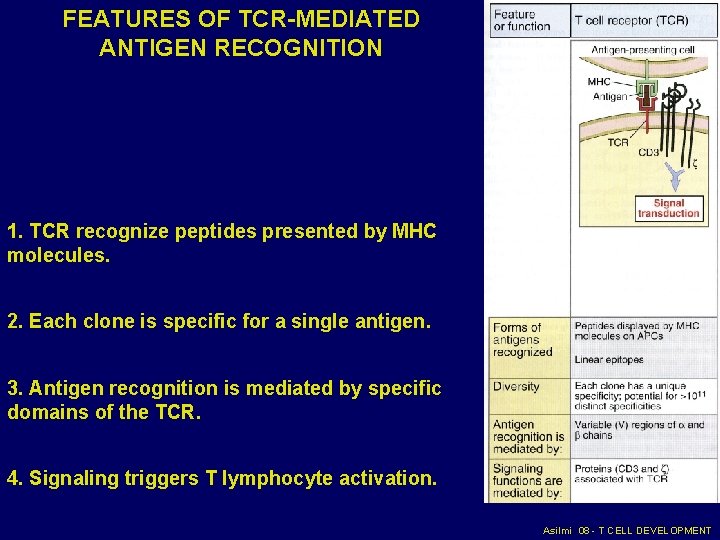
FEATURES OF TCR-MEDIATED ANTIGEN RECOGNITION 1. TCR recognize peptides presented by MHC molecules. 2. Each clone is specific for a single antigen. 3. Antigen recognition is mediated by specific domains of the TCR. 4. Signaling triggers T lymphocyte activation. Asilmi 08 - T CELL DEVELOPMENT
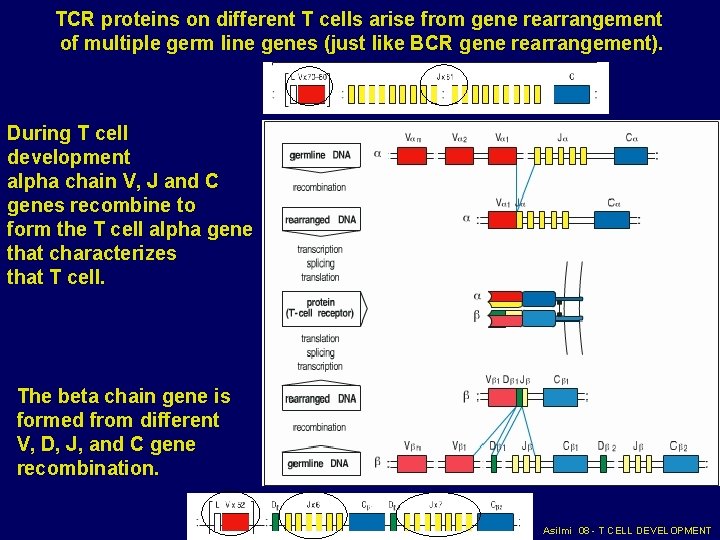
TCR proteins on different T cells arise from gene rearrangement of multiple germ line genes (just like BCR gene rearrangement). During T cell development alpha chain V, J and C genes recombine to form the T cell alpha gene that characterizes that T cell. The beta chain gene is formed from different V, D, J, and C gene recombination. Asilmi 08 - T CELL DEVELOPMENT
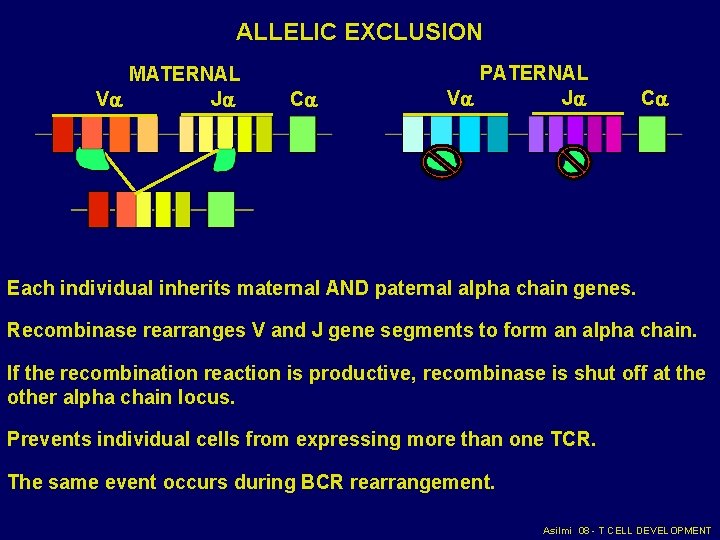
ALLELIC EXCLUSION MATERNAL V J C PATERNAL V J C Each individual inherits maternal AND paternal alpha chain genes. Recombinase rearranges V and J gene segments to form an alpha chain. If the recombination reaction is productive, recombinase is shut off at the other alpha chain locus. Prevents individual cells from expressing more than one TCR. The same event occurs during BCR rearrangement. Asilmi 08 - T CELL DEVELOPMENT
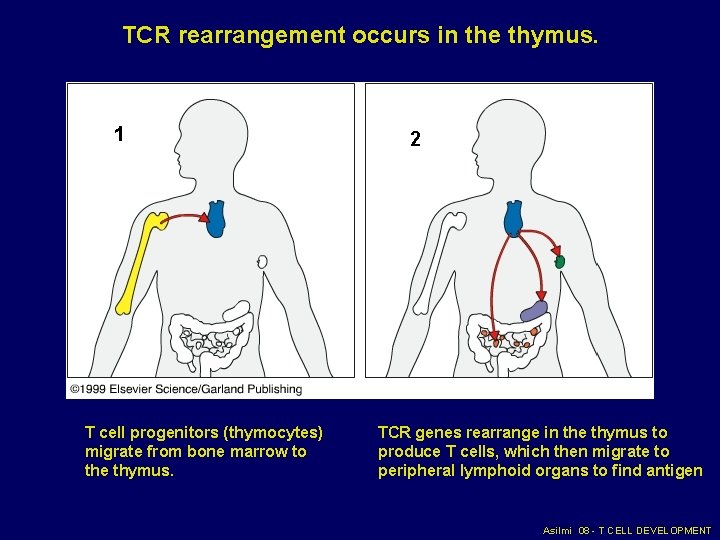
TCR rearrangement occurs in the thymus. 1 T cell progenitors (thymocytes) migrate from bone marrow to the thymus. 2 TCR genes rearrange in the thymus to produce T cells, which then migrate to peripheral lymphoid organs to find antigen Asilmi 08 - T CELL DEVELOPMENT
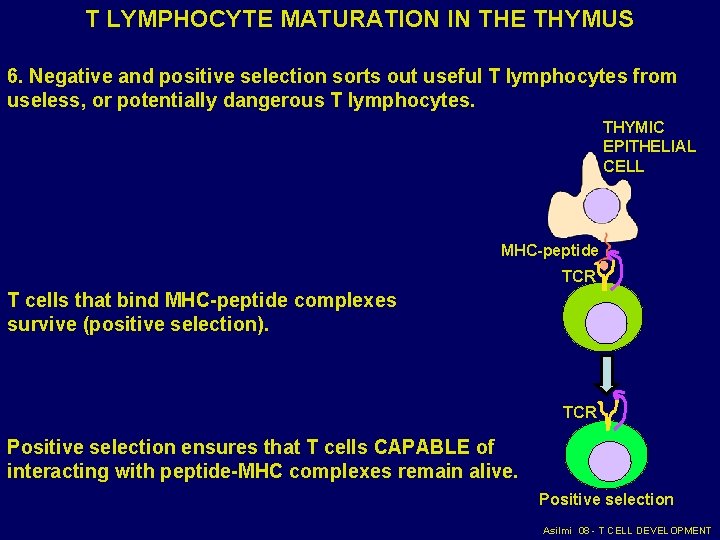
T LYMPHOCYTE MATURATION IN THE THYMUS 6. Negative and positive selection sorts out useful T lymphocytes from useless, or potentially dangerous T lymphocytes. THYMIC EPITHELIAL CELL MHC-peptide TCR T cells that bind MHC-peptide complexes survive (positive selection). TCR Positive selection ensures that T cells CAPABLE of interacting with peptide-MHC complexes remain alive. Positive selection Asilmi 08 - T CELL DEVELOPMENT
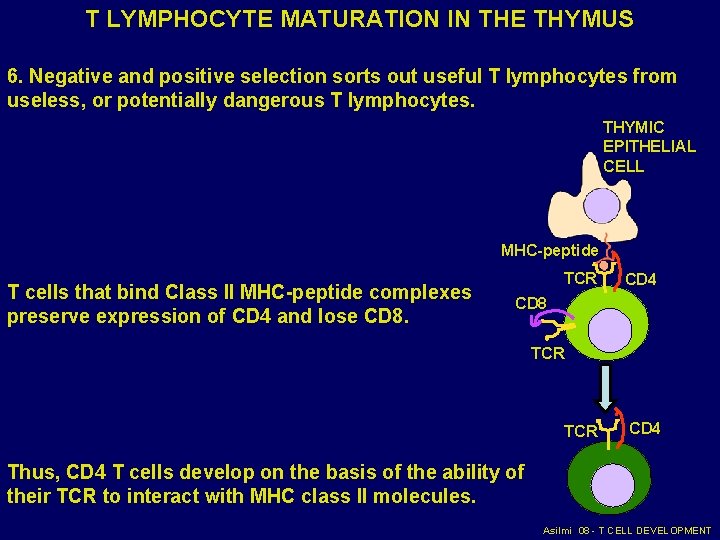
T LYMPHOCYTE MATURATION IN THE THYMUS 6. Negative and positive selection sorts out useful T lymphocytes from useless, or potentially dangerous T lymphocytes. THYMIC EPITHELIAL CELL MHC-peptide T cells that bind Class II MHC-peptide complexes preserve expression of CD 4 and lose CD 8. TCR CD 4 CD 8 TCR CD 4 Thus, CD 4 T cells develop on the basis of the ability of their TCR to interact with MHC class II molecules. Asilmi 08 - T CELL DEVELOPMENT
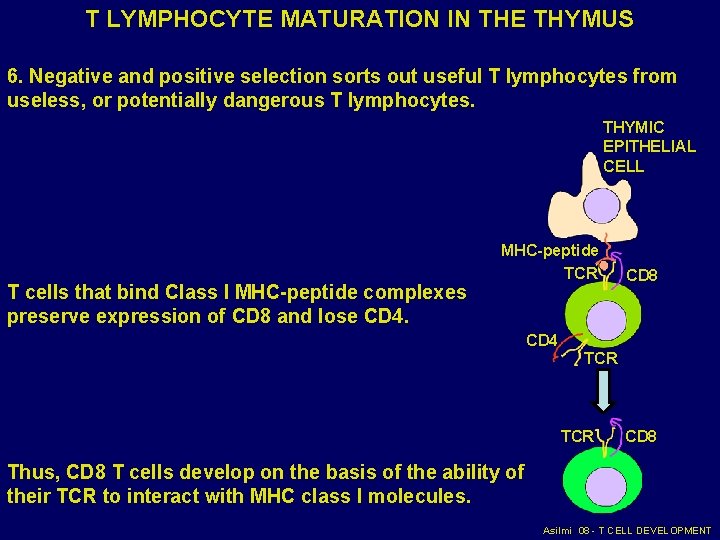
T LYMPHOCYTE MATURATION IN THE THYMUS 6. Negative and positive selection sorts out useful T lymphocytes from useless, or potentially dangerous T lymphocytes. THYMIC EPITHELIAL CELL T cells that bind Class I MHC-peptide complexes preserve expression of CD 8 and lose CD 4. MHC-peptide TCR CD 8 CD 4 TCR CD 8 Thus, CD 8 T cells develop on the basis of the ability of their TCR to interact with MHC class I molecules. Asilmi 08 - T CELL DEVELOPMENT
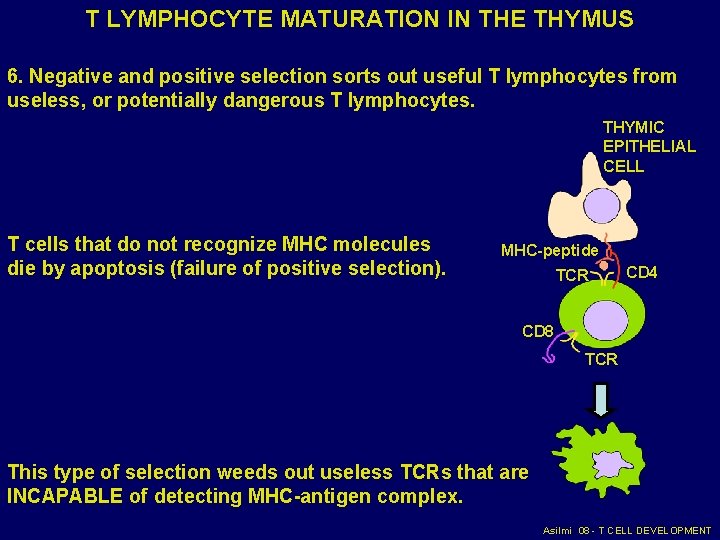
T LYMPHOCYTE MATURATION IN THE THYMUS 6. Negative and positive selection sorts out useful T lymphocytes from useless, or potentially dangerous T lymphocytes. THYMIC EPITHELIAL CELL T cells that do not recognize MHC molecules die by apoptosis (failure of positive selection). MHC-peptide TCR CD 4 CD 8 TCR This type of selection weeds out useless TCRs that are INCAPABLE of detecting MHC-antigen complex. Asilmi 08 - T CELL DEVELOPMENT
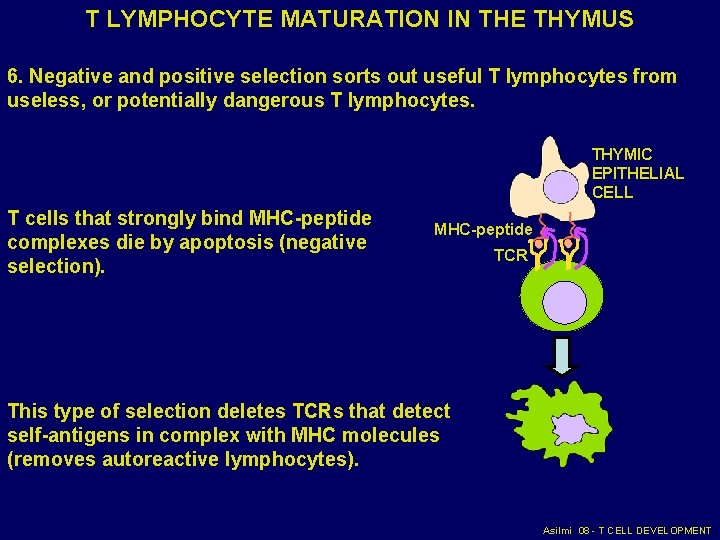
T LYMPHOCYTE MATURATION IN THE THYMUS 6. Negative and positive selection sorts out useful T lymphocytes from useless, or potentially dangerous T lymphocytes. THYMIC EPITHELIAL CELL T cells that strongly bind MHC-peptide complexes die by apoptosis (negative selection). MHC-peptide TCR This type of selection deletes TCRs that detect self-antigens in complex with MHC molecules (removes autoreactive lymphocytes). Asilmi 08 - T CELL DEVELOPMENT
thymocyte maturation occurs in stages. http: //www. ag. uidaho. edu/mmbb/kgustin/mmbb 409509/Lectures. html Asilmi 08 - T CELL DEVELOPMENT
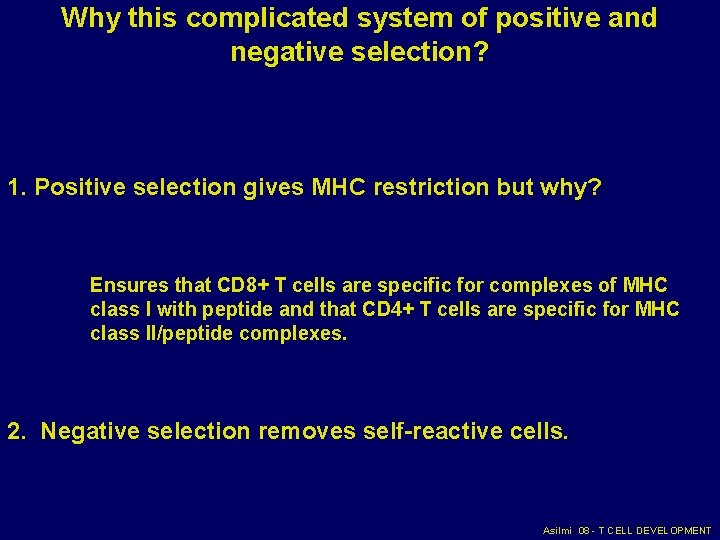
Why this complicated system of positive and negative selection? 1. Positive selection gives MHC restriction but why? Ensures that CD 8+ T cells are specific for complexes of MHC class I with peptide and that CD 4+ T cells are specific for MHC class II/peptide complexes. 2. Negative selection removes self-reactive cells. Asilmi 08 - T CELL DEVELOPMENT
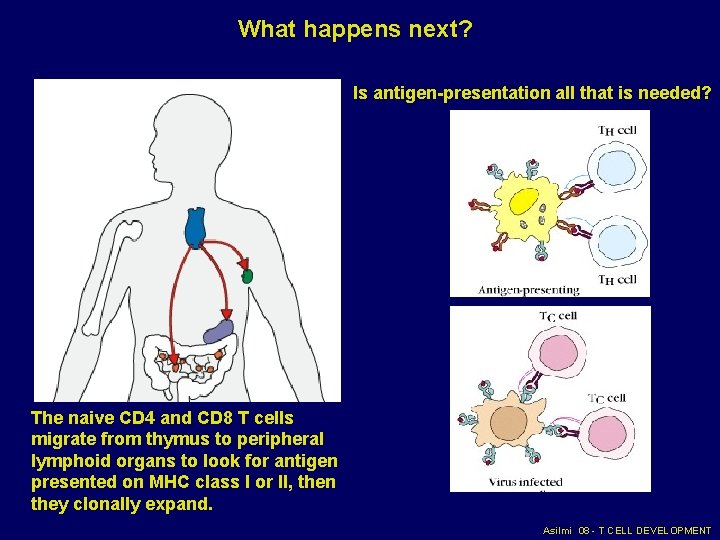
What happens next? Is antigen-presentation all that is needed? The naive CD 4 and CD 8 T cells migrate from thymus to peripheral lymphoid organs to look for antigen presented on MHC class I or II, then they clonally expand. Asilmi 08 - T CELL DEVELOPMENT
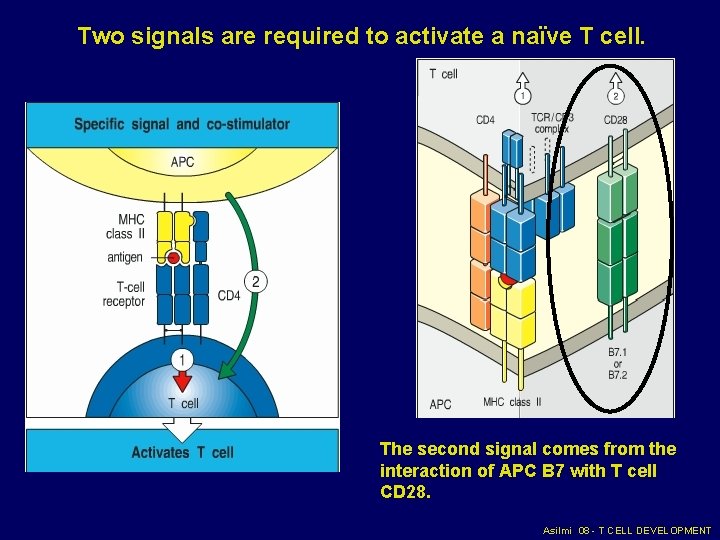
Two signals are required to activate a naïve T cell. The second signal comes from the interaction of APC B 7 with T cell CD 28. Asilmi 08 - T CELL DEVELOPMENT
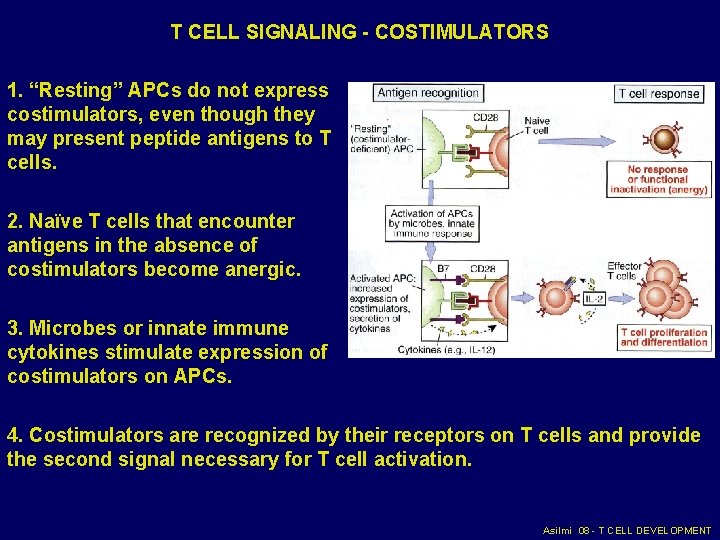
T CELL SIGNALING - COSTIMULATORS 1. “Resting” APCs do not express costimulators, even though they may present peptide antigens to T cells. 2. Naïve T cells that encounter antigens in the absence of costimulators become anergic. 3. Microbes or innate immune cytokines stimulate expression of costimulators on APCs. 4. Costimulators are recognized by their receptors on T cells and provide the second signal necessary for T cell activation. Asilmi 08 - T CELL DEVELOPMENT
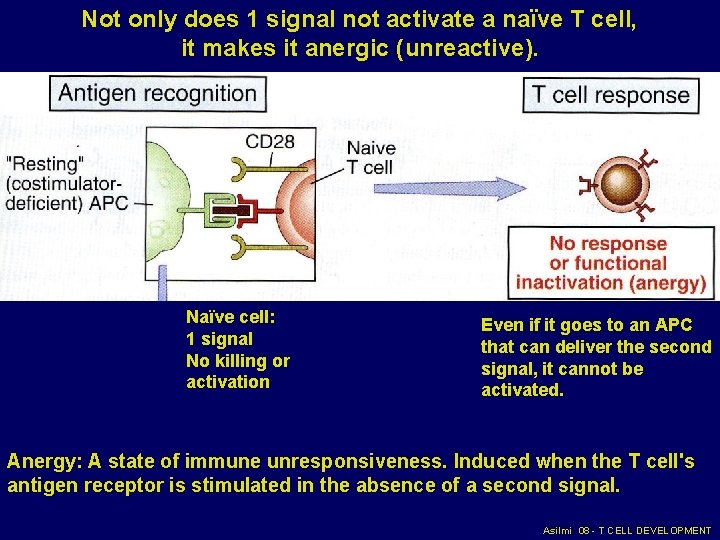
Not only does 1 signal not activate a naïve T cell, it makes it anergic (unreactive). Naïve cell: 1 signal No killing or activation Even if it goes to an APC that can deliver the second signal, it cannot be activated. Anergy: A state of immune unresponsiveness. Induced when the T cell's antigen receptor is stimulated in the absence of a second signal. Asilmi 08 - T CELL DEVELOPMENT
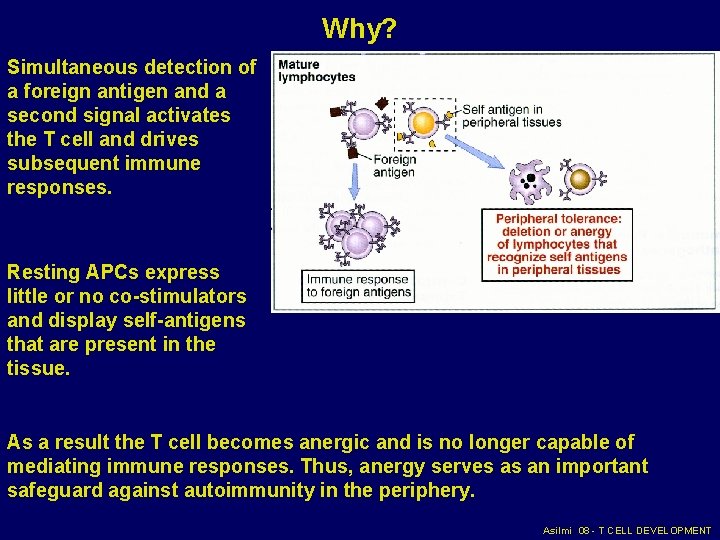
Why? Simultaneous detection of a foreign antigen and a second signal activates the T cell and drives subsequent immune responses. Resting APCs express little or no co-stimulators and display self-antigens that are present in the tissue. As a result the T cell becomes anergic and is no longer capable of mediating immune responses. Thus, anergy serves as an important safeguard against autoimmunity in the periphery. Asilmi 08 - T CELL DEVELOPMENT
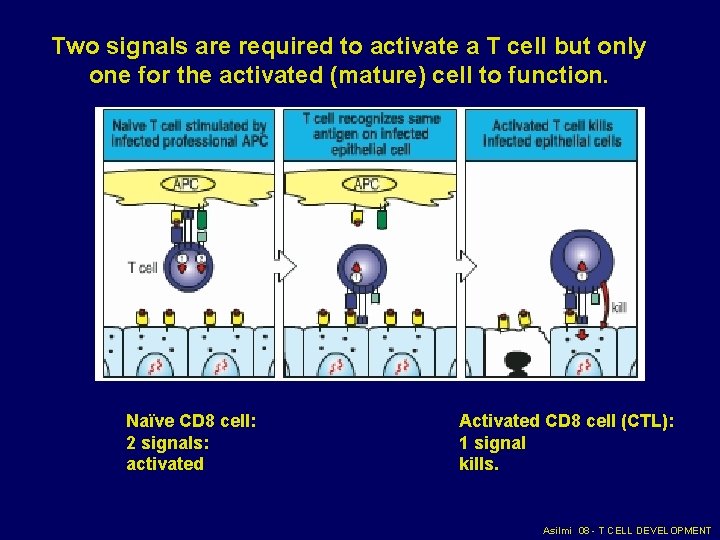
Two signals are required to activate a T cell but only one for the activated (mature) cell to function. Naïve CD 8 cell: 2 signals: activated Activated CD 8 cell (CTL): 1 signal kills. Asilmi 08 - T CELL DEVELOPMENT