
Today Pattern Recognition Review Network Society terms Gibson
Today: Pattern Recognition • • Review Network Society terms Gibson background Blue Ant as network enterprise Paranoia around technology
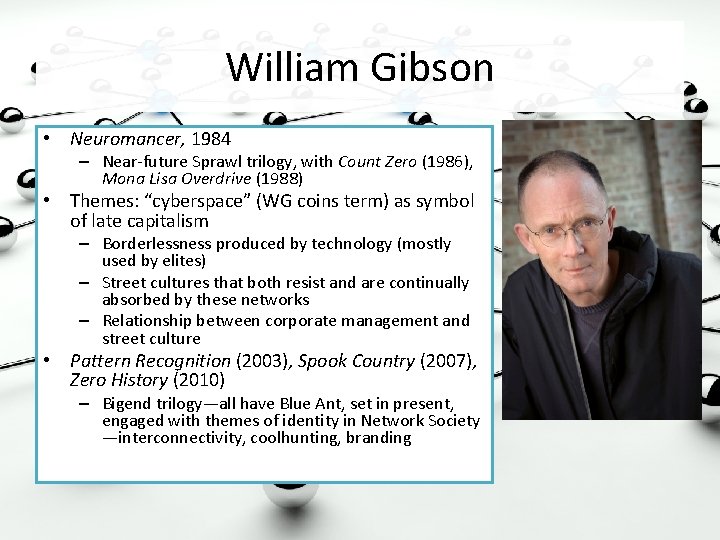
William Gibson • Neuromancer, 1984 – Near-future Sprawl trilogy, with Count Zero (1986), Mona Lisa Overdrive (1988) • Themes: “cyberspace” (WG coins term) as symbol of late capitalism – Borderlessness produced by technology (mostly used by elites) – Street cultures that both resist and are continually absorbed by these networks – Relationship between corporate management and street culture • Pattern Recognition (2003), Spook Country (2007), Zero History (2010) – Bigend trilogy—all have Blue Ant, set in present, engaged with themes of identity in Network Society —interconnectivity, coolhunting, branding
Pattern Recognition overall themes • Networked enterprise as new actor in the globe (no longer CIA of Win Pollard’s era) • Interface between local subcultures and these enterprises (Cayce’s coolhunting, the footage forum) • Forms of paranoia that result from these interfaces (tension between freedom and surveillance) • Ways that network cultures overwrite the twentieth century’s history of violence and war (this is a post-9/11 novel)
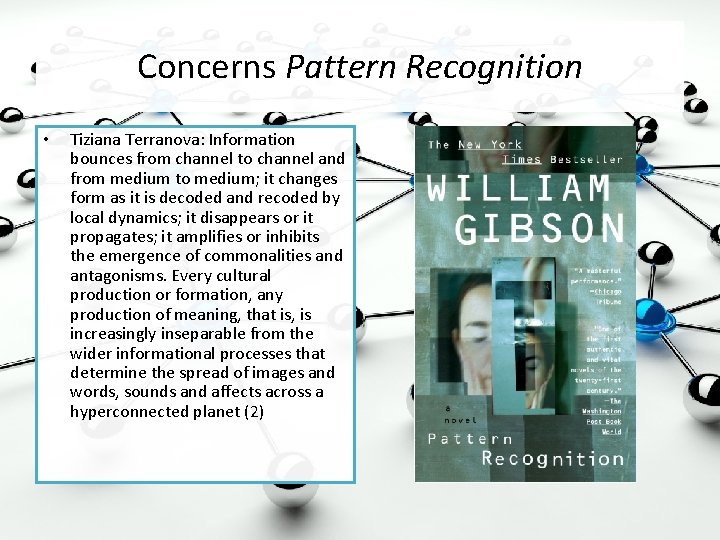
Concerns Pattern Recognition • Tiziana Terranova: Information bounces from channel to channel and from medium to medium; it changes form as it is decoded and recoded by local dynamics; it disappears or it propagates; it amplifies or inhibits the emergence of commonalities and antagonisms. Every cultural production or formation, any production of meaning, that is, is increasingly inseparable from the wider informational processes that determine the spread of images and words, sounds and affects across a hyperconnected planet (2)
Network Society: Backdrop to Network Enterprise (Blue Ant) • Term associated with sociologist Manuel Castells – The Rise of the Network Society (1996) • Concerned with physical flows of people, information, and goods across the world • Elites are cosmopolitan (borderlessness, move through airports, hotels, exclusive restaurants with little friction) • People are local (face border checks, denied visas, and expensive plane tickets) Based on what we know so far, into what category does Cayce seem to fall? • “She is hyper-specialized, a freelancer, someone contracted to do a very specific job. She has seldom had a salary. She is entirely a creature of fees, adamantly short-term, no managerial skills whatever” (63).
Network Enterprise • Luc Boltanski/Eve Chiapello The New Spirit of Capitalism—in past 40 years, firms are organized, or imagine themselves, as “network enterprises” – Teams are assembled and disassembled – Hierarchy is flat
Network enterprise • “that country without borders that Bigend strives to hail from; a meal in a world where there are no mirrors to find yourself on the other side of, all experience having been reduced, by the spectral hand of marketing, to price-point variations on the same thing” (352). • “Relatively tiny in terms of permanent staff, globally distributed, more post-geographic than multinational, the agency has from the beginning billed itself as a high-speed, low-drag life-form in an advertising ecology of lumbering herbivores” (7). • “Cayce is not someone you hire to run an agency in London. Not someone you hire to run anything. She is hyper-specialized, a freelancer, someone contracted to do a very specific job. She has seldom had a salary. She is entirely a creature of fees, adamantly short-term, no managerial skills whatever” (63)
Network enterprise • Alex Link: “Effectively nationless, Bigend also represents the growth of global cities, or the network of interrelated urban spaces shared by London, New York, and Tokyo that [have] more to do with each other than with their respective regions or nations (74). • Terranova: “As should be expected, such reconfiguration of the overall communication system is linked to the emergence of new geopolitical formations and in particular it seems inextricably linked to the open and unbounded space of [Hardt and Negri’s] post-cold-war global empire” (40)

What, then, do we know about Blue Ant/Bigend? • Write down everything you can remember from today’s reading.
Space of places: local How does Cayce/Gibson describe the street here as a specific place, where [Castells] “people’s life and experiences [are] rooted in places, in culture, in their history” “She’s in a street of what she thinks are called mews houses, little places, scarily cute, still headed toward Portobello and the market, when she sees them: three men, variously jacketed, their collars up, staring gravely into the open trunk of a small and uncharacteristically old mirror-world car. Not so much a mirror-world car as an English car, as no equivalent exists, on Cayce’s side of the Atlantic, to mirror. Vauxhall Wyvern, she thinks, with her compulsive memory for brand names, though she doubts that this is one of those, whatever those might have been. As to why she notices them now, these three, she later will be unable to say” (26). “She’s starting to feel like she’s really here” (37). In the following pages, where do we see specific knowledge that only applies in this context?
Outside of network enterprise • "Briefly, though, she imagines the countless Asian workers who might, should they say yes, spend years of their lives applying versions of this symbol to an endless and unyielding flood of footwear. What would it mean to them, this bouncing sperm? Would it work its way into their dreams eventually? Would their children chalk it in doorways before they knew its meaning as a trademark? ” (13). • Many references to war/violence: – Tombstones in Confederate graveyards, Vietnam lighters. Tension between global advertising and shadows of war. (Chapter 2, 14 -15) – Calculators made in Buchenwald (30) – Donny’s pistol (41) – Keys that look like inside automatic pistol (52) – Post-9/11 Anthrax paranoia (54) – Hummer (59) – Rickson’s jacket
Footage: feeling of belonging, new possibility in network • • • Introduction F: F: F (4 -5) Passage barman 19 -20 Passage Parkaboy 40 Passage new footage (21). Passage new footage (48) Passage Ur-footageheads (49). Skim through your passage. What seems to characterize either the footage or the forum? Caroline Levine: network “defined patterns of interconnection and exchange that organize social and aesthetic experience” (113). Tiziana Terranova: “the cultural politics of information involves a stab at the fabric of possibility, an undoing of the coincidence of the real with the given” (27)
Footage Next, look at the conversation between Cayce and Bigend (69). “Do you imagine that no one else is looking? Far more creativity, today, goes into the marketing of products than into the products themselves, athletic shoes or feature films. That is why I founded Blue Ant: that one simple recognition. In that regard alone, the footage is a work of proven genius” (69). What potential collisions do you see between Bigend’s intentions and the footage community?
Moment when Cayce realizes Dorotea has infiltrated her apartment • Patrick Jagoda: “less controlled experiences of overload, confusion, distance, and paranoia [of] a networked historical moment” (29) • Bigend: “I want to make the public aware of something they don’t quite yet know that they know—or have them feel that way. Because they’ll move on that, do you understand? They’ll think they’ve thought of it first” (65)
Relationship between footage and paranoia/violence “In New York, once, on an uptown train in rush hour, during the anthrax scares, as she’d mentally recited the duck mantra, she’d found herself looking at a still no bigger than a business card, frame-grabbed and safetypinned, from a fragment she’d not yet seen, on the green polyester uniform blazer of a weary-looking black woman. Cayce had been using the mantra to ward off a recurring fantasy: that they would drop light bulbs full of the very purest stuff on the subway tracks, where, as she too well remembered Win once having told her, it would take only a few hours, as the Army had evidently proven in experiments in the 1960 s, to drift from Fourteenth to Fifty-ninth Street” (54).
- Slides: 15