
Today Lecture 18 The Josephson effect beyond tunnel
Today Lecture 18: The Josephson effect --- beyond tunnel junctions (SNS, microbridges, SFS, …) Discussion of the Josephson effect in five parts: 1. Theory and phenomena 2. RSJ model 3. Magnetic field effects 4. Fluctuations and quantum tunneling 5. Beyond tunnel junctions (SNS, microbridges, SFS, …) Next time Lecture 19: The dc SQUID --- models

Plan for the rest of the course

Final project 27 students 6 groups of 4 -5 Explore a topic --- make a set of slides 12 minute presentation on May 12 (last day of class) Topics: 1. Conventional superconducting qubits vs. topological superconducting qubits 2. Superconducting qubits vs. ion trap qubits 3. Superconducting qubits vs. semiconductor qubits 4. Quantum Supremacy 5. Superconductors for Quantum Networking 6. Superconductors for Quantum Sensing 7. Quantum computing for discovery of new superconductors Or a topic of your choosing
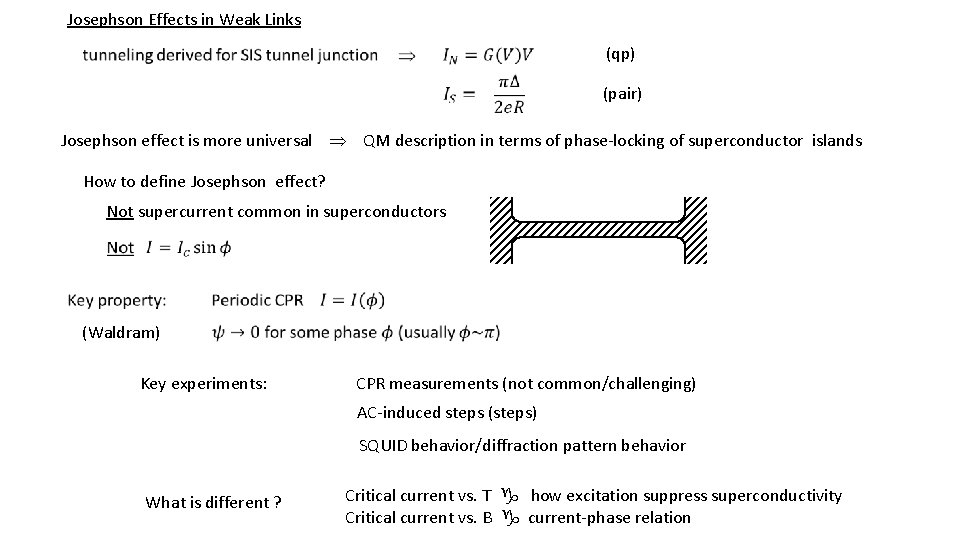
Josephson Effects in Weak Links (qp) (pair) Josephson effect is more universal QM description in terms of phase-locking of superconductor islands How to define Josephson effect? Not supercurrent common in superconductors (Waldram) Key experiments: CPR measurements (not common/challenging) AC-induced steps (steps) SQUID behavior/diffraction pattern behavior What is different ? Critical current vs. T how excitation suppress superconductivity Critical current vs. B current-phase relation

Types of Josephson junctions S-I-S insulator S-N-S normal metal S-F-S ferromagnet S-Sm-S semiconductor S-TI-S topological insulator S-v-S vacuum (STM) S-g-S graphene microbridge “Dayem bridge” (variable thickness microbridge)
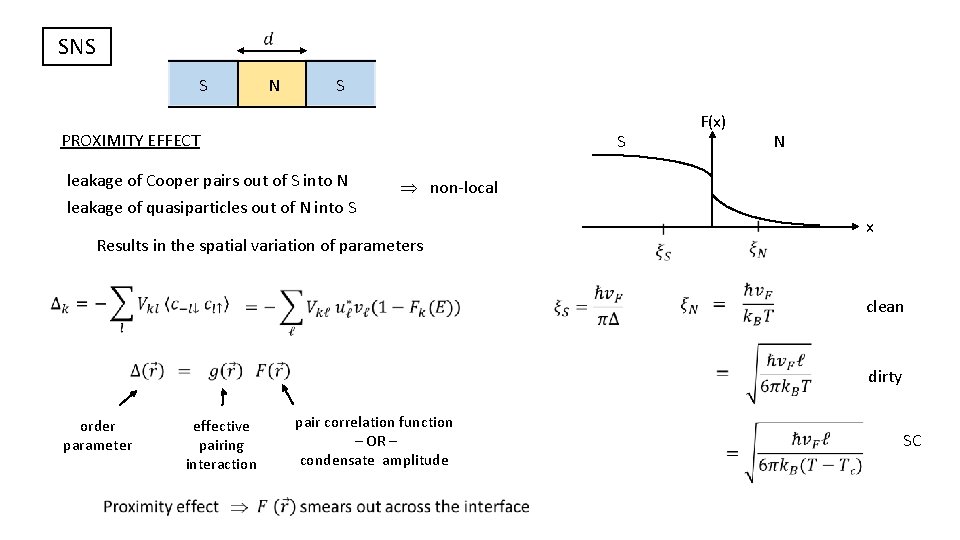
SNS S N S PROXIMITY EFFECT S leakage of Cooper pairs out of S into N leakage of quasiparticles out of N into S x clean order parameter N non-local Results in the spatial variation of parameters F(x) effective pairing interaction pair correlation function – OR – condensate amplitude dirty SC
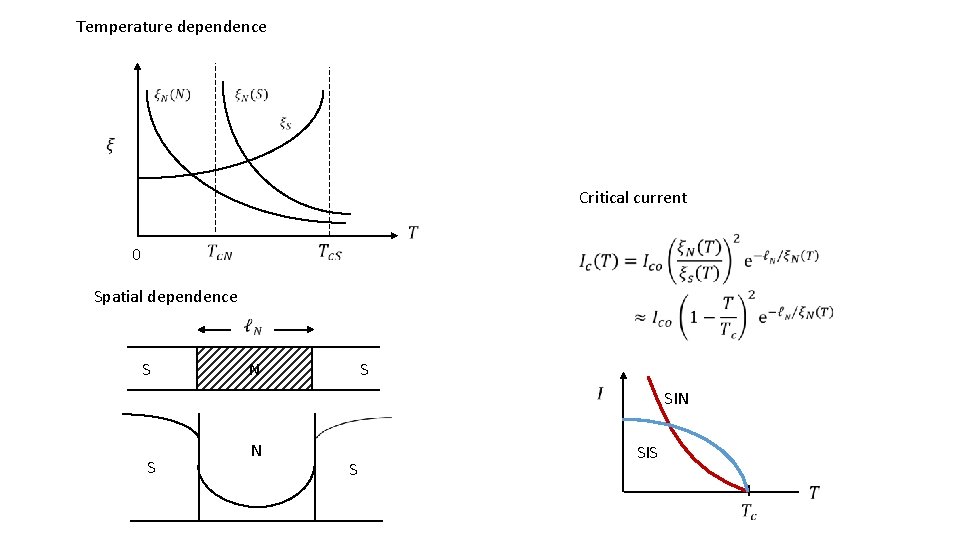
Temperature dependence Critical current 0 Spatial dependence S N S SIN SIS I
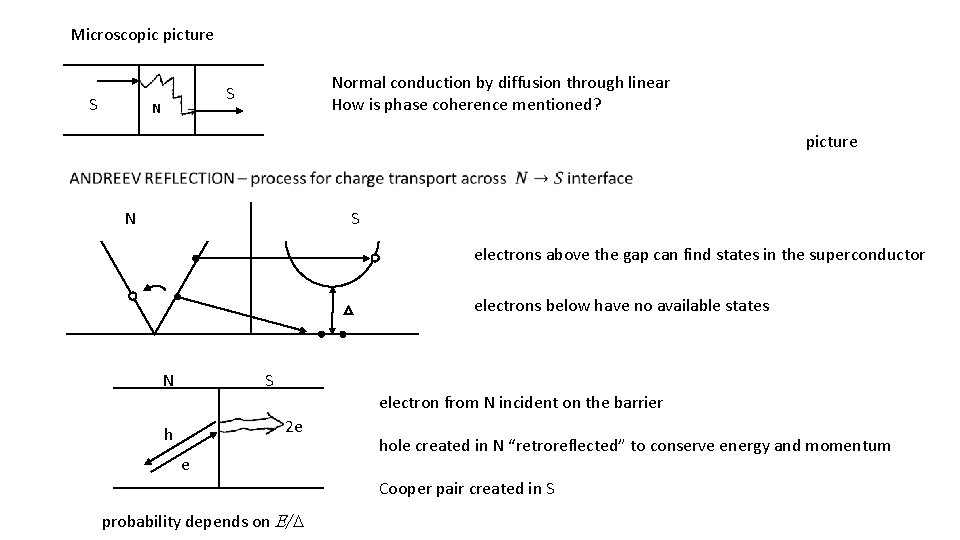
Microscopic picture S Normal conduction by diffusion through linear How is phase coherence mentioned? S N picture S N electrons above the gap can find states in the superconductor electrons below have no available states S N electron from N incident on the barrier 2 e h e hole created in N “retroreflected” to conserve energy and momentum Cooper pair created in S probability depends on /
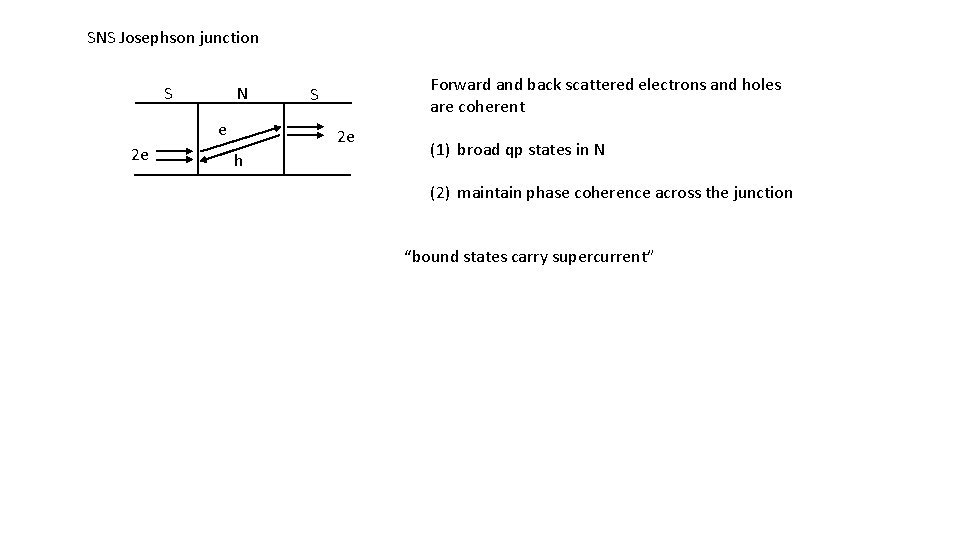
SNS Josephson junction S N e 2 e S 2 e h Forward and back scattered electrons and holes are coherent (1) broad qp states in N (2) maintain phase coherence across the junction “bound states carry supercurrent”
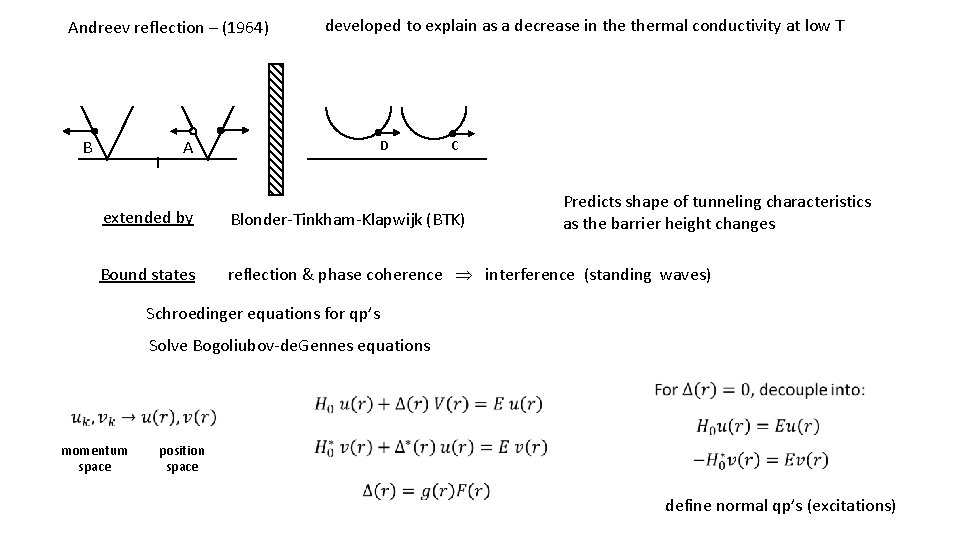
developed to explain as a decrease in thermal conductivity at low T Andreev reflection – (1964) B I A extended by D C Blonder-Tinkham-Klapwijk (BTK) Predicts shape of tunneling characteristics as the barrier height changes Bound states reflection & phase coherence interference (standing waves) Schroedinger equations for qp’s Solve Bogoliubov-de. Gennes equations momentum space position space define normal qp’s (excitations)
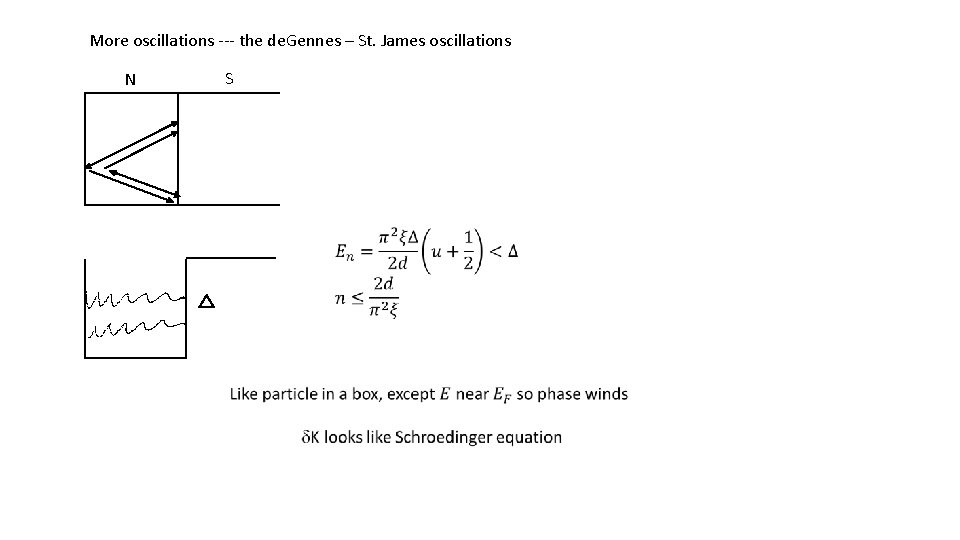
More oscillations --- the de. Gennes – St. James oscillations N S
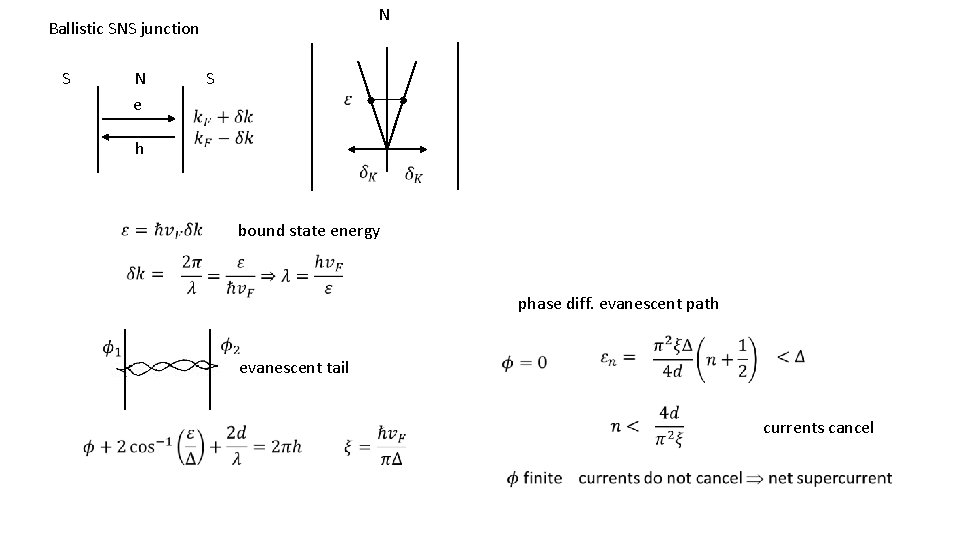
N Ballistic SNS junction S N e h S bound state energy phase diff. evanescent path evanescent tail currents cancel
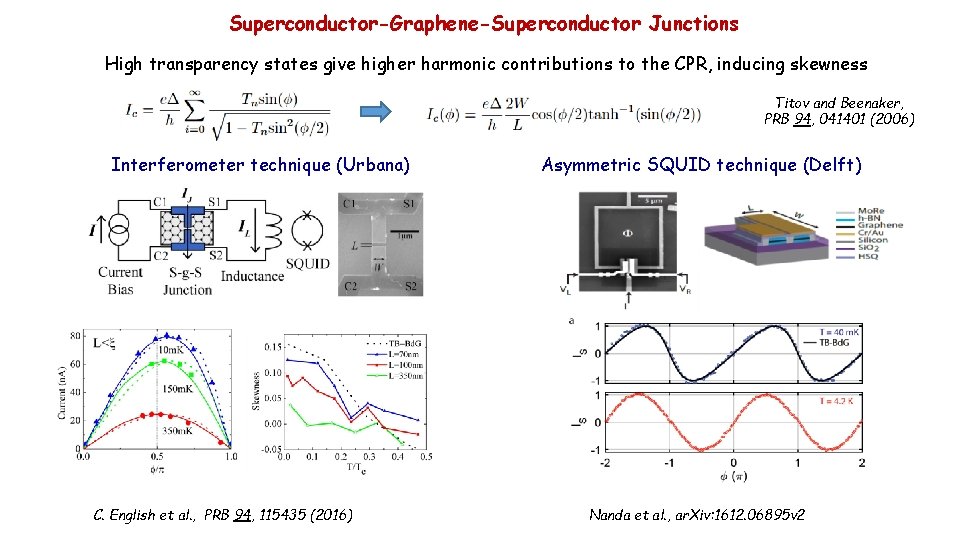
Superconductor-Graphene-Superconductor Junctions High transparency states give higher harmonic contributions to the CPR, inducing skewness Titov and Beenaker, PRB 94, 041401 (2006) Interferometer technique (Urbana) C. English et al. , PRB 94, 115435 (2016) Asymmetric SQUID technique (Delft) Nanda et al. , ar. Xiv: 1612. 06895 v 2
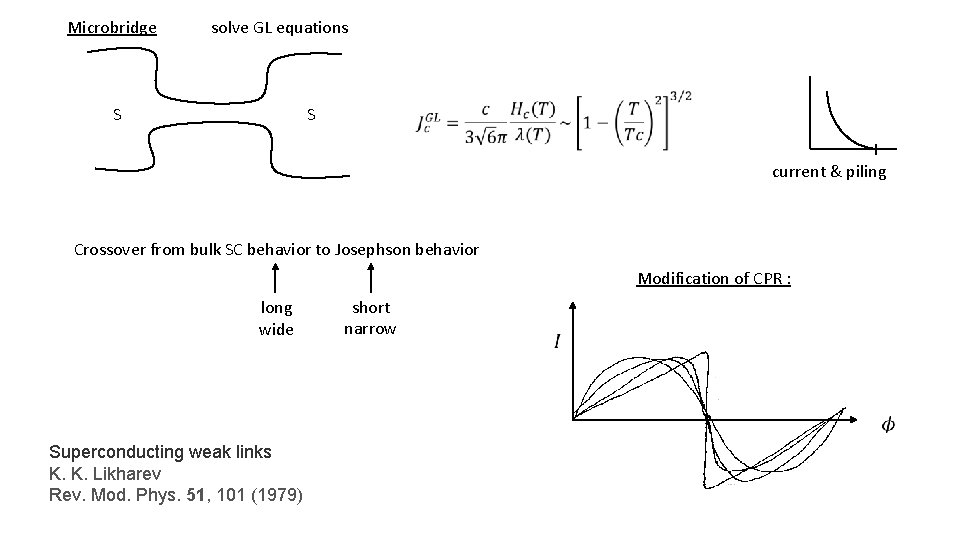
Microbridge solve GL equations S S I current & piling Crossover from bulk SC behavior to Josephson behavior Modification of CPR : long wide short narrow Superconducting weak links K. K. Likharev Rev. Mod. Phys. 51, 101 (1979)
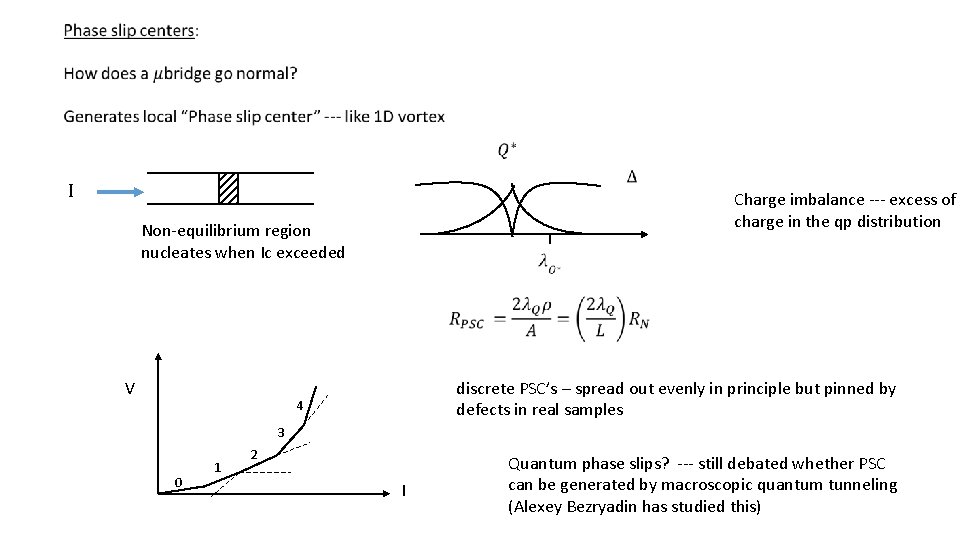
I Non-equilibrium region nucleates when Ic exceeded Charge imbalance --- excess of charge in the qp distribution V discrete PSC’s – spread out evenly in principle but pinned by defects in real samples 4 3 0 1 2 I Quantum phase slips? --- still debated whether PSC can be generated by macroscopic quantum tunneling (Alexey Bezryadin has studied this)
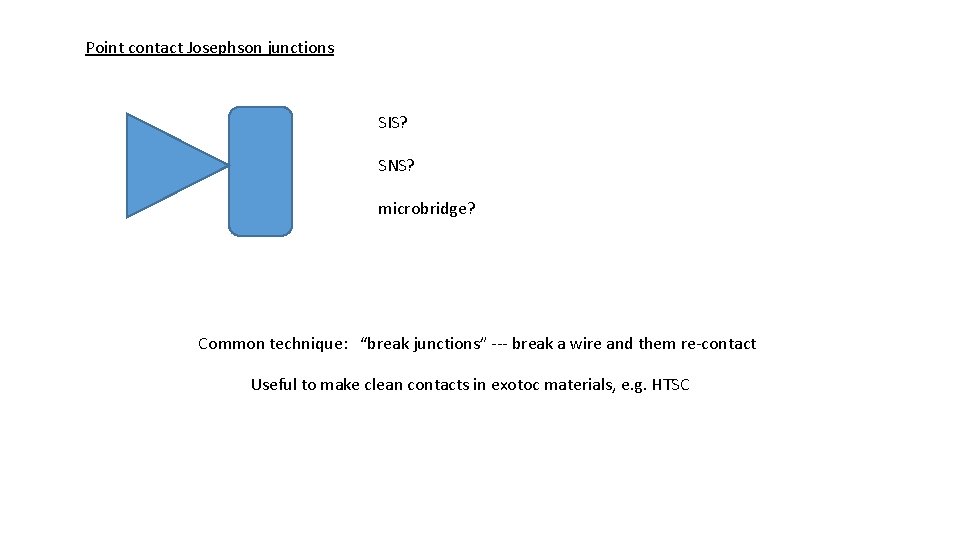
Point contact Josephson junctions SIS? SNS? microbridge? Common technique: “break junctions” --- break a wire and them re-contact Useful to make clean contacts in exotoc materials, e. g. HTSC
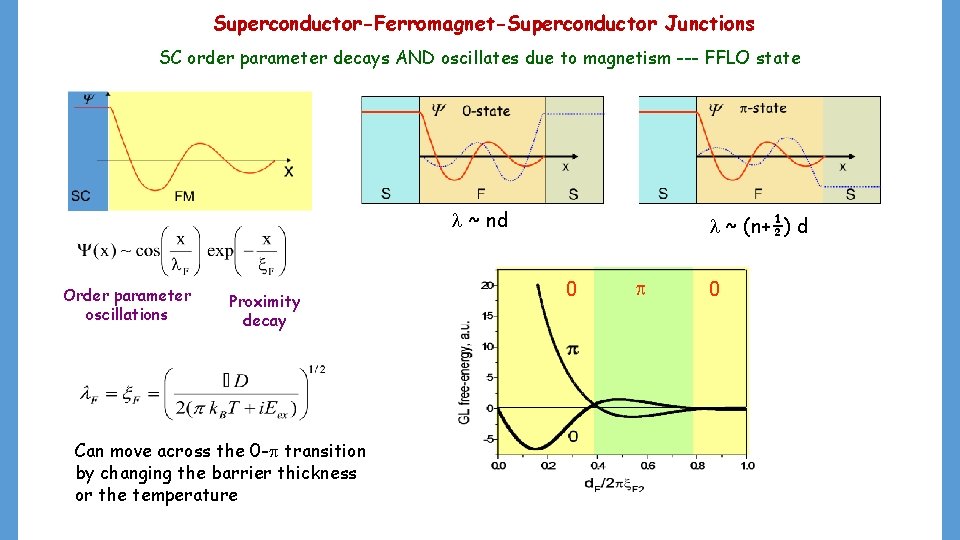
Superconductor-Ferromagnet-Superconductor Junctions SC order parameter decays AND oscillates due to magnetism --- FFLO state ~ nd Order parameter oscillations Proximity decay Can move across the 0 - transition by changing the barrier thickness or the temperature ~ (n+½) d 0 0

-Josephson junction 0 -junction minimum energy at 0 I -junction minimum energy at I f E I = Icsin( + ) = -Ic sin negative critical current E = EJ [1 - cos( + )] = EJ [1 + cos ] -2 0 2 - Spontaneously-broken symmetry Spontaneous circulating current for b. L>1 in zero applied magnetic flux
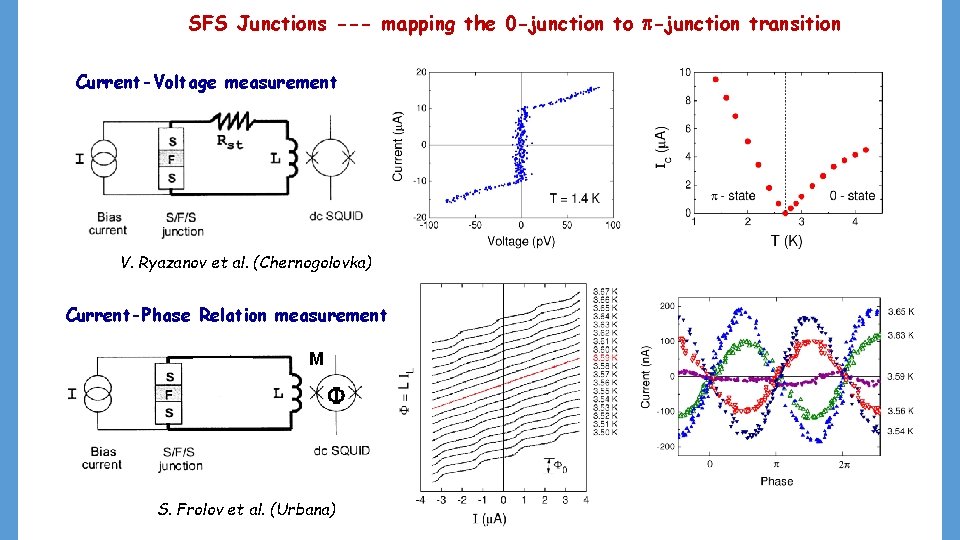
SFS Junctions --- mapping the 0 -junction to -junction transition Current-Voltage measurement V. Ryazanov et al. (Chernogolovka) Current-Phase Relation measurement M S. Frolov et al. (Urbana)

SFS Junctions --- looking for higher harmonics The vanishing of the first-order Josephson effect allows a search for higher harmonics in the CPR T = 2. 58 K Ic 2 T = 2. 40 K T = 2. 27 K T = 2. 20 K Ic 1 Ic 2 ≈ +35 m. A T Origin: rapid spatial changes in the critical current from 0 -junction to -junction M. Stoutimore et al. (Urbana) T = 1. 97 K T = 1. 81 K
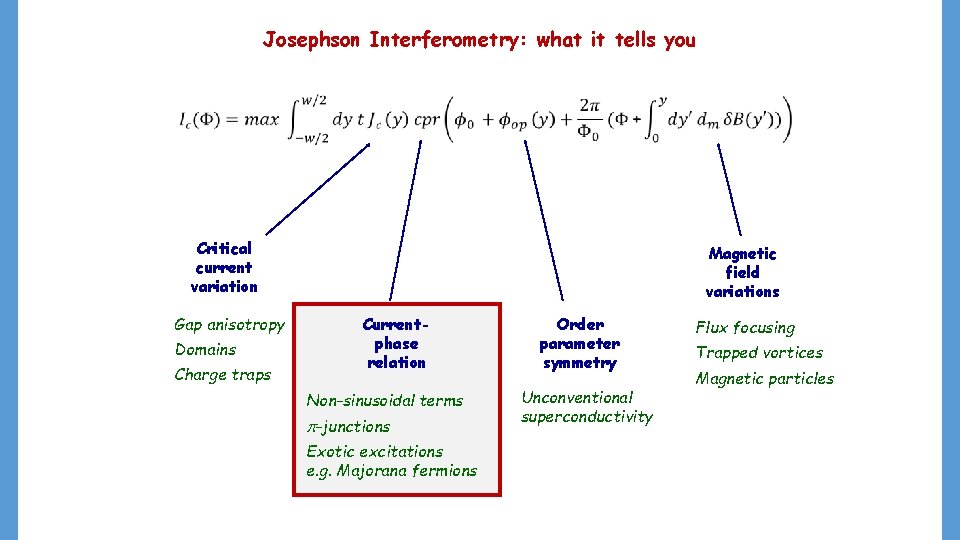
Josephson Interferometry: what it tells you Critical current variation Gap anisotropy Domains Charge traps Magnetic field variations Currentphase relation Non-sinusoidal terms -junctions Exotic excitations e. g. Majorana fermions Order parameter symmetry Unconventional superconductivity Flux focusing Trapped vortices Magnetic particles
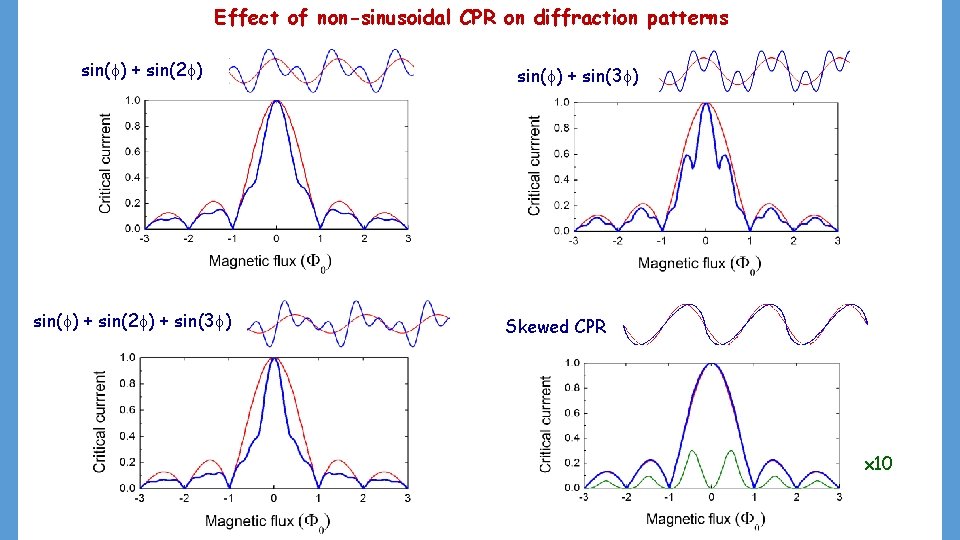
Effect of non-sinusoidal CPR on diffraction patterns sin( ) + sin(2 ) + sin(3 ) sin( ) + sin(3 ) Skewed CPR x 10
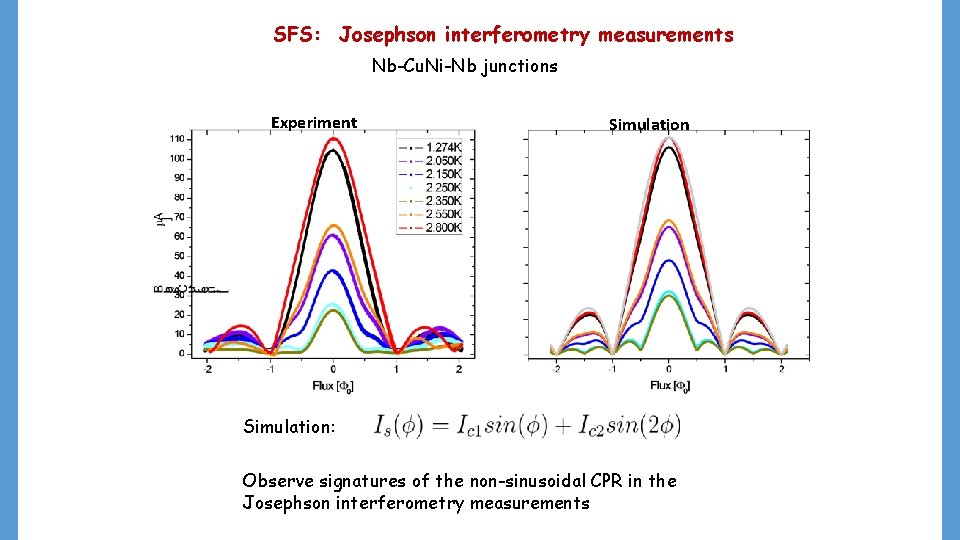
SFS: Josephson interferometry measurements Nb-Cu. Ni-Nb junctions Experiment Simulation: Observe signatures of the non-sinusoidal CPR in the Josephson interferometry measurements
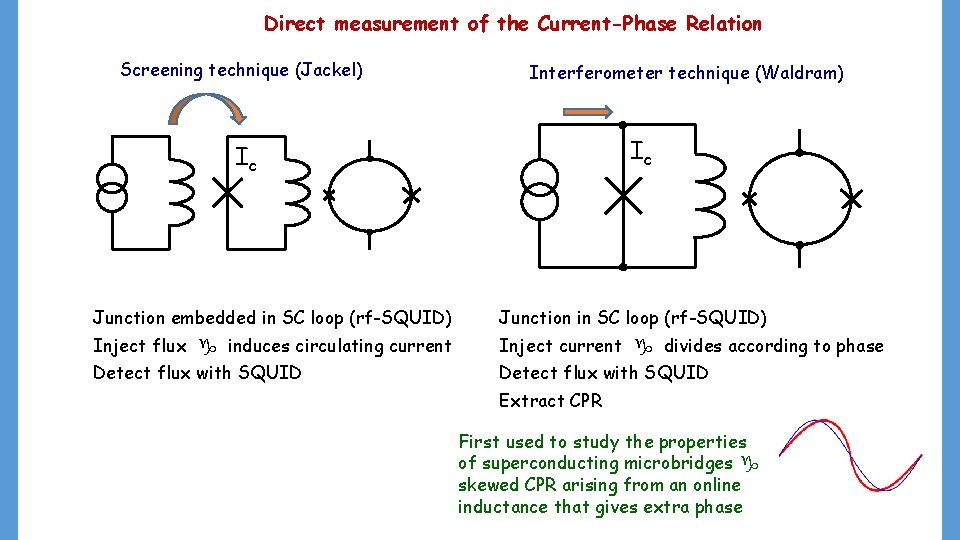
Direct measurement of the Current-Phase Relation Screening technique (Jackel) Interferometer technique (Waldram) Ic Ic Junction embedded in SC loop (rf-SQUID) Junction in SC loop (rf-SQUID) Inject flux induces circulating current Inject current divides according to phase Detect flux with SQUID Extract CPR First used to study the properties of superconducting microbridges skewed CPR arising from an online inductance that gives extra phase
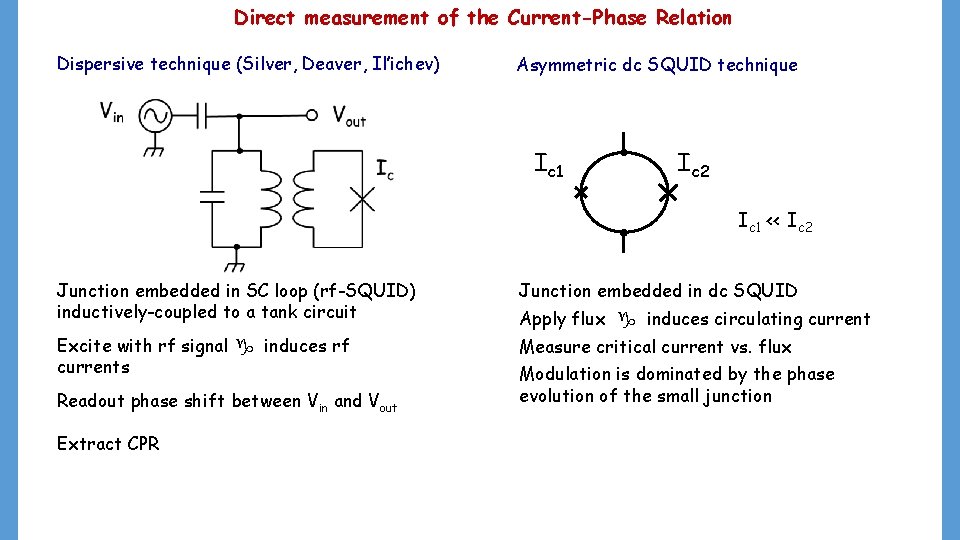
Direct measurement of the Current-Phase Relation Dispersive technique (Silver, Deaver, Il’ichev) Asymmetric dc SQUID technique Ic 1 Ic 2 Ic 1 << Ic 2 Junction embedded in SC loop (rf-SQUID) inductively-coupled to a tank circuit Junction embedded in dc SQUID Excite with rf signal induces rf currents Measure critical current vs. flux Readout phase shift between Vin and Vout Extract CPR Apply flux induces circulating current Modulation is dominated by the phase evolution of the small junction
- Slides: 25