
Today in Biology Homework Make Biology Learning Goal
Today in Biology Homework: Make Biology Learning Goal: Overview of sure- review turned in chapter 6 – Genes, DNA, vocabulary Chromosomes and chromatids complete Fact of the Day Warm Up Question: Look at definition of binary fission. Does Rats multiply so quickly that in 18 this happen in prokaryotes or months, two rats Eukaryotes? Explain. could have over 1 To Do Today: 1. Make sure review from Q. 1 is turned million descendants. Week #2 Quarter 2 (10/21) in. 2. Complete vocabulary words for Chap 6 3. Make sure notebook Q 2 notebook done
Today in Biology Week #2 Quarter 2 (10/22) Biology Learning Goal: Overview of chapter 6 – Genes, DNA, Chromosomes and chromatids Warm Up Question: What do you know about Mitosis? Explain. To Do Today: 1. Check notebook – complete 2. Overview of Chapter 6 Notes Homework: None Fact of the Day If one was to weigh all of the land animals of the earth, 10% of that mass would be ants.

Review of Cells Over view of cells http: //wn. com/cells_biology introduction to cells segment. human anatomy - the body made entirely of cells - which make up tissues - which make up organ systems - which make up you 41
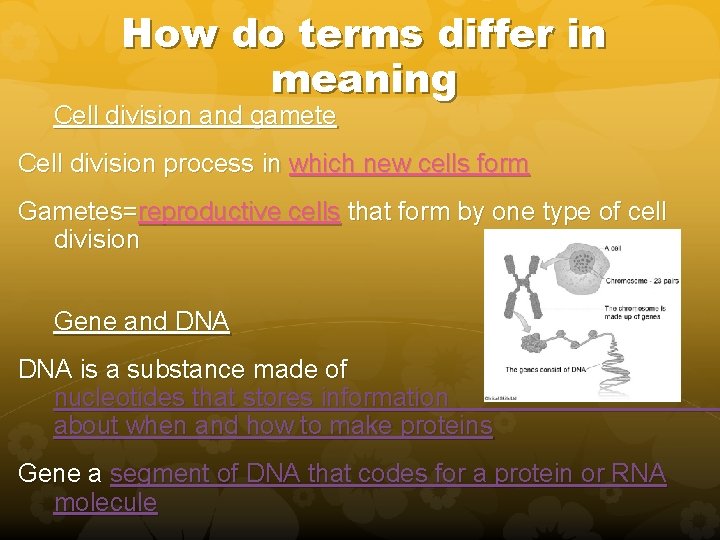
How do terms differ in meaning Cell division and gamete Cell division process in which new cells form Gametes=reproductive cells that form by one type of cell division Gene and DNA is a substance made of nucleotides that stores information about when and how to make proteins Gene a segment of DNA that codes for a protein or RNA molecule
65
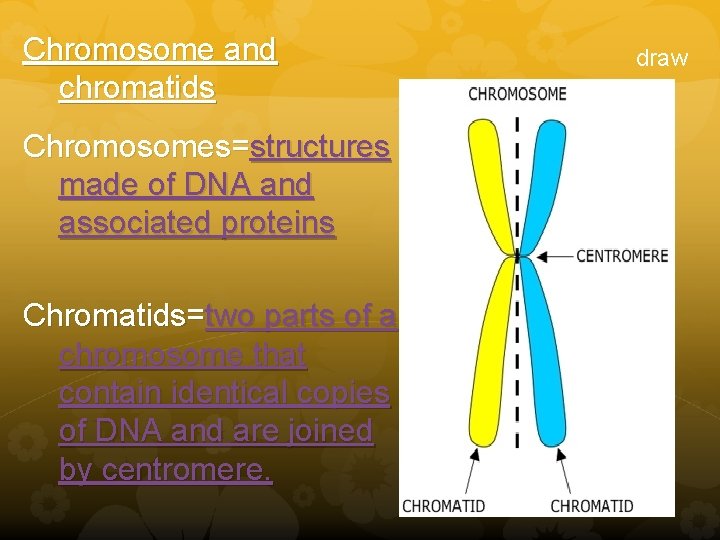
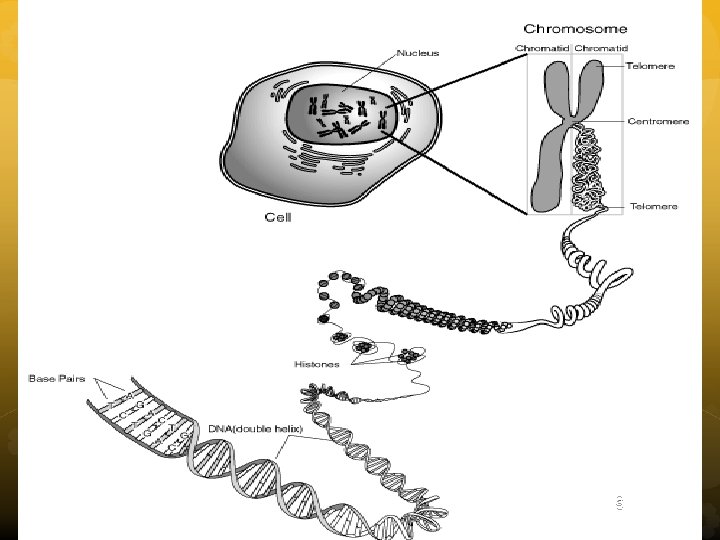
Chromosome and chromatids Chromosomes=structures made of DNA and associated proteins Chromatids=two parts of a chromosome that contain identical copies of DNA and are joined by centromere. draw TELOMERE
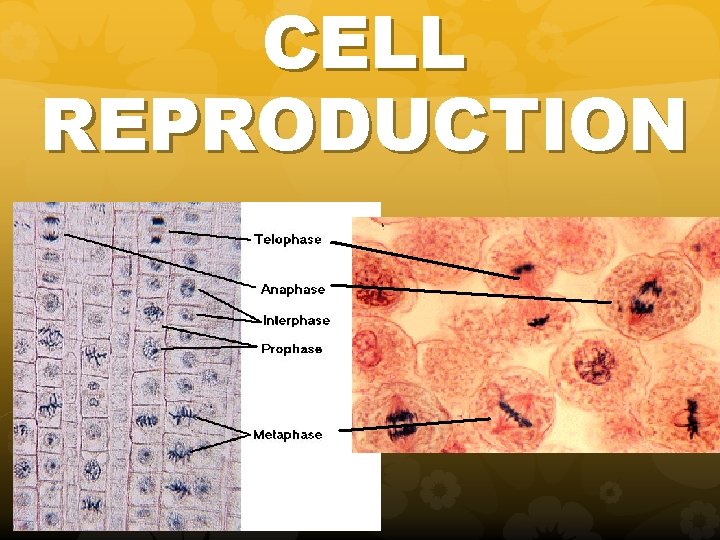
CELL REPRODUCTION
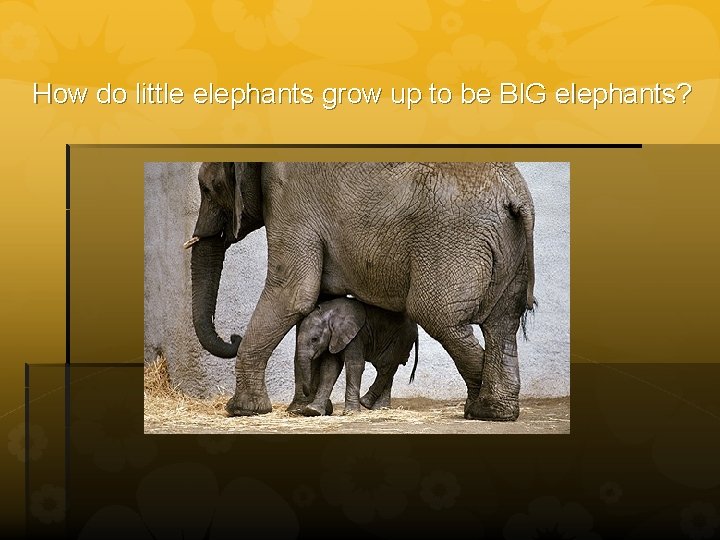
How do little elephants grow up to be BIG elephants?
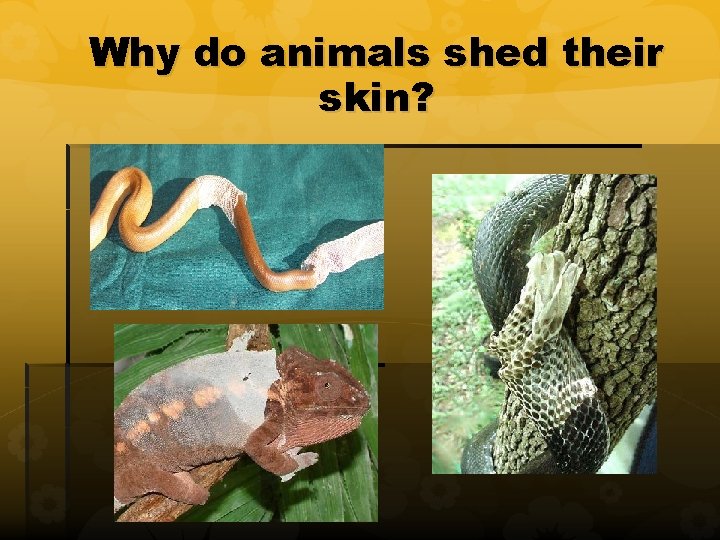
Why do animals shed their skin?
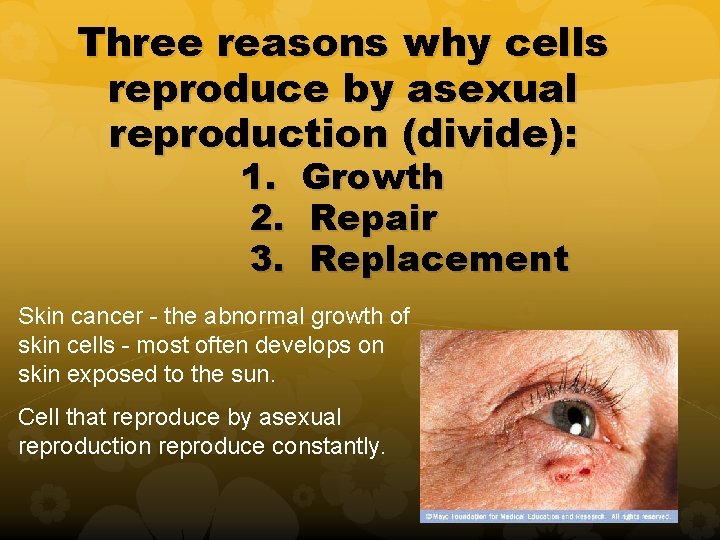
Three reasons why cells reproduce by asexual reproduction (divide): 1. 2. 3. Growth Repair Replacement Skin cancer - the abnormal growth of skin cells - most often develops on skin exposed to the sun. Cell that reproduce by asexual reproduction reproduce constantly.
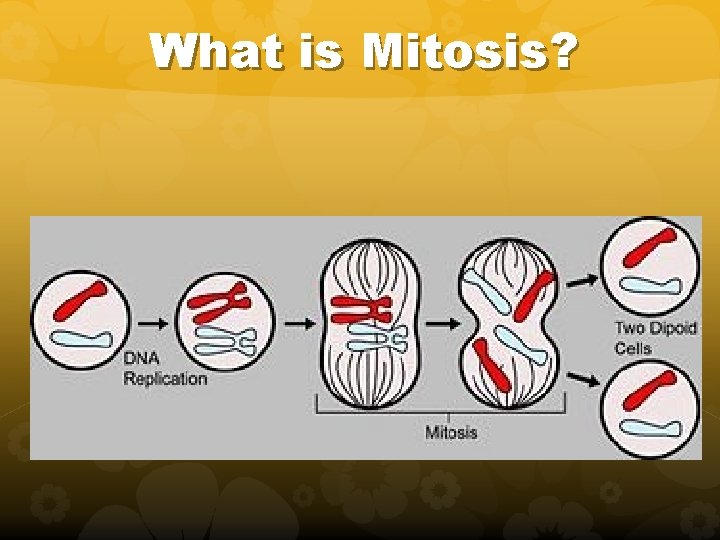
What is Mitosis?

Mitosis MITOSIS- reproduction of somatic (body) cells also known as NUCLEAR DIVISION
TERMS USED………. . Diploid= full # of chromosomes or (2 n) Haploid= half # of chromosomes or (n) SOMATIC CELLS is any biological cell forming the body of an organism; that is, in a multicellular organism, any cell other than a gamete, germ cell, gametocyte or undifferentiated stem cell. (ex. skin, nerve, muscle cells)
Today in Biology Week #2 Quarter 2 (10/23&24) Biology Learning Goal: Overview of chapter 6 – Genes, DNA, Chromosomes and chromatids Warm Up Question: Explain the difference between haploid and diploid cells. To Do Today: 1. Check notebook – complete 2. Begin discussion on cell cycle 3. Mitosis notes 4. Mitosis flip book Homework: None Fact of the Day A hedgehog's heart beats 300 times a minute on average
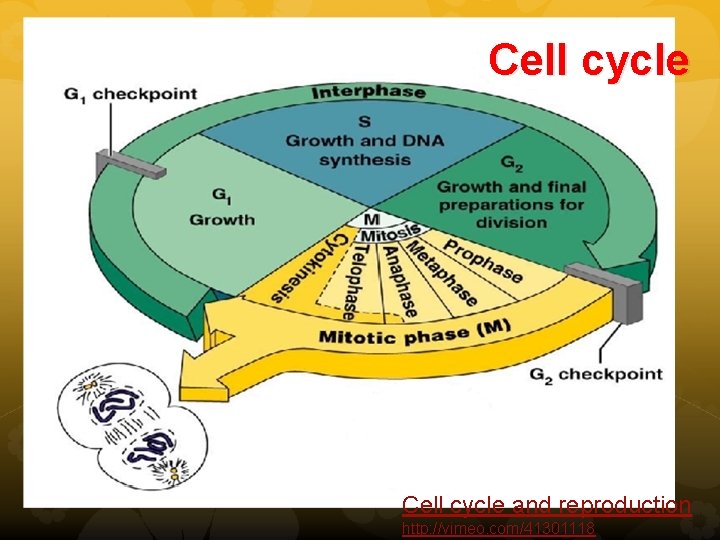
Cell cycle and reproduction http: //vimeo. com/41301118
Page 7 Cell Cycle Regular sequence of cell growth and division Time it takes varies with type of cell and external factors
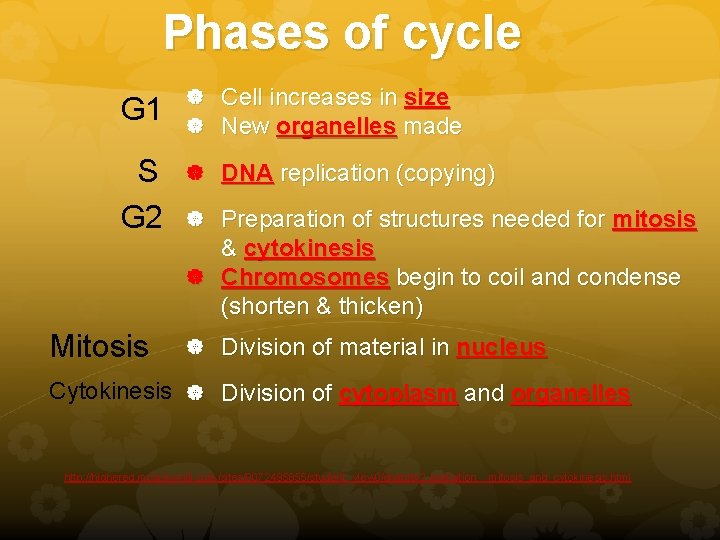
Phases of cycle G 1 S G 2 Cell increases in size New organelles made DNA replication (copying) Preparation of structures needed for mitosis & cytokinesis Chromosomes begin to coil and condense (shorten & thicken) Mitosis Division of material in nucleus Cytokinesis Division of cytoplasm and organelles http: //highered. mcgraw-hill. com/sites/0072495855/student_view 0/chapter 2 animation__mitosis_and_cytokinesis. html
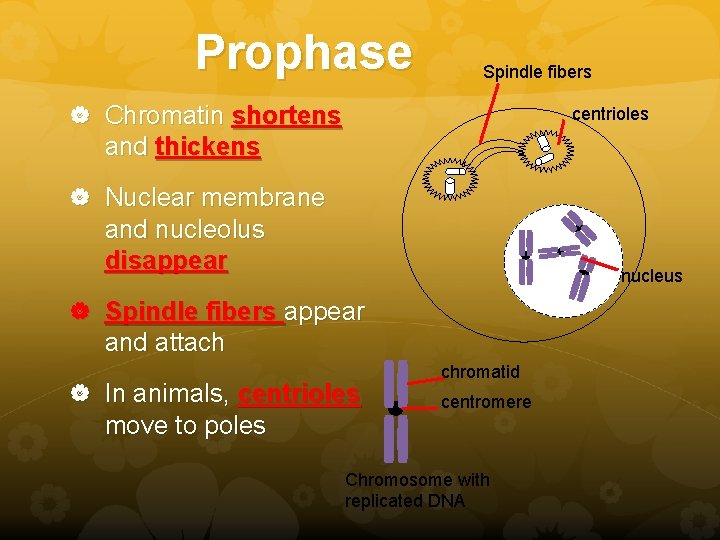
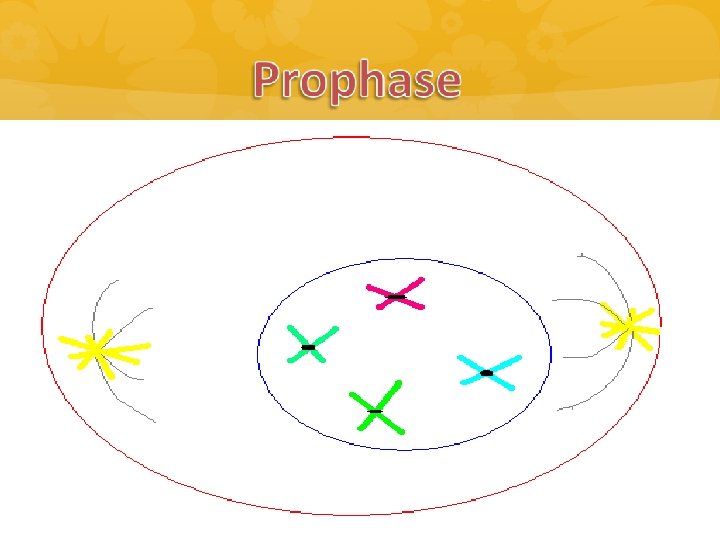
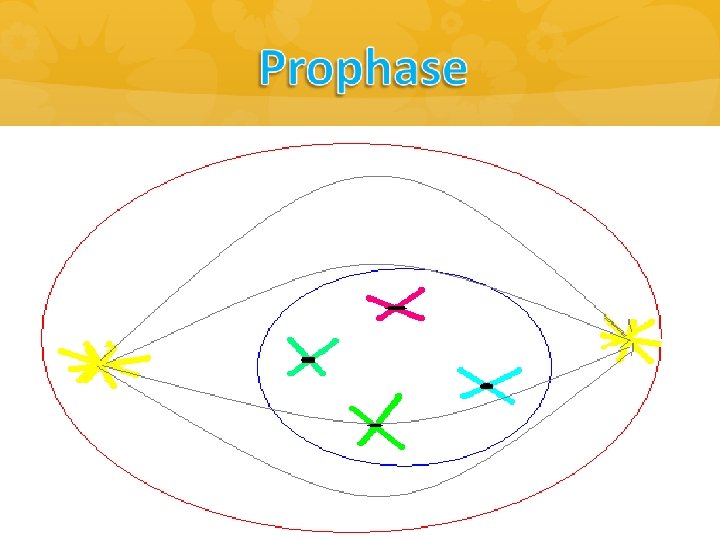
Prophase Spindle fibers Chromatin shortens centrioles and thickens Nuclear membrane and nucleolus disappear nucleus Spindle fibers appear and attach In animals, centrioles move to poles chromatid centromere Chromosome with replicated DNA
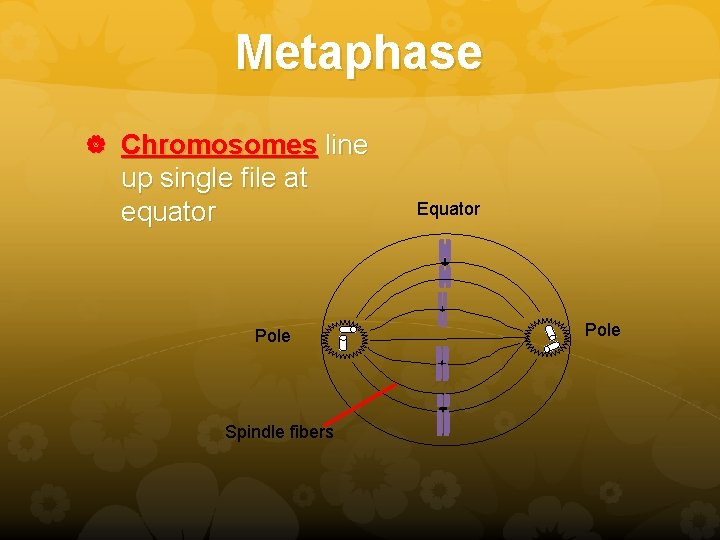
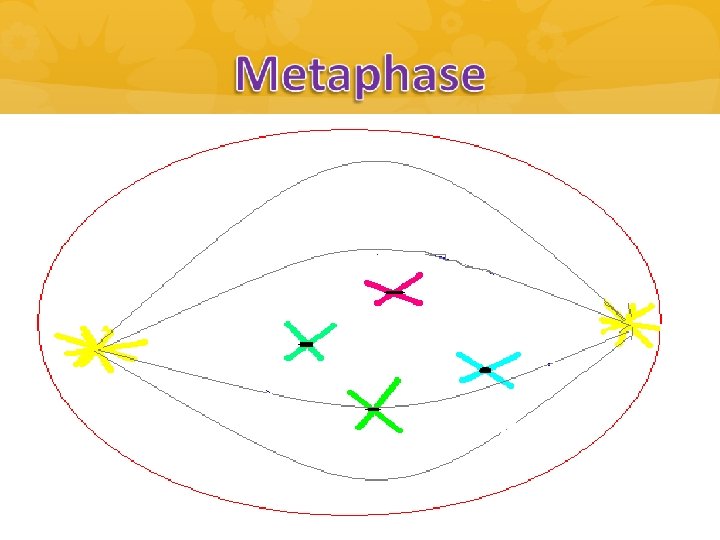
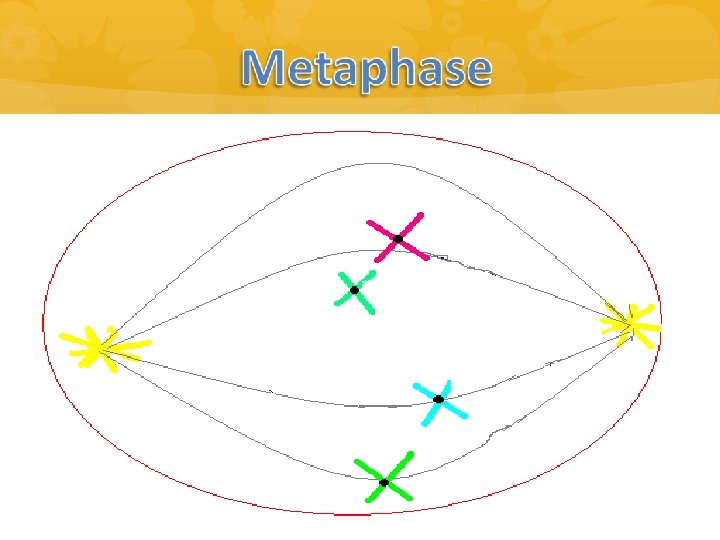
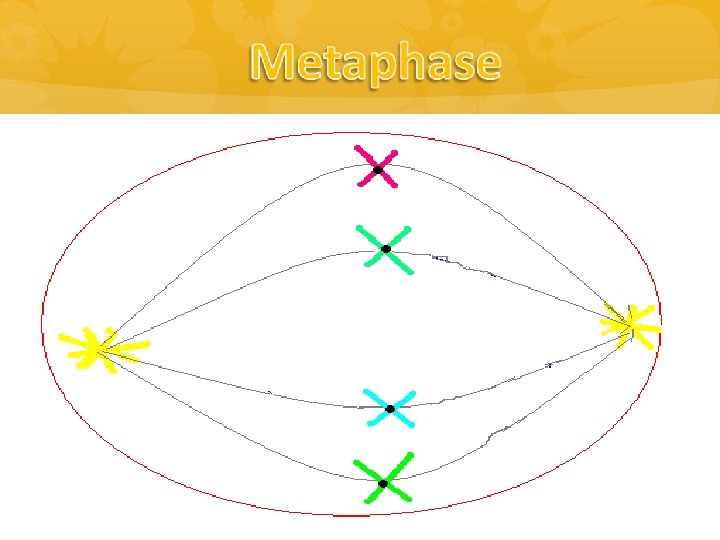
Metaphase Chromosomes line up single file at equator Pole Spindle fibers Equator Pole
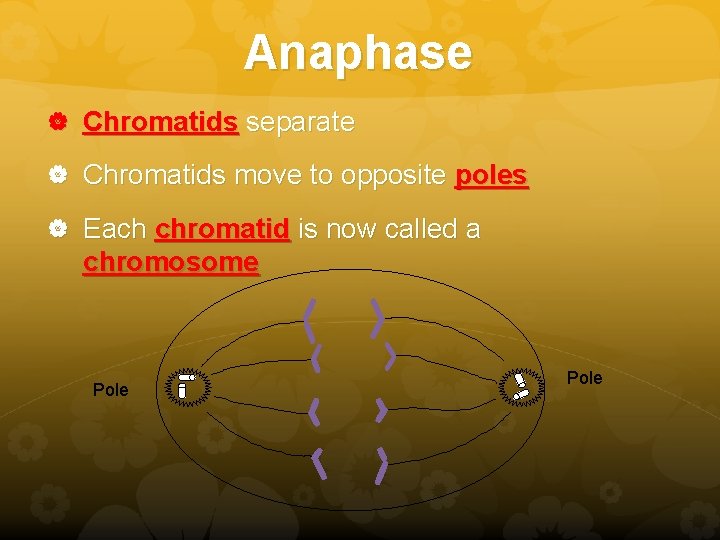
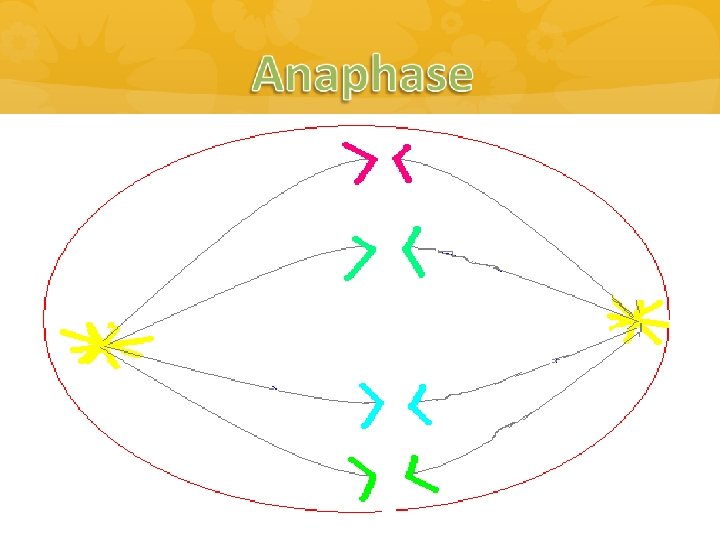
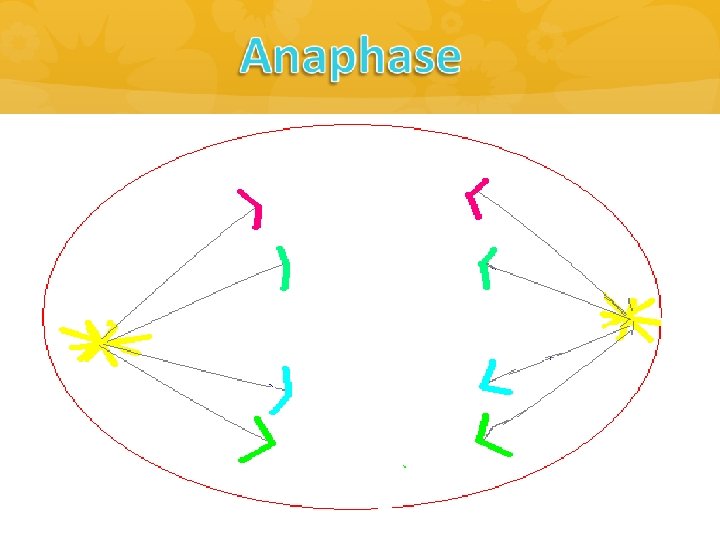
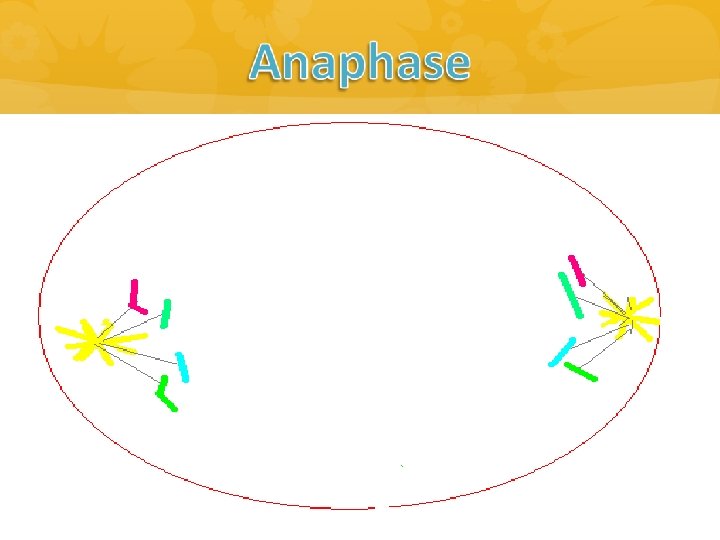
Anaphase Chromatids separate Chromatids move to opposite poles Each chromatid is now called a chromosome Pole
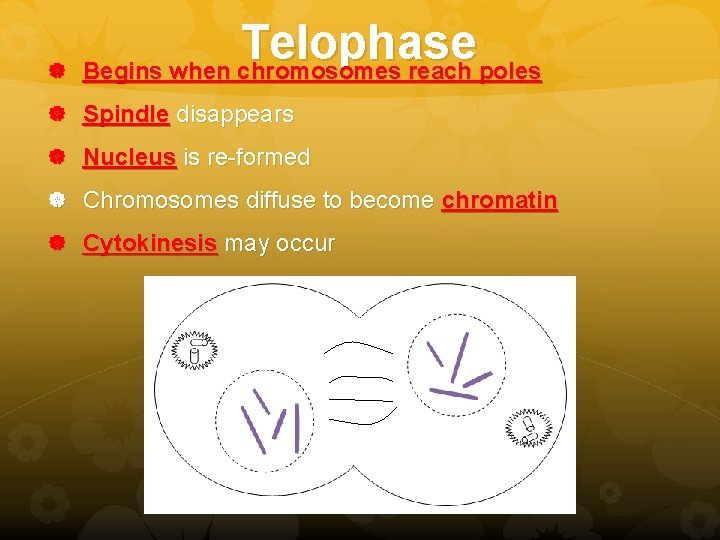
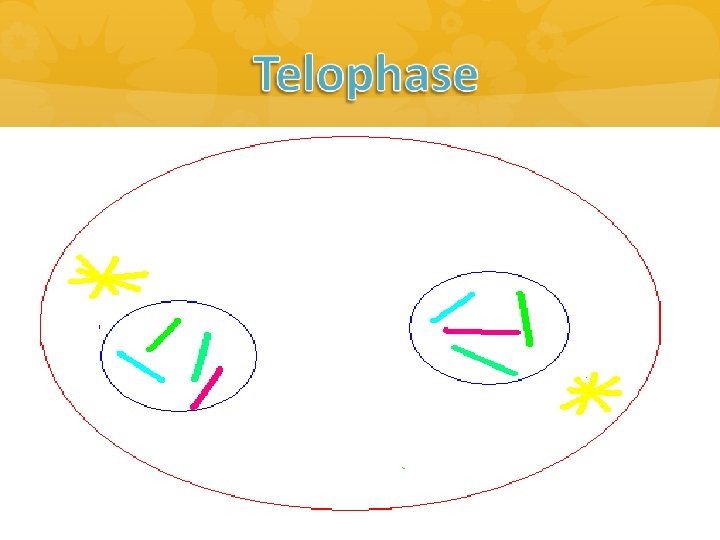
Telophase Begins when chromosomes reach poles Spindle disappears Nucleus is re-formed Chromosomes diffuse to become chromatin Cytokinesis may occur
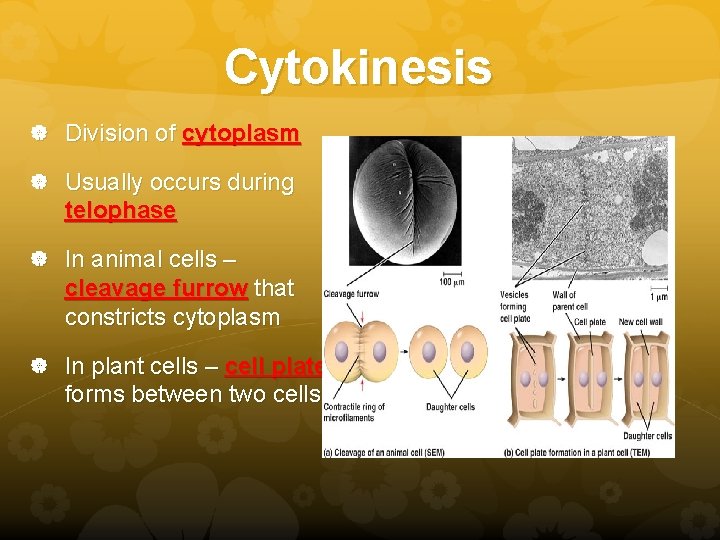
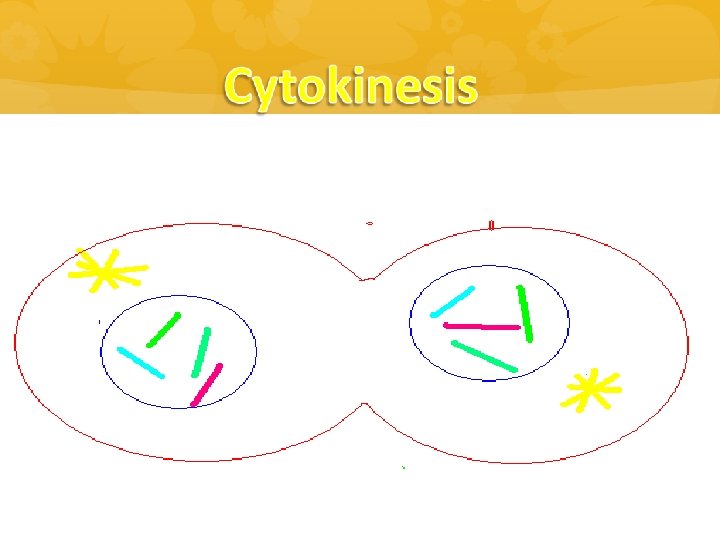
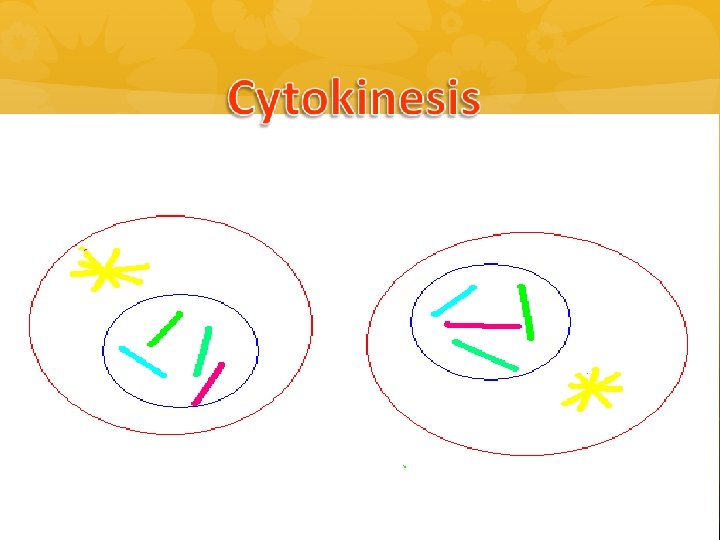
Cytokinesis Division of cytoplasm Usually occurs during telophase In animal cells – cleavage furrow that constricts cytoplasm In plant cells – cell plate forms between two cells
When mitosis ends – two new cells with same amount of DNA
Reasons for Mitosis Formation of adult from fertilized egg (development) Maintenance or repair Growth in multicellular organisms Asexual reproduction in one-celled organisms Mitosis – Mr. Parr http: //www. youtube. com/watch? v=Il. V 9 h. Ex. XZn. M&list=UUJjst. NDkwkt. Hyv Udtc. Bfb 2 g&index=114&feature=plcp
Review In the 17 th century, Robert Hooke peered through a microscope at a slice of cork and discovered that it was composed of cells. Centuries later, Rudolf Virchow set forth the cell theory, in which he proposed that the cell was the basic unit of all living organisms. We now know that this theory is true; cells make up all living things, whether they are plants, animals, or microorganisms. There is only one way to make more cells—by the division of those that already exis 16 14
Goal of the Cell Cycle: To produce two genetically identical cells from one precursor cell. 1. Copy and pass on its genetic information to the next generation of cells. This requires the replication of the DNA in each chromosome 2. Accurate separation of the chromosomes into the daughter cells so that each cell receives a copy of the entire genome. 3. Once accomplished, the cell will physically divide to produce two identical daughter cells 17 15
The entire cell cycle will take different amounts of time depending of the organism. For example, cell division in the bacteria (e. g. Escherichia coli) can take as little as 20 minutes. In a single-celled yeast it takes 90 -120 minutes. Cells in organs such as the heart do not divide in the adult, except in cases where disease or trauma causes damage. Cells in the nervous system and the brain do not divide after birth, which is why an injury to the spine is usually irreversible. Hair, skin, fingernails, taste buds, and the stomach's protective lining are replaced constantly and at a rapid rate throughout our lives reproduce every 15 -30 days 18 16
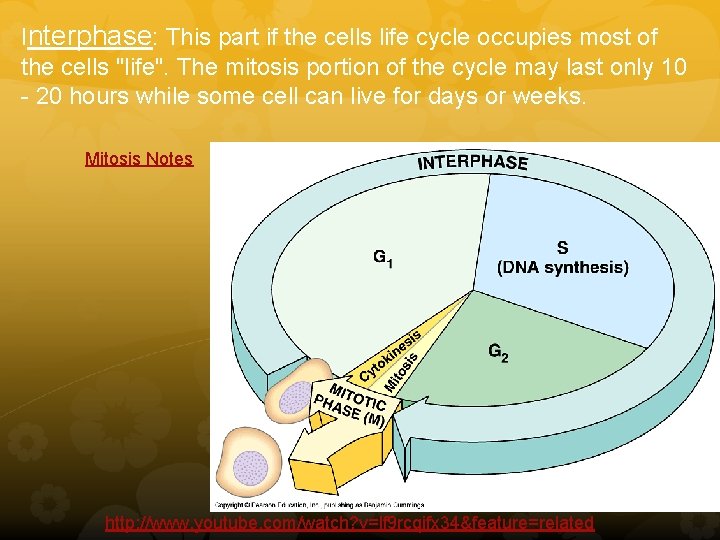
Interphase: This part if the cells life cycle occupies most of the cells "life". The mitosis portion of the cycle may last only 10 - 20 hours while some cell can live for days or weeks. Mitosis Notes 19 http: //www. youtube. com/watch? v=lf 9 rcqifx 34&feature=related
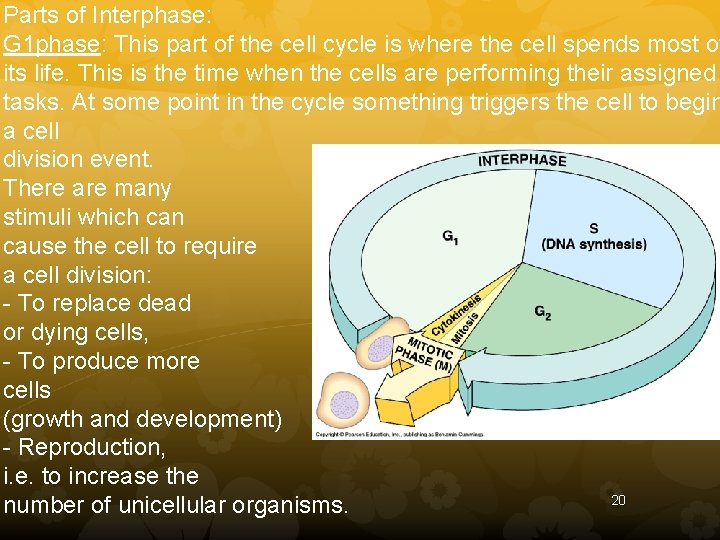
Parts of Interphase: G 1 phase: This part of the cell cycle is where the cell spends most of its life. This is the time when the cells are performing their assigned tasks. At some point in the cycle something triggers the cell to begin a cell division event. There are many stimuli which can cause the cell to require a cell division: - To replace dead or dying cells, - To produce more cells (growth and development) - Reproduction, i. e. to increase the 20 number of unicellular organisms.
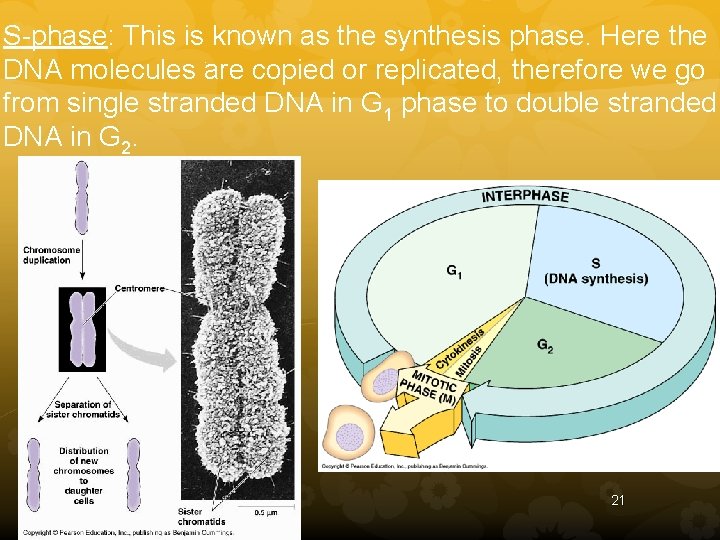
S-phase: This is known as the synthesis phase. Here the . DNA molecules are copied or replicated, therefore we go from single stranded DNA in G 1 phase to double stranded DNA in G 2. 21
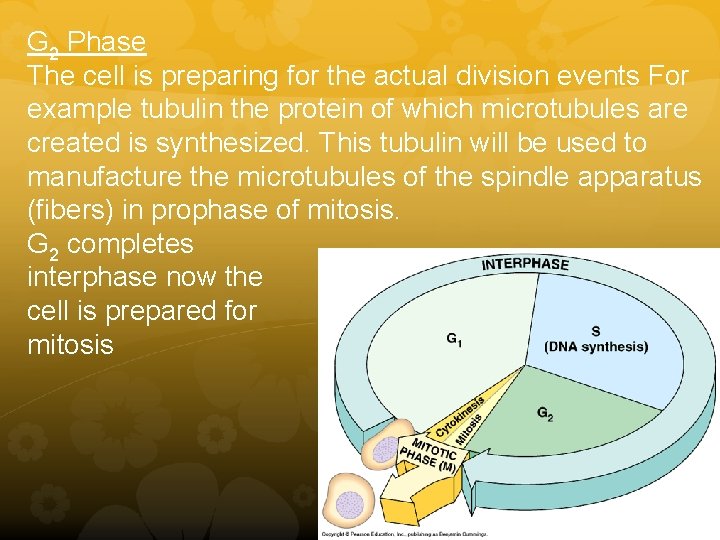
G 2 Phase The cell is preparing for the actual division events For example tubulin the protein of which microtubules are created is synthesized. This tubulin will be used to manufacture the microtubules of the spindle apparatus (fibers) in prophase of mitosis. G 2 completes interphase now the cell is prepared for mitosis 22

http: //www. cellsalive. com/cell_cycle. htm
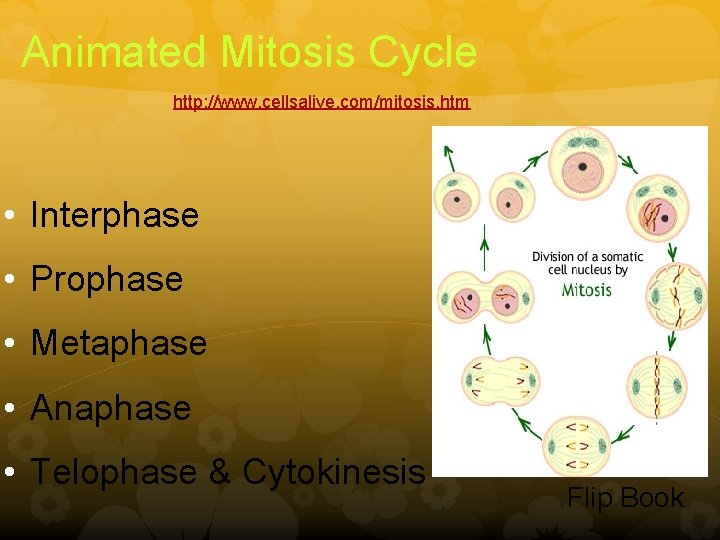
Animated Mitosis Cycle http: //www. cellsalive. com/mitosis. htm • Interphase • Prophase • Metaphase • Anaphase • Telophase & Cytokinesis Flip Book
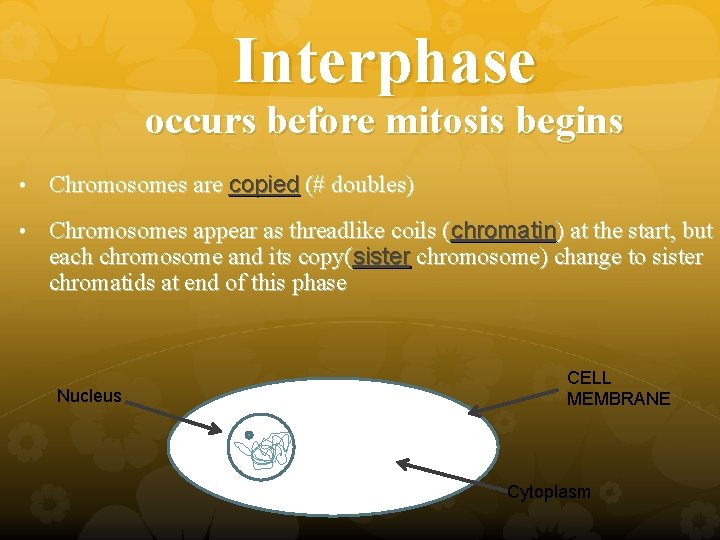
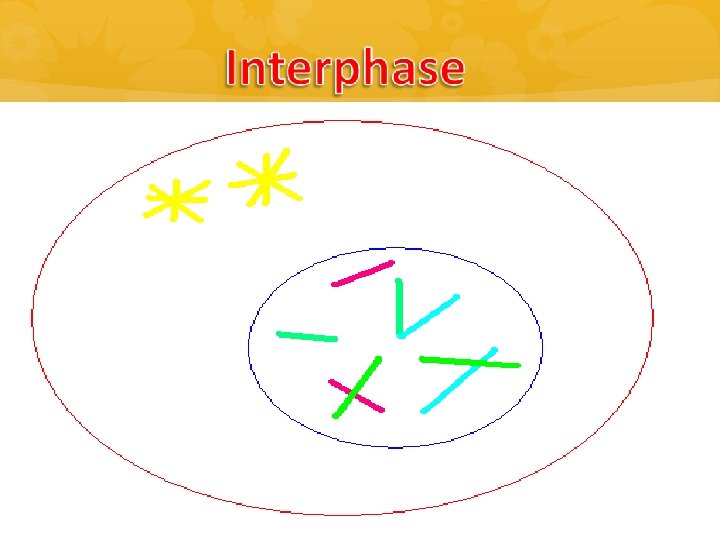
Interphase occurs before mitosis begins • Chromosomes are copied (# doubles) • Chromosomes appear as threadlike coils (chromatin) at the start, but each chromosome and its copy(sister chromosome) change to sister chromatids at end of this phase Nucleus CELL MEMBRANE Cytoplasm
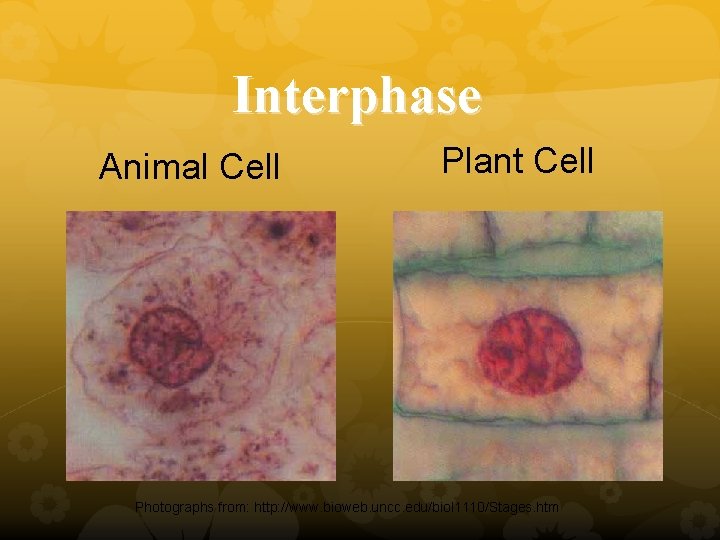
Interphase Animal Cell Plant Cell Photographs from: http: //www. bioweb. uncc. edu/biol 1110/Stages. htm
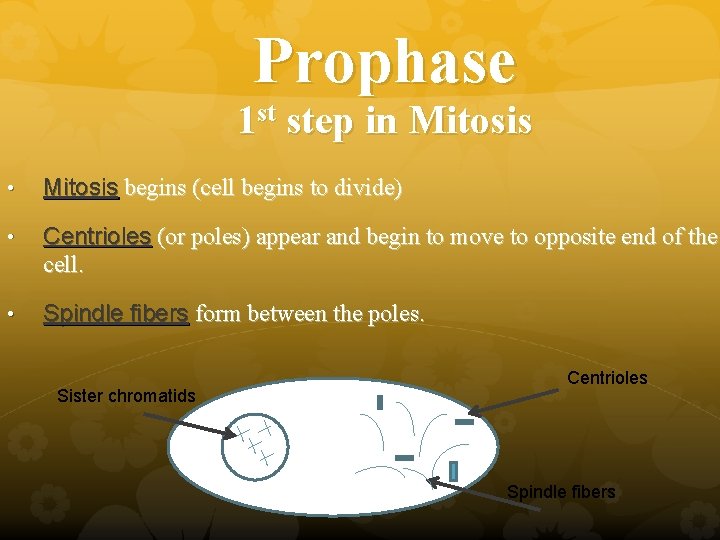
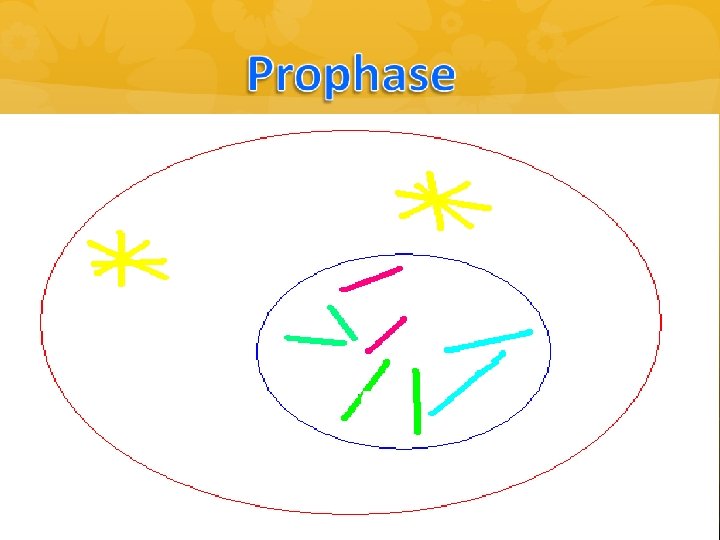
Prophase 1 st step in Mitosis • Mitosis begins (cell begins to divide) • Centrioles (or poles) appear and begin to move to opposite end of the cell. • Spindle fibers form between the poles. Sister chromatids Centrioles Spindle fibers
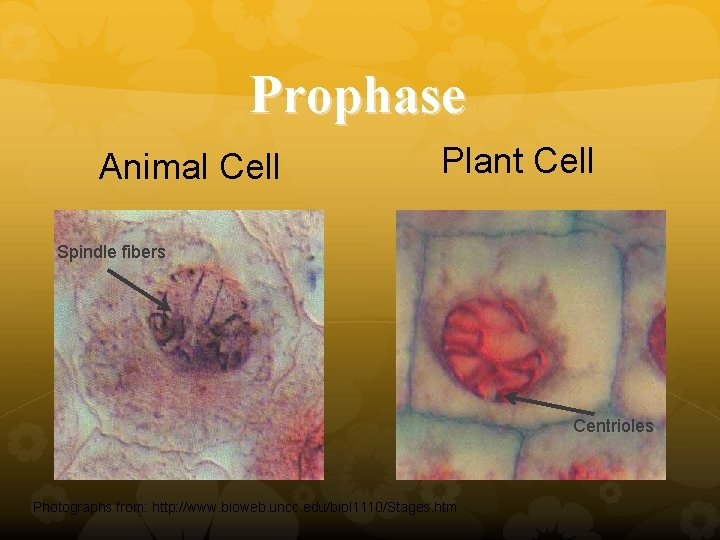
Prophase Animal Cell Plant Cell Spindle fibers Centrioles Photographs from: http: //www. bioweb. uncc. edu/biol 1110/Stages. htm
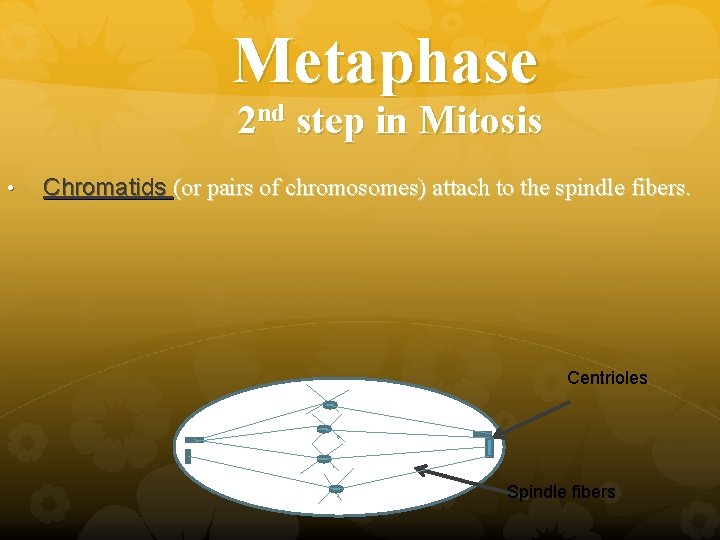
Metaphase 2 nd step in Mitosis • Chromatids (or pairs of chromosomes) attach to the spindle fibers. Centrioles Spindle fibers
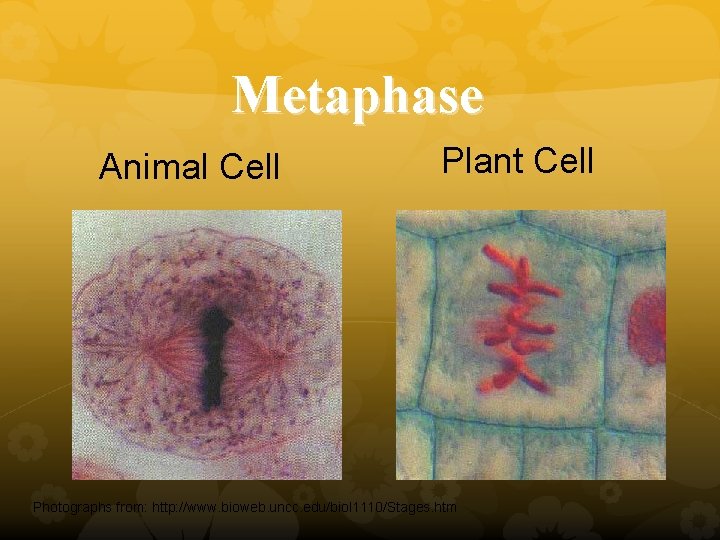
Metaphase Animal Cell Plant Cell Photographs from: http: //www. bioweb. uncc. edu/biol 1110/Stages. htm
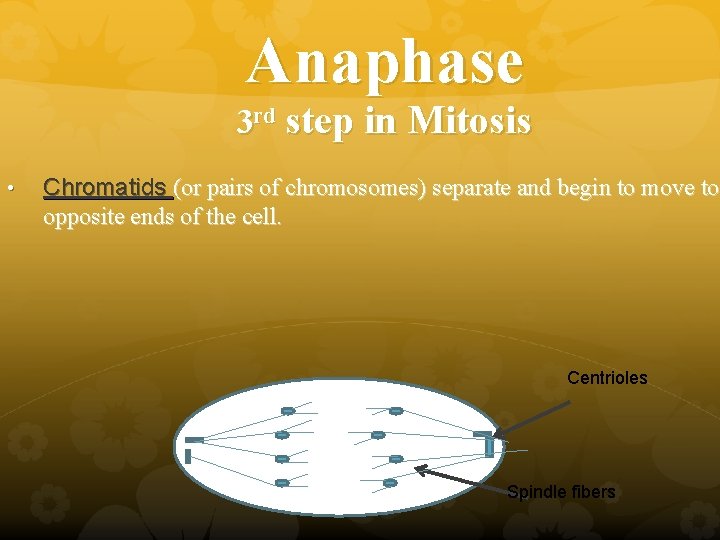
Anaphase 3 rd step in Mitosis • Chromatids (or pairs of chromosomes) separate and begin to move to opposite ends of the cell. Centrioles Spindle fibers
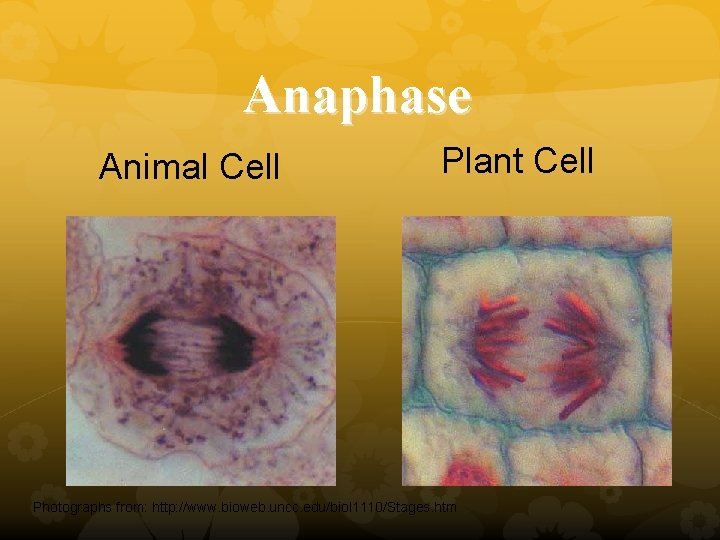
Anaphase Animal Cell Plant Cell Photographs from: http: //www. bioweb. uncc. edu/biol 1110/Stages. htm
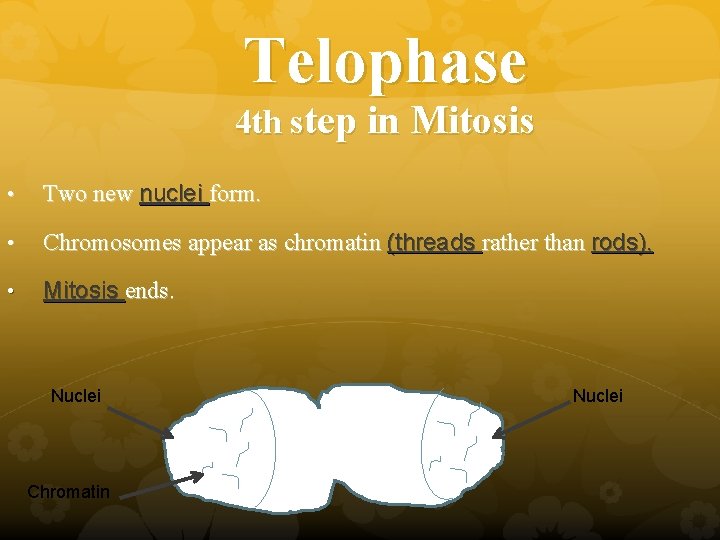
Telophase 4 th step in Mitosis • Two new nuclei form. • Chromosomes appear as chromatin (threads rather than rods). • Mitosis ends. Nuclei Chromatin Nuclei
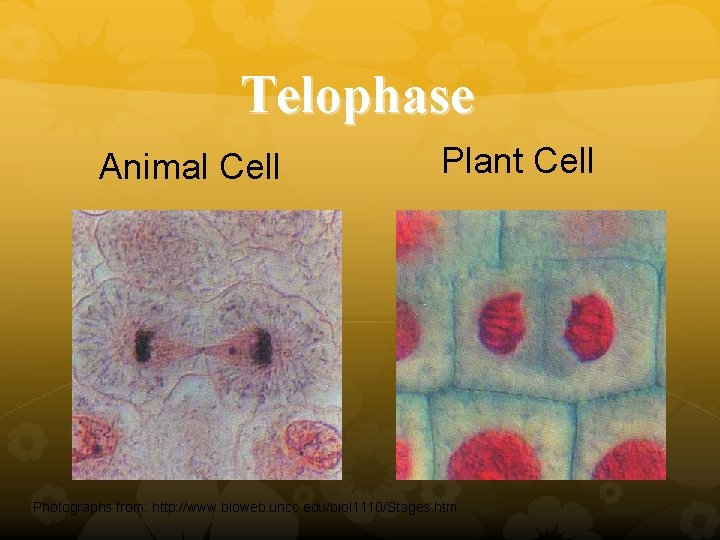
Telophase Animal Cell Plant Cell Photographs from: http: //www. bioweb. uncc. edu/biol 1110/Stages. htm
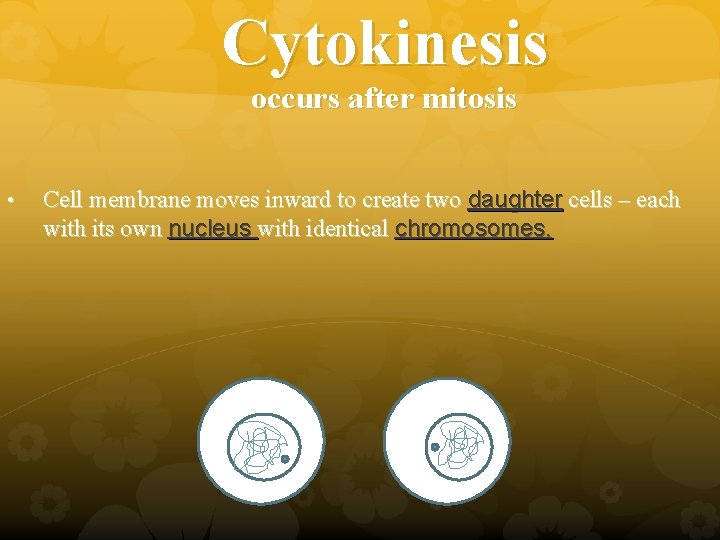
Cytokinesis occurs after mitosis • Cell membrane moves inward to create two daughter cells – each with its own nucleus with identical chromosomes.
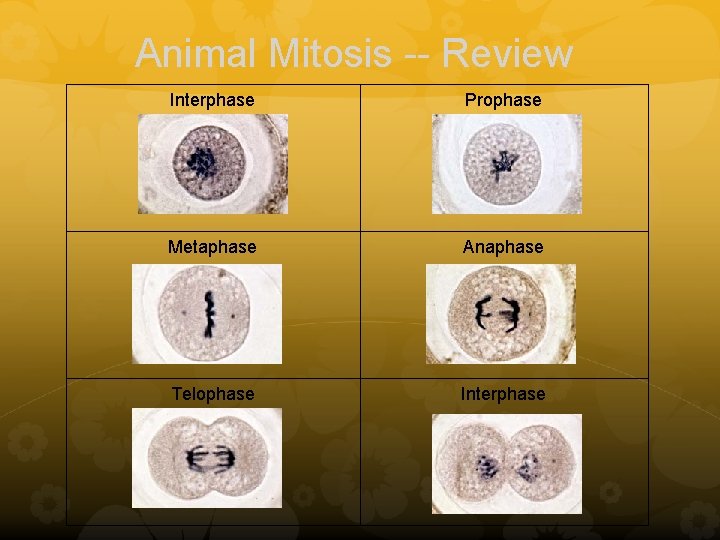
Animal Mitosis -- Review Interphase Prophase Metaphase Anaphase Telophase Interphase
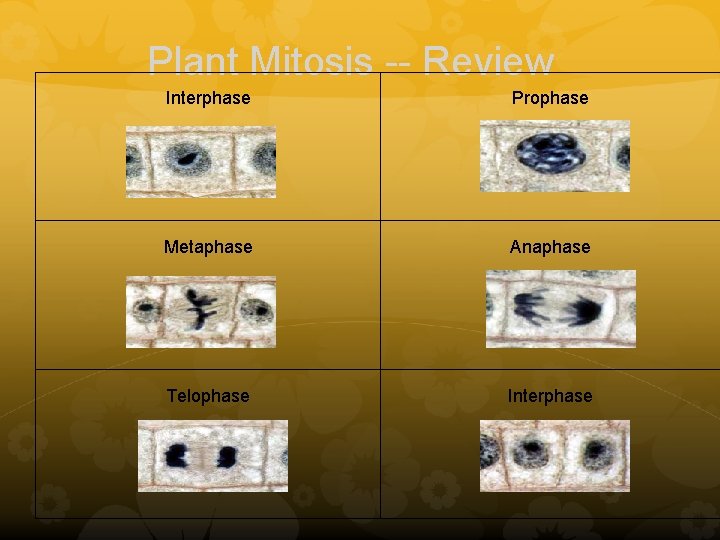
Plant Mitosis -- Review Interphase Prophase Metaphase Anaphase Telophase Interphase
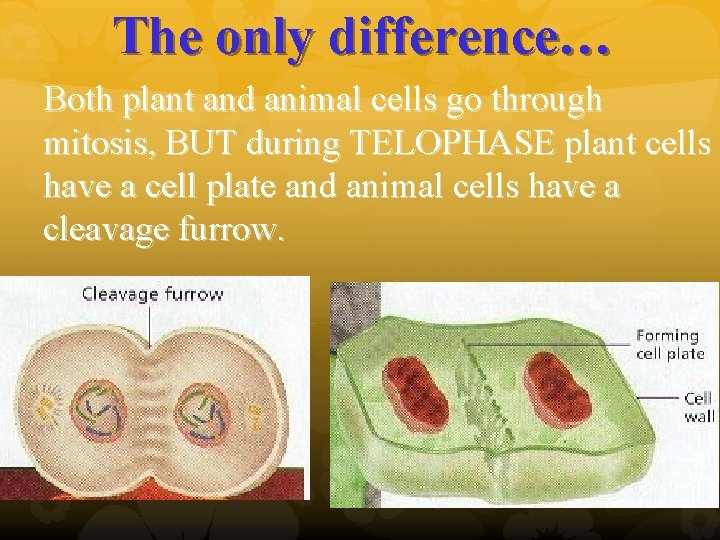
The only difference… Both plant and animal cells go through mitosis, BUT during TELOPHASE plant cells have a cell plate and animal cells have a cleavage furrow.
Today in Biology Homework: Biology Learning Goal: Overview of Mitosis Worksheet Due chapter 6 – Genes, DNA, Monday Chromosomes and chromatids QUIZ MONDAY Warm Up Question: Reflection turn in! Fact of the Day When you die What are spindle fibers? your hair still What is a centriole? grows for a What is a centromere? couple of months. That is why To Do Today: ghosts and scary 1. Mitosis flip book creatures have 2. Mitosis worksheet – homework due long hair. Monday Week #2 Quarter 2 (10/23&24)

Cell Cycle Mitosis Flip Book 19
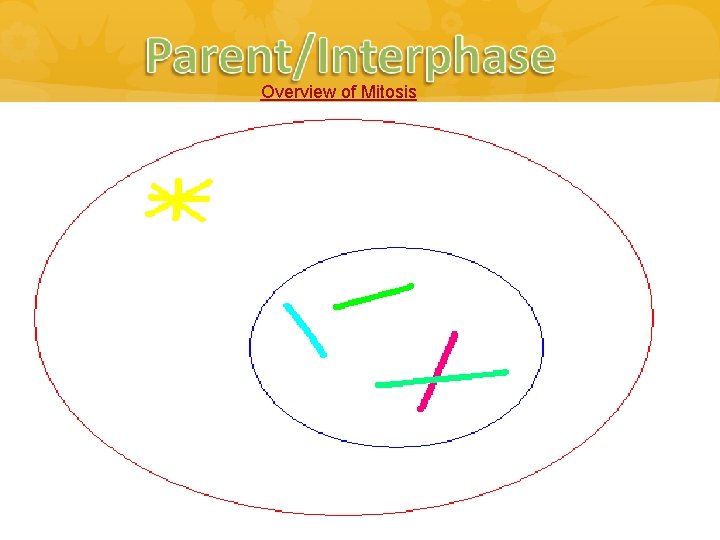
Overview of Mitosis
- Slides: 63