
Tobacco Tax Policy Reform under WB Development Policy
Tobacco Tax Policy Reform under WB Development Policy Operations: The Colombian Experience Jasmin Chakeri Program Leader – Equitable Growth, Finance and Institutions Mexico & Colombia Roberto Iunes Senior Economist – Health, Nutrition and Population GP Latin America & the Caribbean Washington DC, April 19, 2017
Outline of Presentation • • Development Policy Financing instrument Colombian context Tobacco tax in Colombia Objectives of the comprehensive tax reforms Support from the WBG Outcomes Lessons learned
Development Policy Financing (DPF) Instrument • • Financing for general budget support • Adequate macroeconomic framework as assessed by the World Bank • Upstream analytical work underpinning the program; parallel technical assistance • Customize content and design to country circumstances Program focuses on achieving measurable development results through government policies and institutional actions
Colombian context • Economic slowdown following oil price shock • Impact on fiscal accounts • Peace Agreement and implementation of post-conflict agenda • Fiscal consolidation while protecting social and peace-related spending • Move towards a “new economy” that relies less on extractives industries
Tobacco tax in Colombia (pre-reform) • Represents one of the most important departmental taxes • Revenue earmarked for health sector financing (and sports) • Dual structure (introduced in 2010) • • Specific component: COP 659/pack in 2016 (updated annually by CPI inflation) Ad valorem component: 10% of sales value • General VAT rate (16%) applied as well
Tobacco tax in Colombia (pre-reform) cont. • Price per pack of cigarettes low • US$1. 81 (PPP) for most-sold brand, compared to US$2. 5 (PPP) in other Latin American countries and US$7. 03 (PPP) in OECD countries • Share of taxes in sales price low • 49. 4% vs. 53% average for the Americas Overall collections from tobacco tax low • 0. 07% of GDP in 2013, compared to 0. 59% in Chile and 0. 21% in Mexico
Objectives of the comprehensive tax reform • Creation of Tax Commission in 2015 to prepare comprehensive proposal • Several objectives • • • Increase tax revenue Enhance equity Simplify the tax system Improve competitiveness Address externalities (public health & environment) – – • Increase liquor & wine tax Increase tobacco tax Introduce sugary drinks tax Environmental taxes Difficult political environment • • Rejection of first Peace Agreement Reaching peace remained No. 1 political priority
Support from the World Bank Group • DPF to support fiscal sustainability and competitiveness reforms • • Fiscal reforms to help adjust to the new environment of low oil prices and create space for peace-related spending Structural reforms to diversify the economy and improve competitiveness in the context of the “New Economy” • Close cooperation between WB macro-fiscal, trade & competitiveness and health teams • • • Dialogue on overall tax reform with Mo. F: fiscal point of view (generate revenue) Dialogue on tobacco control with Mo. H: public health point of view (reduce consumption) Dialogue on customs with Mo. H and Mo. F: reduce smuggling

Support from the World Bank Group • Questions that needed to be addressed • • What is the “optimal” tax rate? Elasticity Will tax increase lead to an increase in smuggling? Should there be one large increase or a more gradual approach? What is the short-term vs. long-term effect on the poor? • WB provided technical expertise: in-house and international experts • WB also brought convening power: joint meetings with Mo. F and Mo. H to bridge differences
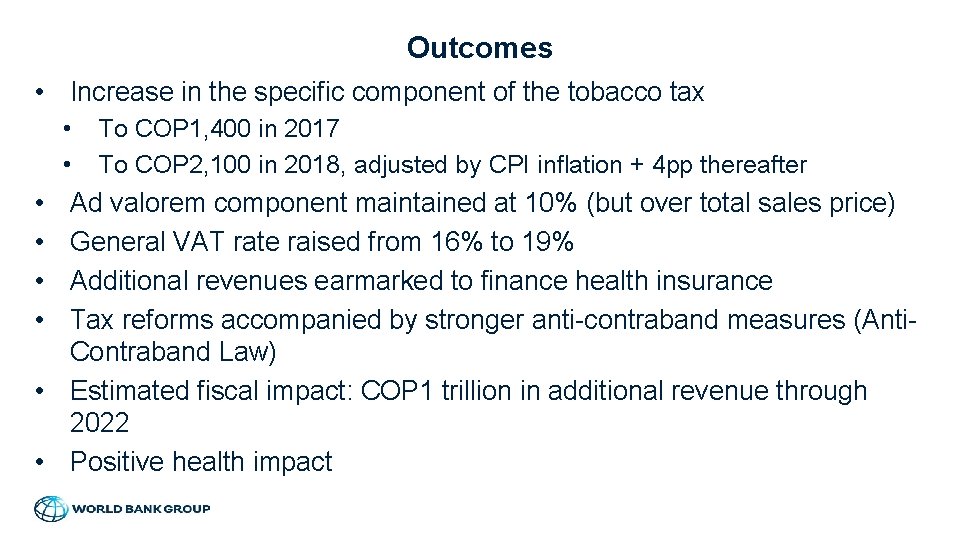
Outcomes • Increase in the specific component of the tobacco tax • • • To COP 1, 400 in 2017 To COP 2, 100 in 2018, adjusted by CPI inflation + 4 pp thereafter Ad valorem component maintained at 10% (but over total sales price) General VAT rate raised from 16% to 19% Additional revenues earmarked to finance health insurance Tax reforms accompanied by stronger anti-contraband measures (Anti. Contraband Law) • Estimated fiscal impact: COP 1 trillion in additional revenue through 2022 • Positive health impact
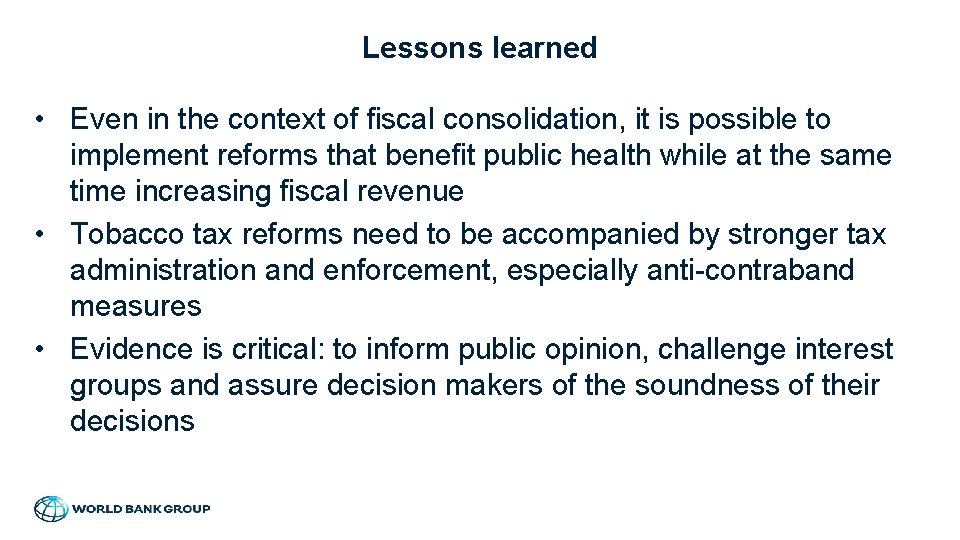
Lessons learned • Even in the context of fiscal consolidation, it is possible to implement reforms that benefit public health while at the same time increasing fiscal revenue • Tobacco tax reforms need to be accompanied by stronger tax administration and enforcement, especially anti-contraband measures • Evidence is critical: to inform public opinion, challenge interest groups and assure decision makers of the soundness of their decisions
- Slides: 11