
To use all 4 operations efficiently in combination
To use all 4 operations efficiently in combination to solve multi-step problems involving measure. Year 5 - Measure (GDS) Lesson 3
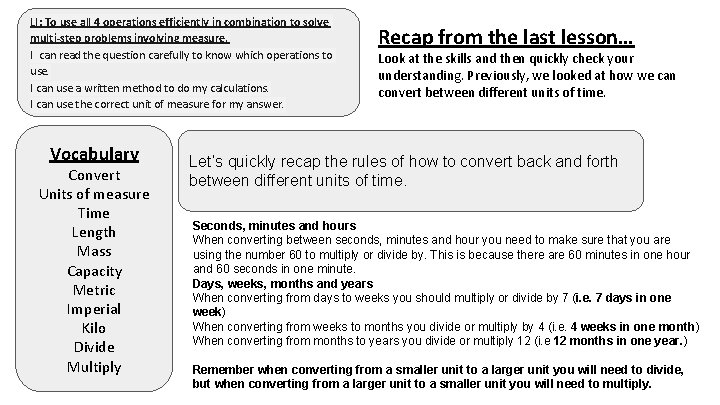
LI: To use all 4 operations efficiently in combination to solve multi-step problems involving measure. I can read the question carefully to know which operations to use. I can use a written method to do my calculations. I can use the correct unit of measure for my answer. Vocabulary Convert Units of measure Time Length Mass Capacity Metric Imperial Kilo Divide Multiply Recap from the last lesson… Look at the skills and then quickly check your understanding. Previously, we looked at how we can convert between different units of time. Let’s quickly recap the rules of how to convert back and forth between different units of time. Seconds, minutes and hours When converting between seconds, minutes and hour you need to make sure that you are using the number 60 to multiply or divide by. This is because there are 60 minutes in one hour and 60 seconds in one minute. Days, weeks, months and years When converting from days to weeks you should multiply or divide by 7 (i. e. 7 days in one week) When converting from weeks to months you divide or multiply by 4 (i. e. 4 weeks in one month) When converting from months to years you divide or multiply 12 (i. e 12 months in one year. ) Remember when converting from a smaller unit to a larger unit you will need to divide, but when converting from a larger unit to a smaller unit you will need to multiply.
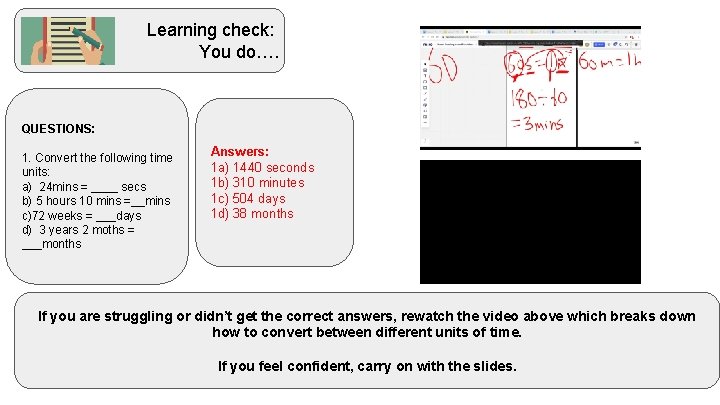
Learning check: You do…. QUESTIONS: 1. Convert the following time units: a) 24 mins = ____ secs b) 5 hours 10 mins =__mins c)72 weeks = ___days d) 3 years 2 moths = ___months Answers: 1 a) 1440 seconds 1 b) 310 minutes 1 c) 504 days 1 d) 38 months If you are struggling or didn’t get the correct answers, rewatch the video above which breaks down how to convert between different units of time. If you feel confident, carry on with the slides.
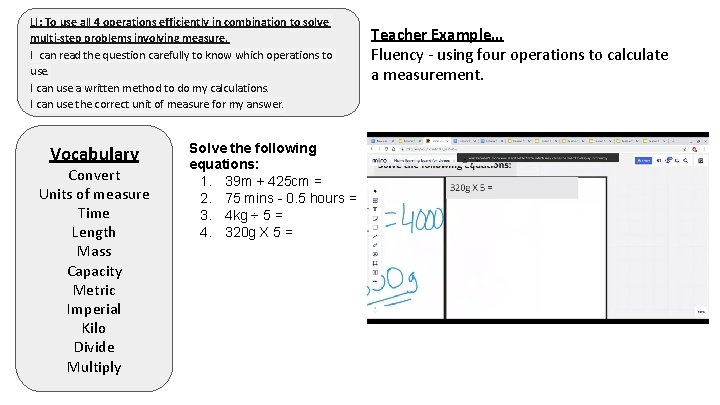
LI: To use all 4 operations efficiently in combination to solve multi-step problems involving measure. I can read the question carefully to know which operations to use. I can use a written method to do my calculations. I can use the correct unit of measure for my answer. Vocabulary Convert Units of measure Time Length Mass Capacity Metric Imperial Kilo Divide Multiply Solve the following equations: 1. 39 m + 425 cm = 2. 75 mins - 0. 5 hours = 3. 4 kg ÷ 5 = 4. 320 g X 5 = Teacher Example… Fluency - using four operations to calculate a measurement.
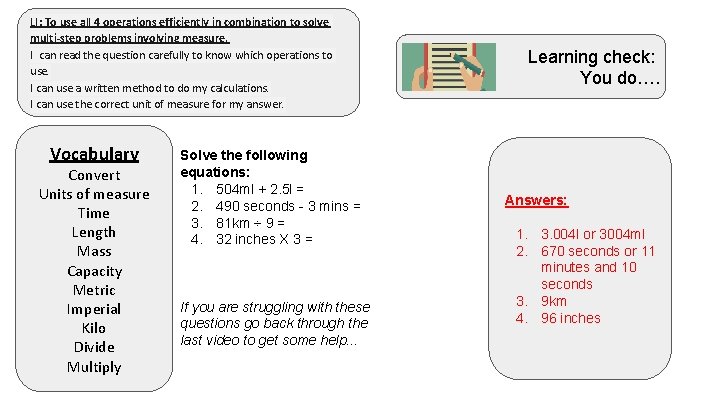
LI: To use all 4 operations efficiently in combination to solve multi-step problems involving measure. I can read the question carefully to know which operations to use. I can use a written method to do my calculations. I can use the correct unit of measure for my answer. Vocabulary Convert Units of measure Time Length Mass Capacity Metric Imperial Kilo Divide Multiply Solve the following equations: 1. 504 ml + 2. 5 l = 2. 490 seconds - 3 mins = 3. 81 km ÷ 9 = 4. 32 inches X 3 = If you are struggling with these questions go back through the last video to get some help. . . Learning check: You do…. Answers: 1. 3. 004 l or 3004 ml 2. 670 seconds or 11 minutes and 10 seconds 3. 9 km 4. 96 inches
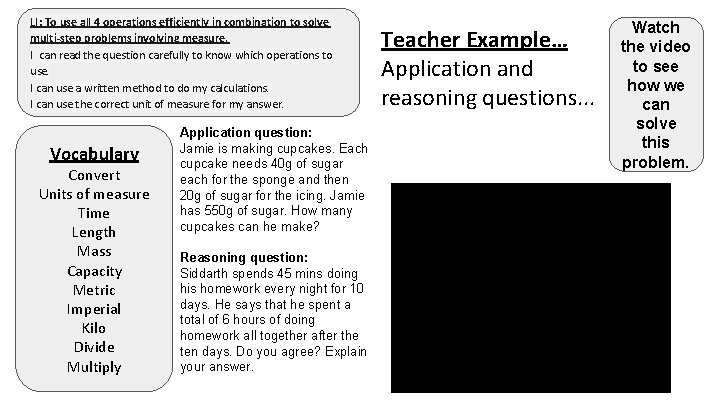
LI: To use all 4 operations efficiently in combination to solve multi-step problems involving measure. I can read the question carefully to know which operations to use. I can use a written method to do my calculations. I can use the correct unit of measure for my answer. Vocabulary Convert Units of measure Time Length Mass Capacity Metric Imperial Kilo Divide Multiply Application question: Jamie is making cupcakes. Each cupcake needs 40 g of sugar each for the sponge and then 20 g of sugar for the icing. Jamie has 550 g of sugar. How many cupcakes can he make? Reasoning question: Siddarth spends 45 mins doing his homework every night for 10 days. He says that he spent a total of 6 hours of doing homework all together after the ten days. Do you agree? Explain your answer. Teacher Example… Application and reasoning questions. . . Watch the video to see how we can solve this problem.
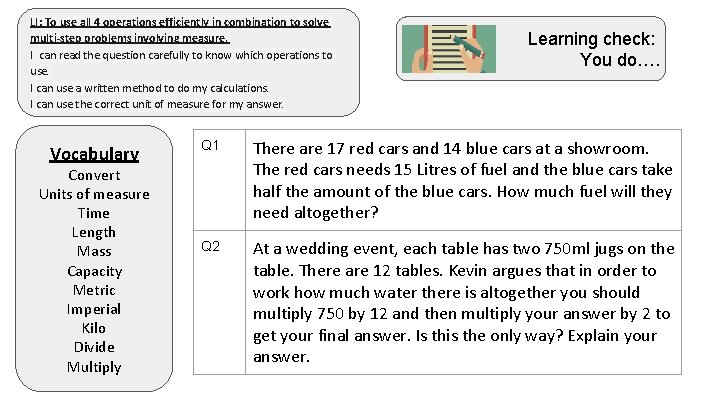
LI: To use all 4 operations efficiently in combination to solve multi-step problems involving measure. I can read the question carefully to know which operations to use. I can use a written method to do my calculations. I can use the correct unit of measure for my answer. Vocabulary Convert Units of measure Time Length Mass Capacity Metric Imperial Kilo Divide Multiply Learning check: You do…. Q 1 There are 17 red cars and 14 blue cars at a showroom. The red cars needs 15 Litres of fuel and the blue cars take half the amount of the blue cars. How much fuel will they need altogether? Q 2 At a wedding event, each table has two 750 ml jugs on the table. There are 12 tables. Kevin argues that in order to work how much water there is altogether you should multiply 750 by 12 and then multiply your answer by 2 to get your final answer. Is this the only way? Explain your answer.
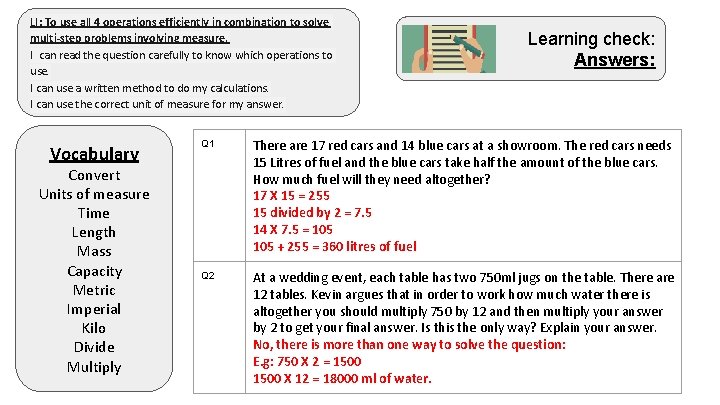
LI: To use all 4 operations efficiently in combination to solve multi-step problems involving measure. I can read the question carefully to know which operations to use. I can use a written method to do my calculations. I can use the correct unit of measure for my answer. Vocabulary Convert Units of measure Time Length Mass Capacity Metric Imperial Kilo Divide Multiply Learning check: Answers: Q 1 There are 17 red cars and 14 blue cars at a showroom. The red cars needs 15 Litres of fuel and the blue cars take half the amount of the blue cars. How much fuel will they need altogether? 17 X 15 = 255 15 divided by 2 = 7. 5 14 X 7. 5 = 105 + 255 = 360 litres of fuel Q 2 At a wedding event, each table has two 750 ml jugs on the table. There are 12 tables. Kevin argues that in order to work how much water there is altogether you should multiply 750 by 12 and then multiply your answer by 2 to get your final answer. Is this the only way? Explain your answer. No, there is more than one way to solve the question: E. g: 750 X 2 = 1500 X 12 = 18000 ml of water.
Well done! Now complete the worksheet below on the google doc. You can either write the answers on the google doc, or write it out on paper and send a picture of your work to your teacher. https: //docs. google. com/document/d/1 JPid 04 Fi. Fr. V 1 HOVp 8 PKp. I 2 Qa. Ia. Vv. P 64 Snk 2 o. UFCfug. Q/edit Remember to log onto maths whizz as well this week!
- Slides: 9