
To understand use approximate equivalences between metric units
To understand use approximate equivalences between metric units and common imperial measurements. Year 5 - Measure (EXS) Lesson 1
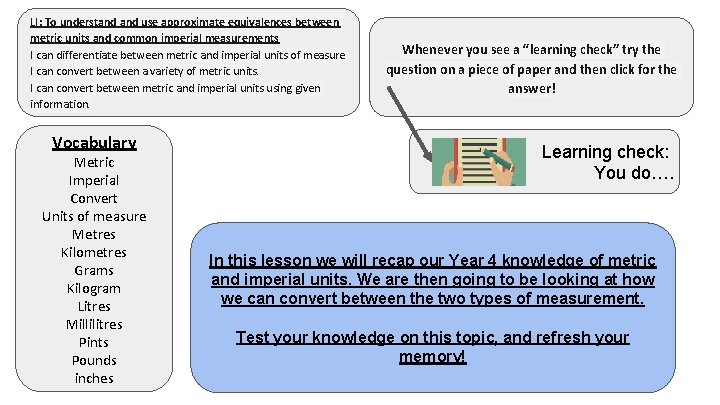
LI: To understand use approximate equivalences between metric units and common imperial measurements I can differentiate between metric and imperial units of measure I can convert between a variety of metric units. I can convert between metric and imperial units using given information. Vocabulary Metric Imperial Convert Units of measure Metres Kilometres Grams Kilogram Litres Millilitres Pints Pounds inches Whenever you see a “learning check” try the question on a piece of paper and then click for the answer! Learning check: You do…. In this lesson we will recap our Year 4 knowledge of metric and imperial units. We are then going to be looking at how we can convert between the two types of measurement. Test your knowledge on this topic, and refresh your memory!
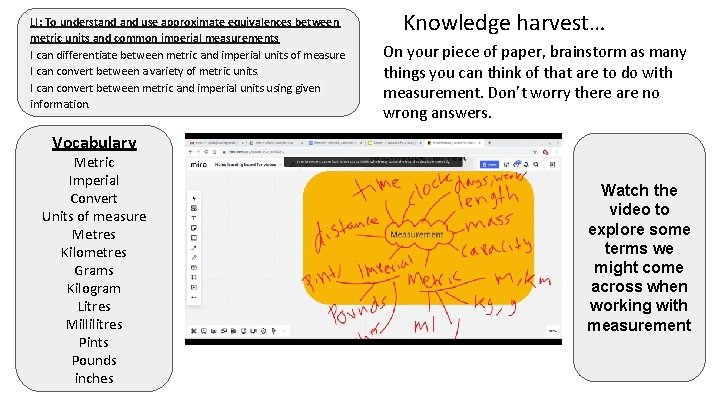
LI: To understand use approximate equivalences between metric units and common imperial measurements I can differentiate between metric and imperial units of measure I can convert between a variety of metric units. I can convert between metric and imperial units using given information. Knowledge harvest… On your piece of paper, brainstorm as many things you can think of that are to do with measurement. Don’t worry there are no wrong answers. Vocabulary Metric Imperial Convert Units of measure Metres Kilometres Grams Kilogram Litres Millilitres Pints Pounds inches Watch the video to explore some terms we might come across when working with measurement
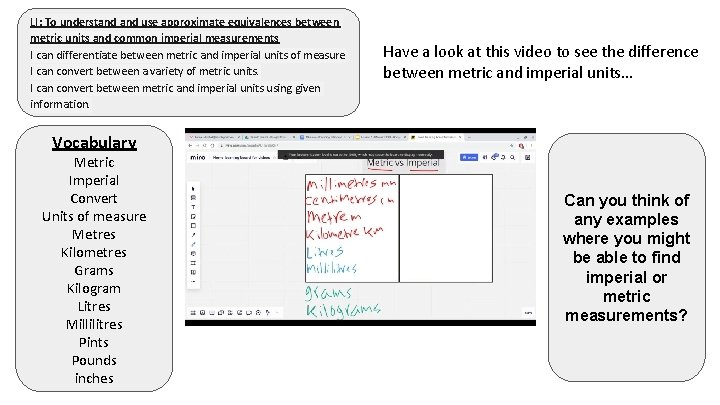
LI: To understand use approximate equivalences between metric units and common imperial measurements I can differentiate between metric and imperial units of measure I can convert between a variety of metric units. I can convert between metric and imperial units using given information. Have a look at this video to see the difference between metric and imperial units. . . Vocabulary Metric Imperial Convert Units of measure Metres Kilometres Grams Kilogram Litres Millilitres Pints Pounds inches Can you think of any examples where you might be able to find imperial or metric measurements?

LI: To understand use approximate equivalences between metric units and common imperial measurements I can differentiate between metric and imperial units of measure I can convert between a variety of metric units. I can convert between metric and imperial units using given information. Vocabulary Metric Imperial Convert Units of measure Metres Kilometres Grams Kilogram Litres Millilitres Pints Pounds inches Convert the following metric measurements: 1. 85 km = ___m 2. 34. 45 kg = ____g 3. _____L = 4302 ml Convert the following metric and imperial units: 500 g = 1 lbs 568 ml = 1 pint 2. 5 cm = 1 inch 1. 5 kg = ____lbs 2. ____ml = 5 pints 3. _____cm = 7 inches Teacher Example… Fluency - Year 4 recap converting between metric units. Followed by converting metric to imperial.
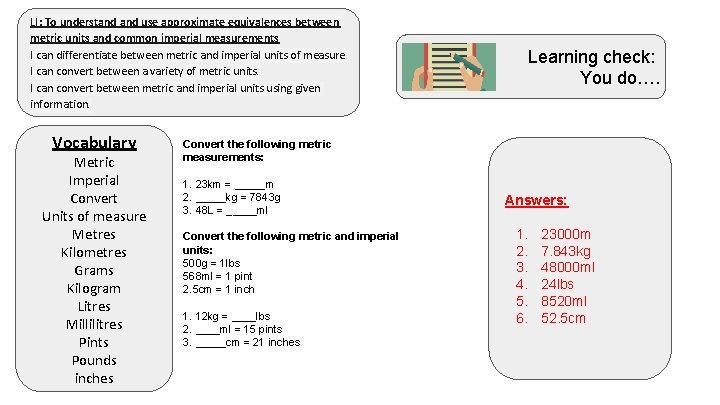
LI: To understand use approximate equivalences between metric units and common imperial measurements I can differentiate between metric and imperial units of measure I can convert between a variety of metric units. I can convert between metric and imperial units using given information. Vocabulary Metric Imperial Convert Units of measure Metres Kilometres Grams Kilogram Litres Millilitres Pints Pounds inches Learning check: You do…. Convert the following metric measurements: 1. 23 km = _____m 2. _____kg = 7843 g 3. 48 L = _____ml Convert the following metric and imperial units: 500 g = 1 lbs 568 ml = 1 pint 2. 5 cm = 1 inch 1. 12 kg = ____lbs 2. ____ml = 15 pints 3. _____cm = 21 inches Answers: 1. 2. 3. 4. 5. 6. 23000 m 7. 843 kg 48000 ml 24 lbs 8520 ml 52. 5 cm
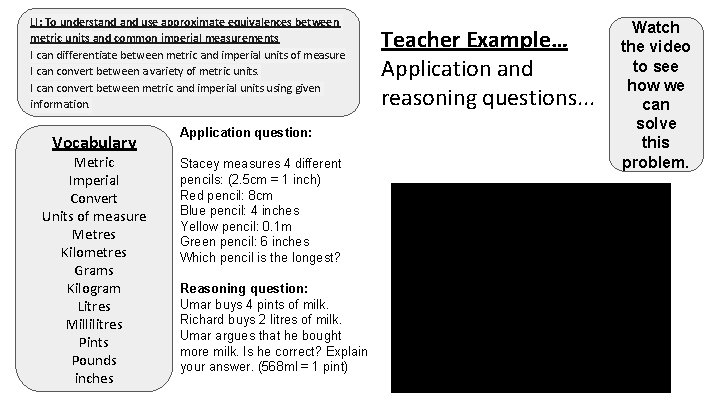
LI: To understand use approximate equivalences between metric units and common imperial measurements I can differentiate between metric and imperial units of measure I can convert between a variety of metric units. I can convert between metric and imperial units using given information. Vocabulary Metric Imperial Convert Units of measure Metres Kilometres Grams Kilogram Litres Millilitres Pints Pounds inches Application question: Stacey measures 4 different pencils: (2. 5 cm = 1 inch) Red pencil: 8 cm Blue pencil: 4 inches Yellow pencil: 0. 1 m Green pencil: 6 inches Which pencil is the longest? Reasoning question: Umar buys 4 pints of milk. Richard buys 2 litres of milk. Umar argues that he bought more milk. Is he correct? Explain your answer. (568 ml = 1 pint) Teacher Example… Application and reasoning questions. . . Watch the video to see how we can solve this problem.
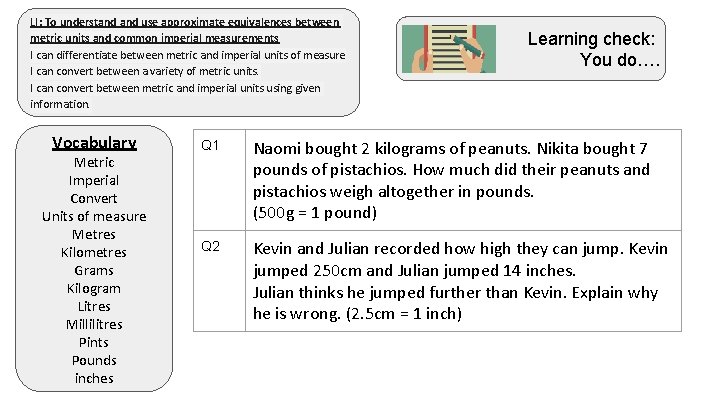
LI: To understand use approximate equivalences between metric units and common imperial measurements I can differentiate between metric and imperial units of measure I can convert between a variety of metric units. I can convert between metric and imperial units using given information. Vocabulary Metric Imperial Convert Units of measure Metres Kilometres Grams Kilogram Litres Millilitres Pints Pounds inches Learning check: You do…. Q 1 Naomi bought 2 kilograms of peanuts. Nikita bought 7 pounds of pistachios. How much did their peanuts and pistachios weigh altogether in pounds. (500 g = 1 pound) Q 2 Kevin and Julian recorded how high they can jump. Kevin jumped 250 cm and Julian jumped 14 inches. Julian thinks he jumped further than Kevin. Explain why he is wrong. (2. 5 cm = 1 inch)
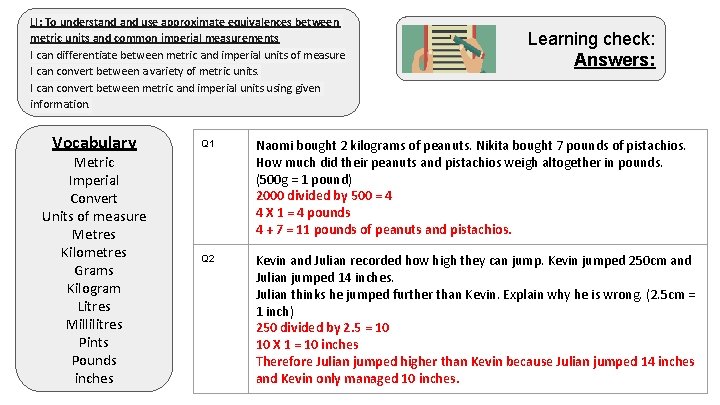
LI: To understand use approximate equivalences between metric units and common imperial measurements I can differentiate between metric and imperial units of measure I can convert between a variety of metric units. I can convert between metric and imperial units using given information. Vocabulary Metric Imperial Convert Units of measure Metres Kilometres Grams Kilogram Litres Millilitres Pints Pounds inches Learning check: Answers: Q 1 Naomi bought 2 kilograms of peanuts. Nikita bought 7 pounds of pistachios. How much did their peanuts and pistachios weigh altogether in pounds. (500 g = 1 pound) 2000 divided by 500 = 4 4 X 1 = 4 pounds 4 + 7 = 11 pounds of peanuts and pistachios. Q 2 Kevin and Julian recorded how high they can jump. Kevin jumped 250 cm and Julian jumped 14 inches. Julian thinks he jumped further than Kevin. Explain why he is wrong. (2. 5 cm = 1 inch) 250 divided by 2. 5 = 10 10 X 1 = 10 inches Therefore Julian jumped higher than Kevin because Julian jumped 14 inches and Kevin only managed 10 inches.
Well done! Now complete the worksheet below on the google doc. You can either write the answers on the google doc, or write it out on paper and send a picture of your work to your teacher. https: //docs. google. com/document/d/12 -Pr 7 F 4 i. Szr 9 zn 99 y. GRY 6 d. J-WZV 3 Q 7 t. SY-Sbuq. Ei. Zj. E/edit Remember to log onto maths whizz as well this week!
- Slides: 10