
To understand the time scale and probable cause
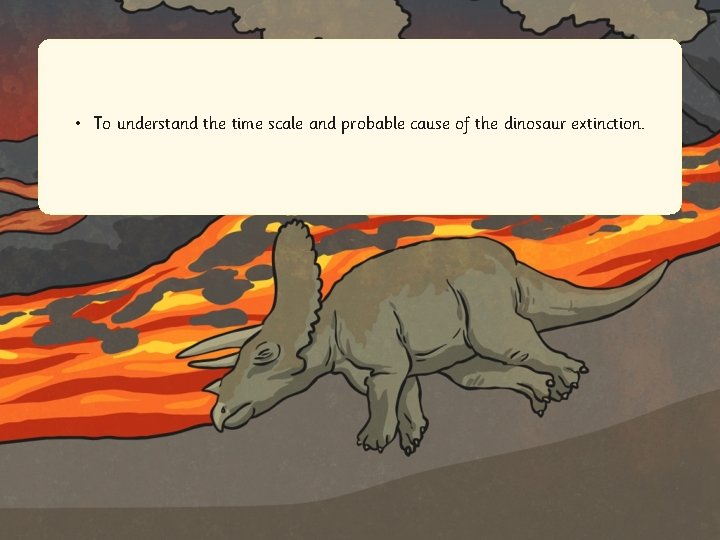
• To understand the time scale and probable cause of the dinosaur extinction.
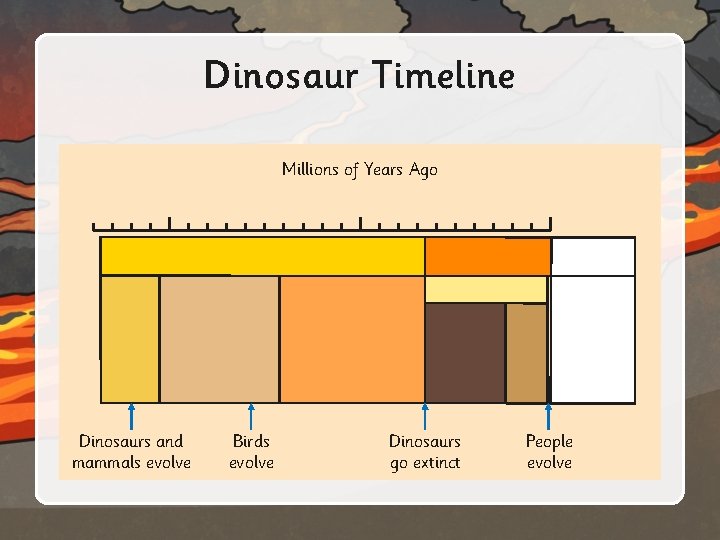
Dinosaur Timeline Millions of Years Ago Dinosaurs and mammals evolve Birds evolve Dinosaurs go extinct People evolve
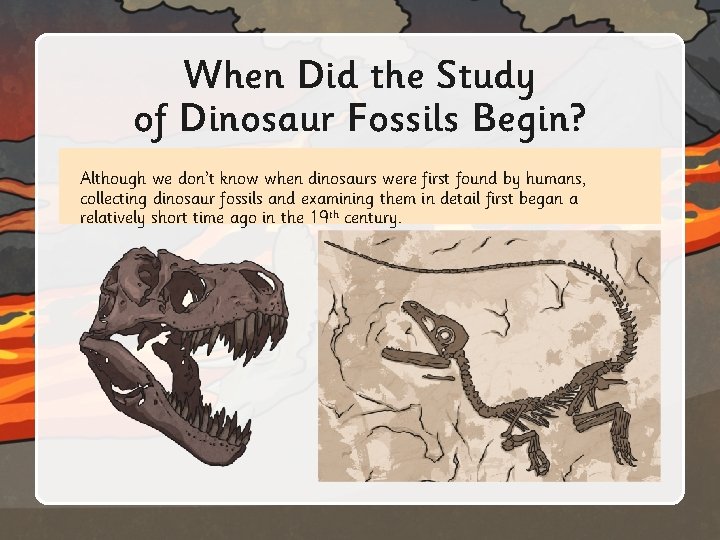
When Did the Study of Dinosaur Fossils Begin? Although we don’t know when dinosaurs were first found by humans, collecting dinosaur fossils and examining them in detail first began a relatively short time ago in the 19 th century.
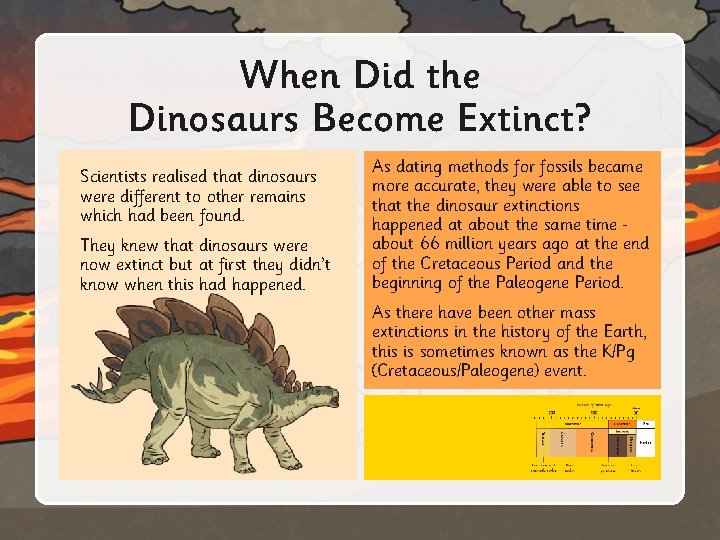
When Did the Dinosaurs Become Extinct? Scientists realised that dinosaurs were different to other remains which had been found. They knew that dinosaurs were now extinct but at first they didn’t know when this had happened. As dating methods for fossils became more accurate, they were able to see that the dinosaur extinctions happened at about the same time about 66 million years ago at the end of the Cretaceous Period and the beginning of the Paleogene Period. As there have been other mass extinctions in the history of the Earth, this is sometimes known as the K/Pg (Cretaceous/Paleogene) event.
How did the Dinosaurs Become Extinct? Once scientists had established that dinosaurs and more than 50% of other life forms on the planet disappeared in a mass extinction about 66 million years ago they began to try and understand why. The dinosaurs had been around for a long time so they were tired and became extinct. There were huge dinosaur ‘wars’ resulting in massive numbers of dinosaur deaths. They were destroyed by visiting aliens. Evolving mammals ate enough dinosaur eggs to drive them to extinction.
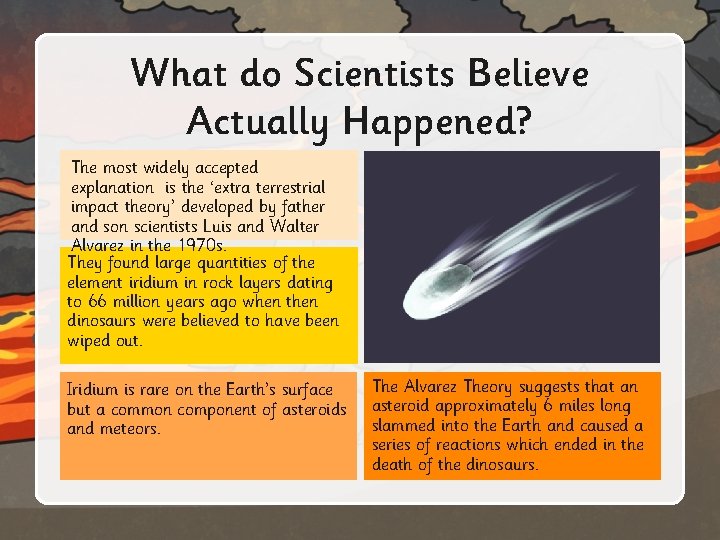
What do Scientists Believe Actually Happened? The most widely accepted explanation is the ‘extra terrestrial impact theory’ developed by father and son scientists Luis and Walter Alvarez in the 1970 s. They found large quantities of the element iridium in rock layers dating to 66 million years ago when then dinosaurs were believed to have been wiped out. Iridium is rare on the Earth’s surface but a common component of asteroids and meteors. The Alvarez Theory suggests that an asteroid approximately 6 miles long slammed into the Earth and caused a series of reactions which ended in the death of the dinosaurs.
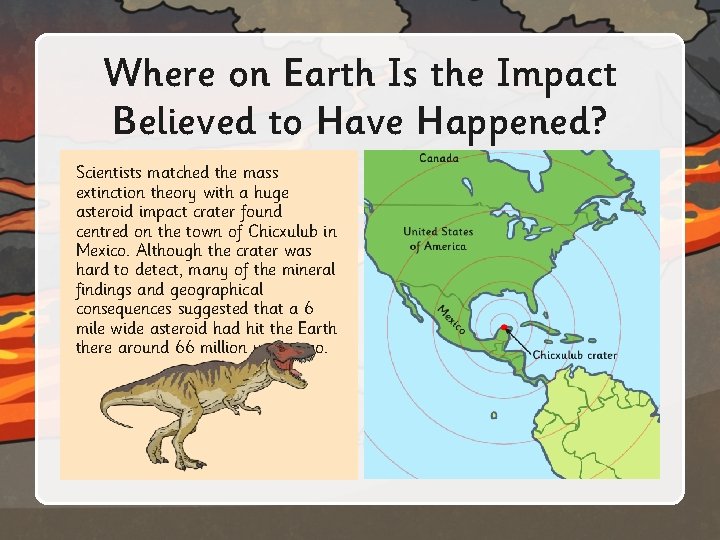
Where on Earth Is the Impact Believed to Have Happened? Scientists matched the mass extinction theory with a huge asteroid impact crater found centred on the town of Chicxulub in Mexico. Although the crater was hard to detect, many of the mineral findings and geographical consequences suggested that a 6 mile wide asteroid had hit the Earth there around 66 million years ago.
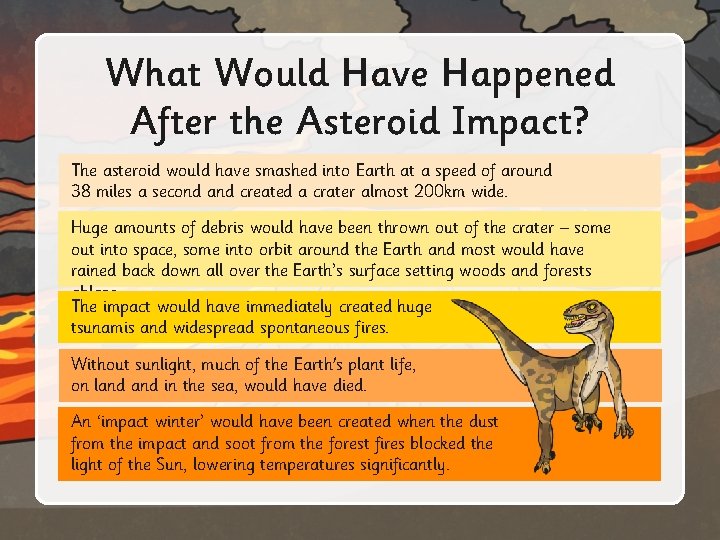
What Would Have Happened After the Asteroid Impact? The asteroid would have smashed into Earth at a speed of around 38 miles a second and created a crater almost 200 km wide. Huge amounts of debris would have been thrown out of the crater – some out into space, some into orbit around the Earth and most would have rained back down all over the Earth’s surface setting woods and forests ablaze. The impact would have immediately created huge tsunamis and widespread spontaneous fires. Without sunlight, much of the Earth's plant life, on land in the sea, would have died. An ‘impact winter’ would have been created when the dust from the impact and soot from the forest fires blocked the light of the Sun, lowering temperatures significantly.
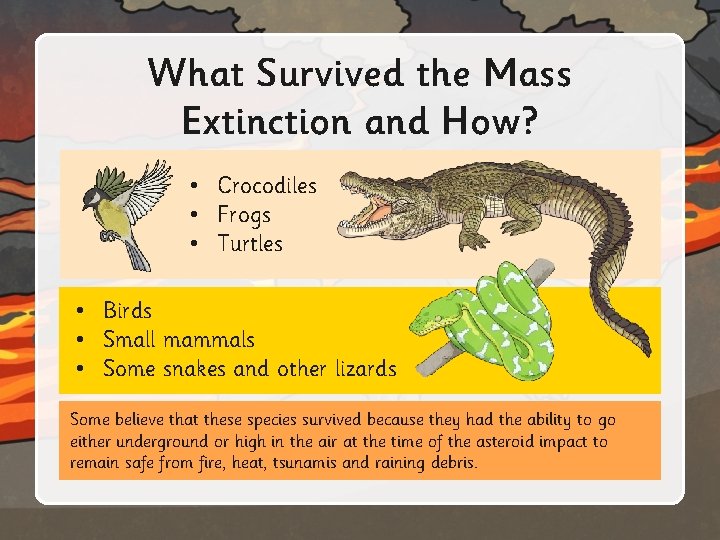
What Survived the Mass Extinction and How? • Crocodiles • Frogs • Turtles • Birds • Small mammals • Some snakes and other lizards Some believe that these species survived because they had the ability to go either underground or high in the air at the time of the asteroid impact to remain safe from fire, heat, tsunamis and raining debris.
Does Everyone Agree with the Extra Terrestrial Impact Theory? The theory is only relatively recent but more and more evidence is being found to support it. It has not been proved 100% but it is widely accepted by scientists. However, some scientists disagree and have argued that the types of animal that survived – small mammals, birds, frogs and lizards would have been most susceptible to the environmental changes caused by the asteroid impact.
Does Everyone Agree with the Extra Terrestrial Impact Theory? Another scientist believes she has found evidence that organisms that eventually went extinct during the K/Pg event were still living 300, 000 years after the Chicxulub asteroid impact. Other scientists believe the extinction may be the result of a period of intense volcanic activity or multiple asteroid impacts affecting the environment on Earth.
What Could I Find out About Next? • Other mass extinction episodes in the Earth’s history. • How fossils are dated. • What the iridium layer associated with the asteroid impact looks like in rock formations. • How craters are formed with this investigation. • Where the Chicxulub asteroid is believed to have come from.
What Could I Find out About Next? • Other meteor or asteroid impacts in the Earth’s history. • The speed at which meteors and asteroids travel. • What an asteroid might look like striking the Earth. • The comet Shoemaker Levy smashing into Jupiter in 1994. • The theory that another mass extinction may currently be underway.
• To understand the time scale and probable cause of the dinosaur extinction.
- Slides: 16