
To understand recursion you must first understand recursion






- Slides: 31
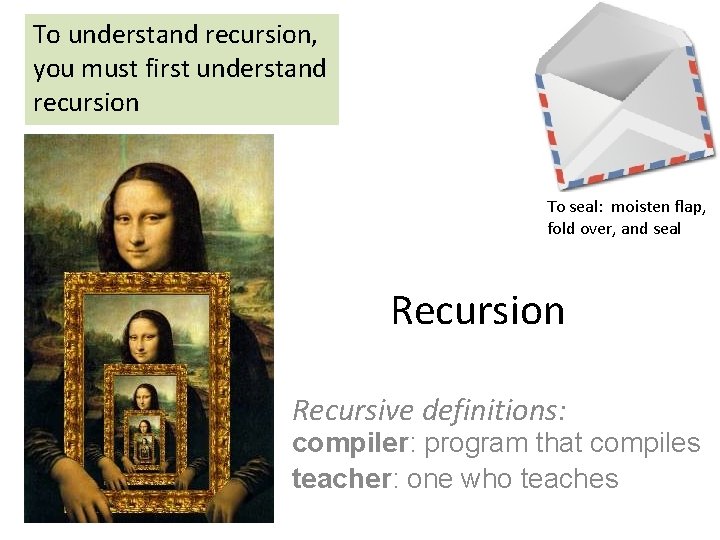
To understand recursion, you must first understand recursion To seal: moisten flap, fold over, and seal Recursion Recursive definitions: compiler: program that compiles teacher: one who teaches
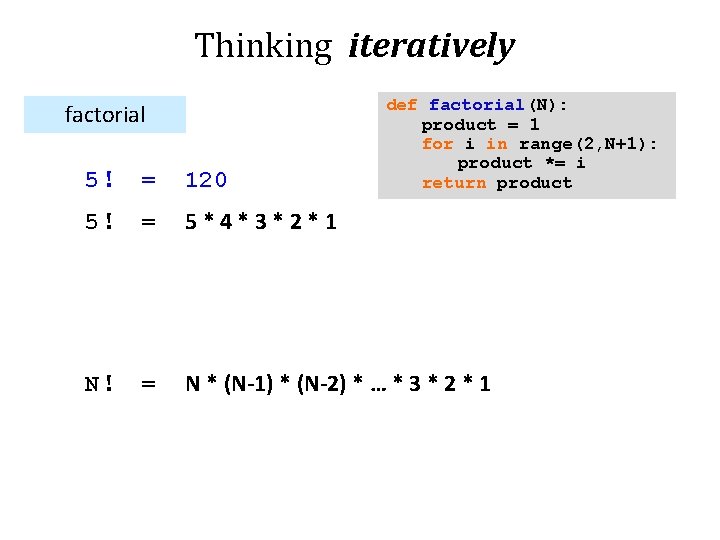
Thinking iteratively factorial def factorial(N): product = 1 for i in range(2, N+1): product *= i return product 5! = 120 5! = 5*4*3*2*1 N! = N * (N-1) * (N-2) * … * 3 * 2 * 1
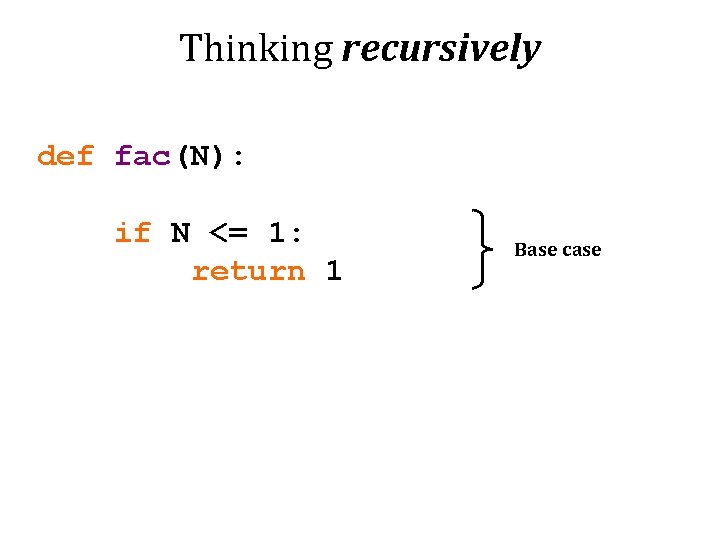
Thinking recursively def fac(N): if N <= 1: return 1 Base case
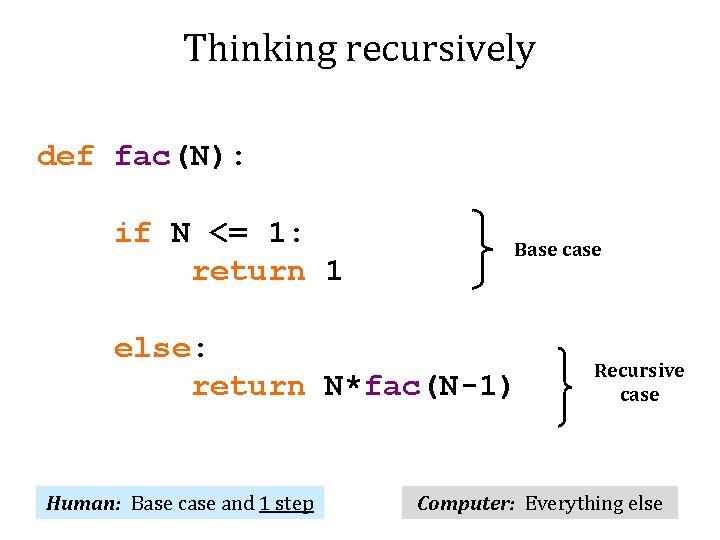
Thinking recursively def fac(N): if N <= 1: return 1 Base case else: return N*fac(N-1) Human: Base case and 1 step Recursive case Computer: Everything else
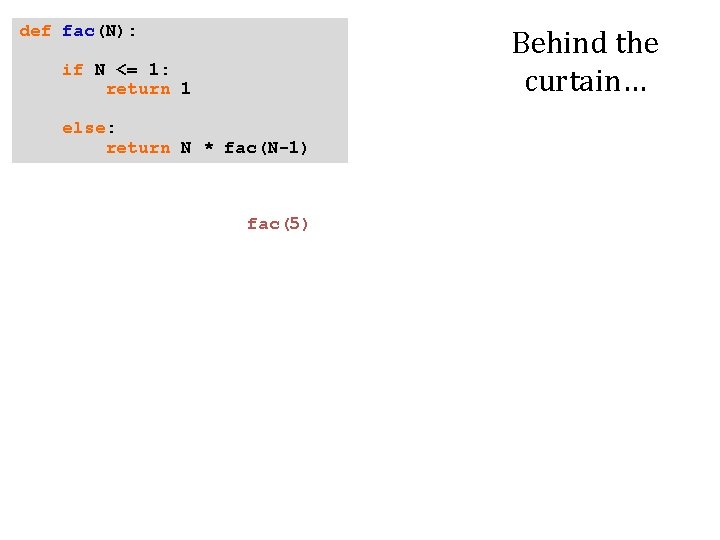
def fac(N): Behind the curtain… if N <= 1: return 1 else: return N * fac(N-1) fac(5)
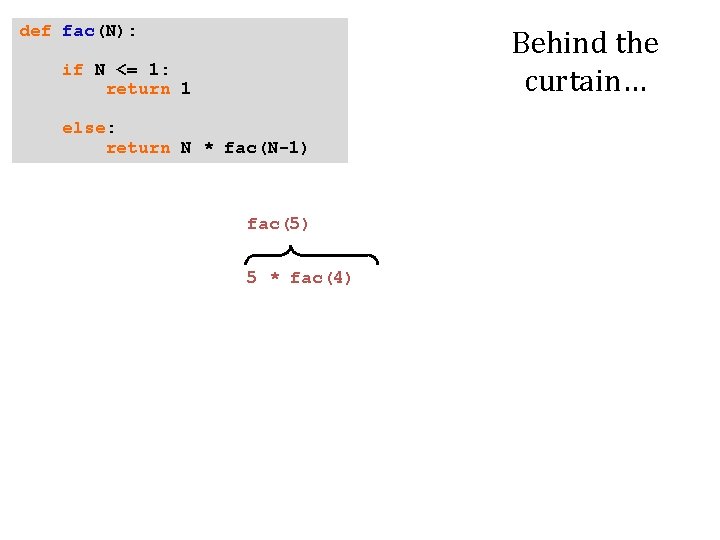
def fac(N): Behind the curtain… if N <= 1: return 1 else: return N * fac(N-1) fac(5) 5 * fac(4)
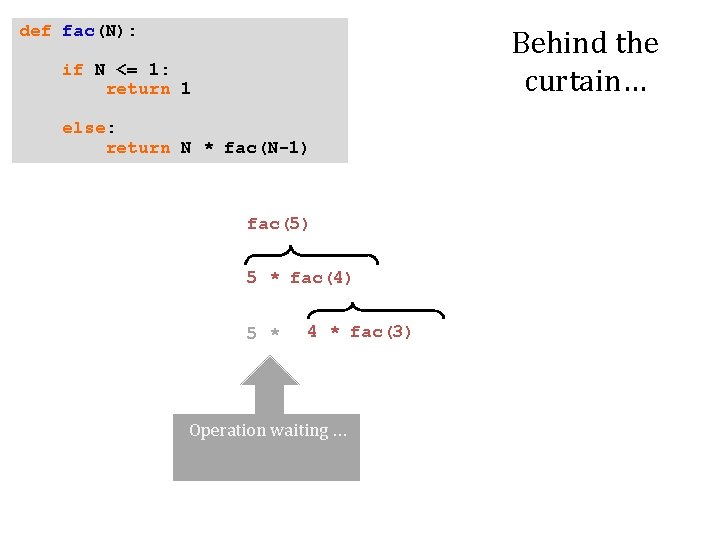
def fac(N): Behind the curtain… if N <= 1: return 1 else: return N * fac(N-1) fac(5) 5 * fac(4) 5 * 4 * fac(3) Operation waiting …
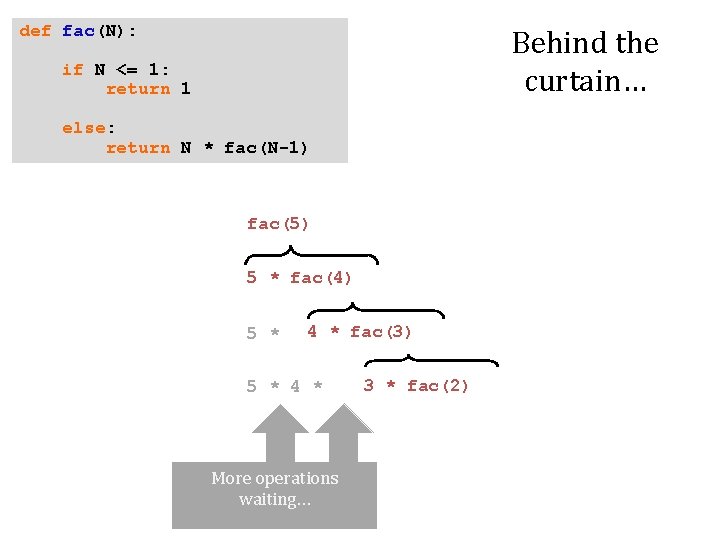
def fac(N): Behind the curtain… if N <= 1: return 1 else: return N * fac(N-1) fac(5) 5 * fac(4) 5 * 4 * fac(3) 5 * 4 * More operations waiting… 3 * fac(2)
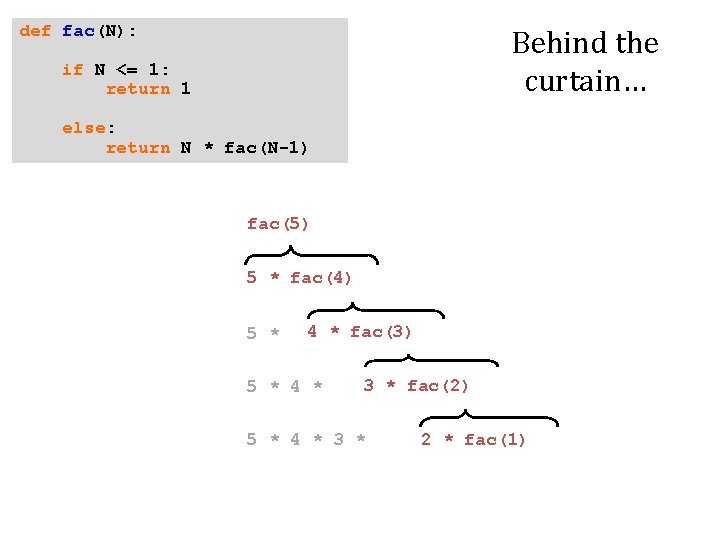
def fac(N): Behind the curtain… if N <= 1: return 1 else: return N * fac(N-1) fac(5) 5 * fac(4) 5 * 4 * fac(3) 5 * 4 * 3 * fac(2) 5 * 4 * 3 * 2 * fac(1)
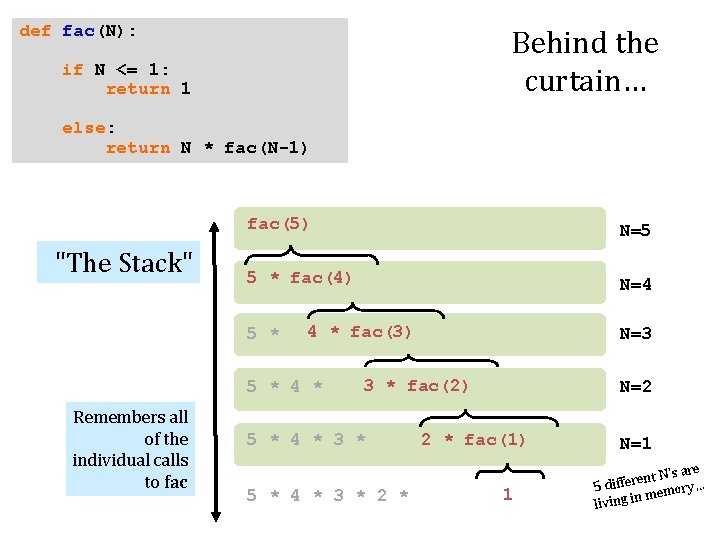
def fac(N): Behind the curtain… if N <= 1: return 1 else: return N * fac(N-1) "The Stack" fac(5) N=5 5 * fac(4) N=4 5 * 4 * fac(3) 5 * 4 * Remembers all of the individual calls to fac N=3 3 * fac(2) 5 * 4 * 3 * 2 * N=2 2 * fac(1) 1 N=1 N's are t n e r e f 5 dif mory… e m n i living
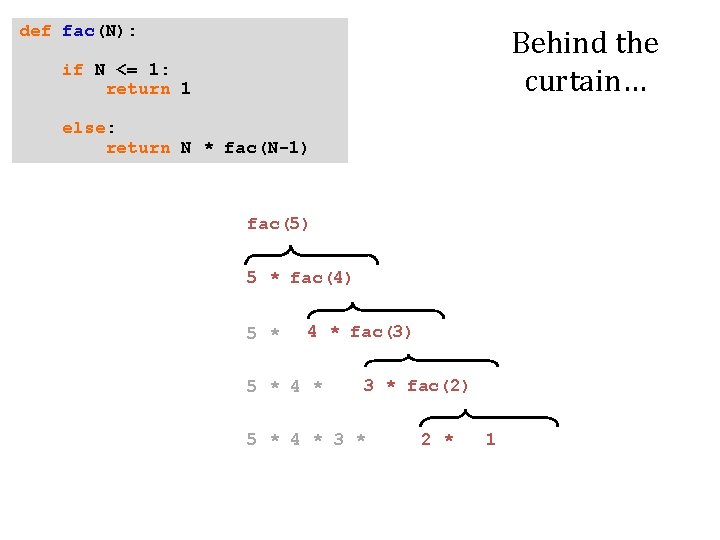
def fac(N): Behind the curtain… if N <= 1: return 1 else: return N * fac(N-1) fac(5) 5 * fac(4) 5 * 4 * fac(3) 5 * 4 * 3 * fac(2) 5 * 4 * 3 * 2 * 1
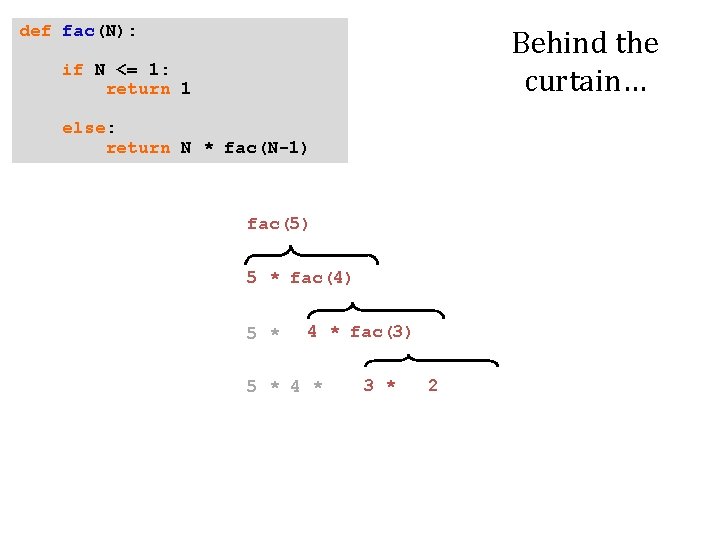
def fac(N): Behind the curtain… if N <= 1: return 1 else: return N * fac(N-1) fac(5) 5 * fac(4) 5 * 4 * fac(3) 5 * 4 * 3 * 2
def fac(N): Behind the curtain… if N <= 1: return 1 else: return N * fac(N-1) fac(5) 5 * fac(4) 5 * 4 * 6
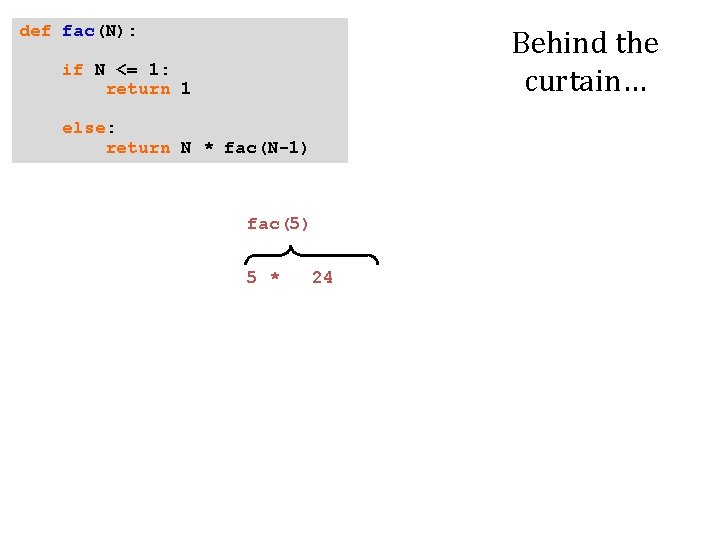
def fac(N): Behind the curtain… if N <= 1: return 1 else: return N * fac(N-1) fac(5) 5 * 24
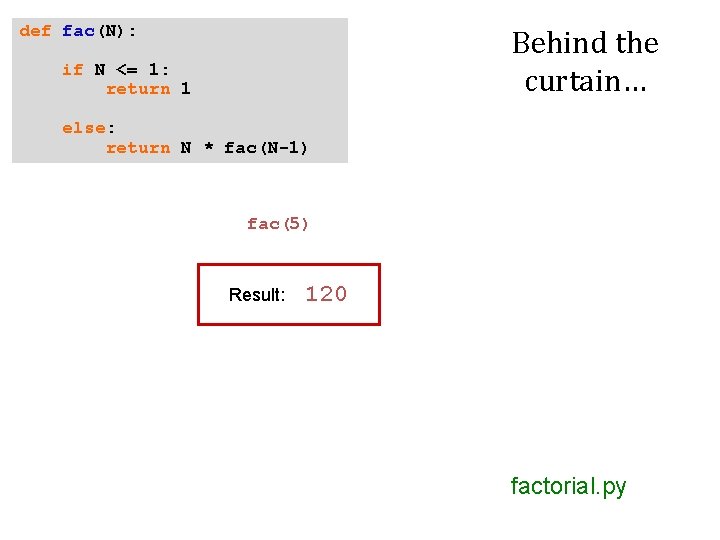
def fac(N): Behind the curtain… if N <= 1: return 1 else: return N * fac(N-1) fac(5) Result: 120 factorial. py
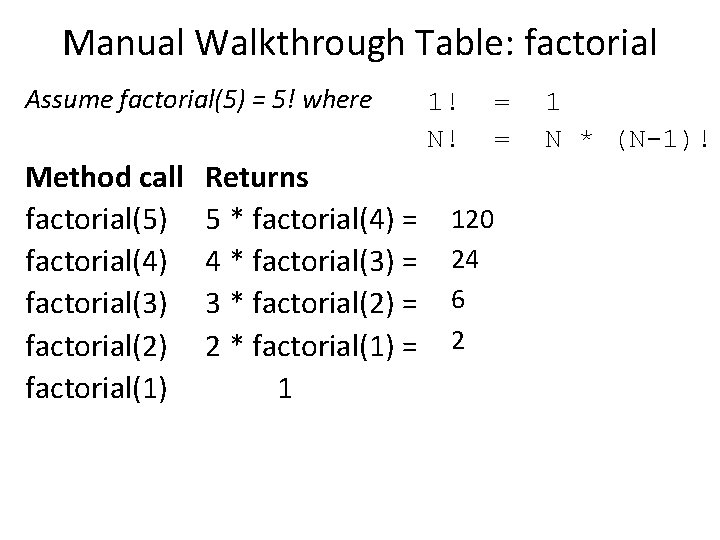
Manual Walkthrough Table: factorial Assume factorial(5) = 5! where Method call factorial(5) factorial(4) factorial(3) factorial(2) factorial(1) Returns 5 * factorial(4) = 4 * factorial(3) = 3 * factorial(2) = 2 * factorial(1) = 1 1! N! 120 24 6 2 = = 1 N * (N-1)!
Let recursion do the work for you. Exploit self-similarity Produce short, elegant code Less work ! You handle the base case – the easiest case! def fac(N): if N <= 1: Recursion does almost all return 1 of the rest of the problem! else: You specify one rest = fac(N-1) step at the end return rest * N
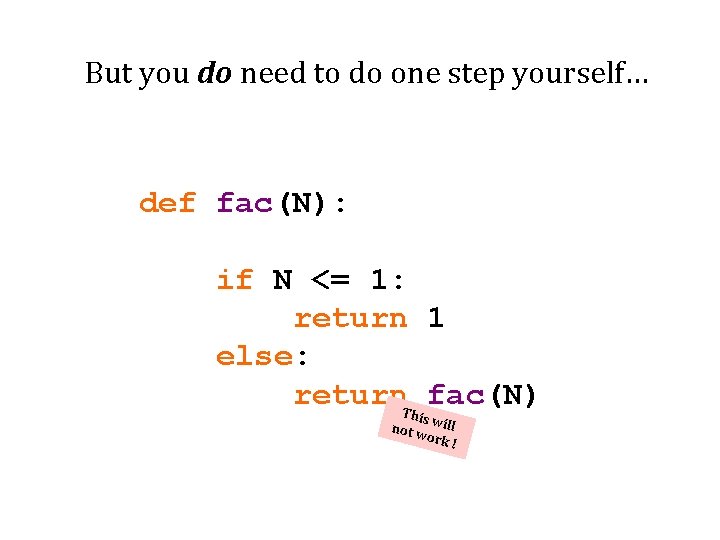
But you do need to do one step yourself… def fac(N): if N <= 1: return 1 else: return. Th fac(N) is not w will ork !
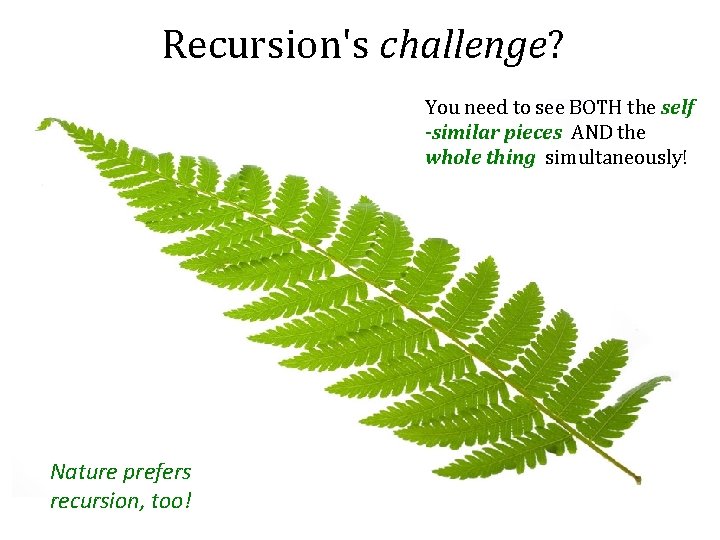
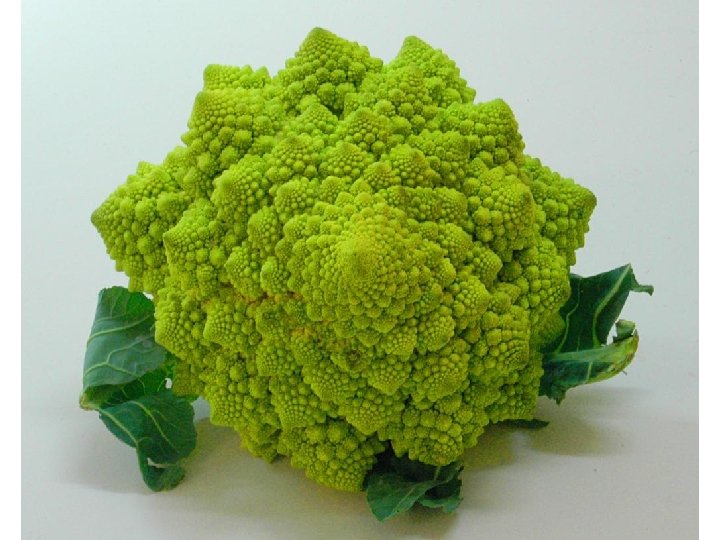
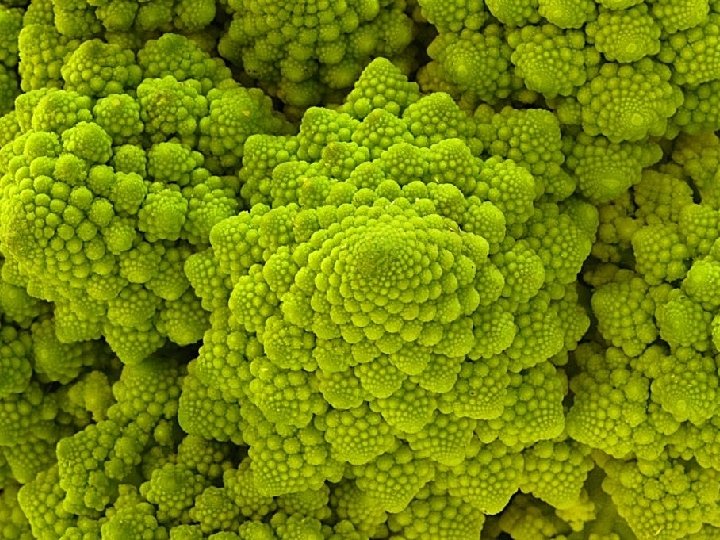
Recursion's challenge? You need to see BOTH the self -similar pieces AND the whole thing simultaneously! Nature prefers recursion, too!
Are these rules for real? Yes. . . and no.
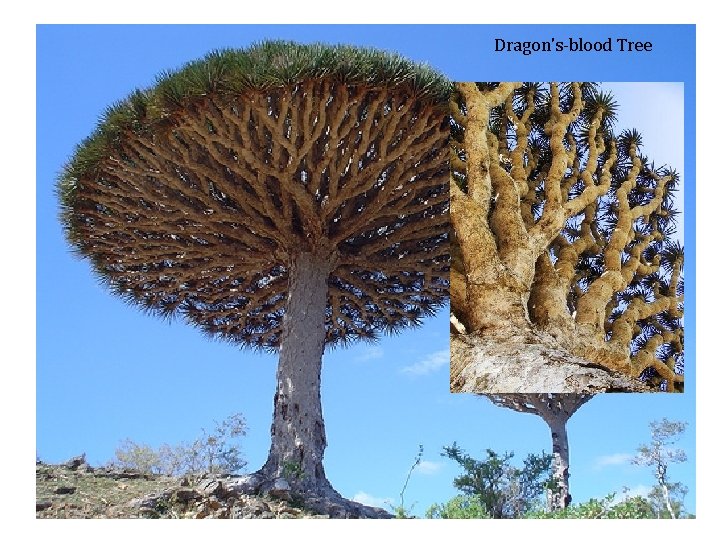
Dragon's-blood Tree
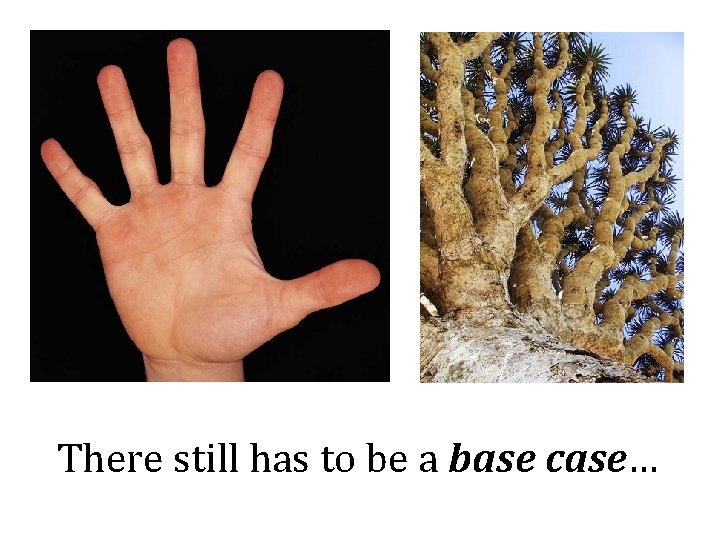
There still has to be a base case…
or else!
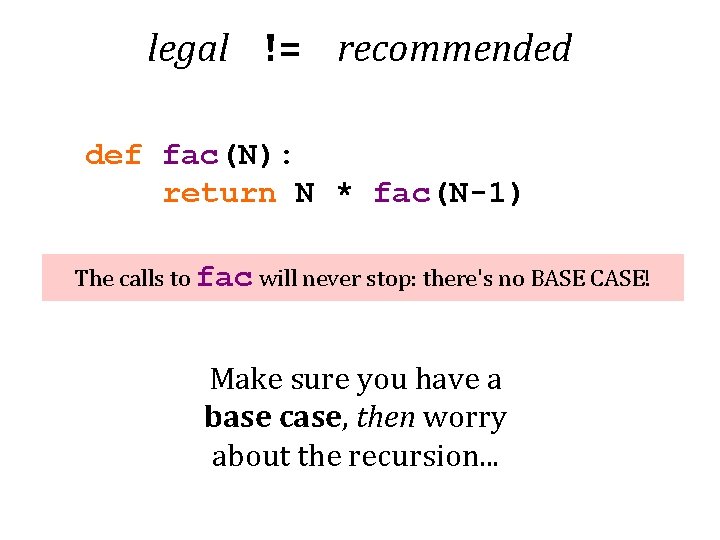
Warning: this is legal! def fac(N): return N * fac(N-1)
legal != recommended def fac(N): return N * fac(N-1) The calls to fac will never stop: there's no BASE CASE! Make sure you have a base case, then worry about the recursion. . .
This runs ~ but does not help! def fac(N): return fac(N) Roadsigns and recursion examples of self-fulfilling danger
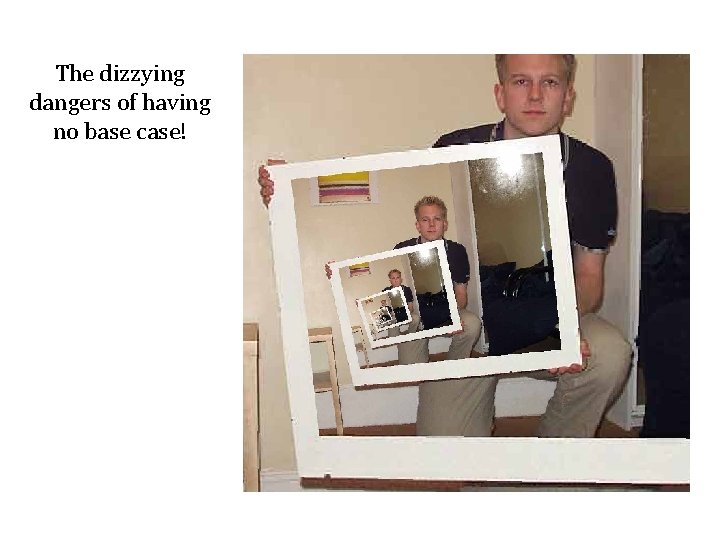
The dizzying dangers of having no base case!
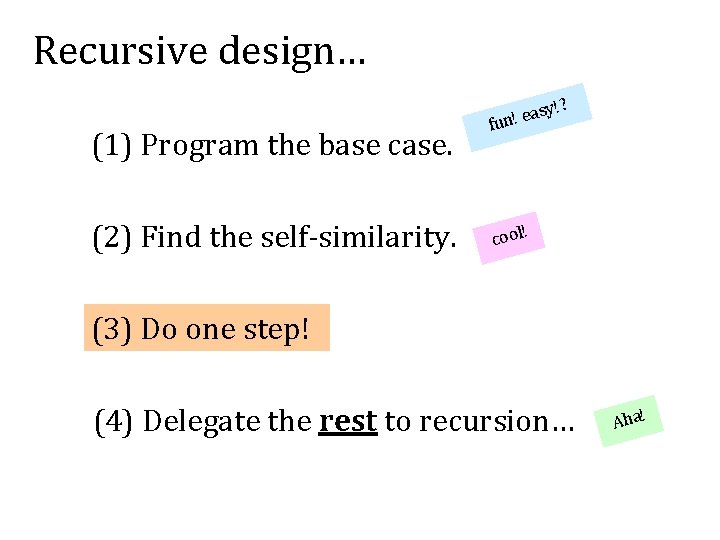
Recursive design… (1) Program the base case. (2) Find the self-similarity. !? asy e ! n u f cool! (3) Do one step! (4) Delegate the rest to recursion… Aha!
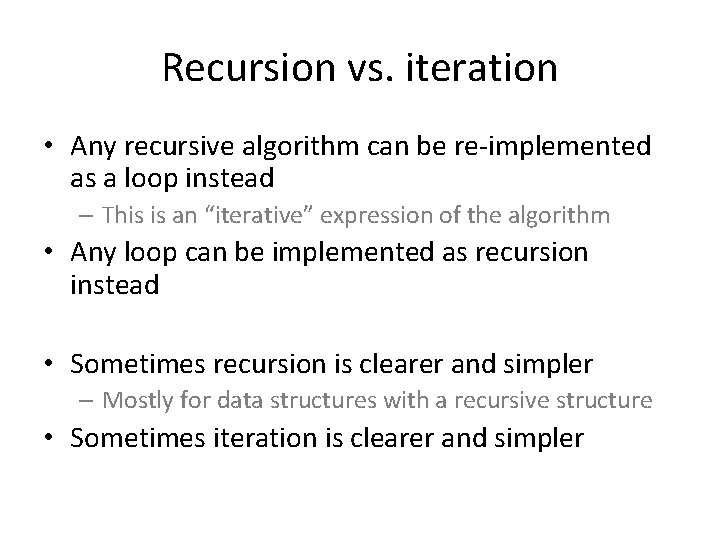
Recursion vs. iteration • Any recursive algorithm can be re-implemented as a loop instead – This is an “iterative” expression of the algorithm • Any loop can be implemented as recursion instead • Sometimes recursion is clearer and simpler – Mostly for data structures with a recursive structure • Sometimes iteration is clearer and simpler
In other words: sum(1) = 1 sum(n) = n + sum(n-1) Try it! Write a function to sum 1 to N: Recursively & Iteratively