
To understand Migration better Types of Migration GLOSSARY
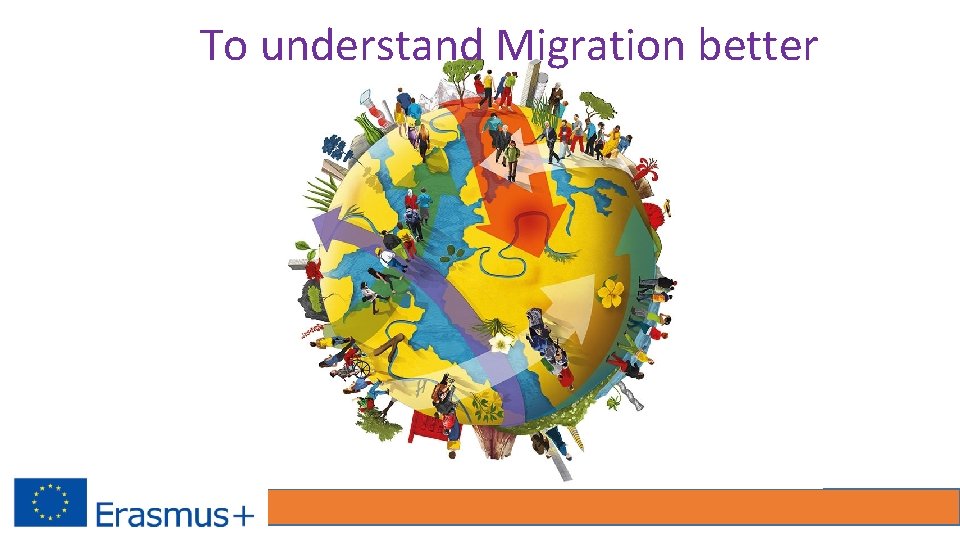
To understand Migration better

Types of Migration: GLOSSARY Migration: movement of people from one place to another. Internal Migration: Moving to a new home within a state, country, or continent. External Migration: Moving to a new home in a different state, country, or continent. Emigration: Leaving one country to move to another (e. g. , the Pilgrims emigrated from England). Immigration: Moving into a new country (e. g. , the Pilgrims immigrated to America). Population Transfer: When a government forces a large group of people out of a region, usually based on ethnicity or religion. This is also known as an involuntary or forced migration. Impelled Migration (also called "reluctant" or "imposed" migration): Individuals are not forced out of their country, but leave because of unfavorable situations such as warfare, political problems, or religious persecution.

Step Migration: A series of shorter, less extreme migrations from a person's place of origin to final destination—such as moving from a farm, to a village, to a town, and finally to a city. Chain Migration: A series of migrations within a family or defined group of people. A chain migration often begins with one family member who sends money to bring other family members to the new location. Chain migration results in migration fields—the clustering of people from a specific region into certain neighborhoods or small towns. Return Migration: The voluntary movements of immigrants back to their place of origin. This is also known as circular migration. Seasonal Migration: The process of moving for a period of time in response to labor or climate conditions (e. g. , farm workers following crop harvests or working in cities off-season; "snowbirds" moving to the southern and southwestern United States during winter)
Why Do People Migrate? People move for a variety of reasons. They consider the advantages and disadvantages of staying versus moving, as well as factors such as distance, travel costs, travel time, modes of transportation, terrain, and cultural barriers. Push Factors: Reasons for emigrating (leaving a place) because of a difficulty (such as a food shortage, war, flood, etc. ). Pull Factors: Reasons for immigrating (moving into a place) because of something desirable (such as a nicer climate, better food supply, freedom, etc. ).
Several types of push and pull factors may influence people in their movements (sometimes at the same time), including: 1. Environmental (e. g. , climate, natural disasters) 2. Political (e. g. , war) 3. Economic (e. g. , work) 4. Cultural (e. g. , religious freedom, education)
Several examples for migration around Turkey and the world:

1. Environmental reasons (e. g. , climate, natural disasters) Turks moved to west from the central asia just because of the drought and famine.

1. Environmental reasons (e. g. , climate, natural disasters) In 1999 hundred thousands of people living in the north west of Turkey moved to other areas because of the big earthquake in Marmara.
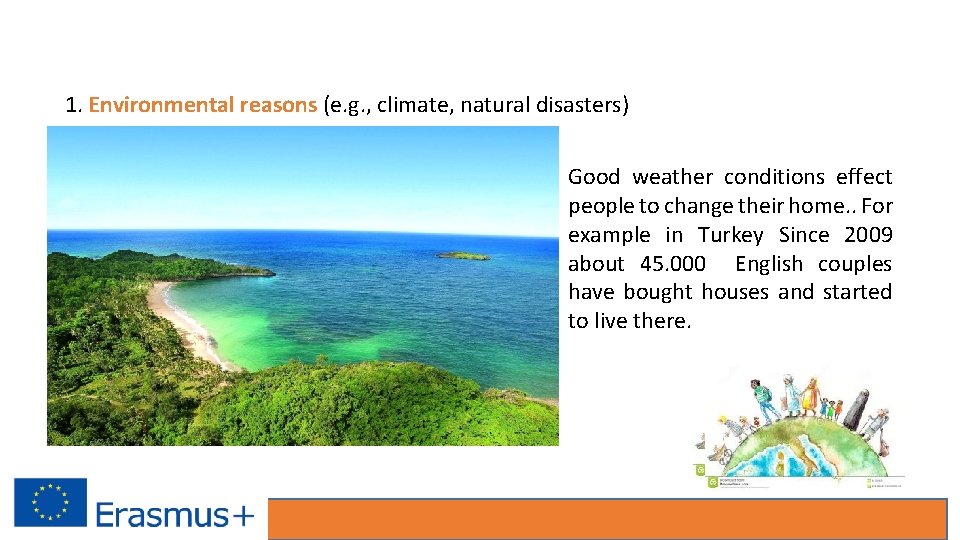
1. Environmental reasons (e. g. , climate, natural disasters) Good weather conditions effect people to change their home. . For example in Turkey Since 2009 about 45. 000 English couples have bought houses and started to live there.
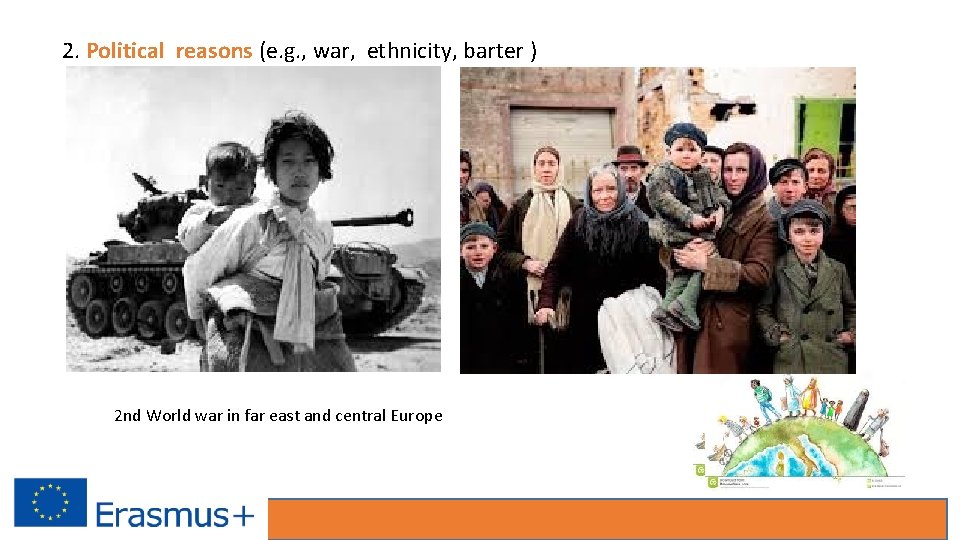
2. Political reasons (e. g. , war, ethnicity, barter ) 2 nd World war in far east and central Europe

2. Political reasons (e. g. , war, ethnicity, exchange ) In Bosnia in 1992 -1995 Exchange in 1922 - Turkey and Greece

3. Economical reasons (e. g. , work, unemployment, no job prospects for skills)
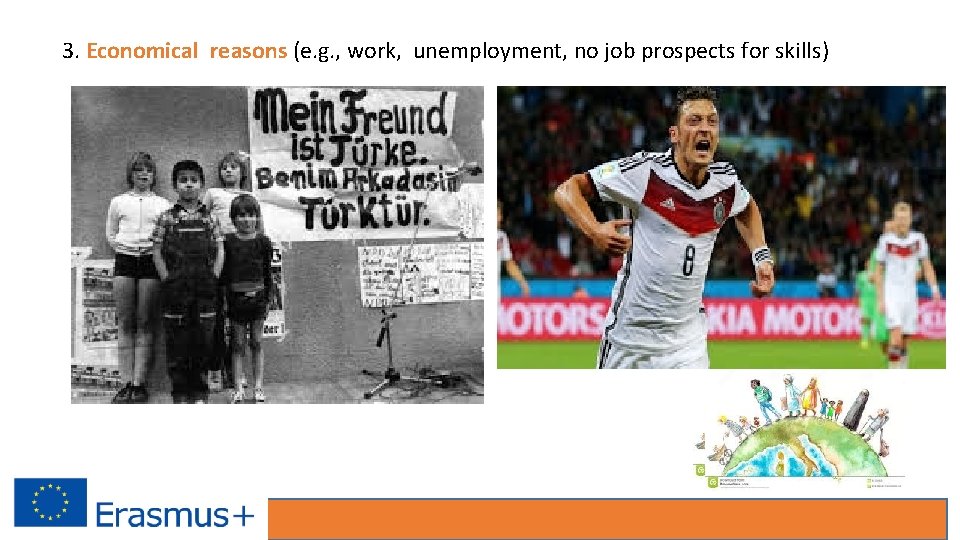
3. Economical reasons (e. g. , work, unemployment, no job prospects for skills)

3. Economical reasons (e. g. , work, unemployment, no job prospects for skills)

4. Cultural (e. g. , religious freedom, education)

4. Cultural (e. g. , religious freedom, education)

4. Cultural (e. g. , religious freedom, education)
Some facts about Turkey • People started to move from villages to cities in the beginning of 1980 s. In 1980 s 40 % of population in Turkey used to be in cities but now it’s 75%.
Some facts about Turkey • Every year about 1 million seasonal workers move to different parts of the country but they come back after the working season.
Some facts about Turkey • Every year number of the students who go abroad for their education increases in 25%.

Some facts about Turkey • Turks mostly emigrated to; Germany, France, Holland, Belgium, Switzerland England
Some facts about Turkey • About 2 million Turks emigrated from Turkey since 1960 s and their population in destination countries is now 4 million.
Some facts about Turkey • In 1989 about 320 thousand people from Bulgaria imigrated to Turkey because of the tortures of the Bulgarian government. It was the biggest migration in Europe since the second World war.
Some facts about Turkey • About 2 million people from Iraq imigrate to Turkey and Iran in 1991 because of the war and almost half of them still remain there.
Some facts about Turkey • About 10 million people from Syria escaped from the war and moved to other countries and almost 4 million of them still live in Turkey.

Thanks for watching us….
- Slides: 26