
To Turn or Not to Turn Pressure injury
- Slides: 1
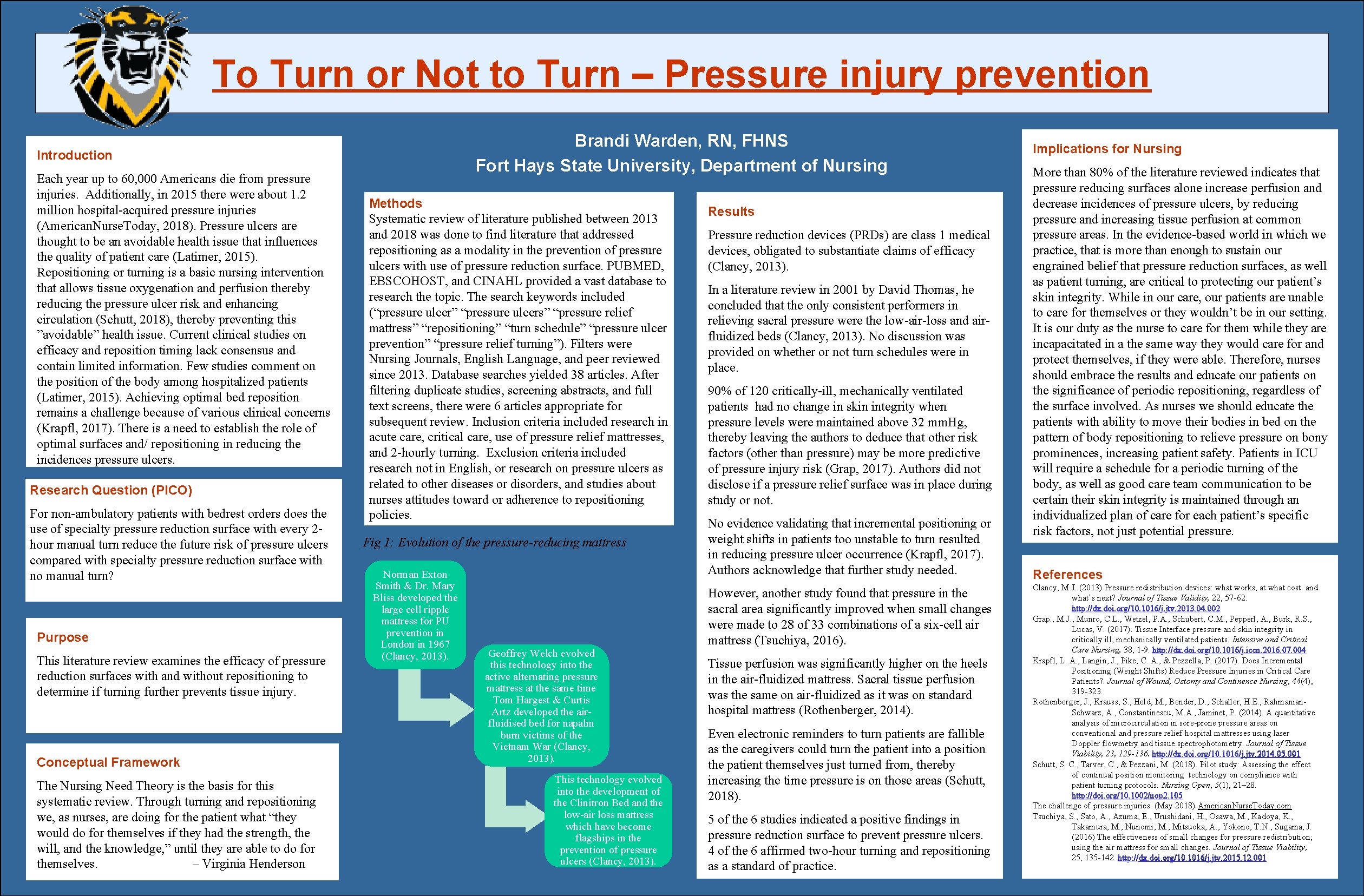
To Turn or Not to Turn – Pressure injury prevention Brandi Warden, RN, FHNS Fort Hays State University, Department of Nursing Introduction Each year up to 60, 000 Americans die from pressure injuries. Additionally, in 2015 there were about 1. 2 million hospital-acquired pressure injuries (American. Nurse. Today, 2018). Pressure ulcers are thought to be an avoidable health issue that influences the quality of patient care (Latimer, 2015). Repositioning or turning is a basic nursing intervention that allows tissue oxygenation and perfusion thereby reducing the pressure ulcer risk and enhancing circulation (Schutt, 2018), thereby preventing this ”avoidable” health issue. Current clinical studies on efficacy and reposition timing lack consensus and contain limited information. Few studies comment on the position of the body among hospitalized patients (Latimer, 2015). Achieving optimal bed reposition remains a challenge because of various clinical concerns (Krapfl, 2017). There is a need to establish the role of optimal surfaces and/ repositioning in reducing the incidences pressure ulcers. Research Question (PICO) For non-ambulatory patients with bedrest orders does the use of specialty pressure reduction surface with every 2 hour manual turn reduce the future risk of pressure ulcers compared with specialty pressure reduction surface with no manual turn? Purpose This literature review examines the efficacy of pressure reduction surfaces with and without repositioning to determine if turning further prevents tissue injury. Conceptual Framework The Nursing Need Theory is the basis for this systematic review. Through turning and repositioning we, as nurses, are doing for the patient what “they would do for themselves if they had the strength, the will, and the knowledge, ” until they are able to do for themselves. – Virginia Henderson Methods Systematic review of literature published between 2013 and 2018 was done to find literature that addressed repositioning as a modality in the prevention of pressure ulcers with use of pressure reduction surface. PUBMED, EBSCOHOST, and CINAHL provided a vast database to research the topic. The search keywords included (“pressure ulcer” “pressure ulcers” “pressure relief mattress” “repositioning” “turn schedule” “pressure ulcer prevention” “pressure relief turning”). Filters were Nursing Journals, English Language, and peer reviewed since 2013. Database searches yielded 38 articles. After filtering duplicate studies, screening abstracts, and full text screens, there were 6 articles appropriate for subsequent review. Inclusion criteria included research in acute care, critical care, use of pressure relief mattresses, and 2 -hourly turning. Exclusion criteria included research not in English, or research on pressure ulcers as related to other diseases or disorders, and studies about nurses attitudes toward or adherence to repositioning policies. Fig 1: Evolution of the pressure-reducing mattress Norman Exton Smith & Dr. Mary Bliss developed the large cell ripple mattress for PU prevention in London in 1967 (Clancy, 2013). Geoffrey Welch evolved this technology into the active alternating pressure mattress at the same time Tom Hargest & Curtis Artz developed the airfluidised bed for napalm burn victims of the Vietnam War (Clancy, 2013). This technology evolved into the development of the Clinitron Bed and the low-air loss mattress which have become flagships in the prevention of pressure ulcers (Clancy, 2013). Results Pressure reduction devices (PRDs) are class 1 medical devices, obligated to substantiate claims of efficacy (Clancy, 2013). In a literature review in 2001 by David Thomas, he concluded that the only consistent performers in relieving sacral pressure were the low-air-loss and airfluidized beds (Clancy, 2013). No discussion was provided on whether or not turn schedules were in place. 90% of 120 critically-ill, mechanically ventilated patients had no change in skin integrity when pressure levels were maintained above 32 mm. Hg, thereby leaving the authors to deduce that other risk factors (other than pressure) may be more predictive of pressure injury risk (Grap, 2017). Authors did not disclose if a pressure relief surface was in place during study or not. No evidence validating that incremental positioning or weight shifts in patients too unstable to turn resulted in reducing pressure ulcer occurrence (Krapfl, 2017). Authors acknowledge that further study needed. However, another study found that pressure in the sacral area significantly improved when small changes were made to 28 of 33 combinations of a six-cell air mattress (Tsuchiya, 2016). Tissue perfusion was significantly higher on the heels in the air-fluidized mattress. Sacral tissue perfusion was the same on air-fluidized as it was on standard hospital mattress (Rothenberger, 2014). Even electronic reminders to turn patients are fallible as the caregivers could turn the patient into a position the patient themselves just turned from, thereby increasing the time pressure is on those areas (Schutt, 2018). 5 of the 6 studies indicated a positive findings in pressure reduction surface to prevent pressure ulcers. 4 of the 6 affirmed two-hour turning and repositioning as a standard of practice. Implications for Nursing More than 80% of the literature reviewed indicates that pressure reducing surfaces alone increase perfusion and decrease incidences of pressure ulcers, by reducing pressure and increasing tissue perfusion at common pressure areas. In the evidence-based world in which we practice, that is more than enough to sustain our engrained belief that pressure reduction surfaces, as well as patient turning, are critical to protecting our patient’s skin integrity. While in our care, our patients are unable to care for themselves or they wouldn’t be in our setting. It is our duty as the nurse to care for them while they are incapacitated in a the same way they would care for and protect themselves, if they were able. Therefore, nurses should embrace the results and educate our patients on the significance of periodic repositioning, regardless of the surface involved. As nurses we should educate the patients with ability to move their bodies in bed on the pattern of body repositioning to relieve pressure on bony prominences, increasing patient safety. Patients in ICU will require a schedule for a periodic turning of the body, as well as good care team communication to be certain their skin integrity is maintained through an individualized plan of care for each patient’s specific risk factors, not just potential pressure. References Clancy, M. J. (2013) Pressure redistribution devices: what works, at what cost and what’s next? Journal of Tissue Validity, 22, 57 -62. http: //dx. doi. org/10. 1016/j. jtv. 2013. 04. 002 Grap. , M. J. , Munro, C. L. , Wetzel, P. A. , Schubert, C. M. , Pepperl, A. , Burk, R. S. , Lucas, V. (2017). Tissue Interface pressure and skin integrity in critically ill, mechanically ventilated patients. Intensive and Critical Care Nursing, 38, 1 -9. http: //dx. doi. org/10. 1016/j. iccn. 2016. 07. 004 Krapfl, L. A. , Langin, J. , Pike, C. A. , & Pezzella, P. (2017). Does Incremental Positioning (Weight Shifts) Reduce Pressure Injuries in Critical Care Patients? . Journal of Wound, Ostomy and Continence Nursing, 44(4), 319 -323. Rothenberger, J. , Krauss, S. , Held, M. , Bender, D. , Schaller, H. E. , Rahmanian. Schwarz, A. , Constantinescu, M. A. , Jaminet, P. (2014). A quantitative analysis of microcirculation in sore-prone pressure areas on conventional and pressure relief hospital mattresses using laser Doppler flowmetry and tissue spectrophotometry. Journal of Tissue Viability, 23, 129 -136. http: //dx. doi. org/10. 1016/j. jtv. 2014. 05. 001 Schutt, S. C. , Tarver, C. , & Pezzani, M. (2018). Pilot study: Assessing the effect of continual position monitoring technology on compliance with patient turning protocols. Nursing Open, 5(1), 21– 28. http: //doi. org/10. 1002/nop 2. 105 The challenge of pressure injuries. (May 2018) American. Nurse. Today. com Tsuchiya, S. , Sato, A. , Azuma, E. , Urushidani, H. , Osawa, M. , Kadoya, K. , Takamura, M. , Nunomi, M. , Mitsuoka, A. , Yokono, T. N. , Sugama, J. (2016) The effectiveness of small changes for pressure redistribution; using the air mattress for small changes. Journal of Tissue Viability, 25, 135 -142. http: //dx. doi. org/10. 1016/j. jtv. 2015. 12. 001