
To transform something is to change it In








- Slides: 50
To transform something is to change it. In geometry, there are specific ways to describe how a figure is changed. • Translation • Rotation • Reflection • Dilation
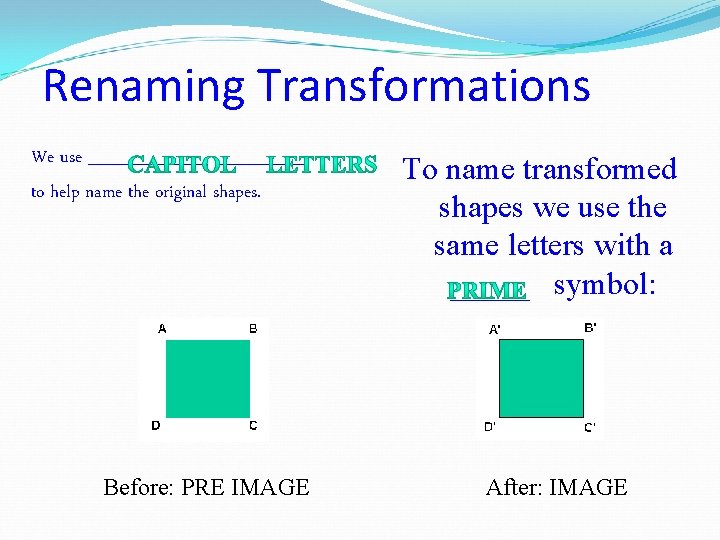
Renaming Transformations We use _______ to help name the original shapes. Before: PRE IMAGE To name transformed shapes we use the same letters with a _____ symbol: After: IMAGE
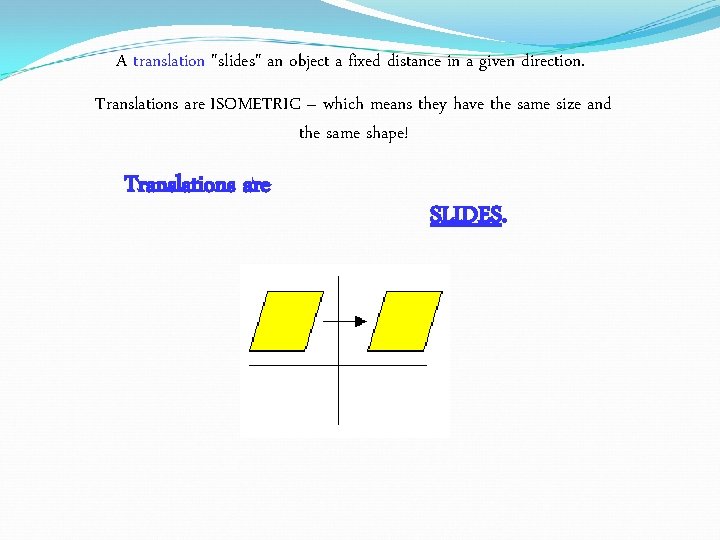
A translation "slides" an object a fixed distance in a given direction. Translations are ISOMETRIC – which means they have the same size and the same shape! Translations are SLIDES.
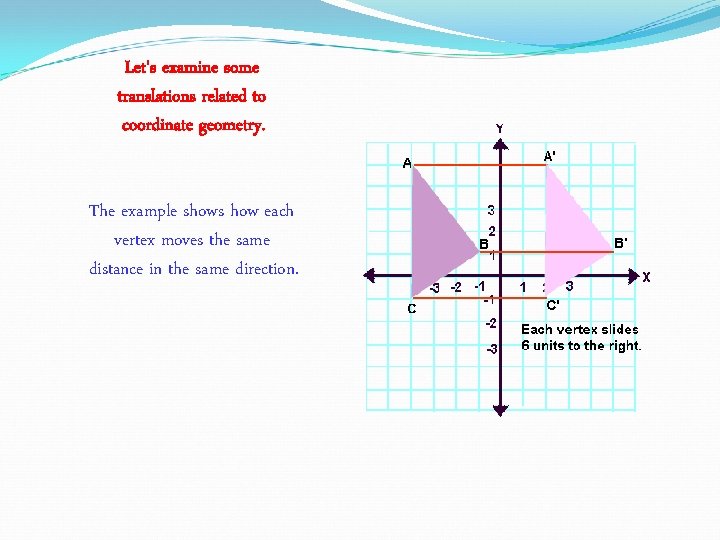
Let's examine some translations related to coordinate geometry. The example shows how each vertex moves the same distance in the same direction.
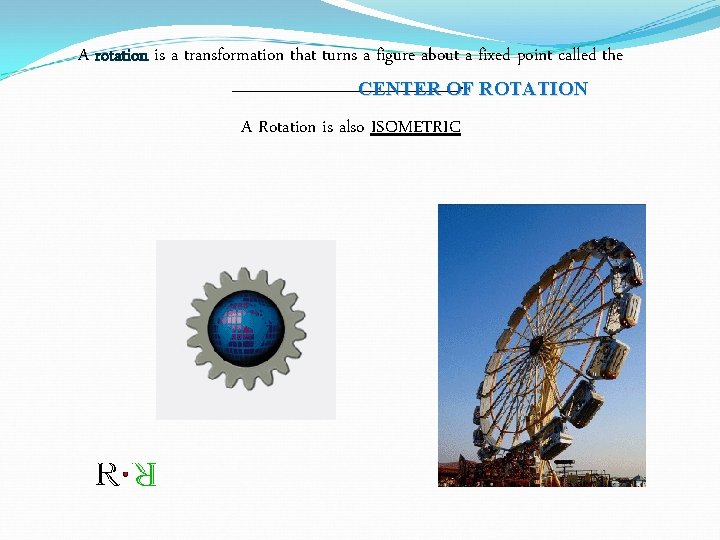
A rotation is a transformation that turns a figure about a fixed point called the __________. CENTER OF ROTATION A Rotation is also ISOMETRIC
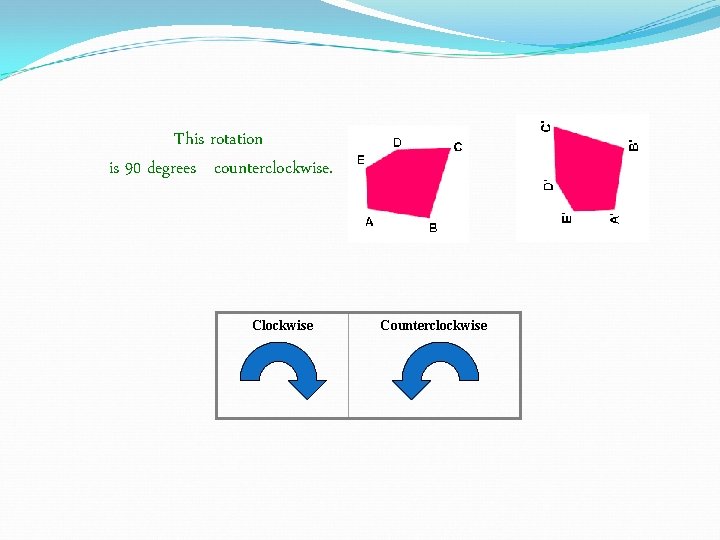
This rotation is 90 degrees counterclockwise. Clockwise Counterclockwise
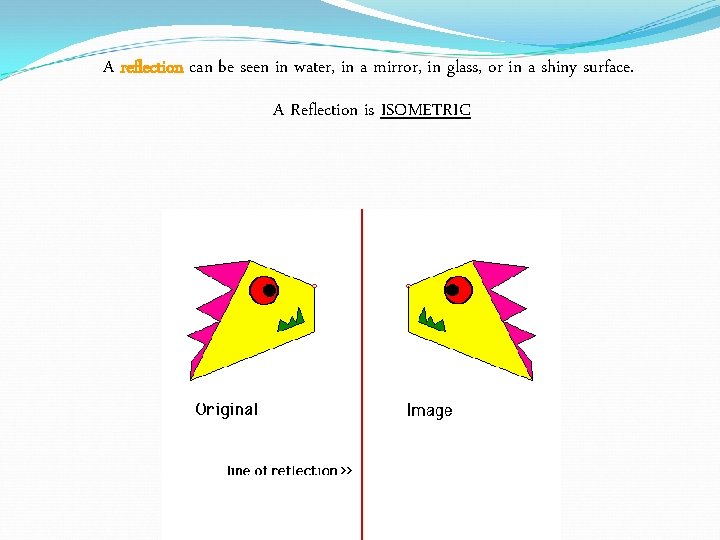
A reflection can be seen in water, in a mirror, in glass, or in a shiny surface. A Reflection is ISOMETRIC
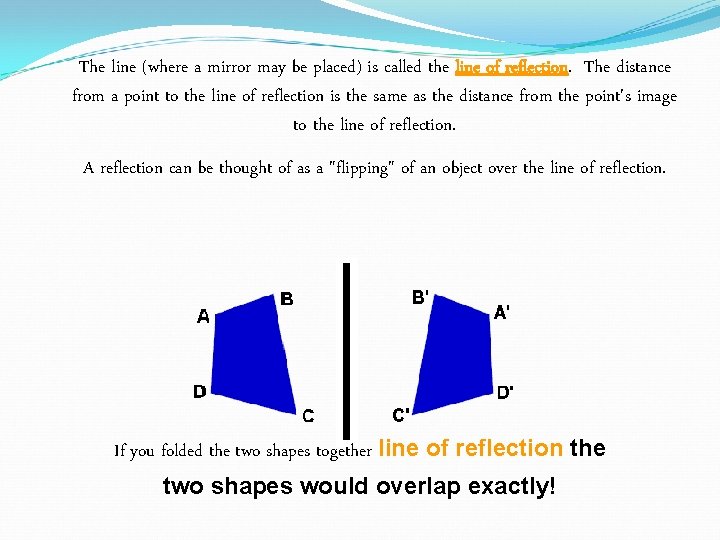
The line (where a mirror may be placed) is called the line of reflection. The distance from a point to the line of reflection is the same as the distance from the point's image to the line of reflection. A reflection can be thought of as a "flipping" of an object over the line of reflection. If you folded the two shapes together line of reflection the two shapes would overlap exactly!
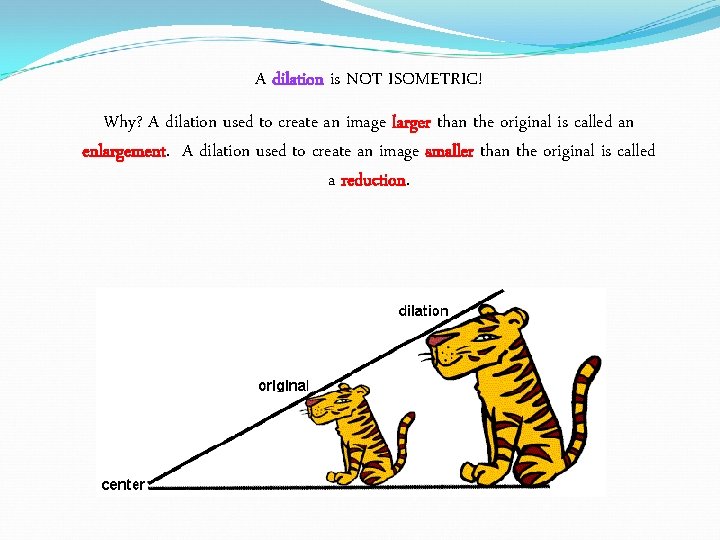
A dilation is NOT ISOMETRIC! Why? A dilation used to create an image larger than the original is called an enlargement. A dilation used to create an image smaller than the original is called a reduction.
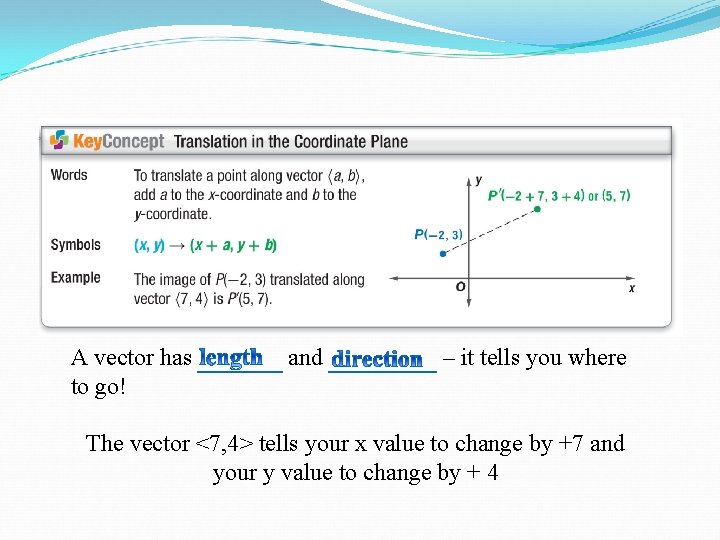
A vector has to go! and – it tells you where The vector <7, 4> tells your x value to change by +7 and your y value to change by + 4
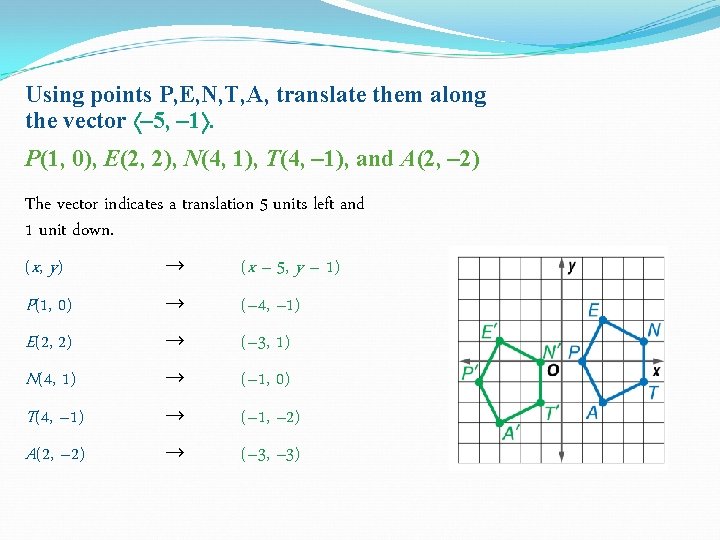
Using points P, E, N, T, A, translate them along the vector – 5, – 1. P(1, 0), E(2, 2), N(4, 1), T(4, – 1), and A(2, – 2) The vector indicates a translation 5 units left and 1 unit down. (x, y) P(1, 0) E(2, 2) N(4, 1) T(4, – 1) A(2, – 2) → → → (x – 5, y – 1) (– 4, – 1) (– 3, 1) (– 1, 0) (– 1, – 2) (– 3, – 3)
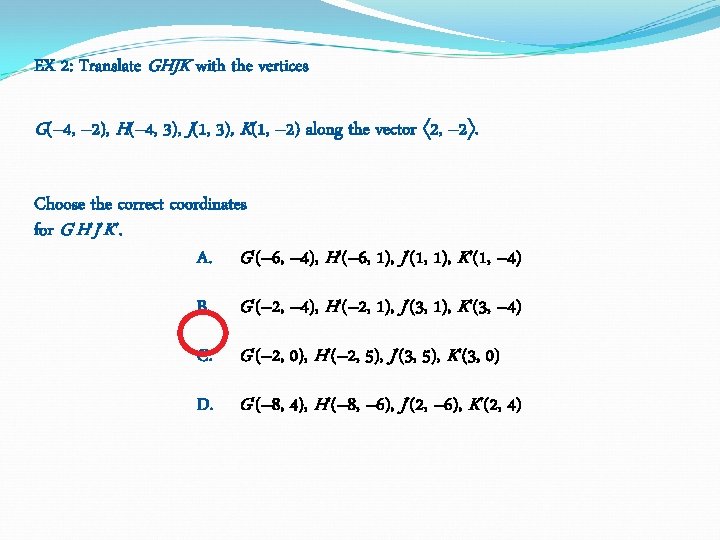
EX 2: Translate GHJK with the vertices G(– 4, – 2), H(– 4, 3), J(1, 3), K(1, – 2) along the vector 2, – 2. Choose the correct coordinates for G'H'J'K'. A. G'(– 6, – 4), H'(– 6, 1), J'(1, 1), K'(1, – 4) B. G'(– 2, – 4), H'(– 2, 1), J'(3, 1), K'(3, – 4) C. G'(– 2, 0), H'(– 2, 5), J'(3, 5), K'(3, 0) D. G'(– 8, 4), H'(– 8, – 6), J'(2, – 6), K'(2, 4)
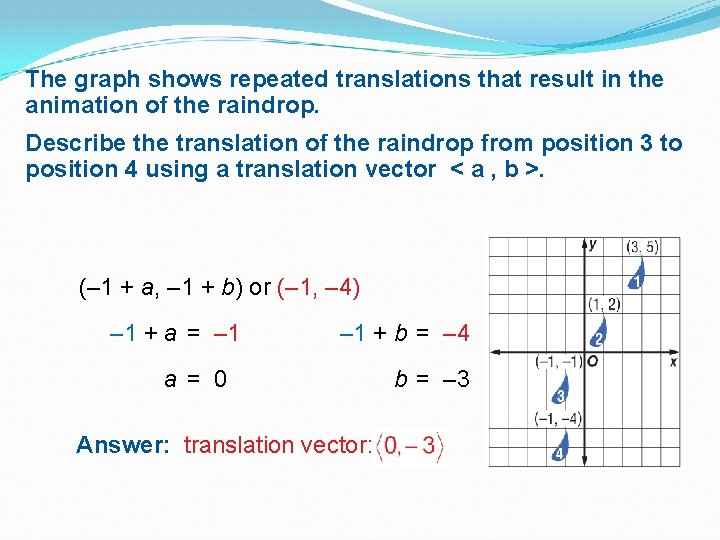
The graph shows repeated translations that result in the animation of the raindrop. Describe the translation of the raindrop from position 3 to position 4 using a translation vector < a , b >. (– 1 + a, – 1 + b) or (– 1, – 4) – 1 + a = – 1 + b = – 4 a= 0 Answer: translation vector: b = – 3
REFLECTIONS
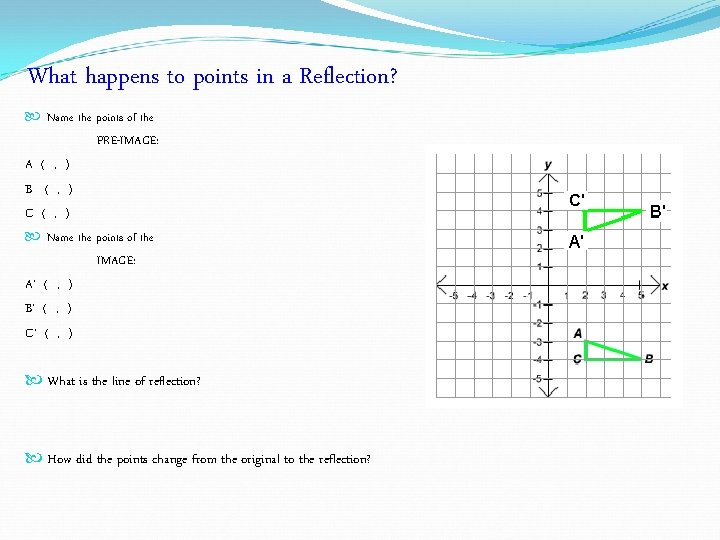
What happens to points in a Reflection? Name the points of the PRE-IMAGE: A ( , ) B ( , ) C ( , ) Name the points of the IMAGE: A’ ( , ) B’ ( , ) C’ ( , ) What is the line of reflection? How did the points change from the original to the reflection?
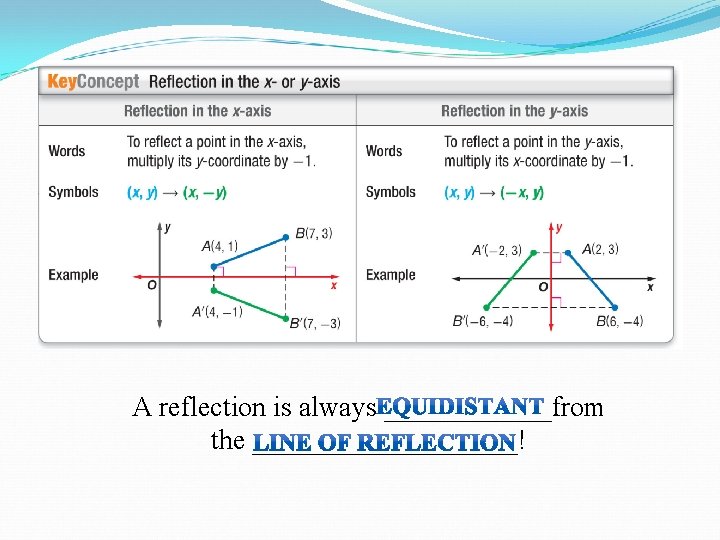
A reflection is always ______from the __________!
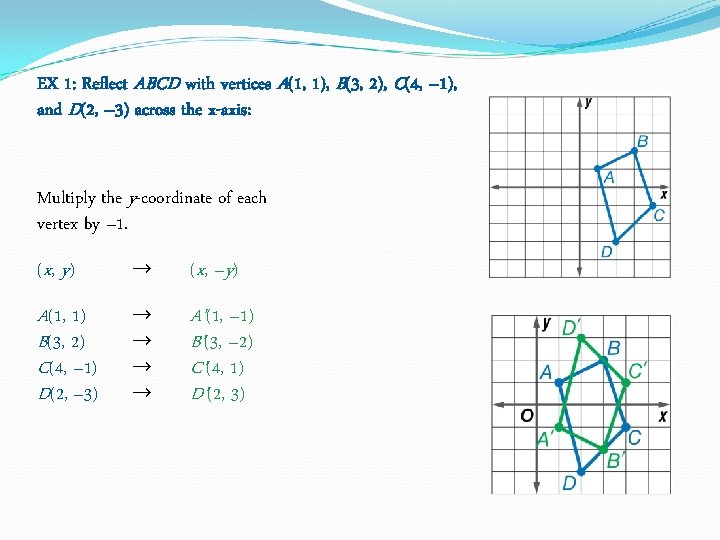
EX 1: Reflect ABCD with vertices A(1, 1), B(3, 2), C(4, – 1), and D(2, – 3) across the x-axis: Multiply the y-coordinate of each vertex by – 1. (x, y) → (x, – y) A(1, 1) B(3, 2) C(4, – 1) D(2, – 3) → → A'(1, – 1) B'(3, – 2) C'(4, 1) D'(2, 3)
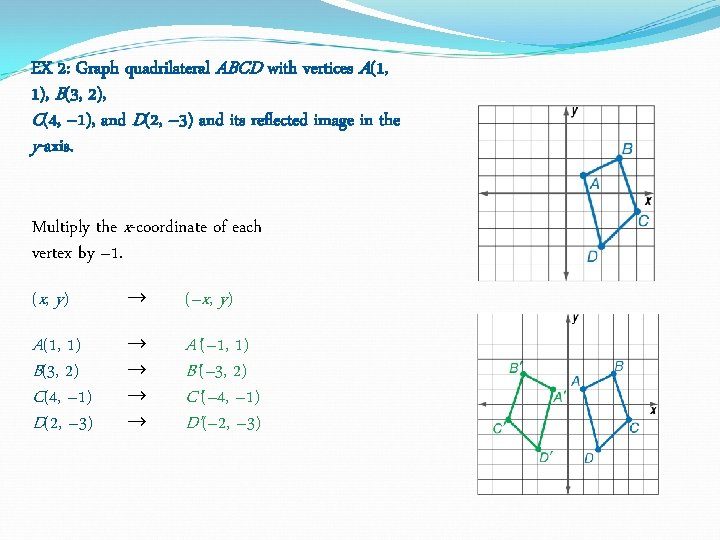
EX 2: Graph quadrilateral ABCD with vertices A(1, 1), B(3, 2), C(4, – 1), and D(2, – 3) and its reflected image in the y-axis. Multiply the x-coordinate of each vertex by – 1. (x, y) → (–x, y) A(1, 1) B(3, 2) C(4, – 1) D(2, – 3) → → A'(– 1, 1) B'(– 3, 2) C'(– 4, – 1) D'(– 2, – 3)
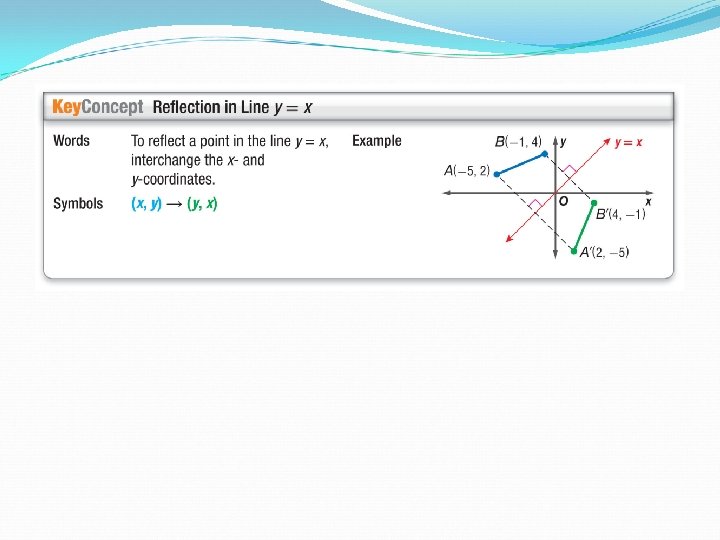
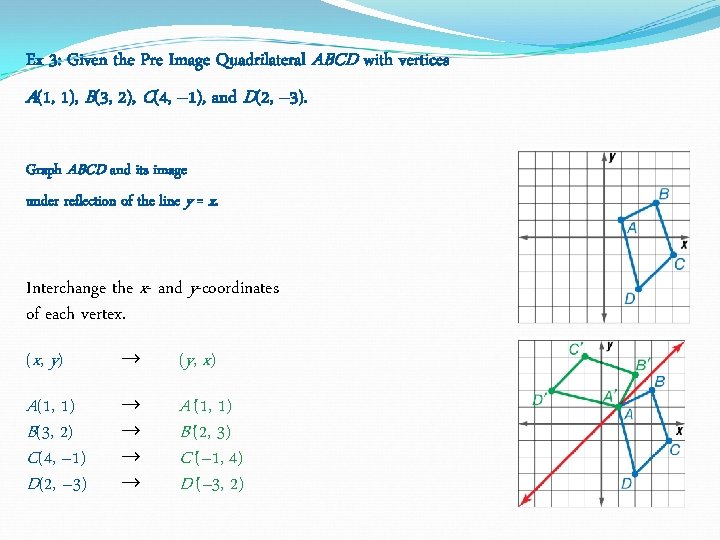
Ex 3: Given the Pre Image Quadrilateral ABCD with vertices A(1, 1), B(3, 2), C(4, – 1), and D(2, – 3). Graph ABCD and its image under reflection of the line y = x. Interchange the x- and y-coordinates of each vertex. (x, y) → (y, x) A(1, 1) B(3, 2) C(4, – 1) D(2, – 3) → → A'(1, 1) B'(2, 3) C'(– 1, 4) D'(– 3, 2)
EX 4: Quadrilateral EFGH has vertices E(– 3, 1), F(– 1, 3), G(1, 2), and H(– 3, – 1). The quadrilateral was reflected, giving the image the coordinates: E'(1, – 3), F'(3, – 1), G'(2, 1), H'(– 1, – 3) How was the quadrilateral reflected? It was reflected over the line y=x, since all of the x and y values have been switched
DILATIONS
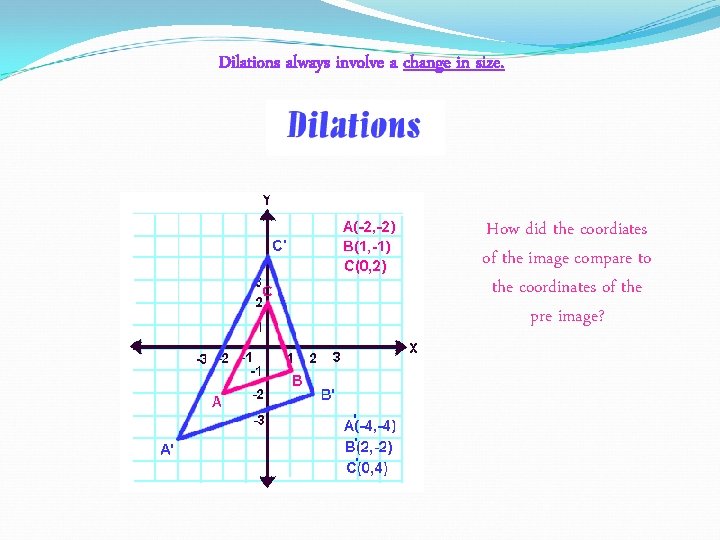
Dilations always involve a change in size. How did the coordiates of the image compare to the coordinates of the pre image?
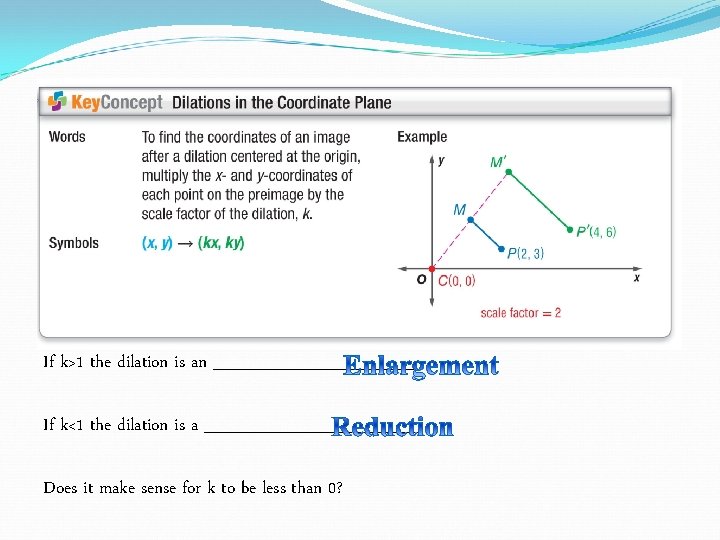
If k>1 the dilation is an _________ If k<1 the dilation is a _________ Does it make sense for k to be less than 0?
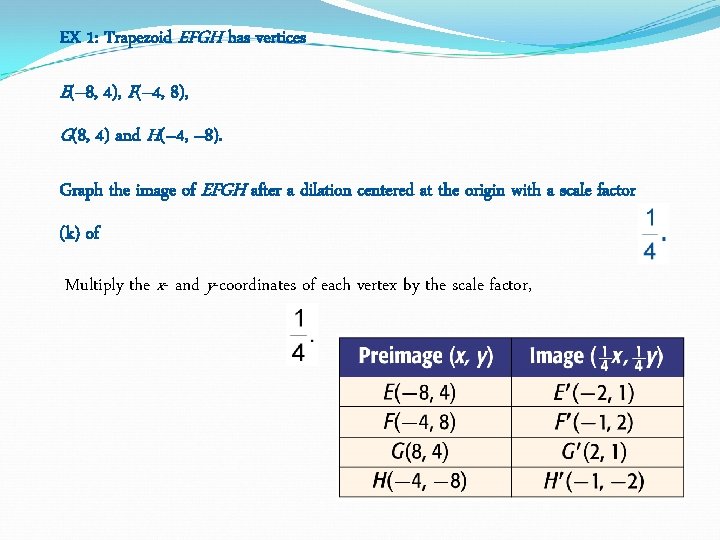
EX 1: Trapezoid EFGH has vertices E(– 8, 4), F(– 4, 8), G(8, 4) and H(– 4, – 8). Graph the image of EFGH after a dilation centered at the origin with a scale factor (k) of Multiply the x- and y-coordinates of each vertex by the scale factor,
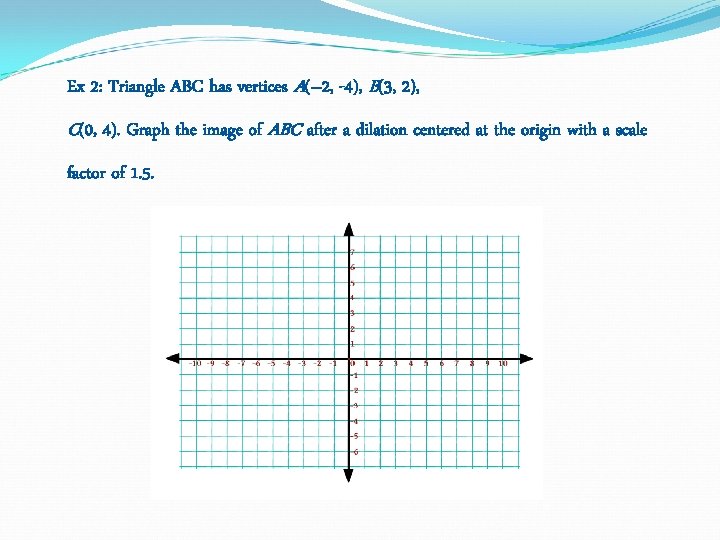
Ex 2: Triangle ABC has vertices A(– 2, -4), B(3, 2), C(0, 4). Graph the image of ABC after a dilation centered at the origin with a scale factor of 1. 5.
Rotations and Symmetry
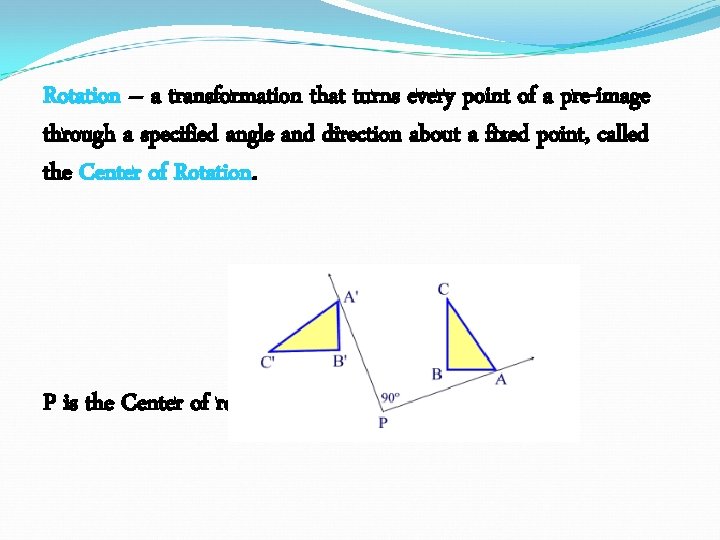
Rotation – a transformation that turns every point of a pre-image through a specified angle and direction about a fixed point, called the Center of Rotation. P is the Center of rotation!
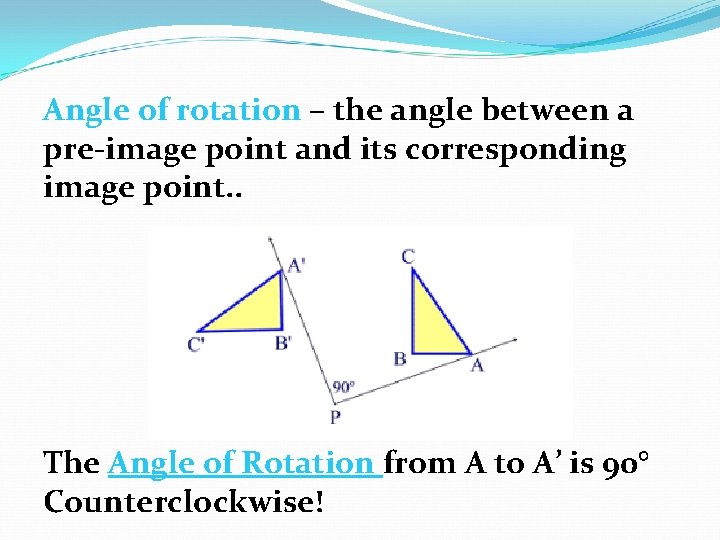
Angle of rotation – the angle between a pre-image point and its corresponding image point. . The Angle of Rotation from A to A’ is 90° Counterclockwise!
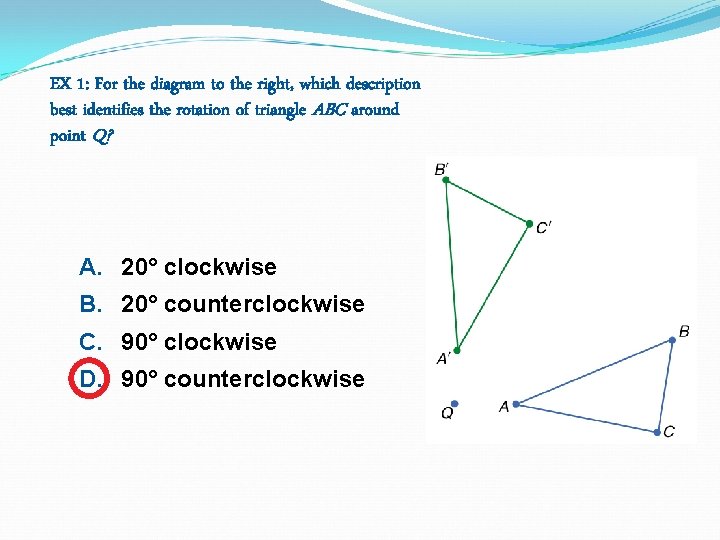
EX 1: For the diagram to the right, which description best identifies the rotation of triangle ABC around point Q? A. 20° clockwise B. 20° counterclockwise C. 90° clockwise D. 90° counterclockwise
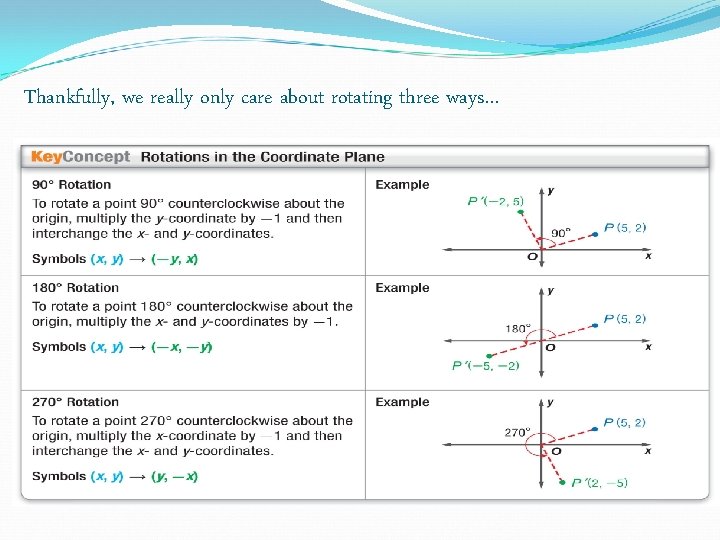
Thankfully, we really only care about rotating three ways…
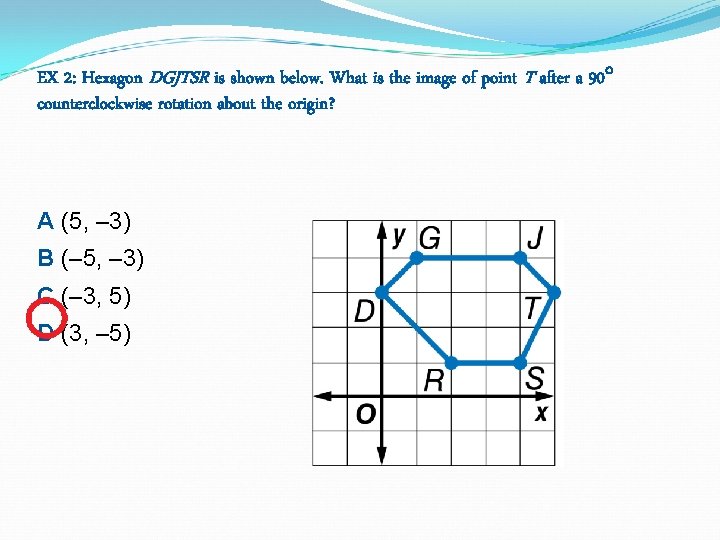
EX 2: Hexagon DGJTSR is shown below. What is the image of point T after a 90 counterclockwise rotation about the origin? A (5, – 3) B (– 5, – 3) C (– 3, 5) D (3, – 5)
EX 3: 1. What is the image of point Q after a 90° counterclockwise rotation about the origin? (– 5, 4) 2. What is the image of point Q after a 180° counterclockwise rotation about the origin? (-4, -5) 3. What is the image of point Q after a 270° counterclockwise rotation about the origin? (5, -4)
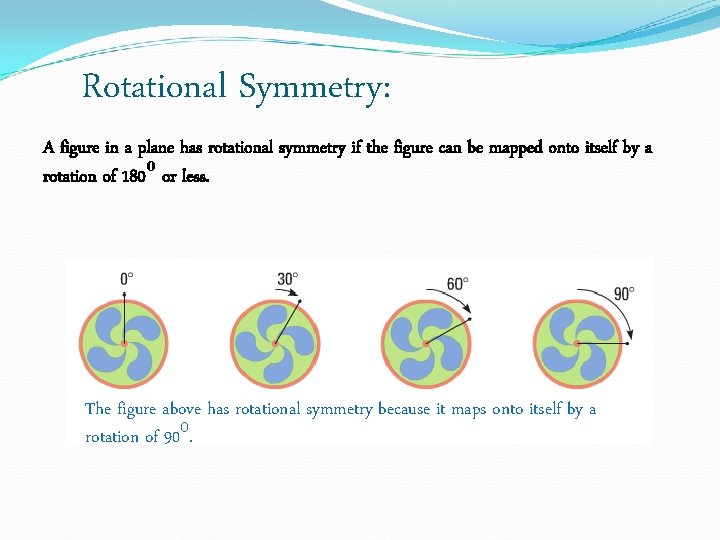
Rotational Symmetry: A figure in a plane has rotational symmetry if the figure can be mapped onto itself by a rotation of 180⁰ or less. The figure above has rotational symmetry because it maps onto itself by a rotation of 90⁰.
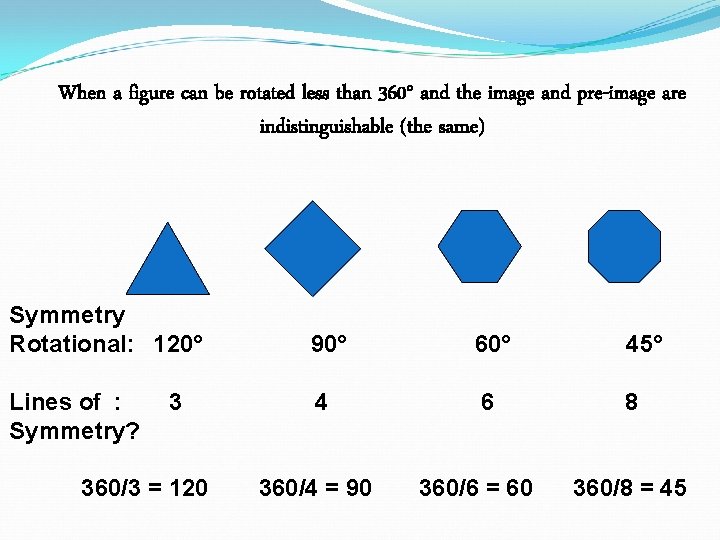
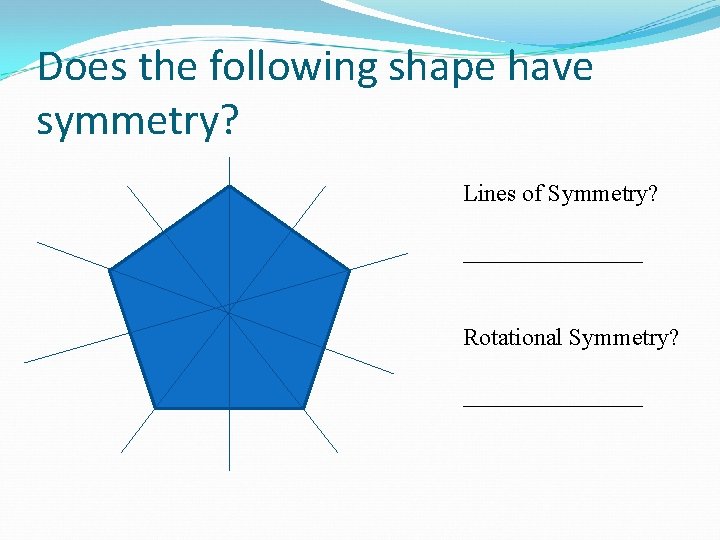
When a figure can be rotated less than 360° and the image and pre-image are indistinguishable (the same) Symmetry Rotational: 120° Lines of : Symmetry? 3 360/3 = 120 90° 60° 45° 4 6 8 360/4 = 90 360/6 = 60 360/8 = 45
Does the following shape have symmetry? Lines of Symmetry? ________ Rotational Symmetry? ________
Day 5 Composites!
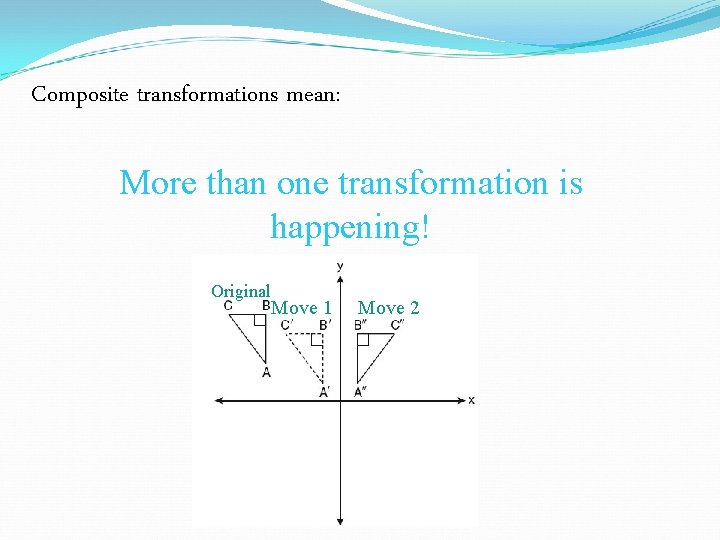
Composite transformations mean: More than one transformation is happening! Original Move 1 Move 2
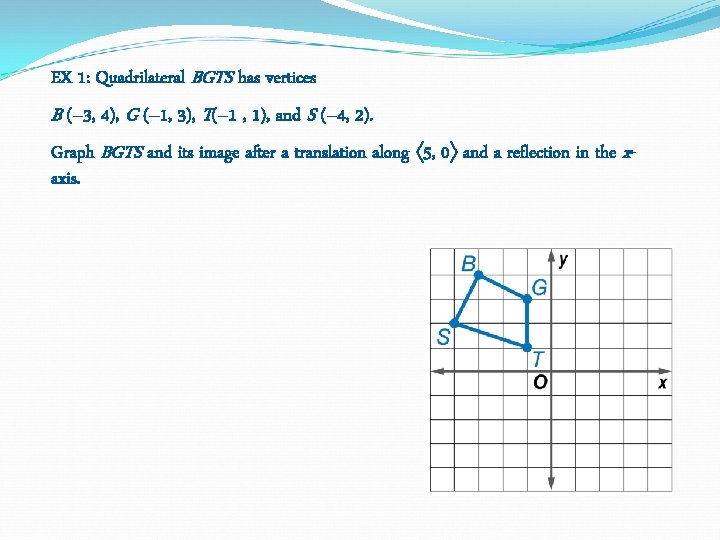
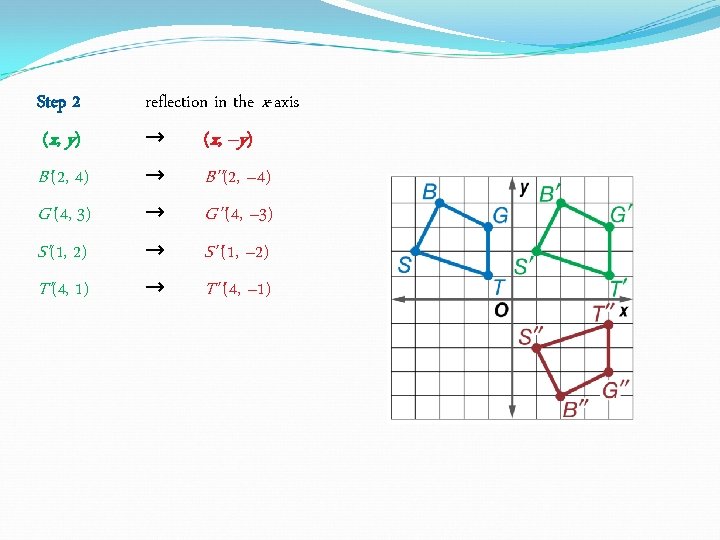
EX 1: Quadrilateral BGTS has vertices B (– 3, 4), G (– 1, 3), T(– 1 , 1), and S (– 4, 2). Graph BGTS and its image after a translation along 5, 0 and a reflection in the xaxis.
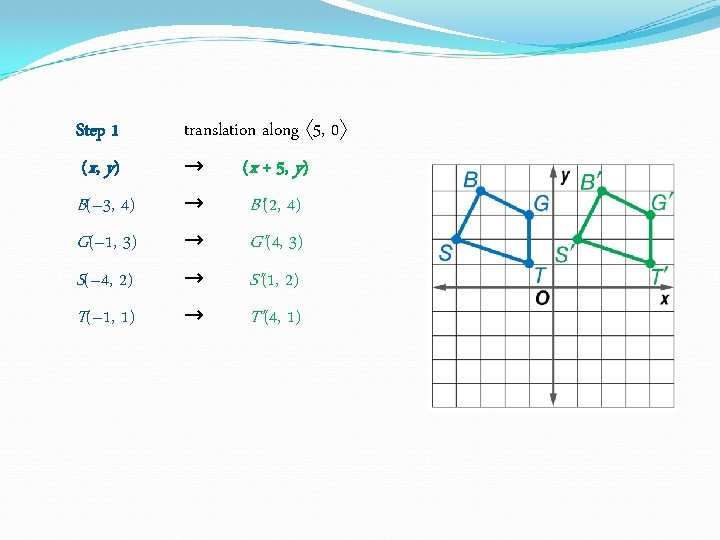
Step 1 (x, y) B(– 3, 4) G(– 1, 3) S(– 4, 2) T(– 1, 1) translation along 5, 0 → → → (x + 5, y) B'(2, 4) G'(4, 3) S'(1, 2) T'(4, 1)
Step 2 reflection in the x-axis (x, y) (x, – y) B'(2, 4) G'(4, 3) S'(1, 2) T'(4, 1) → → → B''(2, – 4) G''(4, – 3) S''(1, – 2) T''(4, – 1)
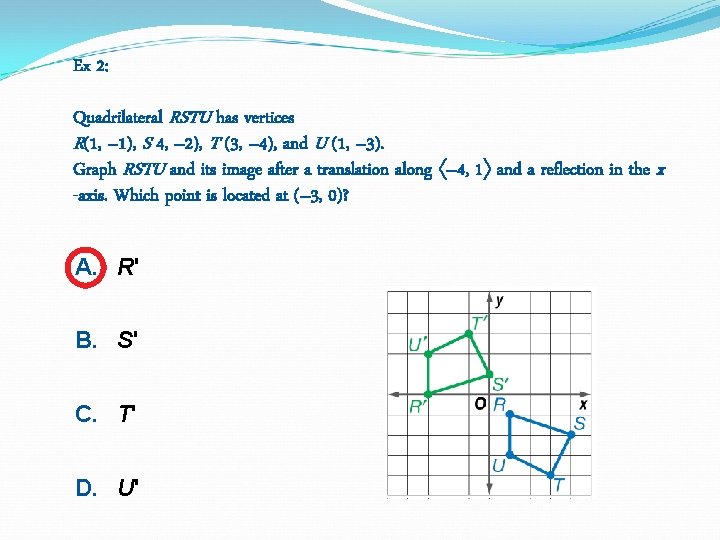
Ex 2: Quadrilateral RSTU has vertices R(1, – 1), S 4, – 2), T (3, – 4), and U (1, – 3). Graph RSTU and its image after a translation along – 4, 1 and a reflection in the x -axis. Which point is located at (– 3, 0)? A. R' B. S' C. T' D. U'
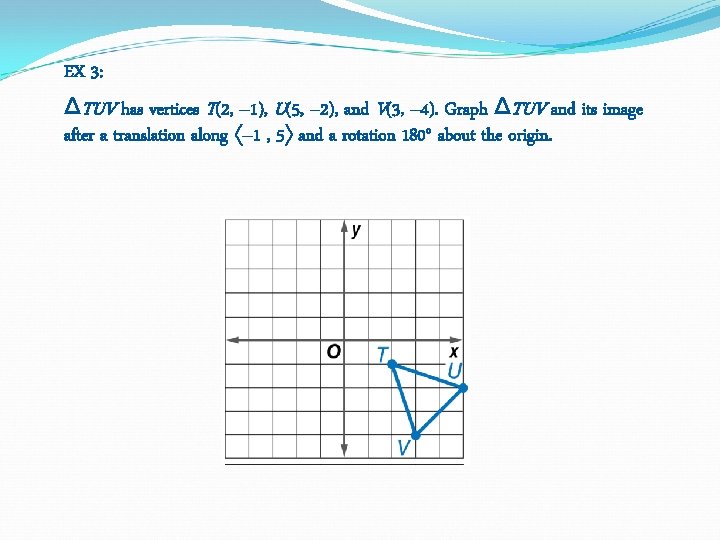
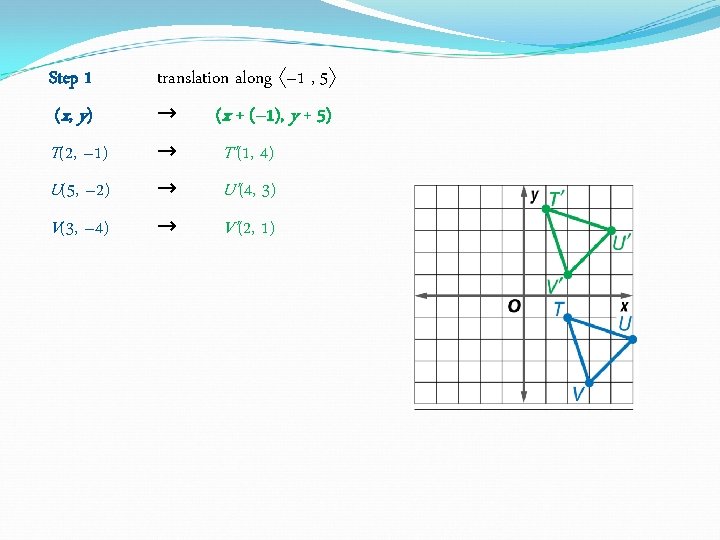
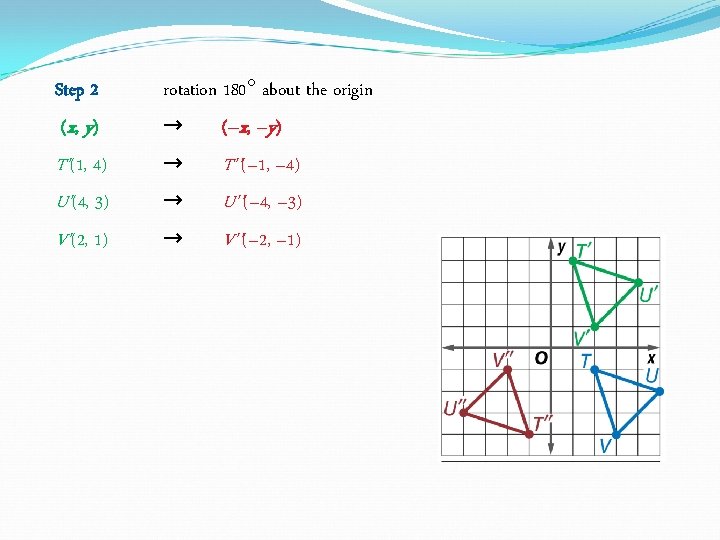
EX 3: ΔTUV has vertices T(2, – 1), U(5, – 2), and V(3, – 4). Graph ΔTUV and its image after a translation along – 1 , 5 and a rotation 180° about the origin.
Step 1 translation along – 1 , 5 (x, y) (x + (– 1), y + 5) T(2, – 1) U(5, – 2) V(3, – 4) → → T'(1, 4) U'(4, 3) V'(2, 1)
Step 2 (x, y) T'(1, 4) U'(4, 3) V'(2, 1) rotation 180 about the origin → → (–x, –y) T''(– 1, – 4) U''(– 4, – 3) V''(– 2, – 1)
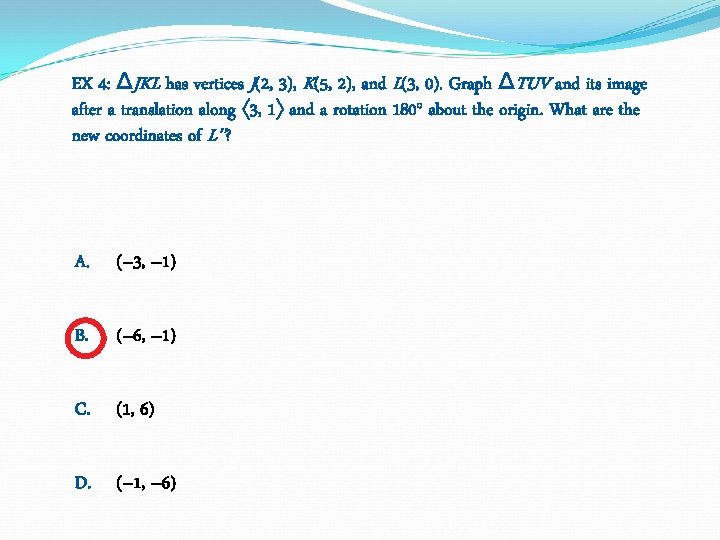
EX 4: ΔJKL has vertices J(2, 3), K(5, 2), and L(3, 0). Graph ΔTUV and its image after a translation along 3, 1 and a rotation 180° about the origin. What are the new coordinates of L''? A. (– 3, – 1) B. (– 6, – 1) C. (1, 6) D. (– 1, – 6)