
To Teach is to Inspire but what else
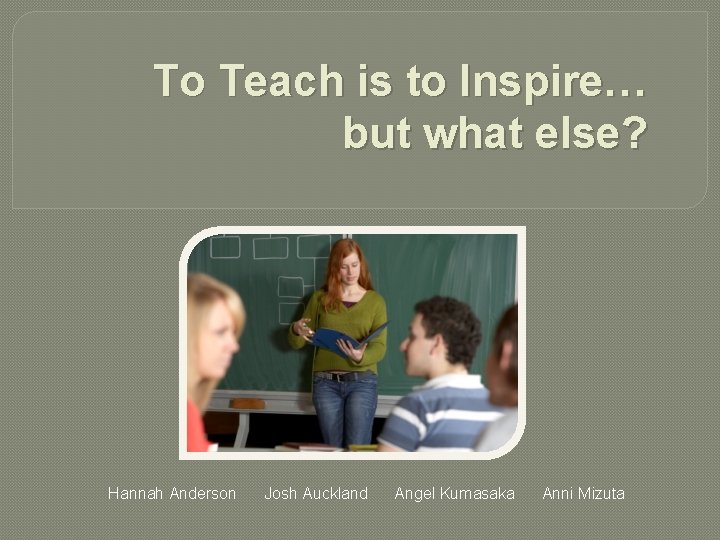
To Teach is to Inspire… but what else? Hannah Anderson Josh Auckland Angel Kumasaka Anni Mizuta
Why Teach? �Why do you teach? �What go you started in this profession?
What Makes a Good Teacher? �How do you change a child’s life? � What qualities do all good teachers posses? • Knowledge about subject matter • Engaging & applicable lessons • Self-reflective & accept constructive feedback • Inspire students
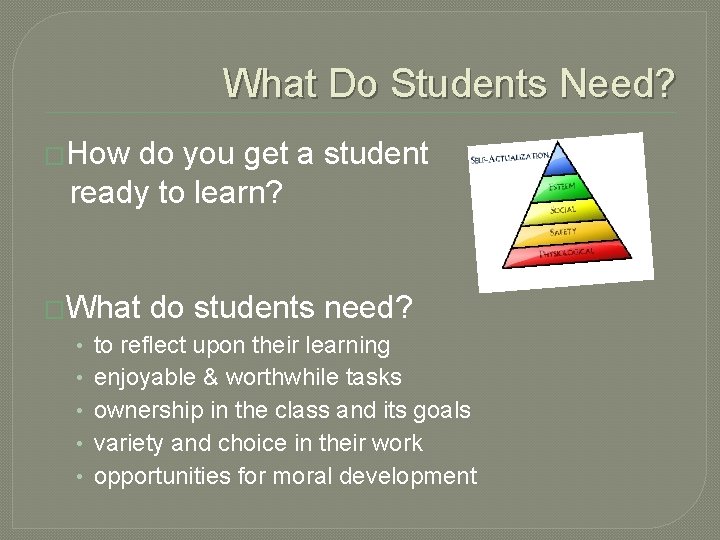
What Do Students Need? �How do you get a student ready to learn? �What • • • do students need? to reflect upon their learning enjoyable & worthwhile tasks ownership in the class and its goals variety and choice in their work opportunities for moral development
What Do Good Classrooms Look Like? � Establishes trust in others and self � Comfortable � Goals and relaxed and expectations are clearly posted � Concise classroom management � Creates ownership and respect for the class � Challenges � Develops students to develop self-respect self-awareness
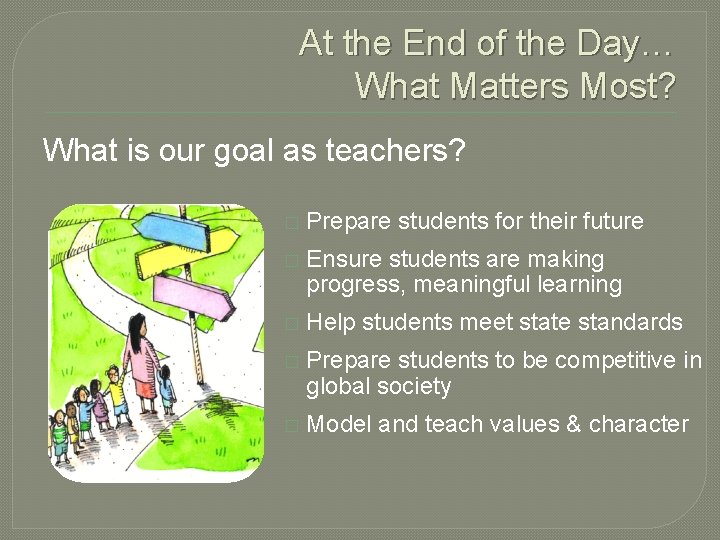
At the End of the Day… What Matters Most? What is our goal as teachers? � Prepare students for their future � Ensure students are making progress, meaningful learning � Help students meet state standards � Prepare students to be competitive in global society � Model and teach values & character

The Reflective Classroom Why is a reflective classroom important? � Self improvement & critical thinking skills � Student empowerment in learning � Cooperative learning & safe atmosphere � Student engagement & openness to learning
How Do You Raise Student Achievement? � Focus on knowledge, skills, and values � Differentiate the learning to make connections � Have high expectations � Have students produce work of true value � Use effective, research-based instructional strategies & curriculum � Allow active participation in learning giving students a voice � Use student reflections for assessment, feedback, and engagement
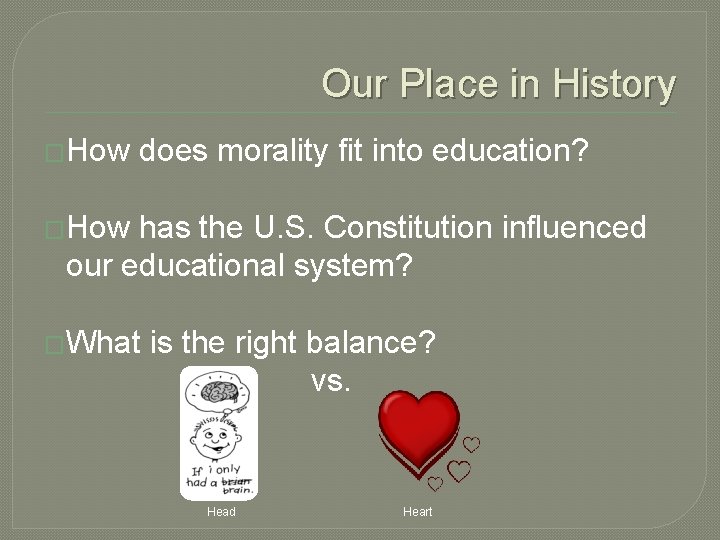
Our Place in History �How does morality fit into education? �How has the U. S. Constitution influenced our educational system? �What is the right balance? vs. Head Heart
In Conclusion…. �We are all made differently with different gifts & skills �There is no “one way” to teach �Teaching is a calling, to make a difference in others’ lives
References � Dewey, J. (1897). My pedagogical creed. School Journal, vol. 54. pp. 77 -80. Retrieved online at http: //dewey. pragmatism. org/creed. htm. � Di. Giulio, R. (2010). Psst…it ain’t about the tests. In A. S. Canestrari & B. A. Marlowe (Eds. ) Educational foundations: An anthology of critical readings (pp. 133 -140). Thousand Oaks, CA: SAGE Publications, Inc. � Ellis, A. K. (1998). Emile Durkheim in the context of the American moral education paradigm. [Course reading] Retrieved from Blackboard. � Ellis, A. K. (2001). Teaching, learning, & assessment together: The reflective Classroom. Larchmont, NY: Eye on Education, Inc. � Ellis, A. K. (2010 a). The emergence of eastern educational thought [Lecture document]. Retrieved from Blackboard. � Ellis, A. K. (2010 b). The emergence of western educational thought. [Lecture document]. Retrieved from Blackboard. � Ellis, A. K. (2010 c). Horace Mann and the common school movement. [Lecture document]. Retrieved from Blackboard. � Ellis, A. K. (Year unknown). Historical Perspectives: Education in the Old World (Part 2 -Renaissance and Reformation) [Class reading document]. � Jackson, P. , Boostrom, R. , & Hansen, D. (1993). The moral life of schools. San Francisco, CA: Jossey-Bass Publishers. � Kohn, H. (2010). Why teach? In A. S. Canestrari & B. A. Marlowe (Eds. ) Educational foundations: An anthology of critical readings (pp. 21 -29). Thousand Oaks, CA: SAGE Publications, Inc. � Marzano, R. J. , Pickering, D. J. & Pollock, J. E. (2001). Classroom instruction that works: Research-based strategies for increasing student achievement. Alexandria VA: Association for Supervision and Curriculum Development. � Mc. Court, F. (2010). Teacher man. In A. S. Canestrari & B. A. Marlowe (Eds. ) Educational foundations: An anthology of critical readings (pp. 3 -8). Thousand Oaks, CA: SAGE Publications, Inc. � Neill, A. S. (2010). The idea of Summerhill. In A. S. Canestrari & B. A. Marlowe (Eds. ) Educational foundations: An anthology of critical readings (pp. 133 -140). Thousand Oaks, CA: SAGE Publications, Inc � Patrick, H. , Turner, J. , Meyer, D. K. , & Midgley, C. (2003). How teachers establish psychological environments during the first days of school. Teachers College Record. Volume 105 Number 8, 2003, (p p. 1521 -1558). Accessed at http: //www. tcrecord. org � Revised Code of Washington Title 28 A – Common School Provisions. Retrieved from http: //www. mrsc. org/mc/rcw%20%2028 A%20 TITLE/rcw%20%2028 A%20%20 TITLE. htm � Washor, E. (2010). When learning matters: Using learning plans to educate one student at a time. In A. S. Canestrari & B. A. Marlowe (Eds. ) Educational foundations: An anthology of critical readings (pp. 150 -160). Thousand Oaks, CA: SAGE Publications, Inc. � Whitehouse, A. N. (1916). The aims of education. [Presidential address to the Mathematical Association of England. ] Retrieved from Blackboard. � Willingham, D. T. (2009). Why don’t students like school? San Francisco, CA: Jossey-Bass.
- Slides: 11