
To solve complex problems involving interpreting line graphs
To solve complex problems involving interpreting line graphs. Year 5 - Statistics (GDS) Lesson 2
LI: To solve complex problems involving interpreting line graphs. I can identify what the axes of the graph are measuring. I can following the X axis first and then the Y axis to read the graph. I can draw conclusion from a line graph. Vocabulary Line graph Time X axis Y axis Title Measure Patterns Conclusions Recap from the last lesson… Look at the skills and then quickly check your understanding. Previously, we looked at how we can read and interpret two-way tables and timetables. Let’s quickly recap the rules of reading tables. . . Two-way tables: Use the heading on top and on the left of the table to understand what is being measured. Remember two-way tables are usually measuring two different variables for example food and drink. In two way tables you can use the information to help you fill in any missing information. Timetables: Timetables are basically a schedule telling what time certain things will happen. The most common type is a train or bus timetable. The main thing you need to remember is that each column is a different train so it might be useful noting that down on your table.
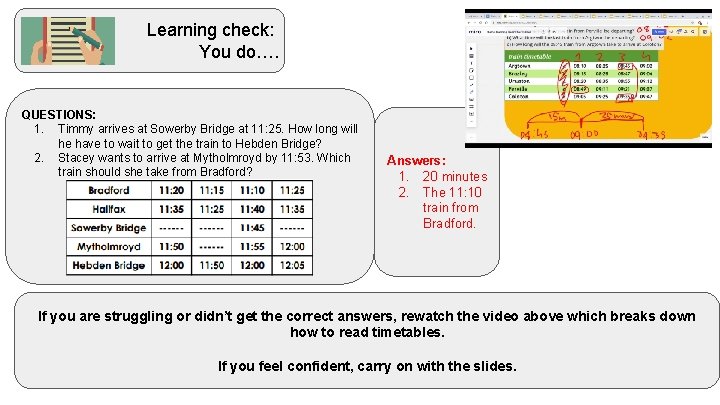
Learning check: You do…. QUESTIONS: 1. Timmy arrives at Sowerby Bridge at 11: 25. How long will he have to wait to get the train to Hebden Bridge? 2. Stacey wants to arrive at Mytholmroyd by 11: 53. Which train should she take from Bradford? Answers: 1. 20 minutes 2. The 11: 10 train from Bradford. If you are struggling or didn’t get the correct answers, rewatch the video above which breaks down how to read timetables. If you feel confident, carry on with the slides.
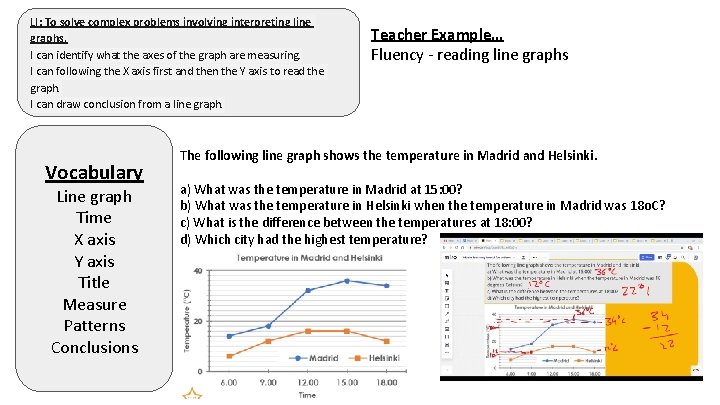
LI: To solve complex problems involving interpreting line graphs. I can identify what the axes of the graph are measuring. I can following the X axis first and then the Y axis to read the graph. I can draw conclusion from a line graph. Vocabulary Line graph Time X axis Y axis Title Measure Patterns Conclusions Teacher Example… Fluency - reading line graphs The following line graph shows the temperature in Madrid and Helsinki. a) What was the temperature in Madrid at 15: 00? b) What was the temperature in Helsinki when the temperature in Madrid was 18 o. C? c) What is the difference between the temperatures at 18: 00? d) Which city had the highest temperature?
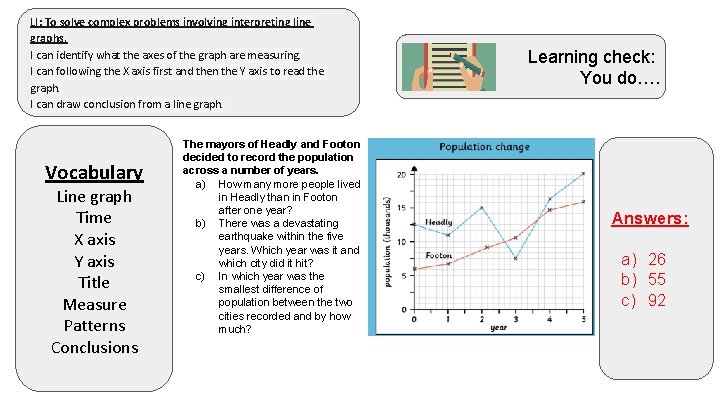
LI: To solve complex problems involving interpreting line graphs. I can identify what the axes of the graph are measuring. I can following the X axis first and then the Y axis to read the graph. I can draw conclusion from a line graph. Vocabulary Line graph Time X axis Y axis Title Measure Patterns Conclusions The mayors of Headly and Footon decided to record the population across a number of years. a) How many more people lived in Headly than in Footon after one year? b) There was a devastating earthquake within the five years. Which year was it and which city did it hit? c) In which year was the smallest difference of population between the two cities recorded and by how much? Learning check: You do…. Answers: a) 26 b) 55 c) 92
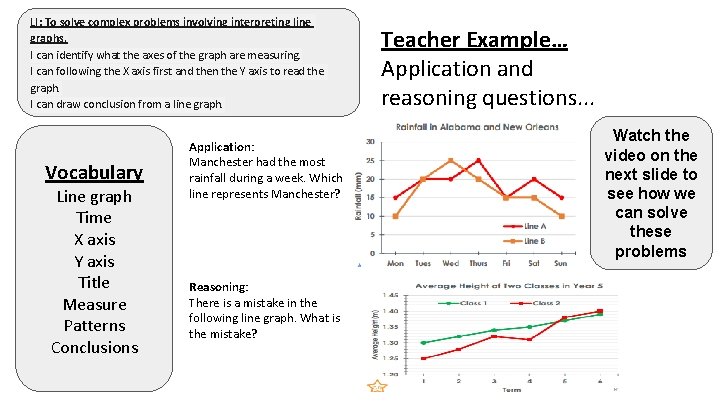
LI: To solve complex problems involving interpreting line graphs. I can identify what the axes of the graph are measuring. I can following the X axis first and then the Y axis to read the graph. I can draw conclusion from a line graph. Vocabulary Line graph Time X axis Y axis Title Measure Patterns Conclusions Application: Manchester had the most rainfall during a week. Which line represents Manchester? Reasoning: There is a mistake in the following line graph. What is the mistake? Teacher Example… Application and reasoning questions. . . Watch the video on the next slide to see how we can solve these problems
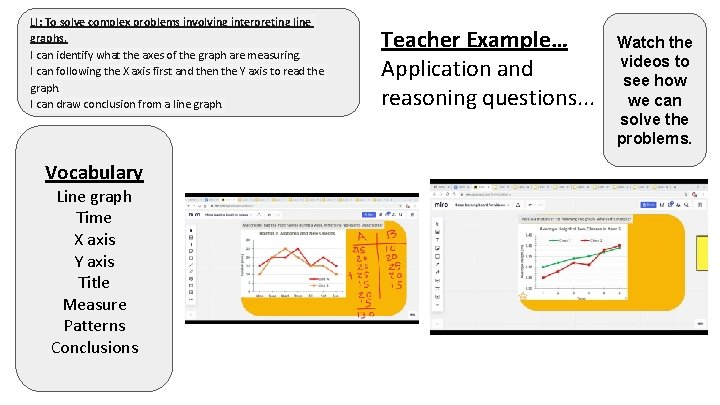
LI: To solve complex problems involving interpreting line graphs. I can identify what the axes of the graph are measuring. I can following the X axis first and then the Y axis to read the graph. I can draw conclusion from a line graph. Vocabulary Line graph Time X axis Y axis Title Measure Patterns Conclusions Teacher Example… Application and reasoning questions. . . Watch the videos to see how we can solve the problems.

LI: To solve complex problems involving interpreting line graphs. I can identify what the axes of the graph are measuring. I can following the X axis first and then the Y axis to read the graph. I can draw conclusion from a line graph. Q 1 Mahmood and Sarah are growing sunflowers. They measured the height of their sunflowers after each week and plotted them on a line graph. In which week did Mahmood’s sunflower not grow? Q 2 There is a mistake on the following line graph. Explain the mistake. Vocabulary Line graph Time X axis Y axis Title Measure Patterns Conclusions Learning check: You do….
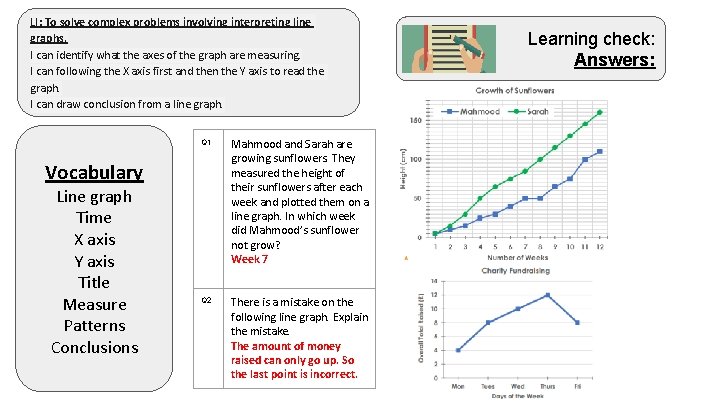
LI: To solve complex problems involving interpreting line graphs. I can identify what the axes of the graph are measuring. I can following the X axis first and then the Y axis to read the graph. I can draw conclusion from a line graph. Q 1 Mahmood and Sarah are growing sunflowers. They measured the height of their sunflowers after each week and plotted them on a line graph. In which week did Mahmood’s sunflower not grow? Week 7 Q 2 There is a mistake on the following line graph. Explain the mistake. The amount of money raised can only go up. So the last point is incorrect. Vocabulary Line graph Time X axis Y axis Title Measure Patterns Conclusions Learning check: Answers:

Well done! Now complete the worksheet below on the google doc. You can either write the answers on the google doc, or write it out on paper and send a picture of your work to your teacher. https: //docs. google. com/document/d/17 MWw 5 s 8 fnbi. THCpj. I 5 Uo 2 UQVYSNZu. Ch. I 6 C 04 EEwrv. N 4/edit Remember to log onto maths whizz as well this week!
- Slides: 10