
To solve complex multi step problems involving multiplying
To solve complex multi step problems involving multiplying four digit numbers and decimals by two digit numbers. Year 5 - Number (GDS) Lesson 2
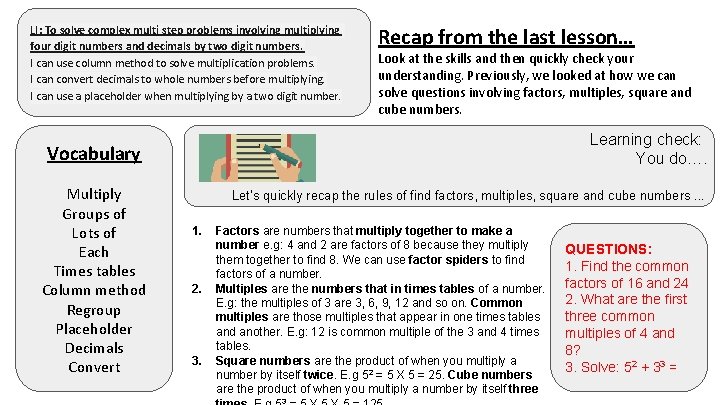
LI: To solve complex multi step problems involving multiplying four digit numbers and decimals by two digit numbers. I can use column method to solve multiplication problems. I can convert decimals to whole numbers before multiplying. I can use a placeholder when multiplying by a two digit number. Recap from the last lesson… Look at the skills and then quickly check your understanding. Previously, we looked at how we can solve questions involving factors, multiples, square and cube numbers. Learning check: You do…. Vocabulary Multiply Groups of Lots of Each Times tables Column method Regroup Placeholder Decimals Convert Let’s quickly recap the rules of find factors, multiples, square and cube numbers. . . 1. 2. 3. Factors are numbers that multiply together to make a number e. g: 4 and 2 are factors of 8 because they multiply them together to find 8. We can use factor spiders to find factors of a number. Multiples are the numbers that in times tables of a number. E. g: the multiples of 3 are 3, 6, 9, 12 and so on. Common multiples are those multiples that appear in one times tables and another. E. g: 12 is common multiple of the 3 and 4 times tables. Square numbers are the product of when you multiply a number by itself twice. E. g 52 = 5 X 5 = 25. Cube numbers are the product of when you multiply a number by itself three 3 QUESTIONS: 1. Find the common factors of 16 and 24 2. What are the first three common multiples of 4 and 8? 3. Solve: 52 + 33 =
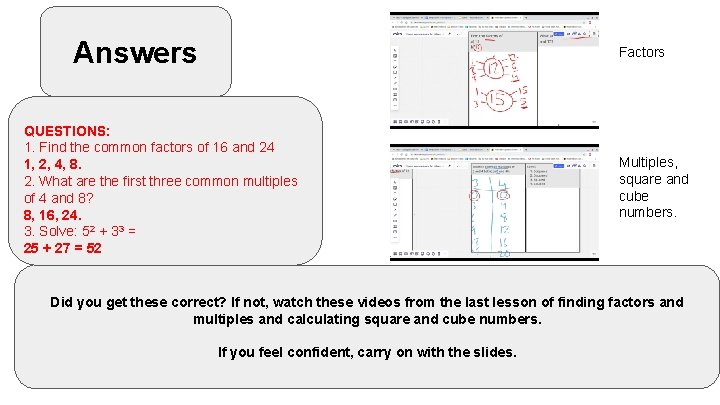
Answers Factors QUESTIONS: 1. Find the common factors of 16 and 24 1, 2, 4, 8. 2. What are the first three common multiples of 4 and 8? 8, 16, 24. 3. Solve: 52 + 33 = 25 + 27 = 52 Multiples, square and cube numbers. Did you get these correct? If not, watch these videos from the last lesson of finding factors and multiples and calculating square and cube numbers. If you feel confident, carry on with the slides.
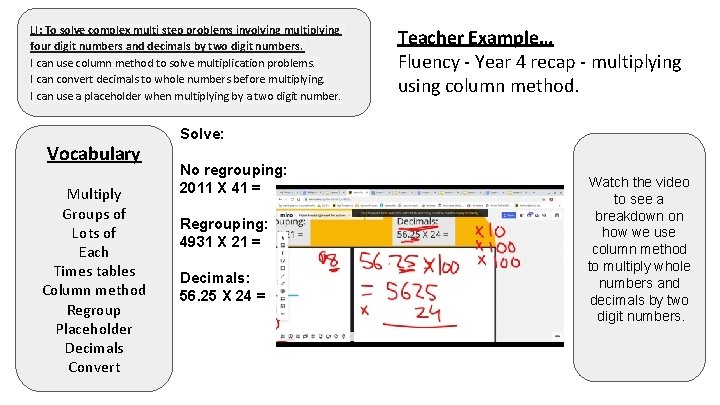
LI: To solve complex multi step problems involving multiplying four digit numbers and decimals by two digit numbers. I can use column method to solve multiplication problems. I can convert decimals to whole numbers before multiplying. I can use a placeholder when multiplying by a two digit number. Vocabulary Multiply Groups of Lots of Each Times tables Column method Regroup Placeholder Decimals Convert Teacher Example… Fluency - Year 4 recap - multiplying using column method. Solve: No regrouping: 2011 X 41 = Regrouping: 4931 X 21 = Decimals: 56. 25 X 24 = Watch the video to see a breakdown on how we use column method to multiply whole numbers and decimals by two digit numbers.
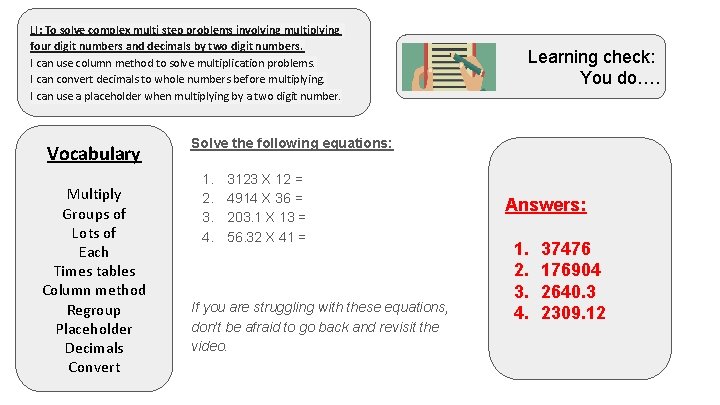
LI: To solve complex multi step problems involving multiplying four digit numbers and decimals by two digit numbers. I can use column method to solve multiplication problems. I can convert decimals to whole numbers before multiplying. I can use a placeholder when multiplying by a two digit number. Vocabulary Multiply Groups of Lots of Each Times tables Column method Regroup Placeholder Decimals Convert Learning check: You do…. Solve the following equations: 1. 2. 3. 4. 3123 X 12 = 4914 X 36 = 203. 1 X 13 = 56. 32 X 41 = If you are struggling with these equations, don’t be afraid to go back and revisit the video. Answers: 1. 2. 3. 4. 37476 176904 2640. 3 2309. 12
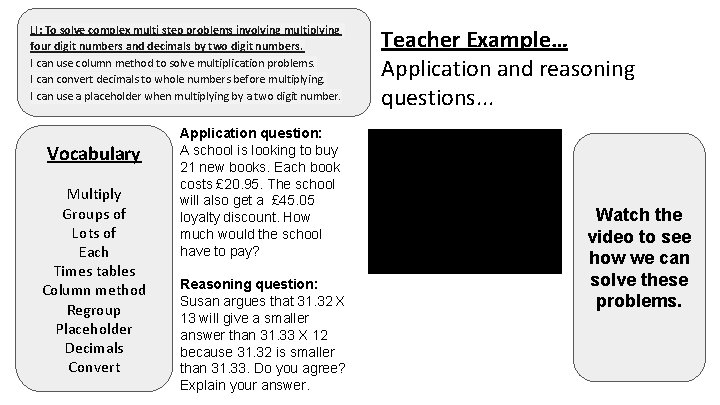
LI: To solve complex multi step problems involving multiplying four digit numbers and decimals by two digit numbers. I can use column method to solve multiplication problems. I can convert decimals to whole numbers before multiplying. I can use a placeholder when multiplying by a two digit number. Vocabulary Multiply Groups of Lots of Each Times tables Column method Regroup Placeholder Decimals Convert Application question: A school is looking to buy 21 new books. Each book costs £ 20. 95. The school will also get a £ 45. 05 loyalty discount. How much would the school have to pay? Reasoning question: Susan argues that 31. 32 X 13 will give a smaller answer than 31. 33 X 12 because 31. 32 is smaller than 31. 33. Do you agree? Explain your answer. Teacher Example… Application and reasoning questions. . . Watch the video to see how we can solve these problems.
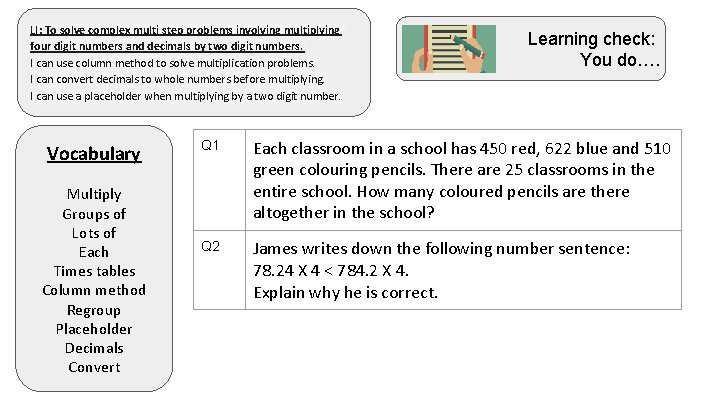
LI: To solve complex multi step problems involving multiplying four digit numbers and decimals by two digit numbers. I can use column method to solve multiplication problems. I can convert decimals to whole numbers before multiplying. I can use a placeholder when multiplying by a two digit number. Vocabulary Multiply Groups of Lots of Each Times tables Column method Regroup Placeholder Decimals Convert Learning check: You do…. Q 1 Each classroom in a school has 450 red, 622 blue and 510 green colouring pencils. There are 25 classrooms in the entire school. How many coloured pencils are there altogether in the school? Q 2 James writes down the following number sentence: 78. 24 X 4 < 784. 2 X 4. Explain why he is correct.
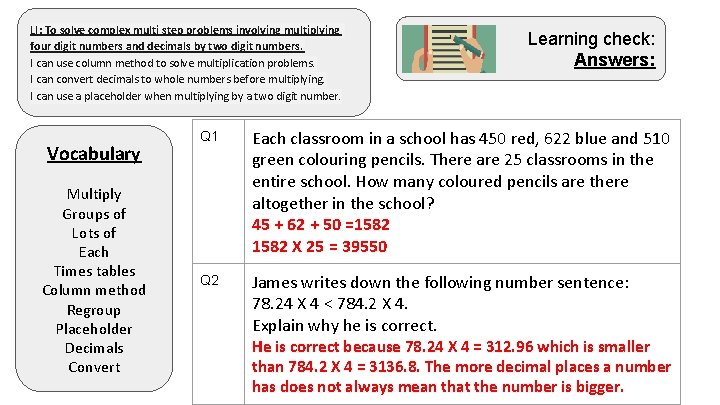
LI: To solve complex multi step problems involving multiplying four digit numbers and decimals by two digit numbers. I can use column method to solve multiplication problems. I can convert decimals to whole numbers before multiplying. I can use a placeholder when multiplying by a two digit number. Vocabulary Multiply Groups of Lots of Each Times tables Column method Regroup Placeholder Decimals Convert Learning check: Answers: Q 1 Each classroom in a school has 450 red, 622 blue and 510 green colouring pencils. There are 25 classrooms in the entire school. How many coloured pencils are there altogether in the school? 45 + 62 + 50 =1582 X 25 = 39550 Q 2 James writes down the following number sentence: 78. 24 X 4 < 784. 2 X 4. Explain why he is correct. He is correct because 78. 24 X 4 = 312. 96 which is smaller than 784. 2 X 4 = 3136. 8. The more decimal places a number has does not always mean that the number is bigger.
Well done! Now complete the worksheet below on the google doc. You can either write the answers on the google doc, or write it out on paper and send a picture of your work to your teacher. https: //docs. google. com/document/d/1 Cx. Az. BW 0 HPx. COMl 3 l. WMXdyjw 2 u. Ojg 5 KZz. LB 2 t. DTYNUe. M/edit Remember to log onto maths whizz as well this week!
- Slides: 9