
To solve complex multi step problems involving all
To solve complex multi step problems involving all four operations. Year 5 - Number (GDS) Lesson 3
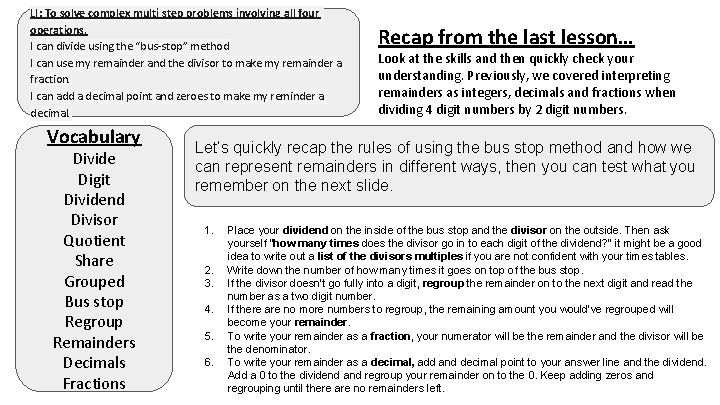
LI: To solve complex multi step problems involving all four operations. I can divide using the “bus-stop” method I can use my remainder and the divisor to make my remainder a fraction. I can add a decimal point and zeroes to make my reminder a decimal. Vocabulary Divide Digit Dividend Divisor Quotient Share Grouped Bus stop Regroup Remainders Decimals Fractions Recap from the last lesson… Look at the skills and then quickly check your understanding. Previously, we covered interpreting remainders as integers, decimals and fractions when dividing 4 digit numbers by 2 digit numbers. Let’s quickly recap the rules of using the bus stop method and how we can represent remainders in different ways, then you can test what you remember on the next slide. 1. 2. 3. 4. 5. 6. Place your dividend on the inside of the bus stop and the divisor on the outside. Then ask yourself “how many times does the divisor go in to each digit of the dividend? ” it might be a good idea to write out a list of the divisors multiples if you are not confident with your times tables. Write down the number of how many times it goes on top of the bus stop. If the divisor doesn’t go fully into a digit, regroup the remainder on to the next digit and read the number as a two digit number. If there are no more numbers to regroup, the remaining amount you would’ve regrouped will become your remainder. To write your remainder as a fraction, your numerator will be the remainder and the divisor will be the denominator. To write your remainder as a decimal, add and decimal point to your answer line and the dividend. Add a 0 to the dividend and regroup your remainder on to the 0. Keep adding zeros and regrouping until there are no remainders left.
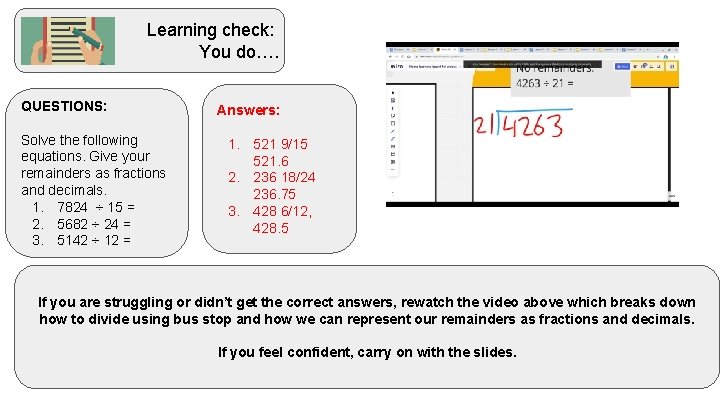
Learning check: You do…. QUESTIONS: Solve the following equations. Give your remainders as fractions and decimals. 1. 7824 ÷ 15 = 2. 5682 ÷ 24 = 3. 5142 ÷ 12 = Answers: 1. 521 9/15 521. 6 2. 236 18/24 236. 75 3. 428 6/12, 428. 5 If you are struggling or didn’t get the correct answers, rewatch the video above which breaks down how to divide using bus stop and how we can represent our remainders as fractions and decimals. If you feel confident, carry on with the slides.
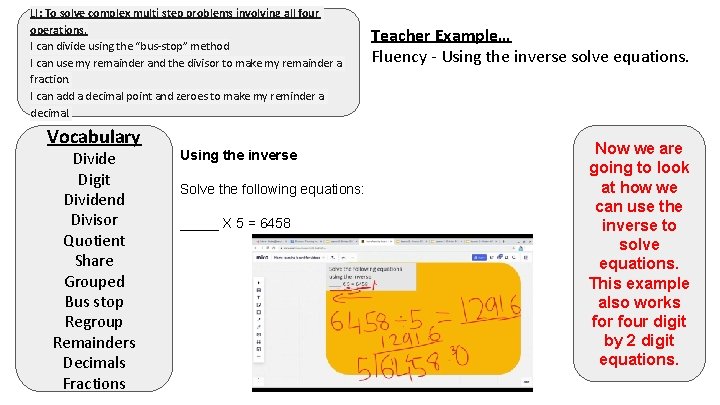
LI: To solve complex multi step problems involving all four operations. I can divide using the “bus-stop” method I can use my remainder and the divisor to make my remainder a fraction. I can add a decimal point and zeroes to make my reminder a decimal. Vocabulary Divide Digit Dividend Divisor Quotient Share Grouped Bus stop Regroup Remainders Decimals Fractions Using the inverse Solve the following equations: _____ X 5 = 6458 Teacher Example… Fluency - Using the inverse solve equations. Now we are going to look at how we can use the inverse to solve equations. This example also works for four digit by 2 digit equations.
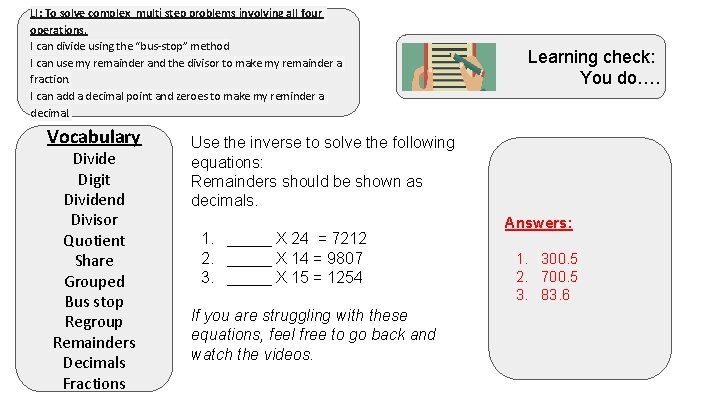
LI: To solve complex multi step problems involving all four operations. I can divide using the “bus-stop” method I can use my remainder and the divisor to make my remainder a fraction. I can add a decimal point and zeroes to make my reminder a decimal. Vocabulary Divide Digit Dividend Divisor Quotient Share Grouped Bus stop Regroup Remainders Decimals Fractions Learning check: You do…. Use the inverse to solve the following equations: Remainders should be shown as decimals. 1. _____ X 24 = 7212 2. _____ X 14 = 9807 3. _____ X 15 = 1254 If you are struggling with these equations, feel free to go back and watch the videos. Answers: 1. 300. 5 2. 700. 5 3. 83. 6
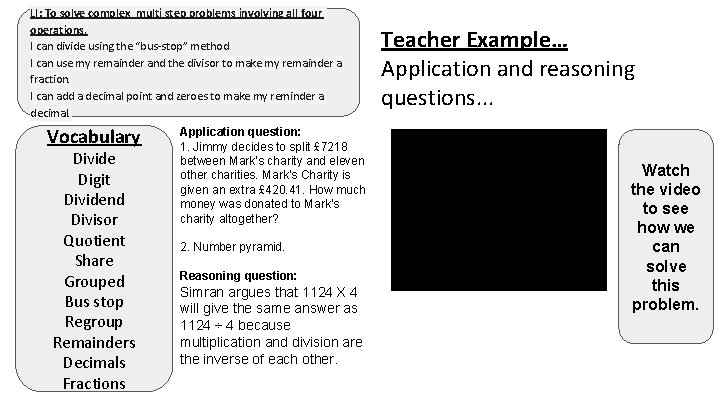
LI: To solve complex multi step problems involving all four operations. I can divide using the “bus-stop” method I can use my remainder and the divisor to make my remainder a fraction. I can add a decimal point and zeroes to make my reminder a decimal. Vocabulary Divide Digit Dividend Divisor Quotient Share Grouped Bus stop Regroup Remainders Decimals Fractions Application question: 1. Jimmy decides to split £ 7218 between Mark’s charity and eleven other charities. Mark’s Charity is given an extra £ 420. 41. How much money was donated to Mark’s charity altogether? 2. Number pyramid. Reasoning question: Simran argues that 1124 X 4 will give the same answer as 1124 ÷ 4 because multiplication and division are the inverse of each other. Teacher Example… Application and reasoning questions. . . Watch the video to see how we can solve this problem.
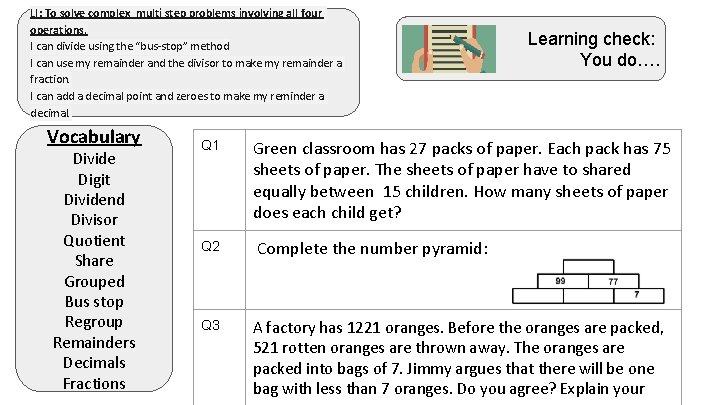
LI: To solve complex multi step problems involving all four operations. I can divide using the “bus-stop” method I can use my remainder and the divisor to make my remainder a fraction. I can add a decimal point and zeroes to make my reminder a decimal. Vocabulary Divide Digit Dividend Divisor Quotient Share Grouped Bus stop Regroup Remainders Decimals Fractions Learning check: You do…. Q 1 Green classroom has 27 packs of paper. Each pack has 75 sheets of paper. The sheets of paper have to shared equally between 15 children. How many sheets of paper does each child get? Q 2 Complete the number pyramid: Q 3 A factory has 1221 oranges. Before the oranges are packed, 521 rotten oranges are thrown away. The oranges are packed into bags of 7. Jimmy argues that there will be one bag with less than 7 oranges. Do you agree? Explain your
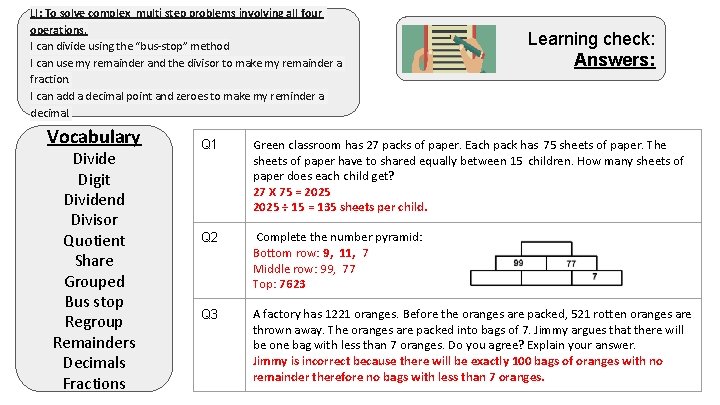
LI: To solve complex multi step problems involving all four operations. I can divide using the “bus-stop” method I can use my remainder and the divisor to make my remainder a fraction. I can add a decimal point and zeroes to make my reminder a decimal. Vocabulary Divide Digit Dividend Divisor Quotient Share Grouped Bus stop Regroup Remainders Decimals Fractions Learning check: Answers: Q 1 Green classroom has 27 packs of paper. Each pack has 75 sheets of paper. The sheets of paper have to shared equally between 15 children. How many sheets of paper does each child get? 27 X 75 = 2025 ÷ 15 = 135 sheets per child. Q 2 Complete the number pyramid: Bottom row: 9, 11, 7 Middle row: 99, 77 Top: 7623 Q 3 A factory has 1221 oranges. Before the oranges are packed, 521 rotten oranges are thrown away. The oranges are packed into bags of 7. Jimmy argues that there will be one bag with less than 7 oranges. Do you agree? Explain your answer. Jimmy is incorrect because there will be exactly 100 bags of oranges with no remainder therefore no bags with less than 7 oranges.
Well done! Now complete the worksheet below on the google doc. You can either write the answers on the google doc, or write it out on paper and send a picture of your work to your teacher. https: //docs. google. com/document/d/1 z 2 TEtcs 3 Lyx. Fb. Npx. GDxh. LRb. Swe. Eb. KTRZyte-w 2 d. J 2 m. E/edit Remember to log onto maths whizz as well this week!
- Slides: 9