
To read and interpret data on timetables Year
To read and interpret data on timetables. Year 5 - Statistics (WTS) Lesson 2

LI: To read and interpret data on timetables. I can use the headings on the table to read a timetable. I can identify the essential information from a timetable. I can use a timeline to help solve problems involving timetables. Vocabulary Two-way Table Headings Timetable Timeline Difference Total Data Time 24 hour 12 hour Recap from the last lesson… Look at the skills and then quickly check your understanding. Previously, we looked at how we can read and interpret two-way tables and timetables. Let’s quickly recap the rules of reading tables. . . Two-way tables: - Use the heading on top and on the left of the table to understand what is being measured. - Remember two-way tables are usually measuring two different variables for example food and drink. - In two way tables you can use the information to help you fill in any missing information.
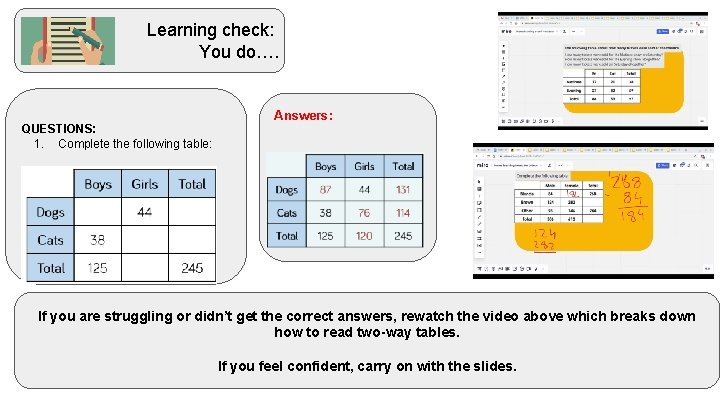
Learning check: You do…. QUESTIONS: 1. Complete the following table: Answers: If you are struggling or didn’t get the correct answers, rewatch the video above which breaks down how to read two-way tables. If you feel confident, carry on with the slides.
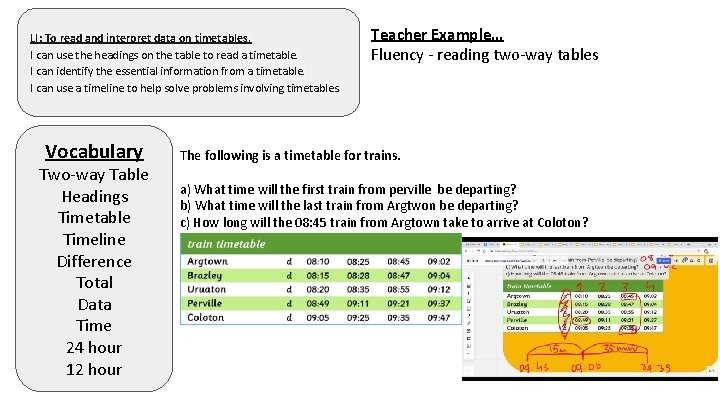
LI: To read and interpret data on timetables. I can use the headings on the table to read a timetable. I can identify the essential information from a timetable. I can use a timeline to help solve problems involving timetables. Vocabulary Two-way Table Headings Timetable Timeline Difference Total Data Time 24 hour 12 hour Teacher Example… Fluency - reading two-way tables The following is a timetable for trains. a) What time will the first train from perville be departing? b) What time will the last train from Argtwon be departing? c) How long will the 08: 45 train from Argtown take to arrive at Coloton?

LI: To read and interpret data on timetables. I can use the headings on the table to read a timetable. I can identify the essential information from a timetable. I can use a timeline to help solve problems involving timetables. Vocabulary Two-way Table Headings Timetable Timeline Difference Total Data Time 24 hour 12 hour The following timetable shows different timings for buses. a) What time will the first bus arrive at Wyke? b) How many stops will the 03: 23 bus take to get to Wyke? c) What time will the second bus from Elland get to Brighouse? Learning check: You do…. Answers: a) 03: 58 b) 3 stops c) 03: 59
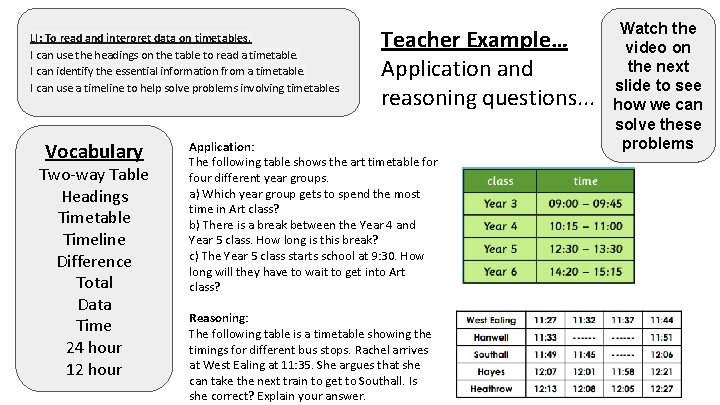
LI: To read and interpret data on timetables. I can use the headings on the table to read a timetable. I can identify the essential information from a timetable. I can use a timeline to help solve problems involving timetables. Vocabulary Two-way Table Headings Timetable Timeline Difference Total Data Time 24 hour 12 hour Teacher Example… Application and reasoning questions. . . Application: The following table shows the art timetable for four different year groups. a) Which year group gets to spend the most time in Art class? b) There is a break between the Year 4 and Year 5 class. How long is this break? c) The Year 5 class starts school at 9: 30. How long will they have to wait to get into Art class? Reasoning: The following table is a timetable showing the timings for different bus stops. Rachel arrives at West Ealing at 11: 35. She argues that she can take the next train to get to Southall. Is she correct? Explain your answer. Watch the video on the next slide to see how we can solve these problems
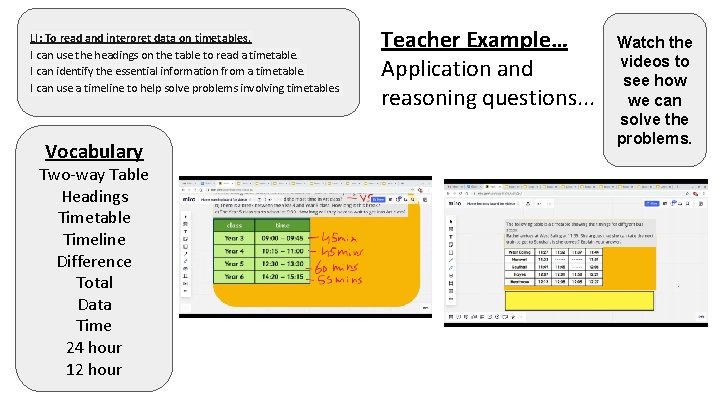
LI: To read and interpret data on timetables. I can use the headings on the table to read a timetable. I can identify the essential information from a timetable. I can use a timeline to help solve problems involving timetables. Vocabulary Two-way Table Headings Timetable Timeline Difference Total Data Time 24 hour 12 hour Teacher Example… Application and reasoning questions. . . Watch the videos to see how we can solve the problems.
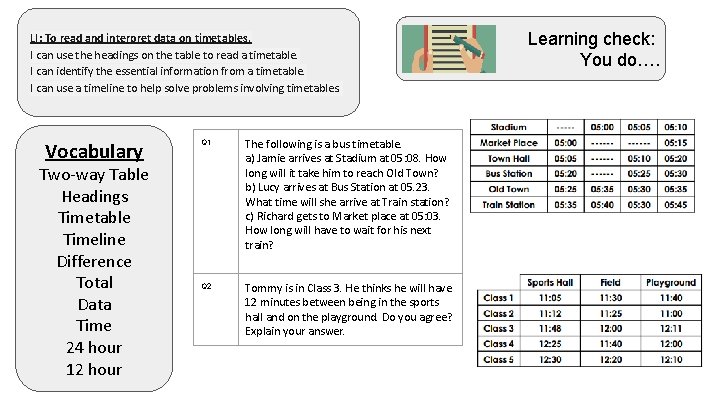
LI: To read and interpret data on timetables. I can use the headings on the table to read a timetable. I can identify the essential information from a timetable. I can use a timeline to help solve problems involving timetables. Vocabulary Two-way Table Headings Timetable Timeline Difference Total Data Time 24 hour 12 hour Q 1 The following is a bus timetable. a) Jamie arrives at Stadium at 05: 08. How long will it take him to reach Old Town? b) Lucy arrives at Bus Station at 05. 23. What time will she arrive at Train station? c) Richard gets to Market place at 05: 03. How long will have to wait for his next train? Q 2 Tommy is in Class 3. He thinks he will have 12 minutes between being in the sports hall and on the playground. Do you agree? Explain your answer. Learning check: You do….
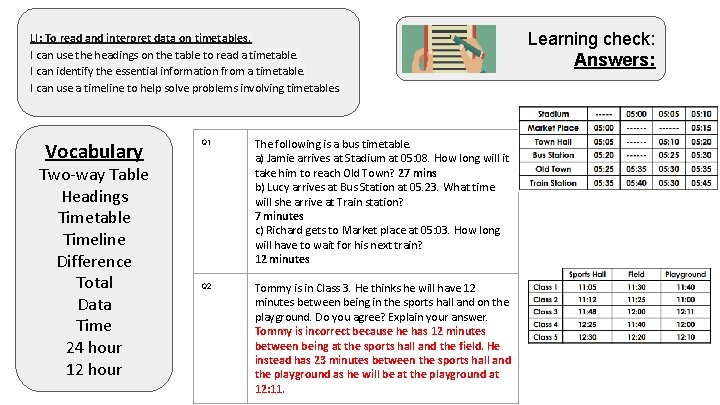
LI: To read and interpret data on timetables. I can use the headings on the table to read a timetable. I can identify the essential information from a timetable. I can use a timeline to help solve problems involving timetables. Vocabulary Two-way Table Headings Timetable Timeline Difference Total Data Time 24 hour 12 hour Q 1 The following is a bus timetable. a) Jamie arrives at Stadium at 05: 08. How long will it take him to reach Old Town? 27 mins b) Lucy arrives at Bus Station at 05. 23. What time will she arrive at Train station? 7 minutes c) Richard gets to Market place at 05: 03. How long will have to wait for his next train? 12 minutes Q 2 Tommy is in Class 3. He thinks he will have 12 minutes between being in the sports hall and on the playground. Do you agree? Explain your answer. Tommy is incorrect because he has 12 minutes between being at the sports hall and the field. He instead has 23 minutes between the sports hall and the playground as he will be at the playground at 12: 11. Learning check: Answers:
Well done! Now complete the worksheet below on the google doc. You can either write the answers on the google doc, or write it out on paper and send a picture of your work to your teacher. https: //docs. google. com/document/d/1 k. HBA 1 Y 20 thl. Hr. BHYRmi. LCIfqsfwdkdgjiz. Tjf. Itw 29 w/edit Remember to log onto maths whizz as well this week!
- Slides: 10