
To react or not to react THAT is

- Slides: 36
To react or not to react? THAT is the question! Chp 15. 2 & 3
• Chemical changes are a result of chemical reactions. • All chemical reactions involve a change in substances and a change in energy. • Neither matter or energy is created or destroyed in a chemical reaction---only changed. • There are so many chemical reactions that it is helpful to classify them into 5 general types:
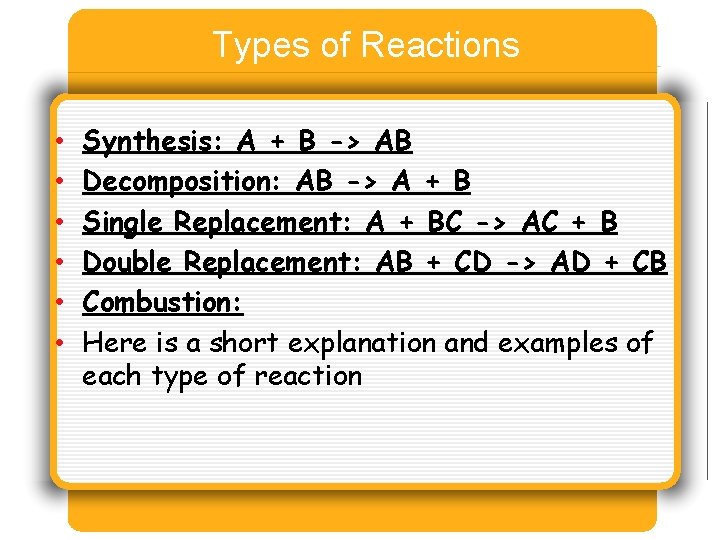
Types of Reactions • • • Synthesis: A + B -> AB Decomposition: AB -> A + B Single Replacement: A + BC -> AC + B Double Replacement: AB + CD -> AD + CB Combustion: Here is a short explanation and examples of each type of reaction
4. 5 types of chemical reactions
Diatomic Elements Info! Diatomic elements are nonmetal elements that form a covalent bond between two atoms. • The diatomic elements are: hydrogen, nitrogen, oxygen, fluorine, chlorine, bromine and iodine. • They always travel in pairs of atoms and therefore you must write then as: • H 2 N 2 O 2 F 2 Cl 2 Br 2 and I 2 •
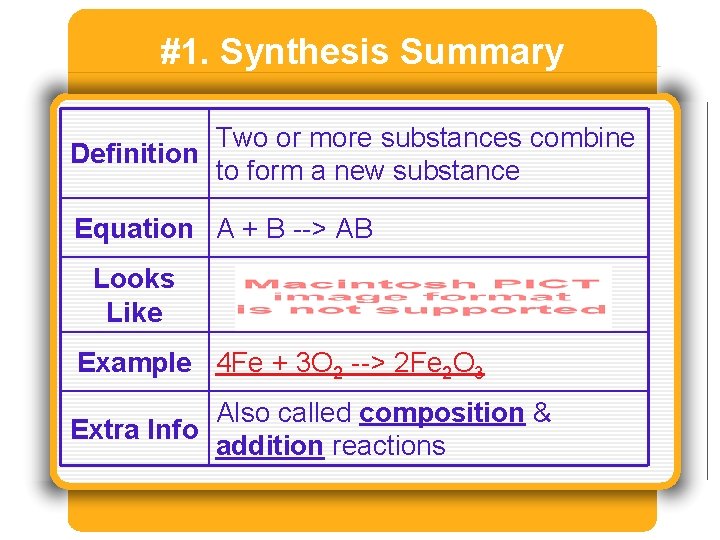
1. Synthesis (Composition) • In a synthesis reaction (also known as a composition reaction), two or more simple substances combine to form a more complex substance. • Two or more reactants yielding one product is another way to identify a synthesis reaction. • In the simplest type of synthesis reaction, two elements combine to form a compound.
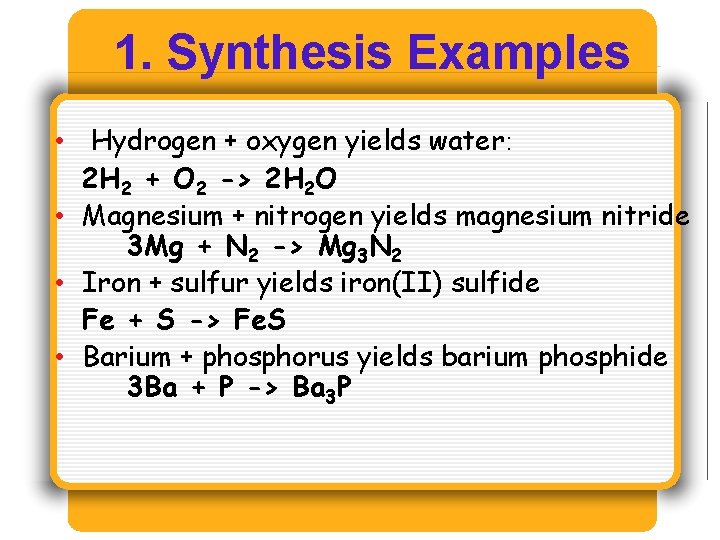
1. Synthesis Examples • Hydrogen + oxygen yields water: 2 H 2 + O 2 -> 2 H 2 O • Magnesium + nitrogen yields magnesium nitride 3 Mg + N 2 -> Mg 3 N 2 • Iron + sulfur yields iron(II) sulfide Fe + S -> Fe. S • Barium + phosphorus yields barium phosphide 3 Ba + P -> Ba 3 P
1. Synthesis • The chemical equation for a synthesis reaction looks like: • reactant + reactant -------> product
#1. Synthesis Summary Two or more substances combine Definition to form a new substance Equation A + B --> AB Looks Like Example 4 Fe + 3 O 2 --> 2 Fe 2 O 3 Also called composition & Extra Info addition reactions
2. Decomposition • In a decomposition reaction, a larger substance breaks apart and forms two or more simpler substances.
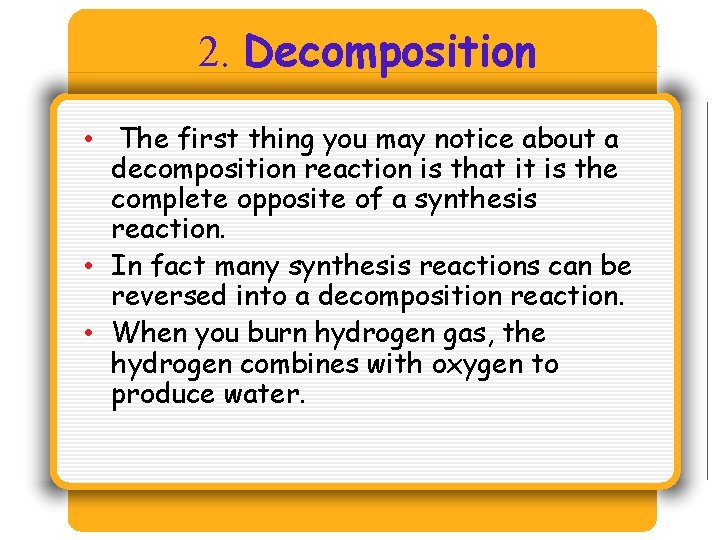
2. Decomposition • The first thing you may notice about a decomposition reaction is that it is the complete opposite of a synthesis reaction. • In fact many synthesis reactions can be reversed into a decomposition reaction. • When you burn hydrogen gas, the hydrogen combines with oxygen to produce water.
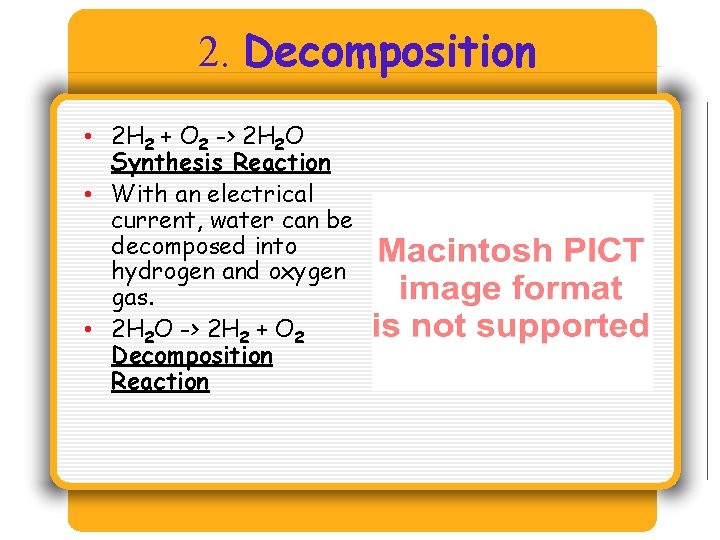
2. Decomposition • 2 H 2 + O 2 -> 2 H 2 O Synthesis Reaction • With an electrical current, water can be decomposed into hydrogen and oxygen gas. • 2 H 2 O -> 2 H 2 + O 2 Decomposition Reaction
2. Decomposition • For example, water can be broken down into hydrogen gas and oxygen gas. • The chemical equation for this decomposition reaction looks like: • reactant -------> product + product
2. Decomposition Summary A single compound is broken down Definition into two or more smaller compounds Equation AB --> A + B Looks Like Example H 2 CO 3 --> H 2 O + CO 2 Large compounds can also Extra Info decompose into several other compounds.
3. Single Replacement • In a single replacement reaction a single uncombined element replaces another in a compound. • Two reactants yield two products. • For example when zinc combines with hydrochloric acid, the zinc replaces hydrogen.
3. Single Replacement • The chemical equation for this single replacement reaction looks like: • reactant + reactant---> product + product • In a single replacement reaction, a more active element replaces a less active element in a compound.
3. Single Replacement • Generally, as you go across the periodic table (from I-A to IIIV-A) metals become less chemically active. • A metal such as magnesium is more chemically active that transition metals such as copper, tin or zinc. • An easier way to identify the activity of element is to use an activity series which shows the chemical activity of both metals and nonmetals.
#3. Single-Replacement �One element replaces a similar Definition element in a compound. Equation AB + C --> AC + B Looks Like Example 2 HCl + Zn --> Zn. Cl 2 + H 2 Here, more-reactive elements replace Extra Info less-reactive ones - so sometimes it is impossible to reverse this reaction.
4. Double Replacement • In a double replacement reaction, two metal ions (in aqueous compounds) switch places.
4. Double Replacement • In a double replacement reaction parts of two compounds switch places to form two new compounds. • Two reactants yield two products. • For example when silver nitrate combines with sodium chloride, two new compounds--silver chloride and sodium nitrate are formed because the sodium and silver switched places.
4. Double Replacement • The chemical equation for this double replacement reaction looks like: • reactant + reactant ----> product + product • One of the products is insoluble and forms a solid. • This solid, called a precipitate, is more dense than the surrounding solution and falls to the bottom of the test tube. • An arrow down is used to identify a precipitate (because the precipitate sinks)
4. Double Replacement • In a reaction between sodium chloride solution Na. Cl (aq) and silver nitrate solution Ag. NO 3 (aq) the products are sodium nitrate • Na. NO 3 (aq) solution and silver chloride solid Ag. Cl (s).
4. Double Replacement • Since silver chloride is insoluble (won't dissolve in water) it forms a white solid and sinks to the bottom of the test tube.
4. Double Replacement • A solid that forms in a double replacement reaction is called a precipitate. Here is a photo of this reaction:
#4. Double-Replacement Definition Ions in two compounds switch places. Equation AB + CD --> AC + BD Looks Like Example Na. Cl + Ag. NO 3 --> Na. NO 3 + Ag. Cl Often, a solid combines with a Extra Info liquid & forms a precipitate in this reaction.
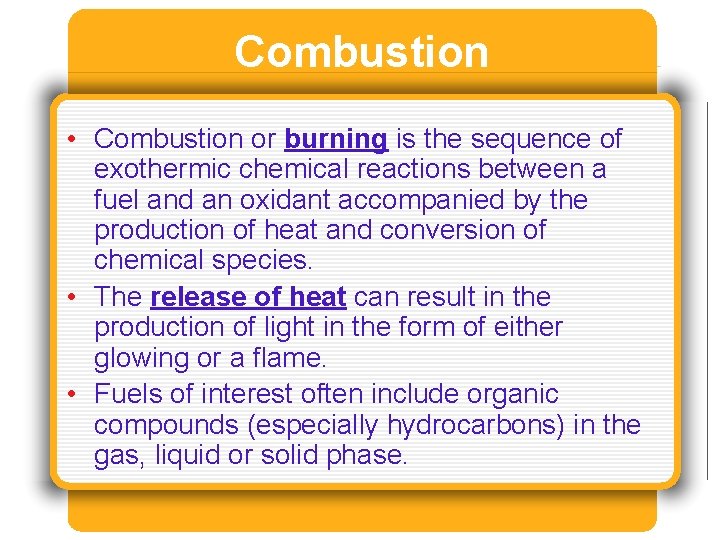
Combustion • Combustion or burning is the sequence of exothermic chemical reactions between a fuel and an oxidant accompanied by the production of heat and conversion of chemical species. • The release of heat can result in the production of light in the form of either glowing or a flame. • Fuels of interest often include organic compounds (especially hydrocarbons) in the gas, liquid or solid phase.
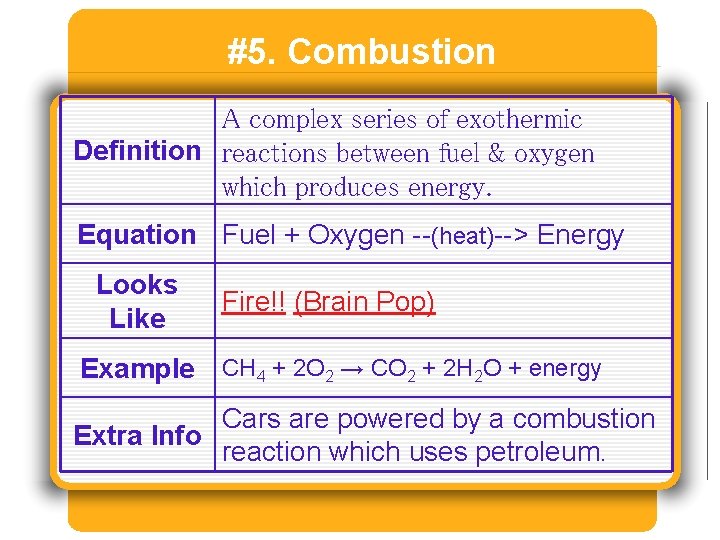
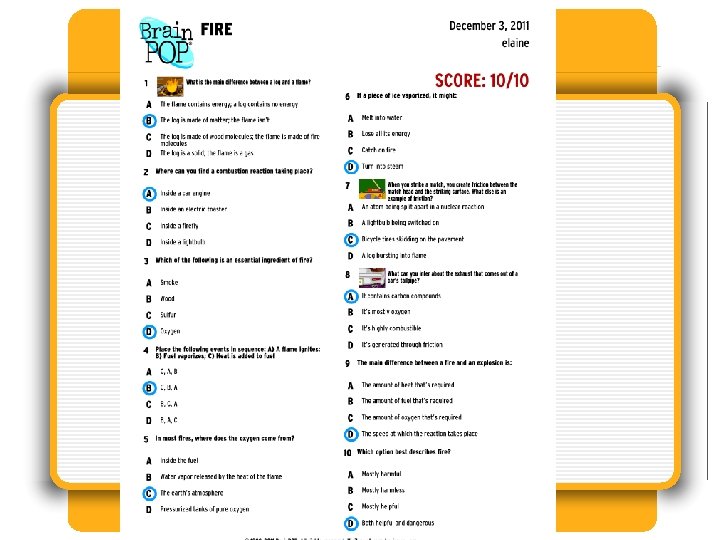
#5. Combustion A complex series of exothermic Definition reactions between fuel & oxygen which produces energy. Equation Fuel + Oxygen --(heat)--> Energy Looks Like Fire!! (Brain Pop) Example CH 4 + 2 O 2 → CO 2 + 2 H 2 O + energy Cars are powered by a combustion Extra Info reaction which uses petroleum.
5. Types of Reactions Summary
Energy & Rates of Chemical Reactions Chapter 15 Section 3
CHEMICAL REACTIONS & Energy • If you’ve every sat by a warm campfire or in front of a stove, you’ve experienced heat from a chemical reaction. • Burning is a chemical reaction that gives off or releases energy in the form of heat & light. • In plants, photosynthesis uses or absorbs energy from sunlight. • In fact, all chemical reactions involve energy
Two Types of Reactions : • Energy is involved in chemical reactions in two ways. • 1. At the start of a chemical reaction, some (or all) bonds between atoms in the reactants must be broken so that the atoms are available to form new bonds. • 2. Energy is released when new bonds form as the atoms recombine into the new compounds of the products • We classify chemical reactions based on how (1) energy used in (2) compares to energy released in
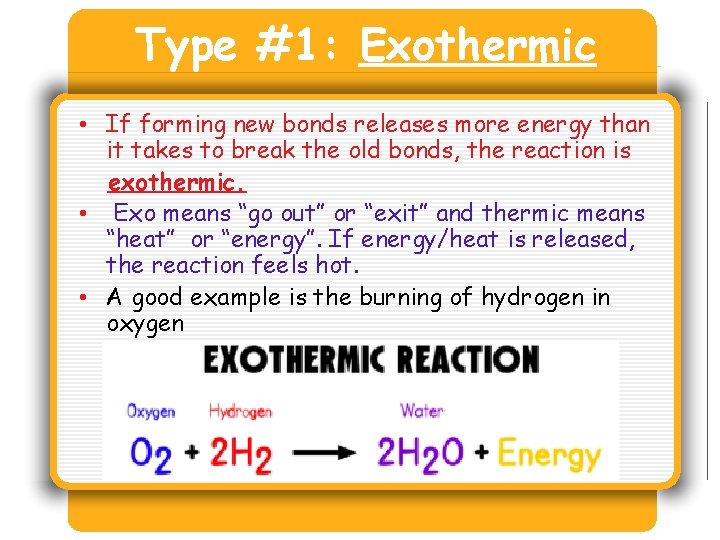
Type #1: Exothermic • If forming new bonds releases more energy than it takes to break the old bonds, the reaction is exothermic. • Exo means “go out” or “exit” and thermic means “heat” or “energy”. If energy/heat is released, the reaction feels hot. • A good example is the burning of hydrogen in oxygen
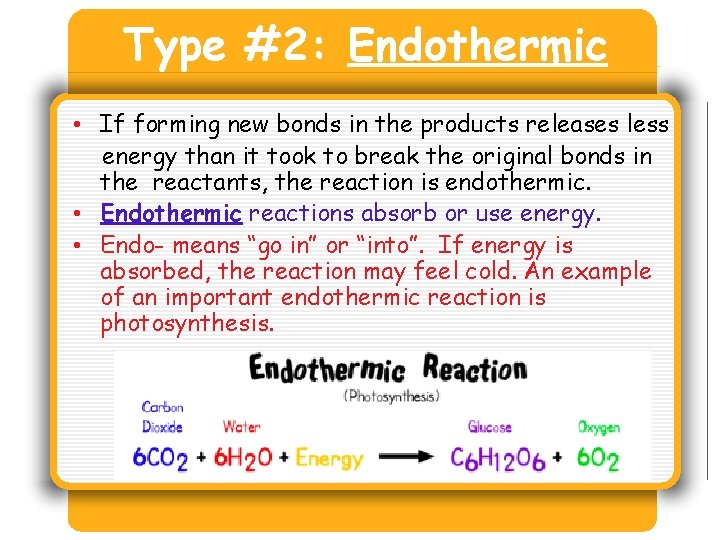
Type #2: Endothermic • If forming new bonds in the products releases less energy than it took to break the original bonds in the reactants, the reaction is endothermic. • Endothermic reactions absorb or use energy. • Endo- means “go in” or “into”. If energy is absorbed, the reaction may feel cold. An example of an important endothermic reaction is photosynthesis.
Review: THE 4 RULES OF CHEMICAL REACTIONS • 1. Chemical reactions are processes in which atoms are rearranged into different combinations of molecules. • 2. Reactants interact, change bonds, and form products with different chemical properties.
Review: THE 4 RULES OF CHEMICAL REACTIONS • 3. In a reaction, the number of atoms stays the same, no matter how they are arranged, so their total mass stays the same. • 4. Chemical reactions usually liberate/release or absorb heat.