
To Protect and Preserve Maintaining Privilege in Audits
- Slides: 24
To Protect and Preserve: Maintaining Privilege in Audits Presented by: MJ Wilson-Bilik, Esq. , Partner Sutherland Asbill & Brennan Lynn A. Gandhi, Esq. , Partner Honigman Miller Schwartz and Cohn
UPPO Presentation Disclaimer Use of the Unclaimed Property Professionals Organization, Inc. , (UPPO) name of copyrighted materials in this presentation does not constitute an endorsement by UPPO of a member, vendor, product or service. The content represents the opinion of the author and not necessarily those of UPPO. This information is not intended as legal advice and should not be used to replace the advice of legal counsel.
UPPO Antitrust Statement UPPO has a policy of strict compliance with federal antitrust laws. UPPO members and/or meeting attendees cannot come to understandings, make agreements, or otherwise concur on positions or activities that in any way tend to raise, lower or stabilize prices or fees. Members and/or attendees can discuss pricing models, methods, systems, and applications, as well as certain cost matters that do not lead to an agreement or consensus on prices or fees to be charged. However, there can be no discussion as to what constitutes a reasonable, fair or appropriate price or fee to charge for any service or product. Information may be presented with regard to historical pricing activities so long as such information is general in nature and does not include data on current prices or fees being charged in any trade area. Any discussion of current or future prices, fees, discounting, and other terms and conditions of sale, which may lead to an agreement or consensus on prices or fees to be charged, is strictly prohibited. Any questions about UPPO’s antitrust policy should be directed to UPPO’s Executive Director.
Today’s Agenda 1. What is: – Attorney-Client Privilege – Work Product Doctrine – A Kovel Letter 2. Why it matters 3. Tips for preserving privilege 4. What to do if privilege has been lost
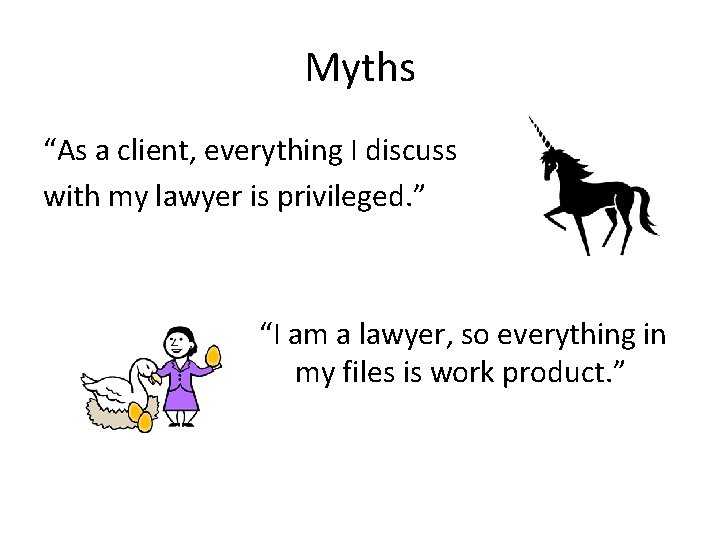
Myths “As a client, everything I discuss with my lawyer is privileged. ” “I am a lawyer, so everything in my files is work product. ”
The Basics Attorney-Client Privilege – Protects communications – Made in confidence – Between protected persons – For the purpose of securing or providing legal advice – Note, not limited to litigation communications Work Product Doctrine – Protects materials prepared in anticipation of litigation or for trial – By or for a party, or that party’s representative – See Fed. R. Civ. P. 26(b)(3)
Attorney-Client Privilege: What does not qualify? • • • Facts Public documents Drafts of documents Attorney notes Invoices (although time detail may be protected)
Attorney-Client Privilege: Privileged Persons - External Experts • Privileged only if necessary to assist the lawyer in giving legal advice • Examples: – Accountants, Translators – Unclaimed Property Consulting Firm • Practice Tip: Have the attorney, not the client, engage and communicate with the external experts, if the goal is to protect the expert’s work product via privilege
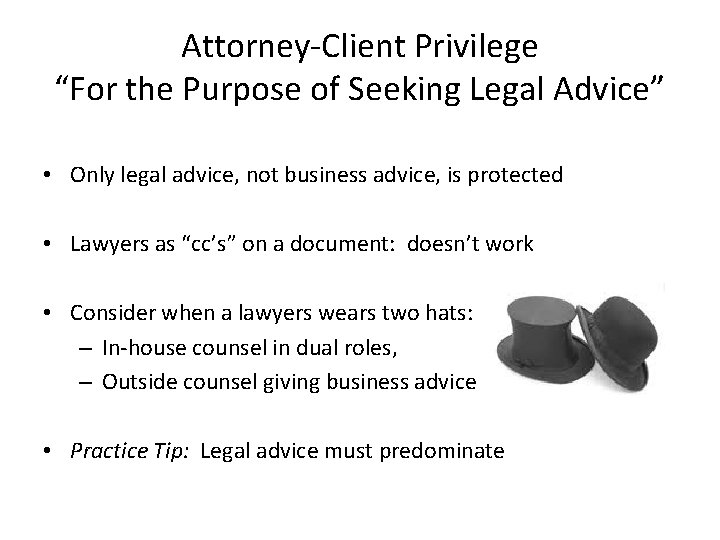
Attorney-Client Privilege “For the Purpose of Seeking Legal Advice” • Only legal advice, not business advice, is protected • Lawyers as “cc’s” on a document: doesn’t work • Consider when a lawyers wears two hats: – In-house counsel in dual roles, – Outside counsel giving business advice on a deal • Practice Tip: Legal advice must predominate
Attorney-Client Privilege: Confidentiality If company doesn’t intend or expect information to be kept confidential, it isn’t privileged: – Tax returns – Filings with regulatory agencies – Facts, such as general ledgers But analyses of legal liability would be confidential
Waiver of Attorney-Client Privilege • Waiver occurs when the confidential communication is disclosed to a third party (whether intentional or unintentional) – Waiver occurs even when the third party is under an obligation of confidentiality (e. g. , auditors, consultants) – Waiver occurs even when the third party does not retain a copy • Compelled disclosure by court order does not waive the privilege • But disclosure to a state agency or unclaimed property auditor would waive the privilege
Work Product Doctrine: What Qualifies? • Must be prepared in anticipation of litigation or for trial • Can be prepared either by the party, its attorneys, and other representatives of the party or attorneys
Work Product Doctrine: “Prepared in anticipation of litigation” Look to timing and motivation • Litigation must be pending or threatened or at least very likely (according to the most liberal approach) • Information must be motivated by litigation – Not prepared in ordinary course of business – If it would have been prepared absent litigation: not protected
Who Owns the Privilege? • Attorney-client privilege: – The client, and only the client • Work Product – Attorney has independent right to protect mental impressions (general rule) – Default: Client owns everything it paid for – Attorney must show good cause to keep work product confidential from client 14
Practical Tips • Create and mark privileged documents – Mark documents from the beginning – Avoid marking documents where there is no legitimate privilege claim – Make clear how the document relates to the provision of legal advice – For documents prepared in anticipation of litigation, indicate on the face of the document – Avoid mixing business and legal advice – Keep the document confidential
Practical Tips • Discuss privilege with the team – Fact gathering: Indicate the work is being performed at the direction of counsel • Does NOT require explicit labeling as privileged – Analysis: Explicitly label • Includes documents containing advice, strategy, liability estimates, observations, including discussions on sufficiency of the data and audit methodology • Document your advice
Practical Tips • Do not copy anyone on the document, let the attorney forward the document. • Do not discuss the issues with anyone unless directed to do so by the attorney. • Do not forward communications from the attorney to other employees. • Maintain a privilege log – know who has seen/access to which documents.
Kovel Agreements: What Are They? • Used to bring a third party within the attorney -client privilege. Does not mean that communications made by the client to the third party in the presence of the attorney are protected. • The third party’s presence must be indispensable to the attorney. • Frequently used to bring accountants or consultants into the privilege.
United States v Kovel, 296 F. 2 d 918 (2 d Cir. 1961) • An agency theory – the derivative attorneyclient privilege. • Accountant employed by a law firm. • What was vital was that the communication was made in confidence for the purpose of obtaining legal advice from the lawyer. • Often compared to using a foreign language interpreter with a client.
Kovel Doctrine • Extension of the attorney-client privilege. • Permits an attorney to consult with a nonlawyer, i. e. , an accountant, and maintain privilege over the communication. • The accountant must be necessary, or at least highly useful, for the effective consultation between the client and the lawyer.
Practical Tips • A formal agreement between the attorney and the accountant (not the client). • Articulates the “necessity” of the accountant in the rendering of legal services. • Require that the consultant properly mark documents “prepared at the request of counsel” and segregate these files from other materials
What to do if privilege is lost? • Can not “partially” reveal privilege, cannot provide only “partial” information or documents • Consider redacting certain information and “print prohibited” pdfs. • If privilege is lost, determine scope of unintentional disclosure, try to get information returned, consider use of nondisclosure agreement, and limit further disclosure • Not the same as the client choosing to “waive” the privilege.
Questions?
Thank you for joining us! MJ Wilson-Bilik Sutherland, Asbill & Brennan LLP 202 -383 -0660 Mj. wilson-bilik@sutherland. com Lynn Gandhi Honigman Miller Schwartz and Cohn LLP 313 -465 -7646 lgandhi@honigman. com