
to Mimi Dai for inviting me 1 Mathematics


















- Slides: 106
to Mimi Dai for inviting me! 1
Mathematics describes only a little of Daily Life But Mathematics* Creates our Standard of Living 2
How can we use mathematics to describe biological systems? I believe some biology is Physics ‘as usual’ ‘Guess and Check’ But you have to know which biology! 3
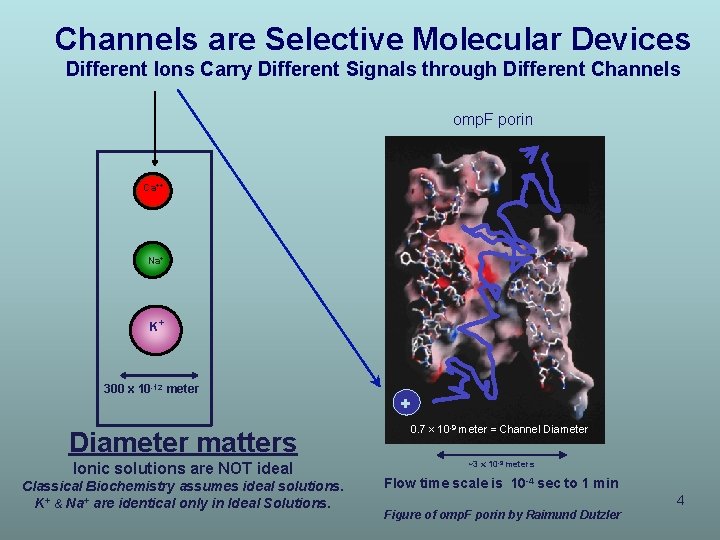
Channels are Selective Molecular Devices Different Ions Carry Different Signals through Different Channels omp. F porin Ca++ Na+ K+ 300 x 10 -12 meter + Diameter matters 0. 7 10 -9 meter = Channel Diameter Ionic solutions are NOT ideal ~3 x 10 -9 meters Classical Biochemistry assumes ideal solutions. K+ & Na+ are identical only in Ideal Solutions. Flow time scale is 10 -4 sec to 1 min 4 Figure of omp. F porin by Raimund Dutzler
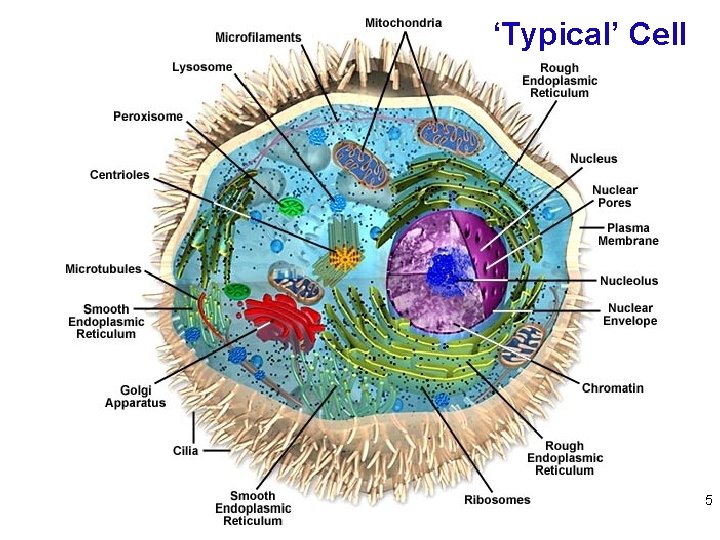
‘Typical’ Cell 5
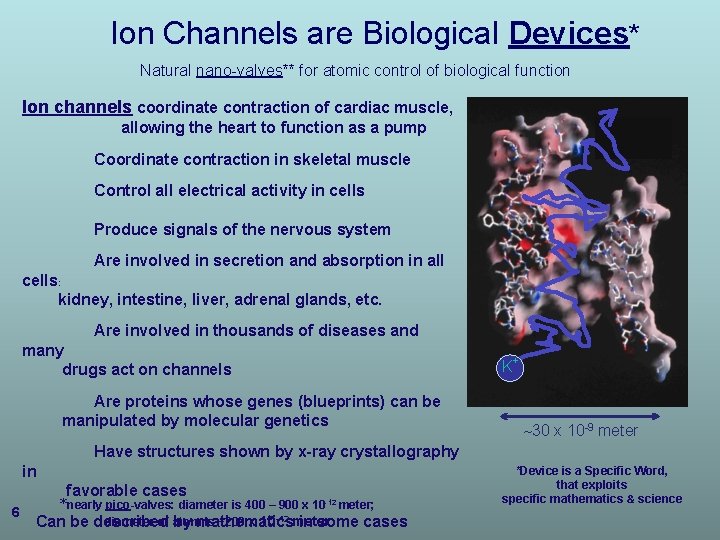
Ion Channels are Biological Devices* Natural nano-valves** for atomic control of biological function Ion channels coordinate contraction of cardiac muscle, allowing the heart to function as a pump Coordinate contraction in skeletal muscle Control all electrical activity in cells Produce signals of the nervous system Are involved in secretion and absorption in all cells: kidney, intestine, liver, adrenal glands, etc. Are involved in thousands of diseases and many drugs act on channels Are proteins whose genes (blueprints) can be manipulated by molecular genetics K+ ~30 x 10 -9 meter Have structures shown by x-ray crystallography in favorable cases *nearly pico-valves: diameter is 400 – 900 x 10 -12 meter; 6 diameter of atom is ~200 x 10 -12 meter Can be described by mathematics in some cases *Device is a Specific Word, that exploits specific mathematics & science
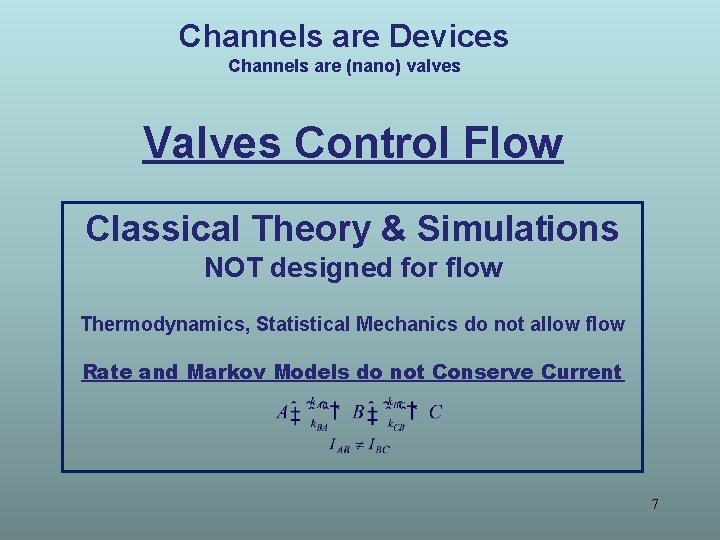
Channels are Devices Channels are (nano) valves Valves Control Flow Classical Theory & Simulations NOT designed for flow Thermodynamics, Statistical Mechanics do not allow flow Rate and Markov Models do not Conserve Current 7
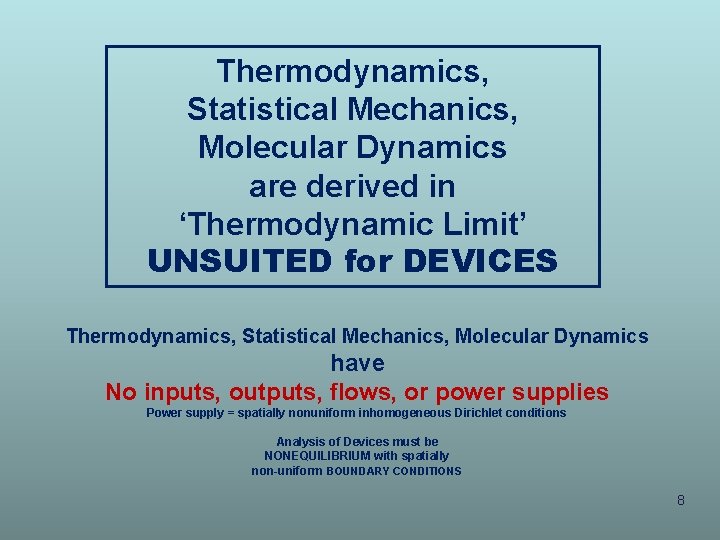
Thermodynamics, Statistical Mechanics, Molecular Dynamics are derived in ‘Thermodynamic Limit’ UNSUITED for DEVICES Thermodynamics, Statistical Mechanics, Molecular Dynamics have No inputs, outputs, flows, or power supplies Power supply = spatially nonuniform inhomogeneous Dirichlet conditions Analysis of Devices must be NONEQUILIBRIUM with spatially non-uniform BOUNDARY CONDITIONS 8
Multi-Scale Issues are Always Present in Atomic Scale Engineering Atomic & Macro Scales are both used by channels just because Channels are Nanovalves By definition: all valves use small structures to control large flows 9
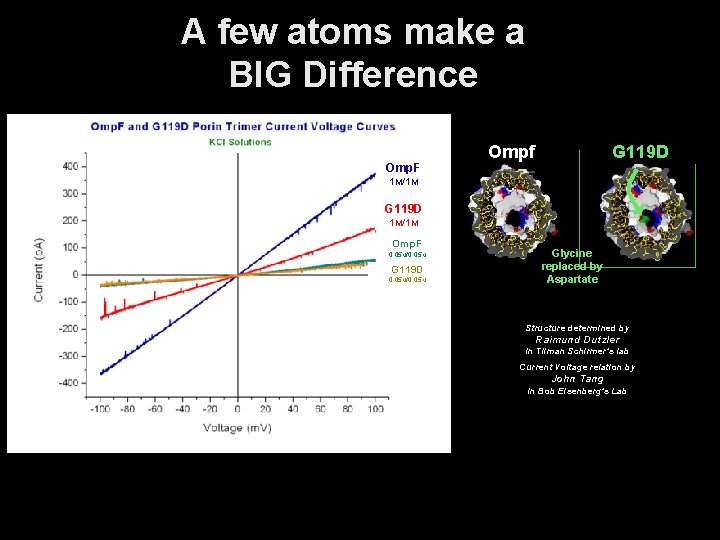
A few atoms make a BIG Difference Omp. F Ompf G 119 D 1 M/1 M Omp. F 0. 05 M/0. 05 M G 119 D 0. 05 M/0. 05 M Glycine replaced by Aspartate Structure determined by Raimund Dutzler in Tilman Schirmer’s lab Current Voltage relation by John Tang in Bob Eisenberg’s Lab 10
How does it work? How do a few atoms control (macroscopic) Biological Function Mathematics of Molecular Biology is about Solving Specific Inverse Problems Problem for Channels has actually been solved Burger, Eisenberg, Engl (2007) SIAM J Applied Math 67: 960 -989 11
Where to start? Why not compute all the atoms? 12
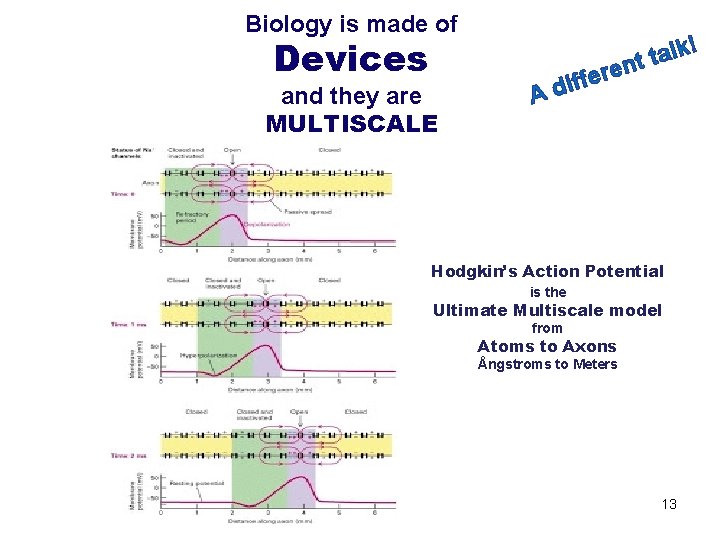
Biology is made of Devices and they are MULTISCALE lk a t t en r e f f i A d Hodgkin’s Action Potential is the Ultimate Multiscale model from Atoms to Axons Ångstroms to Meters 13 !
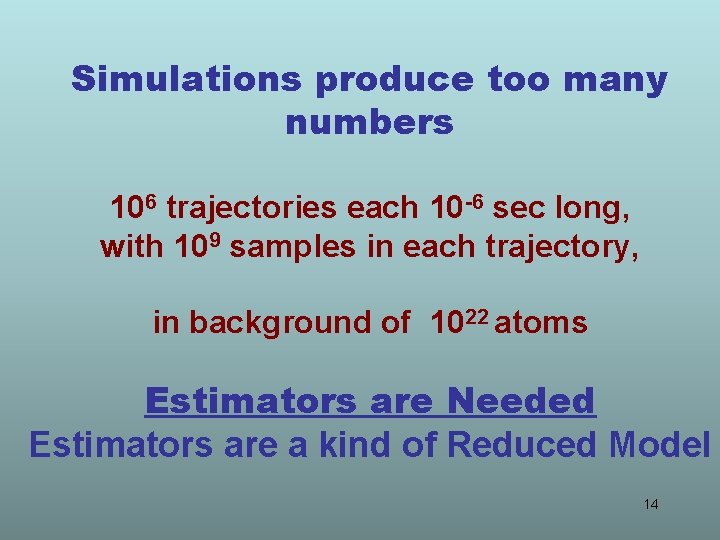
Simulations produce too many numbers 106 trajectories each 10 -6 sec long, with 109 samples in each trajectory, in background of 1022 atoms Estimators are Needed Estimators are a kind of Reduced Model 14
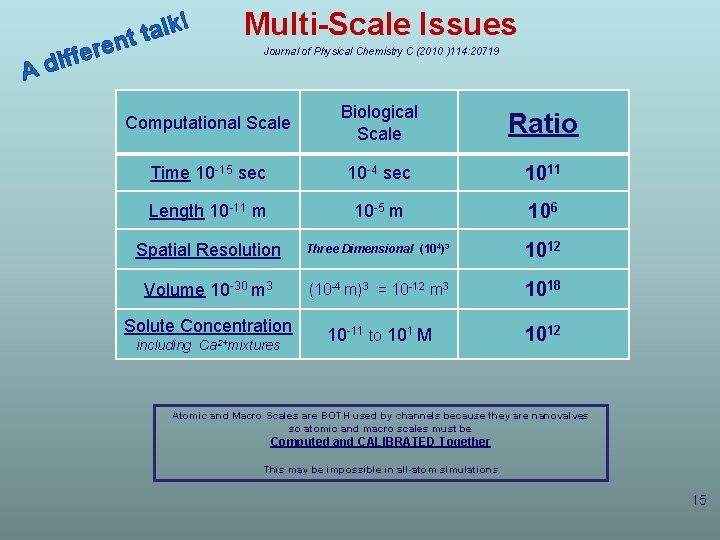
k! l a t t n e r ffe i d A Multi-Scale Issues Journal of Physical Chemistry C (2010 )114: 20719 Computational Scale Biological Scale Ratio Time 10 -15 sec 10 -4 sec 1011 Length 10 -11 m 10 -5 m 106 Spatial Resolution Three Dimensional (104)3 1012 Volume 10 -30 m 3 (10 -4 m)3 = 10 -12 m 3 1018 10 -11 to 101 M 1012 Solute Concentration including Ca 2+mixtures Atomic and Macro Scales are BOTH used by channels because they are nanovalves so atomic and macro scales must be Computed and CALIBRATED Together This may be impossible in all-atom simulations 15
Where to start? Mathematically ? Physically ? 16
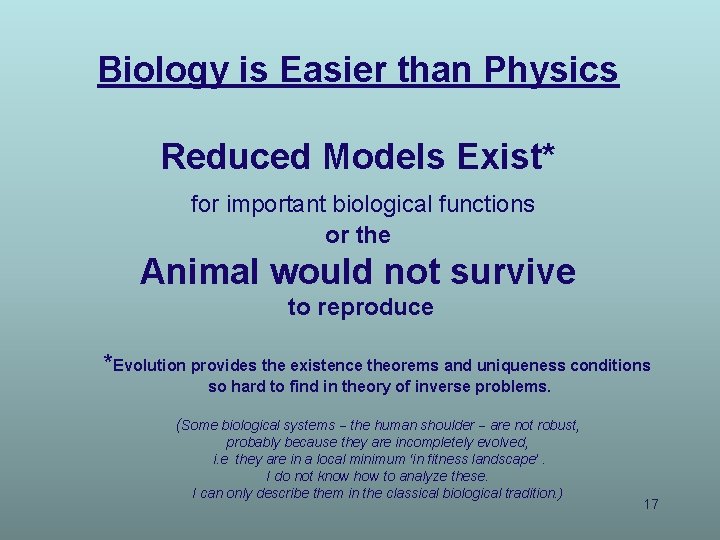
Biology is Easier than Physics Reduced Models Exist* for important biological functions or the Animal would not survive to reproduce *Evolution provides the existence theorems and uniqueness conditions so hard to find in theory of inverse problems. (Some biological systems the human shoulder are not robust, probably because they are incompletely evolved, i. e they are in a local minimum ‘in fitness landscape’. I do not know how to analyze these. I can only describe them in the classical biological tradition. ) 17
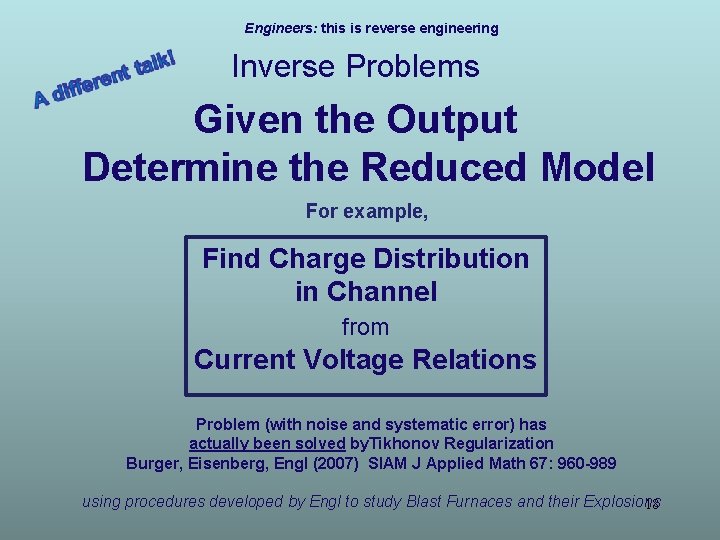
Engineers: this is reverse engineering Inverse Problems Given the Output Determine the Reduced Model For example, Find Charge Distribution in Channel from Current Voltage Relations Problem (with noise and systematic error) has actually been solved by. Tikhonov Regularization Burger, Eisenberg, Engl (2007) SIAM J Applied Math 67: 960 -989 using procedures developed by Engl to study Blast Furnaces and their Explosions 18
Here is where we do Science, not Mathematics Here we GUESS and CHECK 19
Guess Working Hypothesis Crucial Biological Adaptation is Crowded Ions and Side Chains Thanks to Jie Liang UIC Bioengineering! Wise to use the Biological Adaptation to make the reduced model! Reduced Models allow much easier Atomic Scale Engineering 20
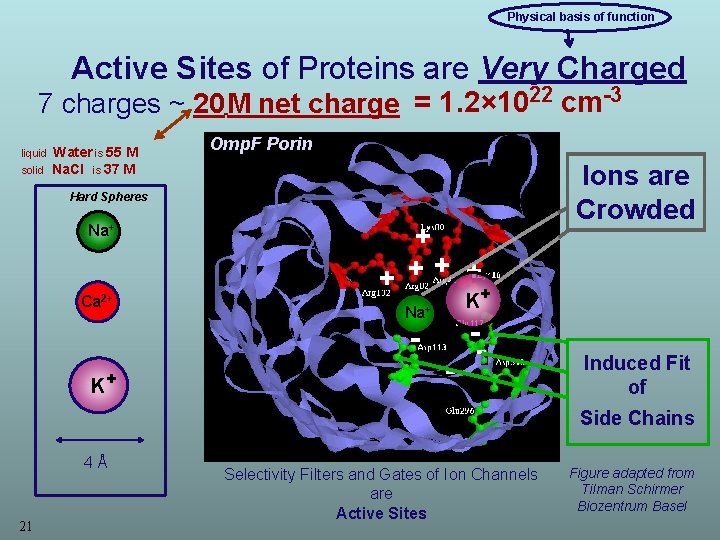
Physical basis of function Active Sites of Proteins are Very Charged 7 charges ~ 20 M net charge = 1. 2× 1022 cm-3 liquid Water is 55 M Omp. F Porin Ions are Crowded solid Na. Cl is 37 M Hard Spheres + + + Na+ Ca 2+ K Na+ K+ 4 Å 21 - - Induced Fit of Side Chains Selectivity Filters and Gates of Ion Channels are Active Sites Figure adapted from Tilman Schirmer Biozentrum Basel
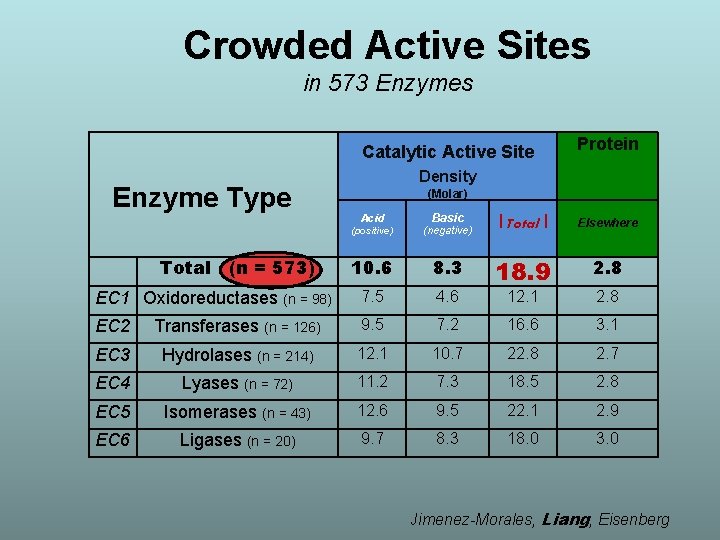
Crowded Active Sites in 573 Enzymes Enzyme Type Catalytic Active Site Density Protein (Molar) Acid (positive) (negative) Basic | Total | Elsewhere 10. 6 8. 3 2. 8 EC 1 Oxidoreductases (n = 98) 7. 5 4. 6 18. 9 12. 1 2. 8 EC 2 Transferases (n = 126) 9. 5 7. 2 16. 6 3. 1 EC 3 Hydrolases (n = 214) 12. 1 10. 7 22. 8 2. 7 EC 4 Lyases (n = 72) 11. 2 7. 3 18. 5 2. 8 EC 5 Isomerases (n = 43) 12. 6 9. 5 22. 1 2. 9 EC 6 Ligases (n = 20) 9. 7 8. 3 18. 0 3. 0 Total (n = 573) Jimenez-Morales, Liang, Eisenberg
Everything Interacts with Everything Else by steric exclusion inside crowded active sites Everything interacts with macroscopic Boundary Conditions (and much else) through long range electric field ‘Law’ of mass action needs to be generalized 23
Physical Chemists Physiologists Biophysicists are Frustrated ! lk a t t en r e f f i A d by Ionic Solutions Theories and Simulations Cannot deal with Sea Water at equilibrium and fail even more badly when flow is involved 24
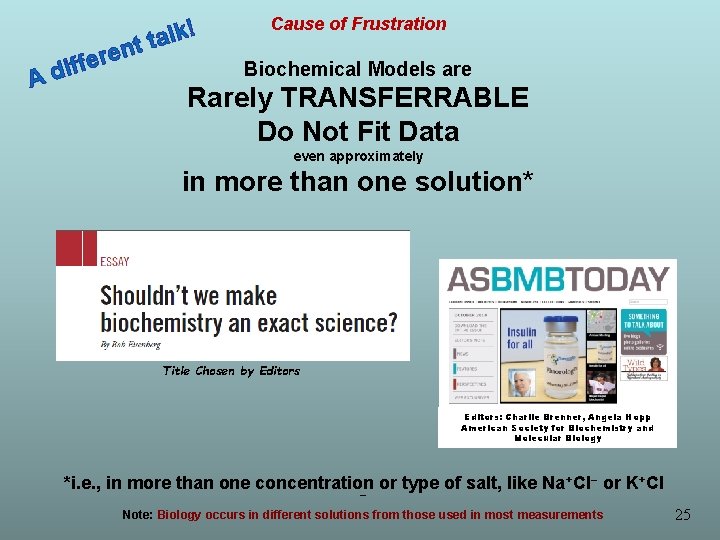
k! l a t ent r e f f i A d Cause of Frustration Biochemical Models are Rarely TRANSFERRABLE Do Not Fit Data even approximately in more than one solution* Title Chosen by Editors: Charlie Brenner, Angela Hopp American Society for Biochemistry and Molecular Biology *i. e. , in more than one concentration or type of salt, like Na +Cl− or K+Cl − Note: Biology occurs in different solutions from those used in most measurements 25
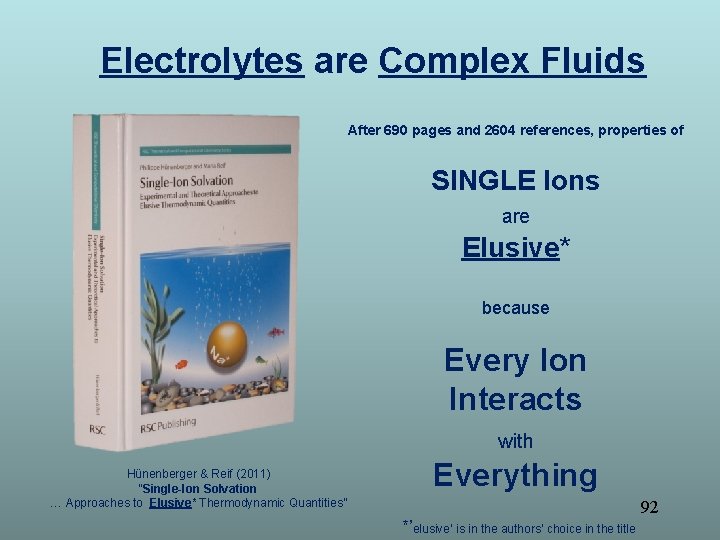
Electrolytes are Complex Fluids ‘Everything’ interacts with everything else Treating a Complex Fluid as if it were a Simple Fluid will produce Elusive Results “Single-Ion Solvation … Elusive Quantities” 690 pages 2604 references Hünenberger & Reif, 2011 26
Don’t worry! Crowded Charge is GOOD It enables SIMPLIFICATION by exploiting a biological fact (an adaptation) Charges are Crowded where they are important Enzymes, Nucleic Acids, Ion Channels, Electrodes 27
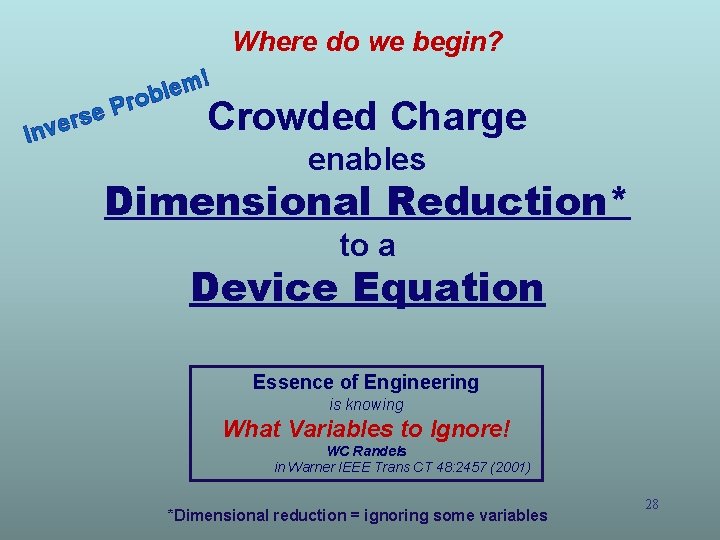
Where do we begin? P e s r Inve ! m e l rob Crowded Charge enables Dimensional Reduction* to a Device Equation Essence of Engineering is knowing What Variables to Ignore! WC Randels in Warner IEEE Trans CT 48: 2457 (2001) *Dimensional reduction = ignoring some variables 28
Where do we begin? Crowded Charge has HUGE electric fields Poisson Equation, i. e. , Conservation of Charge and LARGE steric repulsion Fermi distribution 29
Now some Math ‘Derivation’ of Field Equations 30
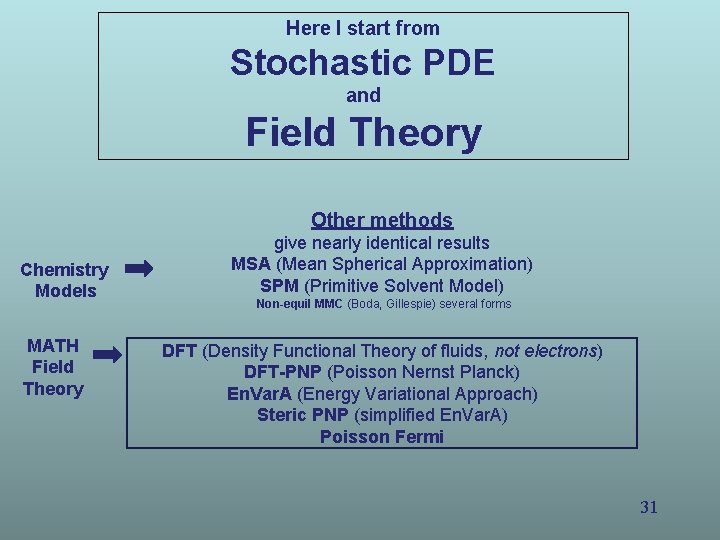
Here I start from Stochastic PDE and Field Theory Other methods Chemistry Models MATH Field Theory give nearly identical results MSA (Mean Spherical Approximation) SPM (Primitive Solvent Model) Non-equil MMC (Boda, Gillespie) several forms DFT (Density Functional Theory of fluids, not electrons) DFT-PNP (Poisson Nernst Planck) En. Var. A (Energy Variational Approach) Steric PNP (simplified En. Var. A) Poisson Fermi 31
Solved with PNP including Correlations Other methods give nearly identical results MMC Metropolis Monte Carlo (equilibrium only) DFT (Density Functional Theory of fluids, not electrons) DFT-PNP (Poisson Nernst Planck) MSA (Mean Spherical Approximation) SPM (Primitive Solvent Model) En. Var. A (Energy Variational Approach) Non-equil MMC (Boda, Gillespie) several forms Steric PNP (simplified En. Var. A) Poisson Fermi 32
Always start with Trajectories Ze’ev Schuss Department of Mathematics, Tel Aviv University Always start with Trajectories because 1) Trajectories are the equivalent of SAMPLES in probability theory 2) Trajectories satisfy PHYSICAL boundary conditions 3) Trajectories satisfy classical PHYSICAL ordinary differential equations (we hope) 33
From Trajectories to Probabilities in Diffusion Processes ‘Life Work’ of Ze’ev Schuss Department of Mathematics, Tel Aviv University Theory and Applications of Stochastic Differential Equations 1980 Theory and Applications Of Stochastic Processes: An Analytical Approach 2009 Singular perturbation methods for stochastic differential equations of mathematical physics SIAM Review, 1980 22: 116 -155 34 Schuss, Nadler, Singer, Eisenberg
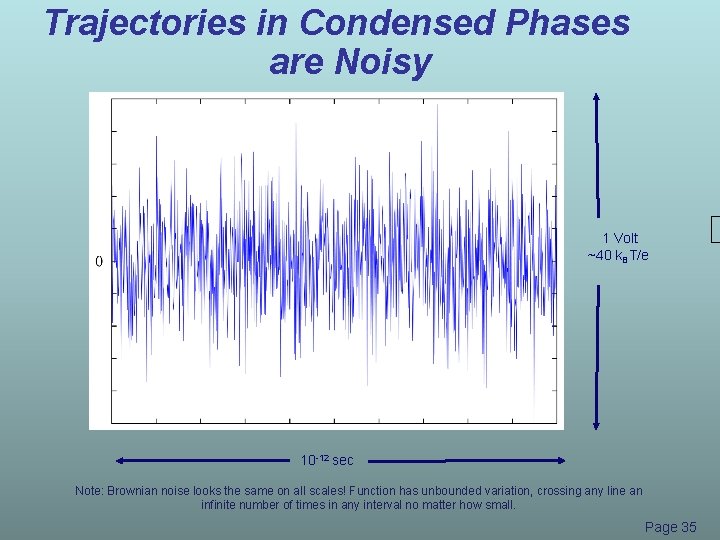
Trajectories in Condensed Phases are Noisy 1 Volt ~40 k. BT/e 10 -12 sec Note: Brownian noise looks the same on all scales! Function has unbounded variation, crossing any line an infinite number of times in any interval no matter how small. Page 35
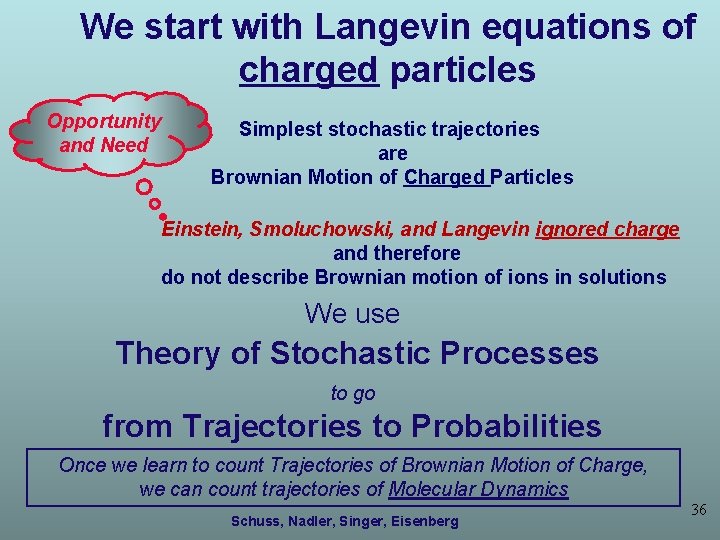
We start with Langevin equations of charged particles Opportunity and Need Simplest stochastic trajectories are Brownian Motion of Charged Particles Einstein, Smoluchowski, and Langevin ignored charge and therefore do not describe Brownian motion of ions in solutions We use Theory of Stochastic Processes to go from Trajectories to Probabilities Once we learn to count Trajectories of Brownian Motion of Charge, we can count trajectories of Molecular Dynamics Schuss, Nadler, Singer, Eisenberg 36
James Clerk Maxwell “I carefully abstain from asking molecules where they start… I only count them…. , avoiding all personal enquiries which would only get me into trouble. ” slightly reworded from Royal Society of London, 1879, Archives no. 188 In Maxwell on Heat and Statistical Mechanics, Garber, Brush and Everitt, 1995 37
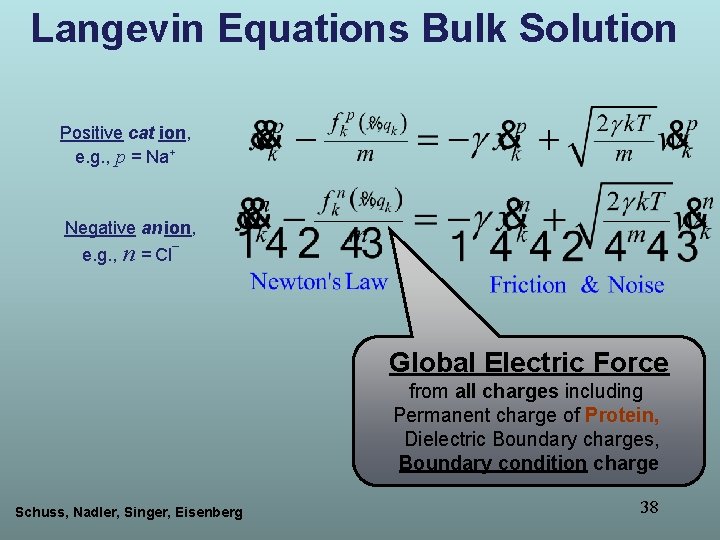
Langevin Equations Bulk Solution Positive cat ion, e. g. , p = Na+ Negative an ion, e. g. , n = Cl¯ Global Electric Force from all charges including Permanent charge of Protein, Dielectric Boundary charges, Boundary condition charge Schuss, Nadler, Singer, Eisenberg 38
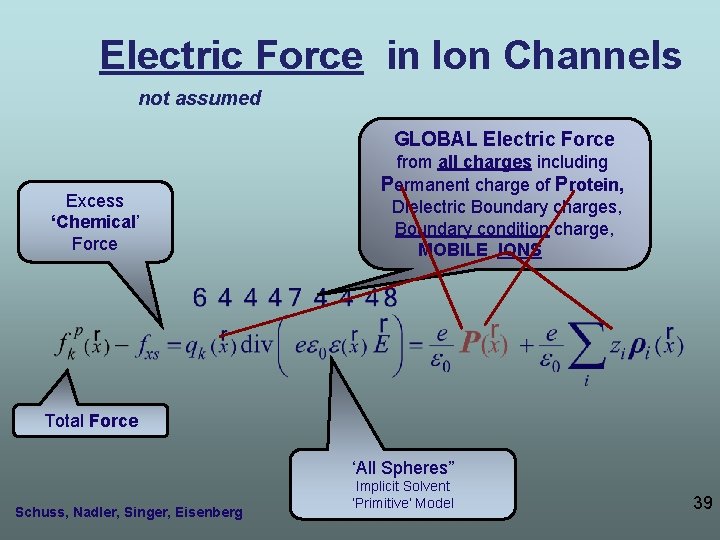
Electric Force in Ion Channels not assumed GLOBAL Electric Force Excess ‘Chemical’ Force from all charges including Permanent charge of Protein, Dielectric Boundary charges, Boundary condition charge, MOBILE IONS Total Force ‘All Spheres” Schuss, Nadler, Singer, Eisenberg Implicit Solvent ‘Primitive’ Model 39
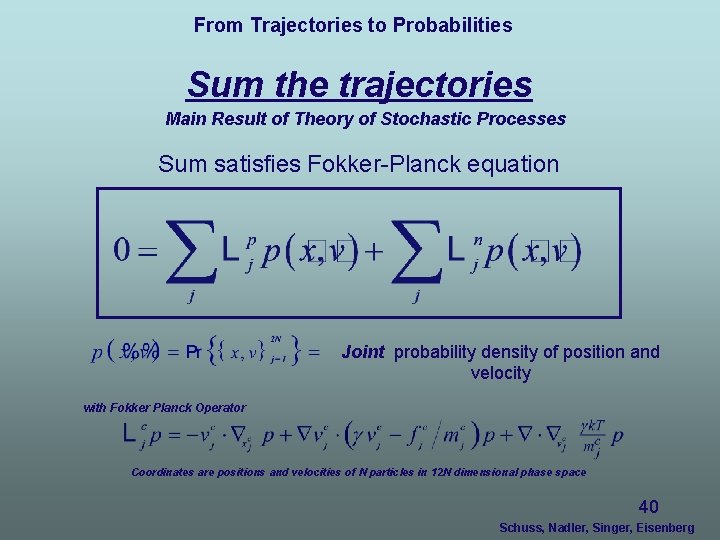
From Trajectories to Probabilities Sum the trajectories Main Result of Theory of Stochastic Processes Sum satisfies Fokker-Planck equation Joint probability density of position and velocity with Fokker Planck Operator Coordinates are positions and velocities of N particles in 12 N dimensional phase space 40 Schuss, Nadler, Singer, Eisenberg
More Math Many papers • We actually performed the sum and showed it was the same as a MARGINAL PROBABILITY estimator of SINGLET CONCENTRATION defined in chemistry • We actually did a nonequilibrium BBGKY expansion with electrostatic & steric correlations • We along with everyone else assume a closure 1) Nadler, B. , T. Naeh and Z. Schuss (2001). SIAM J Appl Math 62: 443 -447. 2) Nadler, B. , T. Naeh and Z. Schuss (2003). "SIAM J Appl Math 63: 850 -873. 3) Nadler, B. , Z. Schuss and A. Singer (2005). "" Physical Review Letters 94(21): 218101. 4) Nadler, B. , Z. Schuss, A. Singer and B. Eisenberg (2003). Nanotechnology 3: 439. 5) Nadler, B. , Z. Schuss, A. Singer and R. Eisenberg (2004). Journal of Physics: Condensed Matter 16: S 2153 -S 2165. 6) Schuss, Z. , B. Nadler and R. S. Eisenberg (2001). Physical Review E 64: 036116 1 -14. 7) Schuss, Z. , B. Nadler and R. S. Eisenberg (2001). "Phys Rev E Stat Nonlin Soft Matter Phys 64(3 Pt 2): 036116. 8) Schuss, Z, B Nadler, A Singer, R Eisenberg (2002) Unsolved Problems Noise & Fluctuations, UPo. N 2002, Washington, DC AIP 9) Singer, A, Z Schuss, B Nadler, R. Eisenberg (2004) Physical Review E Statistical Nonlinear Soft Matter Physics 70 061106. 10) Singer, A, Z Schuss, B Nadler, R Eisenberg (2004). Fluctuations & Noise in Biological Systems II V. 5467. D. Abbot, S. M. Page
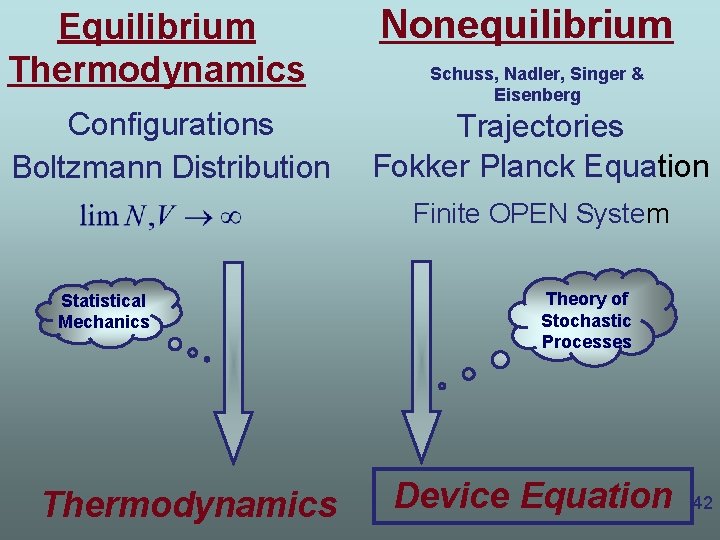
Equilibrium Thermodynamics Nonequilibrium Configurations Boltzmann Distribution Trajectories Fokker Planck Equation Schuss, Nadler, Singer & Eisenberg Finite OPEN System Statistical Mechanics Thermodynamics Theory of Stochastic Processes Device Equation 42
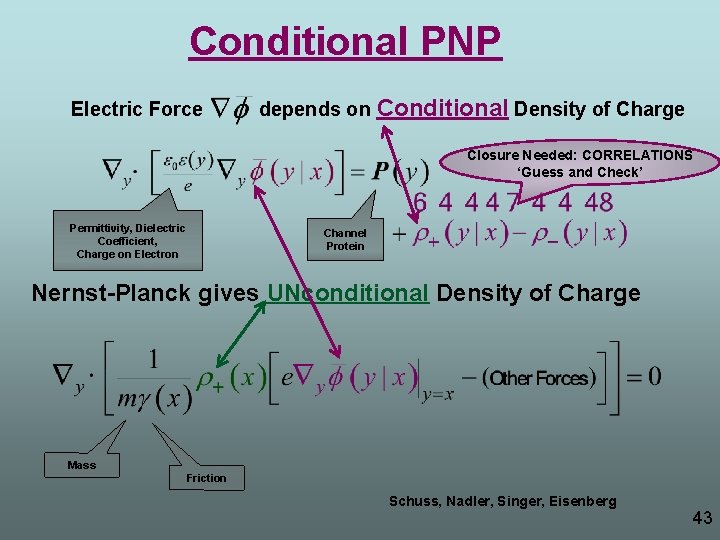
Conditional PNP Electric Force depends on Conditional Density of Charge Closure Needed: CORRELATIONS ‘Guess and Check’ Permittivity, Dielectric Coefficient, Charge on Electron Channel Protein Nernst-Planck gives UNconditional Density of Charge Mass Friction Schuss, Nadler, Singer, Eisenberg 43
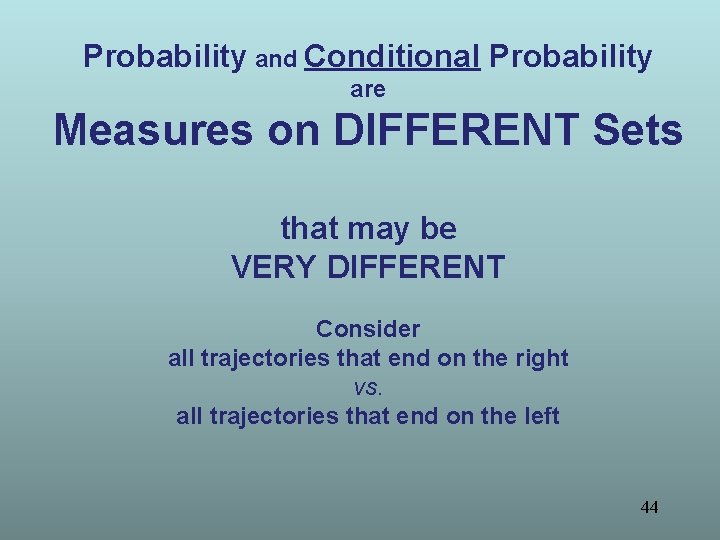
Probability and Conditional Probability are Measures on DIFFERENT Sets that may be VERY DIFFERENT Consider all trajectories that end on the right vs. all trajectories that end on the left 44
Conditioning and Correlations are VERY strong and GLOBAL when Electric Fields are Involved, as in Ionic Solutions and Channels so cannot do the probability theory without variational methods We had to guess the conditioned sets 45
Here is where we do Science, not Mathematics Here we GUESS and CHECK 46
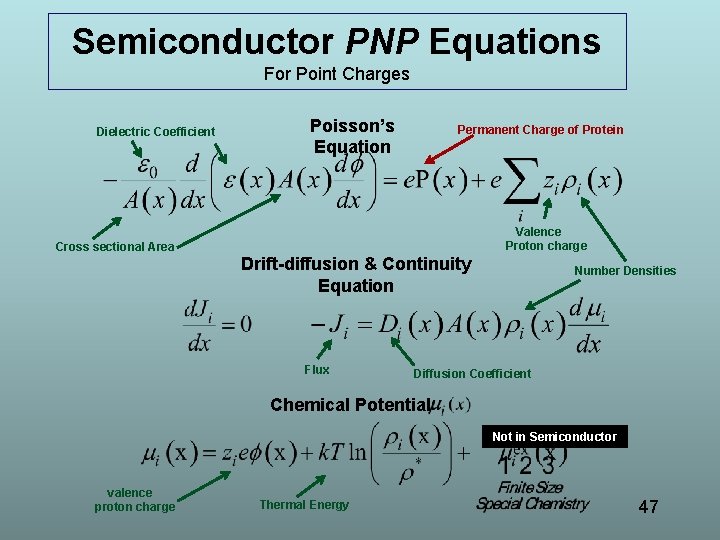
Semiconductor PNP Equations For Point Charges Dielectric Coefficient Poisson’s Equation Permanent Charge of Protein Valence Proton charge Cross sectional Area Drift-diffusion & Continuity Equation Flux Number Densities Diffusion Coefficient Chemical Potential Not in Semiconductor valence proton charge Thermal Energy 47
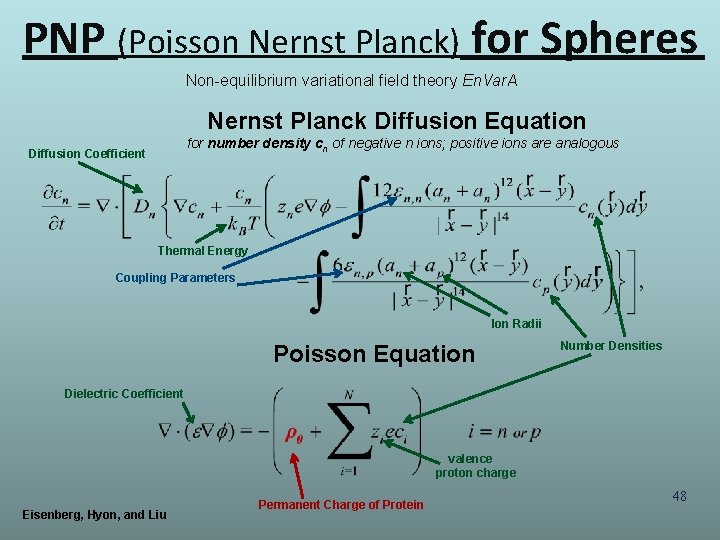
PNP (Poisson Nernst Planck) for Spheres Non-equilibrium variational field theory En. Var. A Nernst Planck Diffusion Equation for number density cn of negative n ions; positive ions are analogous Diffusion Coefficient Thermal Energy Coupling Parameters Ion Radii Poisson Equation Number Densities Dielectric Coefficient valence proton charge Eisenberg, Hyon, and Liu Permanent Charge of Protein 48
All we have to do is Solve them! with Boundary Conditions defining Charge Carriers ions, holes, quasi-electrons Geometry 49
Here is where we do Science, not Mathematics Here we have Two Guesses 50
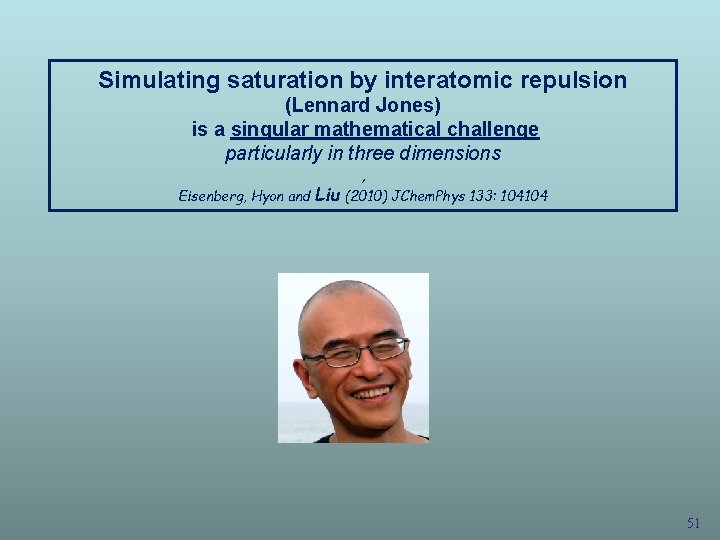
Simulating saturation by interatomic repulsion (Lennard Jones) is a singular mathematical challenge particularly in three dimensions Eisenberg, Hyon and , Liu (2010) JChem. Phys 133: 104104 51
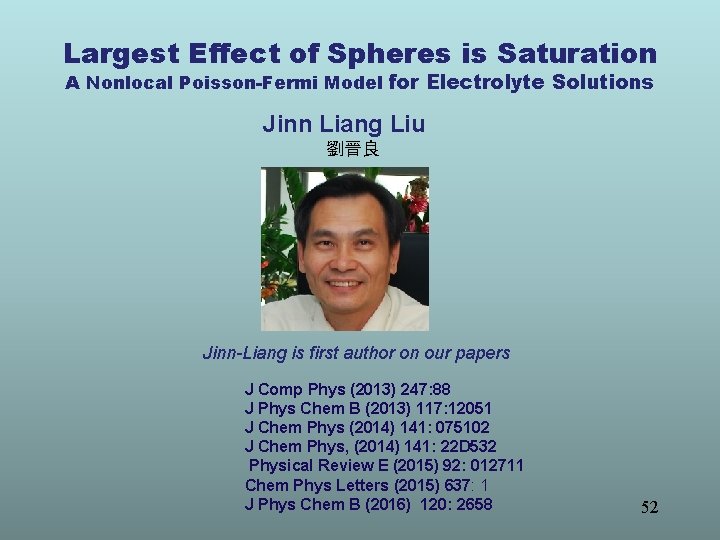
Largest Effect of Spheres is Saturation A Nonlocal Poisson-Fermi Model for Electrolyte Solutions Jinn Liang Liu 劉晉良 Jinn-Liang is first author on our papers J Comp Phys (2013) 247: 88 J Phys Chem B (2013) 117: 12051 J Chem Phys (2014) 141: 075102 J Chem Phys, (2014) 141: 22 D 532 Physical Review E (2015) 92: 012711 Chem Phys Letters (2015) 637: 1 J Phys Chem B (2016) 120: 2658 52
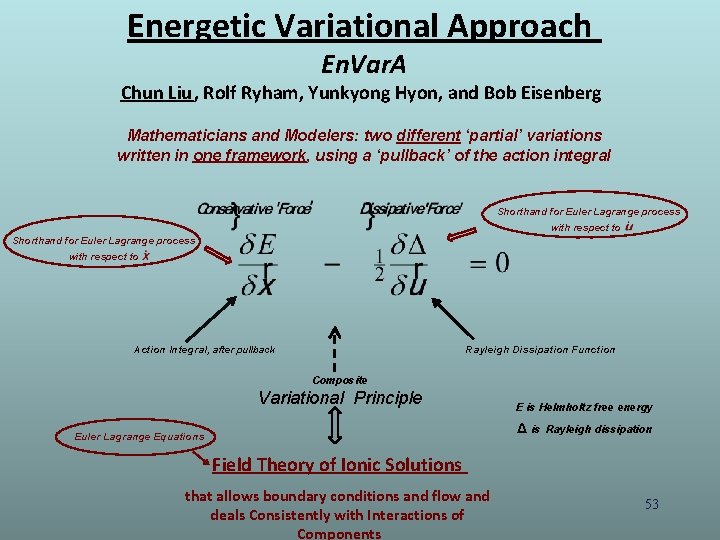
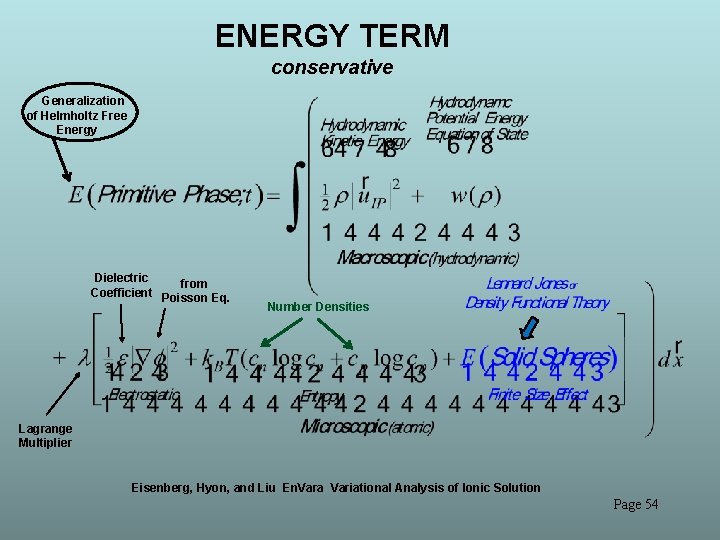
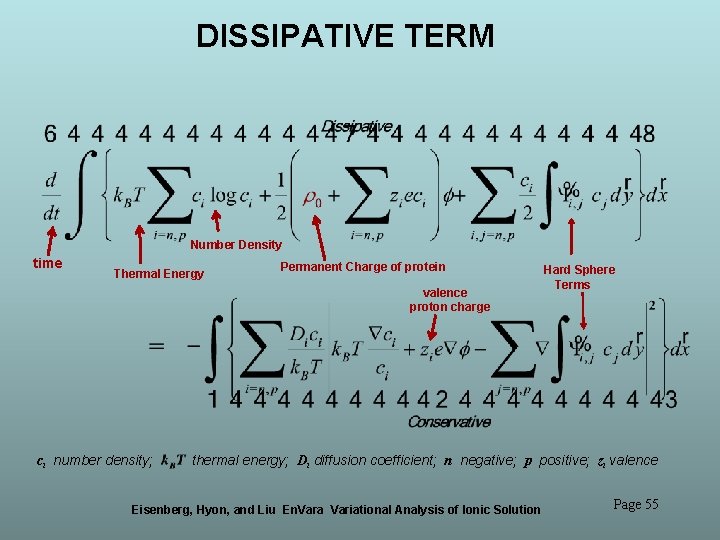
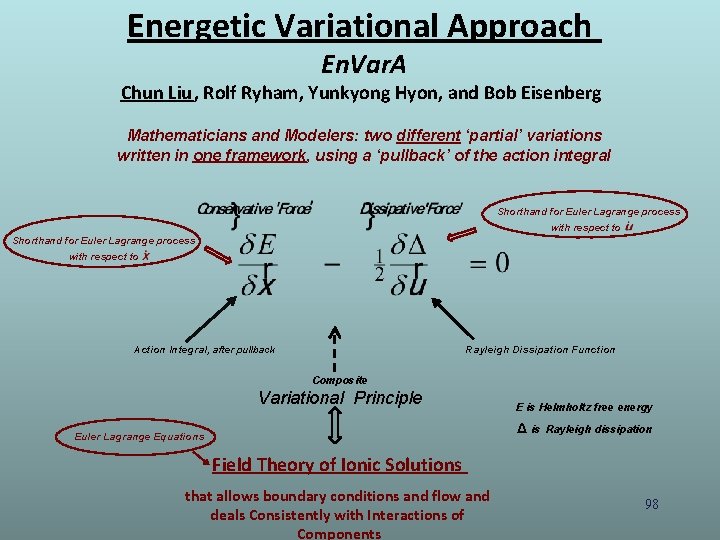
Energetic Variational Approach En. Var. A Chun Liu, Rolf Ryham, Yunkyong Hyon, and Bob Eisenberg Mathematicians and Modelers: two different ‘partial’ variations written in one framework, using a ‘pullback’ of the action integral Shorthand for Euler Lagrange process with respect to Action Integral, after pullback Rayleigh Dissipation Function Composite Variational Principle E is Helmholtz free energy Δ is Euler Lagrange Equations Rayleigh dissipation Field Theory of Ionic Solutions that allows boundary conditions and flow and deals Consistently with Interactions of Components 53
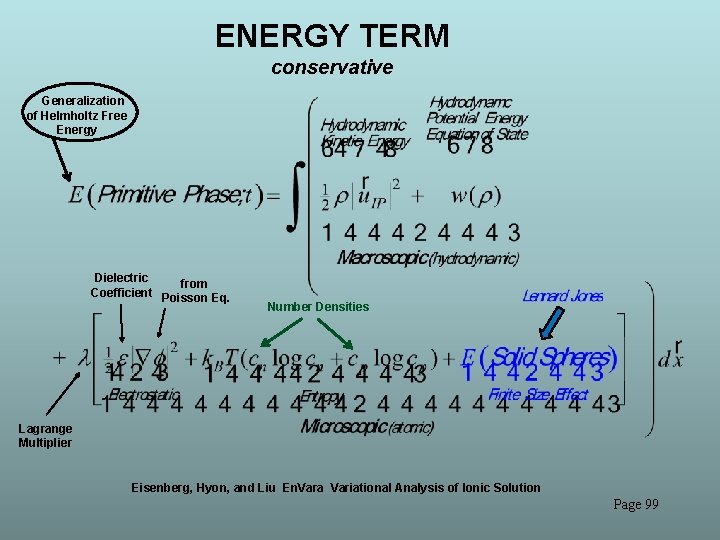
ENERGY TERM conservative Generalization of Helmholtz Free Energy Dielectric from Coefficient Poisson Eq. Number Densities Lagrange Multiplier Eisenberg, Hyon, and Liu En. Vara Variational Analysis of Ionic Solution Page 54
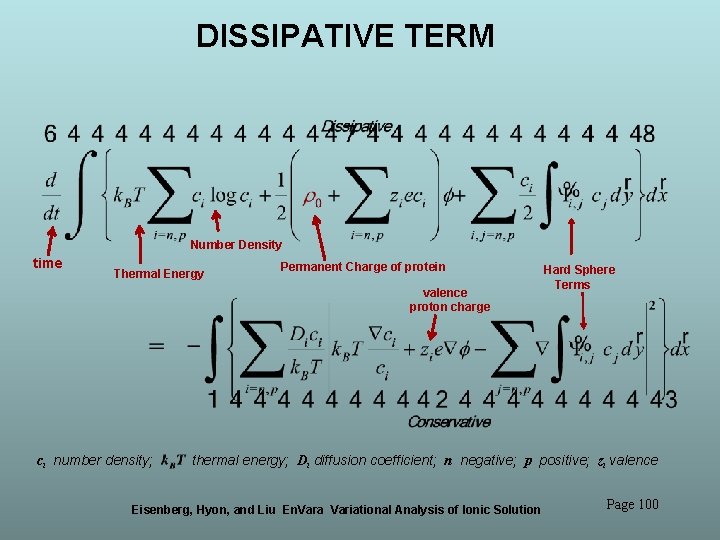
DISSIPATIVE TERM Number Density time Thermal Energy Permanent Charge of protein valence proton charge ci number density; Hard Sphere Terms thermal energy; Di diffusion coefficient; n negative; p positive; zi valence Eisenberg, Hyon, and Liu En. Vara Variational Analysis of Ionic Solution Page 55
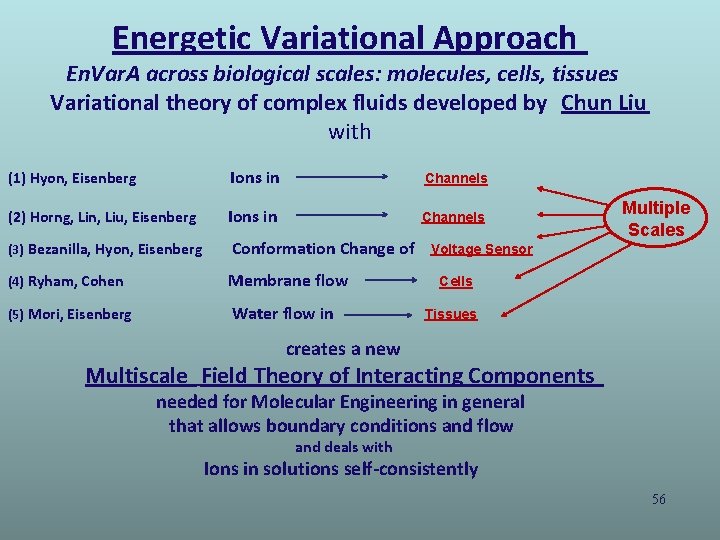
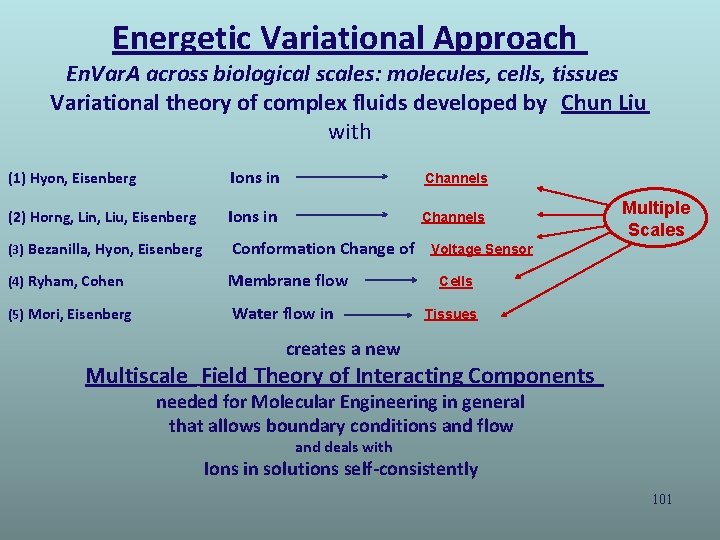
Energetic Variational Approach En. Var. A across biological scales: molecules, cells, tissues Variational theory of complex fluids developed by Chun Liu with (1) Hyon, Eisenberg Ions in Channels (2) Horng, Lin, Liu, Eisenberg Ions in Channels (3) Bezanilla, Hyon, Eisenberg Conformation Change of (4) Ryham, Cohen Membrane flow (5) Mori, Eisenberg Water flow in Multiple Scales Voltage Sensor Cells Tissues creates a new Multiscale Field Theory of Interacting Components needed for Molecular Engineering in general that allows boundary conditions and flow and deals with Ions in solutions self-consistently 56
The End Any Questions? About general Mathematical Treatment? ? 57
Evidence for Reduced Model ‘Crowded Charge’ 58
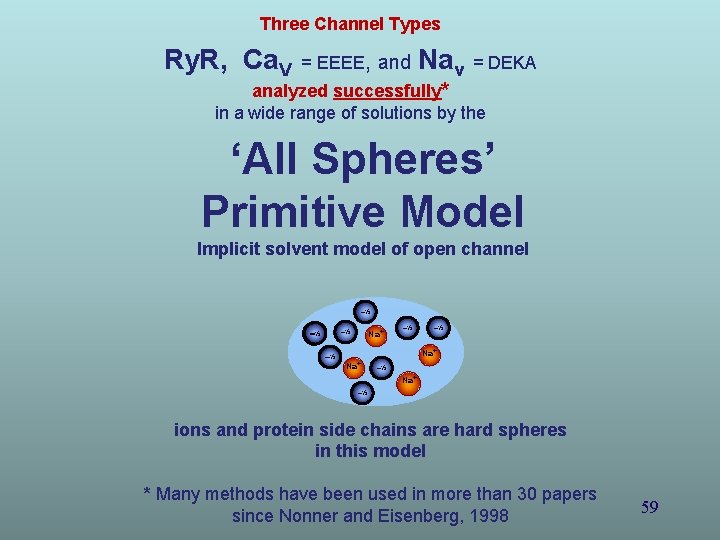
Three Channel Types Ry. R, Ca. V = EEEE, and Nav = DEKA analyzed successfully* in a wide range of solutions by the ‘All Spheres’ Primitive Model Implicit solvent model of open channel ½ Na+ ½ ½ ½ Na+ ½ ions and protein side chains are hard spheres in this model * Many methods have been used in more than 30 papers since Nonner and Eisenberg, 1998 59
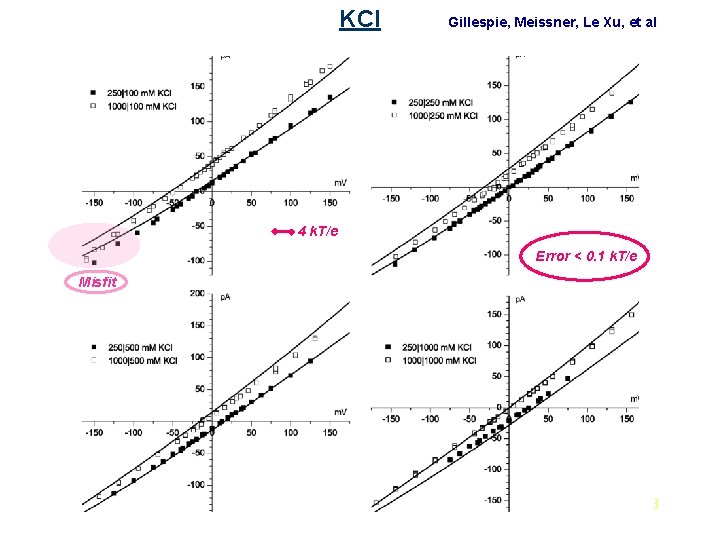
Best Evidence is from the Ry. R Receptor Dirk Gillespie Dirk_Gillespie@rush. edu Gerhard Meissner, Le Xu, et al, not Bob Eisenberg More than 120 combinations of solutions & mutants 7 mutants with significant effects fit successfully
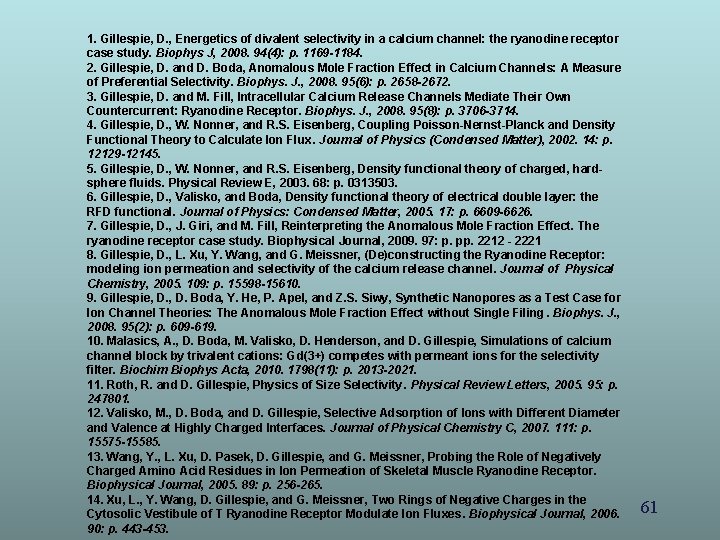
1. Gillespie, D. , Energetics of divalent selectivity in a calcium channel: the ryanodine receptor case study. Biophys J, 2008. 94(4): p. 1169 -1184. 2. Gillespie, D. and D. Boda, Anomalous Mole Fraction Effect in Calcium Channels: A Measure of Preferential Selectivity. Biophys. J. , 2008. 95(6): p. 2658 -2672. 3. Gillespie, D. and M. Fill, Intracellular Calcium Release Channels Mediate Their Own Countercurrent: Ryanodine Receptor. Biophys. J. , 2008. 95(8): p. 3706 -3714. 4. Gillespie, D. , W. Nonner, and R. S. Eisenberg, Coupling Poisson-Nernst-Planck and Density Functional Theory to Calculate Ion Flux. Journal of Physics (Condensed Matter), 2002. 14: p. 12129 -12145. 5. Gillespie, D. , W. Nonner, and R. S. Eisenberg, Density functional theory of charged, hardsphere fluids. Physical Review E, 2003. 68: p. 0313503. 6. Gillespie, D. , Valisko, and Boda, Density functional theory of electrical double layer: the RFD functional. Journal of Physics: Condensed Matter, 2005. 17: p. 6609 -6626. 7. Gillespie, D. , J. Giri, and M. Fill, Reinterpreting the Anomalous Mole Fraction Effect. The ryanodine receptor case study. Biophysical Journal, 2009. 97: p. pp. 2212 - 2221 8. Gillespie, D. , L. Xu, Y. Wang, and G. Meissner, (De)constructing the Ryanodine Receptor: modeling ion permeation and selectivity of the calcium release channel. Journal of Physical Chemistry, 2005. 109: p. 15598 -15610. 9. Gillespie, D. Boda, Y. He, P. Apel, and Z. S. Siwy, Synthetic Nanopores as a Test Case for Ion Channel Theories: The Anomalous Mole Fraction Effect without Single Filing. Biophys. J. , 2008. 95(2): p. 609 -619. 10. Malasics, A. , D. Boda, M. Valisko, D. Henderson, and D. Gillespie, Simulations of calcium channel block by trivalent cations: Gd(3+) competes with permeant ions for the selectivity filter. Biochim Biophys Acta, 2010. 1798(11): p. 2013 -2021. 11. Roth, R. and D. Gillespie, Physics of Size Selectivity. Physical Review Letters, 2005. 95: p. 247801. 12. Valisko, M. , D. Boda, and D. Gillespie, Selective Adsorption of Ions with Different Diameter and Valence at Highly Charged Interfaces. Journal of Physical Chemistry C, 2007. 111: p. 15575 -15585. 13. Wang, Y. , L. Xu, D. Pasek, D. Gillespie, and G. Meissner, Probing the Role of Negatively Charged Amino Acid Residues in Ion Permeation of Skeletal Muscle Ryanodine Receptor. Biophysical Journal, 2005. 89: p. 256 -265. 14. Xu, L. , Y. Wang, D. Gillespie, and G. Meissner, Two Rings of Negative Charges in the Cytosolic Vestibule of T Ryanodine Receptor Modulate Ion Fluxes. Biophysical Journal, 2006. 90: p. 443 -453. 61
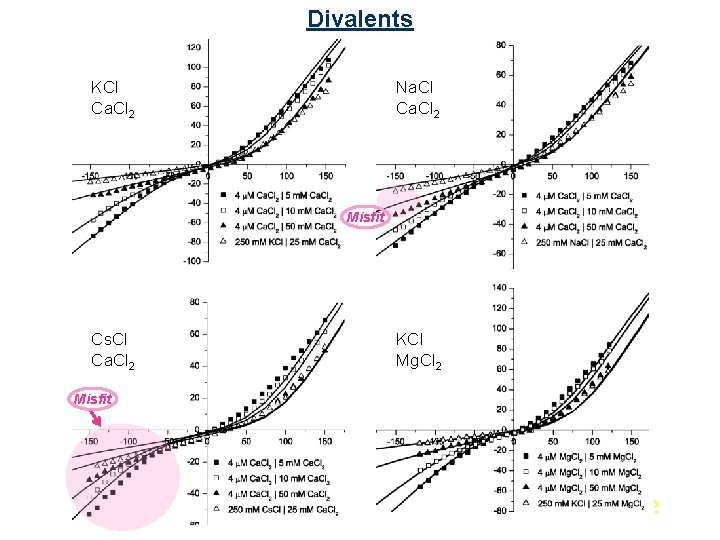
Divalents KCl Ca. Cl 2 Na. Cl Ca. Cl 2 Misfit Cs. Cl Ca. Cl 2 KCl Mg. Cl 2 Misfit 62
KCl Gillespie, Meissner, Le Xu, et al 4 k. T/e Error < 0. 1 k. T/e Misfit 63
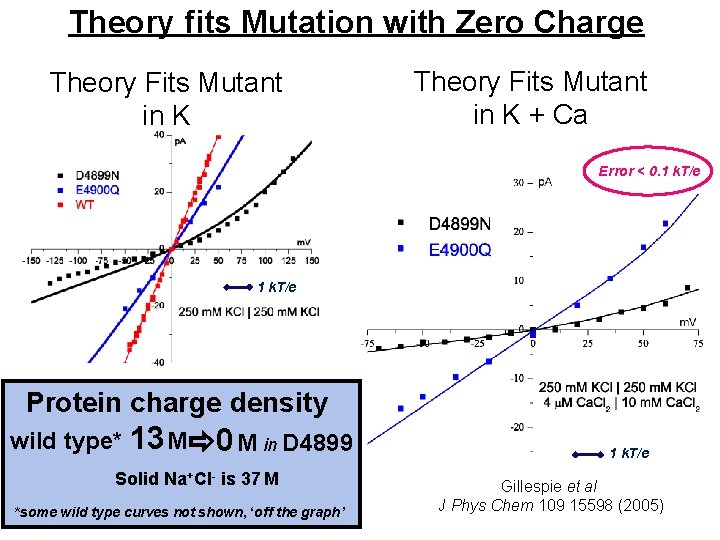
Theory fits Mutation with Zero Charge Theory Fits Mutant in K + Ca Error < 0. 1 k. T/e Protein charge density wild type* 13 M 0 M in D 4899 Solid Na+Cl- is 37 M *some wild type curves not shown, ‘off the graph’ 1 k. T/e Gillespie et al J Phys Chem 109 15598 (2005)
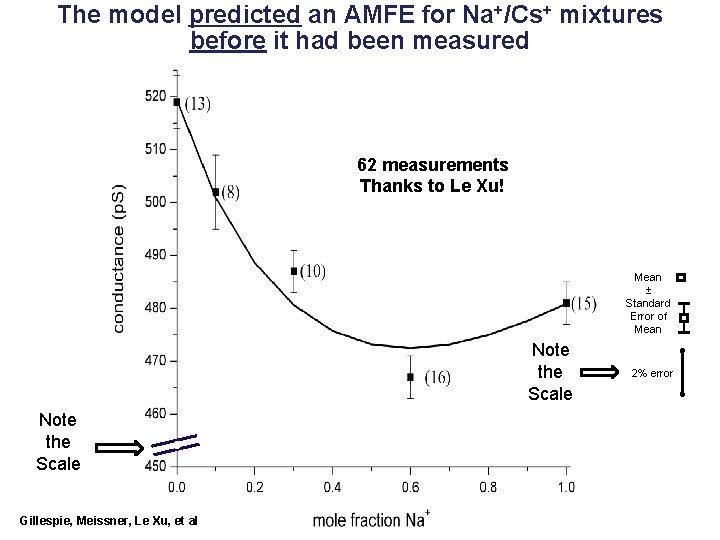
The model predicted an AMFE for Na+/Cs+ mixtures before it had been measured 62 measurements Thanks to Le Xu! Mean ± Standard Error of Mean Note the Scale Gillespie, Meissner, Le Xu, et al 2% error
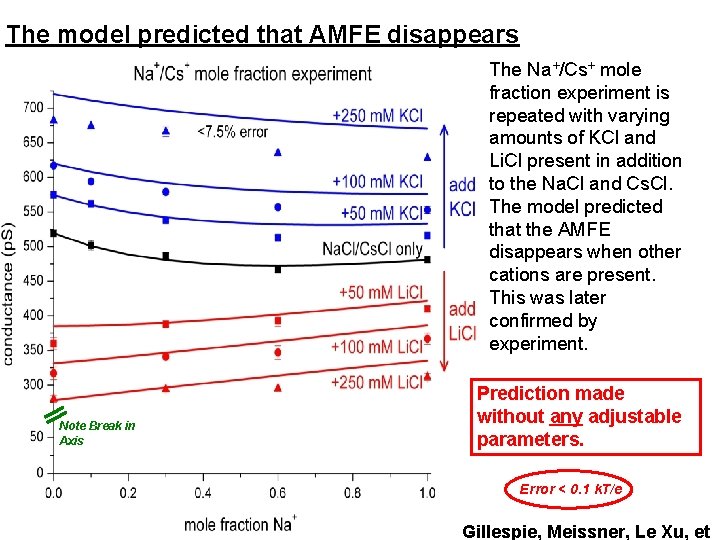
The model predicted that AMFE disappears The Na+/Cs+ mole fraction experiment is repeated with varying amounts of KCl and Li. Cl present in addition to the Na. Cl and Cs. Cl. The model predicted that the AMFE disappears when other cations are present. This was later confirmed by experiment. Note Break in Axis Prediction made without any adjustable parameters. Error < 0. 1 k. T/e Gillespie, Meissner, Le Xu, et
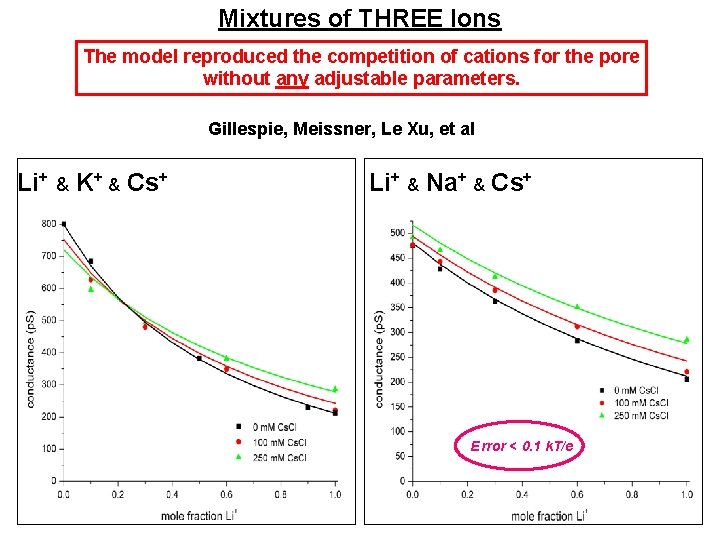
Mixtures of THREE Ions The model reproduced the competition of cations for the pore without any adjustable parameters. Gillespie, Meissner, Le Xu, et al Li+ & K+ & Cs+ Li+ & Na+ & Cs+ Error < 0. 1 k. T/e
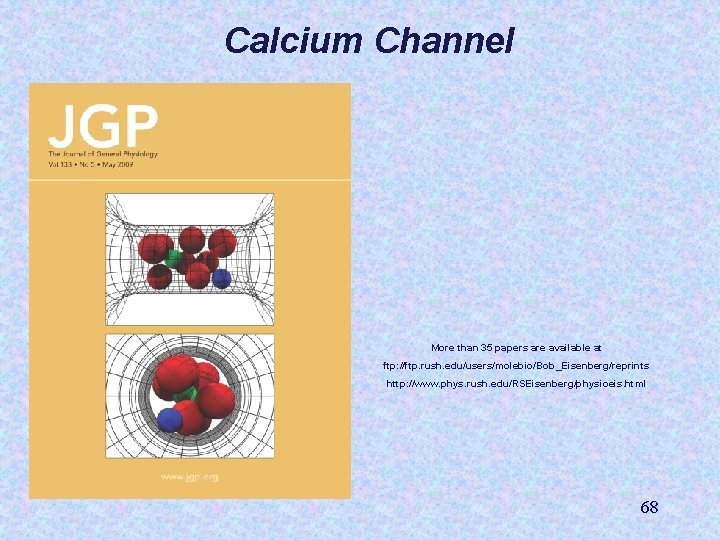
Calcium Channel More than 35 papers are available at ftp: //ftp. rush. edu/users/molebio/Bob_Eisenberg/reprints http: //www. phys. rush. edu/RSEisenberg/physioeis. html 68
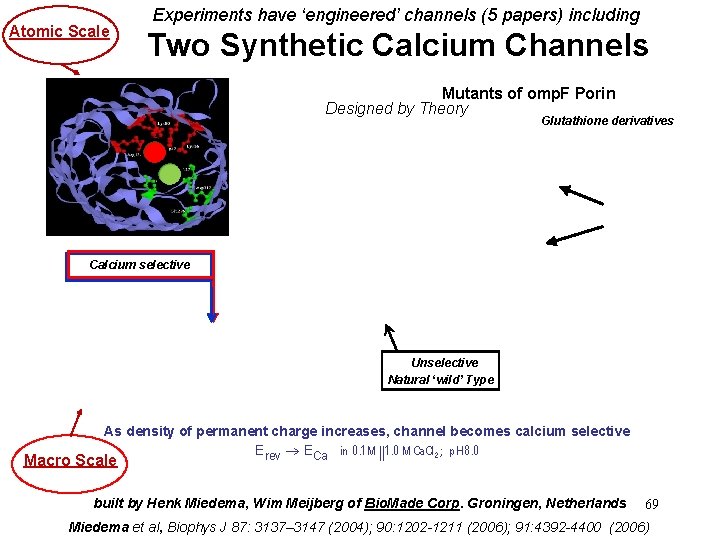
Atomic Scale Experiments have ‘engineered’ channels (5 papers) including Two Synthetic Calcium Channels Mutants of omp. F Porin Designed by Theory Glutathione derivatives MUTANT ─ Compound Calcium selective Unselective Natural ‘wild’ Type As density of permanent charge increases, channel becomes calcium selective Erev ECa in 0. 1 M 1. 0 || M Ca. Cl 2 ; p. H 8. 0 Macro Scale built by Henk Miedema, Wim Meijberg of Bio. Made Corp. Groningen, Netherlands 69 Miedema et al, Biophys J 87: 3137– 3147 (2004); 90: 1202 -1211 (2006); 91: 4392 -4400 (2006)
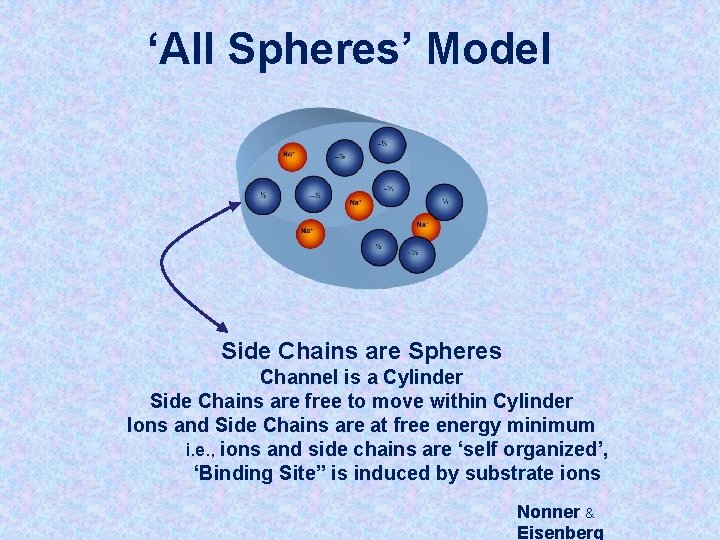
‘All Spheres’ Model Side Chains are Spheres Channel is a Cylinder Side Chains are free to move within Cylinder Ions and Side Chains are at free energy minimum i. e. , ions and side chains are ‘self organized’, ‘Binding Site” is induced by substrate ions Nonner & Eisenberg
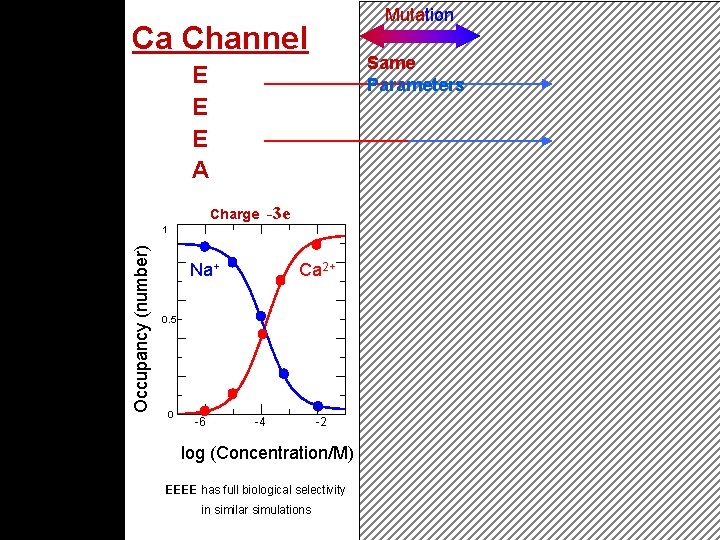
Mutation Ca Channel Same Parameters E E E A Charge Occupancy (number) Na Channel D E K A Charge -1 e -3 e 0. 004 1 Na+ Ca 2+ Na+ 0. 002 0. 5 Ca 2+ 0 -6 -4 -2 log (Concentration/M) 0 0 0. 05 0. 1 Concentration/M EEEE has full biological selectivity in similar simulations Boda, et al 71
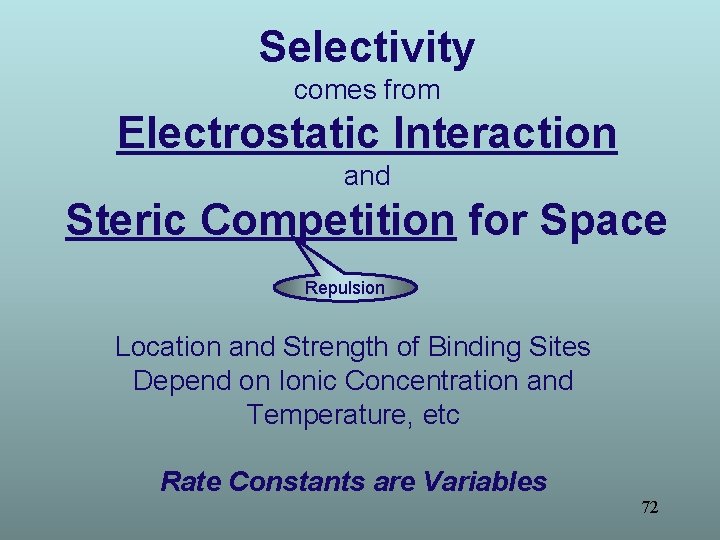
Selectivity comes from Electrostatic Interaction and Steric Competition for Space Repulsion Location and Strength of Binding Sites Depend on Ionic Concentration and Temperature, etc Rate Constants are Variables 72
Sodium Channel Voltage controlled channel responsible for signaling in nerve and coordination of muscle contraction 73
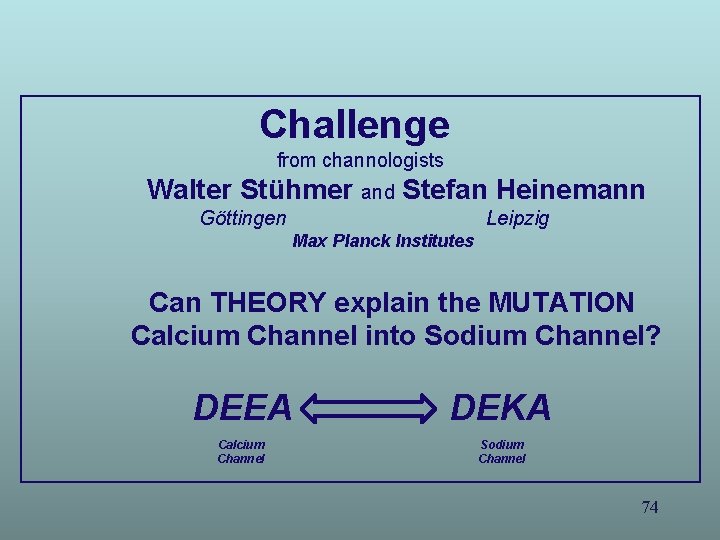
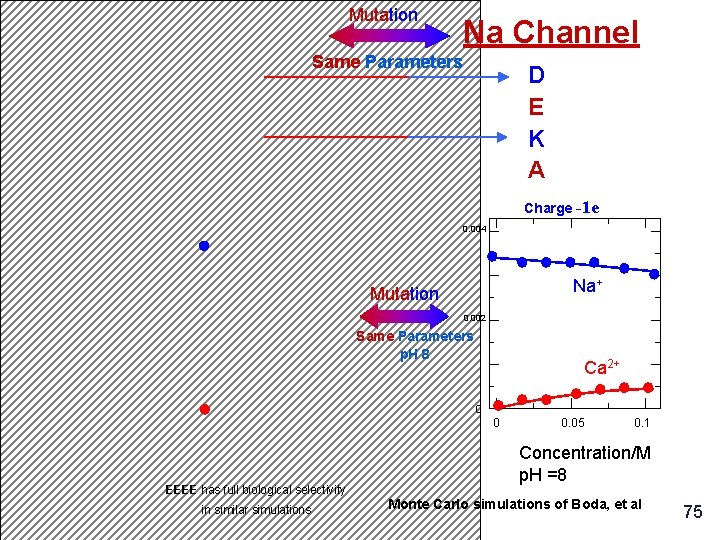
Challenge from channologists Walter Stühmer and Stefan Heinemann Göttingen Leipzig Max Planck Institutes Can THEORY explain the MUTATION Calcium Channel into Sodium Channel? DEEA Calcium Channel DEKA Sodium Channel 74
Ca Channel E E E A Charge Occupancy (number) Mutation Na Channel Same Parameters D E K A Charge -1 e -3 e 0. 004 1 Na+ Ca 2+ Na+ Mutation 0. 002 0. 5 Same Parameters p. H 8 0 -6 -4 -2 log (Concentration/M) EEEE has full biological selectivity in similar simulations Ca 2+ 0 0 0. 05 0. 1 Concentration/M p. H =8 Monte Carlo simulations of Boda, et al 75
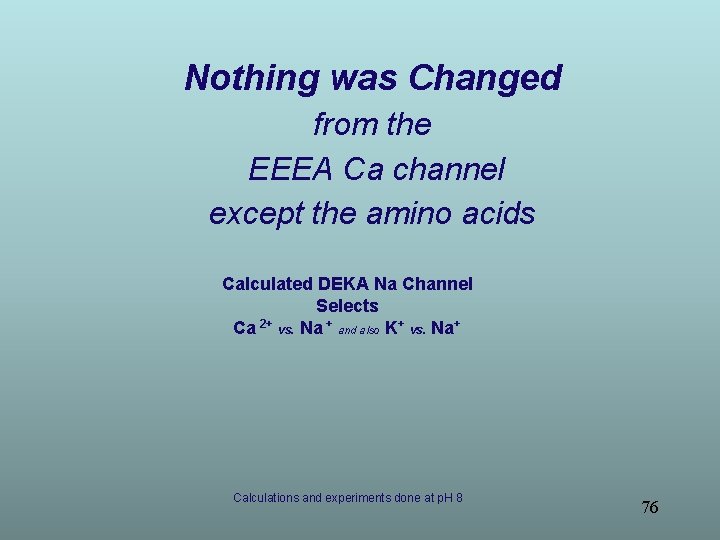
Nothing was Changed from the EEEA Ca channel except the amino acids Calculated DEKA Na Channel Selects Ca 2+ vs. Na + and also K+ vs. Na+ Calculations and experiments done at p. H 8 76
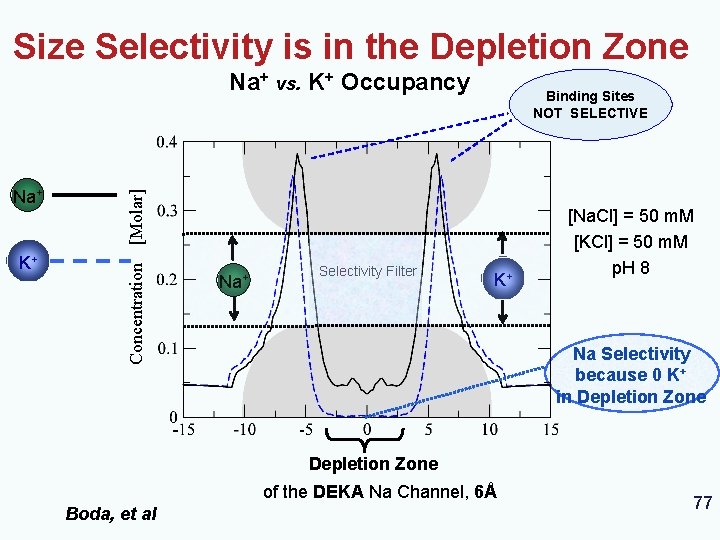
Size Selectivity is in the Depletion Zone Na+ vs. K+ Occupancy Binding Sites NOT SELECTIVE Na+ K+ Concentration [Molar] Channel Protein Na+ Selectivity Filter K+ [Na. Cl] = 50 m. M [KCl] = 50 m. M p. H 8 Na Selectivity because 0 K+ in Depletion Zone of the DEKA Na Channel, 6Å Boda, et al 77
How? Usually Complex Unsatisfying Answers* How does a Channel Select Na+ vs. K+ ? * Gillespie, D. , Energetics of divalent selectivity in the ryanodine receptor. Biophys J (2008). 94: p. 1169 -1184 * Boda, et al, Analyzing free-energy by Widom's particle insertion method. J Chem Phys (2011) 134: p. 055102 -14 Calculations and experiments done at p. H 8 78
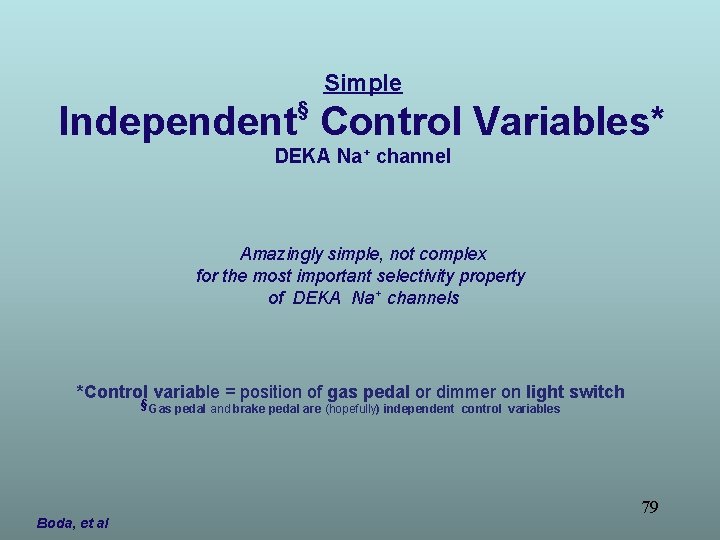
Simple § Independent Control Variables* DEKA Na+ channel Amazingly simple, not complex for the most important selectivity property of DEKA Na+ channels *Control variable = position of gas pedal or dimmer on light switch § Gas pedal and brake pedal are (hopefully) independent control variables Boda, et al 79
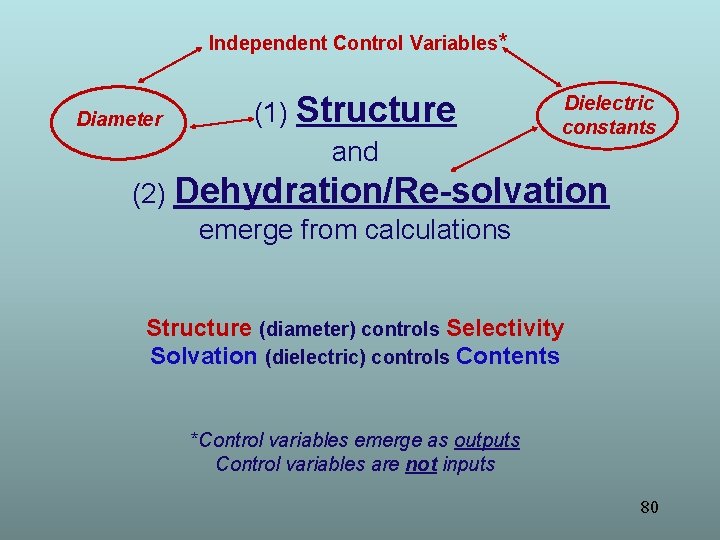
Independent Control Variables* Diameter (1) Structure and Dielectric constants (2) Dehydration/Re-solvation emerge from calculations Structure (diameter) controls Selectivity Solvation (dielectric) controls Contents *Control variables emerge as outputs Control variables are not inputs 80
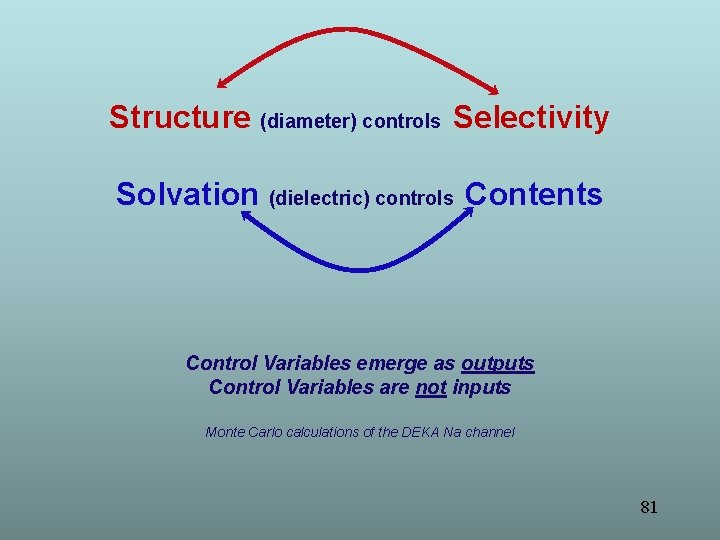
Structure (diameter) controls Selectivity Solvation (dielectric) controls Contents Control Variables emerge as outputs Control Variables are not inputs Monte Carlo calculations of the DEKA Na channel 81
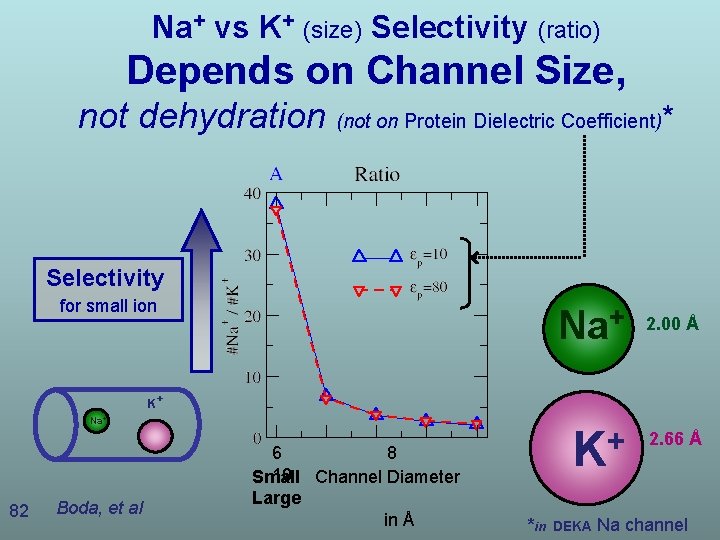
Na+ vs K+ (size) Selectivity (ratio) Depends on Channel Size, not dehydration (not on Protein Dielectric Coefficient)* Selectivity Na+ 2. 00 Å for small ion K+ Na+ 82 Boda, et al 6 8 10 Small Channel Diameter Large in Å + K 2. 66 Å *in DEKA Na channel
What does the protein do? Channel and Contents form a Self-Organized Structure with Side Chains at position of Minimum Free Energy Protein Fits the Substrate ‘Induced Fit Model of Selectivity’ 83
Binding Sites* are outputs of our Calculations This is the Self-organized Induced fit model of Koshland the founders of enzymology, Made specific by Mathematics and Computation 84
Selectivity Depends on Structure is the Computed Consequence of Forces in these models 85
We can actually compute the Structures that determine Selectivity 86
The End Any Questions? About general Mathematical Treatment? ? 87
Physical Chemists are Frustrated by Real Solutions
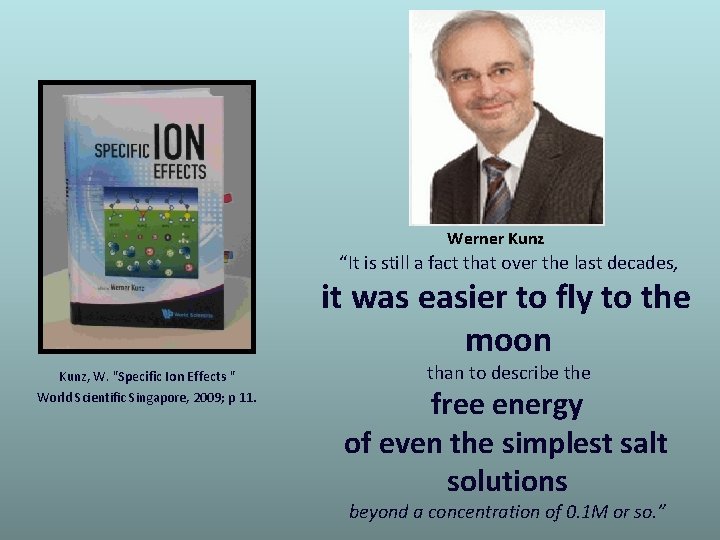
Werner Kunz “It is still a fact that over the last decades, it was easier to fly to the moon Kunz, W. "Specific Ion Effects " World Scientific Singapore, 2009; p 11. than to describe the free energy of even the simplest salt solutions beyond a concentration of 0. 1 M or so. ”
Central Result of Physical Chemistry Ions in a solution are a Highly Compressible Plasma although the Solution is Incompressible Free energy of an ionic solution is mostly determined by the Number density of the ions. Density varies from 10 -11 to 101 M in typical biological system of proteins, nucleic acids, and channels. Learned from Doug Henderson, J. -P. Hansen, Stuart Rice, among others…Thanks! 90
Electrolytes are Complex Fluids Treating a Complex Fluid as if it were a Simple Fluid will produce Elusive Results 91
Electrolytes are Complex Fluids After 690 pages and 2604 references, properties of SINGLE Ions are Elusive* because Every Ion Interacts with Hünenberger & Reif (2011) “Single-Ion Solvation … Approaches to Elusive* Thermodynamic Quantities” Everything *’elusive’ is in the authors’ choice in the title 92
9 3 Everything Interacts Mathematics of Chemistry must deal Naturally with Interactions ‘Law of Mass Action’ assumes nothing interacts So this is a great opportunity for new mathematics and applications!
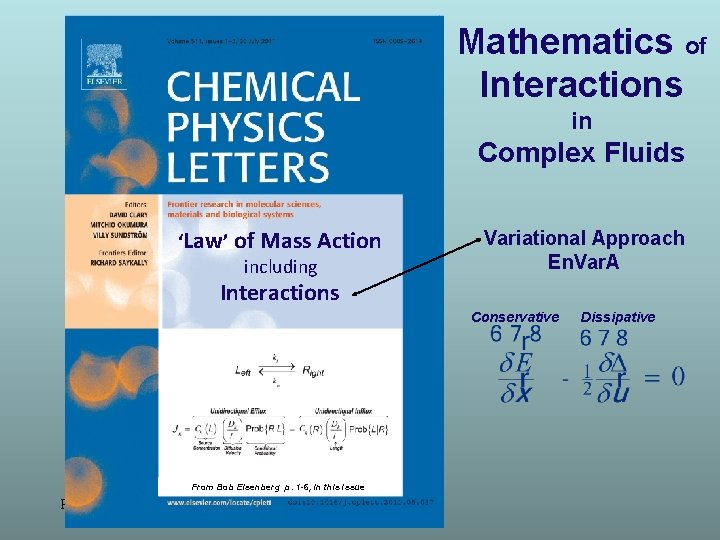
Mathematics of Interactions in Complex Fluids ‘Law’ of Mass Action including Variational Approach En. Var. A Interactions Conservative From Bob Eisenberg p. 1 -6, in this issue Page 94 Dissipative
‘Everything Interacts with Everything Else’ immediately implies the need for Variational Methods for those who understand. But I did not understand for some fifty years, chemists/biologists do not understand even now, so it is not obvious to all. I apologize to those who already understand! 95
Can En. Var. A actually compute the function of these systems? Can En. Var. A serve as a useful Mathematical Framework for Multi-scale Engineering? 96
The End Any Questions? 97
Energetic Variational Approach En. Var. A Chun Liu, Rolf Ryham, Yunkyong Hyon, and Bob Eisenberg Mathematicians and Modelers: two different ‘partial’ variations written in one framework, using a ‘pullback’ of the action integral Shorthand for Euler Lagrange process with respect to Action Integral, after pullback Rayleigh Dissipation Function Composite Variational Principle E is Helmholtz free energy Δ is Euler Lagrange Equations Rayleigh dissipation Field Theory of Ionic Solutions that allows boundary conditions and flow and deals Consistently with Interactions of Components 98
ENERGY TERM conservative Generalization of Helmholtz Free Energy Dielectric from Coefficient Poisson Eq. Number Densities Lagrange Multiplier Eisenberg, Hyon, and Liu En. Vara Variational Analysis of Ionic Solution Page 99
DISSIPATIVE TERM Number Density time Thermal Energy Permanent Charge of protein valence proton charge ci number density; Hard Sphere Terms thermal energy; Di diffusion coefficient; n negative; p positive; zi valence Eisenberg, Hyon, and Liu En. Vara Variational Analysis of Ionic Solution Page 100
Energetic Variational Approach En. Var. A across biological scales: molecules, cells, tissues Variational theory of complex fluids developed by Chun Liu with (1) Hyon, Eisenberg Ions in Channels (2) Horng, Lin, Liu, Eisenberg Ions in Channels (3) Bezanilla, Hyon, Eisenberg Conformation Change of (4) Ryham, Cohen Membrane flow (5) Mori, Eisenberg Water flow in Multiple Scales Voltage Sensor Cells Tissues creates a new Multiscale Field Theory of Interacting Components needed for Molecular Engineering in general that allows boundary conditions and flow and deals with Ions in solutions self-consistently 101
Schuss, Singer, Nadler and I had to guess the conditioned sets Chun is working on doing this right, Stay Tuned!! PS This is not just of abstract importance. Correlations will be different so results will be different 103
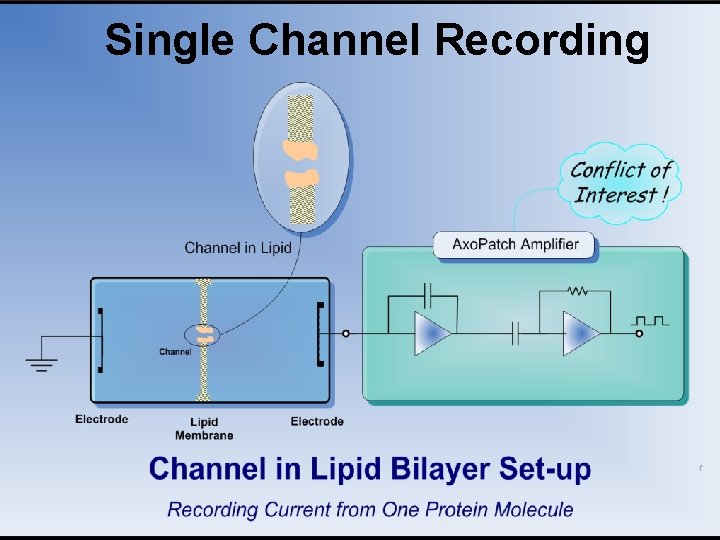
Single Channel Recording 104
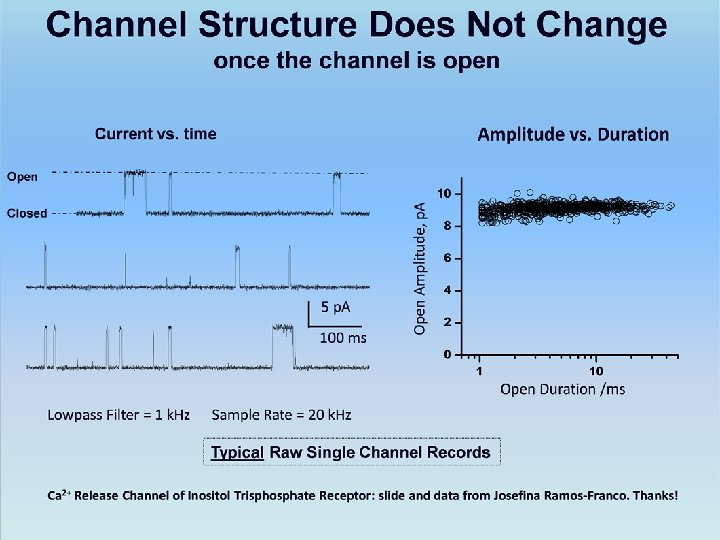
105
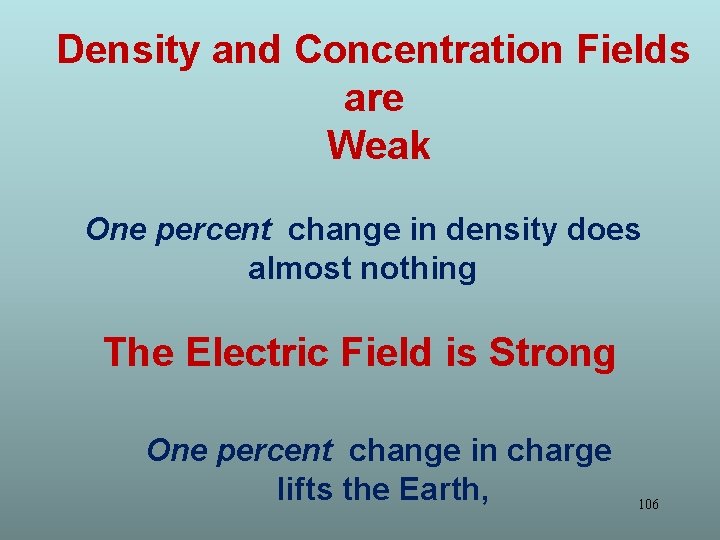
Density and Concentration Fields are Weak One percent change in density does almost nothing The Electric Field is Strong One percent change in charge lifts the Earth, 106