
To learn to identify and use future continuous


- Slides: 50
To learn to identify and use future continuous tense To learn to identify and understand future in the past
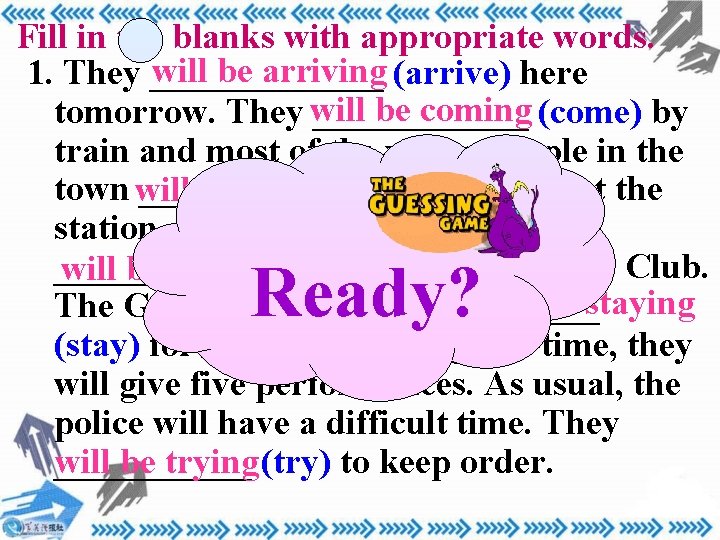
Observe the sentences you have learned. 1. They will be arriving here tomorrow. They will be coming by train and most of the young people in the town will be meeting them at the station. Tomorrow evening they will be singing at the Workers' Club. The Greenwood Boys will be staying for five days. During this time, they will give five performances. As usual, the police will have a difficult time. They will be trying to keep order. (新概念二册)
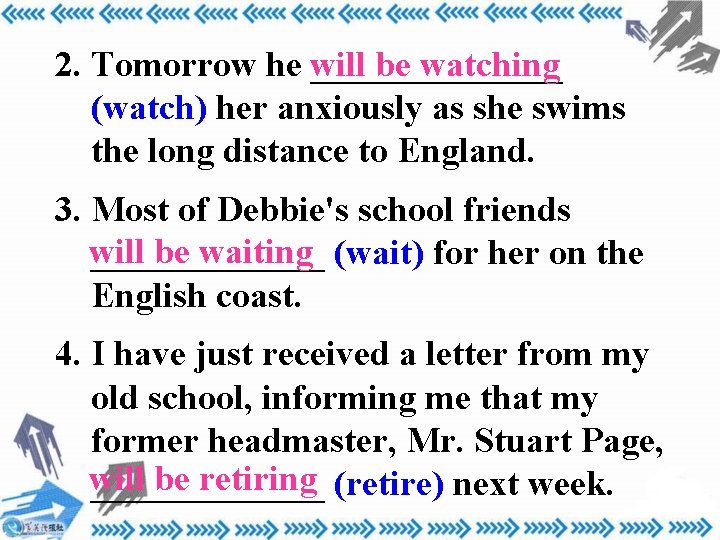
2. Tomorrow he will be watching her anxiously as she swims the long distance to England. (新概念二册) 3. Most of Debbie's school friends will be waiting for her on the English coast. (新概念二册)
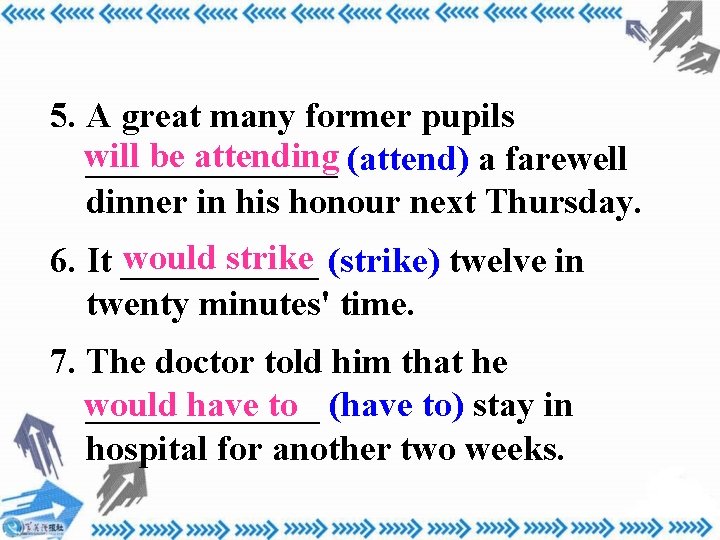
4. I have just received a letter from my old school, informing me that my former headmaster, Mr. Stuart Page, will be retiring next week. (新 概念二册) 5. A great many former pupils will be attending a farewell dinner in his honour next Thursday. (新概念二册 )
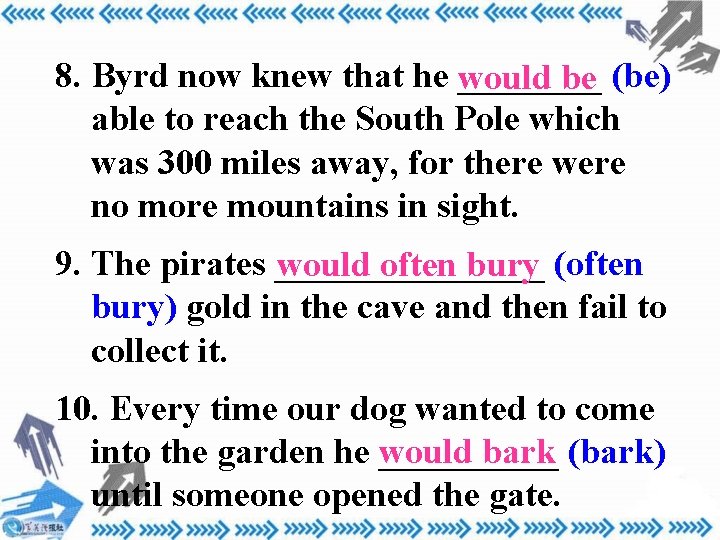
6. It would strike twelve in twenty minutes' time. (新概念二册) 7. The doctor told him that he would have to stay in hospital for another two weeks. (新概念二册) 8. Byrd now knew that he would be able to reach the South Pole which was 300 miles away, for there were no more mountains in sight. (新概念 二册)
9. The pirates would often bury gold in the cave and then fail to collect it. (新概念二册) 10. Every time our dog wanted to come into the garden he would bark until someone opened the gate. (新概念二册)
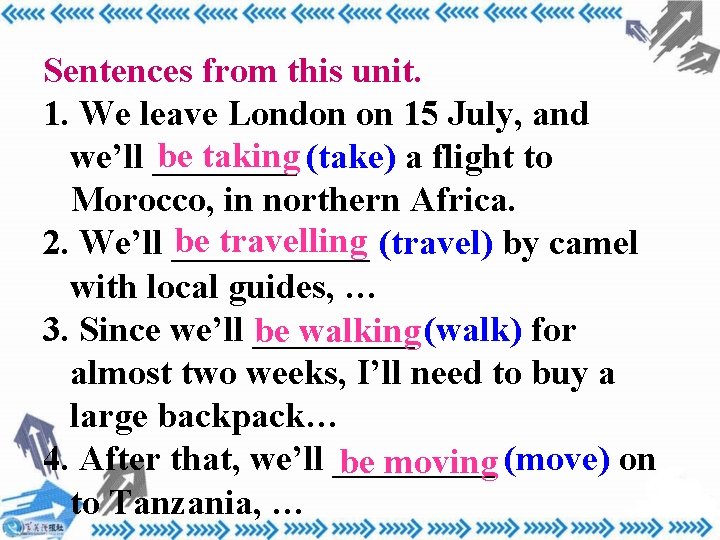
Observe the sentences from this unit. 1. We leave London on 15 July, and we’ll be taking a flight to Morocco, in northern Africa. 2. We’ll be travelling by camel with local guides, … 3. Since we’ll be walking for almost two weeks, I’ll need to buy a large backpack… 4. After that, we’ll be moving on to Tanzania, …
Fill in the blanks with appropriate words. will be arriving (arrive) here 1. They _______ be coming (come) by tomorrow. They will ______ train and most of the young people in the town will _______ be meeting (meet) them at the station. Tomorrow evening they ______ will be singing(sing) at the Workers' Club. will be staying The Greenwood Boys______ (stay) for five days. During this time, they will give five performances. As usual, the police will have a difficult time. They ______ will be trying (try) to keep order. go Ready?
be watching 2. Tomorrow he will _______ (watch) her anxiously as she swims the long distance to England. 3. Most of Debbie's school friends will be waiting (wait) for her on the _______ English coast. 4. I have just received a letter from my old school, informing me that my former headmaster, Mr. Stuart Page, will be retiring (retire) next week. _______
5. A great many former pupils will be attending (attend) a farewell _______ dinner in his honour next Thursday. would strike (strike) twelve in 6. It ______ twenty minutes' time. 7. The doctor told him that he would have to (have to) stay in _______ hospital for another two weeks.
8. Byrd now knew that he would ____ be (be) able to reach the South Pole which was 300 miles away, for there were no more mountains in sight. 9. The pirates ________ would often bury (often bury) gold in the cave and then fail to collect it. 10. Every time our dog wanted to come into the garden he would _____ bark (bark) until someone opened the gate.
Sentences from this unit. 1. We leave London on 15 July, and be taking (take) a flight to we’ll ____ Morocco, in northern Africa. be travelling (travel) by camel 2. We’ll ______ with local guides, … 3. Since we’ll _____ be walking (walk) for almost two weeks, I’ll need to buy a large backpack… 4. After that, we’ll _____ be moving (move) on to Tanzania, …
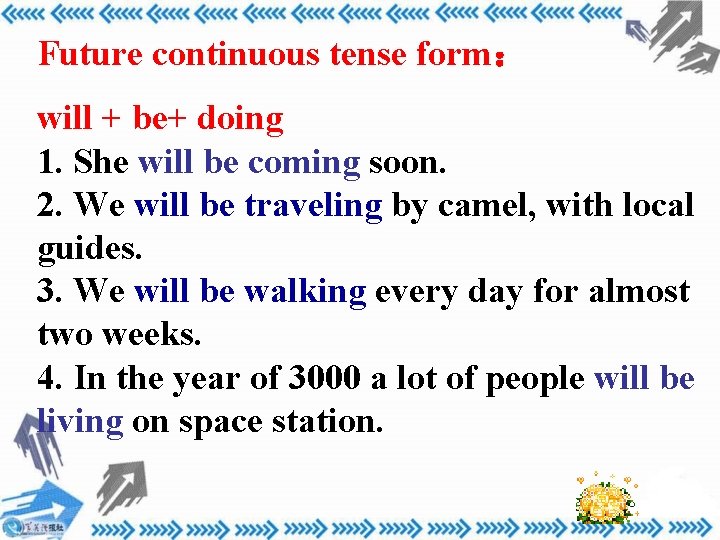
Future continuous tense form: will + be+ doing 1. She will be coming soon. 2. We will be traveling by camel, with local guides. 3. We will be walking every day for almost two weeks. 4. In the year of 3000 a lot of people will be living on space station.
(1)talk about something that will be in progress over a period of time in the future (表示将来某一段时间内持续做的动作)
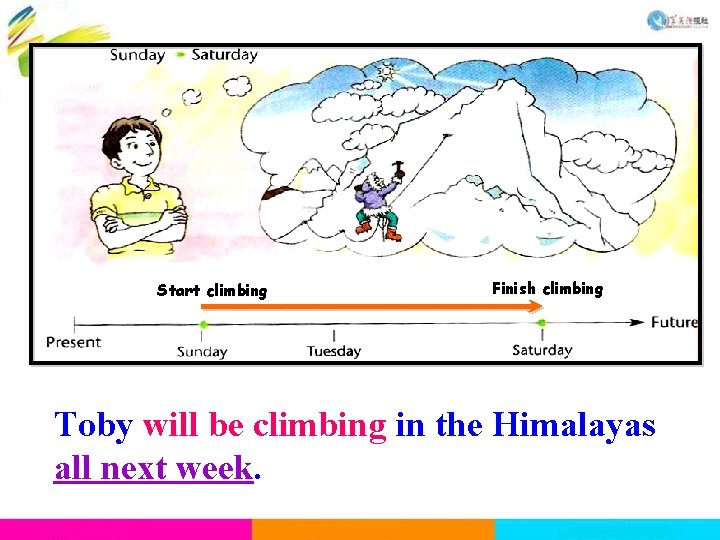
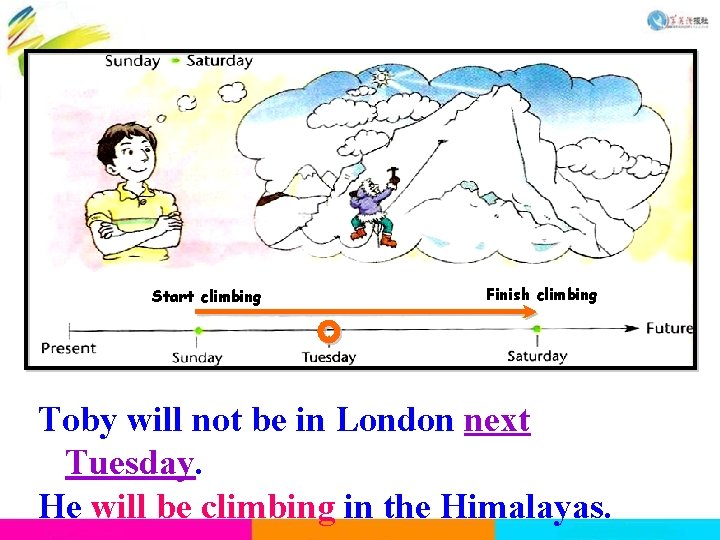
Start climbing Finish climbing Toby will be climbing in the Himalayas all next week.
(2)talk about an action that starts before a point in the future and probably continues after it (表示将来某个时间前已开始做的动 作并很有可能继续下去。)
Start climbing Finish climbing Toby will not be in London next Tuesday. He will be climbing in the Himalayas.
(3)express predictions suggest that something will happen naturally, but not arranged by the speaker. (指不包含说话者主观意愿的纯粹将来。表 达某件事会自然而然地发生,说话者并不 参与安排或计划。) After you take the medicine, you will be feeling much better. It will be raining when we arrive there.
(4)ask politely about other people’s future plans (委婉地询问对方的未来计划,比 用will do听起来更有礼貌。) Will you be visiting your uncle in London?
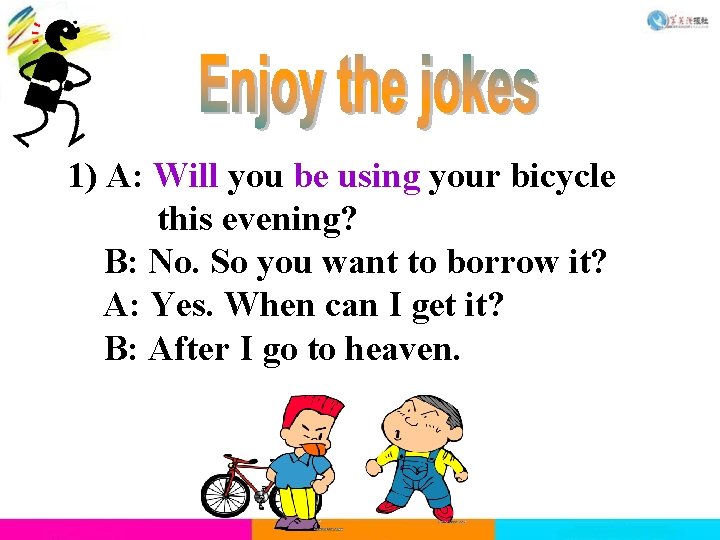
1) A: Will you be using your bicycle this evening? B: No. So you want to borrow it? A: Yes. When can I get it? B: After I go to heaven.
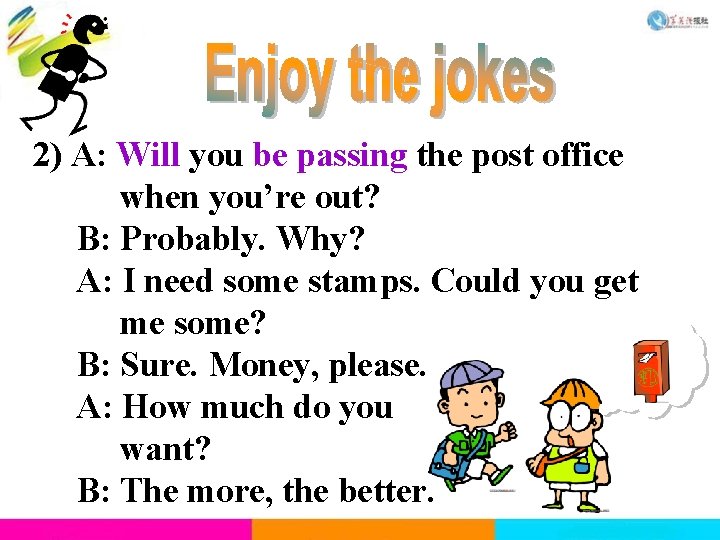
2) A: Will you be passing the post office when you’re out? B: Probably. Why? A: I need some stamps. Could you get me some? B: Sure. Money, please. A: How much do you want? B: The more, the better.
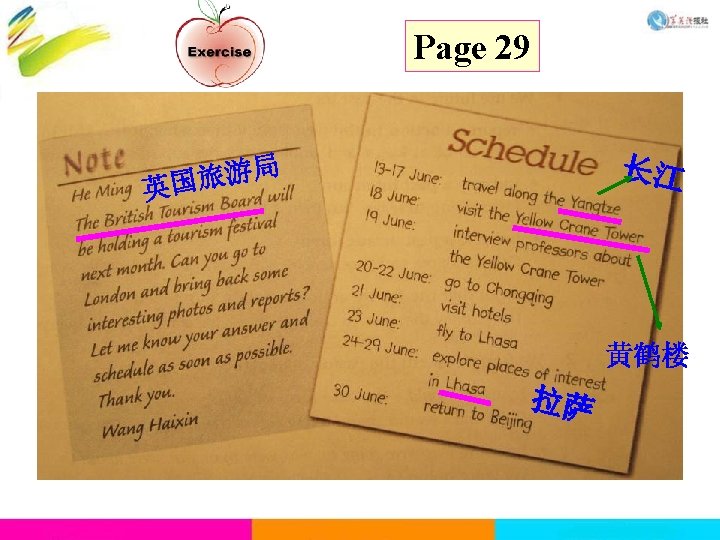
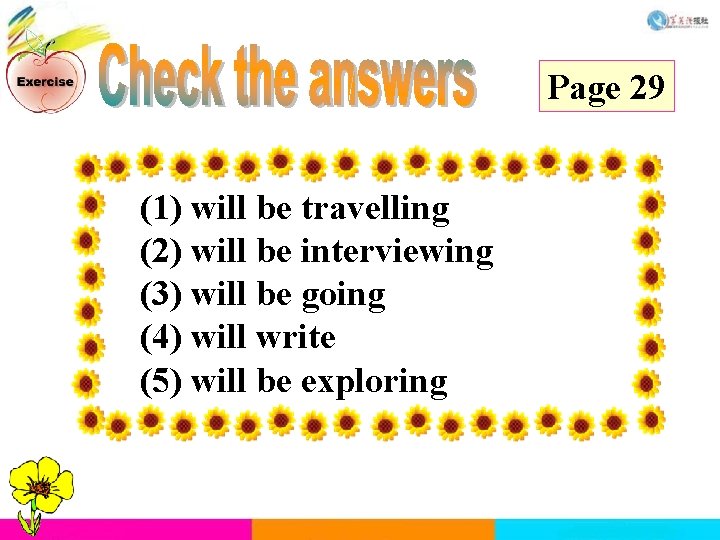
Page 29 (1) will be travelling (2) will be interviewing (3) will be going (4) will write (5) will be exploring
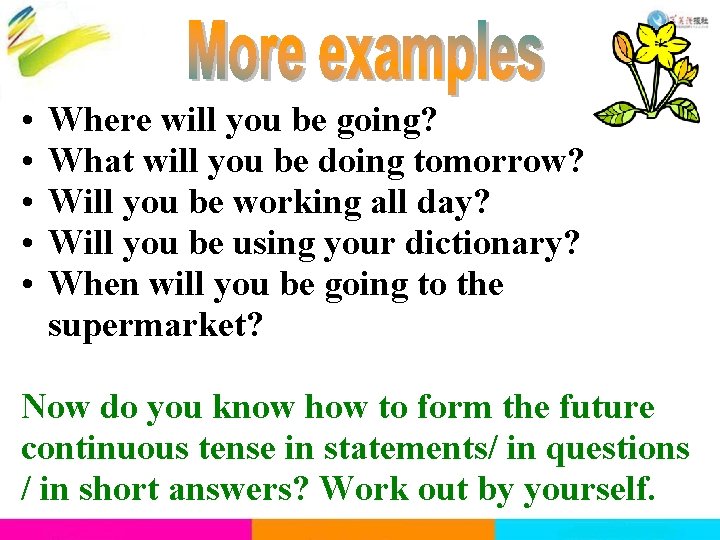
• • • Where will you be going? What will you be doing tomorrow? Will you be working all day? Will you be using your dictionary? When will you be going to the supermarket? Now do you know how to form the future continuous tense in statements/ in questions / in short answers? Work out by yourself.
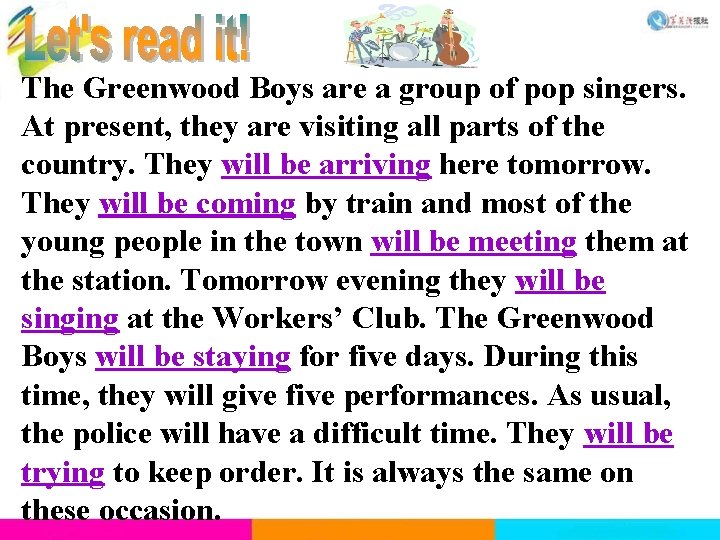
The Greenwood Boys are a group of pop singers. At present, they are visiting all parts of the country. They will be arriving here tomorrow. They will be coming by train and most of the young people in the town will be meeting them at the station. Tomorrow evening they will be singing at the Workers’ Club. The Greenwood Boys will be staying for five days. During this time, they will give five performances. As usual, the police will have a difficult time. They will be trying to keep order. It is always the same on these occasion.
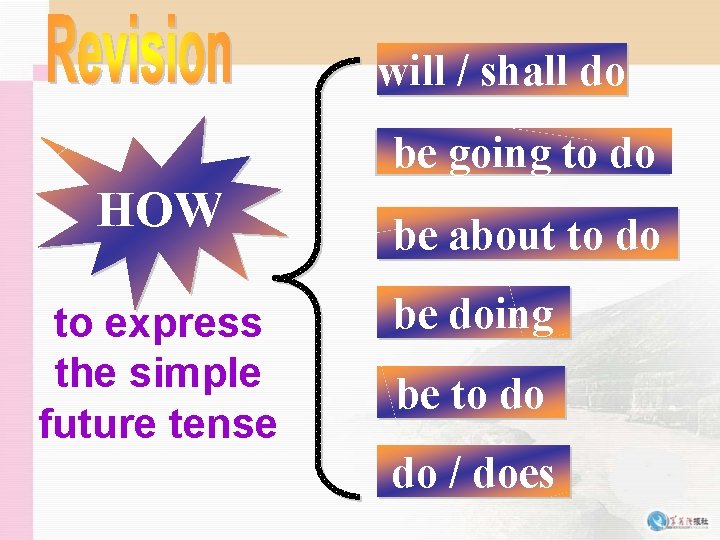
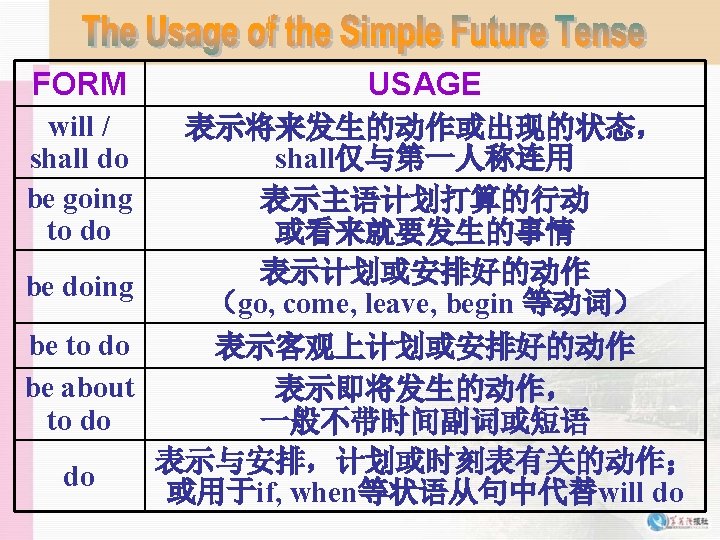
will / shall do be going to do HOW to express the simple future tense be about to do be doing be to do do / does
Sometimes, when we are talking about a past situation, we want to talk about things that people intended to do or that would happen in their future. To do so, we use
Read & think 1. Go over Point 1 on Page 30 to tell in which situations is the future in the past used? (report an action in the past; indicate a past intention; indicate a past arrangement) 2. Go over Point 2 on Page 30 to tell how to form the future in the past?
The form of the future in the past (A) would + do e. g. He hoped the concert would have a lovely relaxed atmosphere. (B) was/were going to e. g. She said she was going to reserve two tickets in advance.
(C) was/were to e. g. He said he was to arrange his holiday with his older brother in a week. (D) was/were about to e. g. The bus was about to start. Colin was about to get off the camel when a child ran towards him. be about to表示即将要发生的动作, 不与表示时间段的状语连用。
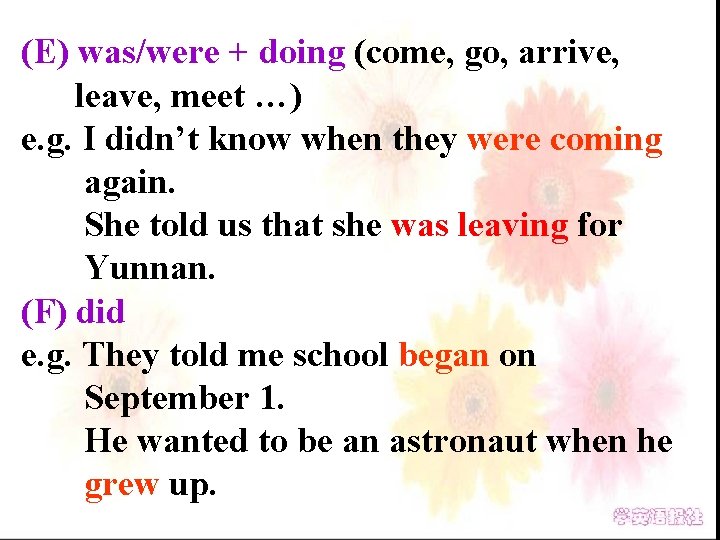
(E) was/were + doing (come, go, arrive, leave, meet …) e. g. I didn’t know when they were coming again. She told us that she was leaving for Yunnan. (F) did e. g. They told me school began on September 1. He wanted to be an astronaut when he grew up.
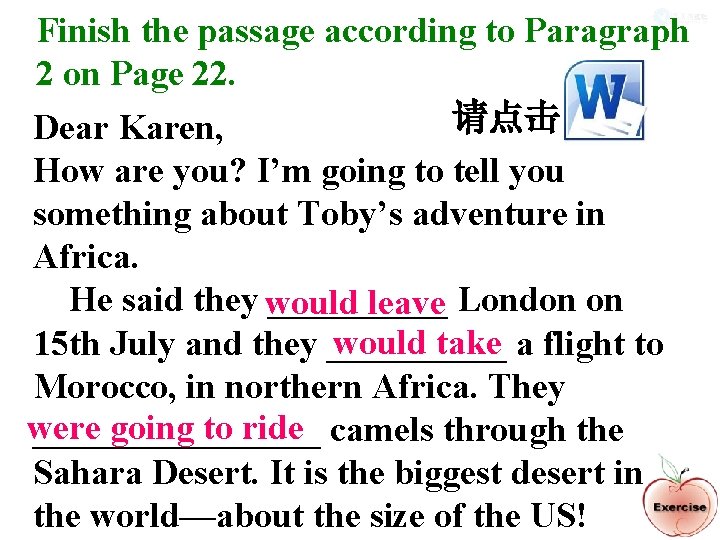
Finish the passage according to Paragraph 2 on Page 22. 请点击 Dear Karen, How are you? I’m going to tell you something about Toby’s adventure in Africa. He said they would _____ leave London on would take a flight to 15 th July and they _____ Morocco, in northern Africa. They were going to ride camels through the ________ Sahara Desert. It is the biggest desert in the world—about the size of the US!
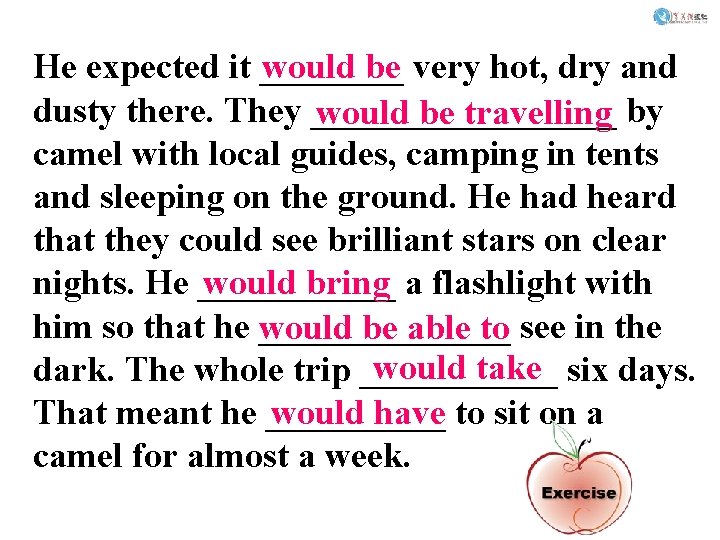
would be very hot, dry and He expected it ____ dusty there. They _________ would be travelling by camel with local guides, camping in tents and sleeping on the ground. He had heard that they could see brilliant stars on clear would bring a flashlight with nights. He ______ him so that he _______ would be able to see in the would take six days. dark. The whole trip ______ That meant he _____ would have to sit on a camel for almost a week.
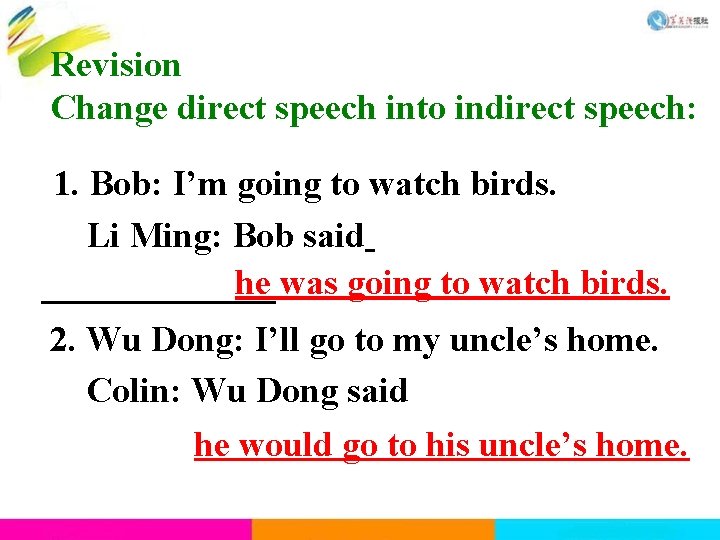
Revision Change direct speech into indirect speech: 1. Bob: I’m going to watch birds. Li Ming: Bob said he was going to watch birds. 2. Wu Dong: I’ll go to my uncle’s home. Colin: Wu Dong said he would go to his uncle’s home.
Time for reflection 1. How to form future continuous 2. tense in statements, in questions or in short answers? 3. 2. Speak out at least three forms of future in the past. 4. 3. Can you remember in which situations do we use future continuous tense? How about future in the past?
Individual activity 请点击
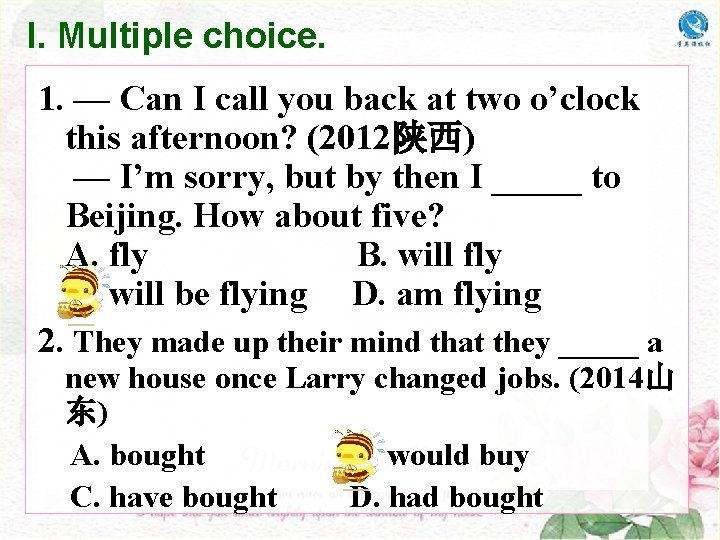
I. Multiple choice. 1. — Can I call you back at two o’clock this afternoon? (2012陕西) — I’m sorry, but by then I _____ to Beijing. How about five? A. fly B. will fly C. will be flying D. am flying 2. They made up their mind that they _____ a new house once Larry changed jobs. (2014山 东) A. bought B. would buy C. have bought D. had bought
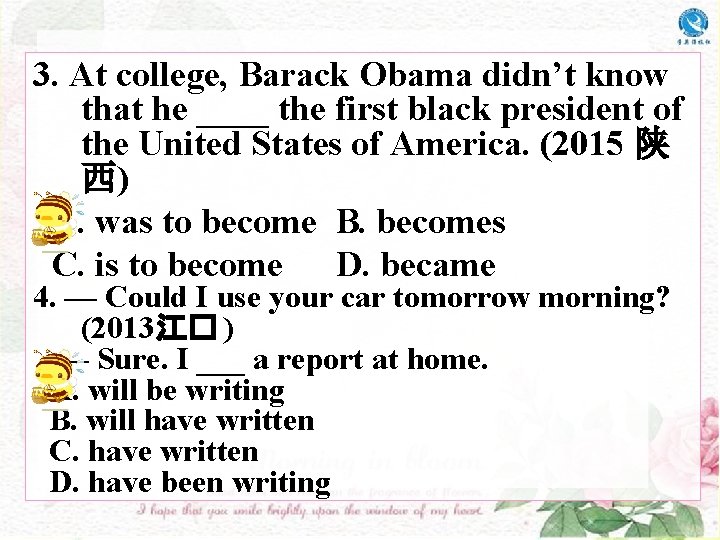
3. At college, Barack Obama didn’t know that he ____ the first black president of the United States of America. (2015 陕 西) A. was to become B. becomes C. is to become D. became 4. — Could I use your car tomorrow morning? (2013江� ) — Sure. I ___ a report at home. A. will be writing B. will have written C. have written D. have been writing
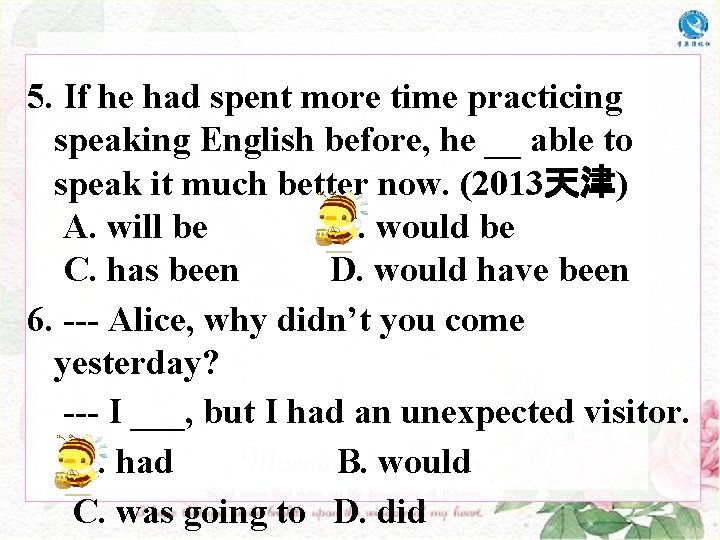
5. If he had spent more time practicing speaking English before, he __ able to speak it much better now. (2013天津) A. will be B. would be C. has been D. would have been 6. --- Alice, why didn’t you come yesterday? --- I ___, but I had an unexpected visitor. A. had B. would C. was going to D. did
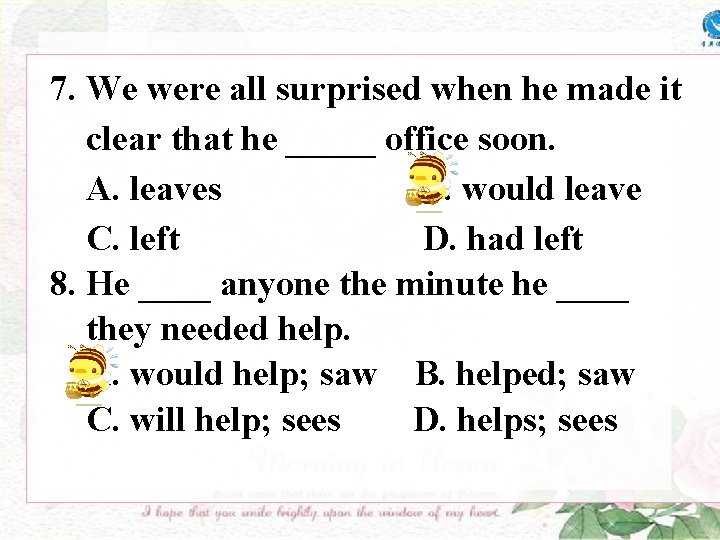
7. We were all surprised when he made it clear that he _____ office soon. A. leaves B. would leave C. left D. had left 8. He ____ anyone the minute he ____ they needed help. A. would help; saw B. helped; saw C. will help; sees D. helps; sees
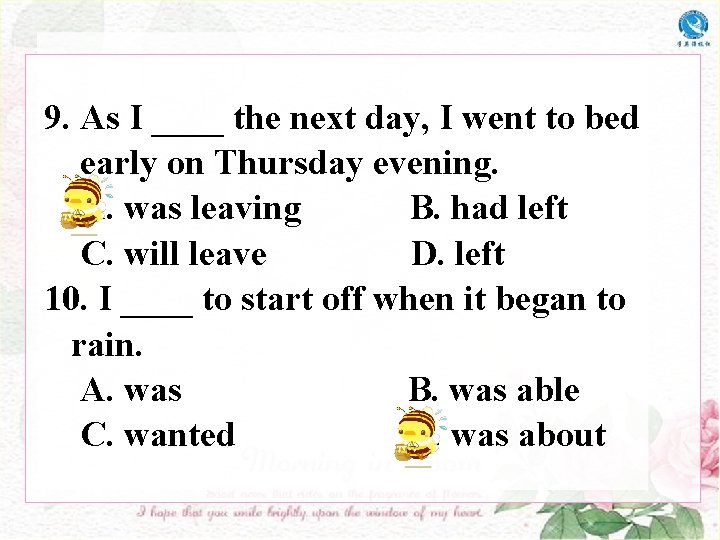
9. As I ____ the next day, I went to bed early on Thursday evening. A. was leaving B. had left C. will leave D. left 10. I ____ to start off when it began to rain. A. was B. was able C. wanted D. was about
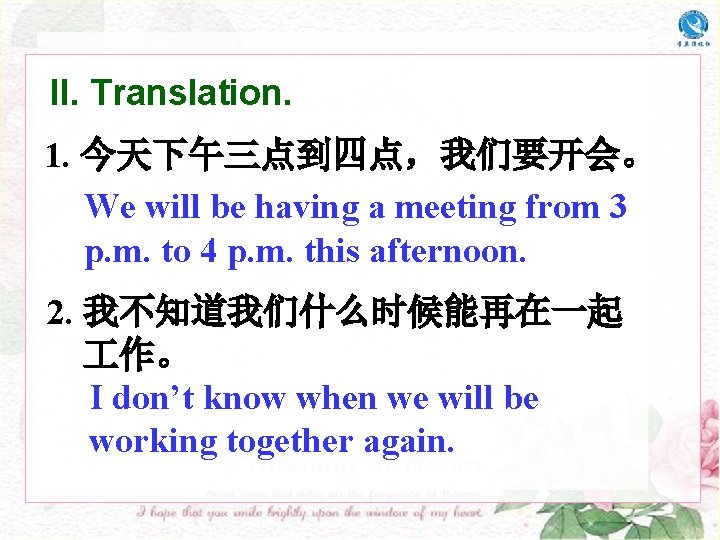
II. Translation. 1. 今天下午三点到四点,我们要开会。 We will be having a meeting from 3 p. m. to 4 p. m. this afternoon. 2. 我不知道我们什么时候能再在一起 作。 I don’t know when we will be working together again.
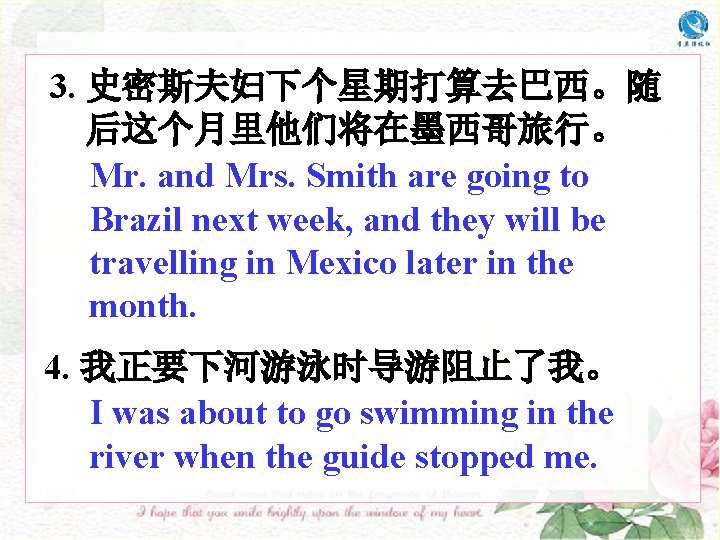
3. 史密斯夫妇下个星期打算去巴西。随 后这个月里他们将在墨西哥旅行。 Mr. and Mrs. Smith are going to Brazil next week, and they will be travelling in Mexico later in the month. 4. 我正要下河游泳时导游阻止了我。 I was about to go swimming in the river when the guide stopped me.
5. 我告诉过你我和玛丽在她上大学前 将花几周旅行。 I told you that Mary and I would spend a few weeks travelling before she goes to university. 6. 没有人知道一百年后会发生什么事 情。 Nobody knew what would happen after a hundred years.
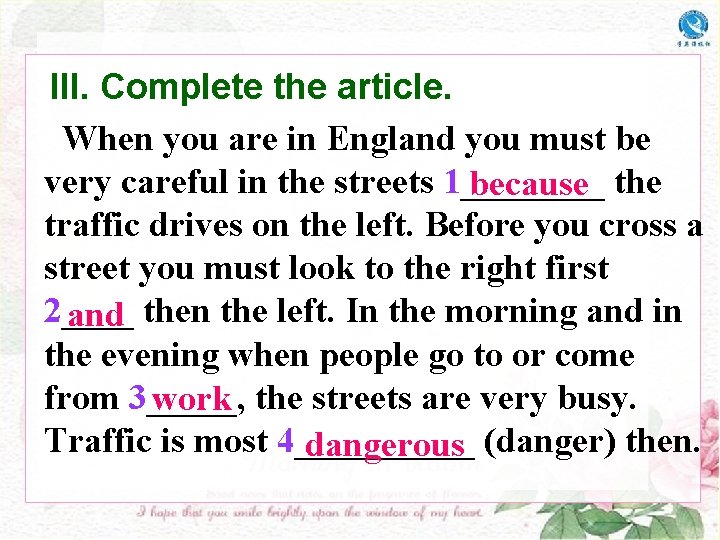
III. Complete the article. When you are in England you must be very careful in the streets 1____ because the traffic drives on the left. Before you cross a street you must look to the right first 2____ and then the left. In the morning and in the evening when people go to or come from 3_____, work the streets are very busy. Traffic is most 4_____ dangerous (danger) then.
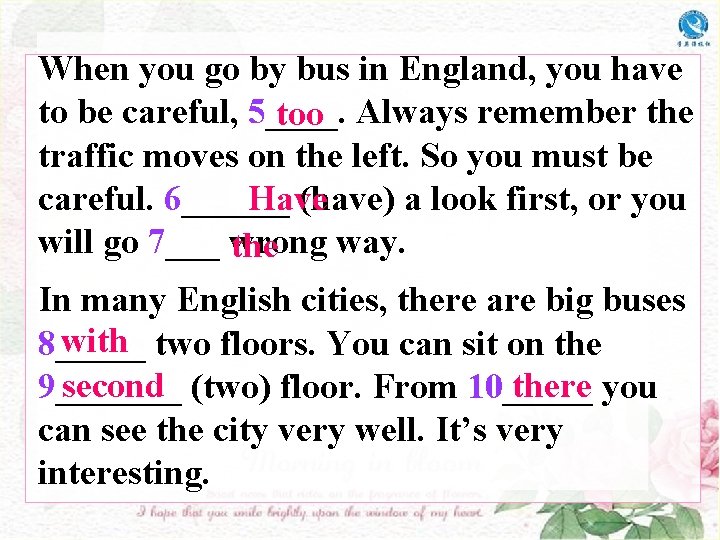
When you go by bus in England, you have to be careful, 5____. too Always remember the traffic moves on the left. So you must be careful. 6______ (have) a look first, or you Have will go 7___ wrong way. the In many English cities, there are big buses with two floors. You can sit on the 8_____ second (two) floor. From 10_____ there you 9_______ can see the city very well. It’s very interesting.
1. Review the points and examples 2. again on Pages 28, 30. 3. 2. Finish Part A & B on Pages 30 -31.