
To Kill A Mockingbird By Harper Lee UNIT
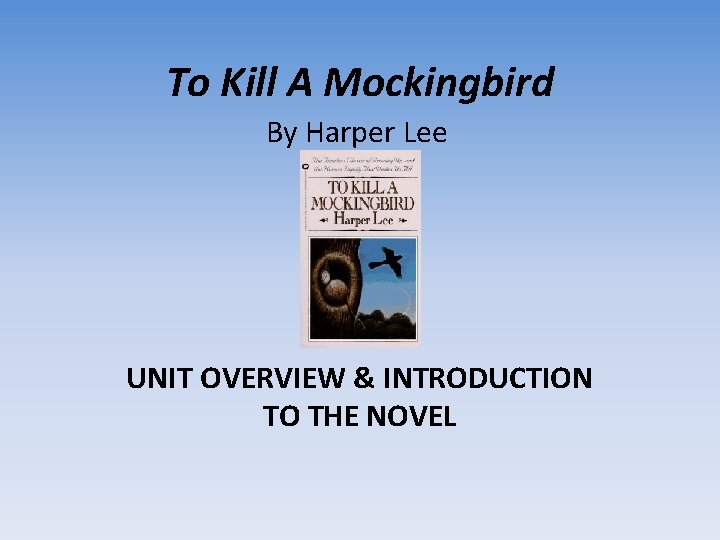
To Kill A Mockingbird By Harper Lee UNIT OVERVIEW & INTRODUCTION TO THE NOVEL
Why do we read this book? • Understand be aware of certain ideas and mindsets that persisted and still exist in society (racism, sexism, classism, etc) • Because it is a timeless story with lessons about justice, challenges, prejudices, courage (physical and moral), identity, family, and growing up emotionally, intellectually and physically…Which of these don’t relate to you? • Make discoveries about ourselves and our world, as with most great stories
Contents of Presentation Goals of Unit • Understanding plot, setting and character development • Understanding the development of important themes • Increasing the use of vocabulary and language • Develop ability to think critically about what is in a novel or other text • Learning history of segregation, southern U. S. A. , great depression and legal battles Introduction to Novel • The Characters • Plot Sequence • Themes & Symbols • Background Issues • About Author Things to Consider While Reading • Important Quotes • Using Resources
Goals of Unit Plot, Setting & Character Development What is PLOT? What is SETTING? What is CHARACTER DEVELOPMENT? The main events that make up the beginning, middle and end of a story. Understanding WHAT HAPPENS in a story is crucial to figuring out WHY things happen. Essentially the setting is WHERE and WHEN the story takes place. To Kill A Mockingbird uses the setting of southern Alabama, the town of Maycomb and the courtroom to develop the story As the characters develop we see changes that are reflections of the plot. As things happen they learn things and move on, hopefully keeping the reader’s interest in the process.
Goals of Unit Theme, Vocabulary, Critical Thinking and History What is THEME? Improve VOCABULARY! Think CRITICALLY! Learn HISTORY! Theme refers to the main idea and the purpose of the work. What is the novel trying to accomplish and/or teach the reader? To Kill A Mockingbird makes use of many words that you may not know. If you do not know the word you will not be able to understand the plot, setting, characters or theme. Therefore, this unit will focus on regular vocabulary improvement. You will learn how to question why authors make decisions about the words they use, the decisions of the characters and the events of the plot and how these things tell the reader an important message. This novel makes mention of many historical aspects that require some knowledge in order for the novel to make complete sense. Therefore we will discuss some of the history within the novel before and during our study of To Kill A Mockingbird.
Introduction to the Novel To help your understanding of the novel you will be first introduced to: Plot Events Characters Themes & Symbols Background Information The Author

Setting • Maycomb, Alabama (fictional city) • 1933 -1935 • Although slavery has long been abolished, the Southerners in Maycomb continue to believe in white supremacy.
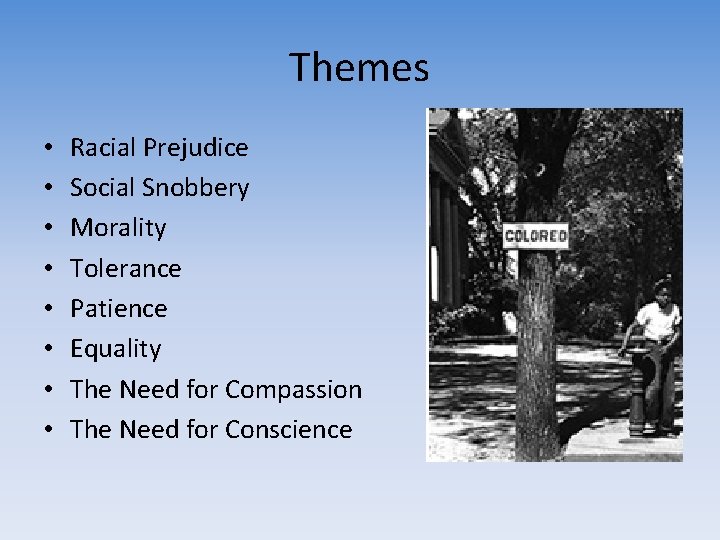
Themes • • Racial Prejudice Social Snobbery Morality Tolerance Patience Equality The Need for Compassion The Need for Conscience
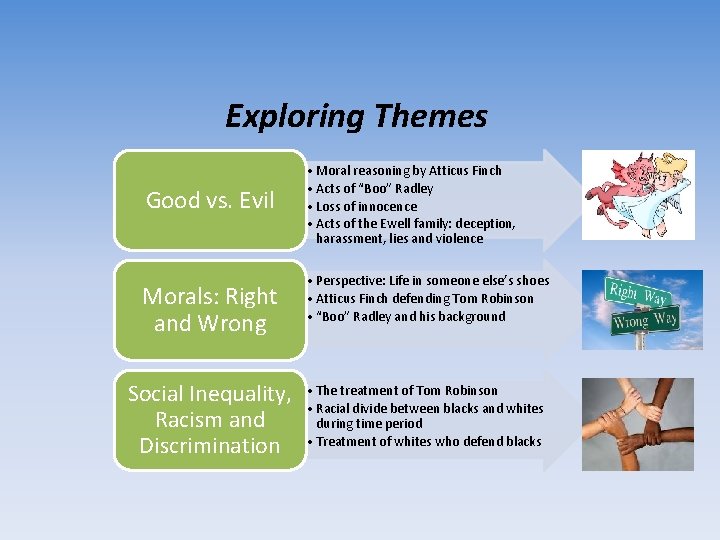
Exploring Themes Good vs. Evil Morals: Right and Wrong Social Inequality, Racism and Discrimination • Moral reasoning by Atticus Finch • Acts of “Boo” Radley • Loss of innocence • Acts of the Ewell family: deception, harassment, lies and violence • Perspective: Life in someone else’s shoes • Atticus Finch defending Tom Robinson • “Boo” Radley and his background • The treatment of Tom Robinson • Racial divide between blacks and whites during time period • Treatment of whites who defend blacks
Exploring Symbols OL: SYMB A word or object that represents another word or object …Be on the lookout for: Small-Town Life “Boo” Radley Mockingbirds / Birds What do these symbols represent!?
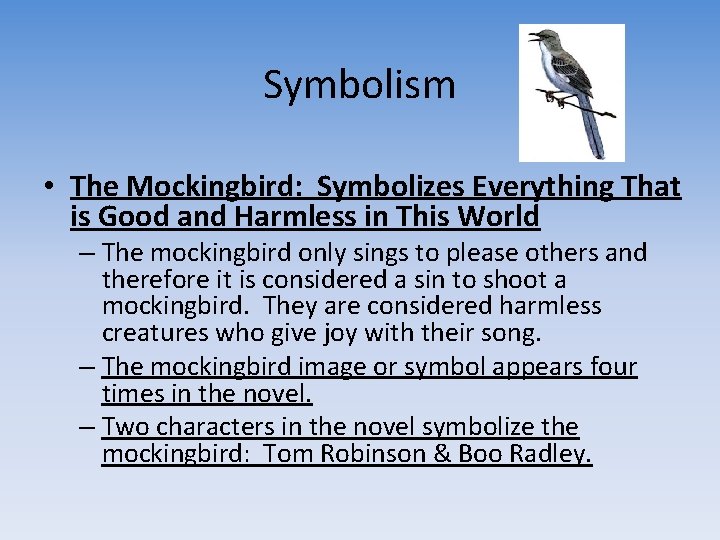
Symbolism • The Mockingbird: Symbolizes Everything That is Good and Harmless in This World – The mockingbird only sings to please others and therefore it is considered a sin to shoot a mockingbird. They are considered harmless creatures who give joy with their song. – The mockingbird image or symbol appears four times in the novel. – Two characters in the novel symbolize the mockingbird: Tom Robinson & Boo Radley.
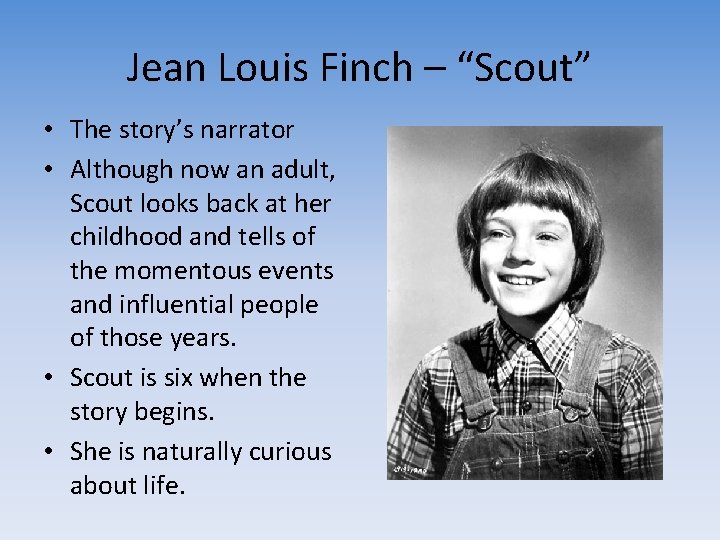
Jean Louis Finch – “Scout” • The story’s narrator • Although now an adult, Scout looks back at her childhood and tells of the momentous events and influential people of those years. • Scout is six when the story begins. • She is naturally curious about life.
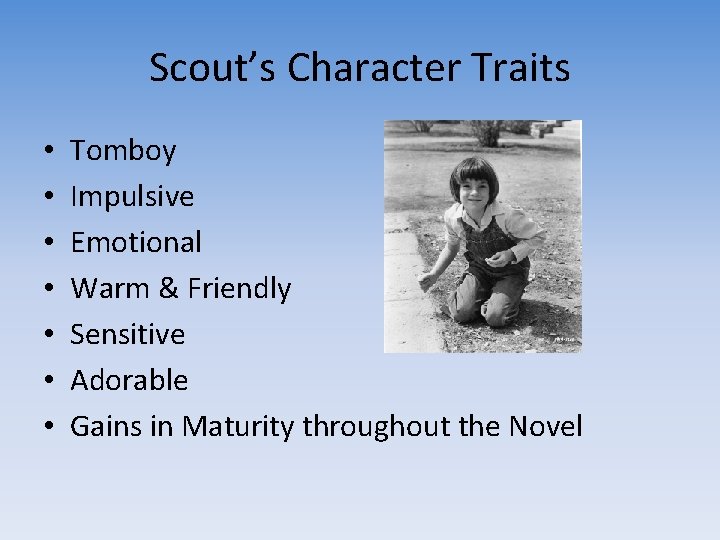
Scout’s Character Traits • • Tomboy Impulsive Emotional Warm & Friendly Sensitive Adorable Gains in Maturity throughout the Novel
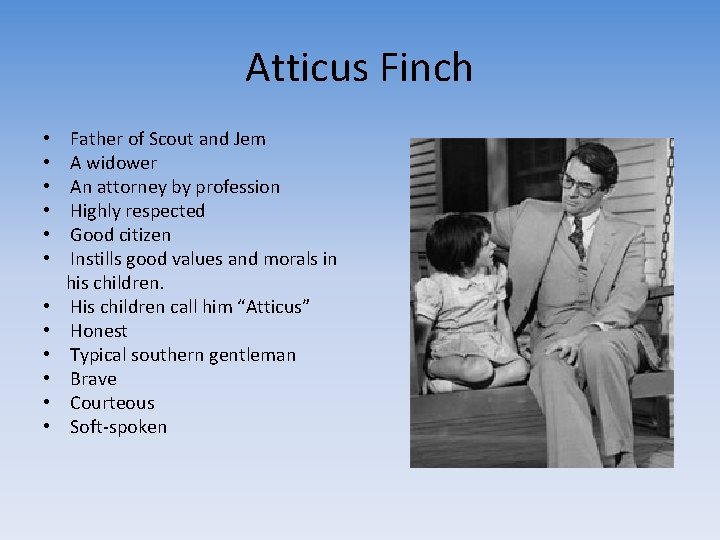
Atticus Finch • • • Father of Scout and Jem A widower An attorney by profession Highly respected Good citizen Instills good values and morals in his children. His children call him “Atticus” Honest Typical southern gentleman Brave Courteous Soft-spoken
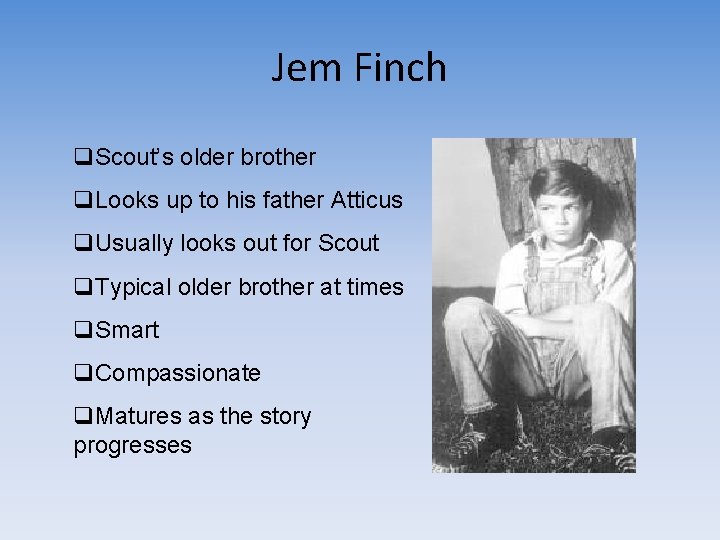
Jem Finch q. Scout’s older brother q. Looks up to his father Atticus q. Usually looks out for Scout q. Typical older brother at times q. Smart q. Compassionate q. Matures as the story progresses
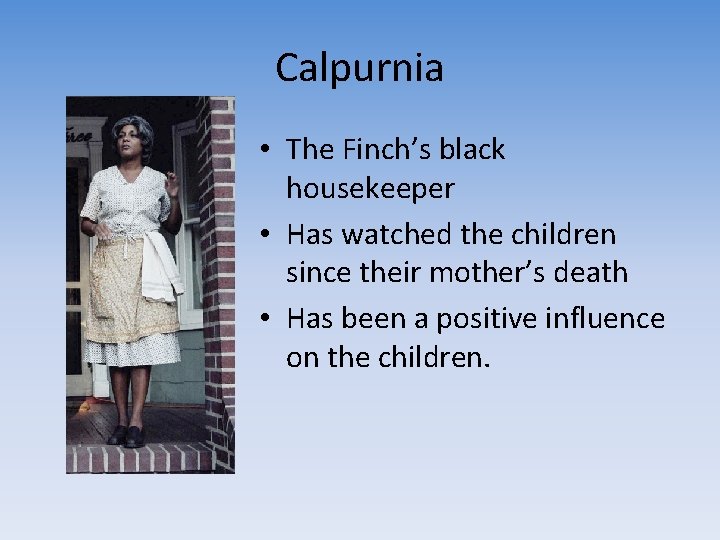
Calpurnia • The Finch’s black housekeeper • Has watched the children since their mother’s death • Has been a positive influence on the children.
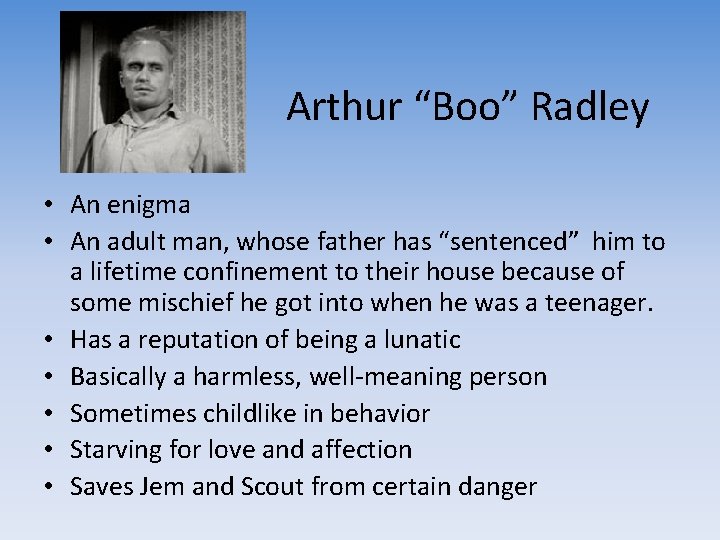
Arthur “Boo” Radley • An enigma • An adult man, whose father has “sentenced” him to a lifetime confinement to their house because of some mischief he got into when he was a teenager. • Has a reputation of being a lunatic • Basically a harmless, well-meaning person • Sometimes childlike in behavior • Starving for love and affection • Saves Jem and Scout from certain danger
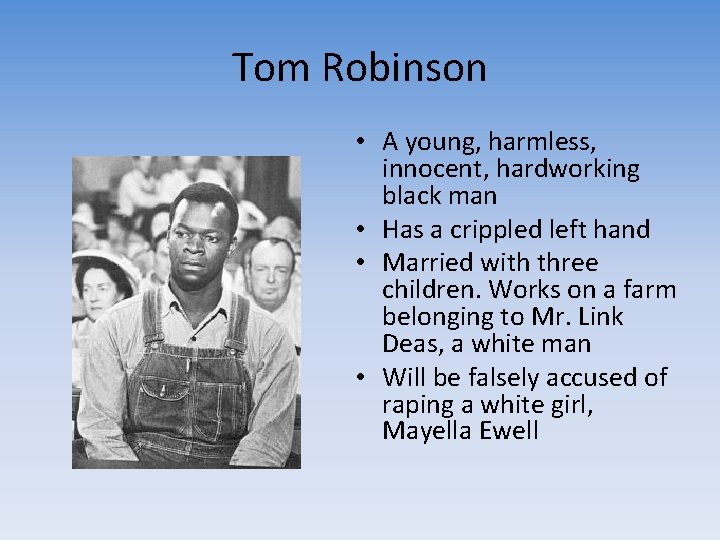
Tom Robinson • A young, harmless, innocent, hardworking black man • Has a crippled left hand • Married with three children. Works on a farm belonging to Mr. Link Deas, a white man • Will be falsely accused of raping a white girl, Mayella Ewell
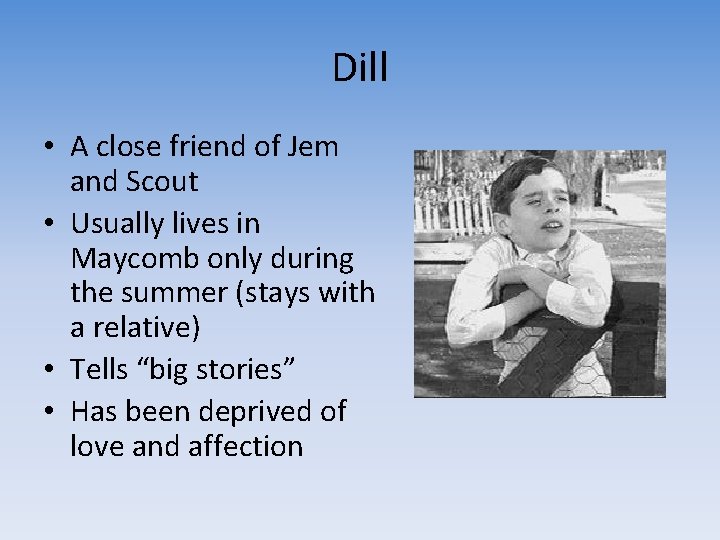
Dill • A close friend of Jem and Scout • Usually lives in Maycomb only during the summer (stays with a relative) • Tells “big stories” • Has been deprived of love and affection
Two Poor White Families: The Cunninghams • • • Poor white family Hard-working Honest Proud Survive on very little Always pay back their debts – even if it is with hickory nuts, turnips, or holly. The Ewells Poor white trash Dirty Lazy Good-for-nothing Never done a day’s work • Foul-mouthed • Dishonest • Immoral • • •
The Black Community Simple Honest Clean Hard-working God fearing Proud Would never take anything without paying it back • Respectful • Had stronger character than most of the whites • • • Oppressed Uneducated Discriminated against Talked about badly Deserve better than what is dished out to them by society
Language • Sometimes the language of Scout will be that of her as a child; other times, she will be speaking in the voice of an adult • Atticus uses formal speech • Calpurnia uses “white language” in the Finch house and switches to “black jargon” when amidst blacks • The Ewells use foul words and obscenities • Jem, Scout, and Dill will use slang words, typical of their age • Tom Robinson uses language typical of the southern black such as “suh” for “sir” and “chillun” for “children” • Various derogatory terms for blacks will be used such as “nigger, ” “darky, ” “Negroes, ” and “colored folk” – Lee uses such language to keep her novel naturally in sync with common language of the times
Tone Genre • Coming-of-age story; social drama; courtroom drama; Southern drama Tone • Childlike, humorous, nostalgic, innocent; as the novel progresses, increasingly dark, foreboding, and critical of society
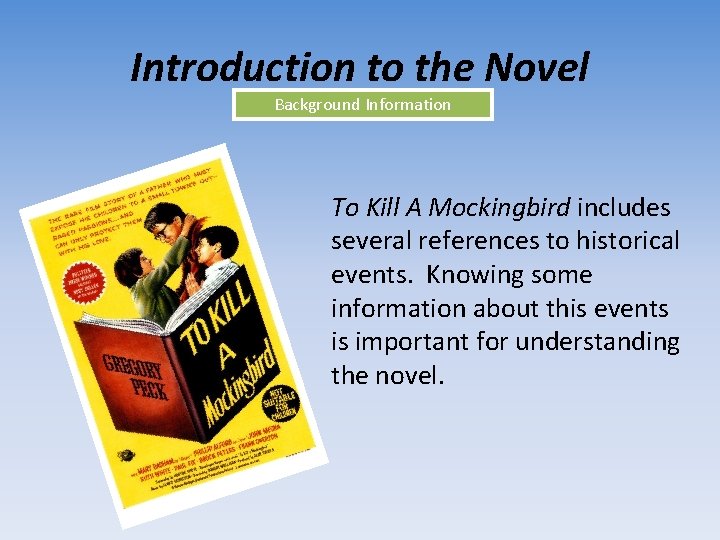
Introduction to the Novel Background Information To Kill A Mockingbird includes several references to historical events. Knowing some information about this events is important for understanding the novel.
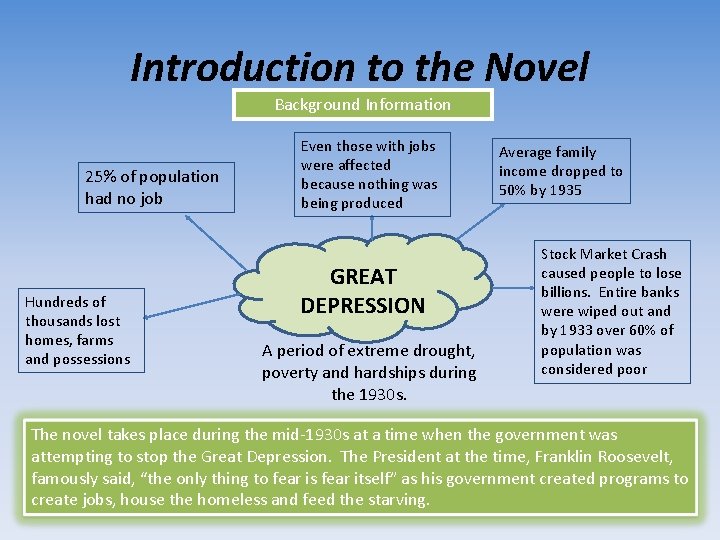
Introduction to the Novel Background Information 25% of population had no job Hundreds of thousands lost homes, farms and possessions Even those with jobs were affected because nothing was being produced GREAT DEPRESSION A period of extreme drought, poverty and hardships during the 1930 s. Average family income dropped to 50% by 1935 Stock Market Crash caused people to lose billions. Entire banks were wiped out and by 1933 over 60% of population was considered poor The novel takes place during the mid-1930 s at a time when the government was attempting to stop the Great Depression. The President at the time, Franklin Roosevelt, famously said, “the only thing to fear is fear itself” as his government created programs to create jobs, house the homeless and feed the starving.
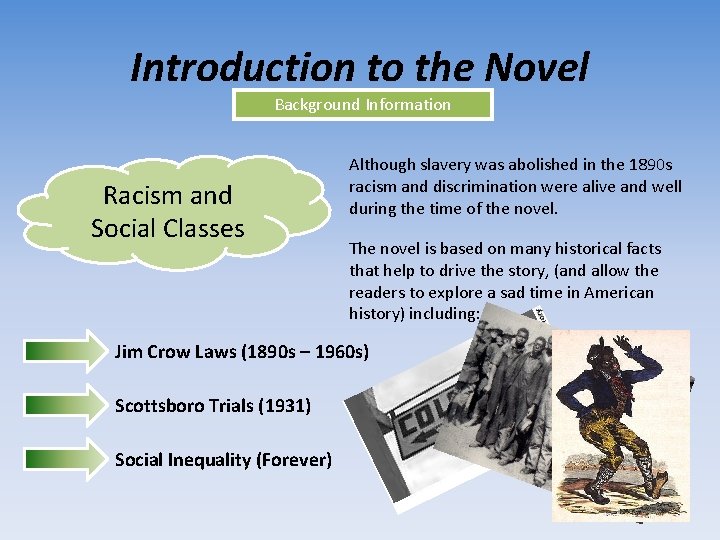
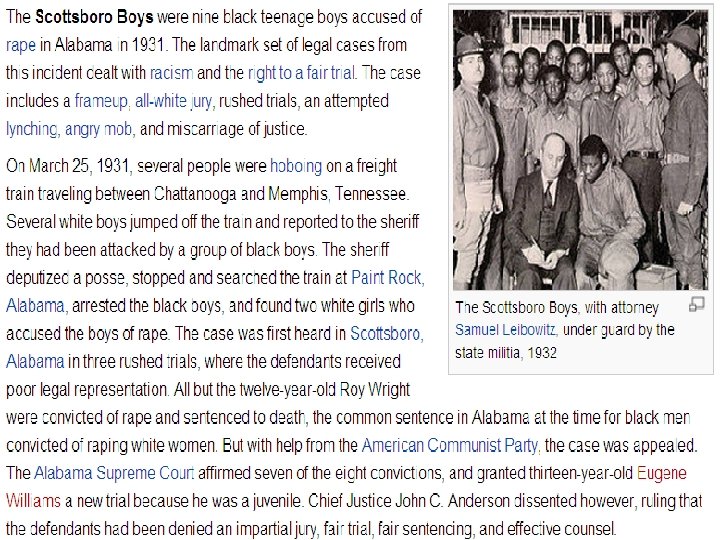
Introduction to the Novel Background Information Racism and Social Classes Although slavery was abolished in the 1890 s racism and discrimination were alive and well during the time of the novel. The novel is based on many historical facts that help to drive the story, (and allow the readers to explore a sad time in American history) including: Jim Crow Laws (1890 s – 1960 s) Scottsboro Trials (1931) Social Inequality (Forever)
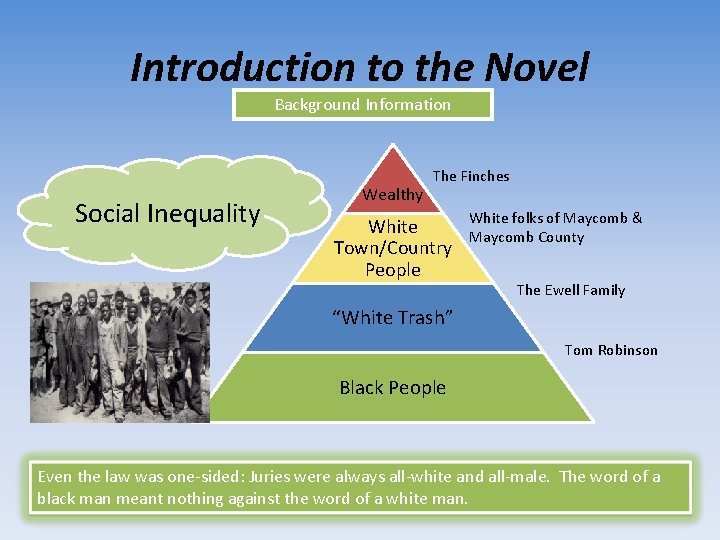
Introduction to the Novel Background Information Social Inequality Wealthy The Finches White Town/Country People White folks of Maycomb & Maycomb County The Ewell Family “White Trash” Tom Robinson Black People Even the law was one-sided: Juries were always all-white and all-male. The word of a black man meant nothing against the word of a white man.
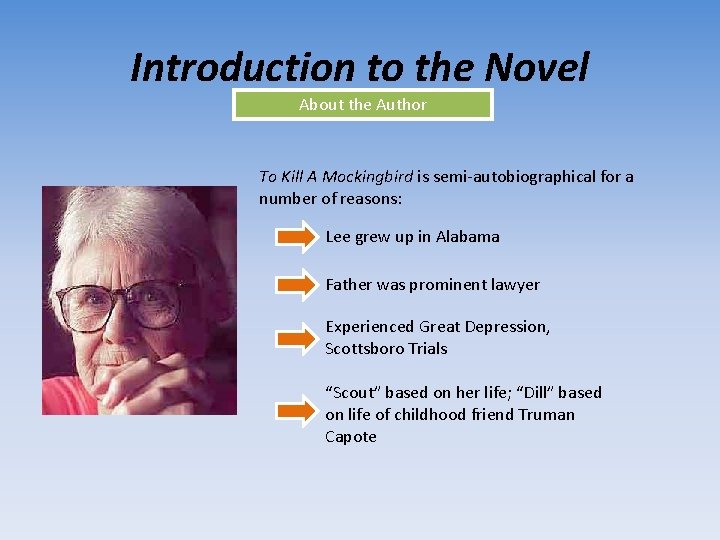
Introduction to the Novel About the Author To Kill A Mockingbird is semi-autobiographical for a number of reasons: Lee grew up in Alabama Father was prominent lawyer Experienced Great Depression, Scottsboro Trials “Scout” based on her life; “Dill” based on life of childhood friend Truman Capote
Things to Consider While Reading The first time you read the novel should be to get a general idea of the setting, characters, plot and themes. However, because this novel can be difficult you are provided with some things to think about while reading that will help you understand the novel.
Things to Consider While Reading Important Quotes As you read be on the lookout for these important quotes from the novel: “Rem embe m u o o c y kingb r it's a sin t l i t n u ird. ” T o ever h on s r hat w kill a l e i e t p a n r a d a s the Atticu some. . . u tand s only t w r t s h e e s i i a n d v y g n f im ” , i. u t o a t a i w n b t y l d o a l n n i i ut it. s a sin e I I aske a o e d p r n r s u i d Mis h, “Your eve aro mh ch st Mau to do fathe a e “You n r things fro in and walk Atticus Fin die r's rig th d “Moc e e k h i k l s d t i i t n , s ” s i w g t s birds od i make con to h n don't haensdaild. i o b f m u m i sig c for u essd, o one r their brin you cl h s to e s outhing lls, e s a r rts osuickn u s i n o to kill ith t for uo wnajoy. . . abp dbout b “Why reasonable people go stark raving mad when anything h rstowa meonck. in. Bgob s. t. Twhaot'ssowh uitfsein, g Neigpretend e involving a Negro comes up, is something I“don't w e irsd ny it lo etw nd f to mebfor ve u. ” , a k 's Fa inch understand… I just hope that Jem and Scout come a in ga ain out” h s e c g H n they their answers instead of listening to the town. th. I ihope ”Sc ur. ch and o b h t trust me enough…” -Atticus Finch neig ken wa. ” o s a br ur live o and
Things to Consider While Reading Using Resources Having difficulty understanding the novel? Try these resources: Sparknotes – Free Web Resource: http: //www. sparknotes. com/lit/mocking/ TKM Student Survival Guide Wikipedia. org: To Kill A Mockingbird Don’t forget about me! Ask me questions you may have!

Great Depression Video
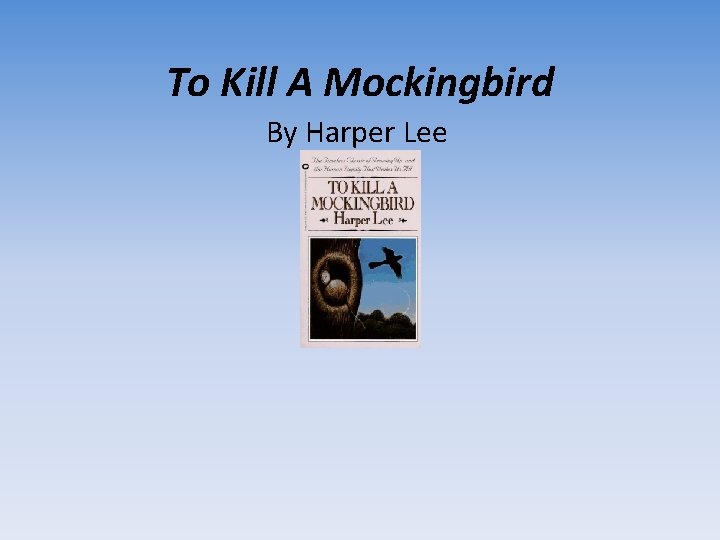
To Kill A Mockingbird By Harper Lee
- Slides: 34